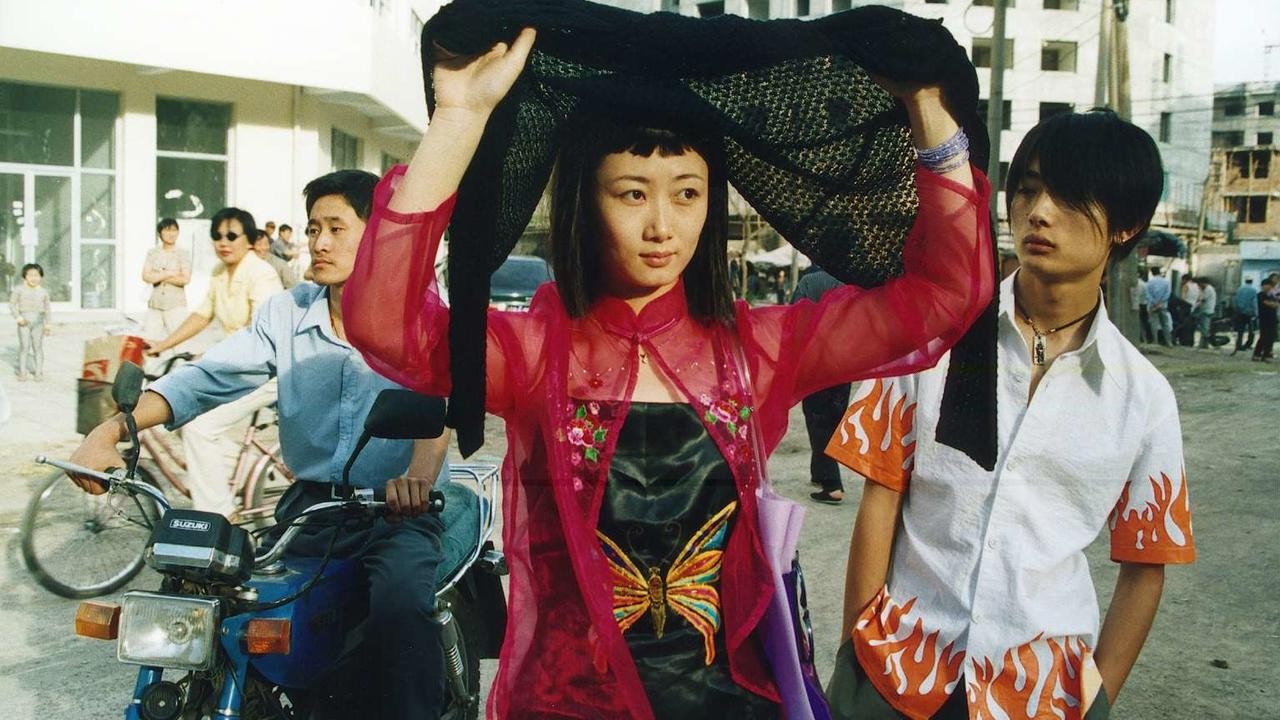
Contemporary street-corner kids in China make good use of their time, because they want to die young. Before then, Xiao Ji first wants to bed a model; Bin Bin is mainly interested in karaoke. The third film by the greatest talent of the Chinese cinema.
Unknown Pleasures, sequel to the widely praised Platform, again focuses on a generation of Chinese kids. In fragmentary observations, Jia sketches a picture of the lethargy of today’s youth, a generation that has grown up with technological gadgets, advertising and Internet. Jia refers to moments in the eventful year 2001, when an unemployed man blew up a whole building and the Olympic Summer Games of 2008 were granted to Beijing. In as far as the scenes were not improvised, the script of the film was inspired by work of the philosopher Zhuangzi, a Taoist who argues in favour of enjoying the (unknown) pleasures of life. The two unemployed kids Xiao Ji and Bin Bin have plenty of time for pleasures like hanging out and falling in love. In the case of Xiao Ji the subject of his affections is Qiao Qiao, a dancer and model for an advertising campaign for a major Mongolian brand of drink. The fact that Qiao Qiao has a dangerous friend does not make much impression on Xiao Ji: he takes his inspiration from American crime films and most wants to die young. Bin Bin does not have much faith in the future either. His girlfriend is going to Beijing to study. She wants to become a businesswoman, while Bin Bin’s ambitions do not extend any further than karaoke and cartoons. –IFFR
Early Work
While a student at the Beijing Film Academy, Jia would make three short films to hone his skills. The first, a ten minute short documentary on tourists in Tiananmen Square entitled One Day in Beijing, was made in 1994 on self-raised funds. Though Jia has referred to his first directorial effort as inconsequential and “naive”, he also described the short day and half shoot as “excitement…difficult to express in words.” But it was Jia’s second directorial effort, the short film Xiao Shan Going Home (1995), that would bring him to the attention of the film world. It was a film that helped establish Jia’s style and thematic interests and, in Jia’s words, was a film that “truly marks the beginning of my career as a filmmaker.” Xiao Shan would eventually to screen abroad where it won a top prize at the 1997 Hong Kong Independent Short Film & Video Awards. More significantly, the film’s success brought Jia in contact with cinematographer Yu Lik-wai and… read more
"The Monkey King is lucky. No parents on his back. He's free as the wind. He doesn't give a shit about the WTO"
If you're going to talk about cinema at present, even if you're not talking very thoroughly, it's inevitable that Yu Lik-wai's work, if not