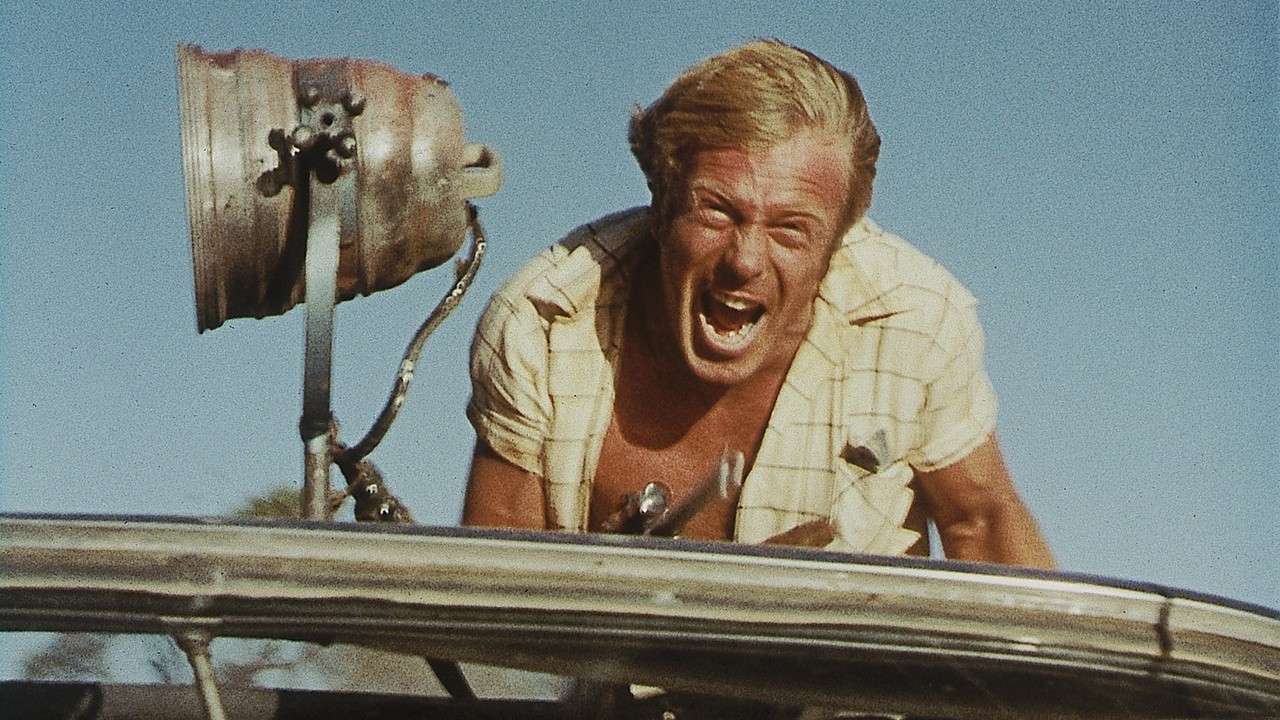
Tiboonda schoolteacher John Grant is en route from the tiny outback town to Sydney for summer holidays when he stops over in the mining community of Bundayabba. Drawn into “the Yabba’s” world of drinking and gambling, he drinks too much and loses all his money in a game of two-up. He misses his plane and the next day he is befriended by jovial Tim Hynes and his mates Dick, Joe and the inscrutable Doc. While the other men knock back the beers, John takes a stroll with Tim’s adult daughter Janette. After a failed seduction attempt, John passes out and awakens the next morning in Doc’s squalid hut. John joins a brutal kangaroo hunt with Doc, Dick and Joe. Their car hurtles through the bush to a pub where they drink until it is dark enough to trap kangaroos in the car’s headlights. Many beers and roos later, John crashes for the night at Doc’s place. Next morning, confused and violated, John escapes and hitches a ride out of town only to find himself accidentally back in “the Yabba”. Desperate, John attempts suicide and ultimately resigns himself to returning to his isolated schoolhouse, alone but wiser for the experience. –Cannes Film Festival
Born in Toronto, Canada, Ted Kotcheff graduated with a degree in English Literature from the University of Toronto. He began his professional career directing TV drama at age 24 at the Canadian Broadcasting Corporation, at the time becoming the youngest director in the CBC. After two years there he went to live and work in England, directing in television and the theatre.
He twice won the British Emmy for Best Director, the second time for an extraordinary docudrama about a female derelict entitled, “Edna, the Inebriate Woman” episode of “Play for Today” (1970). The film also won the Best Actress and Best Script Award. Kotcheff’s television work in Great Britain was part of the new wave of working-class actors and drama that changed British theatre and television in the late 1950s. His stage successes include the long-running Lionel Bart musical, “Maggie May.” His film career started in England: Tiara Tahiti (1962), a social comedy starring James Mason and John Mills; Life at… read more
I understand the problems people have with the reckless kangaroo slaughters - that footage is distressing. Personally though, I don't have an issue with it's inclusion. I think of it as a document of the barbaric behaviour the film is criticising - for me this intensifies the nightmare all the more. It would have been unfair (on the kangaroos and the audience) to shy away.
I guess that's also the only reason 'Wake in Fright' gets lumped in the exploration genre. That label does the film a great disservice.
I don't relish being the lone voice of dissent on this one. There's no denying "Wake in Fright" features some striking outback photography; and the film is interesting as a kind of 'anti-Deliverance,' in which the lead character's suffering is frequently the result of his own complicity or poor decisions. However, the infamous kangaroo slaughter sequence is just stomach-churning and awful. Even though these were licensed hunters, it's clear they were merely taking drunken potshots at the poor animals by the end. I can't approve of filmmakers using footage of wounded animals, dazed and in agony, just to convey a thematic point. I'd advise animal lovers to sit this one out.

“What’s the matter with him? He’d rather talk to a woman than drink?” read review
The follow film is an addition to my list ‘Cinema of the Abstract’. All films that have this piece at the top with have an ‘Abstract’ Rating and a personal score at the end. For more information… read review
Cuando escribía un primer borrador de esta pequeña apreciación, cosa que no suelo hacer en medio de una clase a menos que sea tremenda e insoportablemente aburrida, me hallaba en un lugar propicio… read review
Saw this at Sydney Film Fest, then got to project it at Chauvel. A classic! Gave the Aussie Film Industry a kick in the bum after Michael Powell did such a fine job in ‘67. Then it kept on until when… read review