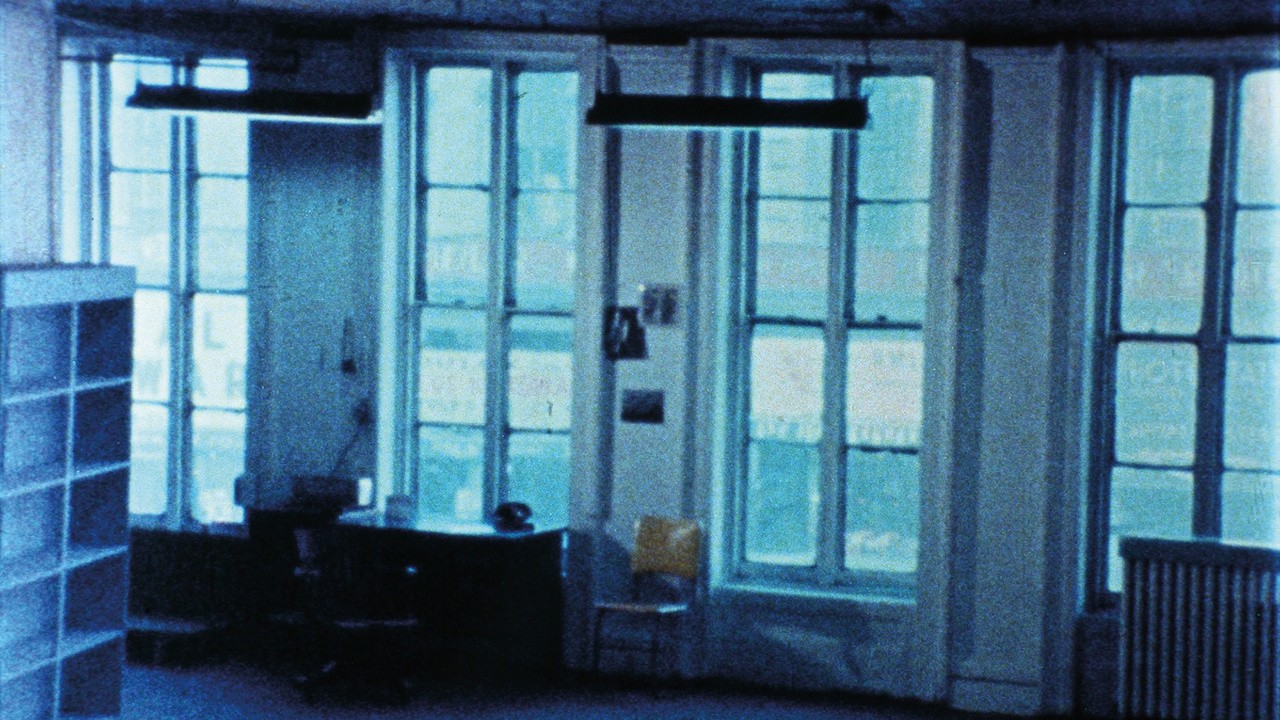
Wavelength consists of almost no action, and what action does occur is largely elided. If the film could be said to have a conventional plot, this would presumably refer to the three “character” scenes. Snow’s intent for the film was “a summation of my nervous system, religious inklings and aesthetic ideas,” he said of the 45-minute-long zoom that incorporates in its time frame four human events, including a man’s death.9 In the first scene two people enter a room, chat briefly, and listen to “Strawberry Fields Forever” on the radio. Later, a man (played by filmmaker Hollis Frampton) enters inexplicably and dies on the floor. And last, the female owner of the apartment is heard and seen on the phone, speaking, with strange calm, about the dead man in her apartment whom she has never seen before. —Wikipedia
Michael Snow is best known for his influential 1967 film Wavelength, which remains one of the landmarks of structuralist cinema. Already an accomplished musician, sculptor, painter, and photographer in his native Canada when he became interested in film after moving to New York in the early ‘60s, he saw filmmaking as a natural extension of his other artmaking activities. His first film, New York Eye and Ear Control, incorporated the “Walking Woman” figure he had already employed in a series of widely-exhibited paintings and sculptures.
His subsequent films investigate the medium’s formal possibilities and are often structured on the mechanical properties of the camera itself. Wavelength is organized around a 42-minute zoom across a New York City loft. His next film, Back and Forth, is built around continuous horizontal and vertical pans across a classroom. These experiments reached their logical extreme with La Région Centrale, for which he built a computer-controlled apparatus… read more
While its innovations are remarkable and its themes (?) (the enduring solidity of things against human immateriality, illusion and disillusion) are viscerally conveyed, this film is too austere, too spartan in spirit, too intentional to fit the frame of my filmic joy. I have to admit that I far prefer the engagement and abundance of for instance Corpus callosum...
Funny a month and a half later and after two more viewings, its becoming one of my favorites...
Cinema that grabs you, shakes you, and doesn't let you go - it almost hurts. What an astonishing film. Savvy
Also: Miriam Bale’s new film journal, Wavelength in LA and more.
The film side of Canadian Artists ’68—an open competition that started with 120 entries and ended with 20 finalists and four prizewinners
While this season of taking stock finds us tinkering on our lists of the best films of the year - best of the decade, even - along comes
Wavelength separates the intellectual from the experiential. More happens as you react to the film. Wavelength needs to be seen in order for it to be meaningful, unlike narrative films that don’t rely… read review
Wavelength.
I just sat through it—I don’t think you can say you ‘watch’ a film like this. You ‘sit through it’. It’s much more than a watching experience, it’s visceral. Not only does it threaten… read review