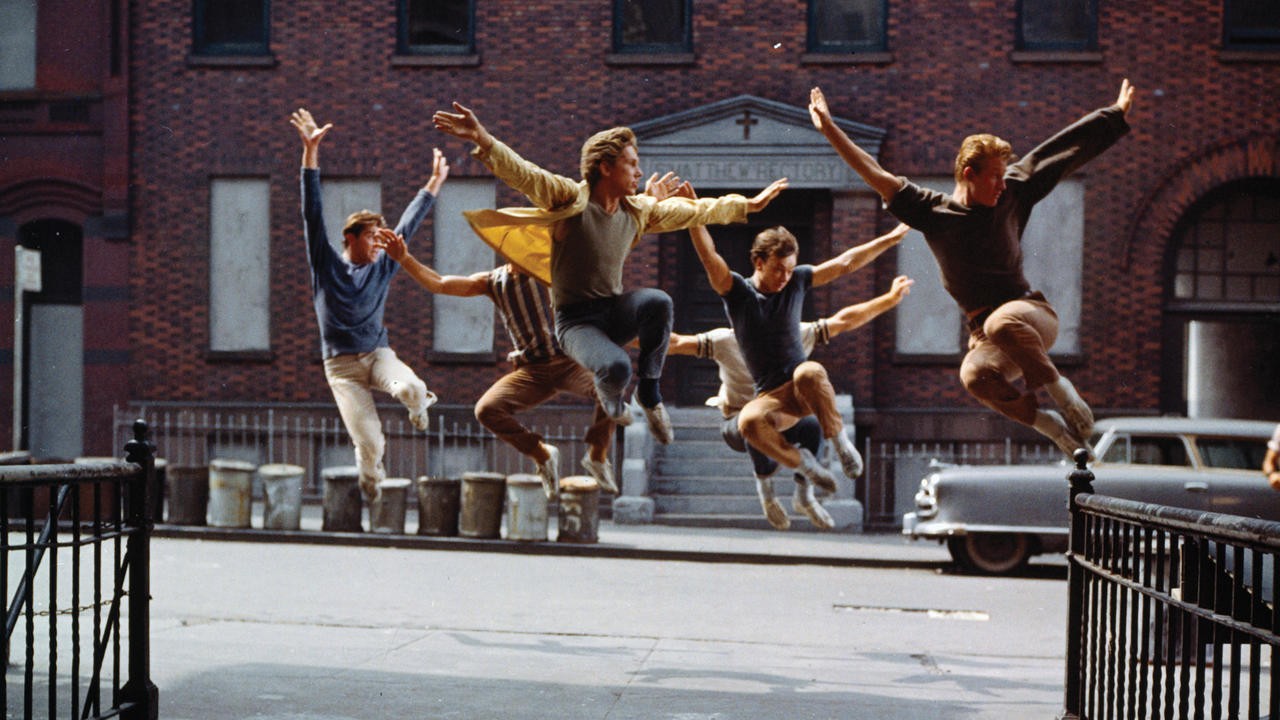
West Side Story is the award winning adaptation of Shakespeare’s classic romantic tragedy Romeo and Juliette. The feuding families become two warring New York City gangs: the white Jets, led by Riff, and the Puerto Rican Sharks, led by Bernardo. Their hatred escalates to a point where neither can coexist with any form of understanding. But when Riff’s best friend (and former Jet) Tony and Bernardo’s younger sister Maria meet at a dance, no one can do anything to stop their love. Maria and Tony begin meeting in secret, planning to run away. Then the Sharks and Jets plan a rumble under the highway – whoever wins gains control of the streets. Maria sends Tony to stop it, hoping he can end the violence. It goes terribly wrong, and before the lovers know what has happened, tragedy strikes and does not stop until the climactic and heartbreaking ending. —IMDb
Jerome Robbins (October 11, 1918 – July 29, 1998) was a five time Tony Award, two time Academy Award, and Kennedy Center Honors winning American theater producer, director, and choreographer known primarily for Broadway Theater and Ballet/Dance, but who also occasionally directed films and directed/produced for television. His work has included everything from classical ballet to contemporary musical theater. Among the numerous stage productions he worked on were On the Town, High Button Shoes, The King And I, The Pajama Game, Bells Are Ringing, West Side Story, Gypsy: A Musical Fable, and Fiddler on the Roof. He won the Academy Award for Best Director with Robert Wise for West Side Story. A documentary about his life and work, Something to Dance About, featuring excerpts from his journals, archival performance and rehearsal footage and interviews with Robbins and his colleagues, premiered in PBS in 2009. —wikipedia
One of the most successful directors of the 1960s, when he became an efficient maker of epic-length pictures, Robert Wise is one of Hollywood’s few popularly recognized filmmakers. He joined RKO in the 1930s as a cutter and eventually became one of the studio’s top editors, working in this capacity on classics such as The Devil and Daniel Webster (1941), Citizen Kane (1941), and The Magnificent Ambersons (1942). He became a director with help from producer Val Lewton, who assigned Wise to finish Curse of the Cat People (1944), a B-movie that had fallen behind schedule, and the resulting picture proved extremely haunting and enduring. Wise later directed The Body Snatcher (1945) for Lewton, but after the producer left RKO, he found himself locked into B-movies. His 1948 psychological Western Blood on The Moon, starring Robert Mitchum, and the acclaimed boxing drama The Set-Up (1949) were the only two important pictures that Wise got to do during his last four years at the studio. Wise… read more
A darling of the Hollywood musical canon, putting a clever contemporary spin on Romeo and Juliet. Laurent’s book is a good writing effort, but it’s the upbeat, syncopated score of Bernstein’s that gets the fingers clicking, along with the fantastic dance scenes and vivacious choreography they accompany that make this most memorable; all vibrantly captured too, with abundant colourful flourishes and camerawork that only add to the charisma this brims with for much of its length.
A look at posters in which actors are absent and the title treatment is king.
From left to right: Stephen Sondheim, Arthur Laurents, Hal Prince, Robert Griffith, Leonard Bernstein and Jerome Robbins Updated through 5
"It's not every day, or year, that you encounter a retrospective like SF Cinematheque and the Pacific Film Archive's co-presentation of
The film is epic in scope beautifully filmed and choreographed. The film is a marvel to witness yet I never found myself connecting to it. Maybe since it started as a broadway show everything is staged… read review