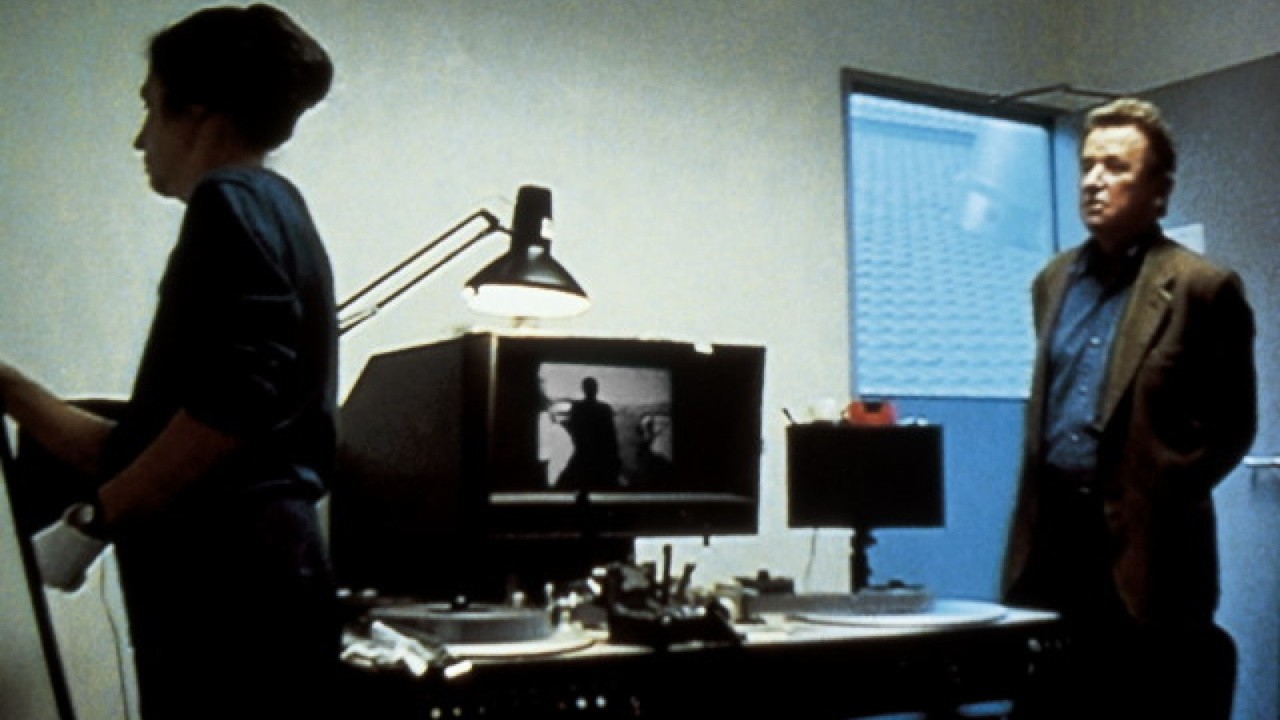
Undaunted by a commission to make a film about his mentors and aesthetic exemplars, the filmmaking team of Jean-Marie Straub and Danièle Huillet, Costa records with great sensitivity and insight the exacting process by which the two re-edit their film SICILIA!, discussing and arguing over each cut and its effect. Incorporating comments about the influence of figures as diverse as Chaplin and Eisenstein, about the ethical and aesthetic implications of film technique and such matters as rhythm, sound mixing, and acting, WHERE LIES YOUR HIDDEN SMILE? becomes a tour de force, immersing us in the mysteries of cinema as practiced by some of its greatest creators. Costa calls the film both his first comedy and his first love story. “Quite simply a masterpiece, and probably the best documentary of any kind that I have ever seen” (Adrian Martin, Senses of Cinema ). —Cinematheque Ontario
Pedro Costa (born 1959) is a Portuguese film director. He is acclaimed for using his ascetic style to depict the marginalised people in desperate living situations. Many of his films are set in a district of Lisbon inhabited by the socially disadvantaged and shot in a natural and low-key way that makes them resemble documentaries. While studying history at University of Lisbon, Costa switched to film courses at School of Theatre and Cinema (Escola Superior de Teatro e Cinema). After working as an assistant director to several directors such as Jorge Silva Melo and João Botelho, he made a first feature film O Sangue (The Blood) in 1989. He collected the France Culture Award (Foreign Cineaste of the Year) at 2002 Cannes International Film Festival for directing the film No Quarto da Vanda (In Vanda’s Room). Juventude em Marcha (Youth on the March, known as “Colossal Youth” in Anglophone countries, and “En avant, jeunesse” – “Onward, Youth” – in Francophone countries) was selected for… read more
There is a wonderful moment in this film in which Huillet tells Straub that the difference between them in cutting is a single frame. Based on my experience collaborating with my girlfriend, I can say Huillet is absolutely right.
Jacques Rancière, Philippe Lafosse and the public in conversation about Straub-Huillet after a screening of their films.
"Robert Kaylor's 1971 documentary Derby is a quintessential movie about the American dream," writes Michael Joshua Rowin for Artforum. "The