Simulacron 1 is the most important project in the institute for cybernetics and futurology – an electronic monster that is supposed to elevate conventional computer technology to a new level. Once it functions, Simulacron will be able to predict future social, economic, and political occurrences as precisely as though they were reality. Thus, Simulacron is a least interesting for two parties: those who are interested in improving future life conditions and those who hope for information privileges vis-à-vis their competitors. This could, for instance, concern the aluminum market. Professor Vollmer (Adrian Hoven) is the initiator and the head of the research project. He dies under mysterious circumstances – the common opinion is that he committed suicide as he showed peculiar signs of a bizarre mental disturbance just prior to his death. Siskins (Karl-Heinz Vosgerau), almighty boss of the institute, makes Dr. Stiller (Klaus Löwitsch), the closest associate of the deceased, Vollmer’s successor. But soon, the colleagues notice odd symptoms in Stiller as well: He claims that the institute’s head of security, Günther Lause (Ivan Desny), has vanished without trace, whereas everyone knows that his name is Hans Edelkern (Joachim Hansen) and that he is as happy as a clam. Stiller also talks about an attempt to murder him – but it is obvious that this was a completely normal accident. Dr. Stiller also opposes his superior Siskins’ intention to pass special Simulacron predictions to private people in advance. It appears that Stiller’s nerves are not sufficiently strong for the type of pressure his new job entails. He gets nauseous, does not recognize people, and instead talks of people nobody apart from him knows. Stiller tries to forget his Simulacron-related problems. For him, Simulacron is not just a lifeless machine but a kind of miniature universe. Although he knows very well that the so-called identity units in Simulacron are nothing but the result of complex electronic procedures, the units sometimes appear like real people to him. And they are indeed based on humans. Because they are programmed to make precise predictions about real people’s behavior, they may not be different from them. Is Stiller schizophrenic? This is exactly what many believe – until one day, during a routine transfer, Stiller’s conscience gets entangled into the circuits of Simulacron where he believes to meet an old acquaintance again: Günther Lause, the institute of cybernetics’ and futurology’s head of security. Of the latter everyone except Stiller claims that he has never existed. World on a Wire neither plays here nor anywhere else, it is not placed in the present but not in the past or the future either. World on a Wire takes place in an artificial world and in an artificial time – it is a fiction, a hypothesis, a plan for further discussion, no more. And no less. —Rainer Werner Fassbinder Foundation
Rainer Werner Fassbinder (May 31, 1945 – June 10, 1982) was born into a cultured bourgeois family in the small Bavarian spa town Bad Wörishofen. Raised by his mother as an only child, the boy had only sporadic contact with his father, a doctor, after the divorce of his parents when he was five. Educated at a Rudolf Steiner elementary school and subsequently in Munich and Augsburg, the city of Bert Brecht, he left school before passing any final examinations. A cinema addict (“five times a week, often three films a day”) from a very early age, not least because his mother needed peace and quiet for her work as a translator, “the cinema was the family life I never had at home.”
Fassbinder made his first short films at the age of twenty, persuading a male lover to finance them in exchange for leading roles. He also applied for a place at the Berlin Film School (dffb), but was refused. He acted in both his early films: DER STADTSTREICHER (The City Tramp), which also featured Irm… read more
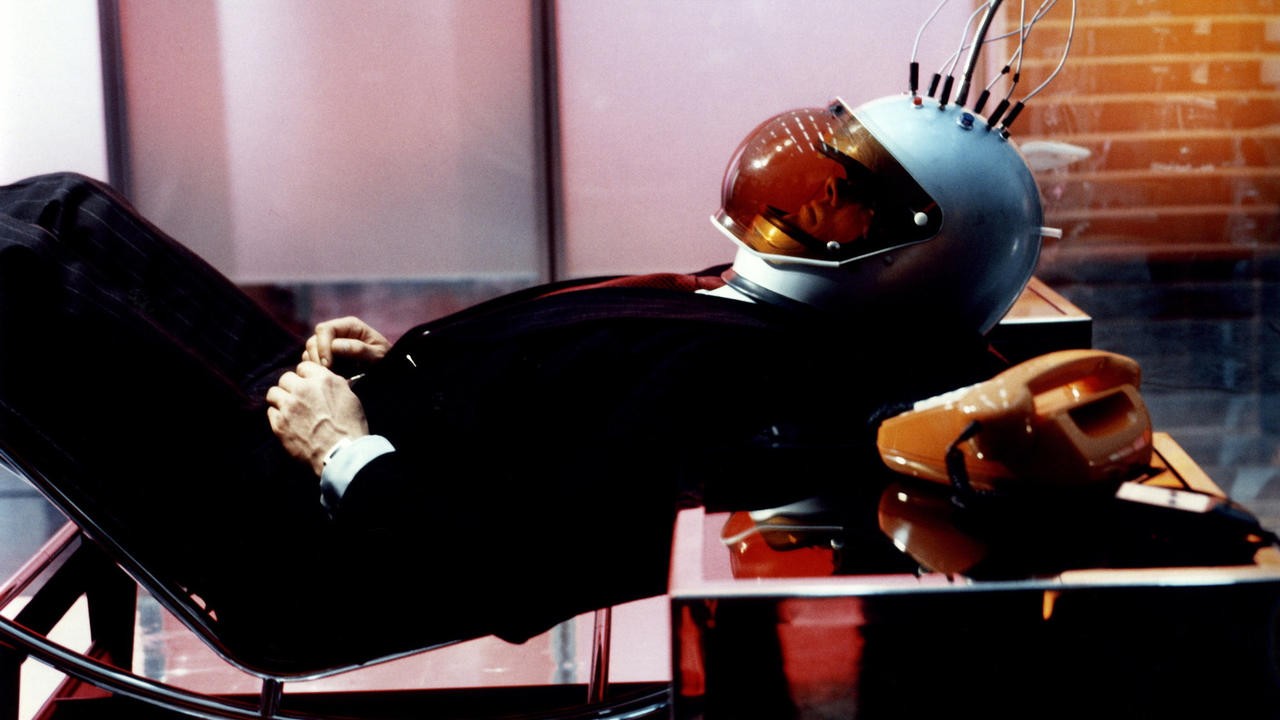
Style freaks, assemble. In centering on the concept of artificial reality, Fassbinder layers his own garish artifice into his treatment: oblique, kinetic visuals, reflective surfaces echoing its mirroring of realities, psychedelic colours, swelling muzak - all surreally capturing its dystopia with a pervasive vertigo. In such nods to the gaudy Weimar cabaret, its depth of field is secured in its engrossing, ambiguous maze of hallucination, reminiscent of Solyaris. Viscera through atmosphere; unrelenting in delivery - a lush trip for the head and heart.
Fassbinder's only venture into science-fiction, 'World on a Wire'is a weird but fascinating early exploration of simulated reality and the P.K. Dickian existential confusion that goes with it. Read my full review: www.brnrd.net/blog/archive/2012/12/19/world-on-a-wire
This week: two major film magazines unveil their new issues, Adam Nayman reveals why Jaws is the “greatest movie ever made”, and more…
Also: David Phelps’s Secret History of America. Remembering Warhol. A pirate’s justification. And more.
In our annual poll, we pair our favorite new films of 2011 with older films seen in the same year to create fantastic double features.
The sci-fi masterpiece, part “Alphaville”, part Fritz Lang, part “The Matrix”, yet wholly original.
Trailer for the Janus Films release of Fassbinder’s made for television sci-fi masterpiece, World on a Wire.
Movie Poster of the Week is excited to be unveiling the exclusive world premiere of the newest poster from the man who may be the hottest designer
Senses of Cinema editor Rolando Caputo, summing up the gist of Murray Pomerance's essay on Second Life, notes that, for those who live there
"There are movies that make news and movies that are news," begins J Hoberman in the Voice. "World on a Wire is one of the latter. Suddenly
Rainer Werner Fassbinder's World on a Wire, "an obscure two-part television movie he made in 1973, is a textbook example of a film that
There is a certain amount of camp humor in the first half that goes unmentioned by most people that is quite funny and appropriately unusual for Fassbinder’s most unusual film. The implication of a… read review
Interesting as a precursor to films like “The Matrix”, “Inception”, and “The Adjustment Bureau” and probably seemed innovative on 70s television but lags even the S.F. literature of its time in sophistication… read review
“I think, therefore I am”, says Fred Stiller… read review