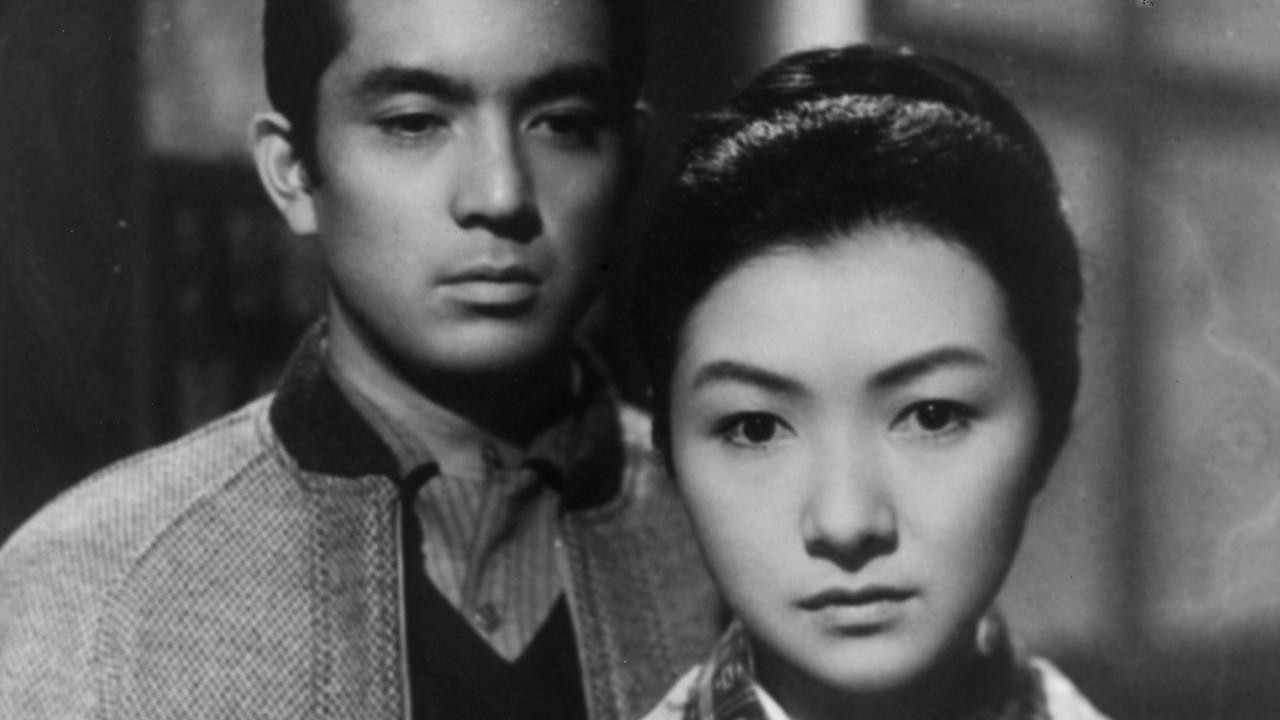
In Yearning, war widow Reiko (Hideko Takamine) struggles to keep her provincial mom-and-pop store afloat against the advent of the supermarket. Living with her in-laws, who are chief among those trying to squeeze her out of her business, she becomes the protector of her young brother-in-law, who is given to drinking and womanizing until he astonishes her with the confession that he is in love with her. —Judy Bloch
Mikio Naruse is one of the least known of Japan’s early master directors, both in the West and in Japan, yet he created some of the most moving, darkly beautiful works in Japanese cinema. Like Kenji Mizoguchi, Naruse showed an uncanny understanding for the psychology of women. Like Yasujiro Ozu, he preferred subtle shifts of character over broad strokes of plot. Unlike either of these early greats, however, Naruse’s vision of humanity was much darker and more clinical. He stripped all vestiges of hope or acceptance from his films, what remains is only a willful struggle to endure. His relentlessly negative view of human existence has resulted in Naruse’s often being labeled a nihilist.
Born in Tokyo, in 1905, Naruse was the youngest of three sons of a desperately poor embroiderer. Although he excelled in elementary school, his family could not afford to further his education. He was instead enrolled in a two-year technical school. There, he spent virtually all of his free time… read more
Naruse' Yearning conveys volumes about the human spirit. Special thanks to all the cinephiles of mubi who champion such a timeless film.
Towards the end of his career Naruse directed the radiant Takamine for the penultimate time in this magnificent widescreen melodrama, one of the very best of their many collaborations. Her expressive face perfectly conveys the torment she goes through when her much younger brother-in-law confesses his love. Naruse conducts proceedings at a perfect tempo right up to the unexpected and devastating finale. Outstanding..
Takamine Hideko only got to see Yearning, in its complete form, in the winter of 1989, at Tokyo's Kawakita Memorial Film Institute. Until then, she had only taken in a few rushes during the making. After the screening, she told an interviewer that Kayama's character was supposed to get drunk and die accidentally in the snow, but Naruse got tired of waiting for a snowstorm and had the character commit suicide. While what we glean from the proceedings is slightly more ambiguous, the odds are that that, in fact, is what actually occurred. Nevertheless, it eventually sets up the final shot, a close-up of Takamine's Reiko (exquisitely captured by Yasumoto Jun, who shot a number of Naruse's 'scope film in the Sixties; in this film, his medium- and long-shot compositions often help emphasize Reiko's loneliness), where she might as well be an embodiment of Munch’s 'silent scream.' But as the late, great Taiwanese master Edward Yang has argued, however, "her expression suddenly becomes calm as if she were saying to herself, 'This is life, and life must go on.'" While to me the transformation is much more subtle (closer to what the Dardennes accomplished with Émilie Dequenne at the end of Rosetta), which only speaks to the greatness of Takamine's performance in this moment, perhaps even surpassing the state of 'midareru' or 'anguished confusion' she portrayed in an earlier train sequence, her expression every so slowly moves from desperate to quietly defiant. I don't think we need to pity Reiko; she'll be okay.
Yearning explores the relationship between two characters that reaches such complex emotional levels that you will remain astounded by the fact that Naruse has actually done it! It would be a travesty… read review