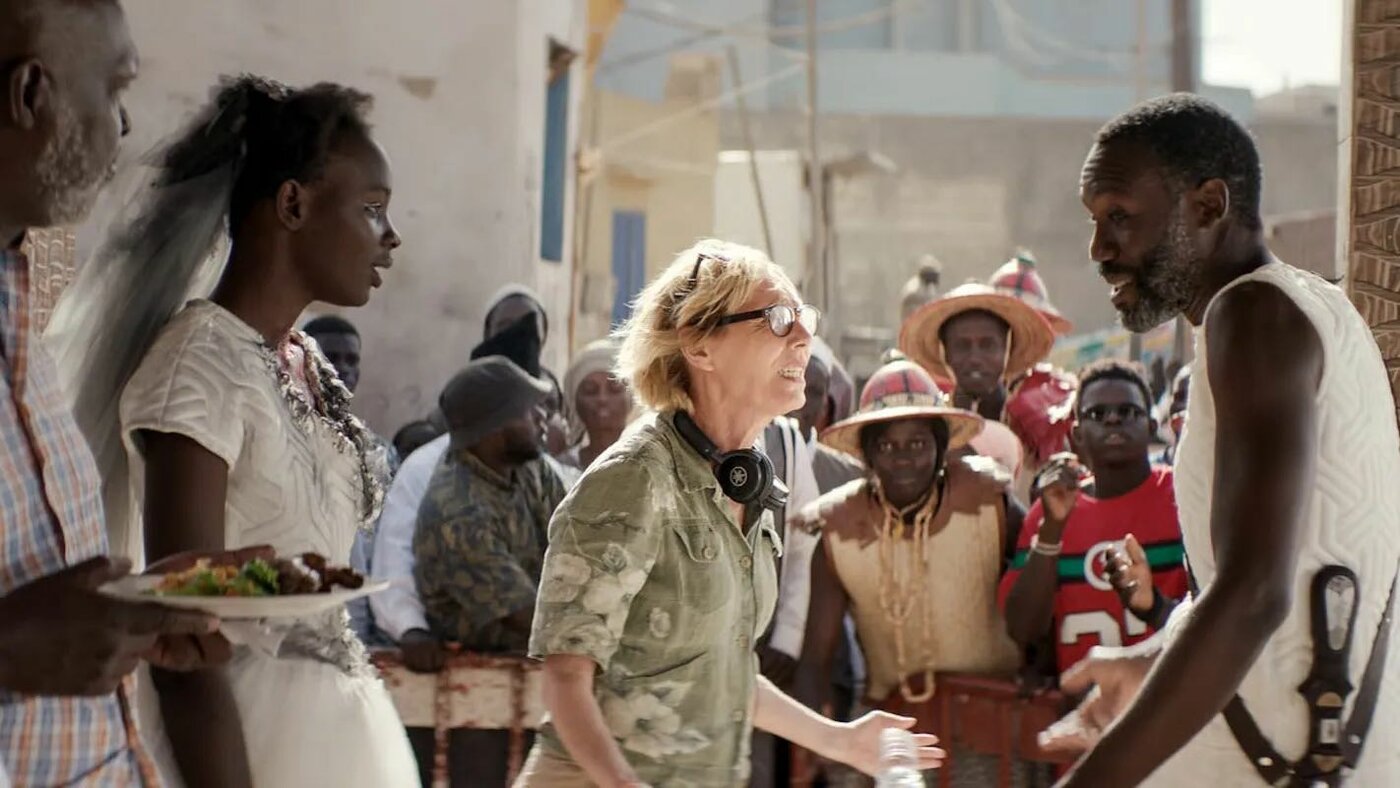
Gavagai (Ulrich Köhler, 2025).
In Ulrich Köhler’s sixth feature film, Gavagai (2025), a somewhat unhinged white female French filmmaker radically reinterprets Medea in Senegal. Soon the action shifts from sunny Dakar to gray Berlin, where what transpired on and off camera reverberates in the events surrounding the film’s premiere at a technically unnamed festival in Potsdamer Platz. Arriving to check in at a luxury hotel paid for by the festival, Nourou (Jean-Christophe Folly), the actor who plays Jason, is racially profiled by an aggressive Polish security guard. Nourou’s Berlin-based costar, Maja (Maren Eggert)—with whom he had an affair during the film’s shooting—comes to his rescue, or so she imagines.
Köhler, a former philosophy student, named his film after an imaginary word in a thought experiment by the logician W. V. Quine, symbolizing the challenges of translation and cultural interpretation. Gavagais abound in Gavagai, revolving around power relations involving class, gender, privilege, art, interpersonal relationships, and even fashion, but primarily race: Jean-Christophe Folly himself experienced a version of that incident with the guard before the 2011 Berlinale premiere for Sleeping Sickness, his previous collaboration with Köhler.
Sleeping Sickness was based loosely on Köhler’s childhood in Zaire, where his parents were Lutheran missionaries. It won the filmmaker a Silver Bear for Best Director, but Gavagai has no chance of collecting similar accolades. Two-thirds of the film was shot at Berlinale in 2024, when I was the head of programming. Neither that nor any other A-list festival selected it this year, so it bows instead at the New York Film Festival.
Köhler has made a very personal film that speaks to social and political divides, deftly anticipating the responses to its gavagais. By calling attention to the moral crises of our increasingly solipsistic world, Gavagai creates a hall of mirrors upon which one continues to reflect long after the film (and the film within the film) has ended.
Köhler and I spoke at his Berlin office a week prior to Gavagai’s New York premiere.
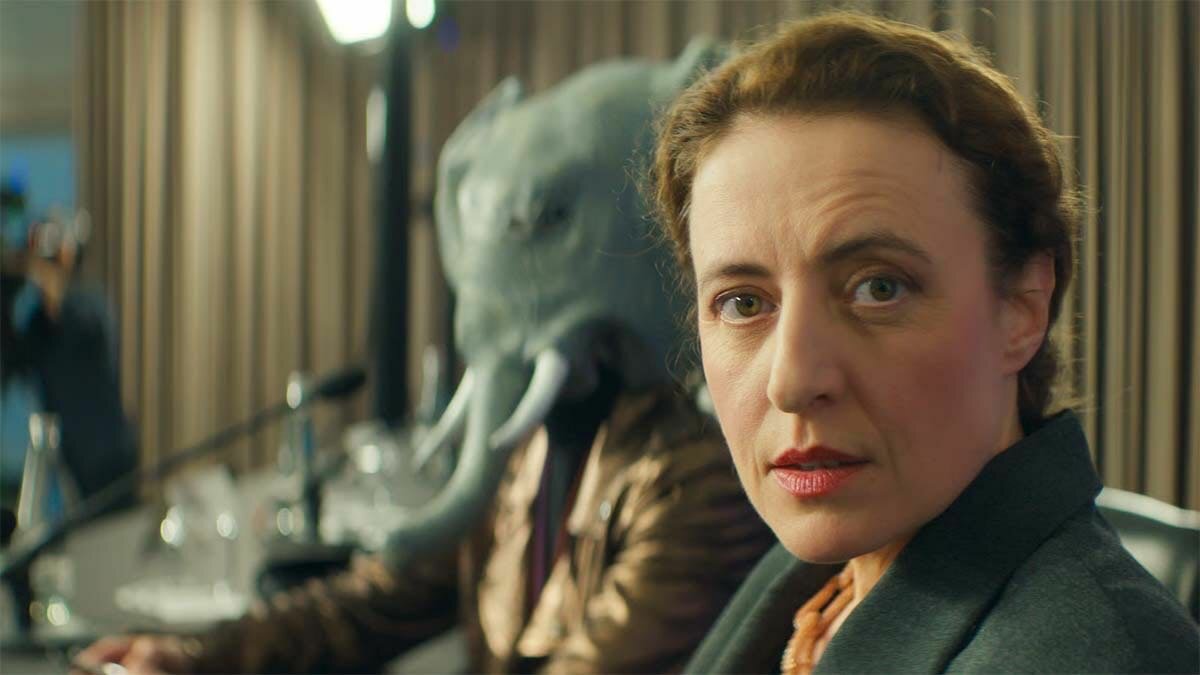
Gavagai (Ulrich Köhler, 2025).
NOTEBOOK: When I started to watch the film, I actually forgot there were going to be scenes shot at the Berlinale, which I guess was an act of unconscious repression. What you’re doing in Gavagai is reliving the making of a traumatic film, and also a traumatic incident that you were involved in at the Berlinale in 2011.
ULRICH KÖHLER: That scene was one of the reasons I wanted to make the film. After shooting Sleeping Sickness, the movie I had done in Cameroon fifteen years ago, I said I never want to shoot in Africa again, but deep down I knew that I couldn’t let it go. In fact, I tried to write an autofictional novel starting with my childhood in Zaire, which I won’t show anyone. Then, after the Arab Spring, I started thinking about African elites, or more specifically about children of the elites living in Europe. You can be privileged and still have to deal with prejudice in your everyday life; privilege doesn’t protect you from racism, as Isabel Wilkerson has written in Caste: The Origins of Our Discontents. I just had the feeling that I had to talk about this again, and about my own hubris in thinking that—having grown up in Zaire and knowing Cameroon quite well—I could escape the contradictions and ethical conundrums other European filmmakers had fallen into when shooting in an African country. And yes, there was also this incident at the Berlinale. That was the start. Why did I go there? I don’t know. I took the risk that history would repeat itself during the shooting in Senegal. But in fact, it didn’t.
NOTEBOOK: You had learned, I guess.
KÖHLER: I don’t know if there was anything I could have learned. There was a different working relationship with the people in Senegal. They had much more experience in filmmaking, basically. And it’s also a different culture, which up to then I didn’t know. I’d never been to that part of Africa before, and I really loved it.
NOTEBOOK: What exactly happened at the Berlinale at the Sleeping Sickness premiere?
KÖHLER: I had a date with Jean-Christophe in the lobby of his hotel. He told me they just tried to profile him, and they had had a big shouting match outside of the hotel. So I confronted the security guy, who was really Polish—like Kolakowski in Gavagai. He didn’t speak German very well, so he didn’t really stand a chance. In retrospect, I wonder how much anti-Polish racism was involved in my dealing with him. I think the reason why I escalated so much was because I had a lot of guilt coming from that shooting, and I felt unconsciously that this would be a way to make up for it. The hotel didn’t really give me a convincing explanation, so I called the festival, and it went up all the way to [the director,] Dieter Kosslick. It was really tough for Jean-Christophe, obviously. It was his first major role, and he was treated very badly. But in a way, I made things worse for him, because everybody was only talking about that incident, not about the film and his acting.
NOTEBOOK: When you decided to make this film, did you first talk to Jean-Christophe?
KÖHLER: We met right here where we’re sitting. He was open to it, and he liked the idea, but he also made clear that it’s still a film and that the character isn’t him, that he needs some distance. At that time, the concept of the film was much more epic. I wanted Maja and Nourou’s love story to really play out and to have them live together. And it took place over a long time, for like a year in Germany. And I also was thinking about following the main actors during their work on other films and theater pieces. It was a much larger concept. Then slowly I started reducing it, so the main action takes place during two or three days at the festival.
NOTEBOOK: For financial reasons?
KÖHLER: No, it was just a process. During COVID, I had a lot of time to think about it. I go through this process quite often. The same thing happened with Bungalow [2002], for example. It was also supposed to be more epic. And then somebody suggested I read Catcher in the Rye again. And the structure of three days came out for Bungalow. It’s often a reduction process for me.
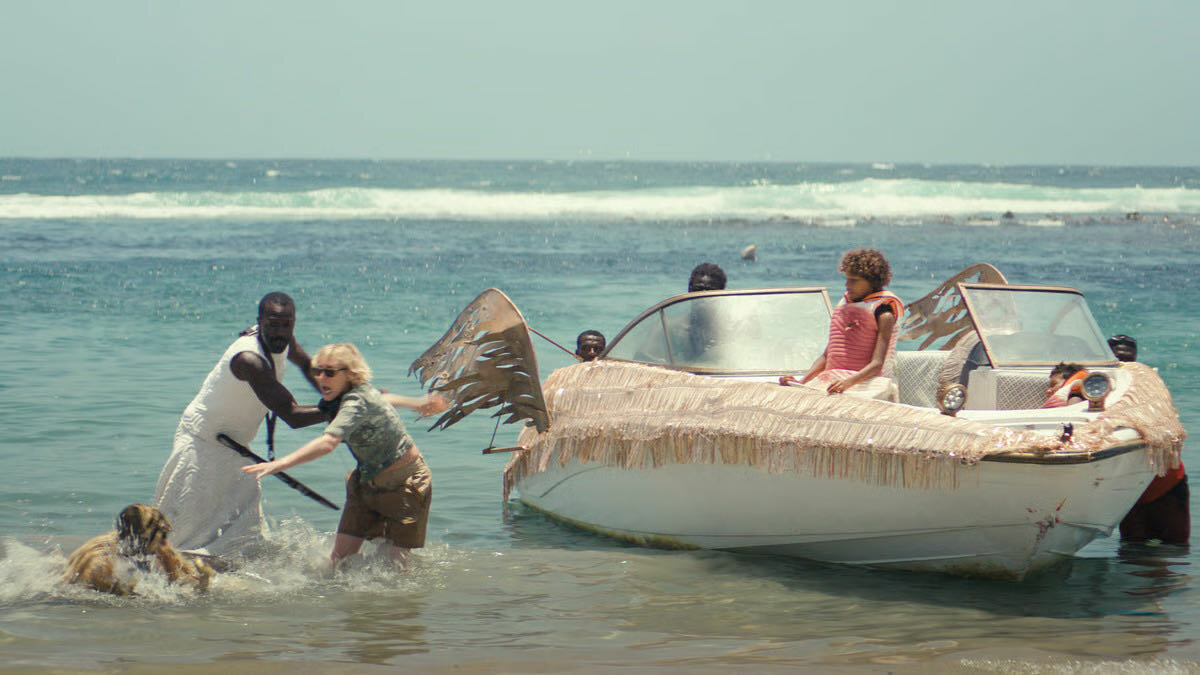
Gavagai (Ulrich Köhler, 2025).
NOTEBOOK: I don’t want to dwell too much on Sleeping Sickness, but I recall that the film’s very first scene is in fact a Black soldier asking a white German for ID, and then asking him for a lift to the next town. Were you conscious of that resonance with this scene at the hotel?
KÖHLER: No. But, yeah, it’s true. But there the white man is still in the power position. For me, the point of that scene is that even at gunpoint, his position of privilege is so strong that he manages to turn it around. At the end, he takes the soldier, but he forces him to remove his uniform.
NOTEBOOK: With that film, you were trying to avoid the problems of a European shooting in Africa, and you were unable to do it. So, in Gavagai, is the position of Caroline, the director, your own position in Sleeping Sickness? I think you also realize that certain viewers will recognize another filmmaker in that character.
KÖHLER: Apparently. I didn’t think that much about it, but yeah, I guess there is a similar age and some physical resemblance to the filmmaker in question. [Laughs.]
NOTEBOOK: Claire Denis.
KÖHLER: But that was not the idea. I’d worked with Nathalie Richard before, and I thought she would be perfect for the role. It’s more a film about me, that’s for sure. People who haven’t been on a set might find Caroline’s behavior extreme. But I think a lot of filmmakers are capable of that kind of behavior in that kind of a pressure-filled situation. And I certainly am. So, in a way, she’s an alter ego, but then also, in the scene in the lobby between Maja and Nourou, Maja is an alter ego as well. I mean, there are parts of me everywhere.
NOTEBOOK: It seems to be a pretty personal film, probably your most personal.
KÖHLER: I think it’s fair to say.
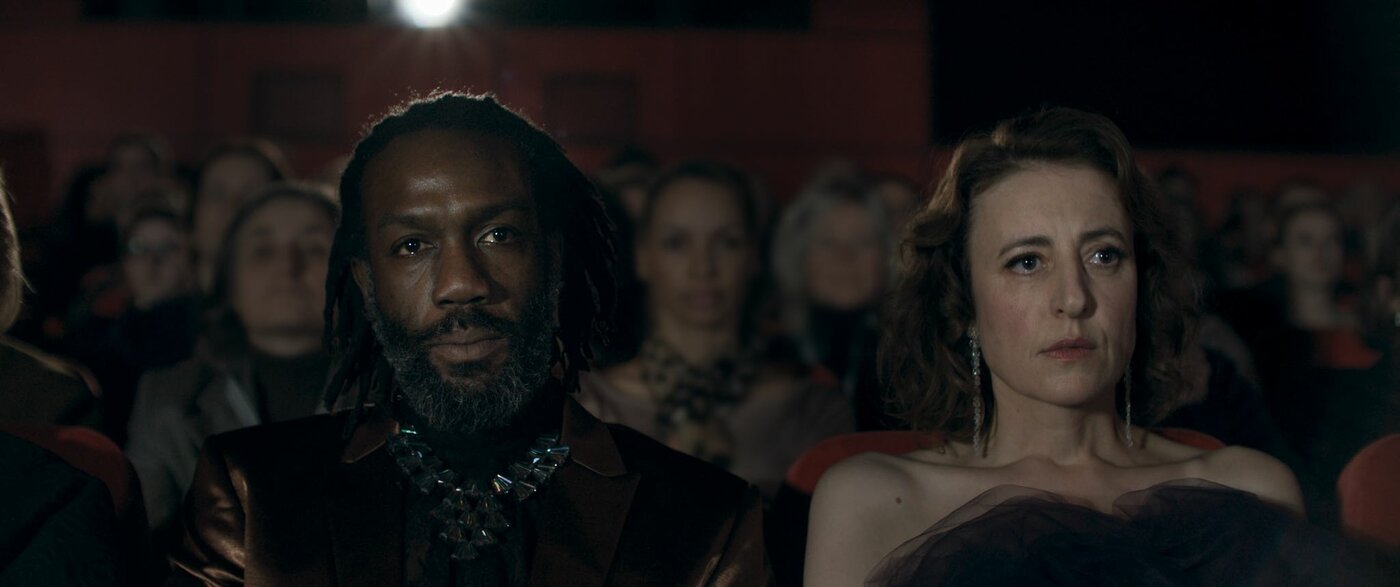
Gavagai (Ulrich Köhler, 2025).
NOTEBOOK: To allude to a sequence in the film I won’t spoil, I’ll bring up “the elephant in the room,” which is that the film is premiering in New York and not elsewhere.
KÖHLER: This is a question you have to ask to the festival circuit and the people who decide about these things.
NOTEBOOK: There was no feedback from the programmers?
KÖHLER: Some people complained about the fact that the film ends with Caroline’s film and not with mine. I think there was also this issue of me choosing a female alter ego as a filmmaker. But you would really have to talk to the people who make the decisions. Anyway, waiting for the premiere had a positive side effect. I had this one idea that came to me after we had finished, and I had time to convince my producer to re-edit. The idea was to take the palace scene from Medea and place it in the middle, before the press conference. To me, it makes the press conference less abstract and also the analogy between Medea’s situation and Nourou’s situation easier to grasp.
NOTEBOOK: It also gets you out of Berlin for a bit.
KÖHLER: Exactly. And it helps rhythmically that you have something more playful in the middle of the film.
NOTEBOOK: Because also the depiction of the two cities is obviously very different. Dakar seems much more lively, Berlin very gray and cold. Maybe it’s just me, but after a while of being in Berlin, I wanted to be back in Dakar. Was there any conception of having a longer sequence of the behind-the-scenes shooting of the film?
KÖHLER: No, that’s pretty much all I shot. And in fact, it’s longer than initially planned. We shot the Berlin part first. After we did a rough cut I thought, “Wow, this is going to be a pretty short movie.” And I convinced the producer to add some film scenes and some shooting scenes. I don’t really remember what, but it’s definitely longer than in the script. It was always planned that we were to have, at most, a third of the shooting days in Senegal.
NOTEBOOK: It’s not really a film about filmmaking per se, even if at the beginning it did remind me of something like Day for Night [1973].
KÖHLER: No. It’s more a film about power relations.
NOTEBOOK: But one set in the milieu of the film festival. Were you concerned at all about how to depict this or what kind of reaction you would get? There aren’t many films set at film festivals. There’s Rifkin’s Festival [2020], which we don’t need to talk about. There’s a couple of Henry Jaglom films too, of which I could say the same. There’s probably a reason for that.
KÖHLER: Yeah, that might be true. In the first treatment, the festival played a much smaller part. But since I wanted to talk about the complex relationship between the two protagonists within a short time frame, the festival came in pretty handy. When financing the film, that made some people nervous because they thought it would be too self-referential. Also it was very important for me to place it in Germany. I couldn’t talk about the ambivalent relationship to the Polish security guard in a different country. I wanted to talk about racism towards Eastern Europeans in Germany.

Gavagai (Ulrich Köhler, 2025).
NOTEBOOK: In the first part, we see that on a film set people might behave differently than they would behave in everyday life, not only regarding Maja and Nourou's affair. And you could say the same thing about being at film festivals.
KÖHLER: Yeah, there’s a lot of pressure, basically.
NOTEBOOK: But also there’s another layer which is that while Nourou is a foreigner at the festival, Maja lives in Berlin.
KÖHLER: Yeah. I think this does impact on behavior: When you’re at a film festival in a place where you live, then you have other concerns. Obviously, your everyday life continues. Also, since I’ve done a lot of films set in the provinces, I really wanted to do a film that takes place in the city. I’ve been living in cities in Germany for 35 years now, so, I thought, this is the moment to have a film that takes place in Berlin.
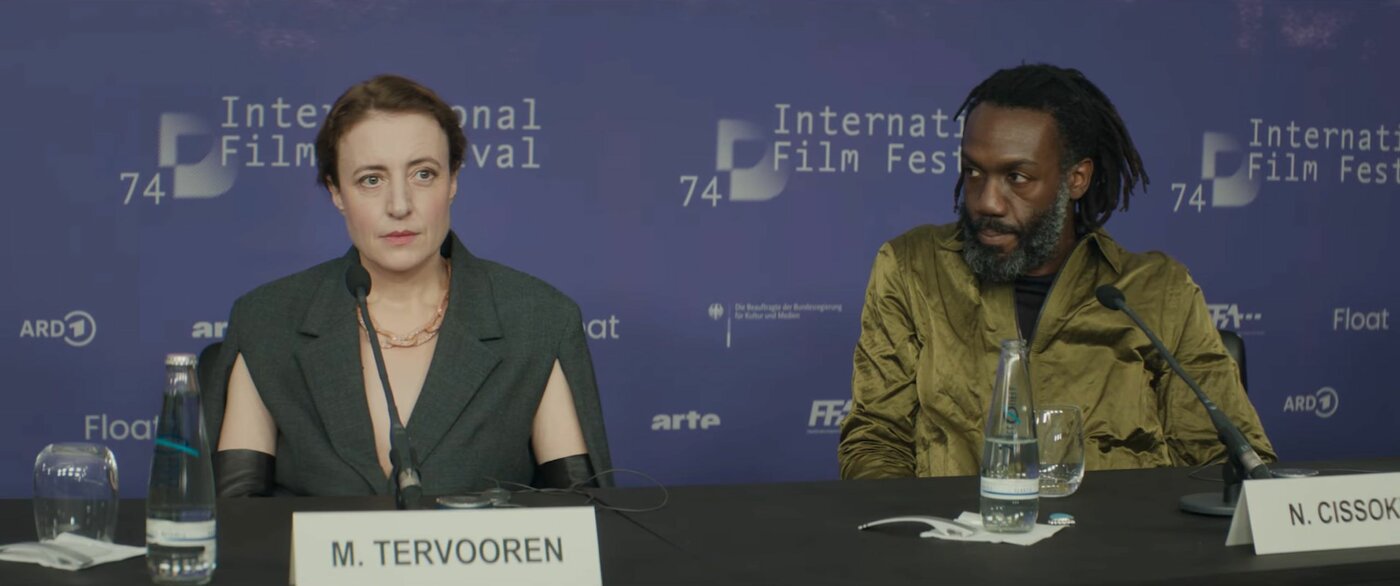
NOTEBOOK: You finally made a real Berlin School film. Let’s talk a bit about shooting at the Berlinale, because you approached me for some help facilitating it, and there was a process of negotiation to make it happen. On every film a director has a list of desires, and then, eventually, you end up compromising. From your perspective, what was it like arranging the shoots at the Berlinale?
KÖHLER: Well, it was complicated, I must say, for both sides. I was thinking this film would have much more documentary elements, with a handheld camera, or embedded elements of people walking and talking through the festival. Now the only embedded element at the Berlinale is the moment the crew gets out of the car at the red carpet.
NOTEBOOK: There’s also the scene where Nourou’s walking on the street in Potsdamer Platz. I was wondering how you got that shot, actually, as it was in a public space and you see people in the background, et cetera.
KÖHLER: We didn’t have a shooting permit for that. In fact, some security guys from the Berlinale asked us what we were doing. As you know, we were hoping to use the press conference room, but I think in the end it was probably easier to shoot it somewhere else than to shoot it in the Hyatt late at night. I was even thinking about using counter shots of the actual press. Basically, the film became much more fictional in terms of the aesthetics. I’m a control freak as a filmmaker. But sometimes, for example in In My Room (2018), I shot a couple of scenes where I didn’t have the control, like during a demonstration or in a nightclub. And I always like these moments when I don’t have the total control or responsibility. So, yeah, finally, this film became very crafted.
Gavagai (Ulrich Köhler, 2025).
NOTEBOOK: How much do you think that the behavior of the characters is dependent on the fact that they are actors?
KÖHLER: I would put it the other way around. I think that the film makes you look at acting differently. I heard from a colleague who shot with an internationally renowned actress who has a tendency to overact. While shooting, he said to her, “I forgot to tell you, the character is not an actress.” In this case, I didn’t have to say that. But then I would say neither Jean-Christophe nor Maren tend to overact. They stay close to their own life experience in the film.
NOTEBOOK: It’s just another level which intertwines the fictionalized reality of Gavagai and the pure fiction of Medea, especially if you’re trying to make a parallel between the two. Why did you want to have Caroline make a version of Medea? In the press conference, she gives an explanation. Is that yours?
KÖHLER: What Caroline says in the press conference really happened to me. I saw [Franz] Grillparzer’s Medea in the Burgtheater in Vienna, and I was really, really touched. Birgit Minichmayr was playing Medea. And I don’t cry in the theater very often. And I also find Medea is misunderstood. I like Pasolini’s Medea [1969], but I don’t agree with his interpretation that pits the modern, pragmatic man against the emotional, animalistic woman. For me, it’s really a story of exclusion. When I started writing, Medea was just the first scene of the film. I didn’t know I was going to shoot the film in the film. And then I found Medea more and more interesting. And I really liked the idea of the film running into another film.
NOTEBOOK: Specifically, it’s the idea of the foreigner.
KÖHLER: That’s the basic idea, both films are about exclusion. There’s a German writer of the last century, Hans Henny Jahnn, who wrote a “Black” Medea, for example. I knew that it was a bad idea to do what Caroline did, but I also wanted the freedom to...
NOTEBOOK: To have a German Medea.
KÖHLER: Yeah, a German Medea. But I’m also not responsible for that idea in the film. Obviously, I am, but it’s Caroline’s film.
NOTEBOOK: What exactly about the Grillparzer did you like?
KÖHLER: Euripides’s version is beautiful and very modern in a way, but it has monologues and it’s harder to film—the Grillparzer is more psychological and has more interaction. Also, Grillparzer makes Jason a weak man. So, I really like that Nourou has to play a character that is very weak and opportunistic. In fact, I read about ten different Medeas. I even started translating the Jean Anouilh one, which is like a Bonnie and Clyde story about a bourgeois man and a woman, who wants to live free and dangerous. And so, it was a process until I decided that it would be Grillparzer.
NOTEBOOK: But still, you—or Caroline—changed the play further in that she doesn't kill her children.
KÖHLER: There’s a Medea where she kills her children not out of revenge, but to spare them from being killed by the mob. Christa Wolff is a very feminist, a little bit too idealistic reading of Medea. That’s the one Maren Eggert played at the Deutsche Theater. Anyway, there are a number of versions where Medea’s not responsible for the deaths of her children.
Gavagai (Ulrich Köhler, 2025).
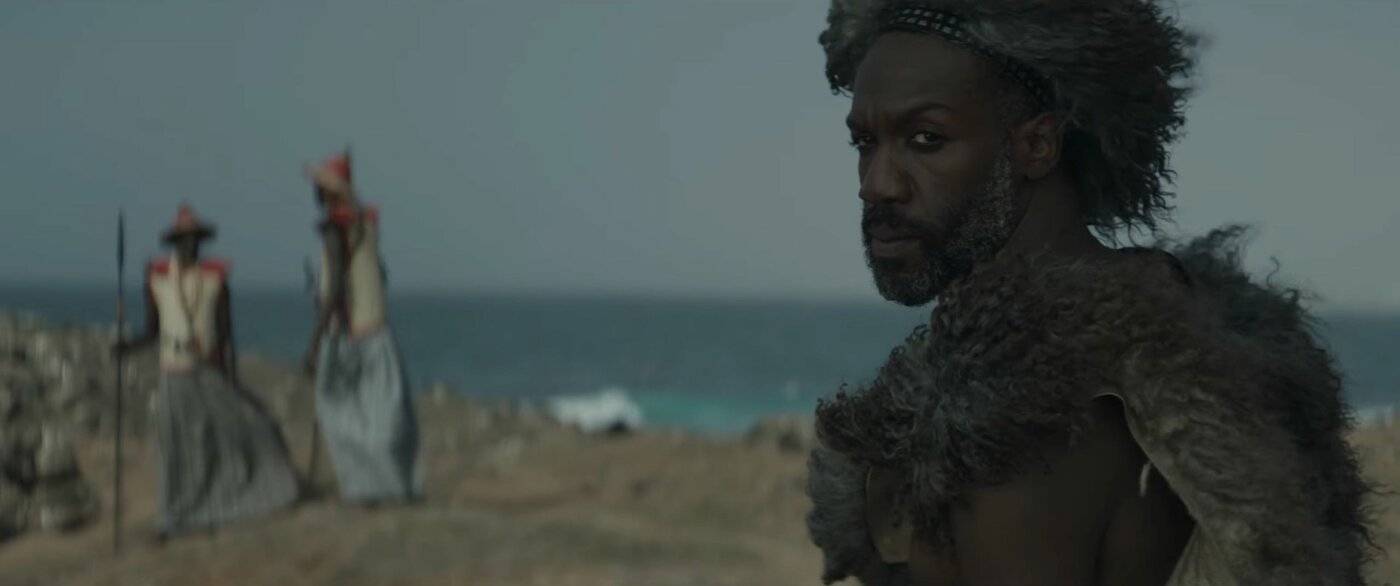
NOTEBOOK: This idea of mixing the contemporary with the ancient must have been pretty amusing to shoot.
KÖHLER: Yeah, it was. It was fun to be free with the costumes, and also to have a very different way of acting in the same movie was quite tempting. That's also what I like about the scene in the car with Mišel Matičevič and Kolakowski, who is played by Mateusz Malecki—it’s like a citation of other movies.
NOTEBOOK: It’s very film noir, and with Mišel Matičevič one obviously thinks of Thomas Arslan and Berlin School movies. Maybe you can talk a bit more about that scene and why you wanted to include it in the film.
KÖHLER: Well, I think it was really the idea that Maja is a white savior and Nourou doesn't want that help, and then the same thing happens to Nourou: Kolakowski doesn’t want his help. Intervention is always double-edged—as soon as you intervene in the lives of others, you might end up making things worse. Maja doesn’t understand the repercussions of what she’s doing. But, obviously, I also wanted to play with the idea of the danger that Nourou runs into doing that.
NOTEBOOK: Also, Nourou doesn’t understand the repercussions of what he’s doing with regard to the guard, but also to Maja with respect to their personal relationship, which reinforces the point that nobody in the film is able to take the viewpoint of another.
KÖHLER: Yeah, exactly. You could say it’s a film about power relations, but it’s also a film about misunderstanding and about the impossibility of really getting into somebody else’s head. As Quine shows, there’s a high risk of misunderstanding if you don’t know the context, and the more context the better, but still you don’t have any objective understanding of what somebody else means. So “gavagai” is from Quine’s essay “Two Dogmas of Empiricism,” where he tries to show that only total systems of belief have a relationship with the world, not single words or single sentences. The example he uses is of an ethnologist who finds a tribe whose language he doesn’t speak, and a rabbit runs past. A man says “gavagai,” and the ethnologist first thinks it means rabbit, but then he starts realizing it could also mean lunch, dangerous, long ears, or whatever. So he realizes that he needs to know a lot more to be sure that even though the man is pointing at the rabbit, he means the animal in its totality. Quine was talking about translation, but his disciple Donald Davidson showed that it’s true for every act of communication between humans. Nobody speaks the same language, that’s basically the idea. You always have to decide if somebody’s saying something wrong, or if he’s using his words differently. Meaning and truth are hopelessly intertwined.
NOTEBOOK: This concept led me to think if there is a message to the film, and what it could be. I felt a strong connection to today’s world because of a certain lack of dignity that people have toward each other, or people refusing or not even thinking they need to understand each other. But if it’s a philosophically ingrained problem, then what you’re doing is depicting something irresolvable, as opposed to proposing a moral vision in the Renoirian sense.
KÖHLER: Well, you could frame it this way: Becoming aware of our biases and potential for misunderstanding will improve human relations—but I’m not even sure of that. No, it’s not a message movie, that’s for sure. It’s just depicting how complicated human interaction is. And more concretely, it’s that the question of racial bias is not easily resolved by good intentions, and that we have to be aware that by trying to do something good, we can make things worse, quite easily.
Gavagai (Ulrich Köhler, 2025).
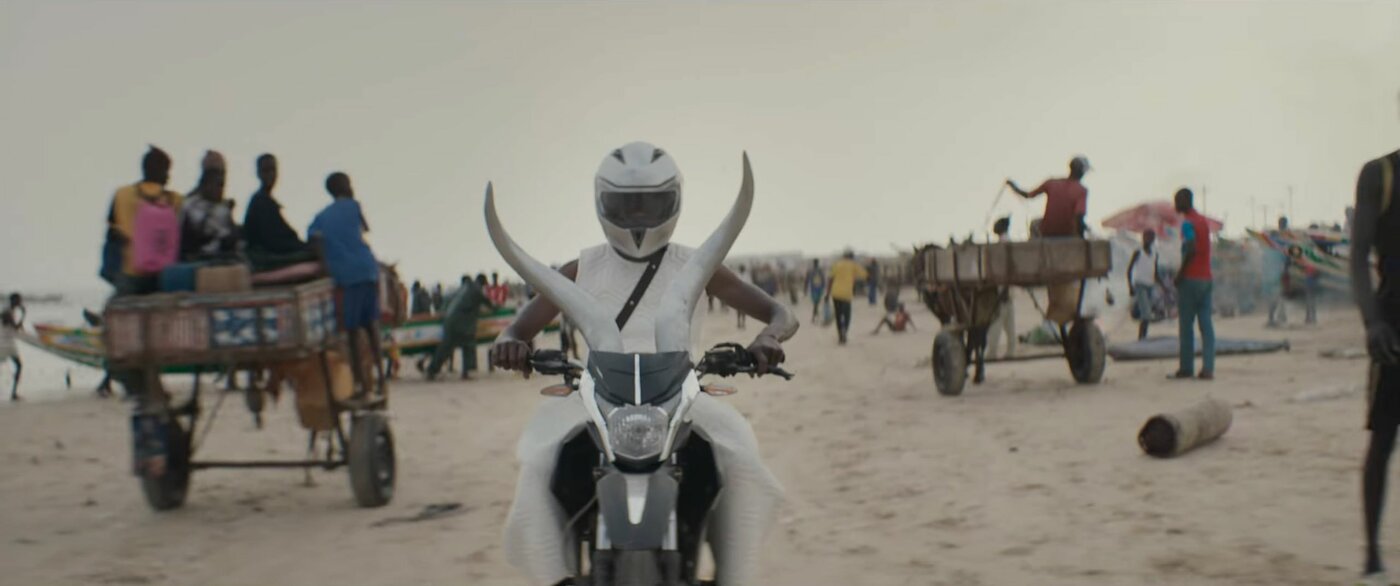
NOTEBOOK: Why did you end the film on that image from Medea of the two kids in the speed boat?
KÖHLER: That came pretty late, in fact. Obviously, it’s Caroline’s film ending, not mine. It’s her FIN. That’s not my FIN. I don’t end with the Shangri-Las, I end with Morton Feldman. But even looking at Caroline’s film, I’m not sure it’s that simple. Is it an image of hope? Looking at the children’s faces, it’s not quite clear if they are all that happy; the brother steering the boat seems quite stressed. Also, the movement of the boat is aimless: It’s turning in circles, not going forward.
NOTEBOOK: Did you include the press conference scene, essentially, to answer potential criticisms of the film?
KÖHLER: In a way you could say that. As a bourgeois filmmaker, which most of us are, making a film about social issues, you always have to question your motives and ask yourself if you have the right to make that movie. I thought so, otherwise I wouldn't have done it. I might be criticized for that, and I understand, but still I had the feeling that I have an interesting perspective on the question. So I’m waiting to find out.
NOTEBOOK: The reporters at the press conference want Nourou’s validation because they assume he’s African, though he’s French. Which is also the same situation with Jean-Christophe’s character in Sleeping Sickness. Besides the fact the press conference actually captures how press conferences normally take place, it seems to me to also be necessary for the filmmaker to be questioned, even if she doesn’t handle it so well.
KÖHLER: I think that Caroline feels she’s doing something courageous in turning things around racially. I mean, I think it’s true that turning things around is a way to help white people understand exclusion. I understand that criticism of Caroline’s Medea, and that’s why I wouldn’t do what she does—although I do! Maybe that’s the most complicated question to answer: my responsibility for Caroline’s film. You can see it as a failed experiment, but this doesn’t make it any less interesting and touching to me. I think Caroline is basically motivated by a feminist interpretation of the myth—she’s countering the traditional narrative of the emotional, irrational, jealous woman. So you could say that she didn’t reflect enough on questions of race.
NOTEBOOK: To conclude on an important point, I haven’t mentioned that the film is also pretty funny, which makes sense for a film about misunderstandings. But I wanted to ask about the pelican in the court scene in Medea, who makes quite the impression.
KÖHLER: Well, he’s the biggest star in the movie! We went to Dakar a year before shooting, and the second day there, I saw this bird at a fish market at the beach. He lives with the fishermen there because he can’t fly anymore. And I said, “This bird has to be in my movie.” Then I found out that he’s in every Senegalese music clip. He’s in every movie. He was great. And he got better and better as we shot over twelve hours. Yeah, that was a chance encounter. The pelican was far easier to work with than the trained dogs in my earlier movies.
NOTEBOOK: Well, the hippo in Sleeping Sickness was the easiest.
KÖHLER: Yes, the hippo was digital!
Keep reading our fall festival coverage.