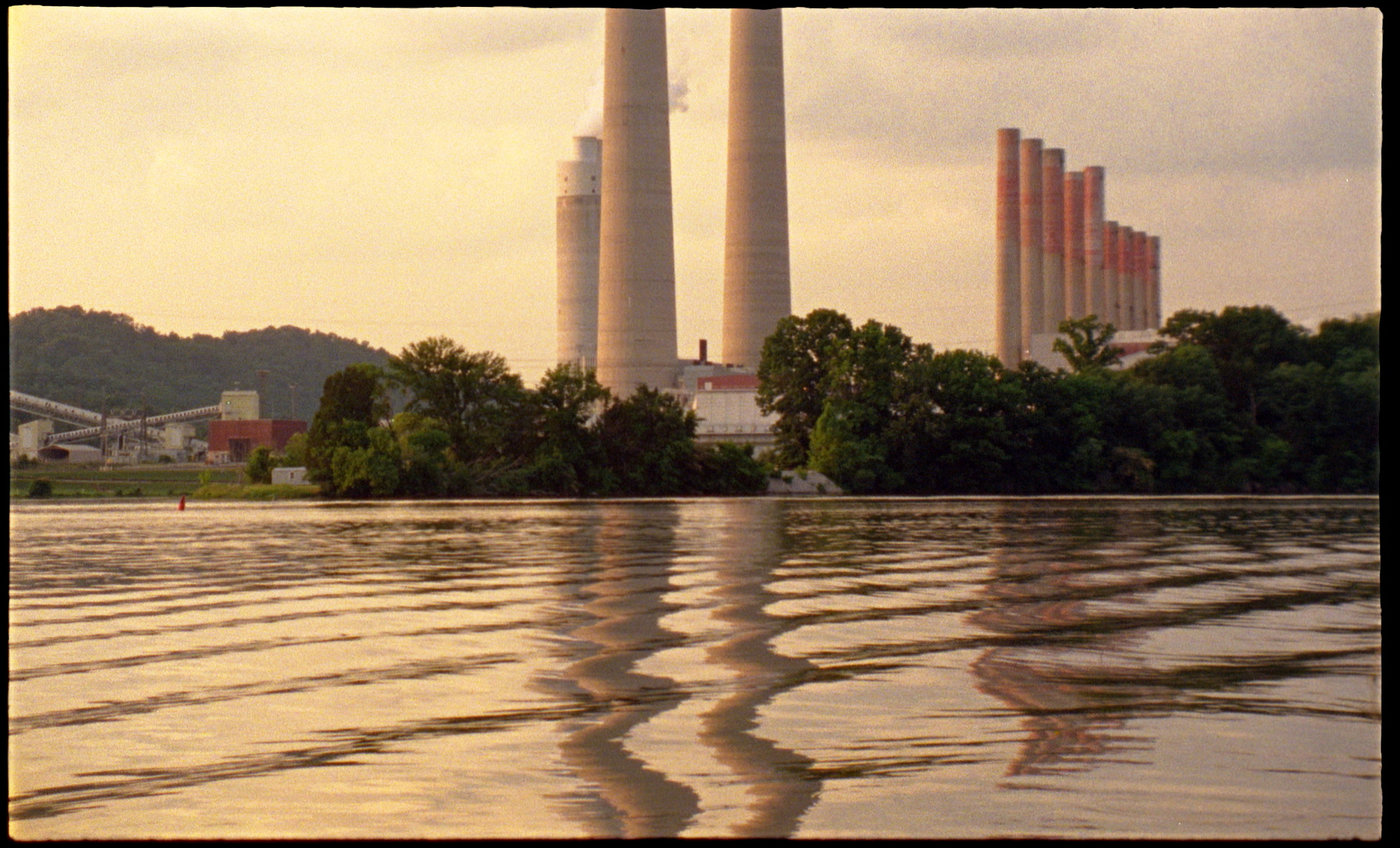
Lynne Siefert's Generations is exclusively showing on MUBI starting August 9, 2021 in the United States and Canada.
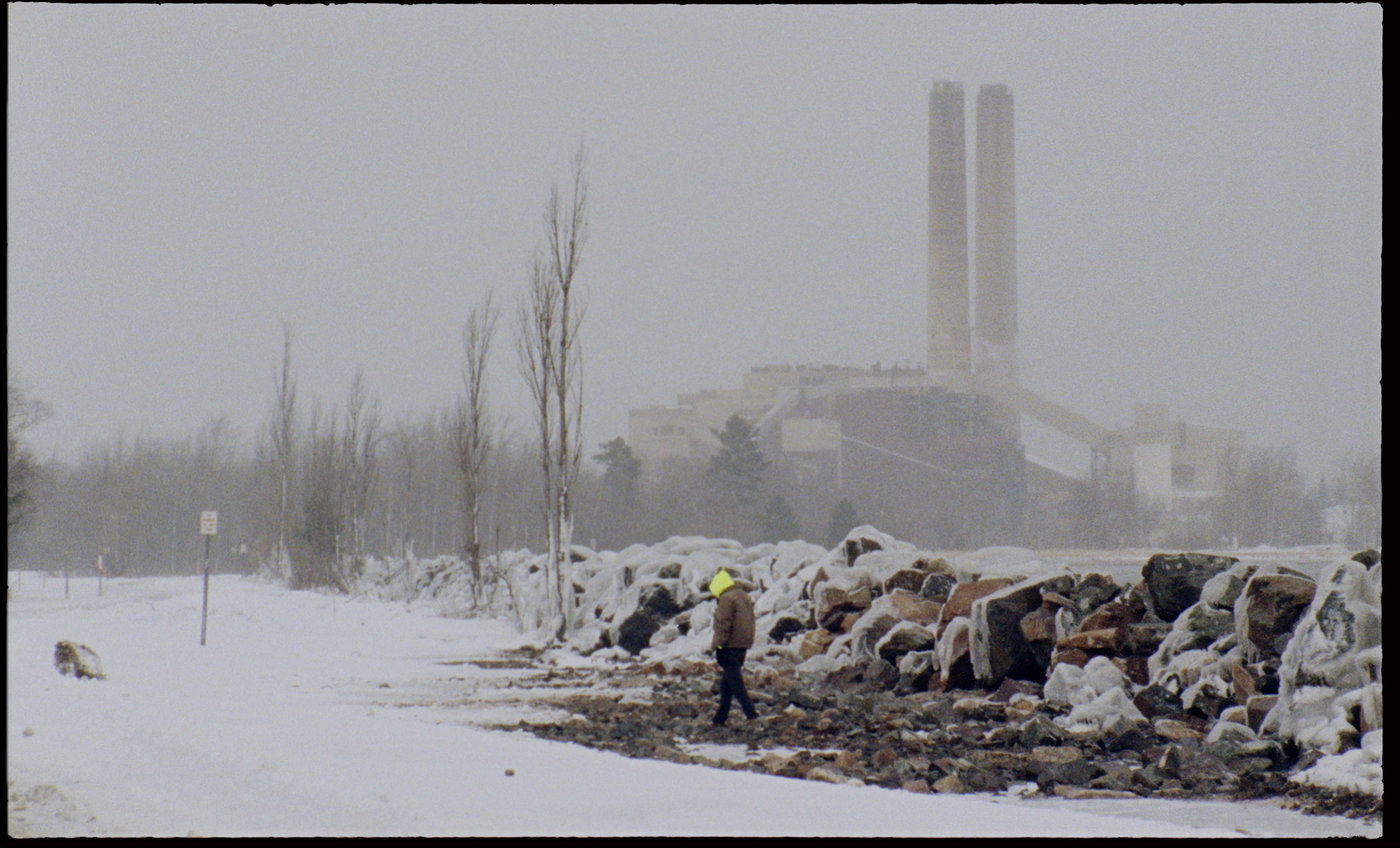
While working on a film in 2016, I found myself heading to a small town with an active coal power plant. I had expected to find a modest smokestack amid old machinery, but was awestruck by what I saw instead: two gigantic cooling towers nestled against a quaint residential community. I watched perplexed as a man shoveled snow out of his driveway, never once casting a glance towards the industrial behemoth that stood a mere 400 meters or so behind him.
The ordinariness of the man quietly shoveling snow outside his home and the gigantic, incongruous structure that billowed behind him left me stunned. My brain struggled to reconcile the two, and I immediately began to develop a series of wide-ranging questions relating to the man, other frontline communities, ecology, and the anthropocene. This encounter with the sublime was the starting point for “Generations.”
Industry is such an integral part of the United States, but we rarely perceive it as an element in our local space or as a presence in our daily life. Many of us tend to experience the source of our power consumption abstractly and at a remove. If we do encounter it, we often experience it at a distance or through sensationalized media. This moment was the opposite of that; it was ordinary and uneventful but astonishing and terrifying at the same time. It felt like a “curtain” had been lifted, revealing something uncanny and unsettling.
I started imagining making scenes like the one I had just experienced. I thought about using a fixed point of view and holding the scene for a long duration to create an open space for the viewer to actively contemplate within. This "format" reminded me of paintings and I started looking at landscape, townscape, and pastoral paintings. Eventually I came across George Inness’s 1856 painting, “The Lackawanna Valley.”
In this painting, Inness depicts a scene at the beginning of the American industrial revolution. He shows a coal-powered steam engine making its way through the hills and trees of the natural world, and through human-altered environments, such as a town in the background, while a lone figure sits in the foreground observing it all. Inness’s depiction of the beginning of industrialization is compositionally balanced and serene, yet critical in a subtle, almost ambiguous way.
This feeling of ambiguity in “The Lackawanna Valley” is noteworthy as it reveals the endless possibilities onto which viewers can project their own narratives and interpretations. Seeing this helped clarify the unobtrusive emotional quality I wanted to convey in my static long shots. I started to see my tableaus as something akin to, but opposite from, the painting. A kind of bookend to Inness’s portrayal of the arrival of industrialization, only now we’ve had 250 years of innovation, “progress,” and human and environmental violations in-between.
Prior to filming, I thought about three different timescales I wanted to include:
The first was to have people existing in their own “real time”— meaning unedited, everyday actions playing out in all their mundanity.
The next was an idea of “industrial” time and how twelve sets of five minutes make up a unit in a clock. I was interested in cutting exactly on the five-minute mark despite whatever action was occurring in front of the lens: five minutes, five minutes, five minutes. To me, this mechanical structure and hard cut mirrored industry’s indifference to the environments and communities surrounding it.
Lastly, I wanted to include several power plants situated on or next to unaltered land or bodies of water, in hopes of evoking a longer geological timescale that would underscore the effects that fossil fuels will carry long into the future.
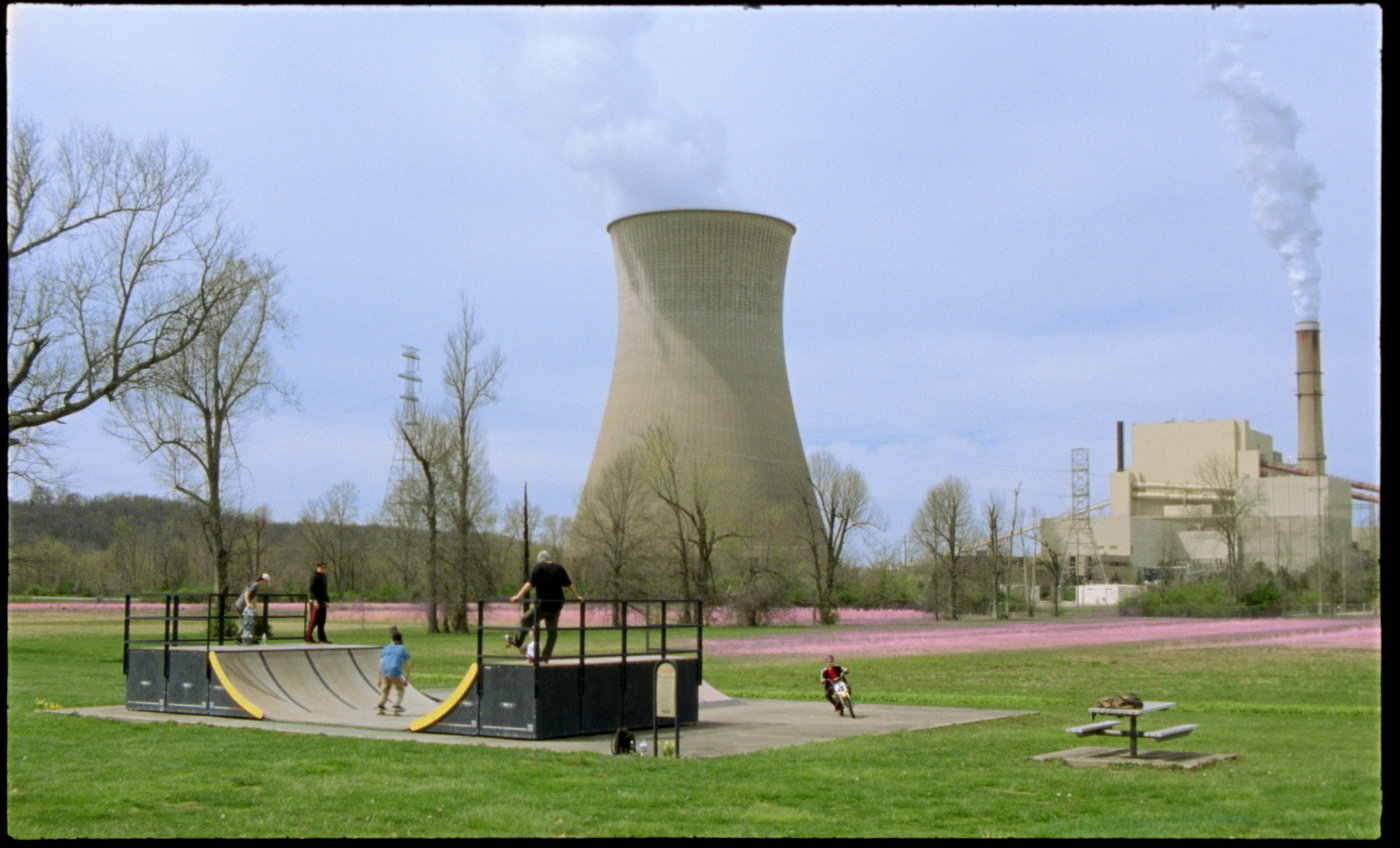
Between 2017 and 2019 I visited around 80 coal power plants throughout the United States and ended up selecting 17 to compose single-shot scenes of (I edited it down to 12 for the film, with a 13th accompanying the credits).
I determined which plants to shoot based on various factors.
For shots containing people, I looked for places where I could flatten the foreground and background into the same focal plane as much as possible, to heighten the close relationship between people and generating stations. I often worked with community members to stage scenes, sometimes asking them to become “figures in the landscape” themselves. Other times, I was able to set up and let things unfold in front of the lens naturally.
For scenes without people, I selected plants based on their polluting records and history. For example, I filmed the TVA Kingston Fossil Plant in Tennessee, the site of the largest coal ash spill in the US, regarded as one of the country’s worst industrial accidents.
I filmed in various regions throughout different seasons, as I wanted to not only create diversity visually, but also convey the continuous and far-reaching integration that coal power has in America. Yet ironically, because of climate change, weather patterns have become so erratic that the usual visual markers of seasons (ie. spring blossoms, fall foliage) were unpredictable. This made planning difficult, and, because my funds were limited, when I traveled to film for a specific season, I had to shoot regardless of if there were any visual indications of the season or not. I couldn’t afford to leave and return.
This challenge eventually led me to take liberties in how I colored the film. Working with my colorist, we “painted” spring flowers in the skateboarding scene in Ohio. We changed green leaves to red in another. Making these choices helped me further connect the work back to the inspiration of painting.
Back when I was beginning to conceive of this film, Obama was in office and scores of coal power plants were set to close, as they couldn’t afford to meet new EPA regulations. Accordingly, plants that had set decommission dates also became priorities in my shooting selection as I wanted to document and bear witness to these generating stations whose carbon emissions would nonetheless continue to impact the climate long after they closed. But, as I started shooting, Trump was elected and things changed. With the dismantling of Obama-era regulations, many decommission dates shifted or altogether disappeared and a new layer of uncertainty was added to the project.
The horizon line, which in classical landscape painting often symbolizes the infinite possibilities that lay before humankind, is now broken, punctuated by these generating stations. As I filmed, I wondered—will these power stations become relics of the past, or will they remain as they are—actively contributing to the forces that hurtle us closer towards total ecological collapse?