Unexpected Things Can Happen: Making Grand Theft Hamlet
Matt Turner
Exploring questions of community and creativity in the vast open world of Grand Theft Auto Online, Matt Turner talks to writer-directors Pinny Grylls and Sam Crane about the making of their singular documentary Grand Theft Hamlet.
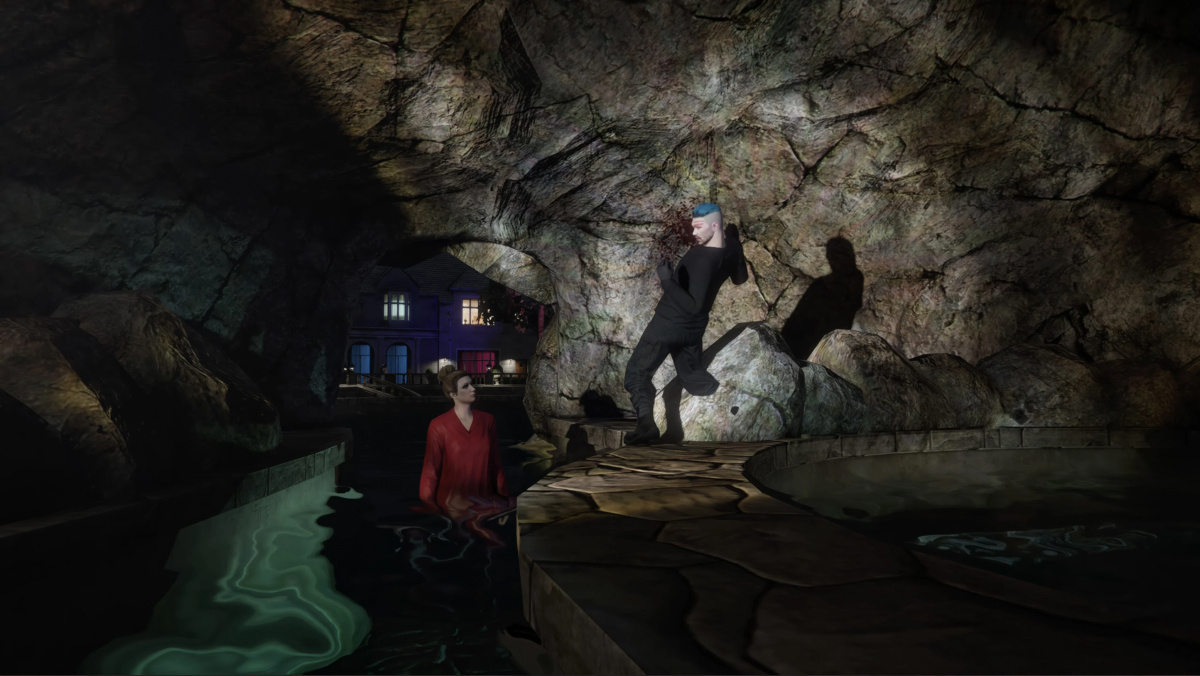
Artists identify opportunities where others see problems. At the onset of the COVID‑19 pandemic, actor Sam Crane and documentary filmmaker Pinny Grylls found themselves unable to conduct their work. Instead of lamenting their misfortune, the married couple found a creative solution: codirecting a feature documentary that details their staging of a theatrical production of Hamlet within the online version of the 2013 video game Grand Theft Auto V (GTA). Shot entirely within the game’s engine, Grand Theft Hamlet (2024) reveals how Crane, working with his friend and fellow out-of-work actor Mark Oosterveen, embraced the challenges posed by attempting to stage a Shakespeare play inside a violent virtual world.
What might seem, on the surface, to be incompatible with the source material proves to be unexpectedly fitting. Imaginative, irreverent, and moving, the film goes behind the scenes of an innovative theatrical production, following the project from its tentative conception through to the impressive execution of the final in-game performance. All the while, Crane and Grylls slowly sketch a relatable portrait of professional anxiety and existential malaise at the height of the pandemic, demonstrating that valuable creative collaborations can be forged despite the barriers of distance and difference. In this interview, the filmmakers explain the conditions and thinking from which this project emerged, while also unpacking some of the challenges that present themselves when making creative work within online spaces.
Grand Theft Hamlet (Pinny Grylls and Sam Crane, 2024)
MUBI: I’m curious about the genesis of the project. I get the sense from watching the film that it evolved quite a lot through the process of development and production.
PINNY GRYLLS: The background of it was the pandemic. Sam was about to be doing one of the biggest jobs of his life playing Harry Potter in Harry Potter and the Cursed Child [2016–]. We thought, this is great, he’s got a year’s contract doing this West End show. Then the theaters closed in March 2020. And I’m a documentary filmmaker, so I’m very much out there with real people making films.
SAM CRANE: As with lots of people at that time, we were trying to think, Well, what is there in the digital world that we can use to find some kind of equivalence here? People tried to do live performances and filmmaking projects on Zoom, and I think there were a couple of examples that were interesting, but for the most part it was such a limited, frustrating platform to be on.
GRYLLS: Our kids were being homeschooled, and they were spending a lot of time online––literally ten hours a day. They were ten and twelve years old, and we asked them what they were watching on YouTube and what games were they playing. For the first time, we were really asking them about their online worlds.
CRANE: Our son was watching Dream, who is this big YouTuber. He makes a lot of stuff in Minecraft [2011] and he had this thing called the Dream SMP, which was his multiplayer server. Attached to this was a kind of ongoing fictional storytelling project inside the game––like a soap opera but live streamed. He was in the game with other YouTubers and they would have this ongoing drama that people got really invested in. I didn’t really have a conception of what online video games were, or how they could be used for live storytelling. So that was what opened up my mind to those possibilities. And then I discovered that there’s a whole world of roleplaying inside online video games, and that one of the big places people do it is GTA. I watched a lot of videos of that, and then I thought, I might as well start playing this. Why not? I’ve got time. I got in touch with Mark, a friend of mine who is a big gamer, and an actor. I thought that maybe we could do something interesting in GTA. And so we started just hanging out in the game.
When I started playing GTA, I thought it was really fun but also more sophisticated than I had imagined it would be. GTA is a cultural phenomenon. It’s played by millions of people, but it’s known by millions more who haven’t played it but have an idea of what it is. It has a notoriety as this violent, terrible world that’s destroying our kids’ lives. When I started playing, I was like, okay, it is really violent, but it’s also fun, beautiful, and satirical. It’s an exciting place to be.
Grand Theft Hamlet (Pinny Grylls and Sam Crane, 2024)
GRYLLS: And then you found this theater inside the game and you started doing experiments.
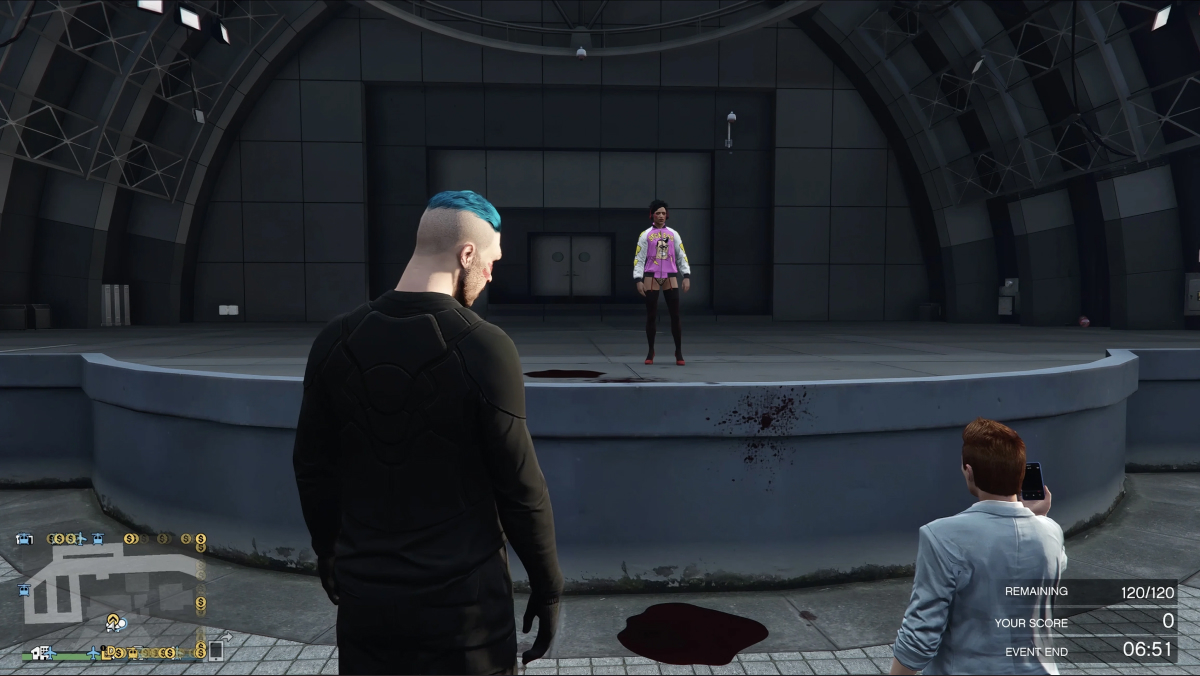
CRANE: That there was actually a theater space in GTA was a real “fucking hell” moment. So, I thought, why don’t we try and do a play? This would be really fun. We practiced it a few times, and I was initially thinking that we couldn’t do a play in this chaotic world. But then I saw this early machinima film by Eva and Franco Mattes called Freedom [2010] that was made inside Counter-Strike [2000]. It was them going into this online game and saying: “Please don’t shoot us, we’re trying to make this artwork.” And then someone would blow them away. I thought it was funny, dramatic, and quite moving. It had this feeling of not knowing what was going to happen next due to it being staged inside this genuinely live online server.
MUBI: I wanted to ask you about a term that is used in games, “emergent gameplay,” which is when things happen that the developers didn’t necessarily plan for. I think that one of the strengths of Grand Theft Hamlet lies in these unexpected moments that come through encountering people who don’t necessarily follow predictable patterns. How did you work through the unpredictabilities of trying to create something structured within an open multiplayer space?
GRYLLS: I’m a documentary filmmaker with an anthropology background, so I’m really interested in rules, and how when you go into a society or a culture––whether a game space or another country––you have to learn quite quickly what is appropriate and what is not. It’s almost that by pushing the edges of those rules you understand what that world is like. And that’s what emergent gameplay is like. What I quickly realized was that what was going to make things interesting here was poking at the edges of this world.
CRANE: Emergent gameplay, or liveness, connects all the different strands of this project. Obviously, with theater, this liveness is what makes it distinct. You can have a plan, rehearse, and have a script, but the fact it is live means that unexpected things can happen and that is what makes it special. You have this in online games too, because you’re in a live space with other people at the same time, so there is the potential for chaos. Then the other sphere where this is apparent is documentary filmmaking. Again, you have to respond to what is happening in the moment. You can have a plan, or a rough idea of what might happen, but people are never following a script.
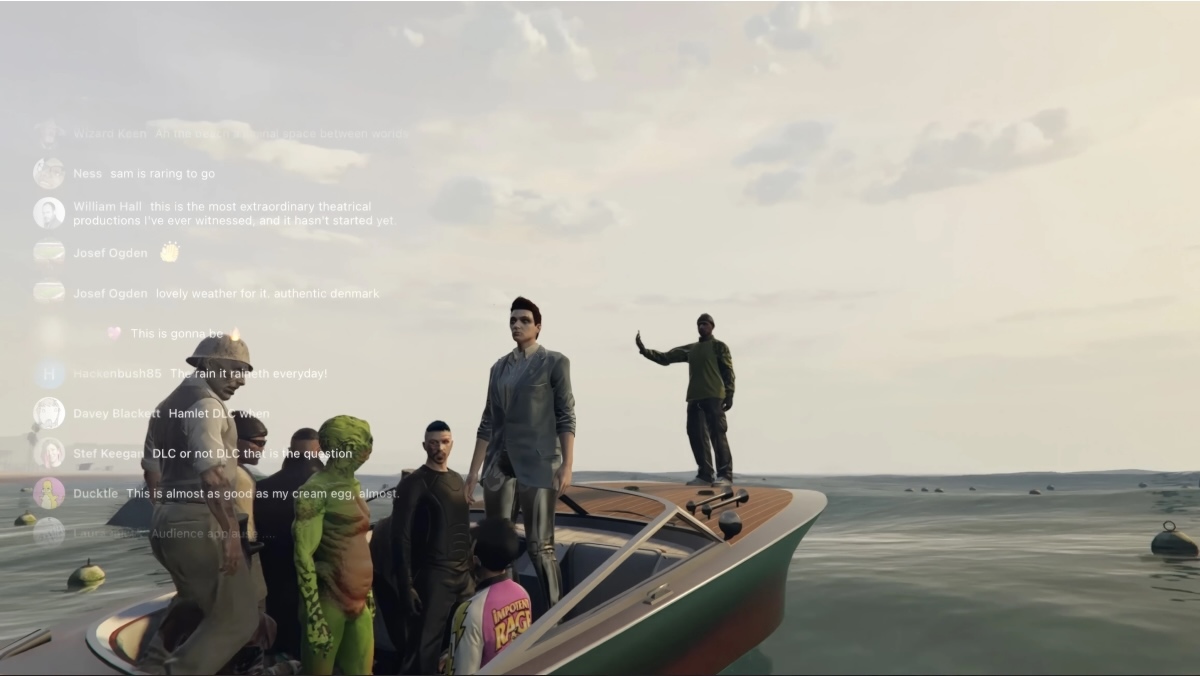
GRYLLS: You’re always going to discover moments that are better than anything you could possibly have written yourself. We decided to hold auditions in the game, and various people turned up. Some of them were professional actors, some were nonprofessional, and some people were just on the server. I think the best moment is when ParTeb Mosmir turns up. He’s the Finnish Tunisian guy who is dressed like an alien. He doesn’t know any Shakespeare, so he decides instead to recite a bit of the Quran. People have said that this was the moment when they realized that they understood what the film was. “How can I be getting emotional about this film that’s made inside a game?” There was something so sincere about this moment––lovely and poetic. And it is also about community, which I think gaming is too.
Grand Theft Hamlet (Pinny Grylls and Sam Crane, 2024)
MUBI: Could you talk about your experiences with online cultures, and how this idea of anonymity and community plays into the story you were structuring?
GRYLLS: As we explored online communities more what we found really touching was the number of people who were from diverse backgrounds. There were lots of teenage boys, of course, but there were also disabled people, neurodivergent people, and transgender people. One character, Nora, is going through a gender transition and is only nineteen. It’s fascinating that people actually find these game spaces really comfortable. You might think that GTAwould be an aggressive space, because it’s a game where everyone is shooting each other, but instead people on there are meeting friends, hanging out, and having fun.
MUBI: How did you think about questions of access within the online space?
CRANE: It’s interesting because I think lots of theaters want to work hard to be accessible and find new audiences, but practically it’s difficult because there are always barriers. If you don’t live in a town that has a theater, or if you haven’t grown up in a culture that has theatergoing within its sphere of possibilities, then you’re not going to think you have access. But gaming, whether you like it or not, is massively accessible the world over. There are statistics that suggest that, by a certain stage, half the world’s population will have played a video game. It’s potentially the most accessible kind of media there is.
GRYLLS: Nora said that she had never seen a play before. She’d studied Hamlet at school, but she hadn’t seen it performed live. This was her first experience of seeing theater, but it was inside GTA. I love that.
Grand Theft Hamlet (Pinny Grylls and Sam Crane, 2024)
MUBI: The film does a good job of counteracting that negative stereotype of the gamer as this lazy person who is wasting their time. It shows you that there are many things you can do in a video game.
CRANE: Playing games is a creative act. It’s not a passive form of consumption. You’re pretending to be someone else and creating a story as you go along. And in doing that with other people, you’re creating a community.
MUBI: The film suggests that the game space as an environment for theater isn’t something that is isolated to the pandemic. What else would you like to see explored within games, in terms of cinema or theater? What have you learned that other people might want to know?
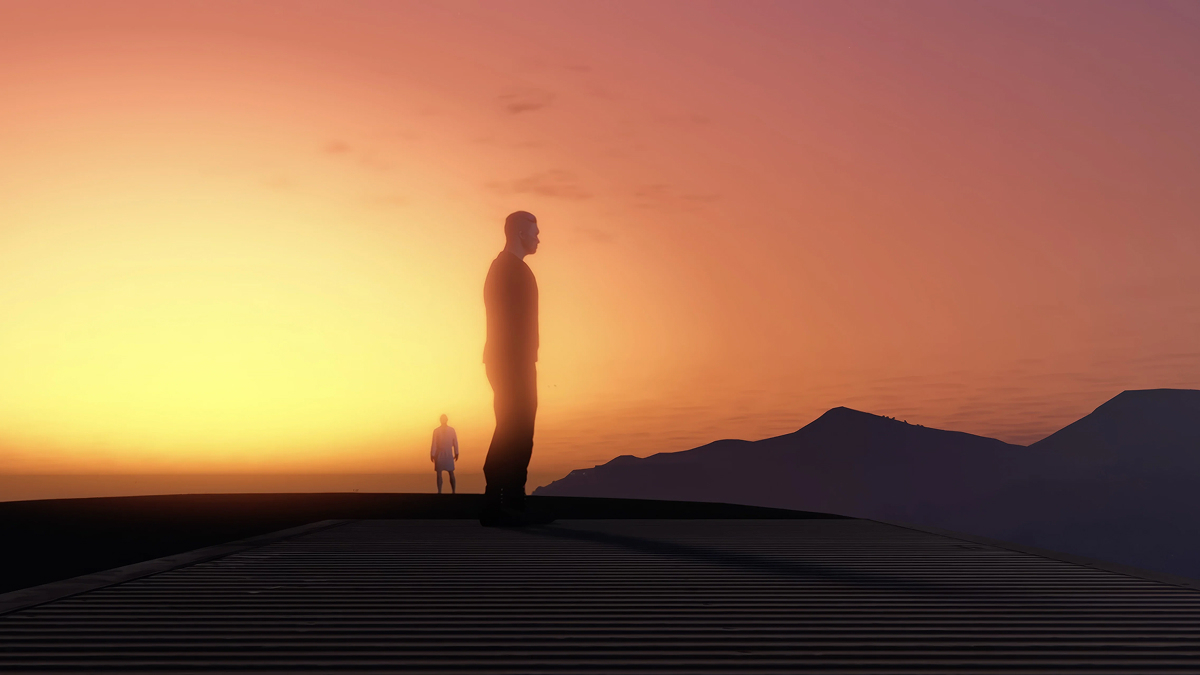
CRANE: It feels like we’re in the foothills of what is possible and what might happen. I think there is going to be a lot more exploration as games and other virtual social spaces develop further. The blurring of boundaries between the digital and the real world will only increase, and that’s exciting to think about.
GRYLLS: We have to learn how to tell stories about our digital lives in a cinematically interesting way. And I think that filmmakers struggle with that. Sometimes they’ll say, “Well, we can’t just make a film with someone on their smartphone the whole time.” These worlds are so important to people in terms of finding community and exploring identity that I do think now, finally––with our film but also with other recent films that have been made––we are collectively starting to up our game.