All of a Sudden (Ryûsuke Hamaguchi, 2026).
At 197 minutes, Ryûsuke Hamaguchi’s latest film, All of a Sudden (2026), is neither the longest nor the most radical of the Japanese director’s dozen-plus features. In fact, its story, about two women of different cultural backgrounds who meet and grow close over the course of a few weeks, is decidedly straightforward and occasionally even sentimental—a far cry from the convoluted, miserabilist narratives that tend to dominate the world of international art cinema. Inspired by When Life Suddenly Takes a Turn: Twenty Letters Between a Philosopher with Terminal Cancer and a Medical Anthropologist, a collection of epistolary nonfiction written by two Japanese intellectuals, All of a Sudden is deceptively complex despite its surface-level linearity; for a filmmaker synonymous with sprawling social mosaics (Happy Hour, 2015) and ambitious literary adaptations (Asako I & II, 2018; the Oscar-winning Drive My Car, 2021), it’s the 47-year-old Hamaguchi’s richest and most direct work to date.
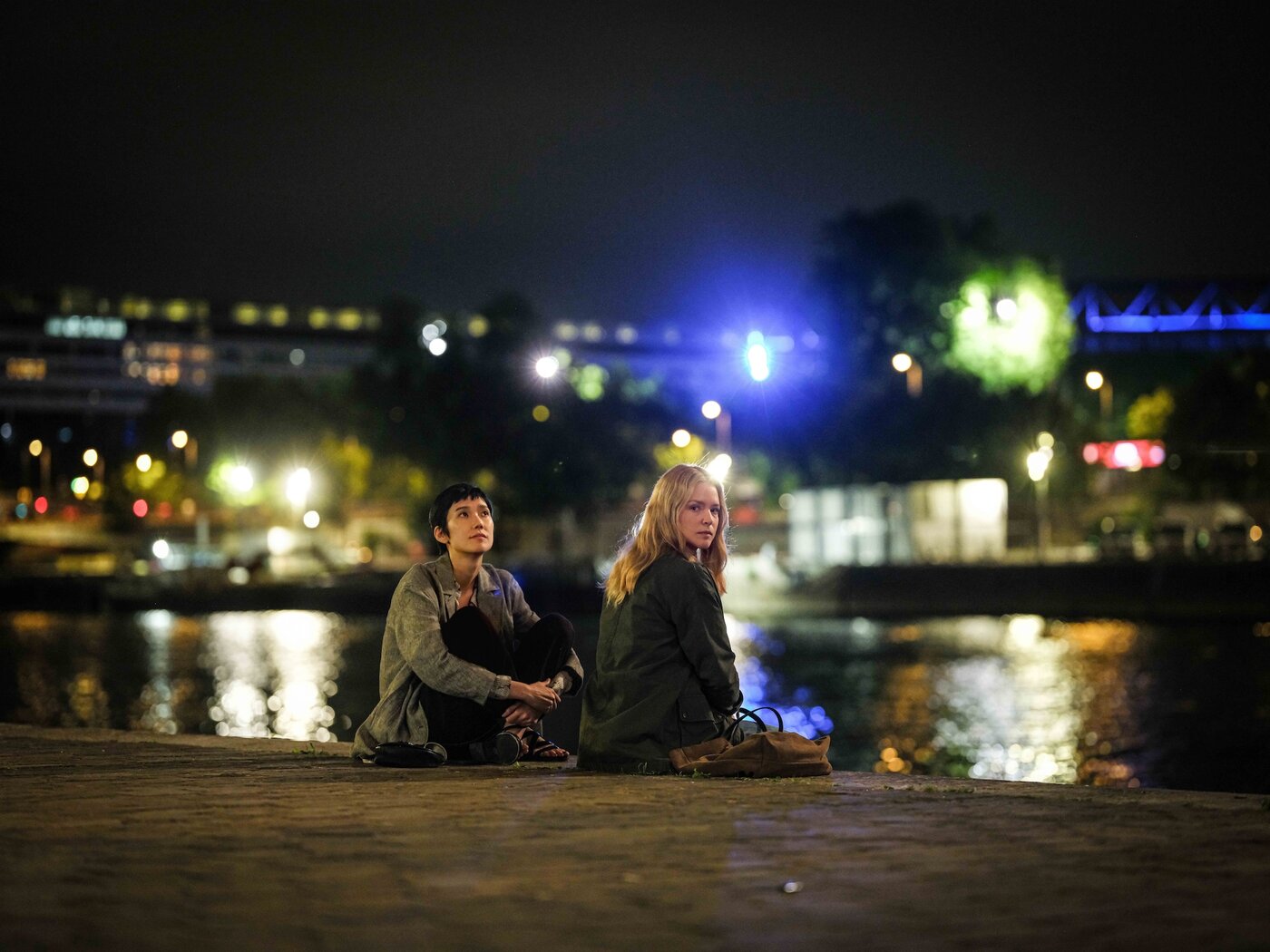
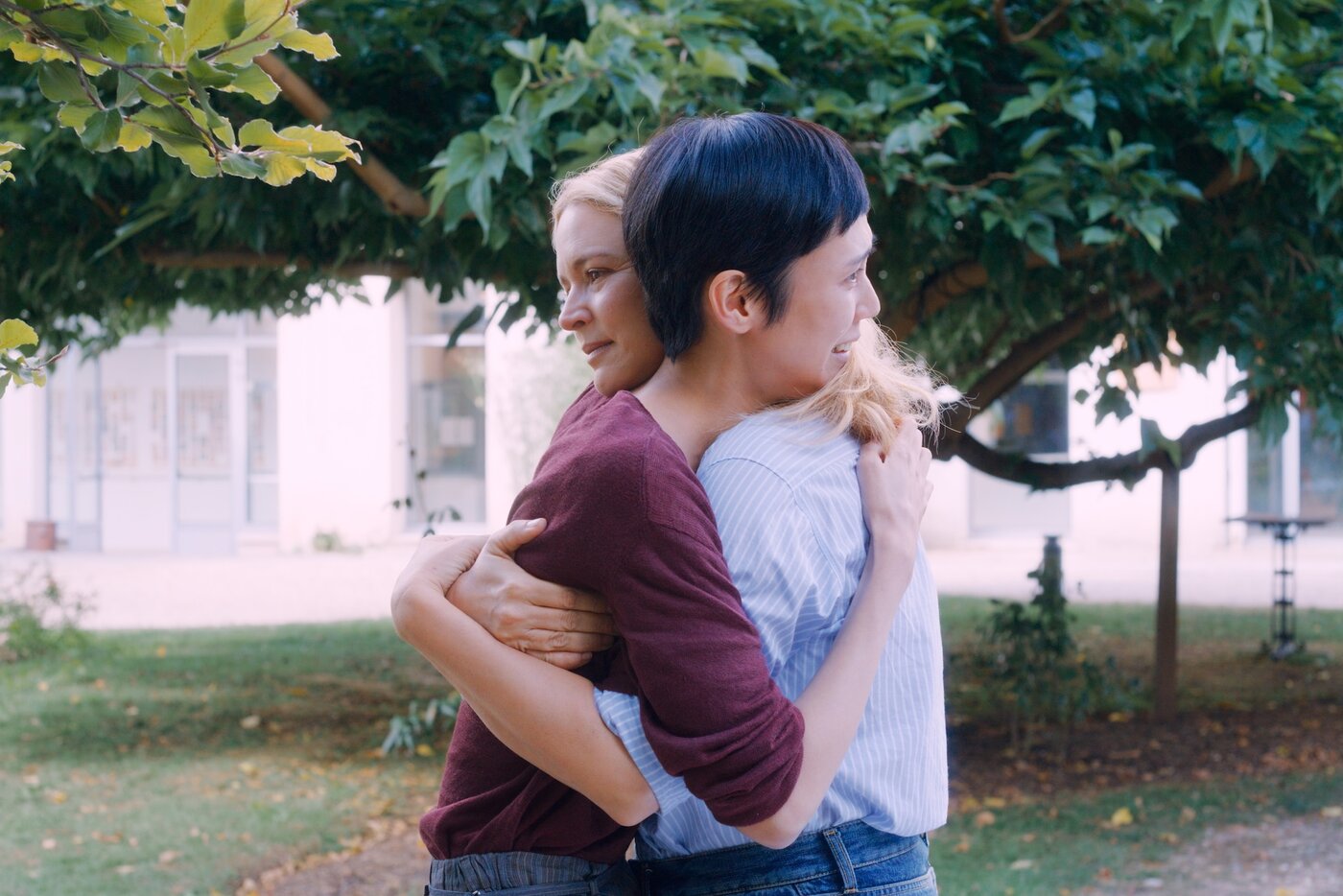
Starring Virginie Efira as Marie-Lou, the director of a nursing home in the Parisian suburbs, Hamaguchi’s first film primarily outside of Japan takes its time setting up the professional dynamic of the care center, which is in the process of implementing a humane treatment technique called “humanitude.” Despite resistance from some of her colleagues, Marie-Lou is committed to this procedure, which grants patients dignity by encouraging them to stand and walk with the help of a staff member. While on the train home from work one day, Marie-Lou crosses paths with Tomoki (Kodai Kurosaki), an autistic Japanese teenager who’s wandered off from his grandfather and caretaker, Gorō (Kyōzō Nagatsuka). When Gorō arrives, he explains to Marie-Lou that he’s in Paris to act in a play and introduces her to the director, Mari (Tao Okamoto), who invites Marie-Lou to attend the next performance. During the Q&A, Mari reveals that she has terminal cancer and Marie-Lou, so moved by the play and the thoughtfulness of the director’s responses, invites Mari for a walk along the Seine and, eventually, to spend an evening at the care center where they discuss, in lengthy scenes shot with unassuming elegance by French cinematographer Alan Guichaoua, their artistic and philosophical beliefs and bond over the beauty and ephemerality of human existence.
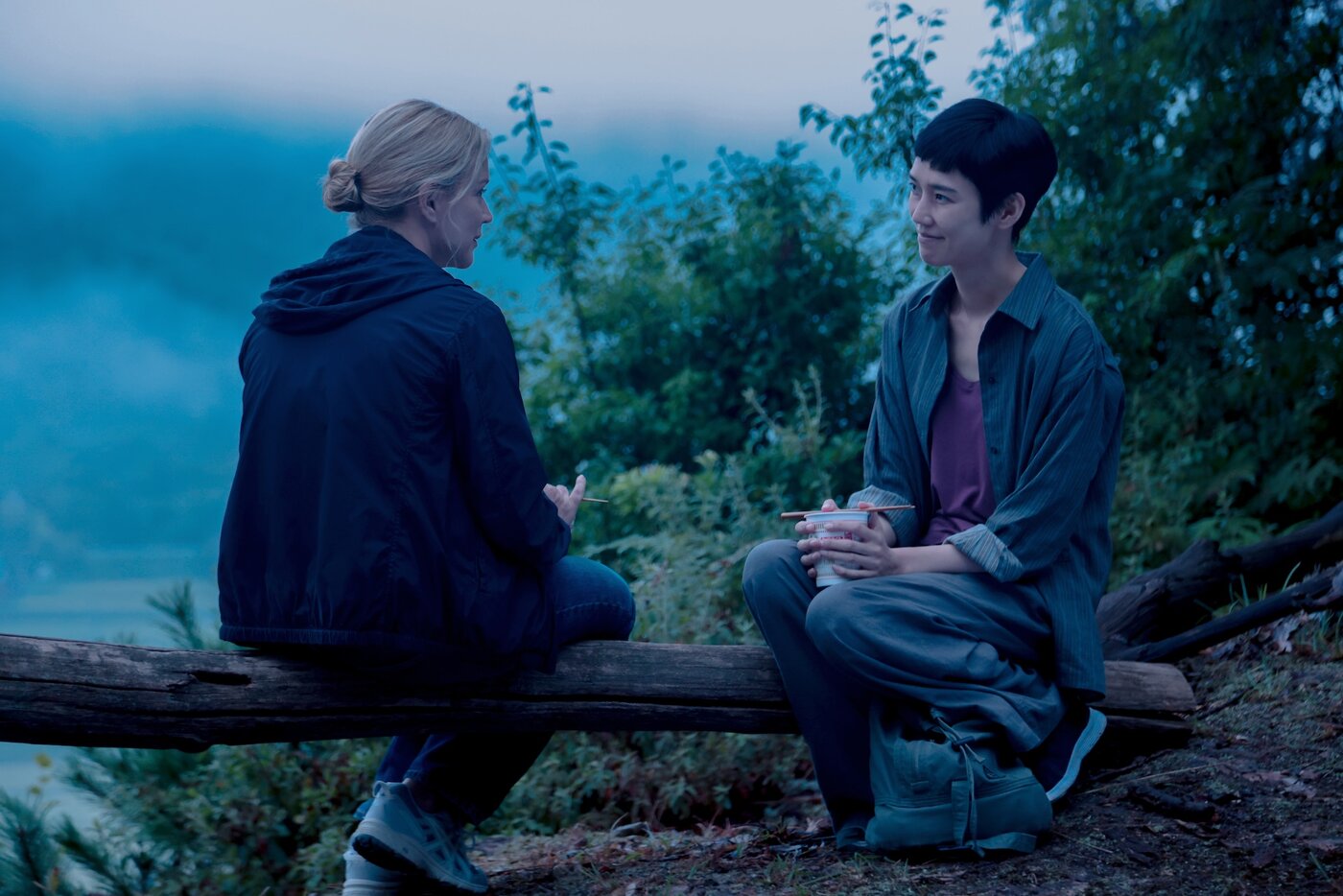
Extensive exposition notwithstanding, All of a Sudden is a film light on incident but also rife with emotion. Hamaguchi, working with co-writer and interpreter Léa Le Dimna, turns the sentiments, rather than the specifics, of the letters comprising the source text (which also hinges on a cancer diagnosis) into intimate, intelligent, and intensely moving dialogue that practically sings with feeling. Punctuated by the occasional date stamp, the narrative, which quietly moves from France to Kyoto and back again without breaking the film’s quasi-realtime feel, deepens the director’s longstanding interest in cinema’s durational possibilities. Here, everything from a précis on late-stage capitalism to a character’s entire existential worldview can be explicated in the time it takes to brew a pot of coffee or let a cup of instant noodles steep in boiling water—to say nothing of the time and space granted to the care facility’s real-life residents, who perform alongside Efira and the rest of the cast with a kind of grace and integrity rarely afforded to the disabled community. In an age when so much arthouse cinema is needlessly cynical and the so-called life-affirming movies of a more mainstream variety are so flagrantly hollow, All of a Sudden is the rare film to leave one feeling hopeful about the state of both the art and the world.
During a recent visit to Los Angeles, Hamaguchi and I met to discuss how he translated the emotion of the source material into a narrative, the depth of cinematic time, and the increasing role that chance has played in the conception and content of his work.
NOTEBOOK: How did you discover the book that the film is based on? From what I understand, it’s composed of letters written between a philosopher and an anthropologist. What about the book felt cinematic to you?
RYÛSUKE HAMAGUCHI: The book came to me through the Japanese producer of the film, Hiroko Matsuda. She gave me the book towards the end of 2020. That was around the time that I was done editing Drive My Car. So I was introduced to this book quite some time ago. The book had come out about a year before I read it, but Hiroko told me how moved she was when she read it and passed it along to me. And once I read it, I was also very moved. In fact, it was the only project that I received during that time—and I was receiving a lot—that really moved me.
Like you say, it’s an exchange of letters between a philosopher, who has cancer, and a medical anthropologist. About halfway through their ten exchanges, the philosopher’s cancer takes a turn for the worse. What I found interesting is that the philosopher’s academic focus is on coincidences, and the medical anthropologist’s focus is on risks. And so in some ways these two themes have a commonality in what they’re dealing with. The conversation between the women is sort of abstract, but as the cancer takes a turn, the exchange becomes more human and emotional. So even though it’s an incredibly emotional experience, it’s not overly sentimental, because the exchange is built on the foundation of something more intellectual. Something about their words felt unlike anything I had read before.
In a general sense, I would say that the original material doesn’t necessarily have anything in it that one might call cinematic. But it did have something that I saw in movies and in cinema, which is emotion. There’s a purity to the emotion in the original material. It was up to me to think about how I could bring that emotion into a film.
NOTEBOOK: It’s interesting to say that. When we spoke several years ago about Drive My Car, you said that adaptation is “about transcribing the emotions you feel when you first read the text.”
HAMAGUCHI: I think what I was doing here is basically the same thing that I did when I was adapting Drive My Car. With that film, the ultimate form became very different from the original short story. I was including different elements from other short stories within the collection that the film is based on and essentially built a different world from what the original material is doing. It was really about visualizing the emotion that’s there. Again, with this film, that was sort of my main focus: to think about how to visualize the emotions that are felt through the original material.
I would say that 99 percent of the words in All of Sudden are words I wrote for the script—not words that are drawn from the source material. What I was really trying to do is to think through ideas of coincidence and risk and about how people act and react to experiencing certain coincidences and how to then transplant this emotion into the film.
All of a Sudden (Ryûsuke Hamaguchi, 2026).
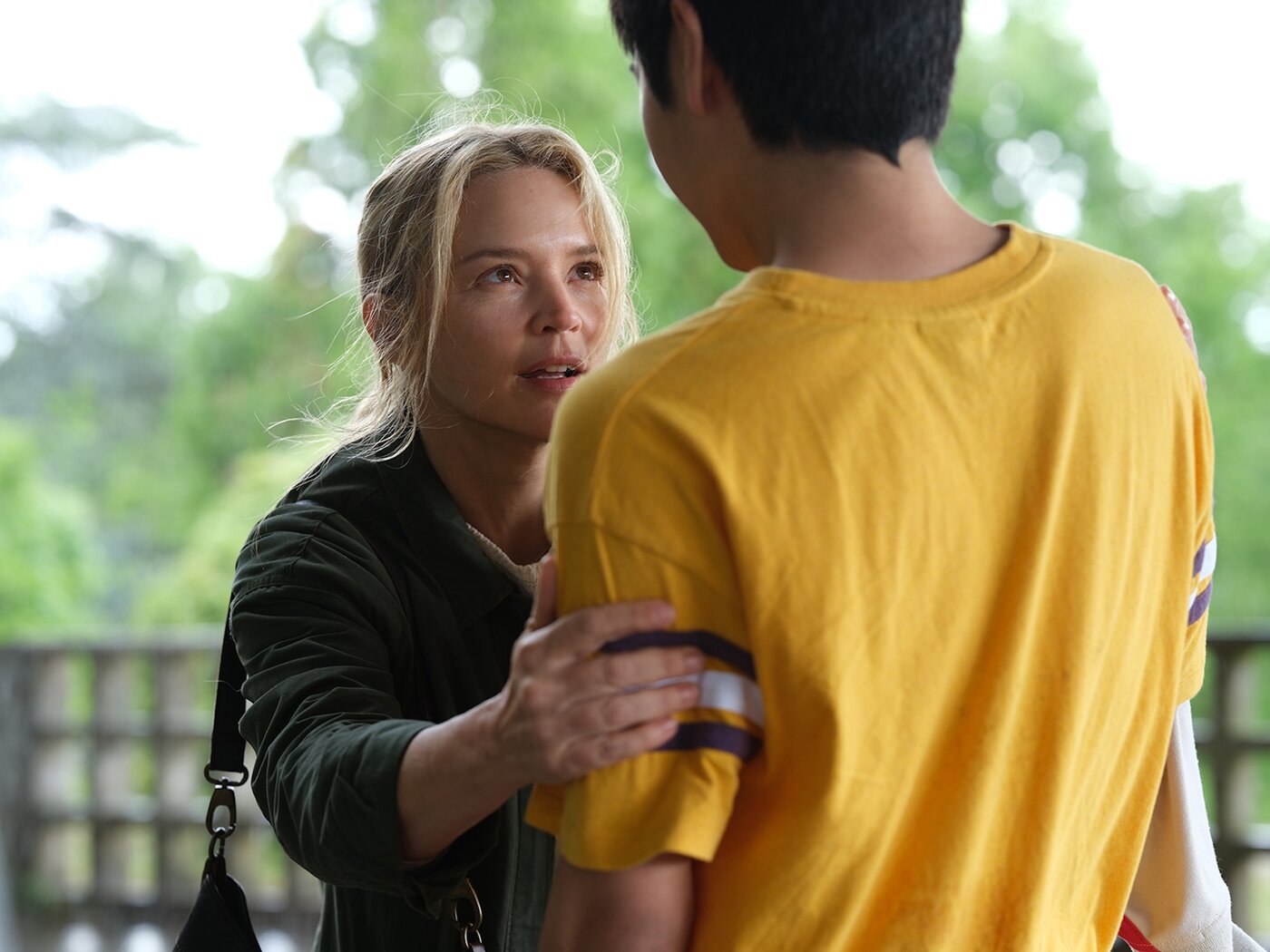
NOTEBOOK: While rewatching All of a Sudden, I thought about this motif of chance, or coincidence, in your work. It’s a major theme in Asako I & II and Wheel of Fortune and Fantasy [2021], but it’s also present in this film when Virginie Efira’s character encounters the teenage Tomoki—it’s purely happenstance. Is this idea something that connects the recent films for you?
HAMAGUCHI: Coincidence is something that has increasingly become important to me throughout my filmmaking. I would say one influence for me are the films of Éric Rohmer. I feel like the way he handles chance and coincidence is something that has influenced how I approach directing. I’ve started to think more and more about how to include coincidences into my stories. Because ultimately life as we live it is full of coincidences and chance occurrences. But once you put these things into a fictitious world, they can start to feel unbelievable or conveniently placed. So I began trying to work through those complications with Asako I & II and Wheel of Fortune and Fantasy.
In considering the nature of coincidences, I read this book called The Problem of Contingency by Shūzō Kuki, who’s a Japanese philosopher. This book is actually a very difficult read. However, Makiko Miyano, who is the philosopher of the book that I’m adapting for this film—her PhD dissertation was actually on Kuki’s book. And while the source material for All of a Sudden talks through some of Kuki’s ideas in a more understandable way, it was Miyano’s dissertation, which was published after her death, that became a really nice guide for me to understand what was going on in The Problem of Contingency. It helped me get a more philosophical and almost abstract understanding of what coincidences might be. And so in some ways there’s also an element of chance between Kuki’s book and Miyano’s dissertation and how I came to both of them.
NOTEBOOK: Was the film always conceived as being set between Paris and Kyoto, or was this a byproduct of the project being an international co-production?
HAMAGUCHI: It’s really sort of a chain or sequence of coincidences that led to how it ended up being set between France and Japan. Again, as I said, the original material didn’t really have a lot of visual elements to work with. It’s an abstract exchange of ideas in a lot of ways. I really didn’t know how I was going to visualize and adapt this into a film. So I interviewed Maho Isono, the co-writer of the book, who’s still alive. And I also talked to the family of the philosopher who passed away, as well as some of her friends. But again, what I was really interested in was turning the emotions into a film. It was through the research process that I realized I wasn’t really looking to depict the backgrounds of these people.
At that point, about two years had already passed since I started thinking through this project. And it was around this time that Cinefrance, which is the French production company we ended up working with, reached out and said they were interested in working with me. That was when something clicked for me. It made me realize that, okay, in Japan, if we were to keep these philosophical and abstract conversations somewhat intact for the film, it isn’t going to draw an audience—and therefore, the budget is going to be limited. A limited budget, of course, means there’s going to be an issue with the quality of the work that I’d eventually be able to do. But I also felt I wouldn’t be able to realize the kind of labor conditions that I wanted to make sure I had on the production. It was once this French element came into play that I realized, well, France has this tradition of having conversational cinema, of films built around philosophical conversations, and I felt that in the French context, a film like this can have commercial viability, and that the producers would still be able to bring a certain amount of budget to the film. So I had the Japanese and French producers meet, and through that we arrived at the idea of having two protagonists, one French and one Japanese.
Once that was decided, I needed to figure out what element could connect these two contexts. I was already interested in this care technique called humanitude that appears in the film. This was a technique that was born in France but was starting to be introduced to Japan about fifteen years ago. So I thought this could be a good connector between the two contexts and, through that, I decided the French protagonist would be a care facility director in France. As for the Japanese character, it happens that Makiko Miyano, the philosopher, directed theater at Kyoto University. Miyano was from Wakayama, which is somewhat close to Kyoto but still a quite different part of Japan, but I figured that this connection to Kyoto was enough to set this part of the film there.
All of a Sudden (Ryûsuke Hamaguchi, 2026).
NOTEBOOK: You’ve mentioned in the past that you don’t have a huge interest in theater, and yet theater keeps popping up in your films.
HAMAGUCHI: In my early versions of the script I had a care worker from Japan go to France to learn about humanitude. With that in mind, I actually went to France to visit various care facilities, and I came upon one in particular that became an inspiration for this film. This facility was in the process of implementing humanitude and was facing different kinds of issues related to the transition. As in the film, they had a female care director and a male associate director, and there was a sort of conflict between their ideals.
By that point, I knew that I was going to set this film in a care facility, but I still needed to think more about why this Japanese person was in France. I knew about Makiko Miyano’s relationship with theater, but I was sort of trying to ignore that for a while. Because I had already dealt with a theater piece in Drive My Car, I was somewhat resistant to incorporating theater again in this film. But once I really started to consider the possibility of this character being a theater director, it became an easy path into thinking about why this person would come to France if they were an internationally known and touring theater director. It felt like things could develop smoothly by having that kind of plot setup.
In adapting the book, I was looking for different kinds of movements. For example, humanitude: Because of the way the technique works, it has a lot of movement. There’s a sort of choreography that is inherent to the technique. So by having theater involved, through workshops or through the theater piece itself, I felt I could create a sort of movement within the story.
All of a Sudden (Ryûsuke Hamaguchi, 2026).
NOTEBOOK: Was it difficult adapting your working method with actors to a French context? I know that Virginie Efira learned Japanese for the film, but from what I understand, some of the people in the care facility are real residents. Did you have to alter your approach at all when working with either the French actors or the non-professional performers?
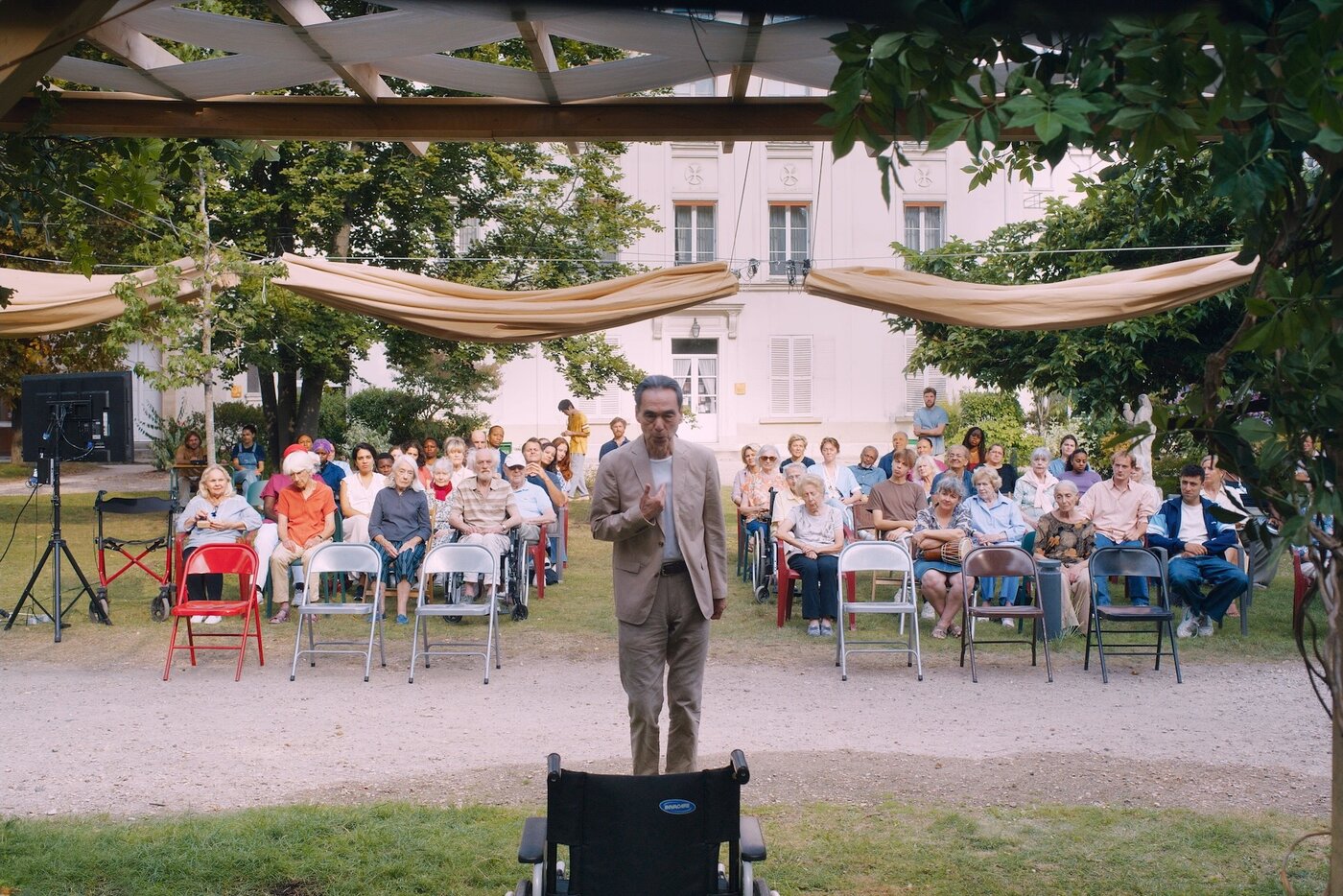
HAMAGUCHI: Well, I should say that most of the roles in the film—or at least all the ones that have dialogue—were played by professional actors. The only non-professional actors were extras, and those were some of the staff and residents of the care facility where we shot. But the residents who did participate were all people who were able to give consent to appear in the film, meaning people who didn’t have problems with communication.
In terms of depicting people with autism or with dementia, we really needed the time to be able to research and understand the movements to really build out those characters. We did a lot of that research in Japan; for about six months before moving the production to France, we worked to create and put together the movements for these scenes, as well as the choreography for the theater piece.
Before we moved to France, I had said to both the French production team and the casting director that I’m somebody who likes to take time to rehearse with the actors. And so in that sense, there was a lot of labor involved. But because there was already an understanding among everybody, it was a very smooth process. Once we started working, we did a lot of rote, non-emotional readings of the script. And, as I usually do, I also gave texts—which I call subtexts—to the actors that contained a historical understanding of the characters’ backgrounds and the life they’ve lived thus far. For Virginie and Tao, that included taking lessons in the language as well. Because of all this preparation, once we embarked on actually shooting, the process went quite well. I remember the French team telling me how they’ve never prepped so much ahead of a shoot. But, to be honest, in Japan it’s not often the case that you get to prep so much either. So in that sense I was able to work at a very leisurely pace, which was ultimately good because it allowed the actors time to build relationships and discover something new by spending extra time with each other. I found many of the actors coming up to me to say thank you for giving them that extra time.
NOTEBOOK: Speaking of time, can you talk about how you depict duration in the film? Even more than in some of your prior films, you seem to be really drawing attention to the idea of duration here, specifically in the quasi-realtime scenes of the coffee and noodles being made.
HAMAGUCHI: These are ideas I’ve long thought about, but time actually gets discussed in the original material in the book. Before the two women started writing these letters, they only really knew of each other—they didn’t have a deep relationship. These ten back-and-forth exchanges occurred over the course of just two months. And yet through this short amount of time they were able to express their relationship as a kind sharing of their souls. As you read, you actually wonder how they were able to deepen their relationship so much; it becomes sort of a mystery to them as well.
In the book, they talk about how time is not just something that happens linearly or horizontally, but as something that can have depth as well. And that depth in time is something that goes beyond time as seen on a clock. That’s also something I feel through my own experience: that the way time works when I’m on set is very different from the quality of time I feel in everyday life. And I think that’s also true about cinematic time. Of course, I’ve made films that are three hours and five hours long, and yet I’ve had audience members come up to me and say, “I didn’t feel the time pass.” Not everybody feels that way, but I still do understand what that feeling is like. And I often wonder what it is that allows for that sensation to happen.
For example, with the two moments you mentioned, of making coffee or noodles, I did that to build a certain kind of tension through time. But I’m also trying to show that even in the short amount of time it takes to make coffee, you can actually have a discussion about the construction of the world. Or that in the short time that it takes to make cup noodles, you can actually talk about life and death. I wanted to really express and heighten that sensation. Ultimately, I think the way that time flows, if people are able to feel this kind of depth through the three hours of my film, it’s a result of the camera and mic having recorded the depth that happened on set. Because three hours is actually a short amount of time when you think about it in relation to experiencing a depth of feeling. So even if time is not something I can control, if I am able to somehow get to a place where we feel we’re entering a deepened sense of time, I think that can actually be translated to an audience who is watching what was recorded in that moment.
All of a Sudden (Ryûsuke Hamaguchi, 2026).
NOTEBOOK: One of the most unique things about All of a Sudden is how optimistic it is, both in the context of contemporary international art cinema, which tends to be quite bleak, and in your own recent filmography, with your previous feature, Evil Does Not Exist [2023], being especially dark. How intentional was it for you to make something so hopeful in light of the current state of the world?
HAMAGUCHI: I would say that there’s three broad elements to consider in response to that question. The first part concerns the original material I was working with. The book is headed towards death in the way it progresses. However, it’s really so much about living; it’s thoroughly about living. I knew that I wanted to stay true to that. Throughout the women’s exchange, they never forget their sense of humor. And until the very end of Makiko Miyano’s life, you really see that she has this full will to live. I wanted to make sure to keep that intact in the film. I think once you commit to that, it just naturally connects to a certain kind of hope.
Second, I think the reason I was able to feel this way is because I made Evil Does Not Exist. I made that film after Drive My Car, and even though the story itself may be dark, the remote setting and small-scale production itself was really refreshing. It was a real cleansing feeling to be able to do something like Evil Does Not Exist.
The third part is John Cassavetes, who I was thinking about a lot when I was making this film. Hiroko Matsuda, my Japanese producer who I mentioned earlier, was the editor of a legendary film magazine called SWITCH in the late 1980s and early ’90s, when she was in her twenties. It was through an issue of the magazine dedicated to Cassavetes that his work was introduced to Japanese cinephiles, and after that issue, a lot of theaters in Japan started to show his films. She really started that flow in Japan. So here’s this legendary person I knew about, who I also felt indebted to in a way, who I always wanted to work with—and she happened to now be a producer!
Cassavetes is somebody who really changed my life and made me realize what filmmaking can be. His work encouraged me to commit my life to filmmaking. His films depict a lot of turmoil or hardship, and yet they’re always full of life—they brim with life. And so in thinking about finally working with Hiroko, I felt that I wanted to keep intact this sense of liveliness and a will to live.