
Never Sleep Again (Pia Frankenberg, 1992).
After years of hand-wringing about the state of the romantic comedy, a slate of winking takes on the genre dominated screens this summer. Movies like Materialists, Splitsville, and Together, as well as Lena Dunham’s Netflix series Too Much have asked: What is romance right now? Can we have it? It’s hardly the first time those questions have been asked. Viewers of a certain disposition might immediately think of Elaine May’s debut A New Leaf (1971), a winning send-up of the genre. Much lesser known—which is saying something, given May’s relative obscurity until recent years—is the work of writer, director, and actress Pia Frankenberg, the subject of a retrospective at the Institute of Contemporary Art in London. Working in Germany in the 1980s and early ’90s, during the golden age of romantic comedies in Hollywood, Frankenberg saw that the absurdity of the genre rested in the devil’s bargain it offered women: your freedom for security. Ha, ha.
The pressure women feel to weigh that bargain plagues every one of Frankenberg’s female protagonists. They want to have secure futures, but just as much, they want their lives to follow the unpredictable patterns of their desires and whims. A woman wants to be a respected film director who can speak fluently in the technical lexicon of her field, but she also wants to marry rich; a woman wants to give full reign to her sexual desires, sleeping with as many men as often as she likes, but she also wants her ex to want her back; a woman has a secure domestic life, husband, child, house and all—but every now and again a “tingling” in her scalp will compel her to “do something physical,” like jump into the river Spree.
Though this thematic concern would seem to indicate a feminist slant, Frankenberg—like other great feminist auteurs before her—holds the label at arm’s length. As if to nip that discussion in the bud, in the first five minutes of her first feature, Ain’t Nothin’ without You (1985), she telegraphs her ambivalence. The protagonist, Martha (played by Frankenberg in one of two starring roles in her small filmography), a filmmaker living in Hamburg, says that while others may identify a “feminist aesthetics” in her films, she doesn’t give it much thought: “Things like that really have a crippling effect on me from the start.” Martha is being interviewed by Ilona, whose line of inquiry mirrors the kind of thinking one might find between the pages of the (real) German journal Frauen und Film (“Women and Cinema”), a copy of which Ilona flips through in the film’s closing sequence. The viewer is duly warned: Check your theories at the door.
Despite the headiness suggested by that opening, Frankenberg’s first two films—Burning Beds followed in 1988—are mostly comic, punctuated by slapstick gags. In Ain’t Nothin’ without You, the most joke-forward of her films, Martha and her suitor, Alfred (Klaus Bueb), meet when they crash into each other on a frozen lake. In Burning Beds, Gina (Frankenberg) faints at the feet of the unwitting Englishman Harry (punk musician Ian Dury), then passes him off as her husband in order to secure the lease for a Hamburg apartment. Her plan goes awry when Harry stays on, becoming first her roommate and then—after a series of misunderstandings, arguments, and problems—her lover.


Burning Beds (Pia Frankenberg, 1988).
In true anti-rom-com spirit, Frankenberg’s first two films skip the early, honeymoon days of coupledom and dive straight into disillusionment. Gina looks for a new apartment because she has just left her boyfriend, spooked by his encroaching pressure to marry. She doesn’t want to be a wife: She wants to live for herself. In contrast, Martha and Alfred’s relationship can’t work because Martha is looking for the kind of security to which Gina refuses to submit. Martha laments the advantage of her class privilege, but she intends to maintain it. Alfred “lacks the most important qualification,” she tells a friend—he doesn’t have money. For both Martha and Gina, entering coupledom means compromise. Either you sacrifice security for love, or you sacrifice love for security.
In the 1980s, much was made of women’s frustration with that tension, which the feminist ’70s had failed to resolve. While negotiating disparate spheres of life—the personal, the professional, the political—is especially charged for women, it is incumbent upon any adult. Frankenberg nods to the resulting heartbreak and humor through Harry’s crumbling marriage to Elaine (a wonderfully funny and angry Frances Tomelty). Harry is a percussionist and a loveable eccentric, but also a pyromaniac manchild who spends most of his time tinkering with homemade explosives. By the time their adorable daughter, Cathy, sets off his “one and only Japanese firework ball,” Elaine is already at the end of her rope. She wants a divorce.
Without making further arrangements, Harry sets off for Hamburg. Toward the end of the film, Elaine finds him there to demand what she’s due: a settlement. Maybe the most self-determined woman in Frankenberg’s filmography, Elaine dedicates herself to preserving what’s best for her and her children with unsentimental practicality. For Martha of Ain’t Nothin’ without You, by contrast, family life is one consideration she weighs among others. Martha’s relationship with her toddler, Jonathan, figures only thinly in her day-to-day life; even as she expresses her need for financial security, she seems not to be thinking of her son. Mostly, she leaves him under the care of Teresa, a Portuguese social worker with whom she shares a house. By keeping Jonathan in the background, Frankenberg makes a statement about a mother’s right to have a life outside of her children. But Martha’s reliance on Teresa also kickstarts the immigration subplot that runs in parallel to Martha and Alfred’s misadventures. While the two of them get together, break apart, and get together again, Teresa spends her days tending to marriages facing much more perilous problems. A Senhor Santos, for example, is stranded in Germany with no way of getting his wife and kids over from Portugal.

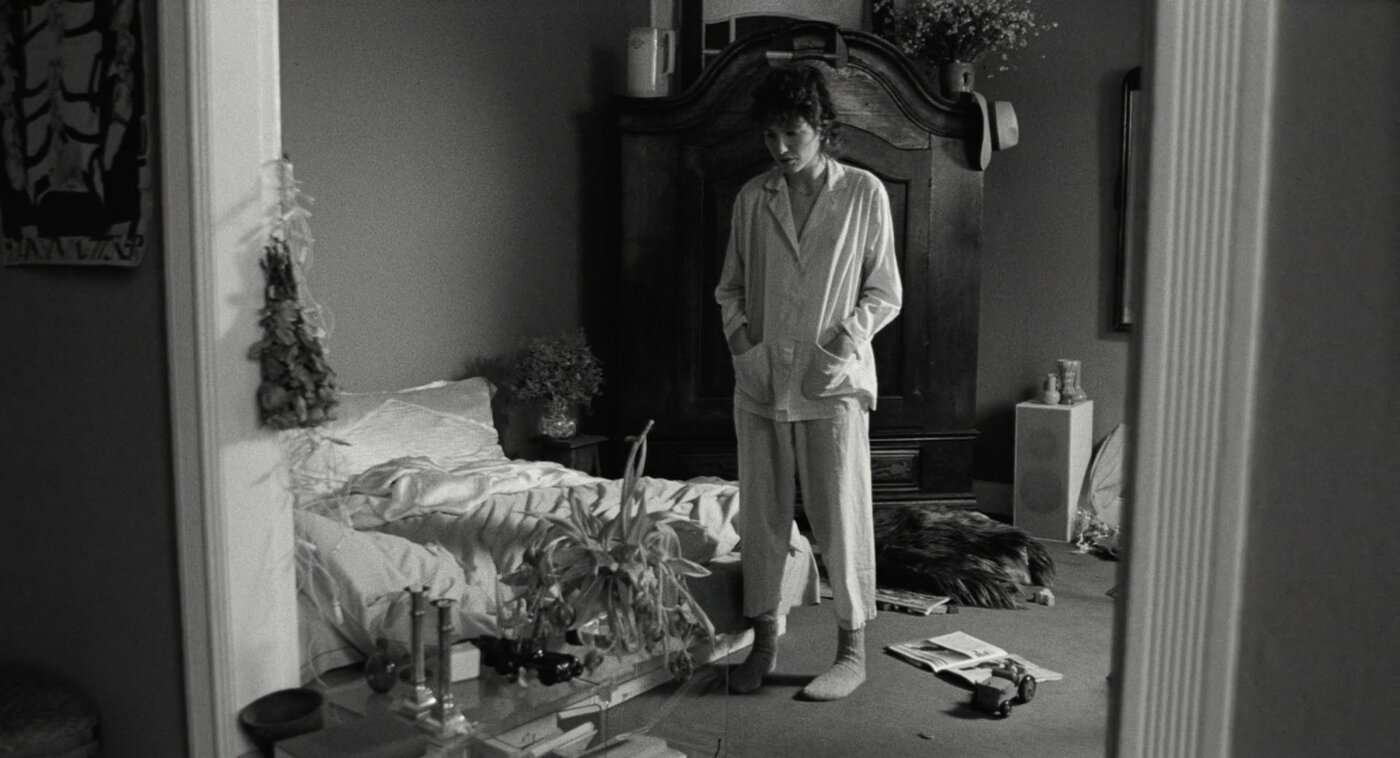
Ain’t Nothin’ without You (Pia Frankenberg, 1985).
Martha tells Ilona that the most important thing for her, as a filmmaker, is to “capture the atmosphere,” though she acknowledges that’s also the most difficult thing to achieve. To her friend, she bemoans that “capturing the spirit of a certain era” is impossible; “in a year, everything will be completely different.” Even so, Frankenberg found a way. Her films are capacious enough to include commentary on sociopolitical and cultural issues, romance, and slapstick comedy. Their compositions are not always even, but they come together around idiosyncratic, irresistible characters.
This approach is most evident and rewarding in Never Sleep Again (1992), in which character and environment work together to evoke the changing atmosphere of a recently reunified Berlin. In Frankenberg’s third and final feature, we follow Roberta (Gabi Herz), Rita (Lisa Kreuzer), and Lilian (Christiane Carstens) through two aimless days in the capital. They have come from Hamburg for a wedding, but that turns out to be the least memorable part of their trip, which they have to extend when their car breaks down. All three women bear some kind of discontent: Rita, a translator, is tired of being a mouthpiece for other people’s ideas; Lilian, a reserved documentarian, tries to make sense of nearly a century of tumult in Germany by filming everything; Roberta has a husband and son, but feels unfulfilled and compelled to inject excitement into her life by pursuing strangers.
Determined to make merriment of misfortune, the three walk around all night drinking and taunting men, like teenagers. Between bars, they stumble upon the capital city’s landmarks, watching as construction workers relocate pieces of the Berlin Wall to a museum across the street. Never Sleep Again shares with its two predecessors a freeform narrative structure: there is no particular plot. But if Martha and Gina consider how to get what they want—whether security or freedom—Roberta, Rita, and Lilian seek escape; they want to stand outside themselves, identifying what they don’t want. The strange clarity born of uncertainty gives the film focus, while the improvised nature of their weekend leaves Frankenberg room to wander. It’s as if her protagonists’ insecurities give her confidence: Never Sleep Again is the steadiest, most self-assured of her films. She doesn’t try to contain her electric, spontaneous energy, and she doesn’t lose her sense of humor, but her beats are more precise.
In her first two features, Frankenberg worked with established cinematographers: Thomas Mauch’s work on Ain’t Nothin’ without You followed several collaborations with Werner Herzog, and Raoul Coutard—a seminal cinematographer of the ’60s known for his vivid colors—shot the opening fireworks of Burning Beds with characteristic brio. But it’s in her collaboration with Judith Kaufmann (former assistant to Mauch) that her observational sensibility finds its best look. Kaufmann’s camera keeps up with the women as they move from place to place with no particular plan; it searches their faces as well as those of strangers. Just as often, though, it steps back to take in the particulars of the group’s dynamic, or the broader context of the city itself. Here they are, lying close together on the B&B bed, sharing a moment of intimate confidence in the midst of an adventure, like girls at a sleepover. Here they are by the river, separately watching the sunset in silhouette; then reality dawns and it’s time to go home.


Never Sleep Again (Pia Frankenberg, 1992).
If Frankenberg had previously found ways to fold contemporary sociopolitical concerns into her stories, in Never Sleep Again, the women’s personal crises dovetail more seamlessly with Berlin’s moment of upheaval. In the aftermath of reunification, it seems like the city, too, is at odds with itself, unsure of how to be. The old structures will not do. Bits of the Wall will hang in museums, Prussian kings will be exhumed and reburied. The distinction between East and West will gradually lose meaning. Women will leave their old lives behind. They will try something new.
Lilian becomes exasperated at the site of the former headquarters of the SS intelligence unit, where she learned to drive. She points to another building that was Prussian territory before becoming the Nazi Ministry of Aviation. Then it housed the GDR government, and “now it’s the Treuhand,” the agency responsible for privatizing formerly state-owned businesses. “What should we do with it now? Blow it up? Let the weeds grow over it? Leave it alone? What attitude should I have toward it?” she asks, before coming to the conclusion that one need not always have an attitude. “I’m standing here, with no attitude,” Roberta laughs. It’s a desperate laughter: That’s exactly what’s wrong with her life.
After Rita separates from the group to covertly see her ex, Lilian and Roberta notice a distraught-looking man on the train and decide to follow him. When they catch up to him at a café, Roberta tells him they’re conducting a study. “What is your innermost wish?” She asks him. “What’s the most beautiful thing you could imagine for yourself right now?” Roberta, whose discontent seems more than a little reminiscent of Betty Friedan’s description of “the problem that has no name” thirty years before, might ask herself the same questions. What is there to strive for, to look forward to? How can a woman build a life that seems to her beautiful and worthy when she has already bargained away the freedom to put her own happiness first? If, in her anti-rom-coms, Frankenberg laughed at the impossibility of answering these questions, in Roberta’s character, she considers them more gravely. No matter what you do, however you mask it—by pretending to be single, by pretending to be happy, by prying into other people’s lives, by standing there, with no attitude—the nagging feeling remains.
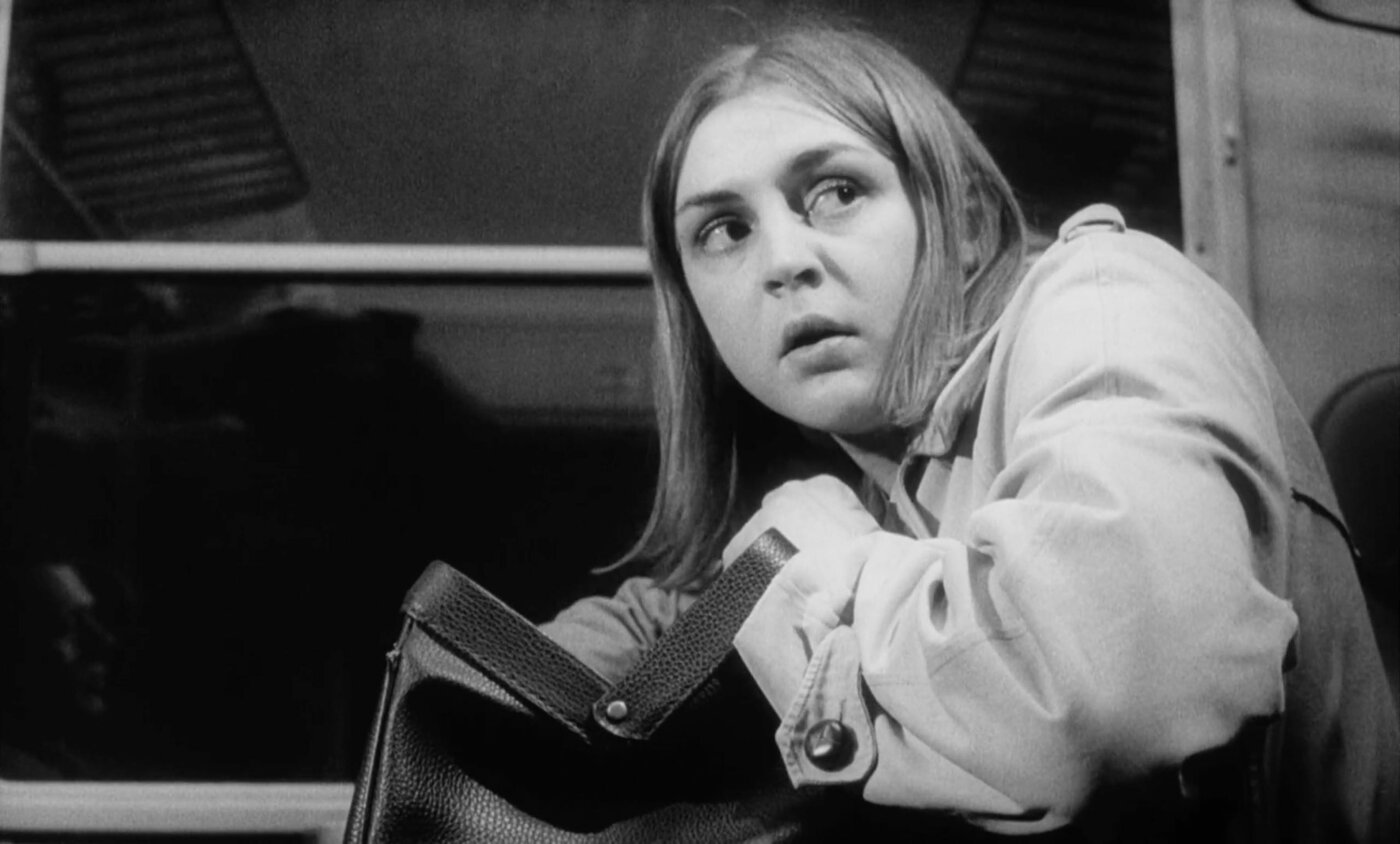
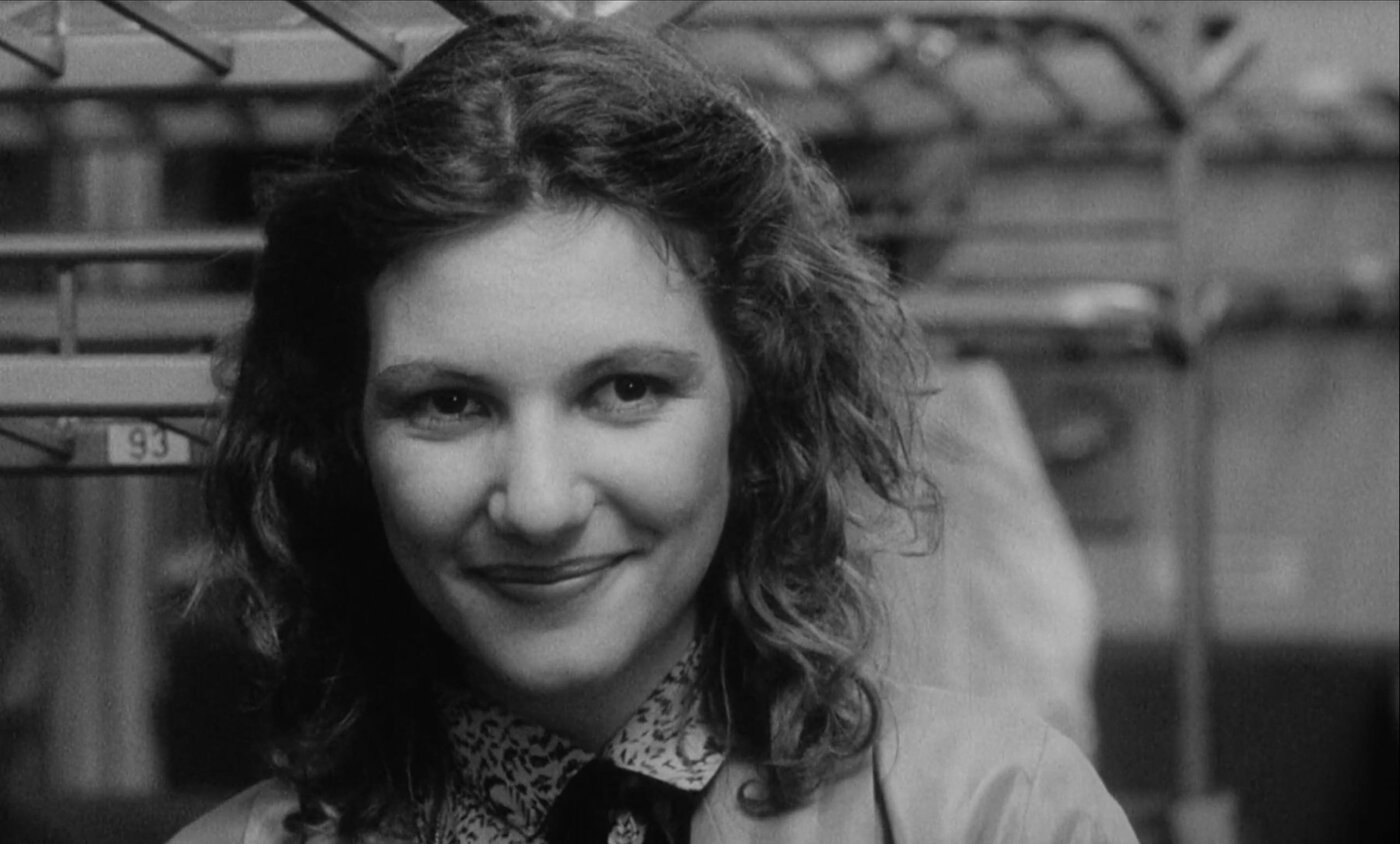
Longing for Something Completely Different (Pia Frankenberg, 1981).
The same impulse that drives Roberta and Lilian to “get to the bottom” of a stranger’s inner life provides the impetus behind Frankenberg’s first short film, Longing for Something Completely Different (1981). In it, a young woman (Elisabeth Stepanek) aboard a night train rifles through the contents of the sleeping passengers’ bags. Holding every item to inspection, she searches aimlessly but attentively, as if hoping that some talisman might emerge from the flotsam of other people’s lives. Waking up to the mess, one passenger (Frankenberg) offers her own bag for inspection. But the young woman isn’t interested in that which is offered, only in the stuff that is stowed away, as if truth can be uncovered only when no one is looking. Lilian and Roberta might plausibly be accomplices to such a mission. After learning that the man they followed looked so distraught because he had accidentally killed someone with his truck—seek and you might find—they sit, shaken, on a street curb. “We should do that again,” Lilian says, ever the documentarian.
At the end of Never Sleep Again, Rita decides that she won’t go home—she will stay in Berlin. “Are you having a crisis or something?” Lilian asks, to which she replies: “Yes, and it’s starting right this second.” Roberta is frustrated: How is she supposed to deal with the burden of her daily life without the support of her friend? Roberta has no problem following the temporary impulses that compel her to “do something physical”—like jumping in the river, hopping out of the bus, or breaking a plate—but she lacks the independence, or the courage, to reform her life altogether. “I have a husband, a kid, a family,” Roberta cries when Rita accuses her of being unhappy, as if to convince herself that those things are supposed to add up to happiness. She fantasizes about living in a South American jungle, among the animals, drinking pisco sours. She is “sickened” by Rita’s decision and exasperated by Lilian’s taciturnity. She can’t say what, but she wants something—she wants out, to get rid of this feeling sitting in her chest. Watching this phenomenal performance by Herz (who shares the intense girlishness of a young Jodie Foster), you almost feel your own scalp tingle with the urge to commit some irrational act.
By the time Lilian and Roberta are ready to take the train home, the rollicking spontaneity of the movie has broken down to expose the listlessness that drives it. How long can you pretend that the real world doesn’t apply to you? Not long, these women find out, but just long enough to have one last drink somewhere nearby.