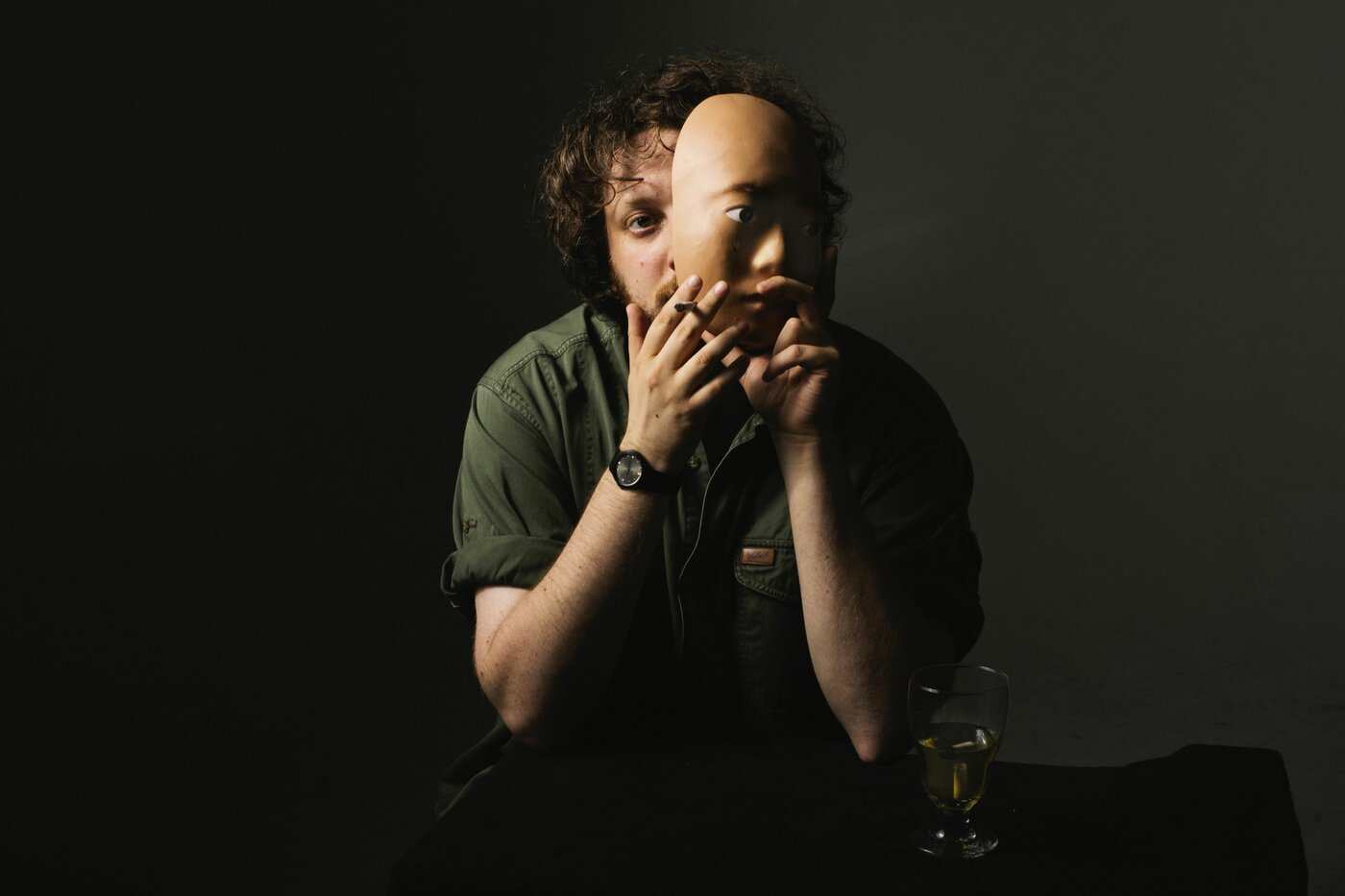
Oneohtrix Point Never. Photo by Timothy Saccenti.
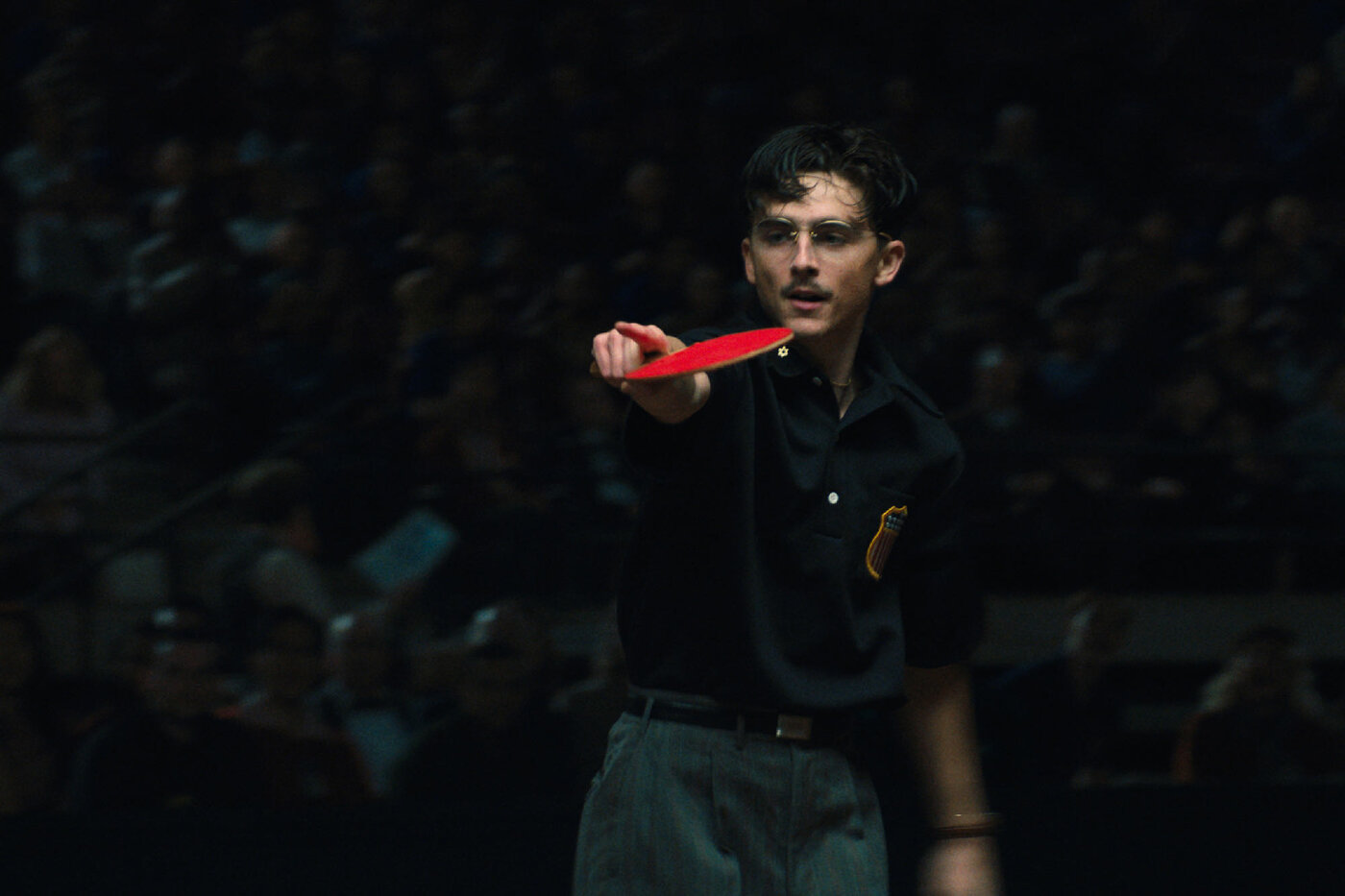
Even though he describes himself as “the ultimate product of Hitler’s defeat,” the past remains off-limits for Marty Mauser. The unwavering protagonist of Josh Safdie’s totemic Marty Supreme (2025) is played with forceful gusto and undeniable charm by a locked-in Timothée Chalamet, delivering a career-defining turn as a Jewish New Yorker who only wants to live in the future. It is a future in which he is the greatest table tennis player in the world, one in which the postwar American dream is finally fulfilled and Marty’s every desire is met. Tragically, the only thing standing in his way is the present—in which he is a nobody, wasting his potential as a clerk in the women’s shoe store of his controlling uncle.
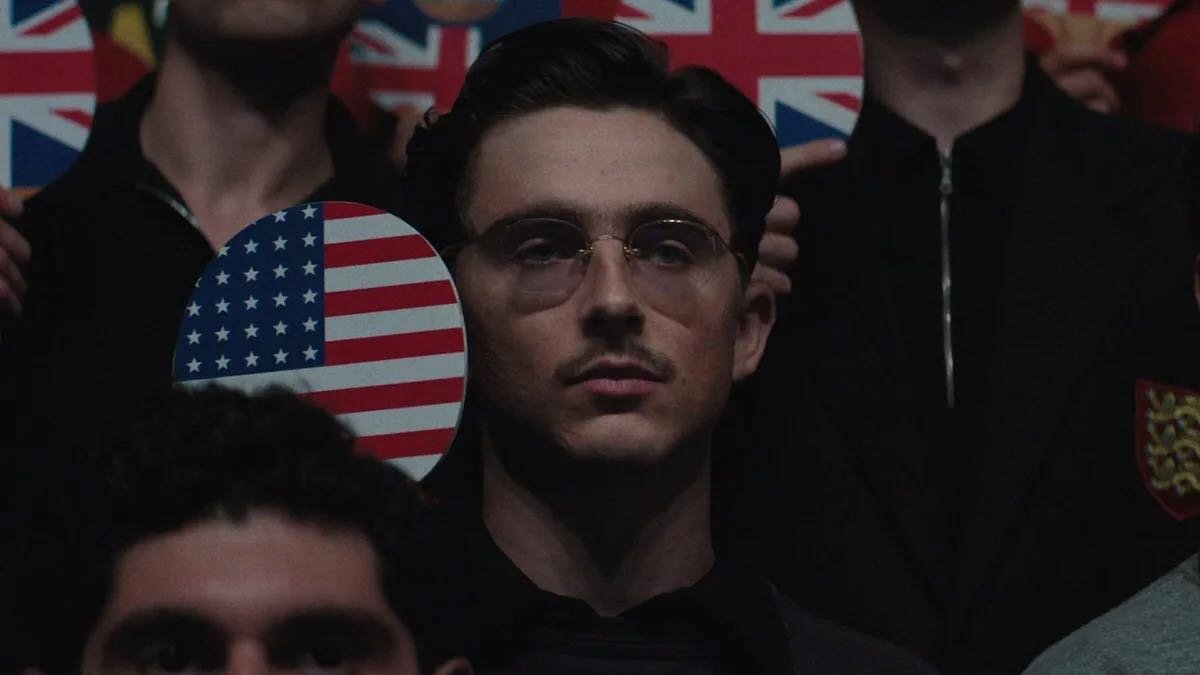
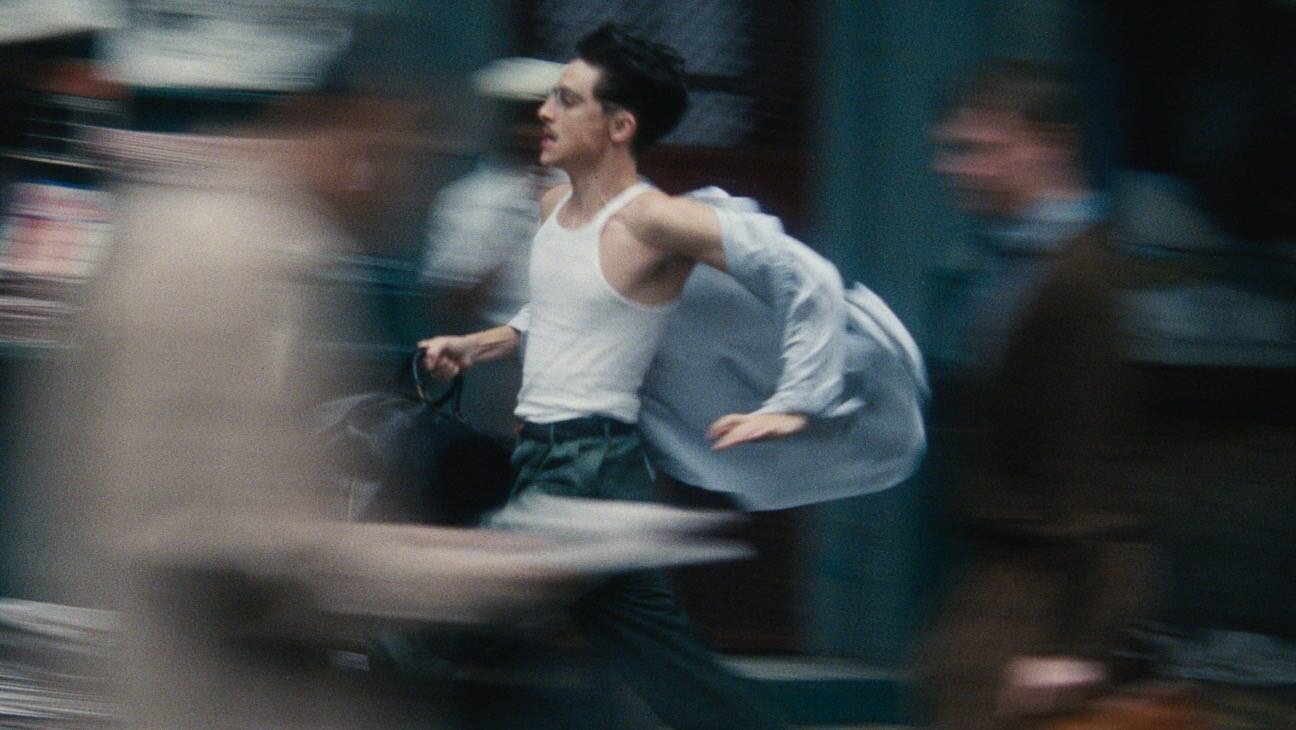
Watching Chalamet dash through immaculate recreations of 1950s New York, London, and Tokyo is akin to witnessing a time traveler defy the fabric of life and pull off the impossible. In lockstep with its protagonist’s manic drive forward, Marty Supreme is a hyper-energetic caper about a young man perpetually scheming his way through the rigidity of an old man’s world, bending reality to his stubborn will in order to manifest his destiny. His plan involves robbing, stealing and lying his way through a series of increasingly more disturbing—yet almost always funny—situations, all so he can bankroll his journey to the World Table Tennis Championships in the UK.
After the anxiety-inducing rollercoasters of Good Time (2017) and Uncut Gems (2019), which Josh Safdie directed alongside his brother Benny, Marty Supreme feels like the crystallization and maturation of these kinetic thrill rides. Most of that has to do with the inherent nature of Marty Mauser, whose existential journey aims at something more profound than the merely delusional and desperate acts of Good Time’s Connie Nikas and Uncut Gems’s Howard Ratner. Marty’s mind is similarly, stridently one-track, and in his attempts to assert himself, he also leaves behind a vile trail of hubris, violence, and sadness. However, there is something more recognizable in, and even admirable about, his naïve conviction that his illusions of grandeur matter on a more cosmic scale. Maybe it’s because Marty actually has a talent, and you want to see his genius on display.
Marty Supreme (Josh Safdie, 2025).
The film’s insistent propulsion turns out to be extremely fertile ground for its composer, Daniel Lopatin. Known by his Mercury Prize–nominated moniker Oneohtrix Point Never, Lopatin is a mad scientist in his own right, crafting intricate and eclectic digital music that resembles the audio equivalent of a time machine. Emerging from the underground Brooklyn noise scene of the aughts with an academic background in archival science, he was initially keen to explore how the sounds of his Roland Juno-60 synthesizer could be dilated and stretched, which warped them into uncanny dimensions. That sculptural approach to his early drone music has been a throughline in the rest of his career, even as each new Oneohtrix Point Never release tackles the sonic spectrum through a novel conceptual approach.
What undergirds the entire Oneohtrix Point Never project is the notion that sound can be understood as a physical object containing its own time movements. Lopatin simply knows how music ticks on a granular level: how, for instance, micro pockets of samples or sound sources carry entire sonic universes within them. Made with this philosophy in mind, his seminal Chuck Person’s Eccojams Vol. 1 (2010) predated the nostalgia-laden and consciously kitschy vaporwave movement that would soon proliferate on the internet. By continuously looping tiny snippets of cheesy ’80s pop, Lopatin opened up more expansive emotional narratives packed into the mantra-like repetitions of popular music that might otherwise be overlooked.
Such potential for disparate sound sources to be transmogrified into novel sonic matter hints at the acclaimed Oneohtrix Point Never albums that followed. Be it the sixteenth-note MIDI arpeggios of Returnal (2010), Replica (2011), and R Plus Seven (2013) jittering gleefully across the sonic spectrum, the ’90s-coded, angsty grunge that fuels the temperamental Garden of Delete (2015), or the decaying broadcasts of long-gone radio stations that now serve as unopened messages in bottles floating in a sea of content overload on Magic Oneohtrix Point Never (2020), Lopatin relishes the unstable, impermanent, and ephemeral nature of music. On his recently released album Tranquilizer, he fashions himself an archaeologist of the future stumbling upon a trove of once-believed-to-be-lost sample packs. Used in the heyday of the ’90s as building blocks to score mainstream television series or video games, these once functional, slightly corny, yet highly affective sounds were all uploaded to the Internet Archive, arousing the curiosity of Lopatin who bookmarked the material for later use. Revisiting these files years later, he found that the sample packs had been deleted, basically condemned to impermanence by the internet’s gluttonous abundance. In true OPN fashion, Lopatin tracked the samples down again to brush the dust off this archaic material and reexamine its potential to craft forward-thinking music. And, as with Marty Supreme, Tranquilizer’s curious hybrid of New Age-tinged nostalgia and conceptually dense experimentation feels appropriately out of time—as if Lopatin had opened a two-way street between the past and the future.
Marty Supreme (Josh Safdie, 2025).
Fittingly, Lopatin’s final tinkering with Tranquilizer dovetailed with the intense scoring process of Marty Supreme, making the almost simultaneously released album and soundtrack utterly compelling companion pieces. As its title suggests, Tranquilizer has a more subdued vibe, with watery pads and crystalline synth glimmers washing over downtempo arrangements. Marty Supreme also uses outmoded instrumentation—from erratic ’80s synthesizer areppegios to zinging harps, synthesized choir voices and beckoning chimes—but all of these synth-based sounds seem in a hurry to crash into each other. Having also contributed phenomenal scores for Good Time and Uncut Gems, it now feels safe to say that the ongoing creative collaboration between Daniel Lopatin and Josh Safdie is the modern-day answer to film history’s most fruitful filmmaker–musician relationships—recalling collaborations between Werner Herzog and Popol Vuh’s kosmische synth guru Florian Fricke, or Dario Argento and the Italian prog-rockers Goblin. Marty Supreme is also Lopatin’s grandest score to date: a constantly enveloping, wildly eclectic yet emotionally coherent piece of music that breaks the linearity of traditional film scores by embracing its own erratic tempos, making it just as thrilling to take in as a work on its own as the action-packed film it is made for.
Always sympathetic to Marty’s plight, Lopatin’s dizzying score offers an earnest exploration of what it feels like to be young: to want more out of life, to have a greater vision for yourself, and to reject society’s limiting norms wholesale. All of that becomes even clearer in the shifting gears of the soundtrack, where Lopatin’s music sits alongside Alphaville’s anthem “Forever Young” and other wildly anachronistic pop bangers of the ’80s. The youthful poptimism of these tracks perfectly complements Lopatin’s explorations of how, in music, the past and the future are much closer to each other than they might seem. Unsurprisingly, as I sat down with Lopatin to discuss his career as a recording artist and composer, it emerged that he strongly identifies with Marty Mauser’s manic quest for self-fulfillment, and that everybody has something to learn from this delightfully delusional young man.
Marty Supreme (Josh Safdie, 2025).
NOTEBOOK: When the Safdies approached you to score Good Time, they shared an insane mood board with you, with eclectic visual references ranging from SpongeBob to images of heists. Did Josh Safdie come to you with something similar for Marty Supreme?
DANIEL LOPATIN: This time, there was no mood board. Ronnie [Bronstein] and Josh sent me the script, which I was reading on a flight on which I had Wi‑Fi. I was talking to them the entire flight as I flipped through the pages. It is a conversation I came back to multiple times during the process of composing, as it was my first reaction and it contained a lot of feelings I had about the soul of the movie. Later on, we canvassed the walls of this little studio in Manhattan where we worked on the music. We covered the walls of this editing bay with archival images of folks from the 1950s that served as references for the characters in the film. These were real people, and functioned as a kind of parallel-universe facsimile. They were incredible—these black-and-white gigantic printouts pinned up on the wall, creating a cocoon of images of these faux characters.
NOTEBOOK: Marty Supreme expands on something already palpable in Good Time and Uncut Gems: the propulsiveness and intuitiveness of manic protagonists. They dive into situations headstrong, usually without overthinking things. This is especially the case with Marty Mauser, as he is the most naïve, most hopeful, and even most optimistic character of them all. How did that sentiment affect the way you approached the score?
LOPATIN: What I find rewarding about working with Josh is that at any moment he allows all the collaborators an opportunity to advocate and persuade him about what they think might benefit the film. He is open, but not in that de facto hippie-commune type of way, where everyone gets their say all the time. This is a world with really strong opinions, and everyone gets pushed to their limits so their best selves will emerge. That kind of attitude is also central to the world of Marty Supreme. It is like, “Give me your best pitch. Why do you think you should get on this plane with me?” So there are strains of truth to Marty Supreme that are a reflection of Josh and Ronnie’s overall attitude. And it is like Marty Mauser says himself: it is part of the culture of New York, with this idea—whether right or wrong—that New Yorkers convince themselves everything is mano a mano. It is a me-against-the-world kind of thing. And that is not unfamiliar to me. That is how I also live a little bit, and that gets reflected in the score.
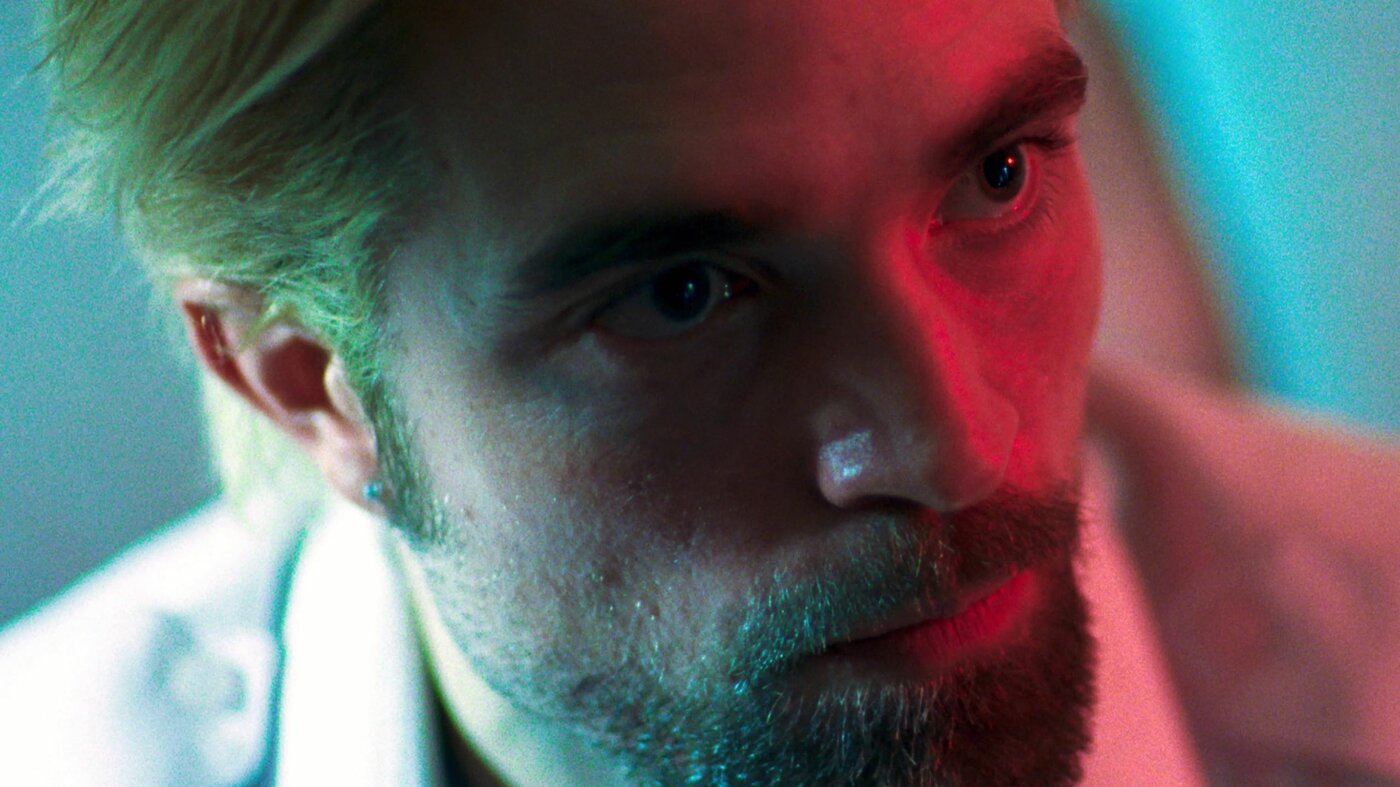
Good Time (Benny and Josh Safdie, 2017).
NOTEBOOK: In most Safdie films, time is a fleeting and valuable resource, resulting in a lot of action packed into incredibly tight sequences that hurtle forward. Your music often feels like it is excavating sonic artifacts from the past, then energetically propelling them toward possible sonic futures. That bilateral movement in the way you approach music seems to relate to the Safdie films you scored. How does this dimension of time as a resource influence your compositions?
LOPATIN: The milieu I came up in challenged conventional time in music—whether out of boredom or some grander, overarching big idea. To be honest, I have no idea why I was attracted to this, but I always found that the inner clock of pop music was interesting; it just always felt like it was there to be manipulated and messed with.
NOTEBOOK: Which is strongly reflected on the Chuck Person’s Eccojams Vol. 1 album, a seminal work of proto‑vaporwave music in which small pockets of pop music are expanded on an exponential scale.
LOPATIN: That is right! Simultaneously, I was always drawn to the films of Andrei Tarkovsky. They were calling to me, as what they did with time strongly influenced my thinking about music. An even more obvious example from cinema history would be my obsession with 2001: A Space Odyssey [1968] and having absolutely no idea how I am getting from point A to point B to point C in that film. I am trying out things in music that are also suggestive of that.
I think Paul Schrader put it very clearly in his book Transcendental Style in Film, suggesting that a film editor has an incredible amount of power. Of course everyone does, but the idea that you can linger on something for too long or get away from something so quickly is very interesting in how it dilates your existential rhythm. It actually affects how a person is breathing and physically receiving the film as they sit in the cinema. Josh understands these kinds of rhythms. So my job is to treat the film in the same way I would try to understand the deeper nature and required pacing of a piece of music. I am simply trying to get in lockstep with the erratic and dilated rhythms of the film, which are natural to Josh’s style.
NOTEBOOK: You scored Marty Supreme while working on Tranquilizer. On that album, the lost soundbanks and sample packs of the past can become sounds of the future again. How do you see the relationship between the way Marty Supreme’s retro-styled score moves forward and Tranquilizer’s futuristic approach to archival material out of the past?
LOPATIN: I think both works are very optimistic. While the directionality seems asynchronous, they are still quite similar to me. Tranquilizer evokes an archaeologist stumbling upon some sonic ruins. Suddenly a question arises: did we really understand what these sound objects were? There is a preconceived notion about what these corny sample-pack sounds were meant to be used for—we even know what they were technically used for—but they have eroded and, in the meantime, the world has changed. Now there is one human perceiving them again, in a sense freeing the object from time, from being fossilized, from being frozen. It is like giving it life again. To me, that is optimistic.
With Marty Supreme, you have a film set in 1953, about a young man who imagines a future for himself that can only be described with the music of the future. It is about a time in his life that will exist, but does not yet. In that sense, it is a dream of music, based on his lived experiences and the many things that still only exist in his unconscious. The optimism of him manifesting his own future is one of the greatest lessons of the film to me, and that is what my score points at.
NOTEBOOK: Is it not ironic, then, that the opening of the film riffs on “Forever Young,” which becomes a kind of leitmotif throughout your score? I want to connect those reflections of youthfulness to a performance you did at Rewire Festival in The Hague two years ago. Alongside visual artist Freeka Tet, you crafted a show in which you collaborated with a younger, miniature version of yourself on stage. It looked like Charlie Kaufman’s Anomalisa [2015], albeit with a younger puppet version of yourself projected on the screen. If we are talking about manifesting your own future destiny, I cannot help but see an overlap between the way you embraced your younger self during that performance and the way Marty Mauser wants to become his future self.
LOPATIN: First of all, I remember that show very well because the power suddenly cut in the room. That was crazy! I was standing there thinking it was definitely my fault. But I want to go on the record now: it fortunately was not my fault. I also very much appreciate that all of this was not lost on you. Ultimately, it all comes back to acknowledging the passage of time in one’s life, which relates to all the work you have done in the past. Surely, it does not need to be the central conceit of an artwork, but it is an unavoidable component of making art. Josh and I are basically the same age, and we are both looking at about fifteen‑plus years spent in the arts. You could say we are well into our middle age here. That brings up certain feelings and an impetus to use the moment to take stock and think, “What am I going to do next?”
What I like so much about Marty Supreme is the way it explores the tension between the young person’s world and the old person’s world—all while Josh and I find ourselves right in the middle of that. There is an American psychologist named James Hillman, who talked about this in terms of the archetypes of the puer and the senex, the young man and the old man. They can both offer each other lessons, but there is actually a lot more that an old man needs to learn from the young man to effectively grow older. That is an integral part of this film: how Marty’s looseness clashes with the rigidity of his environment. That is why, at Rewire, I almost wanted to take an intermission from my work and to consider where I was before I could move forward again.
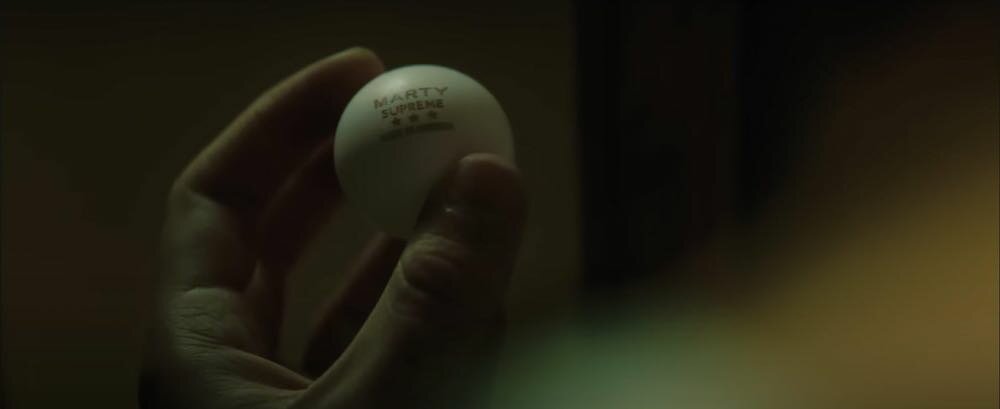
Marty Supreme (Josh Safdie, 2025).
NOTEBOOK: When Josh and Benny approached you for the first time to score their films, they were referencing your more obscure debut release Betrayed in the Octagon [2007], which contains so many musical ideas that are still present in the score of Marty Supreme. You have often spoken of your music as either sculptural or architectural, and it feels like early on you built an incredibly strong conceptual foundation that still undergirds your current projects. It makes me wonder how it felt for you to artistically evolve as a film composer, and if the meticulous processes that come with it easily rest on the artistic center of Oneohtrix Point Never.
LOPATIN: That is a very important question for me. When I score for film, I really try to see myself less as a producer and more as the actual composer. It means that some of the production freedom I give myself on my own records now has to be shared. I actually also think of Josh as a music producer when he works with me on the score. I do not see the ideas he brings up with me as being so different from what I would do as a producer in the studio with somebody else. In the case of Marty Supreme, I explicitly decided to let others produce me—namely score producers who have been my close collaborators for many years now. I cannot do everything all at once any more and still remain human. What I need to do is try to understand the emotional valence of the film. Additionally, I try to look at every cue as an art project, to connect with it more deeply and to emotionally enhance the film in whatever way I can. And, yes, all of the undergirding of what I do as OPN is there, but if it does not match up correctly, it is up to all kinds of mischief and trickery to make it work. It is all an edit—looking at a cue from five or six different versions that get Frankensteined together into something that seems seamless.
NOTEBOOK: Do you enjoy this Frankenstein approach of editing, splicing, and warping music as this kind of raw material that needs to be reshaped?
LOPATIN: It is rather a means of survival—being able to describe musically what I truly have in my mind. I am not classically trained. I might have a bit of a musical background from my parents, but I cannot just sit down like the composers I admire and play a piece fluidly on a piano. What I do is struggle in the dark, with mistakes and all kinds of different approaches, and piece that all together. Ultimately, the final image of my music is always a digital image. That is my natural habitat; that is where things come together for me. Do I enjoy it? I think I do. It can be fun, although I do have envy, because there is something beautiful about being able to fluidly conjure melodies on any instrument. I am trying to do those types of things as well now. “I Love You, Tokyo,” for instance, which gets reprised over the end credits, is a song I can play on any keybed you put in front of me. It is just a simple melodic idea that you can easily play with one hand. I think that is quite aspirational for me—to work more and more in such a way.
NOTEBOOK: Can you bring me back to this studio in Manhattan with all of these ancient guys blown up on the wall: What does a good day in that space look like? What was the actual emotional process of working on this score?
LOPATIN: On a good day, I arrive in the morning when there is no one else around. We actually called this studio “the fishbowl,” because it was one cubicle surrounded by all these other editing suites, with a hallway wrapping around it and people constantly walking back and forth through these sliding doors. It really was a nightmare—like a panopticon. So, on this good day, I come in early to work quietly by myself. Josh is not there yet either, meaning I can look deeper inside myself and work with the image more closely. Then he will come in around 1 or 2 p.m., after having worked on something else for hours on end, so he is already at his own breaking point. He will sit next to me and I will play him what I worked on. If he looks at me, takes out his phone, and asks me to play it again so he can record it on his phone, I know we are getting pretty close. When he does not do that, that is a bad day. It means we just do not have it yet.
To your point, there is a lot of hanging out, really. Taking breaks, talking, watching things, listening to things and thinking more deeply about what we are really doing. It can be like a little clubhouse sometimes, which is really necessary to take your mind off things. Mostly, it feels like you have to climb a mountain, as there is so much work and so little time. But ultimately, I am thankful for it, because it means we got to spend all this time together. Is it not the best feeling in the world to spend time with your friends?
NOTEBOOK: Has your work as a composer changed your relationship with how you conceive of your own music and the role that music plays in your life? Can you say these experiences bleed back into how you see yourself as OPN?
LOPATIN: Well, yes. I think I am very lucky in my life to have had all these experiences. It is like what Drake said: “No new friends.” Most people find it hard to make new friends at an older age. When Josh came into my life, it was a miracle, like suddenly meeting a long-lost brother. It will get me emotional reflecting on this, but we share a language that was already there, before we even met, that just brought us together. We are also very different people. Josh will knock down walls to find what he is looking for. He can be a little bit more extroverted and a little rougher than me. I can be a bit softer and more introspective. And now we both have each other as part of one another, and he brings out certain things in me that I am very grateful for. That is all you want—somebody that changes you in a positive way and makes you a little more interesting, because you see yourself reflected off them. I am probably the most grateful for that, besides all of the exciting art projects we have done together. It is awesome when you can ask, “What do you think about this thing I made? Am I on to something?” and then get an honest answer back from someone you respect. It is a miracle.