This piece was originally published in Issue 8 of Notebook magazine as part of a broader exploration of food on film. The magazine is available via direct subscription or in select stores around the world.
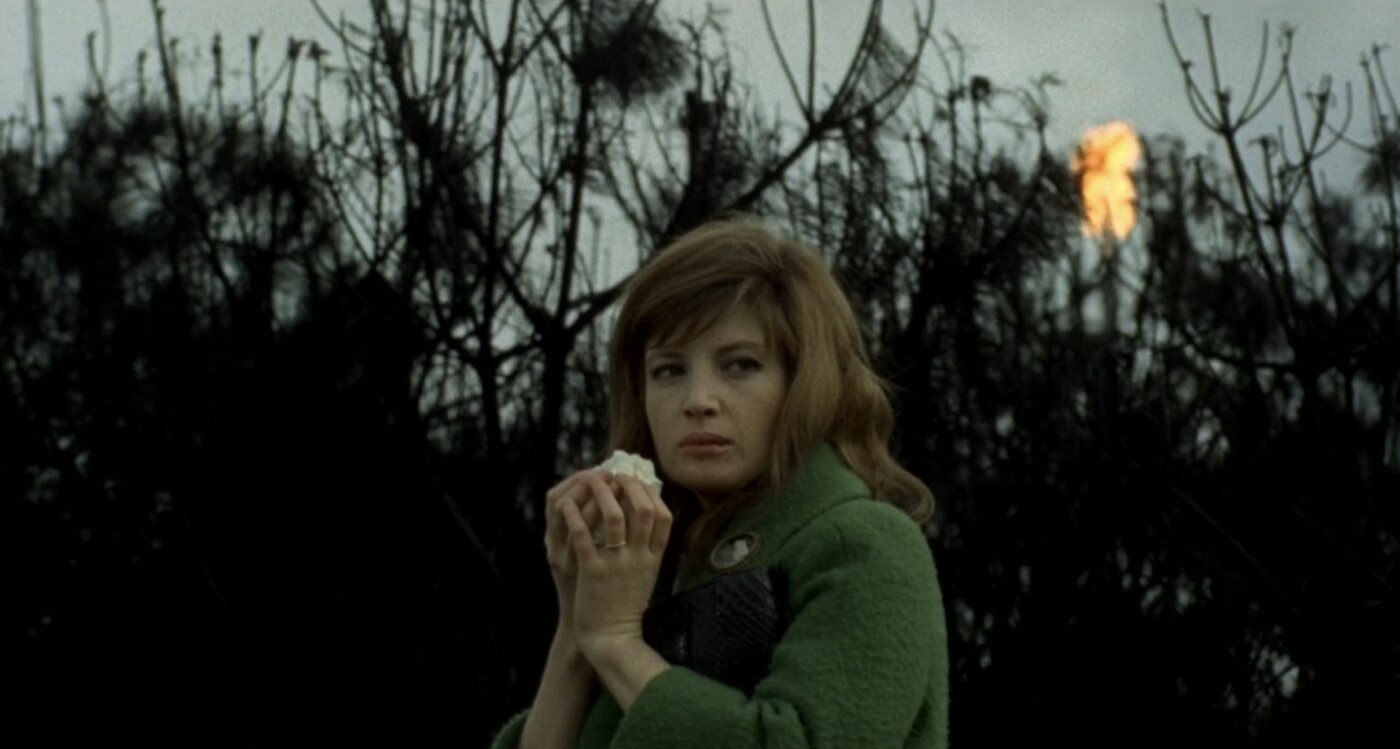
Red Desert (Michelangelo Antonioni, 1964).
In Michelangelo Antonioni’s chromatic masterpiece Red Desert (1964), Monica Vitti bites into a half-eaten sandwich while crouched in a bramble patch, as if in secret shame. Her character, Giuliana, has purchased it off a striking worker at her husband’s chemical factory, bartered impulsively as if it were drugs, certainly with the squirreliness inherent in such a transaction. One doesn’t think for a second that this affluent woman, sheathed in her posh wool coat, could be famished, but panic flits across her features, like those of us who, when we reach the front of the line, realize we don’t know what we want, or what we’re allowed to want. Giuliana asks her son if he wants a bite, but that offer proves false almost immediately—the camera hangs back on the boy’s confused face as she scurries to that bramble patch. She devours the sandwich on autopilot, crumbs clinging to her face like a raccoon; this is the first and surest sign that she will fail to acclimate to the chemical wasteland around her.
In cinema, the image of a woman eating is seldom incidental: Romcoms are rife with Bridget Joneses who cannot control themselves. By contrast, for men, eating is often a display of authority or menace, of power rather than pathology. Perhaps this additional scrutiny can work as an advantage. When a camera watches women eat, it opens the possibility of performance before they even speak, turning their appetite into a subtle assertion of oneself—a rejection of expectations or a claim to private desires. How or what she eats marks her difference: It can measure her position in the world or the distance she keeps from it. Like Vitti, these women can be feral, which is above all a mark of refusal; they are not domesticated, not assimilated, but fragile and dangerous, out of bounds.
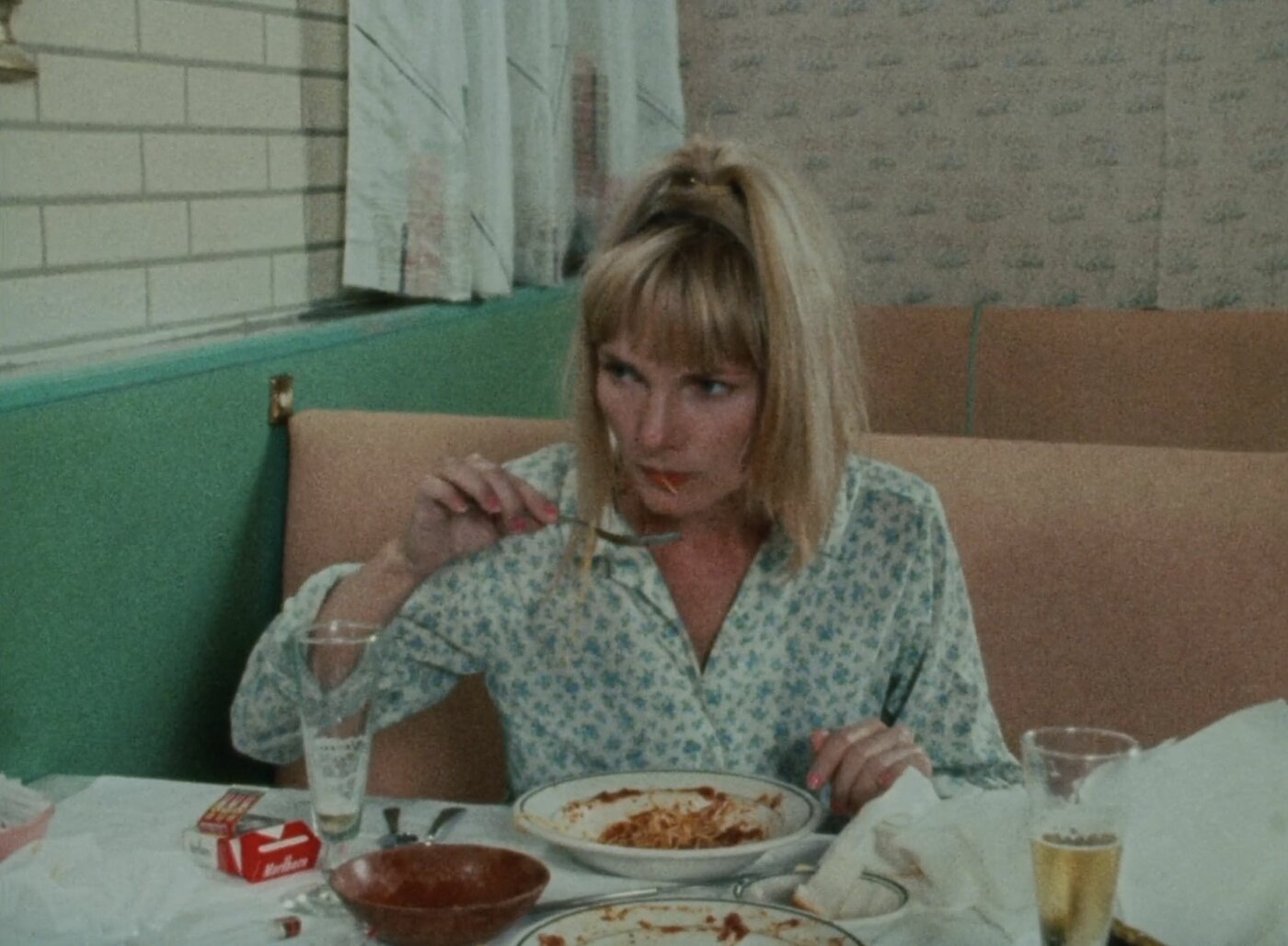
Wanda (Barbara Loden, 1970).
The cinema of the 1960s and ’70s was filled with women whose appetites chafed against the grain of cinematic expectation. Gena Rowlands gnawed through emotional breakdowns; Jane Fonda, on the verge of recoil, bristled with self-containment; Isabelle Huppert folded cool transgression into every gesture. To be feral, specifically, is to inhabit the margins and insist on selfhood when the world demands compliance. Barbara Loden’s Wanda (1970) is a portrait of an aimless, freshly divorced woman in Pennsylvania coal country who becomes an unwitting accessory to robbery, care of the petty, abusive criminal Mr. Dennis (Michael Higgins). While on the run, the odd couple stop at a diner, where Wanda (Loden) treats her fork like a spoon as she eats spaghetti, slurping at two stray noodles caught between the tines, sauce smeared around her mouth. Mr. Dennis chides her for the mess, but Loden’s movements are a study in haphazard delicacy: ungainly yet precise, with a baby-ness that is naïveté writ large. We see this instinctive quality again when she pecks at a potato chip, taking three bites to finish one, or when she fumbles while tying her shoes. Her hesitant movements are of a piece with the character’s arrested development, her inability to move fully into a world that has so little room for her.
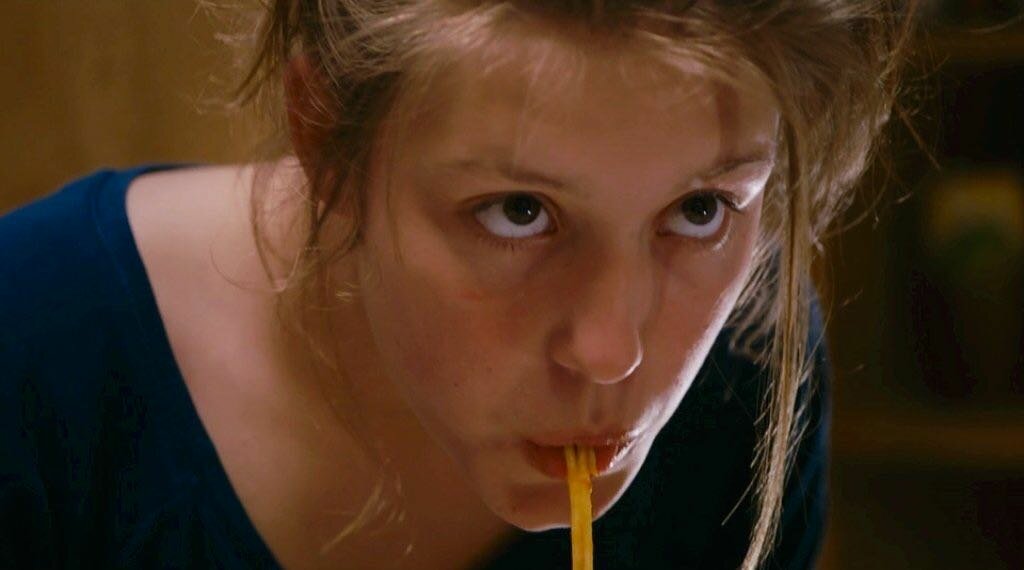

Above: Blue Is the Warmest Color (Abdellatif Kechiche, 2013). Below: À nos amours (Maurice Pialat, 1983).
If this earlier generation’s estrangement played out in private tics, a newer crop of actors were more overt and defiant in their hunger. See Sandrine Bonnaire in Maurice Pialat’s À nos amours (1983), slouching, kissing, or dangling a handful of spaghetti above her mouth in a raw, unruly claim to adolescence and womanhood that cannot be managed by patriarchal structures. Adèle Exarchopoulos continues this lineage in Blue Is the Warmest Color (2013), Abdellatif Kechiche’s coming-of-age drama of sexual discovery. Taking up spaghetti once again, her fifteen-year-old character licks her fingers, drags her tongue across a knife, flashing her teeth all the while in a show of urgent insatiability. By her own admission, she can’t stop eating. Even when she’s full.
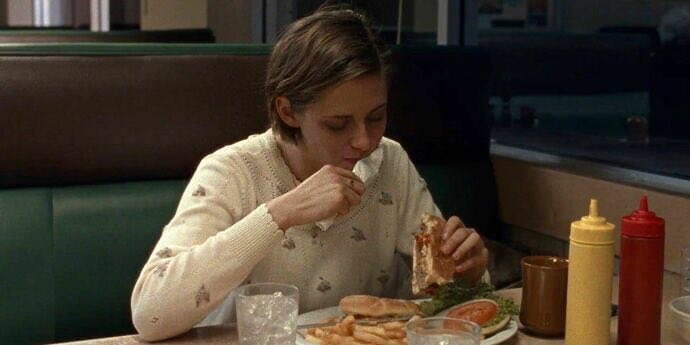
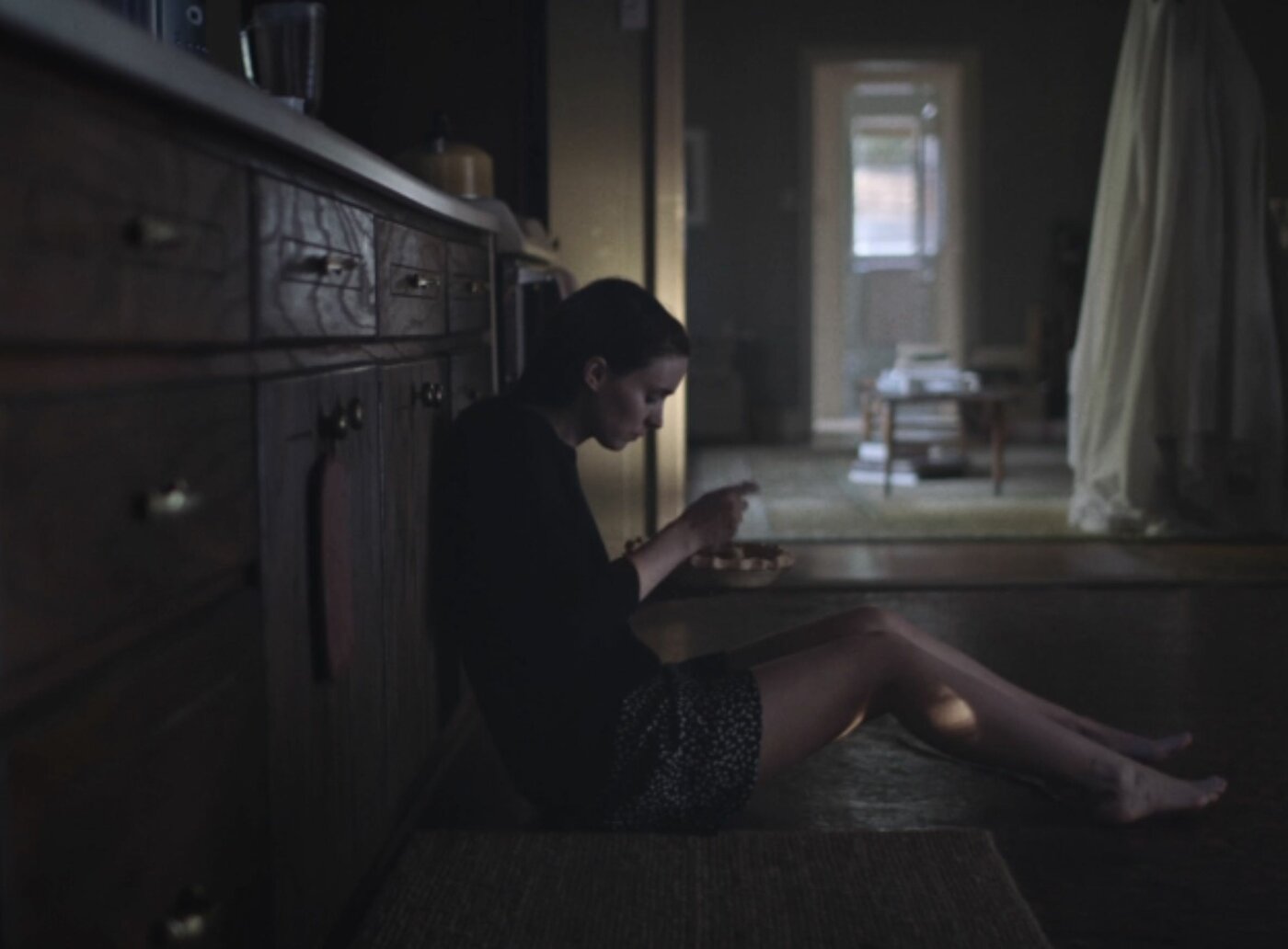
Above: Certain Women (Kelly Reichardt, 2016). Below: A Ghost Story (David Lowery, 2017).
Millennial American actors like Kristen Stewart and Rooney Mara have turned inward again, folding alienation into their very musculature as a ritualized transgression. In Kelly Reichardt’s Certain Women (2016), Stewart sits at a diner booth, balanced on her elbows and craning her head down into her shoulders as she takes an enormous bite of a burger, wiping her face with a napkin still knotted tightly around its utensils—a fatigued, semi-lunatic move that feels drawn from the actor’s particular physicality, protective and bird-like in its grace. Stewart’s performative power has always stemmed from her idiosyncratically tetchy moves, now inseparable from her own offscreen strangeness. The animating force of her character’s hunger and the consequent act of eating is neither lustful nor even particularly satisfying, but is just shy of frantic. She attacks her dessert bowl halfway through her burger, consumed with the compulsion of someone trying to hold things together. She has, after all, driven four hours to teach a night class in town, a mistake born of mixing up alliterative town names (Belfry, not Belgrade). The compulsion feels distinctly contemporary, reflecting how a constant effort to maintain stability and presentability has been exacerbated by pervasive technocultural exhaustion.
In David Lowery’s A Ghost Story (2017), grief is made edible as Mara’s character sits on the kitchen floor with a chocolate pie, a condolence gift following the death of her husband. Unlike a cake, festive and celebratory, the humble pie suits her character—unadorned and in mourning. She begins with small attentive forkfuls, one after another, accumulating into a rhythmic ritual—a bodily negotiation of loss. Mara lets go in a way that’s almost uncomfortable to watch, stabbing at the plate, lurching forward in a private performance of endurance. Each bite embodies the fragile persistence of life when the world feels emptied. As is the case with Stewart, the act becomes a fierce claim to space and selfhood in a world that might otherwise render them invisible: strength expected of them, their vulnerability unseen. Who in this empty house but the pie will bear witness to her grief?
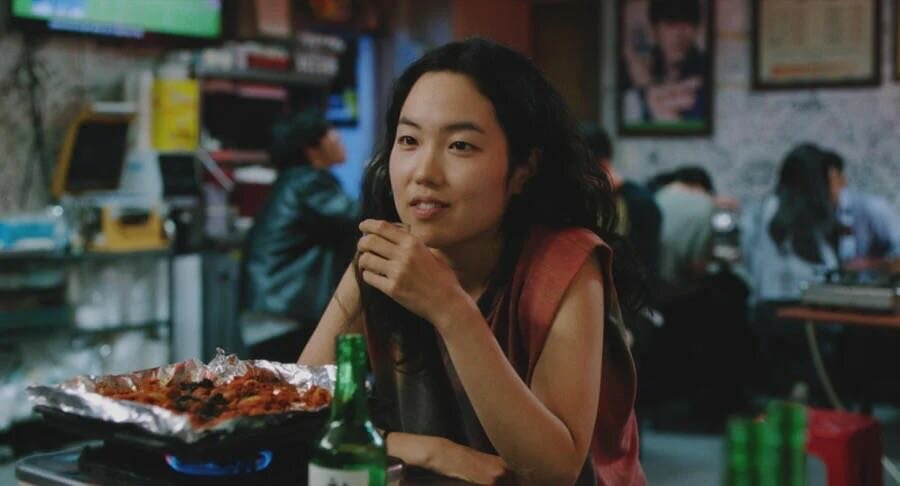
Return to Seoul (Davy Chou, 2022).
Eating alone suggests a refusal—or inability—to submit to the choreography of social life. A woman dining alone might be pitiable and suspect if seen at a restaurant, but she’d even feel the weight of that perception in the privacy of her own home, and especially on her birthday. In Davy Chou’s Return to Seoul (2022), Freddie, a French-Korean adoptee played by Park Ji-min, finds herself home alone with a meal when she turns 27, silently scooping noodles cross-legged on the floor of her apartment, her movements loose and unstudied, her body momentarily unburdened by the need to perform. For once, appetite and interiority align: She eats only for herself, and the solitude reads as ease.
Until this point, she has been swept into communal meals—with the new friends she toasts with shots of soju, and with her biological family, whose customs move with a foreign tempo, ceremonial and overdetermined. Relatives arrange themselves at the table, pouring drinks for elders, and expectantly pressing slices of pears to Freddie’s lips. She negotiates these unfamiliar rituals with the wary tilt of someone being watched, as though her appetite itself were on trial. These family meals are freighted with a sense of belonging she cannot easily slip into; while carrying her Parisian upbringing with her, she’s expected to navigate the foreign codes of Korean life (and the intensely deferential manners it prescribes). Her diffuse desire to forge her own rhythm cannot be satisfied in these spaces, and the dissonance is clarified when she opens her relatives’ refrigerator, bewildered by the alien jars of pickled meats and vegetables whose Korean-language labels she cannot read—an archive of appetites she’s inherited by blood, but nothing more.
Years later, living alone in Seoul, she has settled. To eat in company was always to be corrected: watched and guided by others who, while well-meaning, hemmed her in. To eat alone now—steam rising from the bowl, lips closing around the noodles—is to answer to no one.
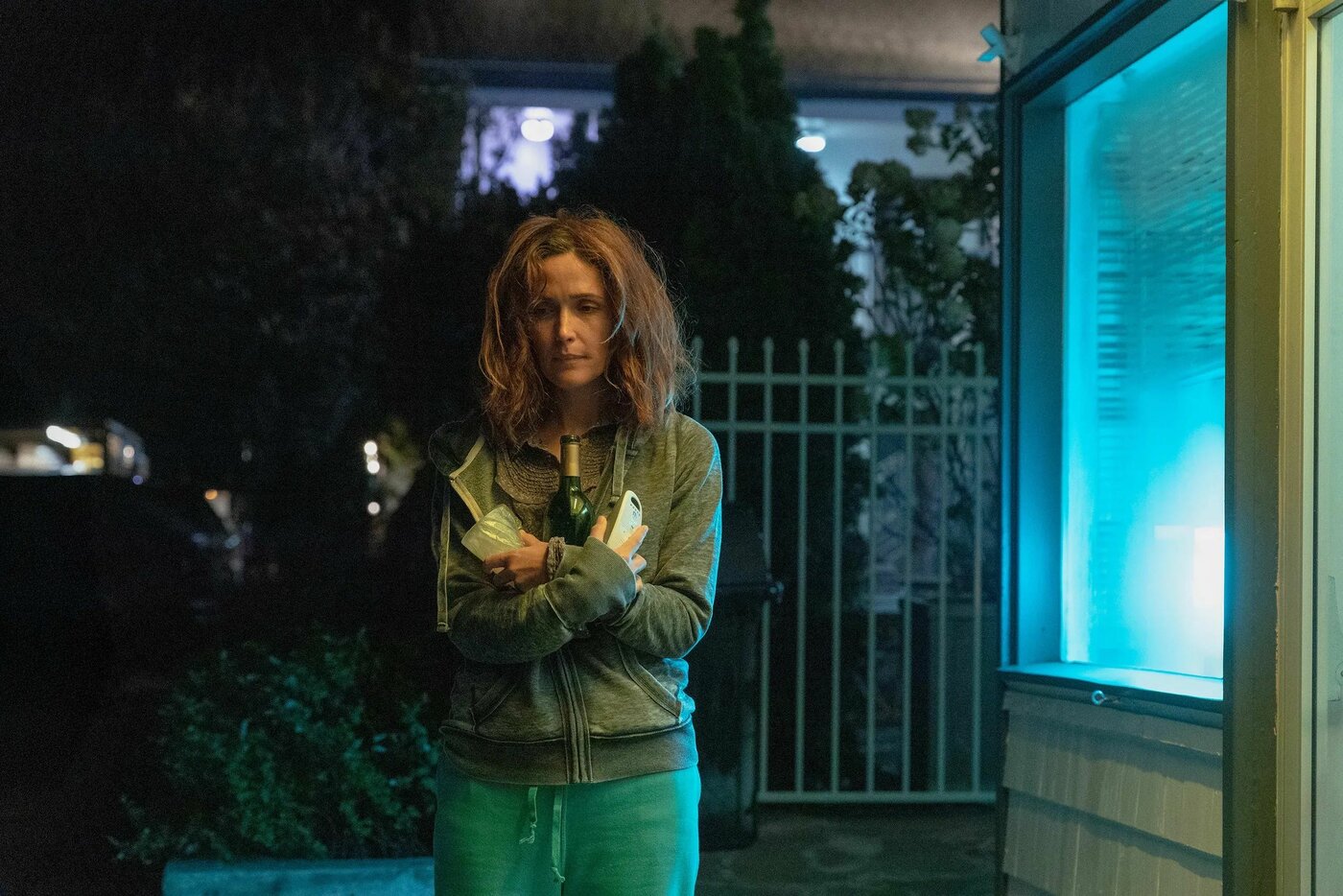
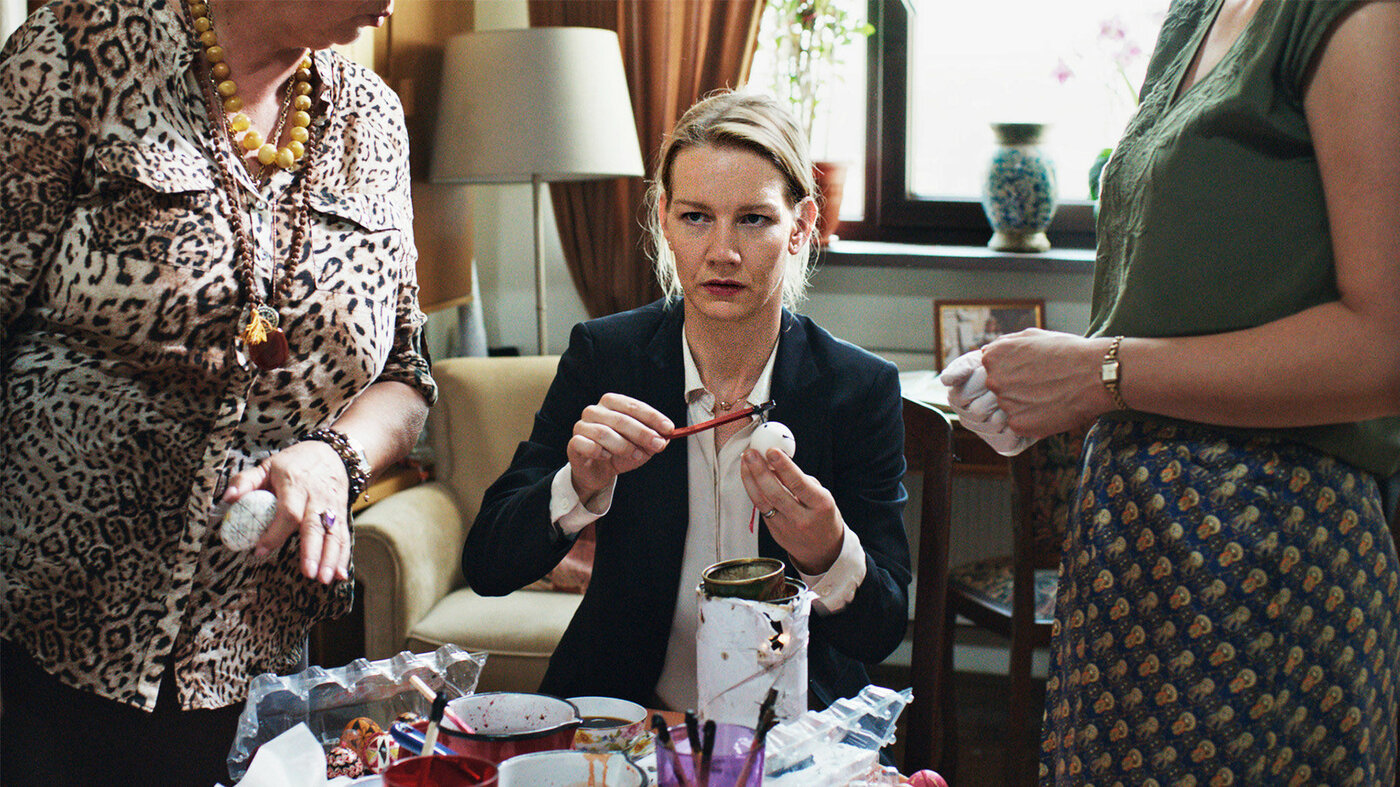
Above: If I Had Legs I'd Kick You (Mary Bronstein, 2025). Below: Toni Erdmann (Maren Ade, 2016).
Female characters in a later stage of life face higher expectations, deeper professional and social pressures. In If I Had Legs I’d Kick You (2025), Mary Bronstein’s black hole of a comedy, Rose Byrne plays an exhausted mother struggling to care for her sick child as her world collapses around her. At one point, she pulls the cheese from a slice of pizza and ingests it with grim determination, like she’s slipping bills into a machine. Her front-of-the-mouth mastication looks less like eating than an effortful distraction, a way to keep herself from unraveling. Elsewhere, Sandra Hüller’s character in Maren Ade’s Toni Erdmann (2016), Ines, is out of step with her surroundings—then makes a bold, almost obscene, assertion of her autonomy with a petit-four. Working as a blue-chip consultant in Bucharest, she has been suffocated by corporate ambition and stripped of joy. Sidelined by her boss during a pivotal client presentation, she reclaims control in a private hotel-room encounter with a colleague by commanding him to ejaculate onto the delicate pastry (the green one, specifically), which she promises to ingest. And she does so with perfect poise, transforming the seemingly reckless bite into a performance of agency, her appetite into a subversive instrument of self-possession in a male-dominated space.
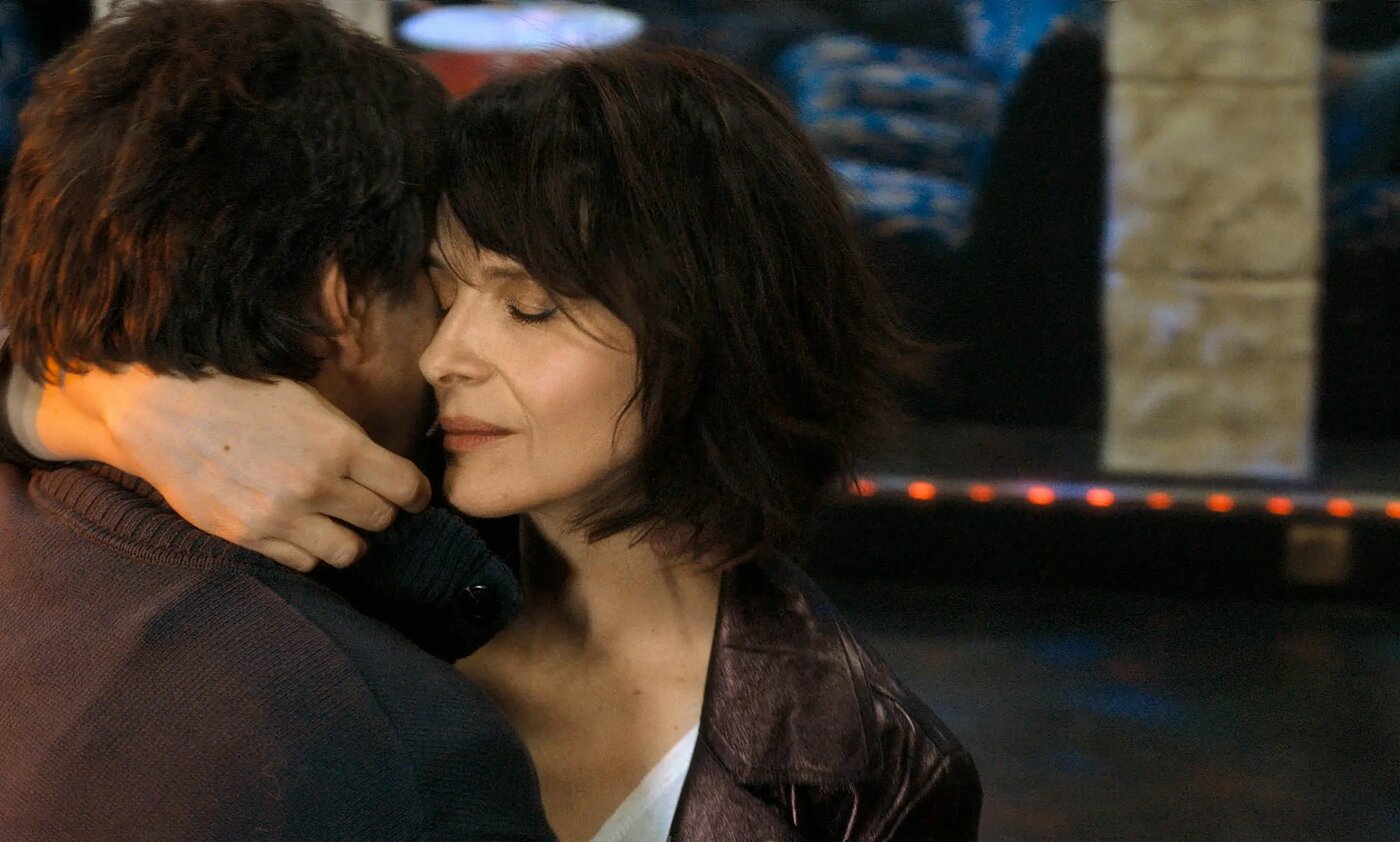
Let the Sunshine In (Claire Denis, 2017).
Where Ines affirms herself through consumption, Juliette Binoche’s Isabelle—a single, middle-aged divorcée—in Claire Denis’s Let the Sunshine In (2017) is denied sustenance, and this lack becomes part of her story. The film, one of Denis’s most elliptical and fragmented, shadows Isabelle on dismal dates with men of varying shades of boorishness, like the banker who inquires about “gluten-free olives” and insists on pouring the exact fingerwidths of whiskey himself. The running gag and private devastation here is that Isabelle never gets to eat. On one date with a younger actor that begins at a bar, she finally interrupts, plaintively, her voice nearly childlike: “Weren’t we going to have dinner?” The line is less a complaint than a flare of need, a reminder that she, too, has hungers.
In the film, food is kept at a remove: The lone sighting of a full meal is muted by the mediating glass of a restaurant window. Between dates, Isabelle visits the fishmonger and fingers produce that she cannot, will not cook. The camera trails her home but stops short of capturing any chopping, simmering, or feeding. The effect is sly and punishing, mirroring Isabelle’s broader romantic frustration, the endless dates that won’t sustain her. Binoche, who for decades has been cinema’s great gourmand—her sensuality inseparable from food in films like Chocolat (Lasse Hallström, 2000) or The Taste of Things (Trần Anh Hùng, 2023)—is suddenly starved. In one late scene, as if in conspiratorial tease, the camera pans over a plate of frisée and fries as her ex scolds, “You want to be happy, don’t you?” And yet, in stolen instances, swaying with a stranger on the dance floor, Isabelle is herself, fully in the moment. Someone let the woman eat.