The Misconceived (James N. Kienitz Wilkins, 2026).
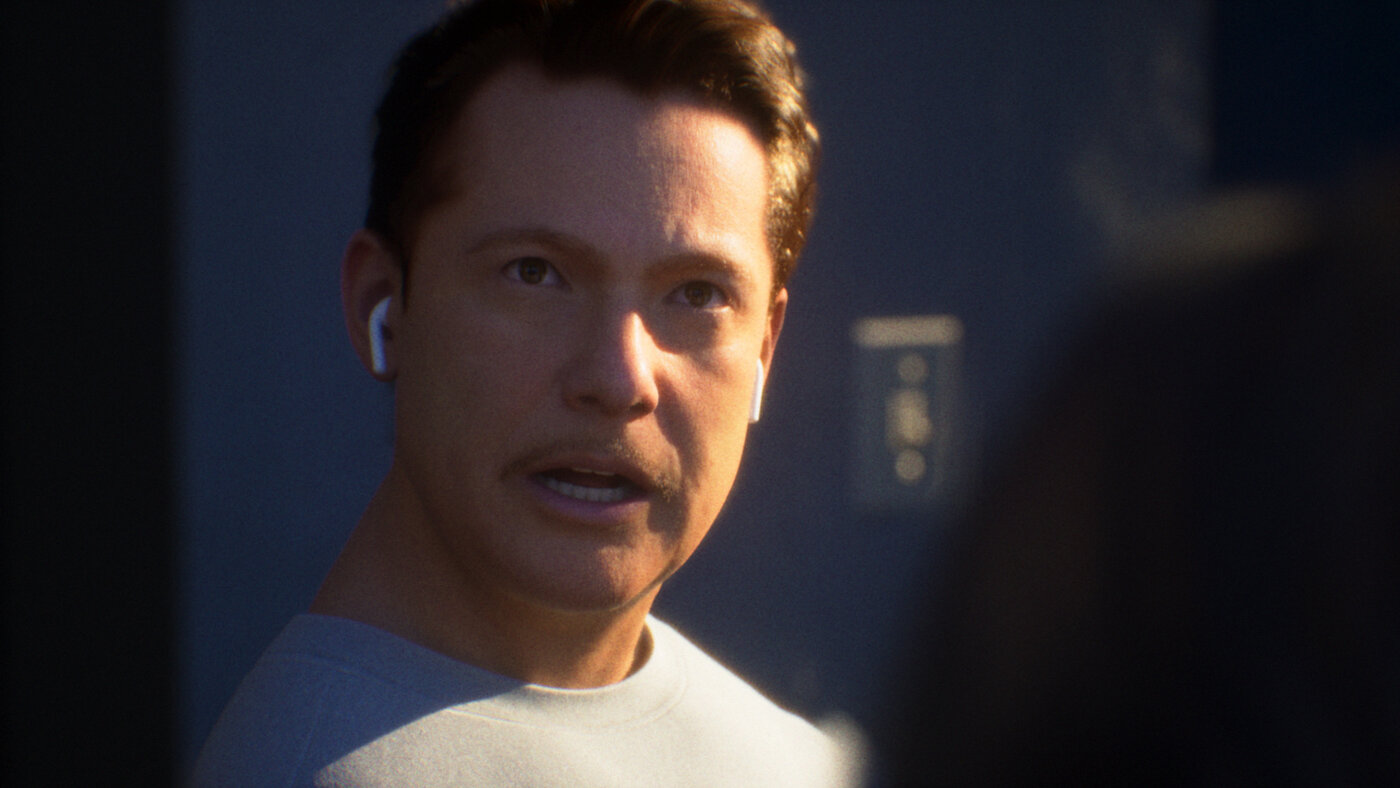
Despite what its title might imply, James N. Kienitz Wilkins’ The Misconceived (2026) is in fact one of the year’s most shrewdly devised films. While the movie originated as a live action feature, it feels somehow preordained that the finished product would end up in its final form as an inventive motion capture animation, as so much of its humor and sociopolitical commentary reflects the circumstances of its own making. A quasi-sequel to the New York-based Wilkins’ 2019 feature The Plagiarists—which, in the spirit of its duplicitous themes, he directed under the pseudonym Peter Parlow—The Misconceived picks up a decade or so later with one of that film’s two protagonists, Tyler, now a failed filmmaker and single father who takes a job working on his ex-college friend Tobin’s home renovation project. Save for a climatic scene set at a party for artworld types, much of the ensuing, dialogue-driven action takes place around Tobin’s house, during working hours, as Tyler and his co-workers—an ad hoc team of colorful personalities led by the veteran foreman Widgey—attempt to coexist despite a generational divide embodied most memorably by Mikey, a twenty-something edgelord with a flair for offending anyone within earshot. Meanwhile, Tobin, a married sculptor of minor repute, has no qualms gossiping behind closed doors with his wife Gwen about the crew's sluggish efforts, or interrupting Tyler to offer condescending advice on his personal and professional struggles.
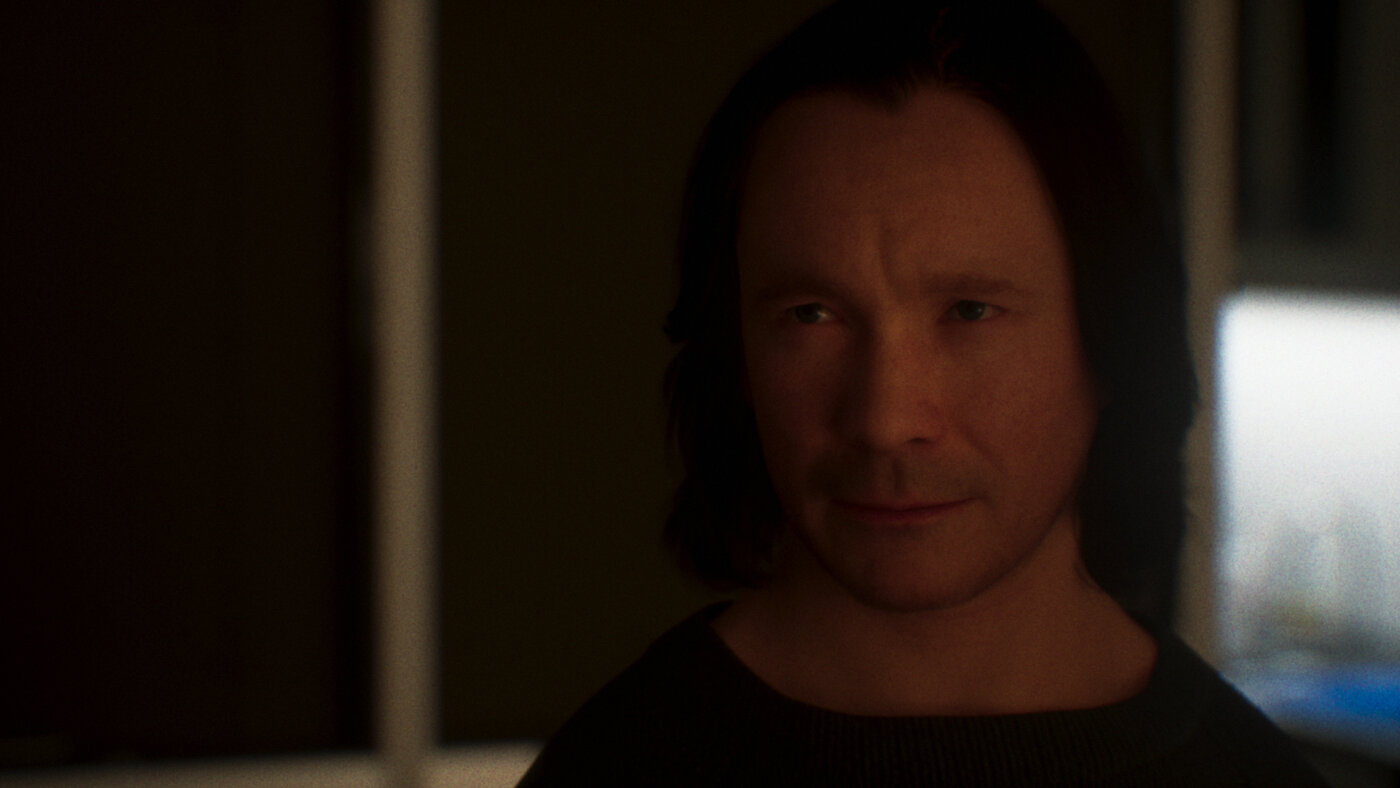
Even by the standards of Wilkins, a filmmaker whose past work includes a three-hour audio film (The Republic, 2017) and a feature made exclusively of 35mm publicity stills (Still Film, 2023), The Misconceived is a curious proposition. Rendered entirely with the open-world video game program Unreal Engine, the film offers an uncanny vision of cinema as a virtual playground. While the film’s voice cast is top-lined by American indie actors like John Magary, Jesse Wakeman, and Callie Hernandez, the motion capture work was done by an assortment of cast and crew members playing characters whose dialogue may or may not correspond to their sometimes cartoonish bodies. (Co-writer Robin Shavoir, for example, did the motion capture for four different characters but no voice work, while Magary provided the voice for Tyler and nothing else.) Like The Plagiarists, The Misconceived is also a film about filmmaking, specifically the economics of independent filmmaking, which Wilkins finds a conducive metaphor for in the film’s depiction of both labor and the class and race relations among the workers. In signature fashion, the writer-director’s dialogue brazenly invokes everything from pop culture to the work of his peers to the more uncomfortable aspects of contemporary life, where difference and diversity is, at best, tolerated, and, at worst, outright ridiculed. As pointed as it gets, though, The Misconceived is never less than a deliriously entertaining viewing experience, a metacomedic romp as odd as it is approachable and as corrosive and it is strangely comforting.
I sat down with Wilkins after The Misconceived’s world premiere at the International Film Festival Rotterdam to discuss the movie’s multi-part production process, the crisis currently afflicting middle-aged millennials, and how he hopes to reclaim the term “independent filmmaker."
The Misconceived (James N. Kienitz Wilkins, 2026).
NOTEBOOK: Based on the title of the film and some of the dialogue, I think I know the answer to this question, but was the movie conceptualized as something you’d make with a video game engine, or was it written as a live action film?
JAMES N. KIENITZ WILKINS: It was written as a live action film. Which is a funny thing to say because it's like, do you have to submit that intent when writing a screenplay? I’ve seen a script for a Pixar movie, but does it say in the script that this is animated? It's something that I hadn't considered—I just assumed it going in. We were planning on trying to raise money to shoot the film photographically, with actors performing as themselves. Robin Shavoir and I wrote the screenplay on the heels of The Plagiarists’ micro success, after it had done its rounds. It was meant to be made with a budget larger than anything we had worked on before. We actually participated in some pitching forums, which were online because of COVID. And that really ruined everything, because there might have actually been a chance of having received some seed financing under normal conditions after The Plagiarists. Pitching was really weird; no one was really wanting to finance movies because everyone was losing money. It was very palpable that something like this—a satire about the current moment—just wasn't going to happen. I remember having some pretty comical discussions with people at A24 and thinking, “Oh, maybe this will be a thing.” [Laughs.]
So we sat on the screenplay and worked on separate things for a number of years. Eventually I started getting really worried that it was a document of only the pre-2020 moment. I think what's happened is that enough time has passed that it feels like it's about that overarching moment—the Biden era, or right before the fall. But I'm really glad it's come out in 2026. I think it works even better now than if it had come out a year ago.
NOTEBOOK: It didn’t occur to me until I saw the film a second time that it’s something of a sequel to The Plagiarists, or at least a continuation of the Tyler character’s story.
WILKINS: We were very pleasantly surprised by how The Plagiarists was received—whatever cultural nerve it sort of hit. So the idea was to approach Tyler as a kind of archetype. He already was to some degree, because Tyler was based off of a character who was in this play that Robin wrote like 15 years ago called The Jag. I helped him a little bit with trying to get that shot, and I helped him edit the text to some degree. He ended up staging it as a play recently, but for a while it was sort of this dormant project that we were in conversation about. And I liked the Tyler character, so for The Plagiarists I was like, what if we take Tyler and we strip him of his actual background, but we use him as an archetype and we write a new story. We basically plug him in: maybe he’s a little older, but still has the same kind of energy. So after The Plagiarists, I thought, what if we do the same thing again, but fast forward into middle age. He's just a Tyler who happens to be here now; there’s probably many types of Tylers.
NOTEBOOK: How has your writing process with Robin changed or evolved over the years?
WILKINS: The way we wrote The Plagiarists and the way we wrote The Misconceived wasn’t much different. We write really well together; it’s sort of a night-day thing where we have different strengths and then we sort of offset each other. It's not the sort of fantasy of, like, going to a cafe together to write. It’s not about that at all. It's actually about separation and then sort of offsetting each other. The Misconceived wasn't written quite as fast as The Plagiarists, and we made the clear decision that I was going to direct this one as opposed to having the kind of ambiguity we did with The Plagiarists. So it was kind of my responsibility to figure out how to make this thing.
NOTEBOOK: You can’t blame “Peter Parlow” this time…
WILKINS: Exactly. [Laughs.] I made changes on my own over the last five years that Robin wasn’t as engaged with because he was off doing his own thing. He came back and did some of the motion capture and designed—actually sketched out—the look of the Mikey character. I then commissioned a 3D artist to make Mikey based on Robin’s sketch. So he was heavily involved in this short critical burst of production design and motion capture—he physically plays the body of Tyler, while John Magary does his voice.
NOTEBOOK: Can you describe how you worked with Unreal Engine? Were you at all familiar with this technology before making the film?
WILKINS: Not at all.
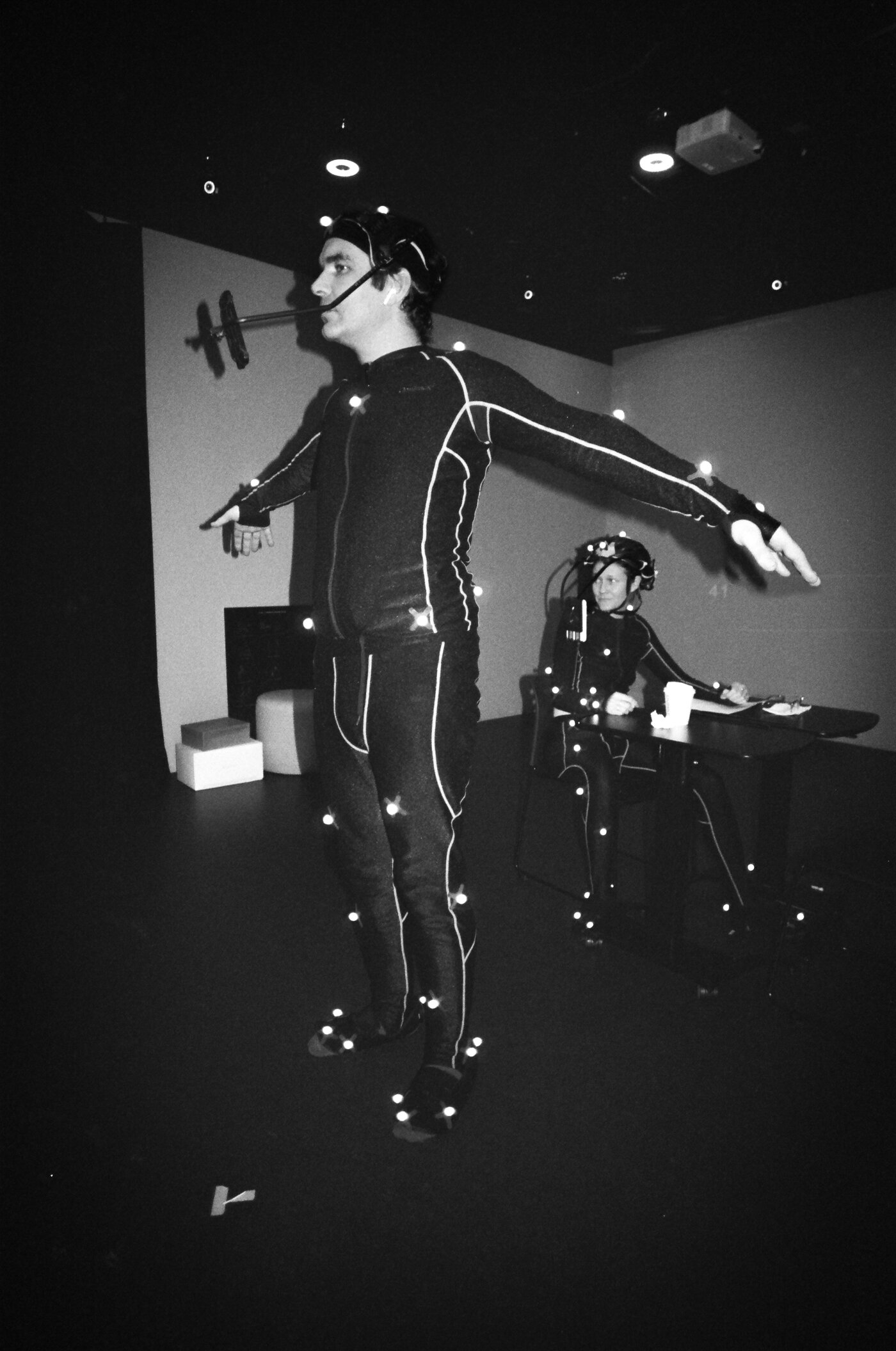
Photo by Pacho Velez.
NOTEBOOK: So you basically workshopped it on your own?
WILKINS:In a way, the movie is kind of a workshop. It’s fundamentally experimental in that we just didn't really know what the outcome would be. But that's not in opposition to having narrative consistency or story and all of that. A lot of the feedback we received was like, “I think the script is pretty good.” And that almost gave me license to experiment in this way, because at the end of the day, the skin of it is all still hanging on a cohesive narrative. And I feel very strongly that that’s where it steps away from similar aesthetic exercises that we see in the art world, where there's an allergy, it seems, to narrative, or this assumption that it's all about the surface or something. It’s not someone playing around with Unreal Engine and being like, I have an idea. I'm interested in this. And then making a bunch of things that reflect those interests, but without the durational commitment.
I did not know the technology. I had never actually heard of Unreal Engine. But I really wanted to make the movie and was bummed that it didn't seem to be happening. Around that time I happened to see these Taiwanese news shows on YouTube. It's this kind of direct conversion of the news, where if there's a fire or a shooting or something, a team of people will make an animation that dramatically reenacts it with voiceover, and it'll be done very quickly and ready to put online [the next morning]. It's really lo-fi animation, but it's really fluid and effective. And I asked my friend, the filmmaker Peter Burr, who makes pixel animations, how they make this stuff so fast. And he was like, “Oh, it's just mocap—motion capture. It’s easy, simple.” And then he tells me that he’s in this long-term residency at the Onassis ONX Foundation, where they have this whole mocap studio. So Emily [Davis], my producer, and I went into the studio with Joey [Frank], the executive producer, and two pages of the script and they got into motion capture suits and just performed it. When I saw it on screen behind them, I was like, “The movie has begun. We are absolutely doing this.”
NOTEBOOK: Regarding the animation, I’m curious why some of the characters look more or less like humans, while others, like Mikey, look more cartoonish?
WILKINS: To get really technical, and this is the complicated thing about it—it’s almost like there were multiple productions. We recorded all the audio first. But the motion capture is the capture of physical movement and facial movement. So imagine your skeletal data and your muscle twitches being recorded. When an actor performs in a motion capture suit, there's no camera angles. It's all 360 [degrees]. And there’s no “look” to the character. It’s just movement data. So any skin can be put on that character. Like, I could have Mikey’s body perform Tobin’s actions instantly, if I wanted to. There's no fidelity there in terms of the way Tobin looks, or the way Gwen looks, the way Widgey looks—the way these human characters look has nothing to do with the way the actors look.
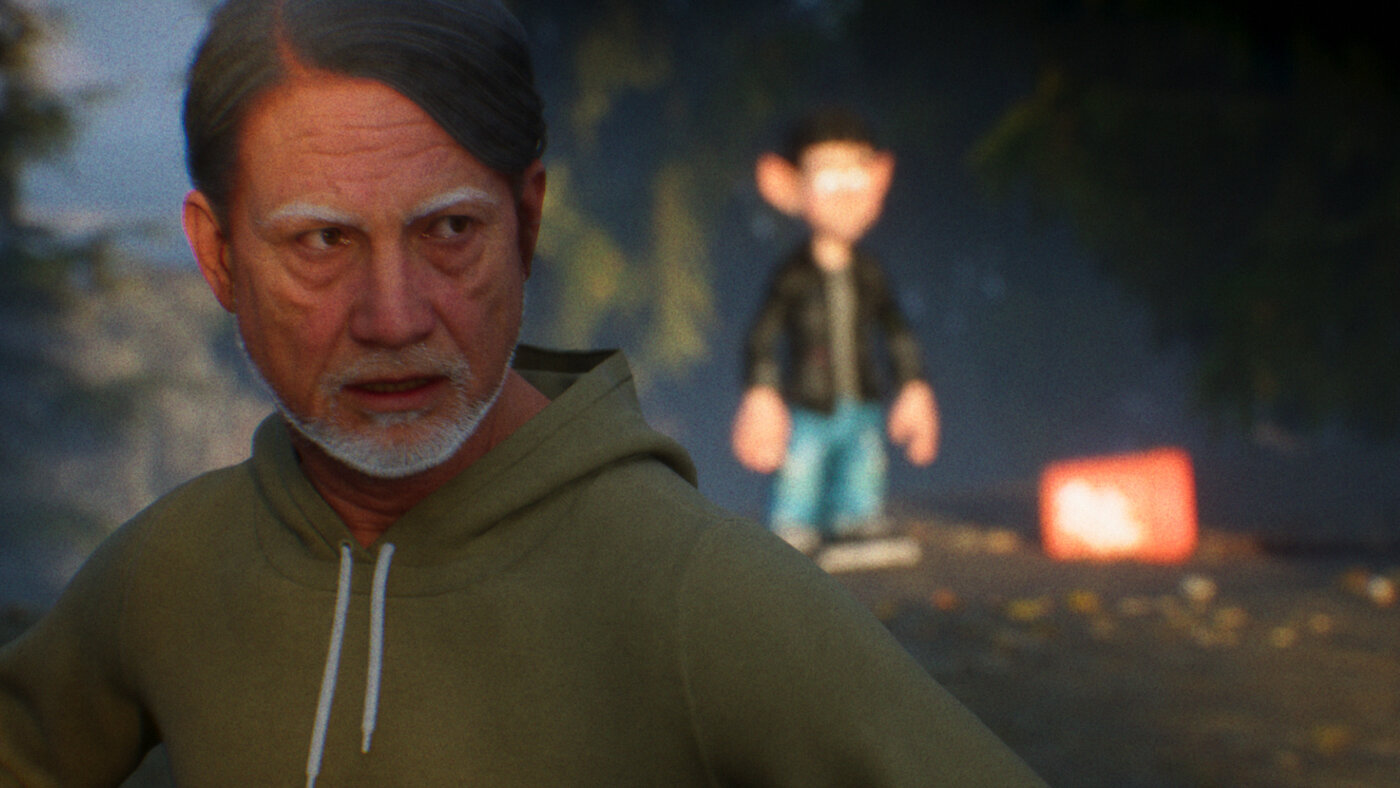
There are also built characters, but we built using different categories of categories. Unreal Engine is a free program, and this was really key with regards to having access. If you make more than $1 million with your project, you have to pay royalties, but under that, it's totally free to use. Unreal has this kind of [human creation system] called MetaHumans, and you can make them any race. It's really bizarre. It actually sort of proves to me that race is truly a construct. Like, I can make somebody that looks like you and then I can use the slider to slowly turn you Black, and then Chinese or something. Also, it’s reliant on the best Unreal Engine can do circa whatever year you're working within the program. And the characters can be rendered at higher or lower quality. We chose a mid-range because we didn't have endless processing power. But there was a kind of hierarchy to what we could achieve at that moment in terms of a humanoid. When I realized that this look was the peak, it made me think about what lies below. Working within the movie is a fundamental class structure: regular employees versus under-the-table employees. This is why the technology really stood out to me. I thought, wow, this completely embodies the economic situation here—and the race dynamics and the class dynamics. It can all be visually represented by how we choose to represent the characters, and how they're exploited or how they're stereotyped.
Beyond the MetaHumans, there are other options like downloading stock characters that have been built already, that we then modify a little bit. And some of them come with deficiencies, like Manuel, the Mexican foreman—his mouth can’t move but his eyes do. But otherwise he's very manual—he’s all hands and muscle. He was made by somebody who was selling him as a royalty-free asset. I bought Manuel for $40, and we rigged him out to move and then to accept motion capture data. So he then becomes a sort of mid-grade character. As far as options, there’s a lot of sexy vampire women, because these nerds who like to make this stuff, they love, like, big titted, sexy anime girls. [Laughs.] It’s like a meat market of these toons. The curator character, who’s played by Callie Hernandez, is a vampire model that I bought. But I didn't want it to be so cut and dry where it was just purely, like, if you're low on the totem pole you’re a toon. But there's also maybe a generational thing happening, where the Gen Z artist kids are more aligned with the toon aesthetic. I was playing with all of that but allowing it to be physically manifest. But it still reflects the limits of what we had: MetaHumans were the best; we had marketplaces where we could buy cheaper characters; and we designed and spent money on one very high-end toon, which is Mikey. And then others were hybrids.
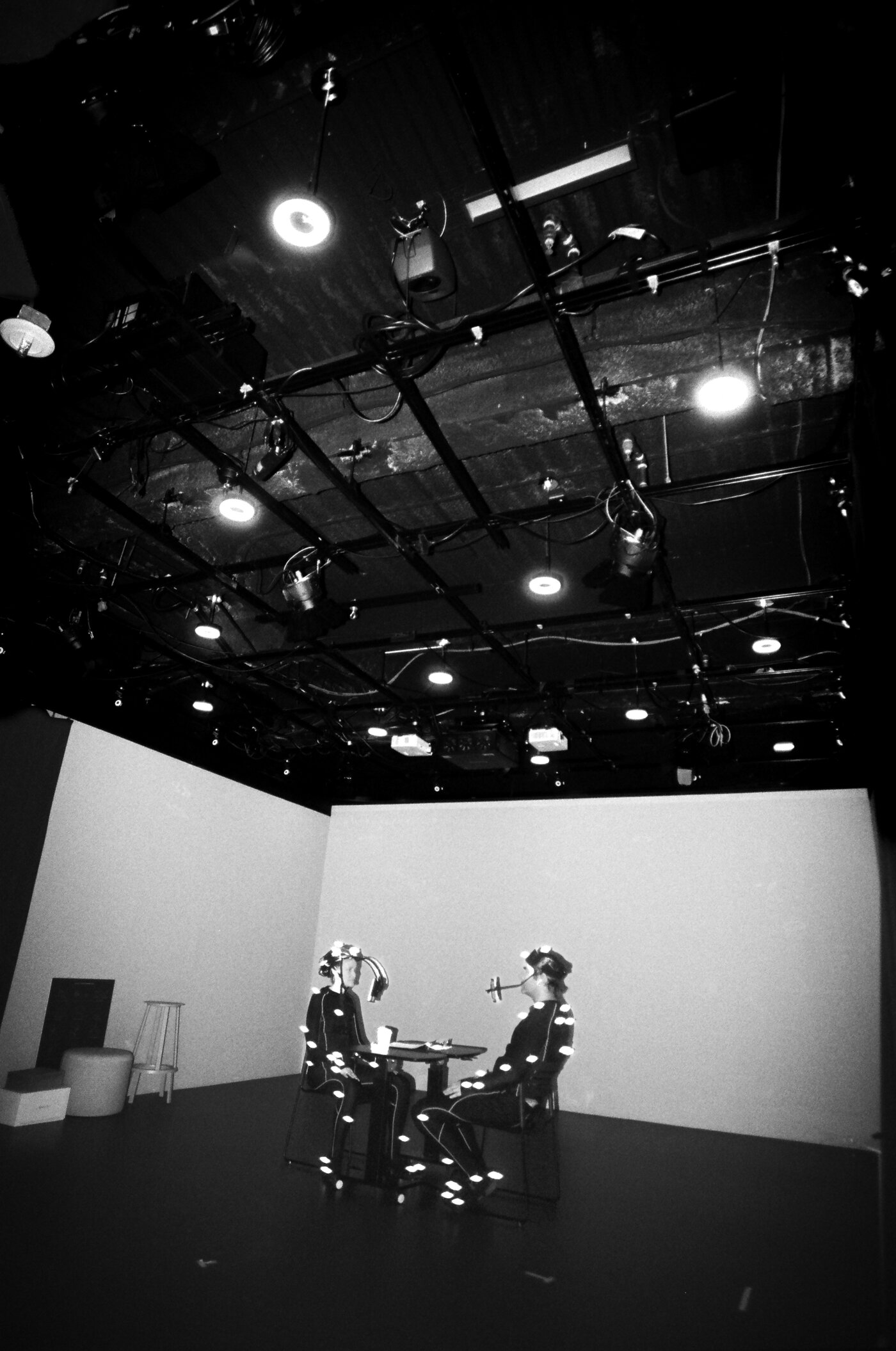
Photo by Pacho Velez.
NOTEBOOK: Did you find there were other limitations to the technology? One of my favorite visual quirks in the film is how the characters can’t quite grip cell phones—there’s a gap between the phones and their hands.
WILKINS: One thing we noted from the start was that if we wanted to have the characters’ fingers move we had to engage a whole other layer of production. We’d have to put on special motion capture gloves that have joints and all of that. And that would have to be another stream of capture data that I have to process. So very early on I was like, forget it, we’ll just have these pancake hands. [Laughs.] But they can do a lot. They can at least bring a phone up near their head. They can say no. They can hold some things. As with a lot in the film, we found how to make it work.
NOTEBOOK: You mentioned that you recorded the audio first?
WILKINS: Right. Part of the reason I knew this could work is because all the voices were recorded first. Before I even knew we were going to use motion capture, I started casting actors and recording them reading the screenplay. I recorded them separately and then edited them together. So I had the whole movie edited as audio first.
NOTEBOOK: Is that similar to how you made The Republic?
WILKINS: Yeah, that was edited the same way. And then I broke it into scenes and the actors are lip syncing to the finished edited audio scenes. It was like the law was the audio—the tempo of it. I knew I wanted the delivery to be specific in that way. And because the motion capture was so new—if the audio was already fixed, I knew that at least it would be editable eventually.
NOTEBOOK: Were you casting people mainly for the voices, then, since in most cases different people are performing the motion capture?
WILKINS: Yeah. We didn't even know what the parameters of the motion capture would be. I think it was really great when a couple of the actors were able to do both.
NOTEBOOK: You mentioned the class and race dynamics among the characters, but there’s also a generational aspect to the story, with Mikey being the clear disrupter and annoyance for a lot of his older co-workers. Was this something you were looking to explore along with those other themes that are present in a lot of your previous films?
WILKINS: We’ve been calling the film a millennial tragic comedy, which is a little misleading in that it's not just about millennials. But I think it's about a certain crisis that middle-age millennials are experiencing now. And that's why it's a movie about now—or like the spread of now, at least. I think very purposely the main figures in this sort of morality play are Mikey, who’s young, 20 or 21; Tobin and Tyler and Gwen are core millennials, like 40; and Widgey’s a boomer. And they all have different takes and ideals. I know people say generations are fabricated and all that, and obviously they are, but I think generations are also a choice. People choose to identify as certain generations as well. I’m very interested in that sort of choice, or when it's not a choice, or when we exhibit the cliches of our generation, or start to see or probably feel that we are old, or when you just start noticing that there's a difference here, a difference in values. And I think millennials in particular are so dominant that it's a little bit of a shock, collectively, to think about what’s currently going on, that there is a younger generation that has its own ideas that aren’t all about, like, curation. Millennials, we’re obsessed with curation, you know? But you can’t control it all. That’s really the theme of our generation. And I think Tobin is really wrestling with that particular theme as a character.
NOTEBOOK: Was it tricky to write the Mikey character? For me, he’s the funniest character, but he’s also saying the most off-color stuff. Did you feel like you had to thread a needle between things being offensive and humorous?
WILKINS: You know at the end of the film when Gwen gives her monologue? She essentially says to Caitlin, “I don't agree with what has been said. Nor with who they are. But I’m at least trying to understand why they say the things they say. It seems like there are people out there that think this way, and maybe, unto itself, there's an honesty there.” I actually don't find Mikey to be that offensive. He's literally kind of a troll, you know? He obviously knows it's going to get a rise out of Tobin. But it's sort of Tobin's choice to take the bait. Mikey is sort of stating the obvious thing. It's tricky stuff. It can be hard to talk about.
And, to be clear, I think this is different than what we're seeing now with this right wing, wealthy-kid filmmaker and podcaster trend. That whole scene is very evidently self-serving. Mikey isn't part of that. And the thing about it is that labor and class play a role. Robin works in construction, and Mikey is modeled on a guy he knew, and I’ve known guys like Mikey as well. They're almost innocent in a way. They’re offensive, but they're almost innocent. And this faction I'm talking about, they’re not innocent. They're playing a power game. Mikey has no power. He fantasizes about it. But he has none. His only power is when he realizes he's getting under someone's skin. For him it’s like, tell me more? Why can't I say this word? And I think his question is legit. If Tobin actually had a good explanation, Mikey would not say the word. He's not interested in saying the word to hurt people. He's like a child, in a way. I feel like I'm kind of fond of him in that sense.
NOTEBOOK: Like The Plagiarists, the new film feels like an implicit comment on the economics of indie filmmaking. I’m curious how you conceived of that aspect of the film while also folding in the layers of reality about its own making along with references to other directors of your generation?
WILKINS: You mean the success stories. [Laughs.] I think that aspect is very critical, and I have a lot to say about it. For me, the sort of big picture, or maybe thematic, impetus, that isn't really named, but I think it's evident, is about having multiple identities: just being a split of something and having expectations or desires that aren't compatible to some degree. I guess one way to look at it would be the art world and the film world: where does one want to succeed? What games do you have to play? And why is it hard to find a third space that's sustainable?
NOTEBOOK: You could say that’s what most of your films are about.
WILKINS: Yeah, because frankly, I want that third space. That’s what I’m most interested in. One thing I've been saying lately, which I feel is maybe offensive, is that the art world is very intelligent, but very lazy, and the film world is extremely hardworking and quite dumb. Especially with narrative, I feel like the art world is interested in my ideas, but then will sort of codify the idea and be like, “Oh, this represents this.” And then everyone says, “Cool, good effort representing this. We'll talk about what it isn’t, what it's supposed to be. Because I don't actually see physically that it is what it is.” So it's just endless discourse. And then in the film world it often seems threatening to get into stuff beyond the story level. But what if you like elements of both and want to function in these spaces?
But as far as indie filmmaking, I kind of want to reclaim the term “independent filmmaker,” because I don't honestly know anybody who embodies it. And this probably sounds hubristic, but I am a completely independent filmmaker. I literally am. There's no question. But if I were to go to Sundance with a movie and say I’m an indie filmmaker, people wouldn’t know what to do with me [because of the way I work]. That contradiction right there is something I've always wrestled with, because I want to make [narrative] features. I like the durational form and the almost novelistic way of engaging with movies. But I think it's pointless to make movies the way that they are often made; it's a really stupid endeavor. And to make yet another movie set in upstate New York with a bunch of young, creative—not even wealthy—but just people who have the free time and the liquid capital to make a movie, is pointless to me. The idea of making a movie as, like, a good ol’ time, and then everyone's supposed to take it seriously—to me, it’s outdated and it's indulgent. But part of me wants to do it.
It’s no coincidence that the core setup of both The Plagiarists and The Misconceived are indie film clichés: two old friends reunite; two bros get back together. I've talked a lot about this with Jesse Wakeman; that film he’s in, Donald Cried (2016), is about that. John Magary's film The Mend (2014) is basically about that. And that's not a judgment on the movies. But I told Jesse that I think Donald Cried is the last of these types of movies—about the dissolution and rekindling of a male friendship—that can be made in this era. So one of the ideas for this film was to take those themes and apply them to a totally different form.
The Misconceived (James N. Kienitz Wilkins, 2026).
NOTEBOOK: Can you tell me a little about your interest in using stock music in your films? And also the idea behind having the music occasionally overwhelm the dialogue in the movie?
WILKINS: The use of stock music is the continuation of a tactic I've used in a number of movies—Pond5 stock music, to be specific. In a way, it made the most sense for this movie because it's not just the music that’s stock: there’s libraries of 3D objects used in the film that are disguised through the cinema lens of Unreal Engine. I think the movie really reflects a breaking point in the availability of this type of media. Even, say, eight years ago, there wasn't as much of the world replicated online and available as royalty-free downloads. People make virtual water bottles and couches and candles and bushes and put them online for free, or for $5, but royalty free. That's why the credits are so long: it's all these stock offers that I would buy from or lease from. And with these I was able to compile this pastiche world that was then sold through framing and cheats as something that's cohesive. For me this also applies to the music, this idea of the generic becoming hyper specific by taking it very seriously. The Plagiarists is a movie that is quite experimental, but under the right circumstances could operate as a commercial object, in which case we would need to clear the rights. So using Pond5 stock music is a cheat to get around that.
The other thing is I just love that kind of music. I find it to be, like, 95% there. Like, it's Neil Young-ish, but it's not Neil Young.
NOTEBOOK: Yeah, the music triggers memories of songs you think you know.
WILKINS: Exactly. It's super close to it. And I love that. Because we're not going to actually get the Eagles or Neil Young. Sometimes the music is diegetic, and other times it’s sort of like themes coming through the characters and suffusing the house. The reason the music is battling with the dialogue, beyond heightening the energy, is that it's like another voice, or another noise in this construction space where you're hearing saws and you're hearing music and it's just going, going, going, going.
NOTEBOOK: One of the big things that’s emerged since you wrote the film is AI, and I could easily imagine someone making this same movie with that technology—though it would, of course, lose its inherent meaning.
WILKINS: That's another reason I'm glad the movie's coming out at this moment. I think that it’s very much marked as a handmade product of the technology that was available in this very specific few years. If this movie had been made even a year later, it probably would have been about AI. And a lot of people do think it's AI generated. We’ve actually had to go out of our way to say, actually, it’s really not. There’s something super specific about the choices I made. AI could copy it, but I think my hand is—I mean, I spent a year-and-a-half by myself just learning this program on YouTube and figuring out how to do it. There was something masochistic about it. It was really painful, to be honest. It was hard, it was so much work and I had no idea when it would end—that was the freaky thing. But I do that to myself. I set these goals for myself, and I'm like, it's just gonna happen. And AI is the antithesis of that. The whole idea behind AI is to eliminate work. I don't think I would work this way again, but by its nature, both culturally and politically, the characters are living in a kind of before-the-fall zone. It’s almost like right before Trump was elected most recently—it feels like the movie occurs in those years. But a compression of those years. So it goes with the AI thing: this movie was made right before that. For me, the only thing that really mattered deadline-wise was just making sure it came out before Grand Theft Auto 6. And also Harmony Korine: he keeps talking about his mocap adventures. I wanted to be on record that I was doing this before Harmony—and with much less money.
NOTEBOOK: Say what you will about Korine’s recent films, but he’s one of the only prominent filmmakers attempting to grapple with new technology in an interesting way.
WILKINS: Totally. His stuff is too stylized and product-oriented for my taste, but I do agree with what he said about how cinema is moving in this direction. That these are the tools of filmmaking now. And that's not to denigrate the way movies have mimicked photography up until now. But it's just odd to me to not be interested in what these tools offer. I think the hang-up that people have is that it often comes with an aesthetic. In the case of this movie, even the way these humans look—they’re aestheticized in a certain way. And that might rub certain people the wrong way, who feel like it's an animation. I actually don't think this is an animation. I don't think that term is accurate for the work that I did and the work that the motion capture actors did. Their data was captured. It was sampled, and then used to essentially bring these puppets to life. You capture footage and you work with what you have. I wasn't manipulating much of the original movements that were captured. It was more about choosing the ones that were the best takes. I don't even have a word for what this is, to be honest.
NOTEBOOK: Can you talk about the freedom the 360 technology afforded you as far as moving through these scenes or spaces and choosing certain angles or details to focus on?
WILKINS: The thing is, I have freedom, but I don’t. There are still parameters—the parameters being technical ability. This is actually where I differ with animators, too. Pixar has freedom, right? They have the freedom of resources where they can truly keep repeating things until they get exactly what has been storyboarded. So, yes, technically it's 360. It’s like building a world, or a map. Unreal Engine is meant for video games that you exist in. So I actually did build a very large acreage of forest land, with the house in the middle of it and the road and all this stuff.
But the first parameter was simply the story, the script. And then the second parameter was visual: I knew it would be mostly done in close-up shots. And the close-up allows for a kind of disguising. Because in order to hide the gaps and the cracks in the process, it was about compression of space through my understanding of lenses and framing and limiting details. The camera can fly around everywhere, and it's really cool and interesting. But that's not the movie, you know? All that material still exists. But for me, that's not the movie. The movie was actually funneling it down and choosing, knowing that it would end up actually flattened, framed, and limited with boundaries: the boundary of the story, the boundary of the frame, the boundary of the close-up, the boundary of the feature-length runtime and not being a Choose Your Own Adventure-type experience. And now we're hoping to print it to 35mm, so also a boundary of it being an actual physical object.
NOTEBOOK: You mentioned that you’re not probably interested in making something like this again, or at least in this manner. But are there things you learned through the process, whether practically or economically, that you might carry with you into your next film, regardless of it’s live action or not?
WILKINS: I wouldn't say that if I return to live action it’s as a response, but more just that I have an idea that suits it. I'm not disinterested in working with motion capture again. It's just that I don’t think I could survive this process again, where it puts so much on my shoulders and the shoulders of a few people with such limited money. But I say that every time I make a movie. The Plagiarists almost killed me, too.
So it’s a question of whether the project fits the form. I would love to make a motion capture TV show, and it doesn't necessarily even have to look this way. The technology is rapidly changing and depending on how much money one has—that's really what it comes down to. I would do it again if I had a lot of money and a team. But I've exhausted it on the sort of indie-film-critique level, in my sort of small scale way.
The key with a movie like this is that it still required a certain experience to be able to pull off. Whether one likes it or doesn't like it. I know how cameras work. And I also know how to spatialize and work with real people in real spaces. That knowledge was absolutely critical to the motion capture and being able to be efficient. And then with the cameras, I built virtual cameras that matched optics that I’m familiar with in real life and that I understood. I needed cinema as it is in order to enter and build a sort of future cinema. They're not mutually exclusive at all. I think it's a continuum: even if I shoot a live action thing next, I'm still going to be working fundamentally with choreography in space and rendering 3D space in 2D media. That’s sort of what it is. Economically, though, money is just an insane thing: it’s the curse of being an American filmmaker who's not engaged with Hollywood.