
2026 Toronto International Film Festival sponsorship ad by Rogers.
At Cannes, competition screenings are preceded by nothing more than a computer-generated set of red-carpet stairs ascending out of the sea, sans any credits for financial supporters or slogans, in keeping with the festival’s self-image as cinema itself, purged of anything inessential. (This conception isn’t true, but it’s a nice, self-burnishing illusion about the world’s most prestigious festival.) This is a flex: To not have to mention sponsors is a self-presentation of financial invincibility. Less affluent concerns must acknowledge sponsors in their opening bumpers (in-house commercials branding both the festival and its supporters), albeit briskly, as in Sundance’s graphics about storytelling shifting to very quick cards listing institutional and individual sponsors. At the bottom of the scale is Tribeca Festival, the for-profit entity which treats audiences as multiplex captives, subjected to a lengthy pre-screening reel of commercials before an introduction, followed by even more ads prior to the film.
The Toronto International Film Festival (TIFF) occupies the top of the lower-end tier: It still shows more dignity than Tribeca (or your average multiplex experience) in avoiding pre-screening ads at public screenings, but after the introduction, audiences are in for it. Things begin innocuously enough, with a land acknowledgment assembled from the films of Canadian documentary legend Alanis Obomsawin, redolent with the flavor of corporate virtue-signaling c. 2020 but not aggressively disingenuous. Just as unexceptional are the ads for Christie projectors, which invite the audience to imagine themselves as children playing with space-themed toys and eventually watching a sci-fi movie in a cinema, suggesting a Hollywood mentality regarding the outer limits of what movies could be. These ads tend to breed feisty call-and-response resistance and, in a strange way, bring audiences together; this year sparked a (terrible) new tradition of self-selecting audience members calling out “We love Christie!” in response to the nonsense corporate tagline, “technology that loves cinema.”
The most notable bumpers at the festival are supposed to present the audience back to itself as common-sense people who like movies but are normal about it. More importantly: They want to see celebrities! For filmgoers who buy tickets to gala premieres, this is a crucial part of the experience—and while almost every festival leverages star power, TIFF goes further than most in stressing this. A fresh addition to the bumper lineup this year were ads for “TIFF 50/50,” a raffle/lottery in which buying tickets makes consumers eligible to win prizes for, among others, weekend getaways and Olivia Rodrigo tickets. A narrator presents three scenarios beginning with “what are the odds,” two of which involve celebrity encounters: riding in an elevator with a famous person, then later standing in line and meeting “the love of your life” while getting photobombed by a movie star. “Anything can happen at TIFF,” the ad promises. Gamifying proximity to fame, at a moment when the rise of legalized gambling in the US—on sports, elections, box office returns and any other scenario that can be gamed out—has become a hot-button issue for the attendant devastation that comes with it, seems both tone-deaf and an inadvertent sign of fiscal desperation. Festivals have all kinds of ways to drain attendees’ wallets, but this is an unusually blunt and meritless way to do so.
Though TIFF shows everything from large blockbusters to experimental short films, its overall balance leans commercial, and watching these ads in different spaces highlights the impossibility of creating a unified experience. At public screenings of big titles, audiences tend to be eager to be pleased; they laugh easily and broadly at these spots, which include ads for sponsors Visa, TikTok, and Rolex. But at the Wavelengths section, a chillier, largely silent or outright hostile response is heard; I think fondly of the year a person yelled, after one particularly egregious spot, “Stop trying to make us buy stuff we don’t need.” It’s hard to maintain a big tent, and TIFF’s conception of its audience decisively favors gala attendees; in artier screenings, it’s hard not to feel marginalized.
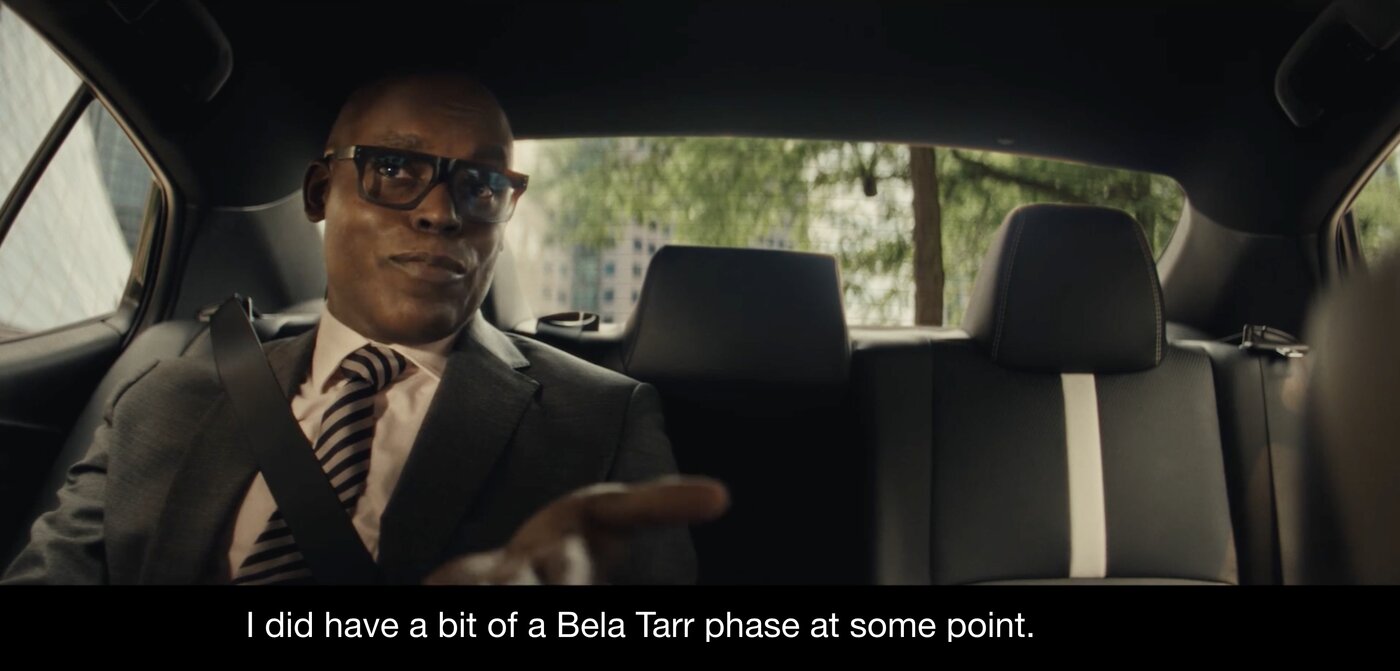
TIFF CEO Cameron Bailey in the 2026 Toronto International Film Festival sponsorship ad by Rogers.
By day five, I was starting to deliberately memorize the worst lines from the TIFF bumper spotlighting longtime fest sponsor Rogers, the direst component of the festival’s prescreening lineup. Here, audiences are presumed to be normal people who “like movies” but would never say a word like “cinema.” Thus, in the first of this year’s two Rogers ads, we encounter the spectacle of a multicultural array of Torontonians saying things that no human ever has. A grocery store vendor, in English: “It was based on a Latvian folk song about sheep herding.” (Response, in Cantonese via subtitles: “What are you saying?” Puncture that pretension!) A teenage girl: “Turns out, I love brutal nihilism.” Penultimately, a cab driver: “Of all the Eastern European New Waves, Hungarian New Wave really does it for me. How about you?” Reverse shot to TIFF CEO Cameron Bailey: “I did have a bit of a Béla Tarr phase at some point.”
Why are jokes about “arty films” invariably combinations of Eastern European countries and presumably impoverished protagonists? Is there such a thing as “anodyne nihilism?” While there was a Hungarian New Wave, Tarr came after it—in any case, is he a phase one goes through en route to maturity, the same way that Quentin Tarantino claims that he ingested Godard before embracing the true cinema values of the grindhouse? Meanwhile, the equally infamous volunteer bumpers annually present little comic skits of volunteers acting wacky; while audiences always applaud these regardless of the content as a sign of thanks for necessary unpaid labor, the ads are seemingly designed to make audiences hate volunteers. In both cases, audiences are encouraged to recognize the behavior of those near them as nerdy or outright pathological, stoking contempt for one’s fellow travelers.
In addition to branding and money, TIFF’s ads also service local interests. This year’s volunteer skit performers included Veronika Slowikowska, a casting choice which has a certain Canadian dog-whistle dimension—Slowikoska is the first Canadian SNL member since Norm Macdonald. The ads for Rogers were directed this year by Chandler Levack, whose first two features (I Like Movies, 2022; Mile End Kicks, 2025) premiered at TIFF, and who’s gone on to direct the Netflix comedy Roommates (2026). In commercial terms, that makes her the leading breakout of recent Canadian cinema, and to direct these spots might be considered a form of paying it back. Foregrounding Cameron Bailey as a punchline in the first of these two spots is part of ongoing efforts to make him the Face of the Festival, a celebrity on par with any of those attending—but I heard zero audience response to the appearance of the TIFF CEO, positive or negative, any of the (too many) times I saw these ads.
None of the chirpy forced populism conceals the obvious truth: TIFF is not, and has not been, “the people’s festival” for some time now. Rising ticket prices and diminished access across the board, coupled with a visible fraying of infrastructure, has made the festival more prone to producing snappish, disgruntled audiences. Stressing the red carpet above all else inadvertently renders the films themselves as anticlimaxes; after you’ve bypassed the skit-night volunteers and annoying cinephiles the bumpers tell you you’re surrounded by, who would want to watch a movie at all?