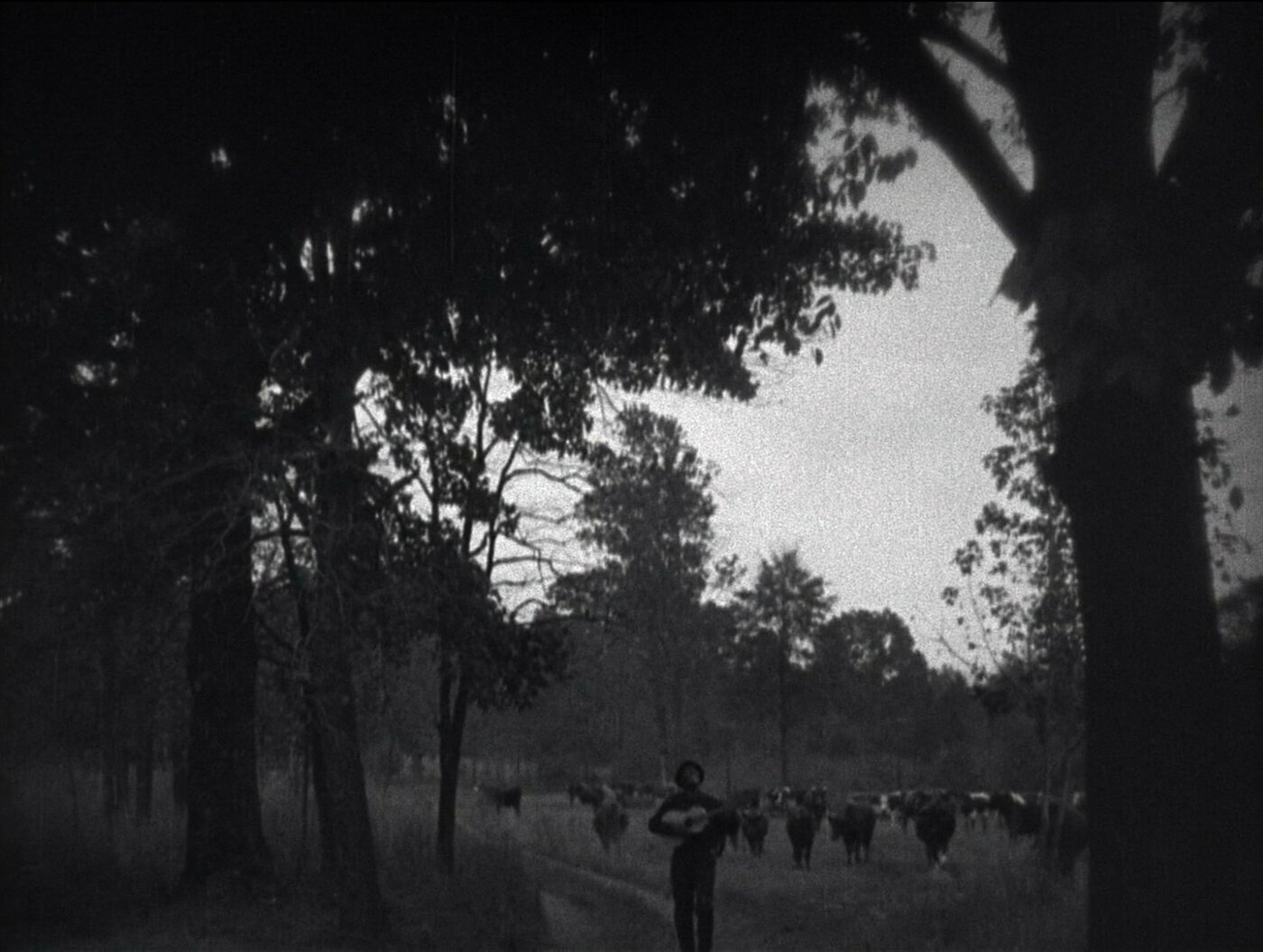
Hallelujah (King Vidor, 1929).
The American South exists only in the imagination, yet it’s as real as sin. It cannot merely be the land situated beneath the Mason-Dixon (the historical survey line that traditionally demarcated Northern and Southern states), whose citizens fought under the banner of the Confederacy; one cannot ignore the obviously Southern states of West Virginia and Kentucky, or the political split between West and East Tennessee. It cannot be a shared culture or a shared history, for the residents of Jacksonville, Florida, find little in common with those families tucked deep in the Appalachian hollers or those ruling the oil-rich cities of eastern Texas. It is not a nation with shared laws, beliefs, or even religions. Instead, as the writers of the region have long known, the American South is a series of stories that overlap, contradict, and play off each other. It is the American history textbooks’ Confederacy, the myth of the Lost Cause, the visions of the New South, the exodus-point of the Great Migration, the last breath of European aristocracy, the dumping grounds of White Trash, the hellish site of America’s sins, the scapegoat for America’s sins, a place where everyone tries to remember, and a place that everyone tries to forget. The stories that are told well and told often create this imaginary South in the minds of its Southerners, and, importantly, in the minds of everyone else. In the twentieth century, there was no bigger storyteller than Hollywood.
There is not one cohesive story that leads to a singular “Hollywood South.” The Hollywood South is also full of competing and contradictory narratives. But, as Deborah Barker and Kathryn McKee note in their introduction to American Cinema and the Southern Imaginary (one of the few studies on the American South in Hollywood), “particular images or ways of seeing the South persist alongside these expanded approaches to [the study of the South], in no small part due to the way the South has been represented in film.” These images, such as the decaying antebellum mansions that would be commonplace in the Southern Gothic, cut through the confusing regional differences and competing historical narratives to represent the South in the minds of cinema-going Americans and eventually, those abroad. These images are themselves anything but simple, but they proffer a unifying concrete vision that only cinema could forge.
A few key figures forged a Hollywood South that came to represent and, in turn, helped create this region, people, and culture. This creation was as accidental as it was deliberate, and, despite Hollywood’s sequestering to Southern California, often involved the participation of Southerners inside and outside the studio system. It’s a story forged by fear, politics, pride, and financial accidents, all of which are reflected in the South it helped to create.
But who, specifically, created this Hollywood South? What kind of decisions were they making, and how often were they vetoed? Did the word of a producer or a writer matter more? When and why did filmmakers choose to shoot, at great expense, in the South itself rather than on a Hollywood studio set? How much did the reaction of Southern audiences matter? The answers to these questions vary among productions, of course, but these are the questions that help uncover a secret history of American cinema.
PART I
ORIGINS
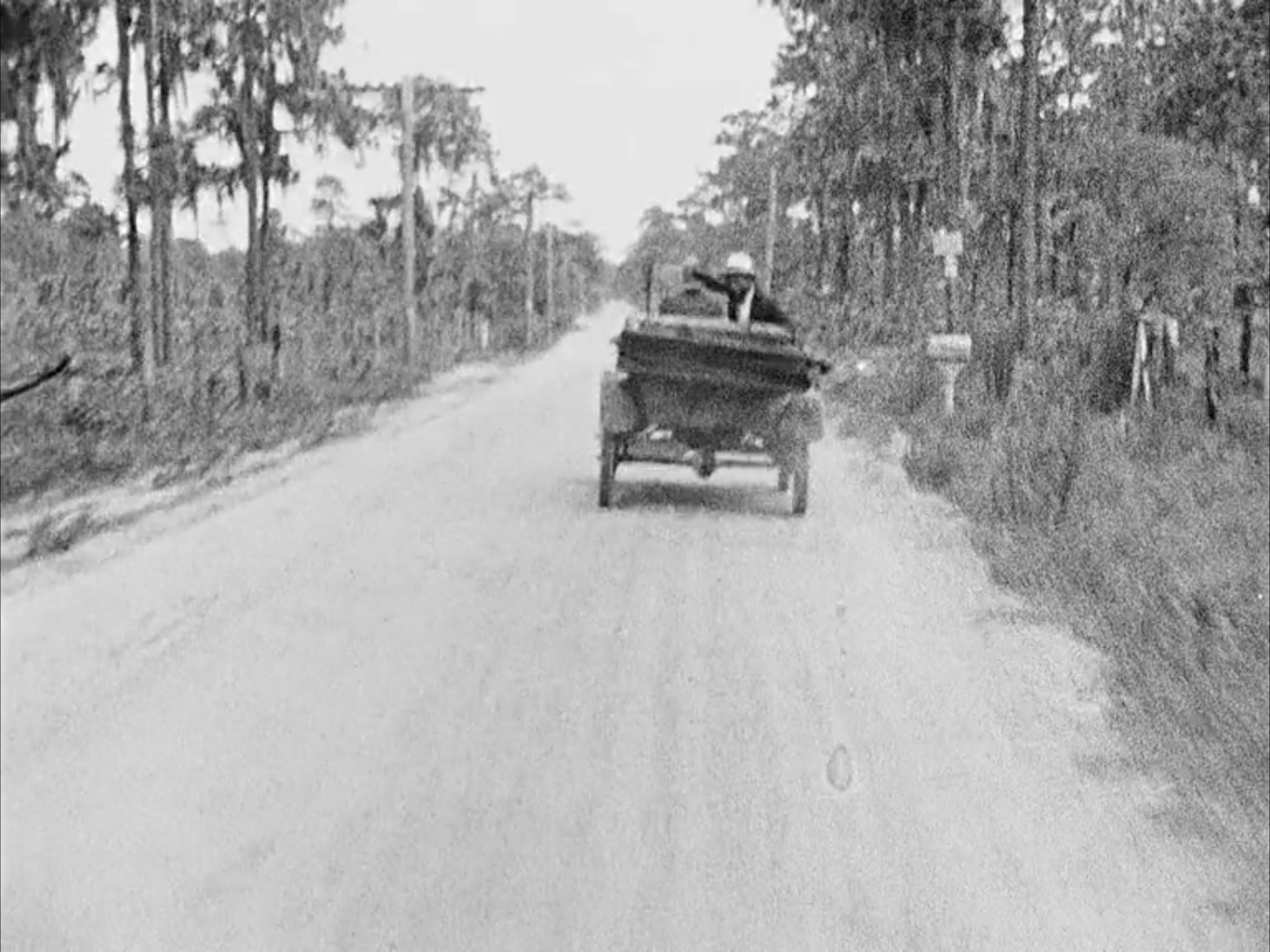
Florida foliage in a chase sequence in The Flying Ace (Richard E. Norman, 1926).
“In looking for a new location you are urged to carefully investigate and consider Jacksonville, the hospitable Southern city … whose history is filled with the romance of the past and citizenship will give you a typical Southern and sunny welcome.” — Telegram from Jacksonville Tourism Bureau head H. H. Richardson to Mack Sennett
“World’s Largest Motion Picture Production Center Will Be Built at Camp Jos. E. Johnston” — Announcement in the Florida Times-Union, January 1, 1921
At the turn of the twentieth century, several early film companies that were based in New York and New Jersey decided to take their production units to a state that offered plenty of land and an always-temperate climate: Florida. It was the obvious choice for the East Coast businessmen, as demand for pictures representing the Spanish-American War rose along with demand for more exotic location shoots. Florida offered the opportunity for both (such as in 1898’s Roosevelt’s Rough Riders, which depicted the famous troop charging ahead before their entry into the war), and the state’s local governments saw an opportunity for a welcome real-estate boom. For a few years, the “movies”—here a term attributed by Floridians to the industry workers themselves—moved to Jacksonville, St. Augustine, and a few other port cities to establish a more permanent home for American cinema.
Though the equipment, money, and crew came from the North, these studios would pay local Floridians to act in front of the camera. While plenty of poor white non-union actors were hired, these studios often hired Black actors as cheap labor to either dot the unique Southern landscape of palm trees and tall mansions or act as center-subject in racist one-reelers. Robert Jackson’s Fade In, Crossroads documents this burgeoning Floridian film industry well, giving special attention to producer Siegmund Lubin’s relationship with Black screenwriter and civil rights leader James Weldon Johnson as the latter delivered dozens of regressive scenarios with as-bad-as-they-sound titles like Coon Town Parade (1909) and He Wanted Chicken (1914). With films now being produced in the South, Americans saw more Black people in nickelodeons and on cinema screens than ever before, but only because these producers were appealing to the familiar Southern tropes of minstrelsy.
However, this Floridian film industry became a victim of its own success. The city of Jacksonville grew too fast, and residents began associating the “movies” with nightlife vice and un-Christian behavior, both onscreen and on Main Street. Jackson also documents how Jacksonville mayor J. E. T. Bowden, a rich man who welcomed the film industry to town under the auspices of the New South’s economic development and cosmopolitanism, lost his re-election campaign to a candidate, young Democrat John Wellborn Martin, whose main platform was to rid the town of the corruption caused by the film industry. It certainly didn’t help that films such as 1909’s A Florida Feud relied on stereotypes of poor, backwards Southerners. Though the “movies” lived in Jacksonville, films like these made clear that they were not a part of Jacksonville. As Jackson notes, “One of the biggest lessons of the uneven Jacksonville film experience in the 1910s, then, was the importance of governmental support for the industry.”
This first big episode in the South’s relationship with the film industry is a microcosm of what would come after. The film industry saw the South as an exotic playground, filled with sellable stories and beautiful backgrounds. The South, under a contradictory rule of New South economics and conservative mores, allowed this burgeoning industry to film and exhibit in its land so long as it played by the South’s rules. While Black actors were more likely to appear in a film set in the South, they could only be depicted in the way white Southern lawmakers and censors (notably not the general public, who either couldn’t care less or who protested the very idea of Black actors) wanted them depicted. Power players in local governments appointed censorship boards, who were quick to ban films that even hinted at subjects like miscegenation.
Another microcosm exists in the Florida story as well. After the residents of Jacksonville kicked out the perceived sex workers and booze-hounds of the major film studios, independent productions continued apace. Most notably, Jacksonvillian Richard E. Norman, a white director and producer, continued to hire Black actors for Black productions exhibited to Black audiences. Films such as Regeneration (1923) and The Flying Ace (1926) are now considered classic “race films”—cheap films featuring an all-Black cast, intended for Black audiences—but they were originally exhibited as a road show as no studio-owned theaters would think to exhibit them in the segregated South.
PART II
A LOST CAUSE: CENSORS
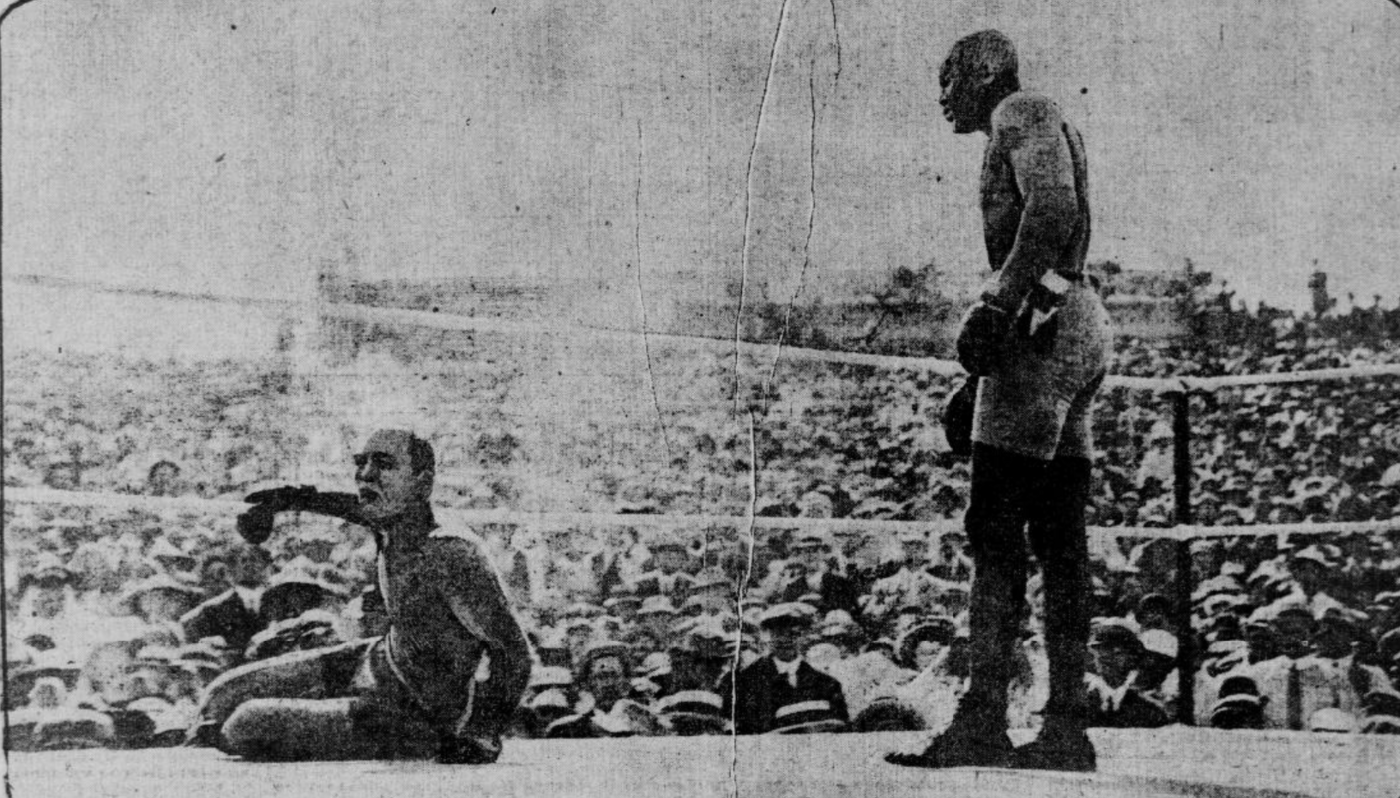
James J. Jeffries knocked out in Jeffries–Johnson World’s Championship Boxing Contest (1910).
“The Memphis Censor Board … is unable to approve your picture [1947’s Curley] with the little Negroes, as the South does not permit Negroes in white schools nor recognize social equality between the races, even in children.” — Lloyd T. Binford to United Artists
“How can people of Memphis tolerate such a man as Binford?” — Hedda Hopper
Directors, writers, and producers had some of the biggest roles in creating the Hollywood South, but none of them could rival the power of local censors. Technically, film studios had always censored themselves in one important way: They produced films based on market demand and turned down ideas that may offend or bore potential paying customers. If the Hollywood South was full of staid stereotypes and conventional imagery, it was mostly thanks to studios turning down risky or untested ideas. Even if an idea passed this self-imposed threshold, a studio might still kill it if they felt that a state or city censor might, with no appeal process, ban the film from key markets. And Southern censors were some of the hardest to please.
Long before Joseph Breen pre-censored every film in Hollywood through his Production Code Administration, film censorship had been turned over to local judgment thanks to the 1915 Mutual Film Corporation v. Industrial Commission of Ohio decision, which ruled that films were commercial entertainment—not art—and were thus not protected as free speech. Some local censorship laws had already been drawn before this case, but after 1915 many states and cities formed boards, drew up laws and guidelines, and, in some cases, appointed a single person to oversee which films could play in local theaters. Only one Southern state, Virginia, formed a formal censorship board while Southern cities adopted disparate measures and methods of censorship, which kept studios on their toes.
While this initial decision to censor films was no different from other Progressive Era decisions about promoting correct virtues and behaviors (like the prohibition of alcohol and the creation of “Americanization” classes for new immigrants), censors in the South frequently appealed to public safety. More often than not, this meant a fear of race riots. Even before the Mutual decision, Southern governments had banned distribution of 1910’s Jeffries–Johnson World’s Championship Boxing Contest. Jack Johnson, the first Black heavyweight champion, fought against retired champ James J. Jeffries, who, echoing the sentiment of his white supremacist supporters, claimed he was fighting “for the sole purpose of proving that a white man is better than a Negro.” When Jeffries lost, riots broke out throughout the country, resulting in the deaths of eighteen Black men, mostly but not exclusively in the South. Local governments feared that the film itself would not just inspire a repeated wave of violence from whites but also empower and embolden Black audiences. The banning of Jeffries–Johnson set a precedent for Southern film censorship for decades, as “racial unrest” became a catch-all reason to ban any sequence of racial strife or Black success.
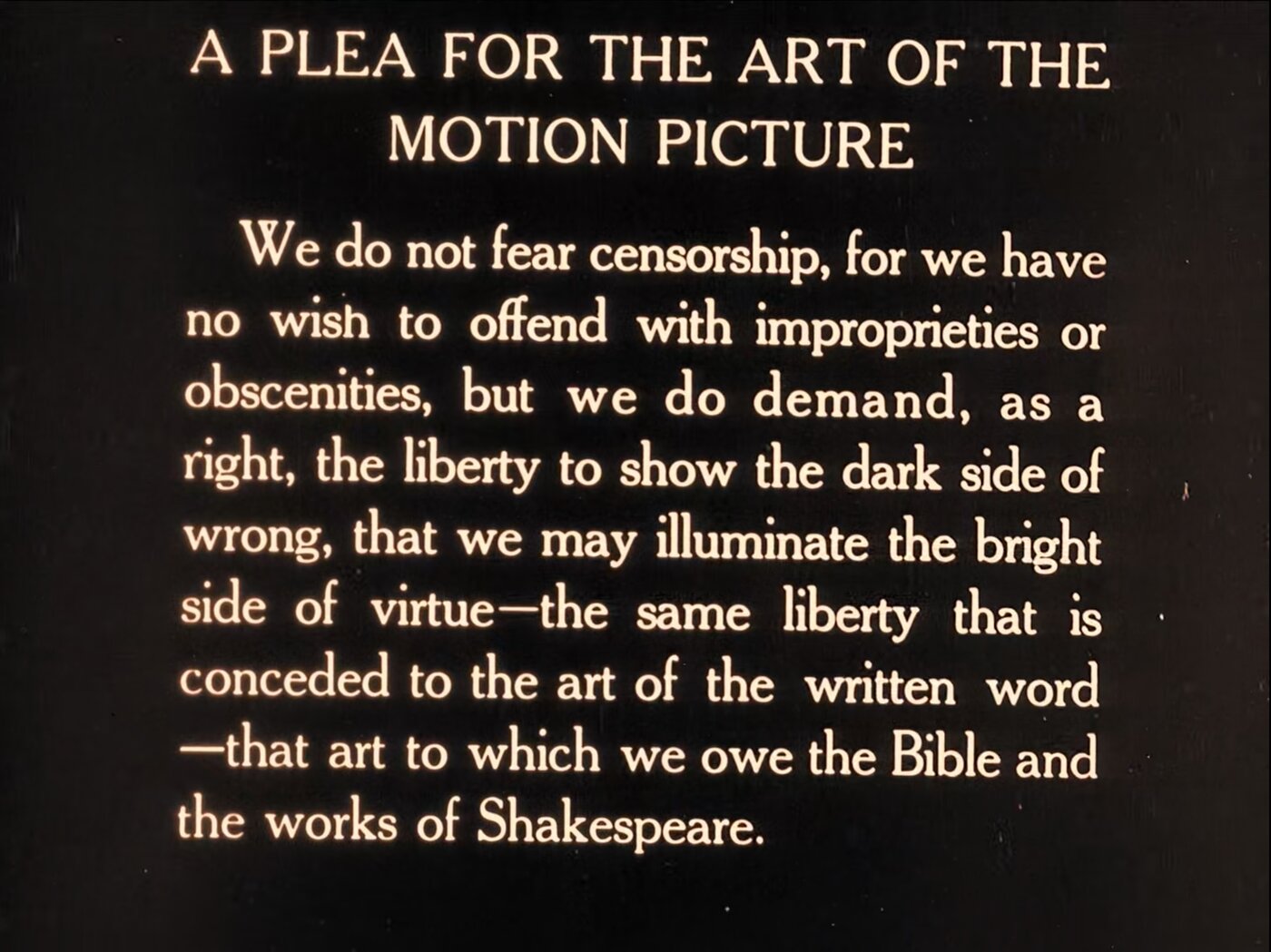
The plea against censorship at the beginning of The Birth of a Nation (D.W. Griffith, 1915), a direct response to the Mutual decision.
One of the biggest opponents of the Mutual decision was none other than D. W. Griffith, whose Birth of a Nation would release in the same year. Griffith saw his Birth as evidence contradicting the reasoning of Mutual since his epic was, as he hoped audiences would see it, evidently art and therefore an act of free expression. This was then wrapped into his marketing campaign (e.g. to watch Birth is to support free speech) and was his go-to defense when questioned about the film’s racial insensitivity. While most post-Jeffries censorship came from white censors attempting to maintain a Jim Crow status quo, when Birth was released, the nascent NAACP (National Association for the Advancement of Colored People) tried to pressure local governments nationwide to ban the film; in the few places they were successful (such as the state of Ohio and in Evansville, KY), censors cited the potential for racial violence as the grounds for a ban. While one might expect Southern censors to agree, virtually no place in the South even considered banning the film. As Stokes reports in his book on Birth, Jim Crow segregation and disenfranchisement had not only weakened the political responsiveness of Southern Blacks, but also had the surprising effect of convincing many whites that racial relations had improved and that Black-led violence was unlikely. What really concerned the Southern censors was any image that threatened the Jim Crow order, and Hollywood did its best to keep them pleased.
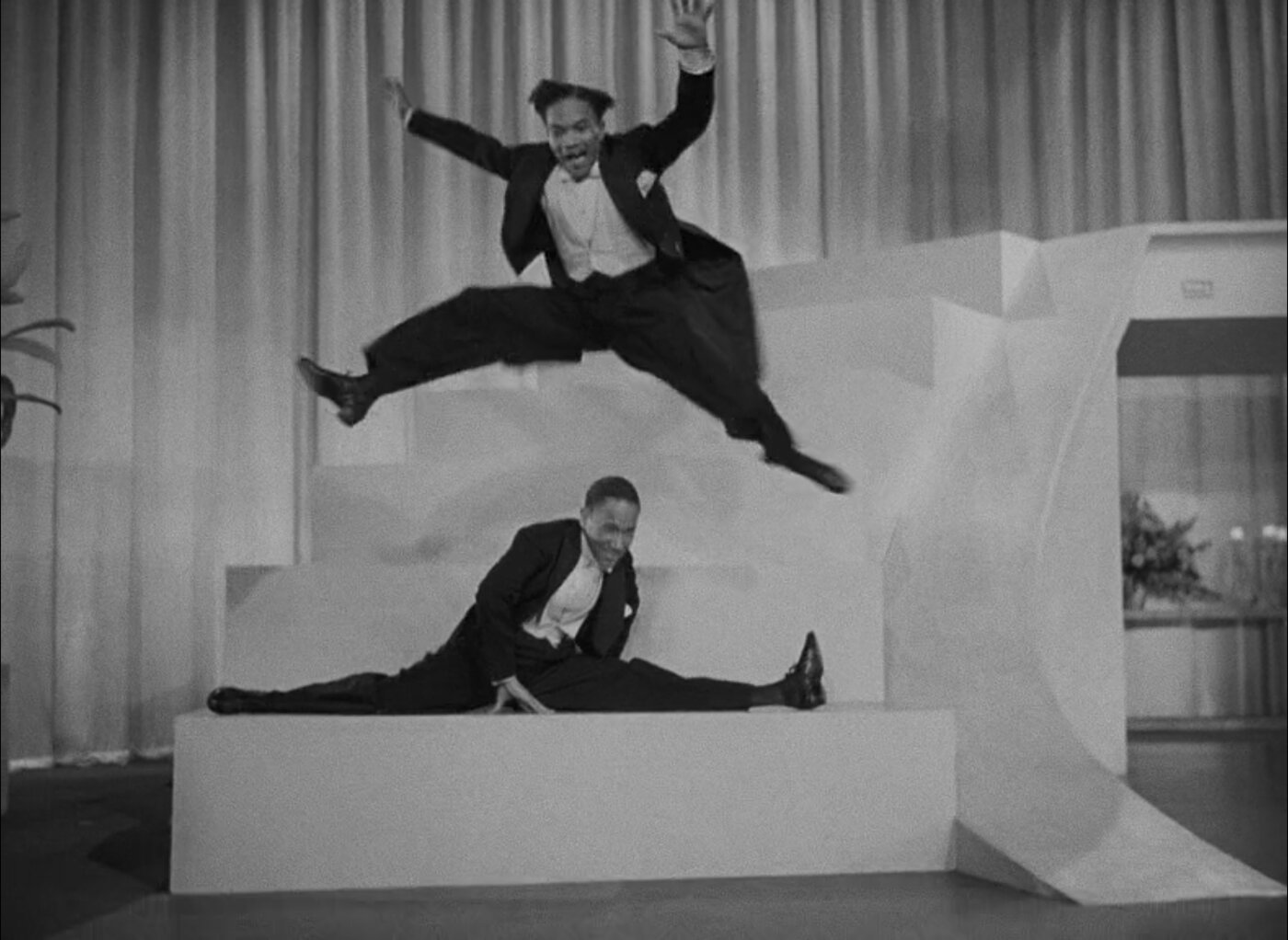
Stormy Weather (Andrew L. Stone, 1943), one of several films with a Black cast that were censored by Lloyd T. Binford.
But what, specifically, did these censors target? Again, in his essential study of Southern cinema, Fade In, Crossroads, Robert Jackson highlights the censorship boards of Memphis and Virginia as edifying case studies. Though the word “board” usually implies a bureaucratic team of multiple members who report to both the people of the city they serve and the government that appointed them, Memphis’s censorship board was Lloyd T. Binford, and he censored whatever he goddamn pleased. Though he banned a movie like Imitation of Life (1934) for implying that Blacks could be better than whites, he soon began censoring films that had a Black cast at all. Jackson lists Stormy Weather (1943), Cabin in the Sky (1943), Brewster’s Millions (1945), and New Orleans (1947) as movies that were outright banned by Binford for having a Black cast; many others required cuts of Black performers in order to play Memphis. Though he justified such bans with the usual “race riot” rationale, no Chaplin film could play Memphis since Binford thought him to be anti-American; Rossellini’s Stromboli (1950) was banned simply because it was “starring a woman who is universally known to be living in open and notorious adultery.” Even Jean Renoir’s The Southerner was banned for depicting Southerners as “illiterate mendicants,” a bizarre verdict that says more about Binford’s attitude to poor Southerners than the film itself (Renoir’s 1941 film Swamp Water seems to have gotten a pass). While this may paint Lloyd Binford as a unique, eccentric case who censored based on whim and prejudice alone, the studios couldn’t afford to ignore him. He enjoyed plenty of political support as he was appointed by Memphis’s city boss E. H. Crump, and his father, Senator James Robert Binford of Mississippi, was the author of what would become the Jim Crow laws throughout the Deep South. As a result, neighboring towns and cities often defaulted to Binford’s judgment. Failing to make his requested cuts might cost a studio tens of thousands of dollars, so, though they often grumbled about it, the studios bent to his prejudice.
As a slightly sobering contrast, Jackson also details the actions of the censor board of the state of Virginia, run by a bureaucratic committee of three appointees, including, throughout its history, many women members. They saw censorship as a “pruning knife,” cutting away the unwanted and invasive kudzu of a degenerating culture before it becomes unmanageable. But rather than enacting outright bans, the board worked as a “last-minute editor” and negotiated changes of intertitles, scenes, images of “vulgarity,” and, most importantly, images that may “produce friction between the races.” Pulling from the whites’ sense of racial harmony in a Jim Crow world, board chairman Evan R. Chesterman banned one-reeler Cracked Wedding Bells for being potentially offensive to Black audiences (among many offenses in its short runtime, a white man dons blackface to attend a Black wedding, and several Black wedding attendants run away from the ceremony when they spot loose chickens to eat), even when others dissented. Jackson notes that this was a paternalistic sensitivity and that Chesterman believed the board must “censor assiduously any treatment of black people that might remind the state’s viewers—black as well as white—of the existence of racial animosity.” This was notably different from the bitter censorship of Binford, as it’s hard to imagine even Birth of a Nation passing such bureaucratic stonewalling (and indeed, the NAACP appealed to the Virginia censorship board to block its 50th anniversary release in 1965). Though such a platform may have sent a message to Hollywood that minstrelsy wasn’t welcome even in parts of the South, its stronger message was that the dreamworld of the Hollywood South must reflect the dreamworld of Jim Crow.
Of course, though these censorship boards were modestly successful in their own right, a much more powerful force affected both Hollywood’s portrayal of the South and how the studios’ films were distributed: segregation. How Black audiences were segregated from whites varied by year and location—some theaters opted for Black-only screenings at certain parts of the day; others relegated Black audiences to the balcony. As cinema became more popular, and, since Black neighborhoods were separated from the theaters in the white neighborhoods, Black-only theaters began to open, albeit largely owned by whites and kept in a state of disrepair. With few exceptions, these were the only theaters that would play independent “race films” like the aforementioned Regeneration and The Flying Ace. Though Hollywood theoretically could have been tempted to make its own race films for the huge population of Blacks in Southern cities, Black audiences would still have had a problem turning out to support such pictures because of the widespread problem of underseating. As Douglas Gomery notes in his Shared Pleasures, “In Atlanta, for example, with a population of ninety thousand blacks in 1930, there were only five black movie houses. In Birmingham, Alabama, also with a black population of ninety thousand, there were only four. And in the former capital of the Confederacy, Richmond, Virginia, with more than fifty thousand black citizens, only two movie houses operated exclusively for blacks.” This was thanks to the explicit laws of Jim Crow as well as their implicit effects, such as Black audiences’ preference for the private entertainment of the radio rather than the humiliating public space of a segregated or second-class theater. This resulted in consistently low turnouts among Black audiences where Black populations were highest—Southern cities—which gave Hollywood the impression that this was not an audience worth including in the making of the Hollywood South.
Part III
A NEW SOUTH: DIRECTORS AND SCREENWRITERS
“Being Georgian became for me at birth an incurable disease. And I can recall very few times in my life when I haven’t been proud of that fact.” — Lamar Trotti
“Why do they live there. Why do they live at all.” — William Faulkner, Absalom! Absalom!
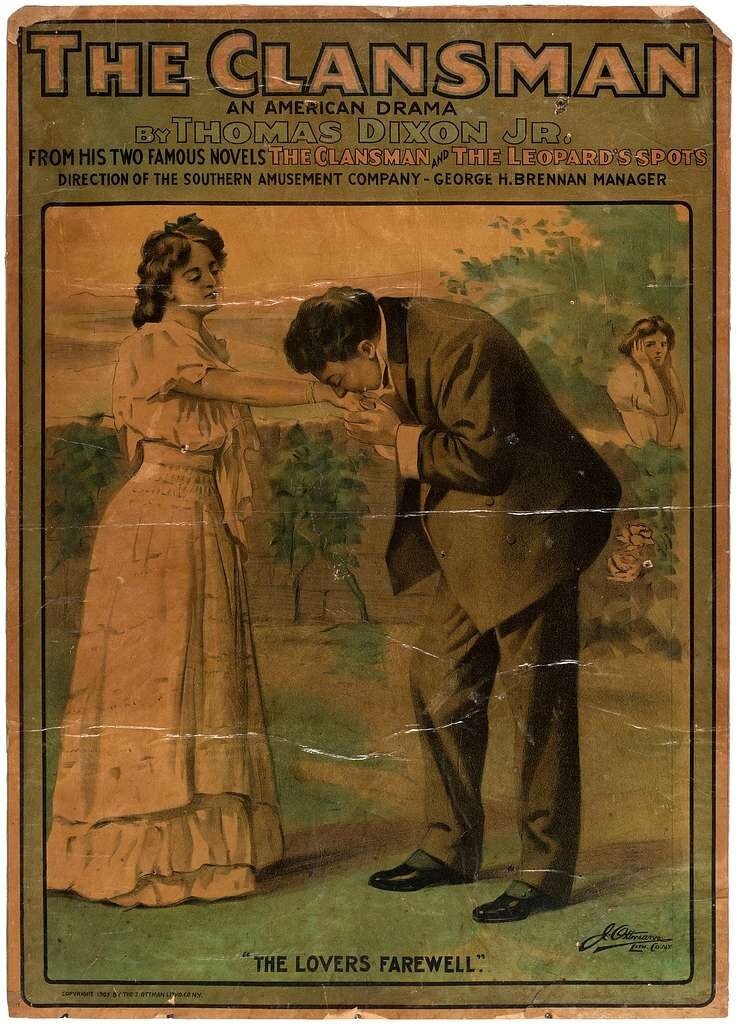
Poster for Thomas Dixon's play of The Clansman—a white reunification romance.
While back in the 1910s it seemed obvious to make Florida films in Florida, who would make Southern films in Hollywood? None of the major studio heads were Southern, and it wasn’t clear that appealing to the South, a region that was seen as still developing and therefore bereft of theaters and culture, would be a profitable venture. Though plenty of directors, producers, actors, and screenwriters came to Hollywood from all over the South, it never became obvious to put them exclusively in charge of Southern productions, just as it never occurred to anyone to outfit nascent Hollywood with native Californians.
Then came The Birth of a Nation.
Before his Birth, Kentuckian David Wark Griffith’s Civil War pictures for Biograph, a studio so large and dedicated to motion pictures that it represented a proto-Hollywood, were hardly Confederate propaganda. He filmed only a few scenarios that took place during the war itself and frequently directed scenarios with Northern protagonists. Griffith’s first Civil War film, The Guerrilla, features a Union soldier who saves his love from a drunken Confederate assailant. But, as Robert Jackson notes in his “The Celluloid War Before The Birth,” by making the Confederate villain a mere loutish guerrilla pretending to be a soldier, “[Griffith] could not bring himself to attribute evil deeds to actual Confederates, only to opportunistic imitators pretending to be the real thing; the stolen uniforms provided a sly escape clause for tarnished southern honor.” His other pro-Union scenarios (The Battle, The Fugitive) fit a similar mold. And, even in his nakedly pro-Confederate films (His Trust, His Trust Fulfilled, The House with Closed Shutters), the characters are more concerned about honoring their family or achieving an honorable death than with any specific Confederate cause. Neither producers nor audiences balked at the native Kentuckian’s depictions of noble Confederate families. After all, the recent Spanish-American War had united veterans of both sides of the Mason-Dixon for a common cause. The mood in the United States was one of quick reconciliation, leading even educated Northerners to accept parts of the Lost Cause mythology. While these pictures were not sold on the basis that they presented the South, Griffith’s early Civil War dramas proved to Biograph investors that even pro-Confederate stories could be bankable in the North. So, on the eve of Europe’s Great War, Griffith began work on his most explicitly pro-Confederate work, The Clansman.
While future Southern directors would fight with producers and censors to depict the South their way, Griffith had an unparalleled independence for The Clansman. He was limited only by funds, which, thanks to the constant hustling of his producers Harry and Roy Aitken, kept refilling. His South was the South of Thomas Dixon, Jr., a North Carolinian preacher who wrote his Trilogy of Reconstruction novels as a response, bordering on fan-fiction, to Uncle Tom’s Cabin, which Dixon viewed as the source of a popular sentiment against the South and for Reconstruction. The third of these novels, The Clansman became the most popular literary expression of a racist Reconstruction revisionism; when Dixon learned that Uncle Tom’s Cabin earned more success as a play, he subsequently adapted The Clansman for the stage. Then, when cinema became the popular mass media du jour, it made sense to Dixon to adapt it yet again. Though he had previously attempted to produce his own version, Dixon was ecstatic to learn that Griffith, who once played the lead in a stage production of Dixon’s own The One Woman, planned to bring his work in front of the largest audience possible. For him, this meant that the wide cultural impact of Uncle Tom’s Cabin would finally be negated.
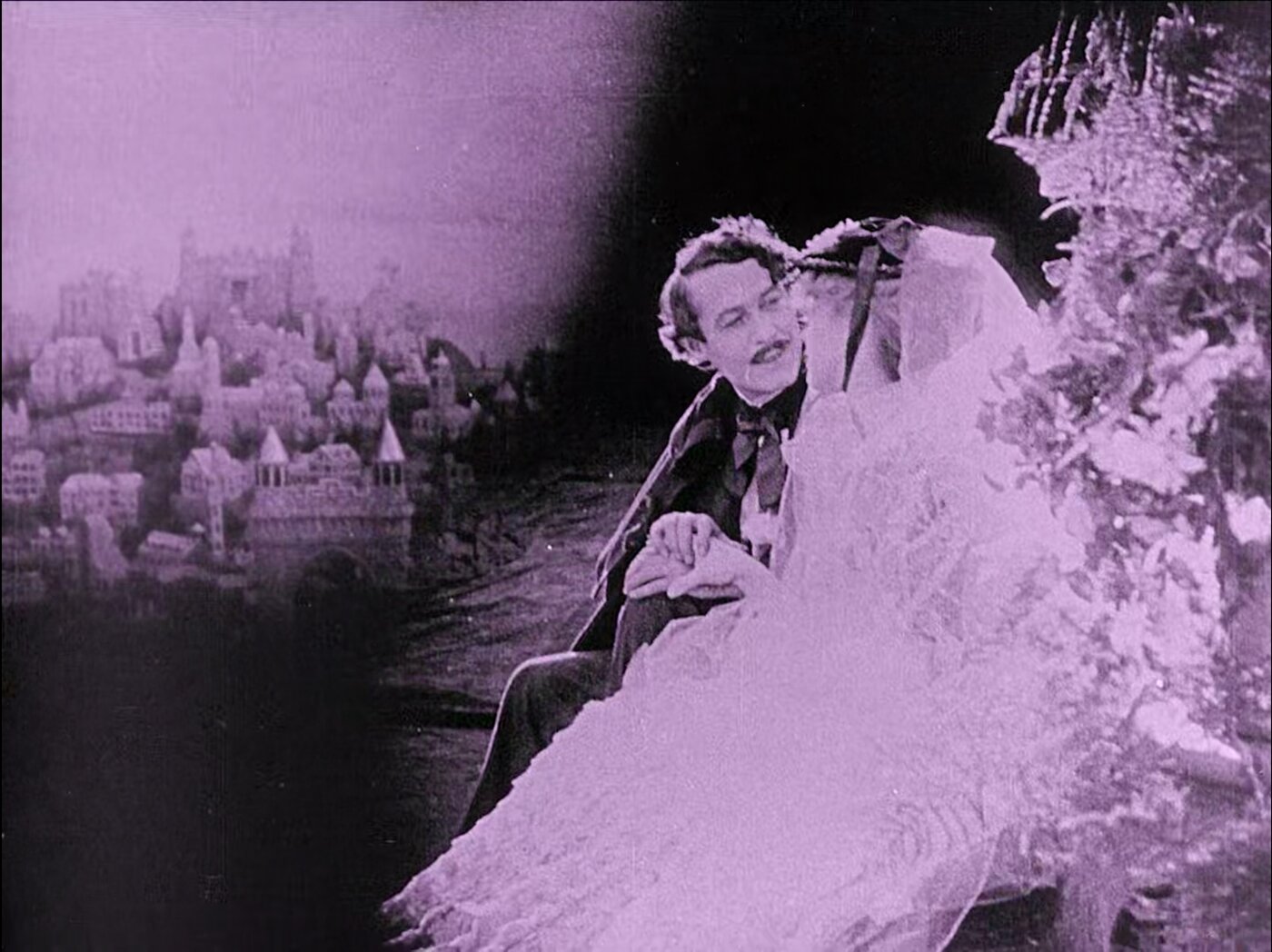
Lovers (and, so said director D.W. Griffith, the nation) reunited at the end of The Birth of a Nation (1915).
Ironically, Griffith’s ploy to represent the Lost Cause mythology to the biggest audience possible required excising much of Dixon’s Lost Cause rhetoric. It’s impossible to determine if Griffith censored much of Dixon’s racist material out of moral concern, but most of the director’s changes were clearly intended to steer the story away from Dixon’s didactic political fights, which would never have translated to the medium of silent cinema. Griffith reframed his adaptation around a Romeo & Juliet-style love story between members of the Northern Stoneman and the Southern Cameron families. This was a narrative that had brought box office success for Griffith at Biograph, as well as playing to the reconciliatory spirit of the time by wedding these families at the end. And, sure enough, white Northern audiences loved the film. Not only did they return for repeat viewings (marking a new phenomenon in moviegoing), but many Northern newspapers also reported that their audiences actively cheered during the final charge of the Little Colonel’s Klan. Melvyn Stokes, in his book-length history of the film notes: “What Dixon had essentially done with his novel was to dramatize the black problem as a national rather than merely sectional issue, to encourage Northern whites to redefine themselves as ‘non-blacks,’ and introduce to Northern readers radical Southern ideas on how blacks should be treated.” Such was the reconciliatory spirit of the day.
Just a few years after the mayor of Jacksonville kicked out the “movies” for their perceived threat to middle-class mores, The Clansman single-handedly made moviegoing a middle-class activity. It played in the grandest city theaters rather than the “dirty” nickelodeons; it was the first film to be accompanied by “respectable” classical music, chosen and timed by the director himself. To make sure that everyone could see the movie, the producers ran extensive marketing campaigns, including a roadshow that brought the film to towns without large theaters (which set the norm for film distribution throughout the rural South for decades). It was for these reasons that in the United States it became the most popular film of all time. Decades after its release, Griffith’s film would still be the singular shared image of the Civil War, antebellum Southern culture, Reconstruction, and the terms of reunification—the latter being of such importance that Griffith renamed the film The Birth of a Nation. With the film’s release, another nation was birthed: the Hollywood South.
***
Regardless of the real reasons behind its success, The Birth of a Nation made the first generation of Southern directors—including King Vidor of Texas, Henry King of Virginia, and Clarence Brown of Tennessee—aware of the box office potential of a Southern film. These, more than any other directors from the South, chose or were chosen for Southern projects when their studios abided.
King Vidor, a third-generation Texan, was born in Galveston six years before the 1900 hurricane destroyed the city. His father, Charles S. Vidor, was a wealthy businessman dealing in forests and sawmills; he was influential enough that a small town adjacent to one of his mills named themselves Vidor, Texas (still in existence and famous for being one of the few notorious “sundown towns” in the state). By 1913, King was already an amateur filmmaker and managed to capture part of that year’s hurricane on film. He formed a small Texas film production company called Hotex (short for Houston, Texas) with a similar-minded business partner, Edward Sedgwick, later famous for his collaboration with Buster Keaton. Though Vidor fully intended to stake a claim for film production in his native state, Hotex folded. Despite this, the ambitious Vidor quickly climbed the ladder in Hollywood, sticking with the Metro studio, later MGM, until a mutually aggressive parting in the early 1940s.
Vidor was able to convince MGM to not just take on Southern projects, but to shoot in the South as well. He used his goodwill at the studio to shoot his Wild Oranges (1924) in Jacksonville and in the swamps around Savannah, Georgia. He also managed to shoot a complicated scene in The Big Parade (1925), in which the line of soldiers seems to march out endlessly to the horizon in flat San Antonio (another early, though much smaller, hub of Southern filmmaking, at one point hosting Francis Ford and Gaston Méliès’s Film Star Ranch). With the advent of sound, Vidor decided that his next project would highlight the music he remembered from his childhood, “the Negro spirituals of the South.” As he tells it in his memoir, “For several years I had nurtured a secret hope. I wanted to make a film about Negroes, using only Negroes in the cast. The sincerity and fervor of their religious expression intrigued me, as did the honest simplicity of their sexual drives.” Though awkwardly argued in his book, Vidor notably wanted to make a film about Black people in the South for neither progressive nor exploitative reasons—he, as a Southerner, simply knew from his experience that they existed there, knew that their singing was good, and felt that to be curiously missing from Hollywood. MGM said no.
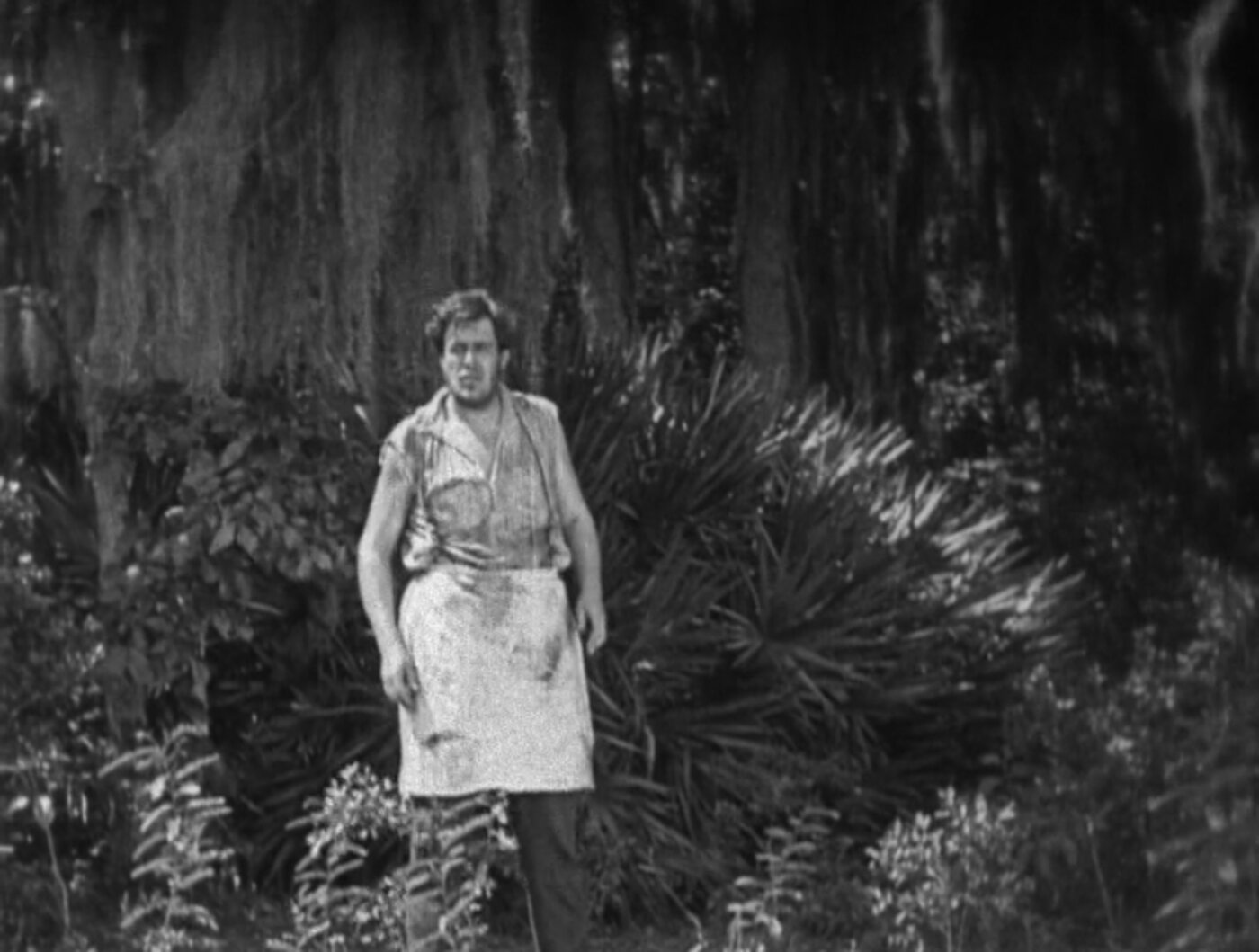
Wild Oranges (King Vidor, 1924).
Though directors usually have to defer to their fifth “no” in a row, Vidor was able to negotiate with MGM’s Nicholas Schenck by promising his entire annual salary as investment. Without the major financial success of The Big Parade and without the major critical success of The Crowd (1928) and without his full belief in the project, 1929’s Hallelujah would not have been made. It required a blank check to collect the cast (mostly actors and singers from Chicago and New York) and transport them to Memphis, something of a home base for shooting. Though the location gave an air of authenticity to the film, Vidor’s memoir also mentions paying local church members and pastors to act as fact checkers and technical advisors for blocking the church sequences and performing the baptismal rites. It was hard to find Southern Baptists in California.
But Vidor’s pushback against the studio didn’t stop there. As he tells it, “I argued that Southern people were more interested in Negro life than Northern people. Having been born and raised in the South, I should know. I was in the New York office of the head booker for the largest string of Southern movie palaces expounding this point in my one-man sales campaign.” He recalls being routinely unsuccessful in getting Southern theaters to exhibit it, except for a betting man who ran a handful of theaters in—surprise, surprise—Jacksonville, Florida. Regardless, Hallelujah gave Northern audiences a vision of an autonomous, joyful (though notably still segregated) Black South that complicated the Hollywood South of their imagination. Griffith’s Birth of a Nation had presented the key image of the Lost Cause South: a raped aristocracy, both victim and would-be victor. Vidor’s South was one curiously bereft of politics but full of a unique culture worth celebrating. And it was made only because a Southern director wanted to see how he remembered his home on screen.
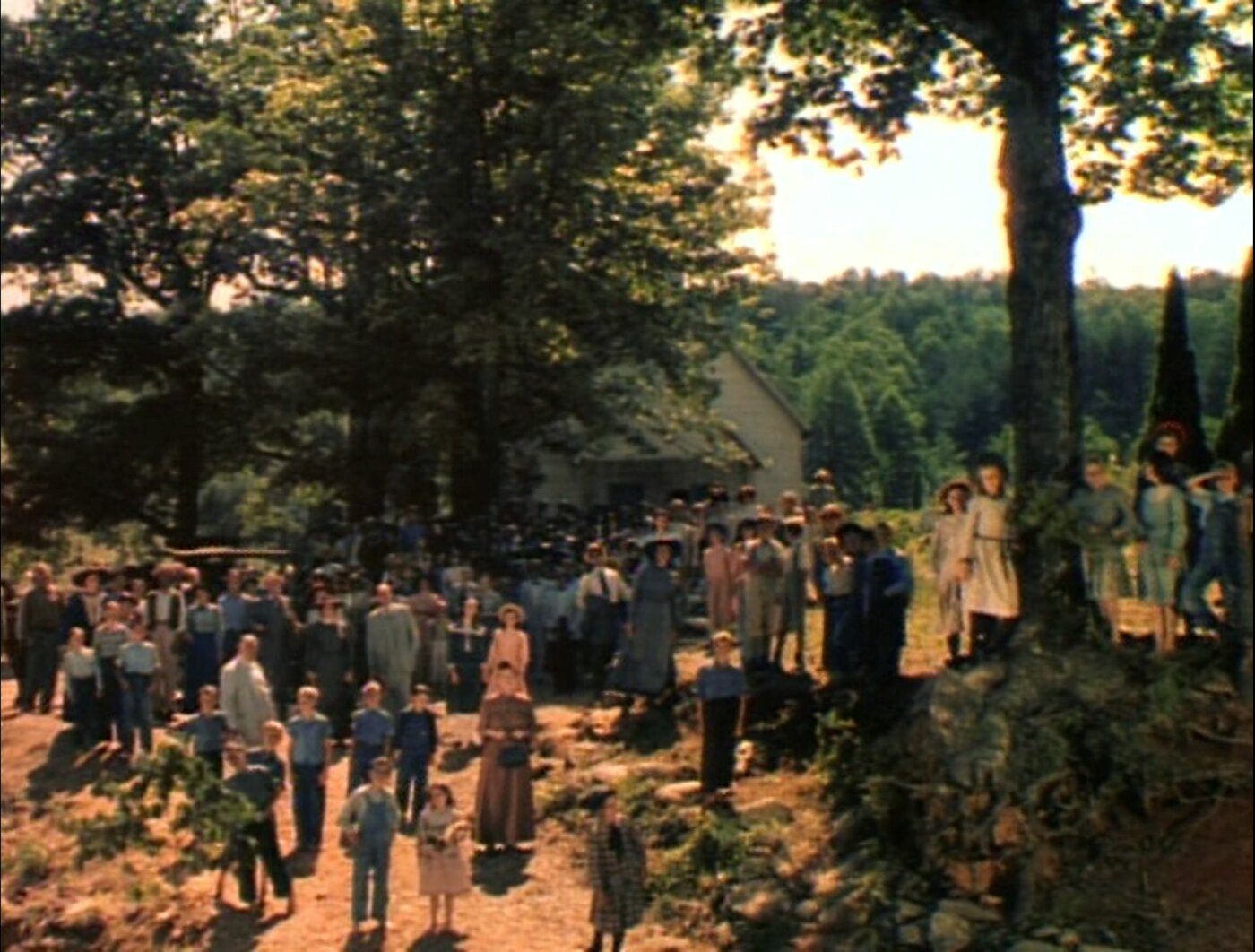
The community of Helen, Georgia bids farewell to William Lundigan’s itinerant preacher in I’d Climb the Highest Mountain (Henry King, 1951).
Henry King, too, leaped at the opportunity to help forge the Hollywood South. While Vidor’s South ranged from the melodrama of the Mississippi River picture The Jack-Knife Man (1920) to the conservative costume drama set only in “the South,” So Red the Rose (1930), to the near-camp hysterics of the North Carolina tale Ruby Gentry (1952), King’s South was consistently one of rural simplicity. His Tol’able David (1921), a story about a tenant farmer’s struggle for honor and respect, was shot near his birthplace in West Virginia and featured plenty of local talent. King quickly became a studio favorite for directing scenes of small-town life, but he was unable to latch onto explicitly Southern projects. He shot Florida to stand in for Havana in Hell Harbor (1930) and captured Southern military bases in Twelve O’Clock High (1949). Carolina (1934) and Wilson (1944) were both Southern pictures but shot on studio sets. Though he dealt in Southern characters and themes throughout his lengthy career, he didn’t formally return to the landscapes of his childhood until his 1951 masterpiece, I’d Climb the Highest Mountain.
King, in his memoir, reflects on screenwriter Lamar Trotti bringing the Corra Harris story to his attention: “It was about people who had never been seen in motion pictures. It looked like it should be made in Georgia with its red clay roads. I thought it was a story worth telling, a story of America, real Americana.” Sure enough, Henry King’s crew traveled to northern Georgia, the southern end of Appalachia, and shot those red clay roads with veteran cinematographer Edward Cronjager’s expert Technicolor photography. The film follows an itinerant pastor and his wife, who settle into a small rural community and entwine themselves with the townsfolk’s hopes, fears, tragedies, and celebrations. William Lundigan plays a pastor far removed from the fire-and-brimstone patriarchs and evolution-deniers expected of the role; instead, his pastor is kind, playful, and life-affirming, like a Protestant Saint Francis. He doesn’t seek to lecture the town’s resident Harvard-educated atheist, nor does he have sexual hang-ups with his wife. His only adversity lies in understanding and gaining the trust of a small community in order to help it in the true spirit of Christian agape.
Indeed, I’d Climb the Highest Mountain’s South is one that welcomes outsiders so long as these outsiders try to understand and respect the people of the South. Trotti echoed this to the residents of Helen and Cleveland, Georgia, when he promised that this film would be no Tobacco Road—a film that had angered many Southern audiences thanks to its exaggerated and comedic characterization of white Southerners as lazy and dim-witted—and that “we’ll hang the first Yankee actor who tries to fake a Southern accent.” Toward the end of his chapter on the film, King laments, “I’m just so sorry that the people making motion pictures today don’t recognize that you can change the culture of the world with motion pictures.” He knew that for both Southerners and outsiders, the Hollywood South stood for division and xenophobia, but he also believed that only by imagining it differently could this be remedied.
Clarence Brown, unlike the two Kings, was not born in the South, nor did he gravitate to especially Southern themes throughout his career. He spent his childhood and early adulthood in Knoxville, Tennessee, with a brief stint in Alabama before jumping into filmmaking in 1913. Like Vidor, he stayed with MGM, but Brown carved a niche for himself by directing big, star-driven pictures with Joan Crawford and Greta Garbo among many other A-listers. He joined his first Southern project late, replacing Victor Fleming on the set of The Yearling (1948), which was already shooting in Florida’s Ocala National Forest. That same year, Brown read William Faulkner’s latest novel, Intruder in the Dust, and immediately petitioned Louis B. Mayer to buy the rights so that he could adapt it. With some help from producer Dore Schary (known to support such social message movies, as Intruder promised to be), Brown won the directing role and secured a location shoot in Faulkner’s Oxford, Mississippi—a college town that served as the inspiration for Faulkner’s mythic Yoknapatawpha County and one that would become an epicenter of future civil rights battles.
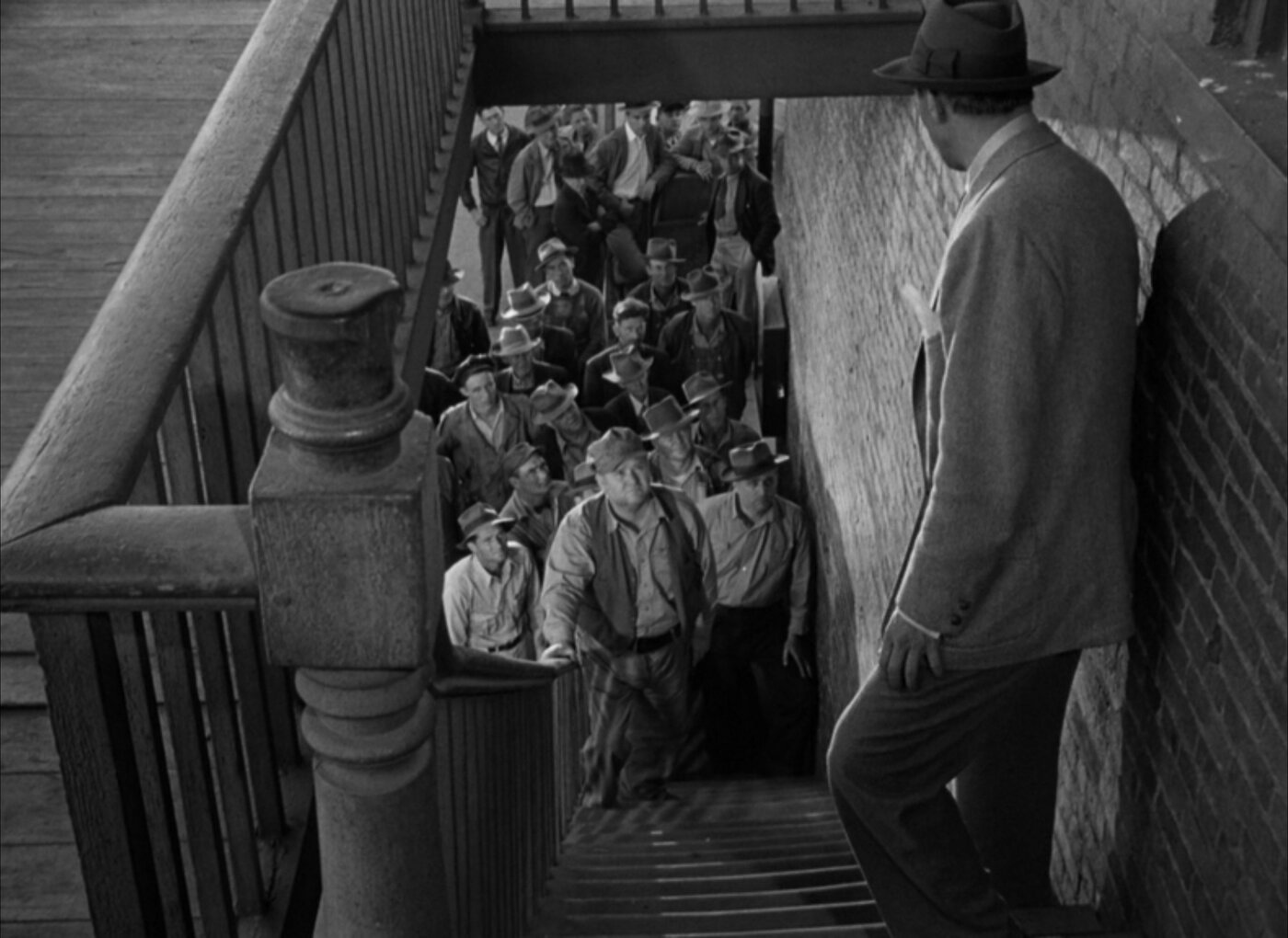
David Brian faces down a crowd of local extras on the staircase leading to his law office (now the deck of frat-favorite bar Rooster’s) in Oxford, Mississippi in Intruder in the Dust (1949).
The film centers on a small Southern town where a Black man, Lucas Beauchamp, has been arrested for the murder of a white man. Lucas asks a young Chick Mallison in the gawking crowd to secure his uncle John to be his lawyer. After John agrees, the town becomes noticeably meaner and restless; there’s no evidence either for or against Lucas’s innocence, and Lucas himself isn’t keen on telling the whole story. Before the town turns into a murderous mob outside the jailhouse, Chick must race against time to figure out what really happened.
Written twelve years before the similar To Kill a Mockingbird, Faulkner’s lawyer is no bleeding-heart defense lawyer like Mockingbird’s Atticus Finch. Uncle John is just as prejudiced against Lucas as the rest of the townsfolk and is never touched by a divine sense of justice; his loyalty is only to Chick, who, since being singled out by Lucas for help, has also stoked the town’s ire. Similarly, Lucas is never portrayed as a saint of a man, nor is there any pointed liberal monologue about the law or civil rights. The town here is the utopia from I’d Climb the Highest Mountain turned nightmare, simply by being thrown headfirst into history. It’s also a riposte to the then-fashionable idea of the New South—one that imagined a prosperous industrial South by playing up folksy Old South imagery (high columned mansions and antebellum dresses) while downplaying the rather embarrassing parts of Southern history that kept Northern investors at bay. Brown’s South follows Faulkner’s oft-quoted dictum from Requiem for a Nun that “[t]he past is never dead. It’s not even past.”
Clarence Brown, famous for directing MGM’s biggest stars in their star vehicles (Anna Karenina, Emma), decided to cast fellow Tennesseans Elizabeth Patton (who also starred in a 1933 Faulkner adaptation, The Story of Temple Drake) as the helpful old Miss Habersham and Claude Jarman Jr. (star of Brown’s previous The Yearling) as Chick. Some of the rest of the cast and nearly all of the extras were nonprofessional Oxfordians—quite the casting demand from someone used to shooting Garbo or Crawford. Most location shots take place in the town’s historic square, and let this writer personally assure you that every Ole Miss student who sees this movie laughs after realizing that Uncle John’s law office is now the infamous Rooster’s, a bar which a grown Chick would likely not patronize. As in I’d Climb the Highest Mountain, the town was assured that they’d be portrayed well, but a mindless, racist mob is never a flattering thing to be. That Faulkner himself was involved with the production possibly helped quell any skepticism, especially from any Southerner who’d volunteer to work with outsiders such as Hollywood in the first place. Oxford’s square was again used as a stand-in for the quintessential Southern community in Vincente Minnelli’s Home from the Hill (1960); two years later, Black student James Meredith was escorted by the National Guard to the newly integrated Ole Miss, riots broke out, and camera crews from out of state were far less welcome.
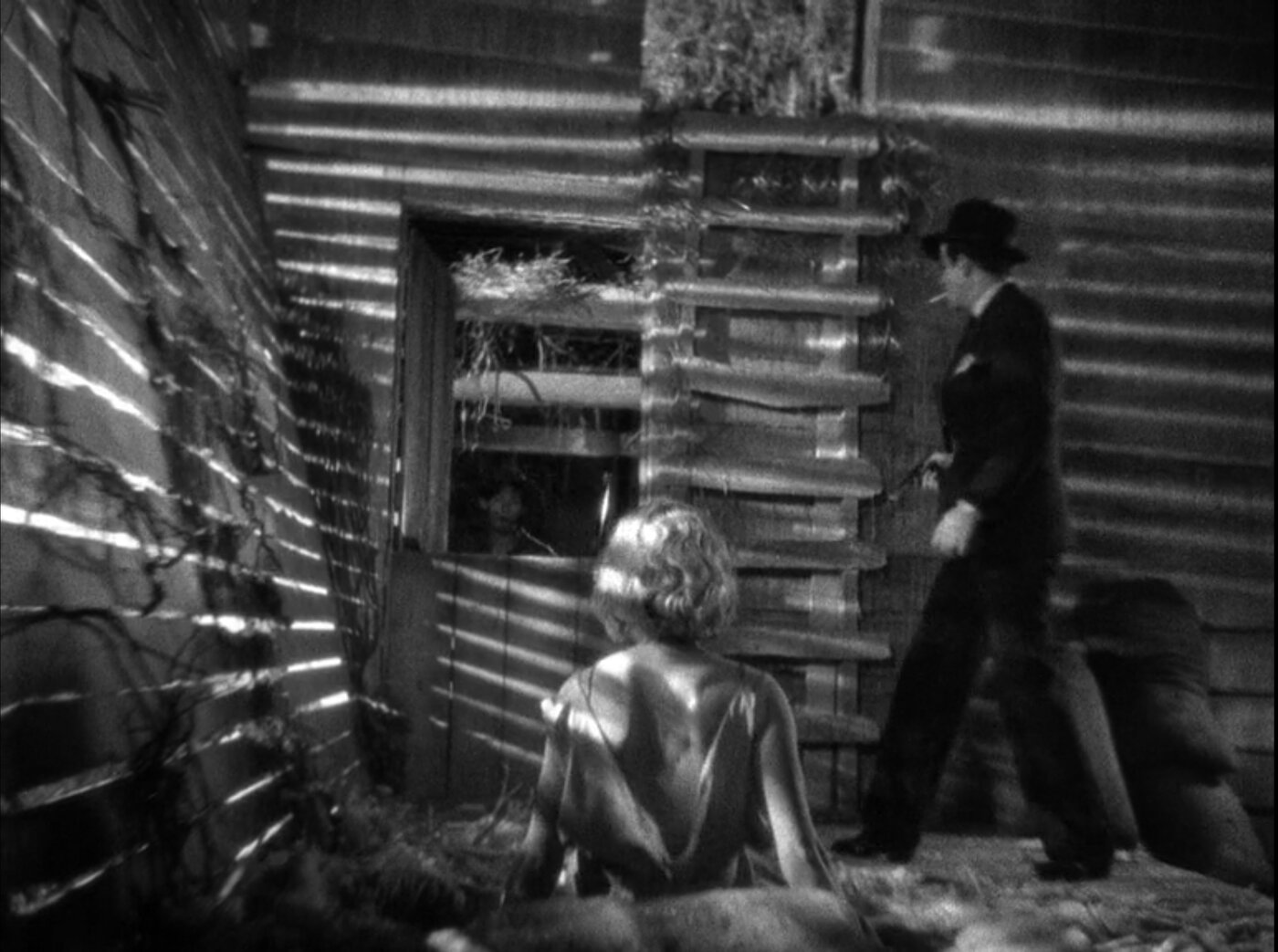
While contemporary Southern literature frequently depicted sexual violence to illustrate regional power relations and racial paranoia, the rape sequence in The Story of Temple Drake (Stephen Roberts, 1933) scandalized more than just Lloyd Binford’s censorship office.
Though Vidor, King, and Brown were able to use their status to negotiate on-location shooting in the American South, most Southern directors did not have such leverage to even choose Southern projects, and most Southern projects went to non-Southern directors. Many also simply didn’t care about such projects. For every Hallelujah there are ten The Littlest Rebels (1935) or Can This Be Dixie?s (1936), films that are uninterested in complicated portraits of the South and which are very fond of using its populace as punchlines. But films that were made with such deliberation and care as those by Vidor, King, and Brown forged a blueprint for a Hollywood South that audiences could respect rather than romanticize (like Griffith’s Birth) or laugh away (like, say, Laurel and Hardy’s Them Thar Hills). It was hardly a utopia but it was better than what came before.
***
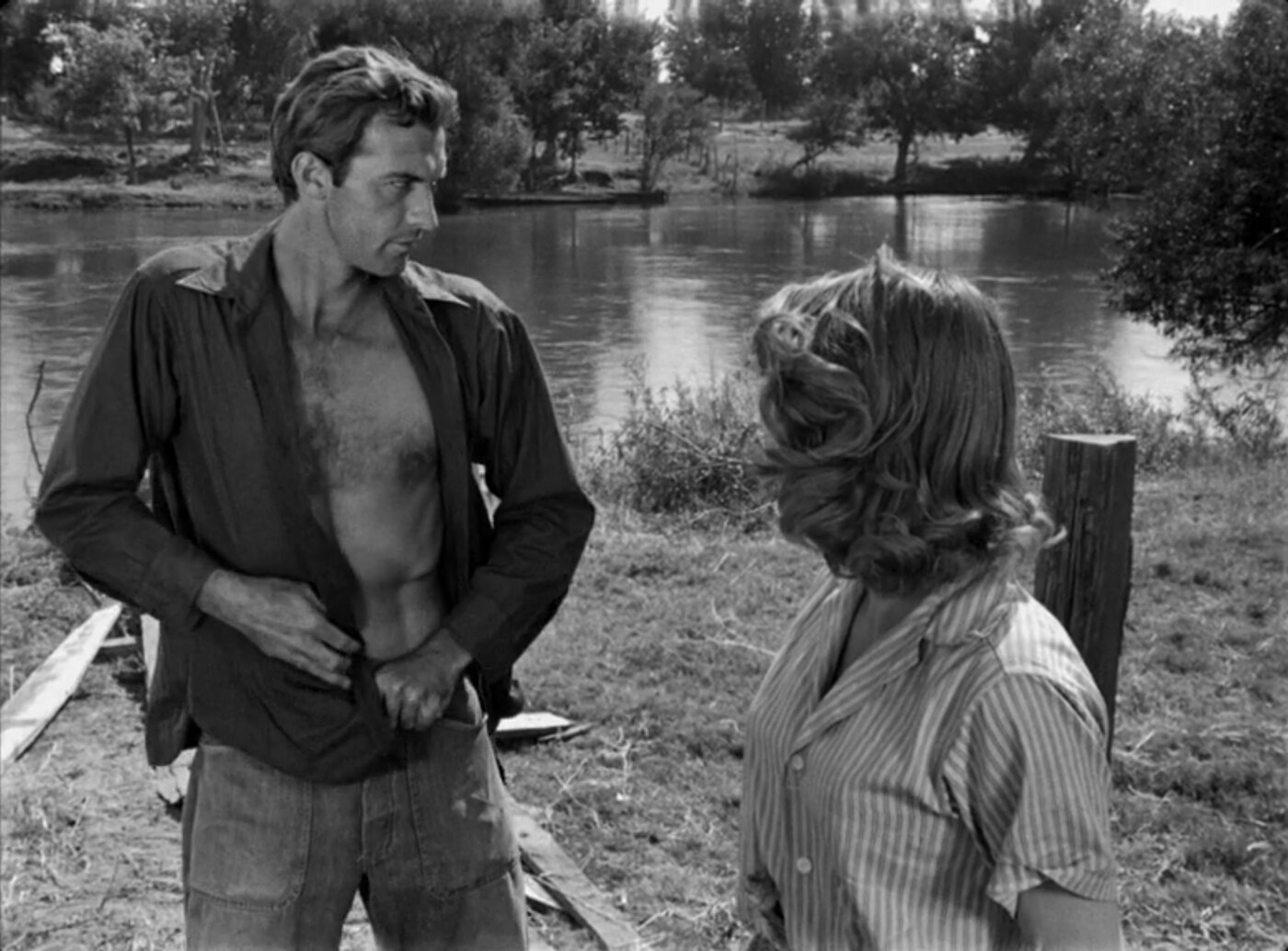
The California landscape plays Jean Renoir’s Texas in The Southerner (1945).
Though producers were often equally apathetic about positive and negative portrayals of the American South, and directors rarely had any power to portray the South as they saw it, one group of Hollywood professionals did actively and freely mold the Hollywood South for better and for worse: writers. Many Hollywood movies set in the South were adaptations of stories and novels that had already performed well with general audiences—Margaret Mitchell’s extremely successful 1936 novel Gone with the Wind being the key example. Plenty of Southern authors saw their work trimmed and censored to fit Hollywood expectations, though many of these authors wrote for publications like Reader’s Digest and The Saturday Evening Post where the writing itself was expected to be simple, uncontroversial, and appealing to a national audience. A few authors were lucky enough to have their challenging work adapted faithfully, such as Texan Dorothy Scarborough’s folkloric novel The Wind (adapted by Victor Sjöström in 1928) and fellow Texan George Sessions Perry’s 1941 Hold Autumn in Your Hand (adapted by Jean Renoir as The Southerner in 1945). Mississippian novelist William Faulkner, meanwhile, saw little Hollywood interest in his work until his scandalous 1931 novel Sanctuary was adapted into the much more scandalous The Story of Temple Drake (1933)—a movie, even in its censored nature, now regarded as the singular catalyst for the enforcement of the censorious Hays Code in 1934 (and predictably banned by Binford, whose namesake appears in Faulkner’s novel as Lucius Binford, a dead Memphis pimp). Though Faulkner would later work as a writer and script doctor in Hollywood, he would never lead an adaptation of his own work, nor would he be asked to contribute to South-set scripts.
However, two Southern writers were kept on Hollywood’s payroll to fine-tune South-set productions. Georgian Lamar Trotti was given a permanent position at Twentieth Century-Fox where he was often tasked with rewriting and censoring Southern stories to abate Southern audiences’ dissatisfaction with their portrayal in Hollywood. Matthew H. Bernstein in his “A ‘Professional Southerner’ in the Hollywood Studio System” particularly points to the 1920s as the decade that put asunder the “reunification” of North and South that Griffith wished to achieve. National newspapers made Northern audiences aware of the alarming rate of lynchings and the terrible treatment of Black sharecroppers under Jim Crow laws. But if Northern audiences didn’t care for such moral indignation (and many didn’t), the journalist H. L. Mencken’s coverage of the Scopes trial still humiliated its Southern subject of Dayton, Tennessee, by presenting the townspeople as backwards zealots violently protecting their right to be stupid and poor. Or at least this was how it would be interpreted, as no matter how much Mencken clarified that he spoke only of the loudest fundamentalists, Southern audiences still felt they were largely seen as violent buffoons single-handedly anchoring the nation away from moral and scientific progress. It certainly didn’t help that Northern political cartoons reinforced this view in national periodicals at the time, depicting Tennesseans as hillbillies and monkeys in equal measure. Trotti worked to make sure that Twentieth Century-Fox, the studio that most frequently bought the rights to South-set material, was never associated with such Menckenian jabs.
Of course, this also meant writing and rewriting scripts for a white Southern audience. Trotti was instrumental in advising Universal bosses that it would be “suicidal” to screen 1927’s Uncle Tom’s Cabin in the South, even if he took no personal offense to it. He was friendly with the censors in his hometown of Atlanta and, in his early career, parroted many of their decisions and biases to his bosses, figuring that he was saving the studio from a financial catastrophe.
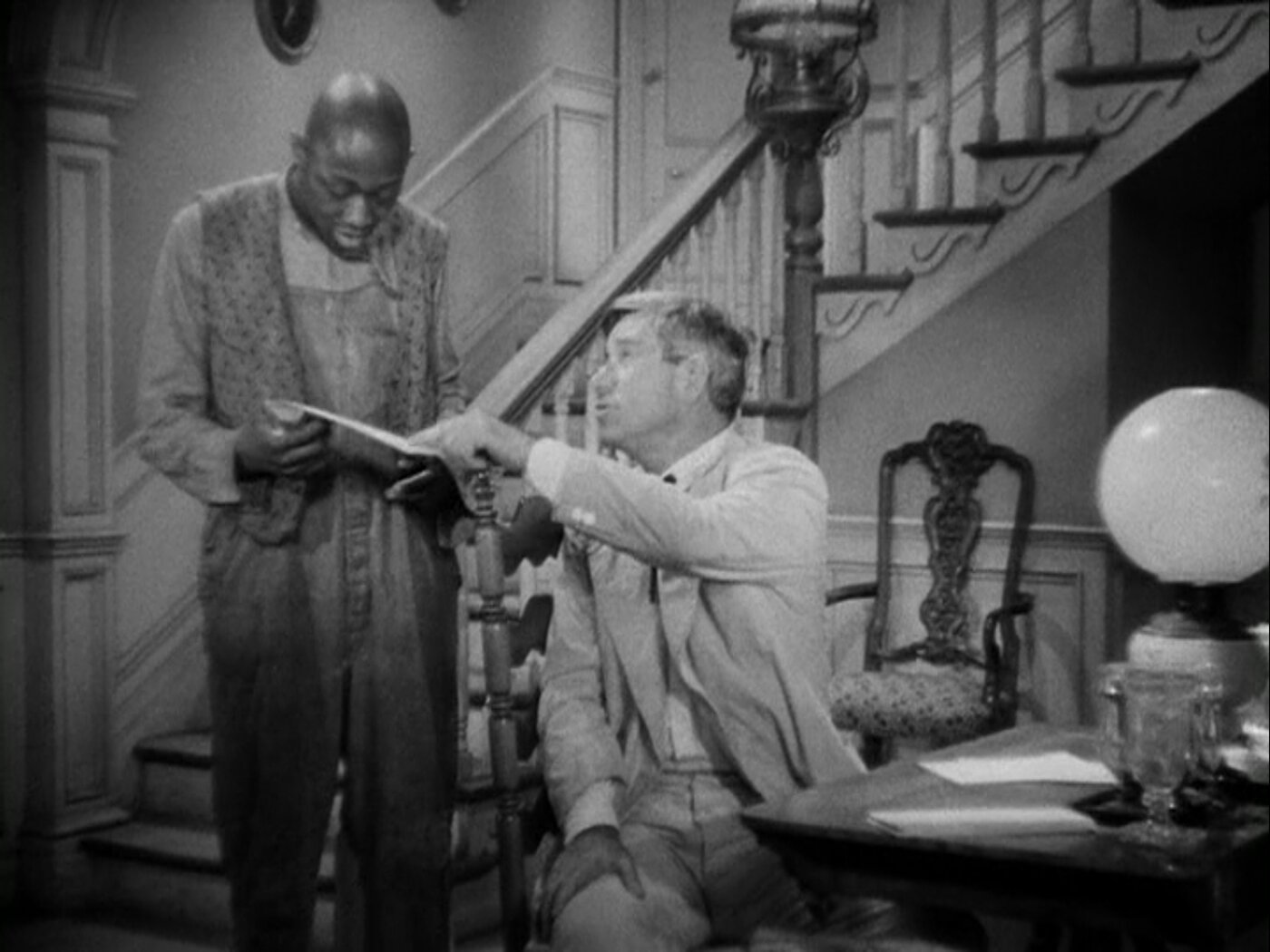
Stepin Fetchit and Will Rogers in Judge Priest (John Ford, 1934). The actors appeared in four movies together and remained good friends off-set.
Later, however, he switched from his defensive position of sanitizing the South for a national white audience to an offensive position of fighting for the South as he saw it. Bernstein’s essay highlights his work writing John Ford’s Judge Priest (1934) as a deliberate remedy to lazy depictions of the South. Like Vidor, and with similarly uneven results, Ford attempted to depict his Black actors (especially Stepin Fetchit) as “human and recognizable” rather than limiting their existence to a punchline or the background. Ford expert Joseph McBride noted that, despite the racial tension in the film, “In his personal and professional isolation, Judge Priest finds that he has more in common with blacks than whites.” Trotti made these decisions only because this was the South he saw and the South he expected Southern audiences to recognize. He and Ford were also careful to, in Bernstein’s words, “satirize the South’s fierce pride in its past, as embodied in the judge’s friends’ boastful, repetitive but argumentative recountings of their exploits in the Civil War. Thus, humor enabled the filmmakers to celebrate the heritage of southern pride at the same time that they gently mocked it.” The Birth of a Nation itself was spurred into production by Griffith’s fond memories of his Confederate father’s tall tales of wartime; but here, Ford, himself surprisingly sympathetic to Confederate military men thanks to his early mentor Griffith, drags such dreamers into the present without condescension. For Ford, for Trotti, and for Judge Priest, the South can be a harbinger of tolerance, but only if it chooses to be.
Trotti worked on many scripts for John Ford, including Steamboat Round the Bend (1934), Young Mr. Lincoln (1939), and Drums along the Mohawk (1939). Bernstein recounts that he was responsible for having Sousa’s band play “The Battle Hymn of the Republic” after marching to “Dixie” in The Stars and Stripes Forever; he’s therefore likely to have pushed for Ford’s titular young Mr. Lincoln to play “Dixie” on his mouth harp before “marching up that hill” to the tune of the Battle Hymn. Though “Dixie,” a favorite of the historical Abe, now connotes a Lost Cause sentiment, this was Trotti’s way of associating the idea of the South with the mythic idea of America. In Thomas Cripps’s Slow Fade to Black, a study of African-American contributions to and representation in early Hollywood, the author paints Trotti as growing increasingly liberal after World War II, prompting him to make the great anti-lynching film The Ox-Bow Incident (1943), starring the very Lincoln who played “Dixie,” Henry Fonda. Even here, in an explicit message against racist mob violence in the South (though set in the West in order to get past the Southern censors, who would have banned such a polemical depiction of racial “unrest”), Trotti rewrites the Confederate veteran of Walter Van Tilburg Clark’s original novel as a fraud stealing Confederate valor, just as Griffith did in his earliest Civil War pictures. Was this purely to cave to local Southern censors’ resentments and pride, just to guarantee Fox more revenue? Or did he simply wish that every Southern town could see this film?
The other “professional Southerner” was also a Georgian, also contracted to Fox, and also one of John Ford’s go-to writers: Nunnally Johnson. Robert Jackson recounts that it was Johnson who gave Ford the advice that “Southerners don’t know they’ve got an accent to begin with until they hear somebody mocking it, and then they get their backs up.” This was for The Prisoner of Shark Island (1936), but there are no outrageous Southern accents in any subsequent Ford film, and his films are full of Southerners. He gave similar advice to Selznick on the set of Gone with the Wind after Southern audiences lambasted the actors’ campy lilting in Jezebel (1938).
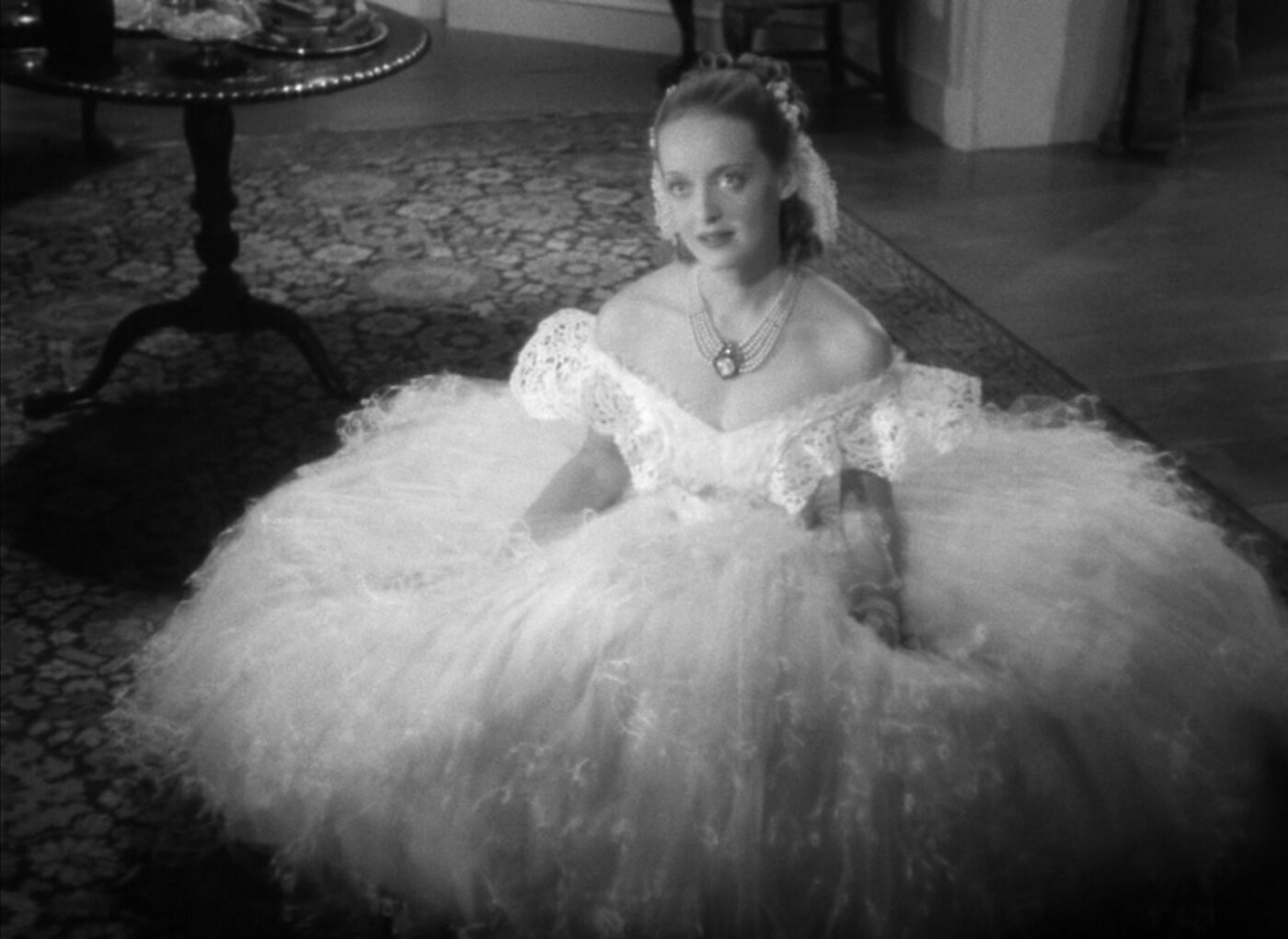
Though Jezebel (William Wyler, 1938) was critically well-received and a box-office success, Southern audiences found the accents strained and cartoonish. Screenwriter Nunnally Johnson personally made sure that the following year’s Gone with the Wind (Victor Fleming, 1940) would pass Southern muster.
Though writers hardly chose their projects, the studio knew that Johnson had a knack for folksy dialogue and simple humor, so Fox put him in charge of a remarkable number of Southern-set scripts. He’s responsible for the depiction of the Okies in The Grapes of Wrath (1940), the New Orleans of Banjo on My Knee (1936), Tyrone Power’s “Little Dixie Missouri” vernacular in Jesse James (1940), the unfortunately censored Georgia of Tobacco Road (1941), and the small Texas town of Jean Renoir’s The Southerner, among many others. Like Trotti, Johnson walked a fine line in representing the South, as he fought back against both sanitized and cartoonish depictions of the land and its people. His Southerners are simple but not stupid, traditional but not incapable of change; they’re distinct, complicated people, and they’re universally musical.
Nevertheless, even Johnson, who worked on more Southern-set productions than any other Southerner, was forced to build a South he didn’t recognize. He couldn’t depict Black Southerners— nearly one-third of the population of the South—in a meaningful way, and he couldn’t adapt some of the South’s best stories (Faulkner, through a letter to Johnson, offered the studios the adaptation rights to his masterpiece Absalom! Absalom! for $50,000, but no studio would touch the—admittedly rather unadaptable—work.). He knew that while Hollywood handled the construction of the Hollywood South, the real architects were calling the shots from the most surprising place: the South. There, these writers’ hundred-page scripts could be expunged by just a few headlong words from Jim Crow’s censor-kings. Though Johnson and his fellow writers could steadily build their Hollywood South, they were not its architects. They could only follow blueprints drafted from Jim Crow’s censor-kings.
PART IV
SOUTHERN CINEMA
The postwar decades changed everything. Laura Wittern-Keller notes in her Freedom of the Screen, “Before the war, fear of losing the southern box office had effectively kept stories about racial and religious bigotry from the screen, but after the war, as Americans came to appreciate serious films and as the movie industry came to realize that the South claimed only 8 percent of movie revenues (whereas New York alone accounted for 14 percent), exploring the dramatic potential of segregation and discrimination became less risky.” Additionally, when the Mutual decision was overturned in 1952, the power of these local Southern censors became largely ceremonial, allowing for blunt message movies like Intruder in the Dust to play without fear of heavily negotiated edits. So long as Northern cities craved stories “ripped from the headlines,” Southern reactions (from whites or Blacks) were negligible, and the likes of Southern consultants like Nunnally Johnson disappeared. With the rise of television, lighter production equipment, and the decentralization of movie production, filmmakers began shooting on location in the South more frequently. And, during and after the civil rights movement, Black actors and filmmakers from the South joined integrated productions and studios. The Hollywood South was dead, but Southern cinema was alive and well.
But, what was the Hollywood South? Cynically speaking, it may simply have been the collection of apathetic compromises the studios made toward a region they knew nothing about. Depictions of Southern whites as backwards mountain folk were common in comedies where stereotypes abound, but “Lost Cause”-influenced aristocrats appear just as often in South-set historical dramas. Since Southern censors were inconsistent in terms of how Black people should be portrayed, studios hardly portrayed them at all. The Hollywood South was an idea that Southerners (excluding censors) rarely controlled: Nascent Southern studios were kicked out by local governments, and the expense and headache of on-location shooting meant that most images of the South came from California or its studio sets. Southern directors and writers could rarely push for a more interesting or complicated portrait of Southern living, but characters and dialogue could be tweaked so as not to offend Mr. Binford. The result was a South without its people, without a history, without its problems, and without a way forward.
Or, perhaps it was not that dire. The Hollywood South was also a playground for those devoted to it. This South could be I’d Climb the Highest Mountain’s idyllic utopia of Christian neighborly love, or it could be the hellscape of Intruder in the Dust. Should Hollywood imagine the South as the best place it could be, a place to strive toward, at the risk of ignoring its problems? Should it act as a mirror to its moral ills and ghosts from the past, at the risk of reflecting back H. L. Mencken’s hopelessly backwards cesspool? Or should it strive for an impossible combination of the two? A few Southern directors and writers, when given their rare opportunities to freely portray it, cast the South in all of these roles. For them, the idea of the South was a product of history, but it was malleable.
Barker, Deborah, and Kathryn B McKee. American Cinema and the Southern Imaginary. University of Georgia Press, 2011.
Bean, Shawn C. The First Hollywood: Florida and the Golden Age of Silent Filmmaking. University Press of Florida, 2008.
Beck, Kay. “Lamar Trotti.” New Georgia Encyclopedia, last modified Sep 4, 2013. https://www.georgiaencyclopedia.org/articles/arts-culture/lamar-trotti-1900-1952/
Bernstein, Matthew H. “A ‘Professional Southerner’ in the Hollywood Studio System: Lamar Trotti at Work, 1925–1952.” In American Cinema and the Southern Imaginary, 2011.
Bogle, Donald. Toms, Coons, Mulattoes, Mammies, and Bucks: An Interpretive History of Blacks in American Films. Bloomsbury Academic, 2016.
Cobb, James C. Away down South: A History of Southern Identity. Oxford University Press, 2007.
Cripps, Thomas. Slow Fade to Black: The Negro in American Film, 1900–1942. Oxford University Press, 1993.
Degenfelder, E. Pauline. “The Film Adaptation of Faulkner’s ‘Intruder in the Dust.’” Literature/Film Quarterly 1, no. 2 (1973): 138–48.
Doherty, Thomas. Hollywood’s Censor: Joseph I. Breen & the Production Code Administration. Columbia University Press, 2009.
Durgnat, Raymond E, and Scott Simmon. King Vidor, American. University of California Press, 2023.
Frank Thompson, “Lamar Trotti,” Atlanta Journal-Constitution, Oct. 26, 1986.
Gomery, Douglas. Shared Pleasures: A History of Movie Presentation in the United States. University Of Wisconsin Press, 1992.
Grieveson, Lee. Policing Cinema: Movies and Censorship in Early-Twentieth-Century America. University of California Press, 2004.
Jackson, Robert. Fade in, Crossroads: A History of the Southern Cinema. Oxford University Press, 2017.
King, Henry, David Shepard, and Ted Perry. Henry King, Director: From Silents to ʼscope. Directors Guild of America, 1995.
McBride, Joseph. Searching For John Ford. Macmillan, 2001.
Slide, Anthony. D. W. Griffith: Interviews. University Press of Mississippi, 2004.
Stempel, Tom. Screenwriter: The Life and Times of Nunnally Johnson. Wh Smith Pub, 1980.
Stokes, Melvyn. D. W. Griffith’s The Birth of a Nation: A History of “the Most Controversial Motion Picture of All Time.” Oxford University Press, 2007.
Strub, Whitney. “Black and White and Banned All Over: Race, Censorship and Obscenity in Postwar Memphis” in Journal of Social History 40, no. 3 (2007): 685–715
Thompson, Frank. The Star Film Ranch: Texas’ First Picture Show. Republic of Texas Press,1996.
Vidor, King. A Tree Is a Tree. Samuel French, Incorporated, 1989.
Wittern-Keller, Laura. Freedom of the Screen: Legal Challenges to State Film Censorship, 1915-1981. University Press Of Kentucky, 2008.