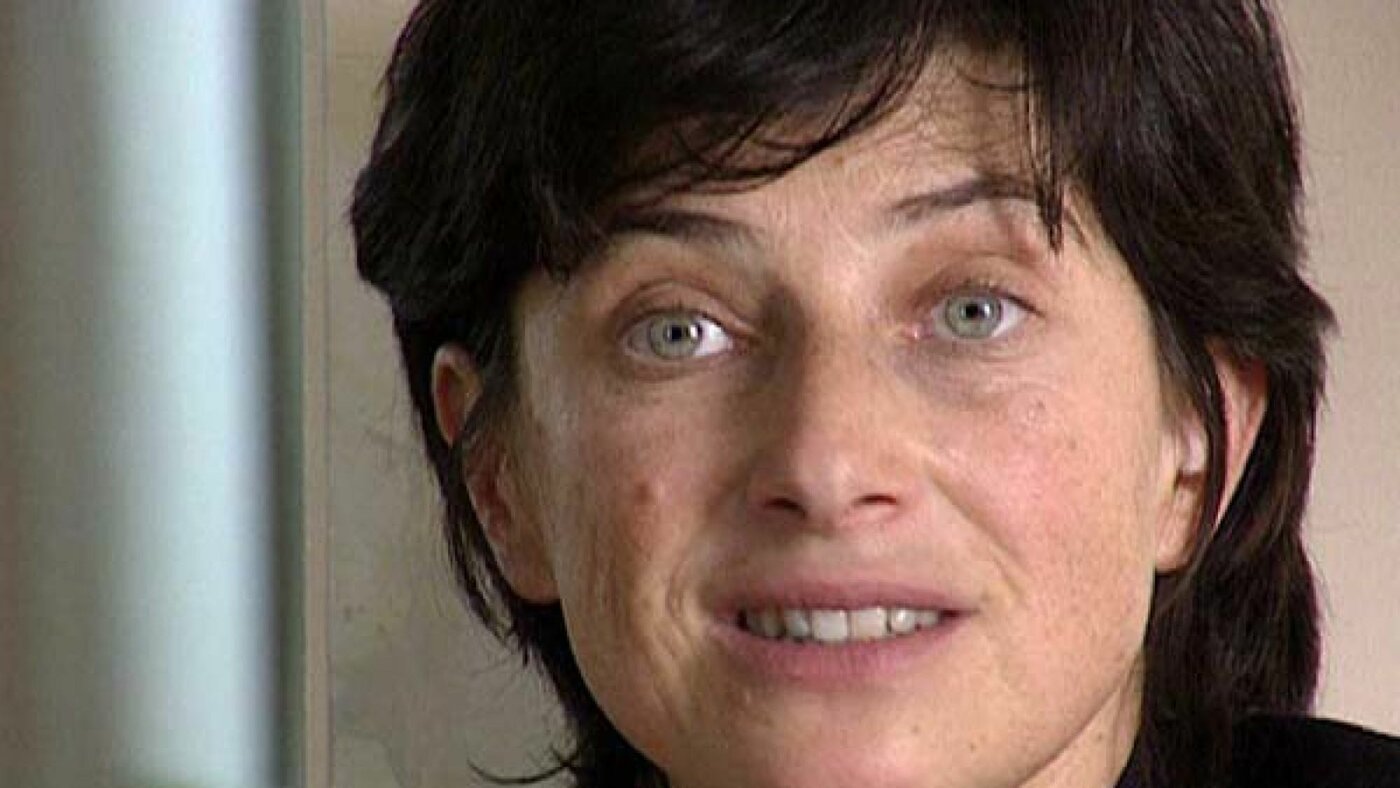
Chantal Akerman par Chantal Akerman (Chantal Akerman, 1996).
In November 2015, about a month after Chantal Akerman’s death, the Cinémathèque Française paid tribute to the filmmaker with a screening of her final work, that year’s No Home Movie. Her longtime editor Claire Atherton spoke, citing a quotation by the French poet Edmond Jabès that Akerman had liked: “Every interrogation is linked to the gaze.” “She said she did not know if this statement was true,” Atherton added, “but that it spoke to her.” Using cinema to raise questions rather than provide answers is at the core of Akerman’s varied and restlessly inventive body of work. With a steady gaze that rewards our attention rather than manipulating our emotions, Akerman invites us to participate in her cinematic interrogations.
Akerman made more than 50 films, a combination of fiction, documentaries, television projects, and experimental shorts, all of which are included in the Museum of Modern Art’s retrospective, Chantal Akerman: The Long View. (Sadly, Akerman’s video installations, nearly twenty pieces that reconfigure many of her films as gallery experiences, are beyond the scope of this program.) If there is a key question at the heart of Akerman’s incredibly varied and deeply personal body of work, it is this: How does one find their place in the world? In Akerman’s case, how does a Jewish woman born in Brussels in 1950 to Natalia, a woman who survived Auschwitz, shape her identity and process the trauma of her family’s history? In her soul-baring and essential memoir, My Mother Laughs, published in 2013, a year before Natalia’s death, Akerman wrote of her perpetual feeling of living in exile: “I don’t feel like I have a home, or an elsewhere.” She also writes, ominously, that she came to understand that “my mother and I were inordinately bound together and that this attachment would prove fatal.” Indeed, Akerman’s book foreshadows her suicide: “I have survived everything to date, and I’ve often wanted to kill myself. But I told myself I could not do this to my mother. Later, when she’s not here anymore.”
For Akerman, cinema was a way to look at the world, but also at one’s self. And her existential unease was always tempered by the playfulness and vitality of her work. In Chantal Akerman par Chantal Akerman (1996), the director attempts, with reluctance and a touch of humor, to speak about her films. Sitting in her apartment, she talks directly to the camera about her discomfort with this self-reflective project, citing a friend’s comment that “the artifice of sincerity disturbs me.” Resisting the simplification of focusing on aspects of her identity as a woman and a second-generation Jewish immigrant, Akerman says, “I make movies because I make movies because I make movies,” and then, after telling an old Jewish joke about a farmer who tries to sell a skinny cow (self-deprecatingly comparing her films to the cow), she proceeds to let scenes from her work form her self-portrait, without narration or further context. Over the next 45 minutes, we see passages from fifteen films, including her magnum opus, Jeanne Dielman, 23, quai du Commerce, 1080 Bruxelles (1975), but also from films that directly include her, including her debut, Saute ma ville (Blow Up My Town, 1968), an anarchic and hilarious short that ends with Akerman blowing up her apartment building while she is inside; her feature debut, Je tu il elle (1971), a triptych of scenes of lust and longing that culminates with what was then a pioneering extended scene of lesbian sex between Akerman and her ex-lover; and News from Home (1976), a defamiliarizing travelogue through the peripheries of New York City as the filmmaker, in voiceover, reads aloud letters from her mother in Brussels.
Some of Akerman’s films are thinly veiled self-portraits: Les rendez-vous d’Anna (1978) portrays the alienation of a film director (Aurore Clément) traveling through a sterile European landscape whose inhabitants are haunted by the aftermath of the war. Along the way, Anna encounters a lonely German man who, while trying to court her, talks in personal terms about how national insecurity led to the rise of Hitler; she visits her mother, to whom she confesses a lesbian affair, even admitting to her “for some strange reason I thought of you” while with the woman. One of Akerman’s most underrated films is the loopy comedy Tomorrow We Move (2004), about a mother and daughter who must move into a house together; the daughter (Sylvie Testud) is a writer of cheap pornographic novels; the mother, like Natalia, is the daughter of a Polish Holocaust victim. They discover the grandmother’s diary, in which she writes, in Polish, “Since I’m a woman I can’t say everything I feel about my memories, my secrets, and my thoughts out loud. All I ever do is suffer in silence.” The lightness of the film, which buzzes with frantic comic energy and is filled with music, strongly contrasts with the darkness of the secrets it discloses. This blend of buoyancy and pain is also found in Akerman’s most purely enjoyable film, the brightly colored musical Golden Eighties (1986), set in an upscale shopping mall. At the center of this brisk and delightfully choreographed pastel-colored rondelay of young love is the shop-owner Jeanne (Delphine Seyrig), the only character in the film to dress in black. We learn from an offhand comment that Jeanne is a Holocaust survivor. Her survival mechanism is to try to always maintain a mood of bubbly effervescence.
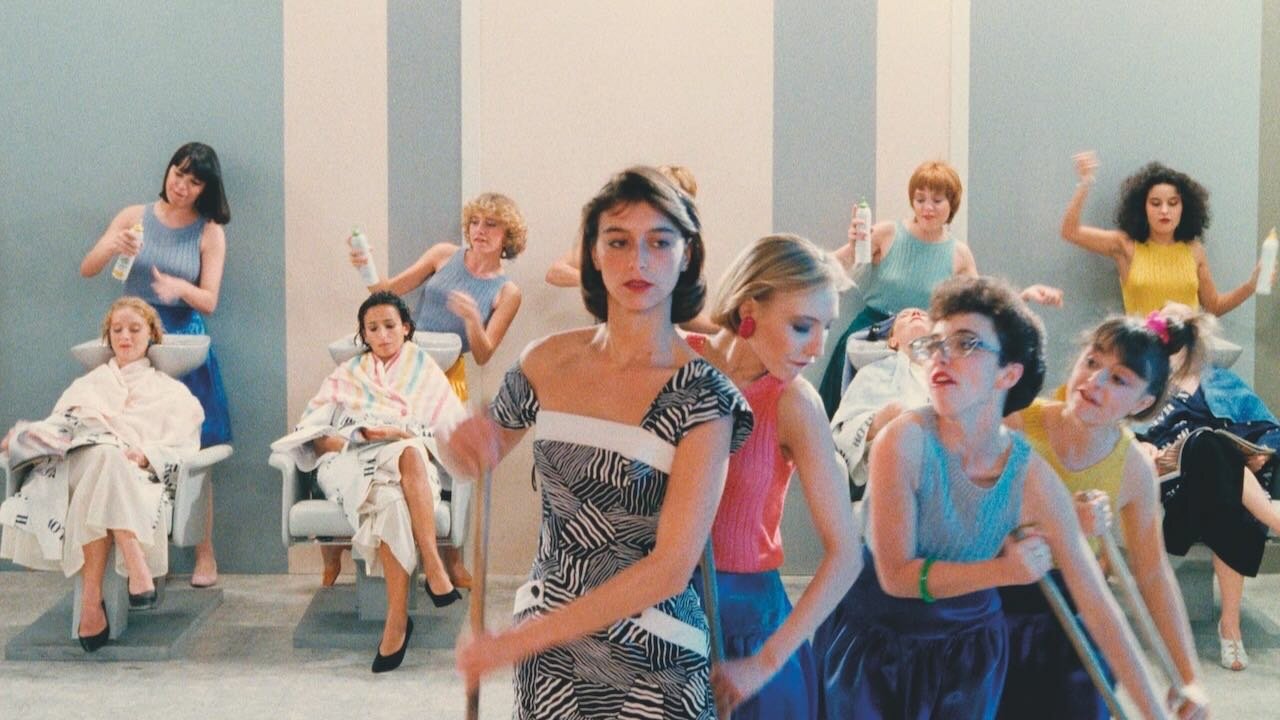
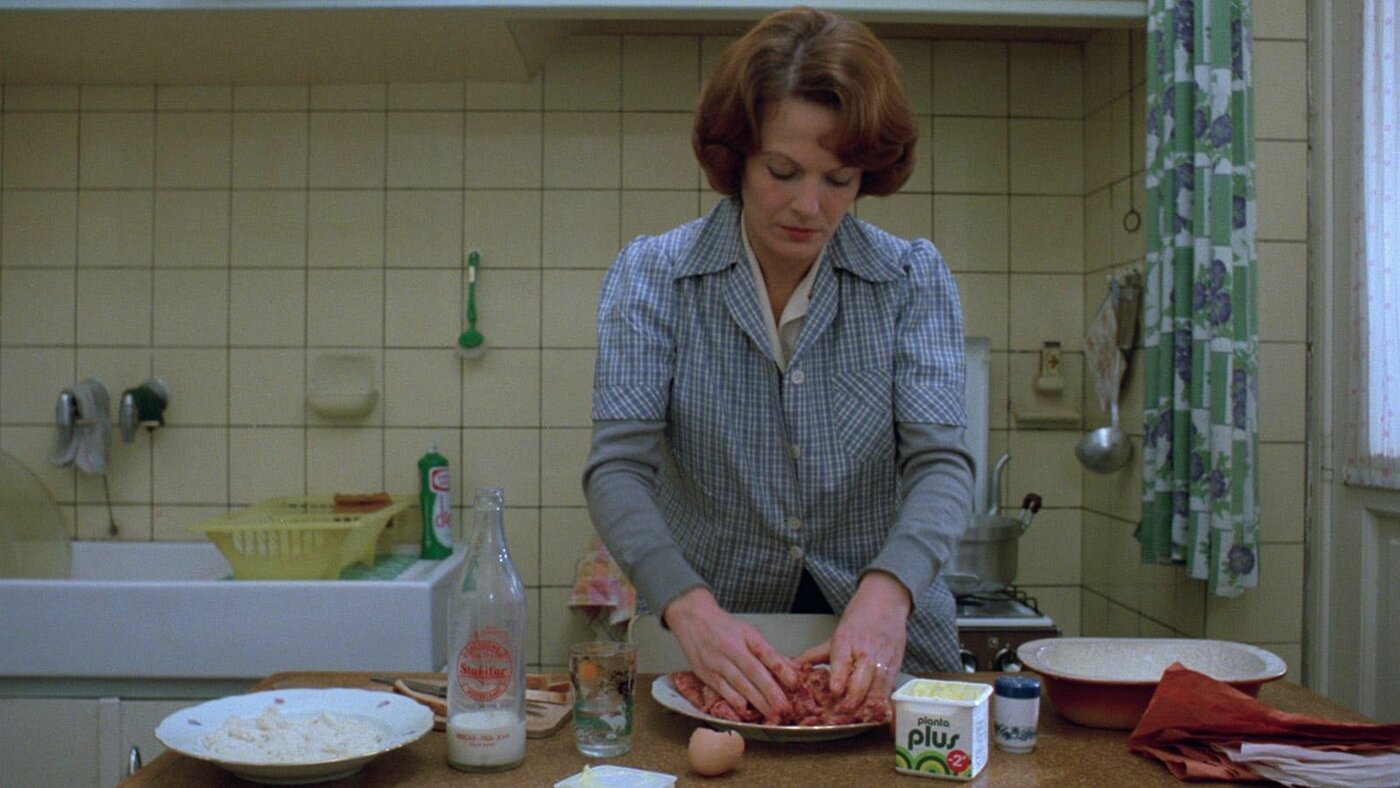
Top: Golden Eighties (Chantal Akerman, 1986). Bottom: Jeanne Dielman, 23, quai du Commerce, 1080 Bruxelles (Chantal Akerman, 1975).
Jeanne Dielman was elevated in stature in 2022 by its selection in Sight and Sound’s decennial critics poll as the greatest film of all time, unseating Alfred Hitchcock’s Vertigo (1958). The surprising choice recognized a film that is at once meticulously crafted, but also defiantly avant-garde in its focus on the minutiae of domestic life. Its most famous scene, set in a kitchen (a favorite Akerman location), consists of Seyrig’s Jeanne preparing a meatloaf in real time. Nearly fifty years after its release, the critical establishment overwhelmingly endorsed the distinctive power of Akerman’s approach to cinema, the way that she controls the medium’s essential elements, sculpting in space and time, to let the viewer feel that they are physically experiencing Jeanne’s story.
This approach grew directly out of Akerman’s encounters with experimental cinema during her time in New York City in 1971 and 1972, where she came of age artistically. Jonas Mekas, unofficial mayor of the city’s film underground, was impressed with Akerman’s Saute ma ville, and welcomed her into his circle of downtown filmmakers. She met Babette Mangolte, who would become a key collaborator, photographing Jeanne Dielman, News From Home, and two key early films, La chambre and Hotel Monterey (both 1972). Mangolte and Akerman spent many hours at experimental film screenings at Anthology Film Archives and other venues. A seminal moment was their viewing of Michael Snow’s three-hour La Région Centrale (1971), a mind-expanding depopulated landscape film made with a gyroscopic camera apparatus atop a remote plateau in Northern Quebec, in which all of the action is generated by the camera’s ceaseless swirling and tilting, gradually transforming the imagery into an abstract cosmic blur. Akerman and Mangolte saw the film at the Elgin Cinema, where it had a two-week run. They spent twelve hours one day watching the film repeatedly. “The sensory experience I underwent was extraordinarily powerful and physical,” Akerman later said. “It was a revelation for me, that you could make a film without telling a story.”
Akerman never made a film that looked like La Région Centrale, but her movies, like Snow’s, are sensory experiences that play with duration and perception, asking us to see the world in new ways. In 1972, when Akerman was scrounging money to make films (sometimes pocketing cash from the box office at a porn theater where she worked), she was commissioned to make a documentary about a Yonkers teen rehab facility. Filmed by Mangolte on a small borrowed Beaulieu 16mm camera, the film was never completed after Akerman lost some reels of footage on the subway. All that remains is a silent half-hour compilation, titled Hanging Out Yonkers (1973). The teens sit in front of the camera, shoot pool, play chess, and talk to each other, trying to act cool while seeming a bit self-conscious. Nothing is happening, but as Akerman wrote in her memoir, referring to other people she had filmed, “It was that nothing that interested me.” The film’s thirteen long shots are all filmed in the static tableau style that would become Akerman’s trademark. It is fascinating to think about how she would have edited the promotional film for which this footage was intended. In its current state, it has the unwavering focus and attention to detail of Jeanne Dielman, filmed just two years later. Akerman said that she deeply regrets not finishing the film, and that she found the footage “really beautiful.” Through her close attention to behavior and self-presentation, she captures adolescence as a limbo state in which identity is being formed. A sign on a wall at the rehab center reads, “You be you, I am I. You do your thing, I’ll do mine.”
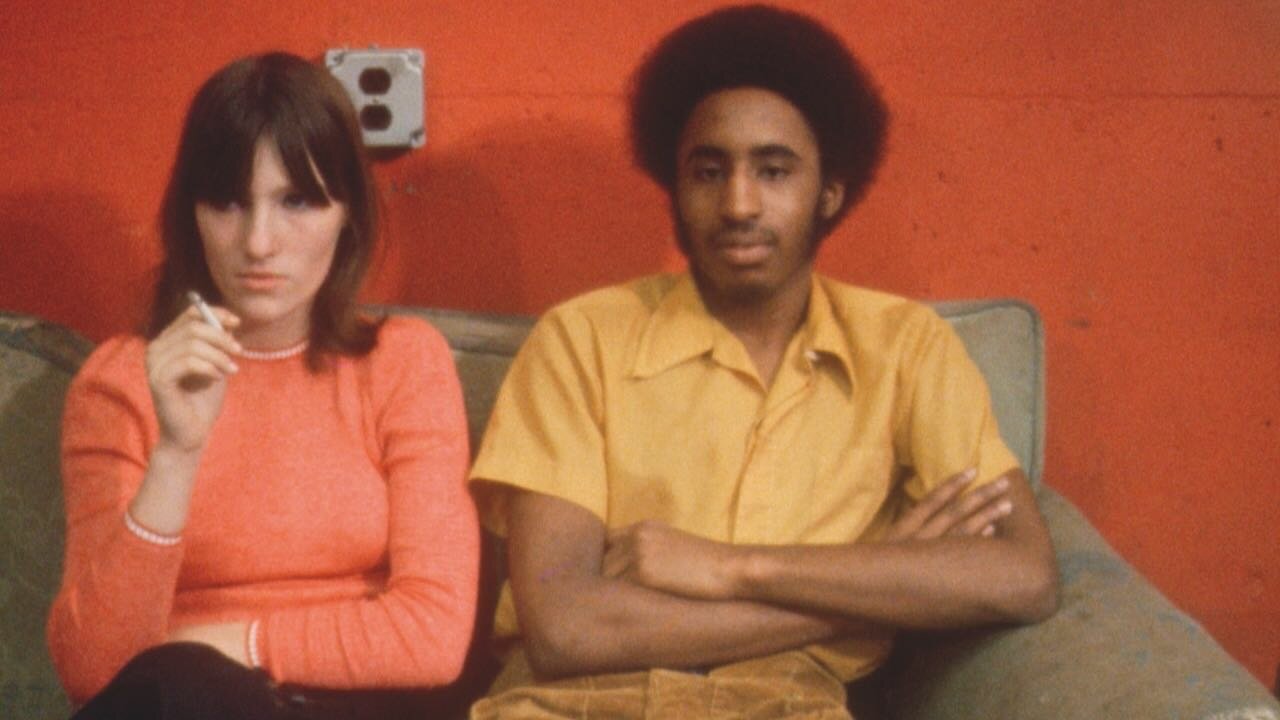
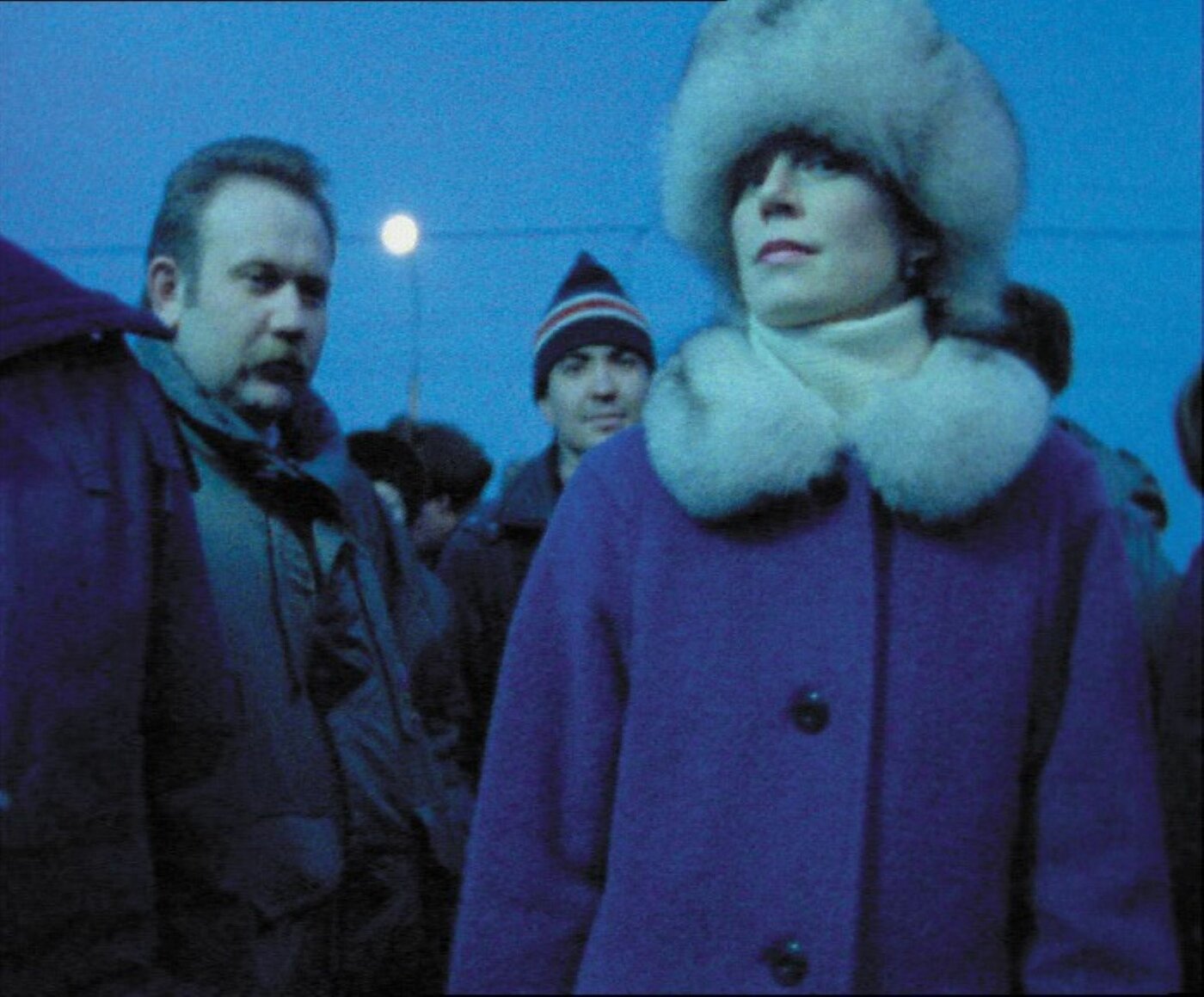
Top: Hanging Out Yonkers (Chantal Akerman, 1973). Bottom: D'est (Chantal Akerman, 1993).
Akerman’s ability to turn “nothing” into powerful art is evident in her D’est (1993), filmed across Eastern Europe in the aftermath of the collapse of the Soviet Union. Filled with tracking shots, often on snowy winter nights, D’Est shows people lining up, trudging to the subway station, waiting for buses, walking through marketplaces, dancing to rock music at a dreary hotel, moving from one place to another, but with nowhere really to go. In an installation version of this feature-length film, Akerman included a text describing her subjects as “people whom history has struck down. People who are walking there, packed together, to be killed, beaten, or starved, or who walk without knowing where they are going. It is obsessive and I am obsessed.” Without ever explicitly stating it, her film carries unmistakable echoes of the Holocaust.
While D’Est was made in response to the disorientation following the fall of the Iron Curtain, the documentary From the Other Side (2002), filmed on the Mexican-American border, captures the anti-immigrant paranoia that spiked after 9/11. Akerman visits diners, homes, and police stations, talking to Mexicans whose family members died during dangerous border crossings, to those who express the need to “keep on going, no matter what the cost” to provide for their families, and to Americans who fear that “Mexicans can do a lot of damage.” Echoing D’Est, there is a haunting five-minute tracking shot of an unending line of cars in the predawn hours at a militarized border checkpoint. To make her powerful documentary Sud (South, 1999), Akerman traveled to Jasper, Texas, shortly after the 1998 murder of James Byrd, Jr., who was dragged to his death from the back of a truck by white supremacists. Sud creates a panoramic view of the town, and an intimate study of American racism, by interviewing Black and white residents and police, and through its ending, a haunting continuous shot recreating the path of Byrd’s fatal ride.
Difficult to categorize (is it a documentary or a diary film?), Là-bas (Down There, 2006) is one of Akerman’s most personal and most complex films. In a Tel Aviv apartment, Akerman points her video camera Rear Window–style at a terrace across the street, where an older couple relaxes. Throughout, Là-bas sets Akerman’s interior life against the quiet scenes of daily urban life, which themselves contrast with Israel’s fraught history. In voiceover, she addresses her deeply mixed feelings about Israel, about not feeling at home in a country that might have been her homeland. (Her Polish father chose to settle the family in Brussels rather than the newly formed Israel in the late 1940s.) During the respite of a visit to the beach, the sight of a Hasidic family walking along the shore makes Akerman wonder, “What if we too went to Israel?” She tells us she spends her time “reading complicated books about the Jews,” and then talks about how a recent bombing in Tel Aviv “puts things in perspective.” As Akerman watches the couple go about their lives, she muses, “I feel disconnected from everything.” Reflecting again on suicide, she tells us that her friend Amos Oz’s mother and her own Aunt Ruth recently killed themselves, one on a “cloudy day in Tel Aviv, and one on a pale, sunny day in Brussels. Suicides happen everywhere. Most of them are a form of exile, wherever they are.” The freedom the film gives us to contemplate while we observe, as Akerman herself does, makes this one of the retrospective’s many treasures.
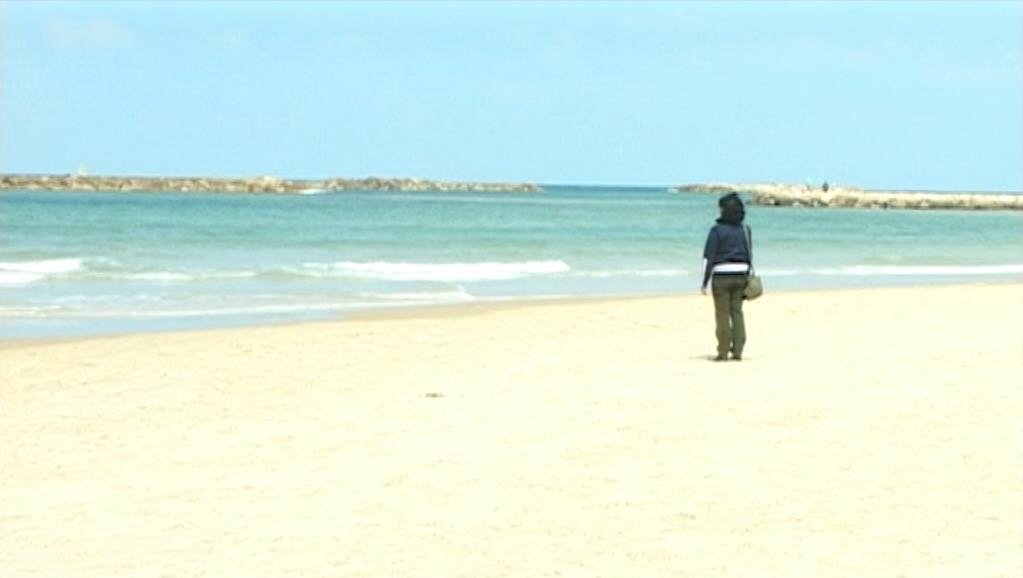
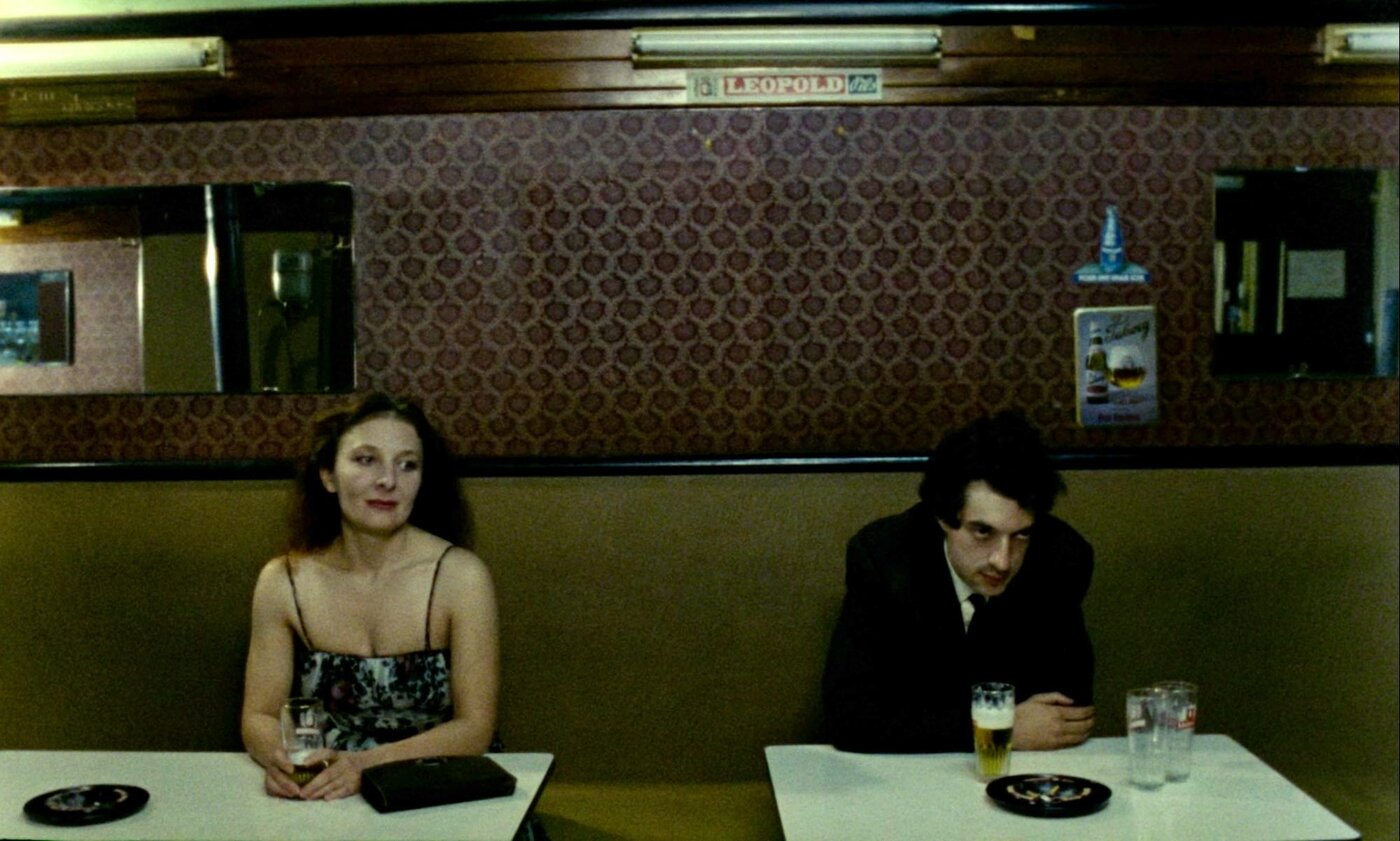
Top: Là-bas (Chantal Akerman, 2006). Bottom: Tout en nuite (Chantal Akerman, 1982).
As much as Akerman’s sensibility invites serious reflection, there is a deadpan comic streak that runs through much of her work, and two of her features are structured as vaudeville-style collections of blackout sketches. Set during a long night and early morning in Brussels, Toute une nuit (1982) is composed entirely of heightened moments, cutting between brief scenes of sleepless couples and loners in their beds, out on the street, in bars, breaking up, dancing, and talking. With their distinct rhythms and spare dialogue, Akerman’s films often feel like musical compositions; Toute une nuit is a delightfully and uncharacteristically staccato work, as is Histoires d’Amérique: Food, Family, and History (1989), in which a series of performers, many from New York’s underground theater world—including Judith Malina and Eszter Balint—speak directly to the camera, alternating between Jewish jokes and more serious personal monologues, forming an oblique portrait of how cultural bonds tie together a group of exiles in their chosen city.
Although both are literary adaptations, two of Akerman’s final feature films feel extremely personal, and are among her most exquisitely crafted works. La captive (2000), inspired by the story “The Prisoner” from Marcel Proust’s Remembrance of Things Past, is a tale about the sexual obsession of a man who becomes convinced that his girlfriend is dating a woman and begins following her every movement, smothering her in a way that seemingly drives her to suicide. Exquisite and dreamlike, it is a variation on Vertigo (1958) that stands up well against Hitchcock’s original. Almayer’s Folly (2011), adapted from the novel by Joseph Conrad, focuses on a European trader who is stranded in Malaysia, where his marriage has fallen apart and his dreams of wealth have faded. He lives with his half-Malay daughter, Nina, who goes to college in Europe and returns only to become enmeshed in a tragic affair. This trancelike, gorgeous film is again a study of exile—both the daughter’s and the father’s.
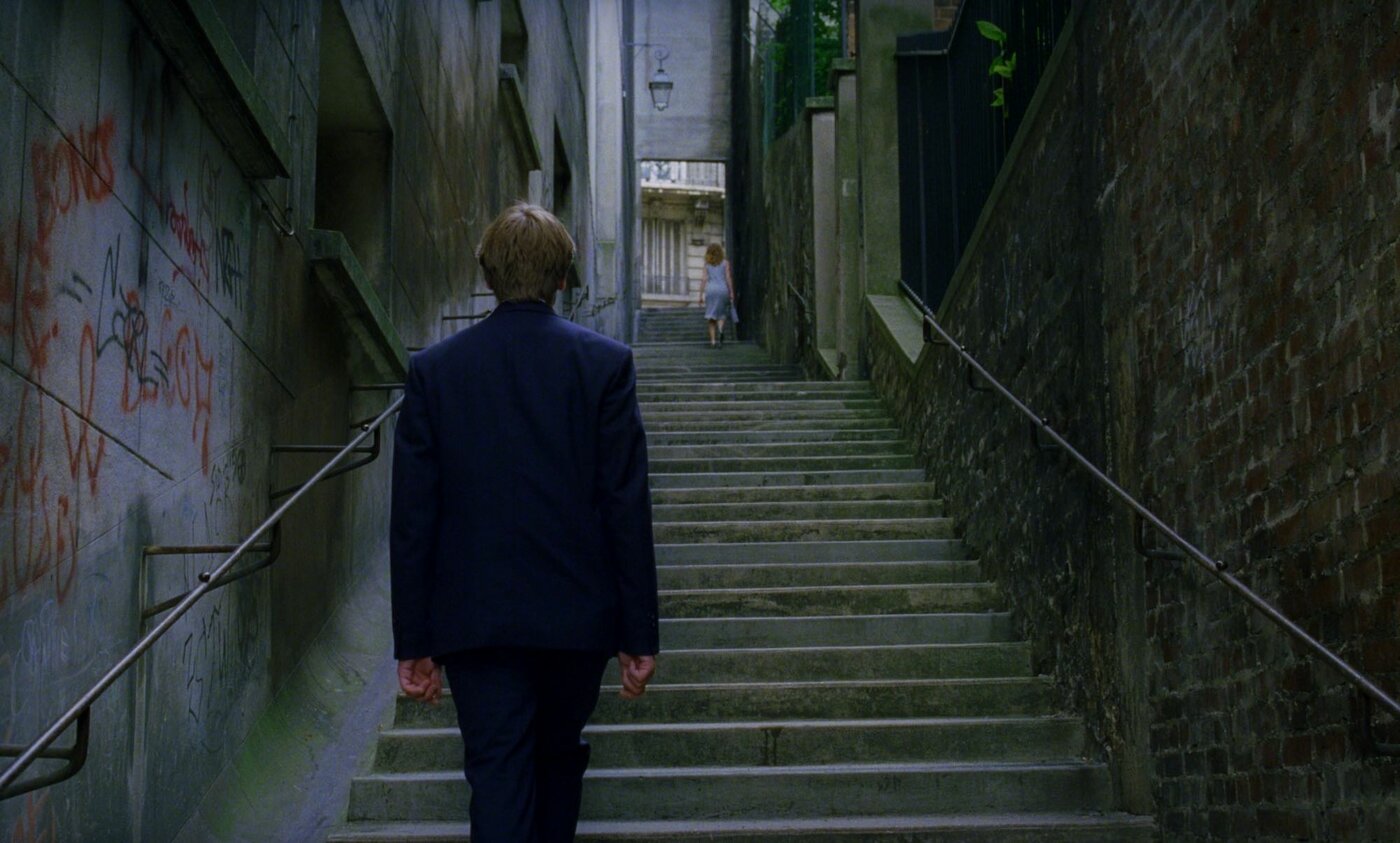
Top: La captive (Chantal Akerman, 2000). Bottom: No Home Movie (Chantal Akerman, 2015).
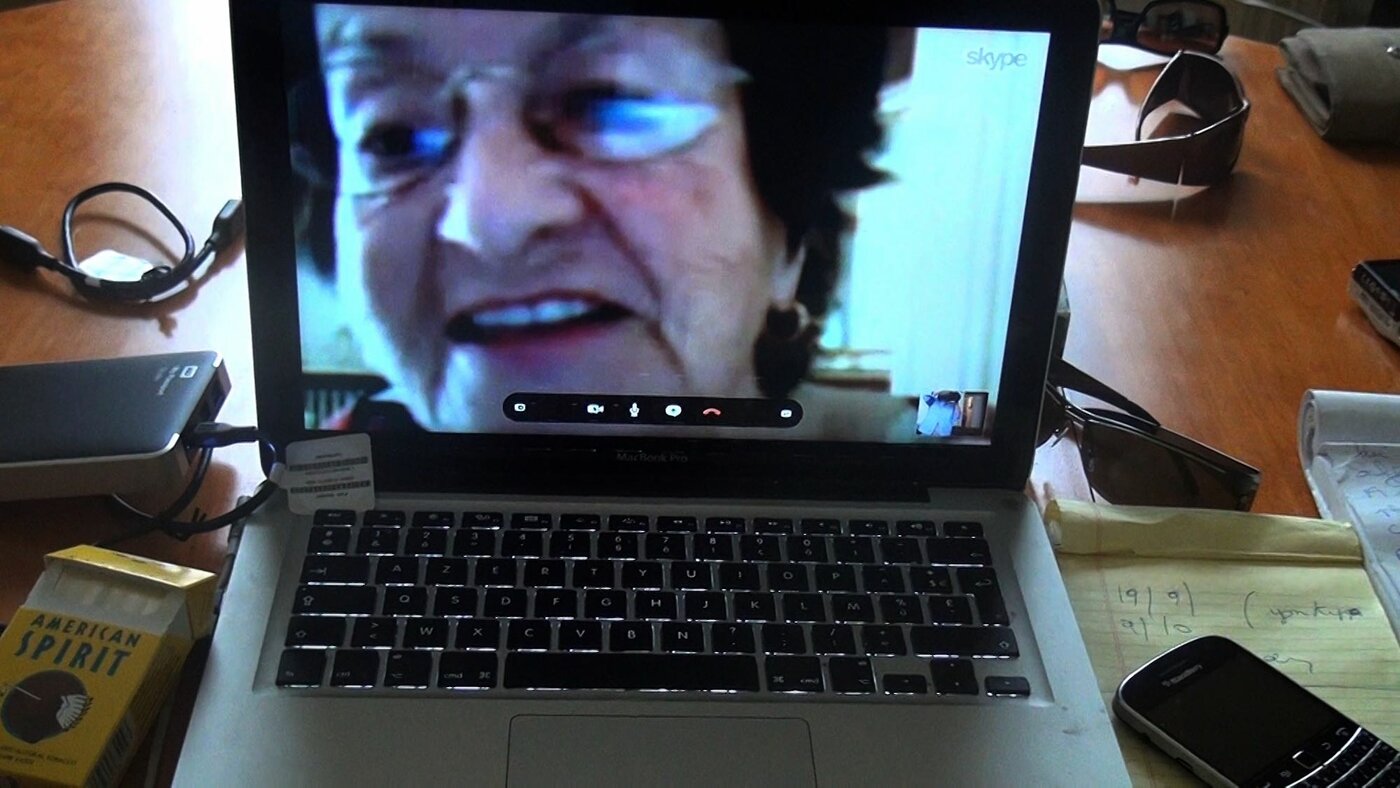
Akerman’s death on October 5, 2015, just two days before No Home Movie played at the New York Film Festival (it had premiered at the Locarno Film Festival in August), was shocking and tragic at the time, though it feels eerily predetermined in hindsight. Her final film is almost entirely a diary about Akerman and Natalia, either spending time together at Natalia’s apartment in Brussels as her health begins to fail, or communicating by Skype as Akerman travels to Mexico (where her sister lives) and other places. Filming their Skype calls, Chantal tells Natalia, “I want to show that there is no more distance in the world.” Natalia responds lovingly, “You always have such ideas in your head, sweetheart.”
The movie opens with a cell-phone video of Israel’s Negev desert. Trees shake in the heavy wind, and the camera jitters. The shot goes on for more than four minutes; it feels both eternal and ephemeral, and it finds the filmmaker in a place that feels like no place. There are any number of ways to understand the title No Home Movie, which contains the ambiguity of Dorothy’s mantra in The Wizard of Oz (1939): “There’s no place like home.”