Illustrations by Chantall Veerman.
Paramount Skydance is trying to buy Warner Bros. Discovery (WBD). Amidst a million more pressing political issues, this one seems quaint, even with billions of dollars at stake. Who cares if the Paramount is the logo before the next Batman movie and Game of Thrones spinoff? The American mainstream cultural world is so corrupted and corporatized, it can be tempting to ignore this deal with cynicism or apathy. But the news matters, the movies matter, labor matters, media matters—our stories matter. Those more pressing political issues are contested in large part through our flawed cultural system, which is itself shaped by our political economic system. The case of the WBD sale is both materially and symbolically part of a broader, violent conflict. The cultural industry of Hollywood is not just a dream factory that produces distraction, it is an exploitative capitalist system that enriches the plutocratic class through financial extraction, monopoly, and wage suppression. The company’s potential new owner, Paramount Skydance, is not just the studio that produces SpongeBob SquarePants (1999–present), it is now part of the American right’s increasingly authoritarian consolidation of power, boosted by corruption in the Trump administration, particularly in crypto, settlements, gifts, and pardons. But as the case represents a larger conflict, so too can resistance to it. It is therefore imperative that this merger should be blocked: The odds may be long, but the stakes are terribly high. Successfully blocking the merger could be a material and symbolic tactical victory in a larger strategy of the people taking back our cultural system.
The world’s six wealthiest men are decimating our cultural world through direct ownership and extraction of key aspects of our media system. The richest of them all, Elon Musk, acquired Twitter through a private, hostile acquisition and transformed it into right-wing agitprop and an AI bot that spent a week generating nonconsensual naked imagery of women and children. His satellite system is an increasingly essential node in global communication. Jeff Bezos neutered the editorial voice of the Washington Post and transformed publishing through Amazon, which continues to impact the media ecosystem with its many devices and platforms. Larry Page and Sergey Brin have evolved Google from a useful search service into an advertising engine that generates AI slop derived from stolen culture. Mark Zuckerberg is failing to build the metaverse with the billions of dollars he generates from polluting the minds of teenagers on Instagram. The sixth, and least well-known, is Larry Ellison, who is building an information and surveillance empire out of Oracle, TikTok, Paramount, and, if he gets his way, Warner Bros. Discover. That’s just the six worst men; there’s a legion of financiers and executives that are bleeding our cultural industries dry through financial engineering strategies such as private equity, hedge funds, venture capital, and derivatives trading. All the big tech and media companies are driven by financialization, just as all the big tech and media companies are complying with authoritarian demands, such as settlements by Disney, Paramount, Meta, and Google. The US media landscape of news, film, television, and music is eroding quickly. Its ability to circulate trustworthy information, democratic values, diverse viewpoints, and meaningful culture is under grave threat from monopoly and consolidation.
If the WBD sale proves successful, it would consolidate the burgeoning media monopoly of Ellison—briefly the wealthiest man on the planet, but hovering in the top six depending on stock market swings—who has climbed to near the top of the billionaire ladder in comparative secrecy to the Musks, Zuckerbergs, and Bezoses of the world. Ellison’s company, Oracle, achieved dominance in the database sector by acquiring its competitors (over 140), just as Microsoft, Google, and Amazon have in other corners of the tech sector (at least 212, 270, and 128 companies, respectively). With his wealth achieved through anti-competitive monopoly, Ellison has purchased many things: a $194 million yacht, the Hawaiian island Lanai (he owns 98% of it, to the deep distress of the indigenous population), as well as legal impunity, like when he had a billion-dollar insider trading lawsuit settled by donating $100 million to his own charity, despite his shady history with philanthropy. Ellison raised millions for Trump’s reelection campaign by auctioning rounds of golf for $100,000, with added perks at a quarter million. These efforts secured the Trump administration’s support in Oracle’s disputes with Google and Microsoft, as well as his successful takeover of the U.S. division of TikTok.
Ellison’s children own Oracle stock valued at more than $4.8 billion. Both decided to spend it in Hollywood, financing movies. His daughter, Megan Ellison, established Annapurna Pictures, a company focused on indie films and winning awards. In 2019, there were reports of “restructuring” at Annapurna amid bankruptcy rumors after it burnt through $350 million of credit and a series of films that failed to turn a profit. Larry Ellison leveraged his own relationship with the lenders, including banks such as JP Morgan and Wells Fargo, to pay off the debt at 80–85 cents on the dollar. Banks don’t make a habit of angering the wealthiest men in the world. Annapurna’s record of financing over-budgeted, under-performing films and then getting its founder’s father to bail it out is not good for the filmmaking community; it deters other investors and artificially raises prices. The independent film infrastructure is fragile at the best of times, reliant as it is on festivals, passionate creators, dedicated workers, and word-of-mouth. Inexperienced heirs throwing around money is destructive to the overall health of the industry. Despite producing classics of contemporary cinema, such as The Grandmaster (2013), Phantom Thread ( 2017), If Beale Street Could Talk (2018),Hustlers (2019), and the delightfully anti-capitalist Sorry to Bother You (2018), Annapurna represents the inherent danger of elite patronage. For independent cinema to rely on a handful of wealthy people, inherently biased in their whiteness, privilege, and security, is a threat to the stability and sustainability of the art form.
Larry’s son, David Ellison, started Skydance Media in 2006, with a focus on television, video games, and blockbuster movies, many starring Tom Cruise (Mission: Impossible 4–8) or new entries in existing franchises (G.I. Joe 2–3, Terminator 5–6, Star Trek 12–13, and the fifth Spy Kids and seventh Transformers films). By 2020, Skydance parlayed its box office successes and financial connections into a billion dollar credit line from JPMorgan and investment from the private equity firms KKR and RedBird Capital. In 2024, with financing from RedBird and Larry Ellison, Skydance was able to acquire the legacy studio Paramount, which had been mismanaged for years under its ailing mogul Summer Redstone and his squabbling children. Technically, David is the new CEO of Paramount Skydance, but with the $6 billion invested by Larry, it’s hard to believe that the decisions, ideologies, and bank credit of David’s father won’t run the show. Thousands of layoffs, a $36 million settlement with the Trump administration over a frivolous accusation while it needed FCC approval, and a rightward tilt to CBS News were some of the first actions by the new owners.
Meanwhile, Oracle is a key player in the AI-fueled data-center building frenzy, including a $500 billion deal with OpenAI and Softbank. Larry believes that AI is necessary so that “citizens will be on their best behavior, because we’re constantly recording and reporting everything that is going on.” His dream is to “unify all of the national data, put it into a database where it's easily consumable by the AI model.” To do so, he’s cooking up risky financial schemes for data centers. Seeking to unleash an overleveraged surveillance and privacy nightmare, this is not the man who should be in charge of CBS News, the storied home of investigative journalists and trusted figures like Edward R. Murrow, Walter Cronkite, Dan Rather, and Connie Chung. Adding the important political agenda-setting function of WBD’s CNN allocates even more power to Ellison. Democracy needs journalism to keep politicians accountable and its citizens informed; meanwhile, billionaires like Ellison need to keep politicians on their payroll and citizens policed.
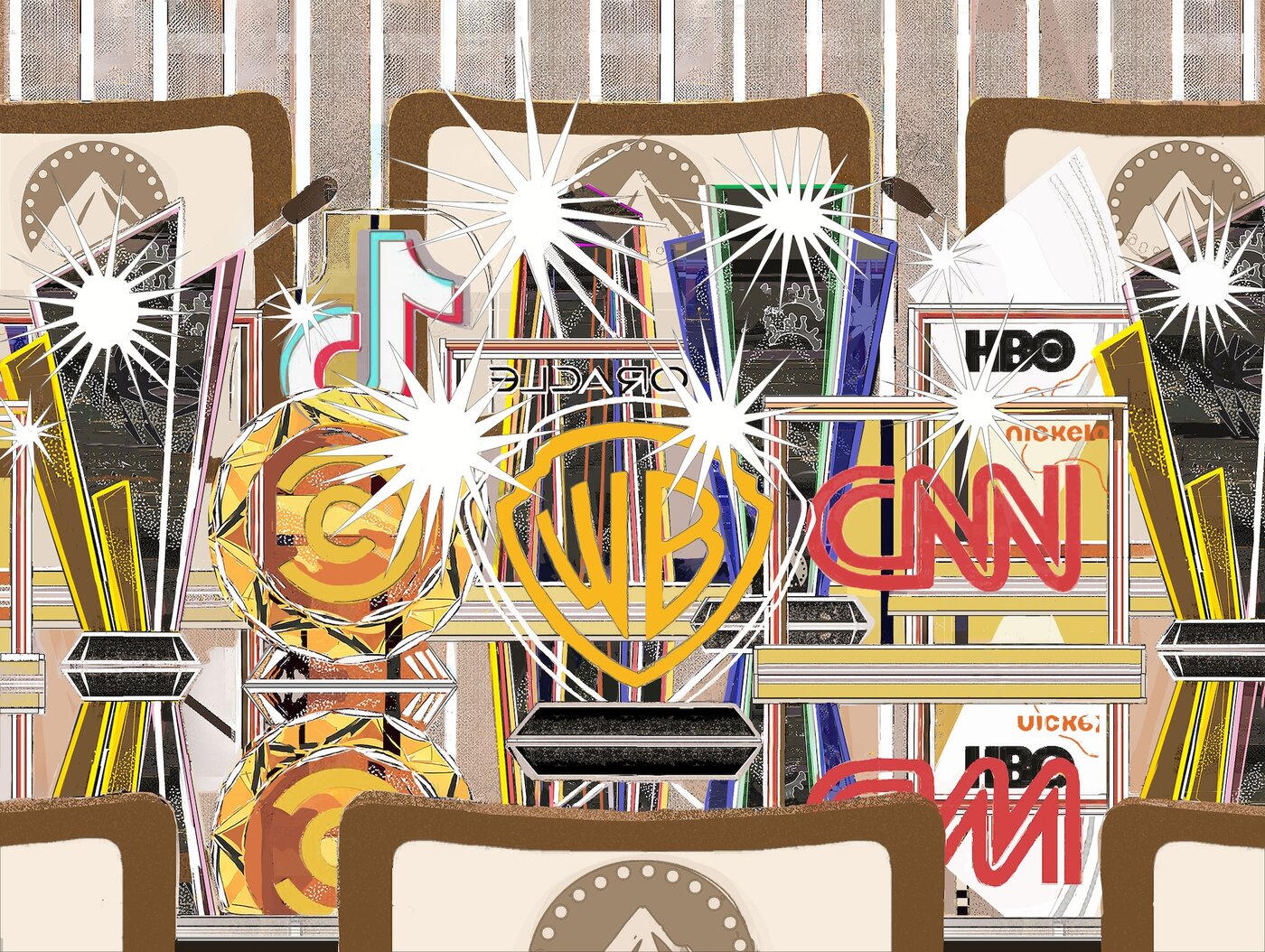
Ellison’s burgeoning information empire already includes TikTok, Oracle, and Paramount with its many holdings, including CBS, Paramount+, Nickelodeon, Miramax, Pluto, MTV, Comedy Central, Showtime, BET, local television stations, sports, and more. Adding Warner Bros., CNN, HBO, DC, New Line, Turner, Discovery, Cartoon Network, various holdings in sports and gaming, and much more would be detrimental to democracy and the public good. If Paramount Skydance is permitted to acquire WBD, it would create a media leviathan, the dominant player in many markets. According to calculations by scholars at the Media And Consolidation Research Organization (MACRO) Lab and the Global Media and Internet Concentration Project, the combined Paramount Skydance-WBD company would catapult to the top of the following markets, replacing Disney as the top company in U.S. Pay TV Programming, U.S. Streaming TV Audience, Total U.S. TV Viewership, and U.S. Theatrical Film Box Office. In U.S. Film Production and Distribution and Total U.S. Streaming Subscribers, it will narrowly miss overtaking Disney’s top market share. It was Disney’s voracious acquisition spree of Fox, Pixar, Marvel, and Lucasfilm that led it to its current dominance. The Paramount Skydance-WBD merger would worsen an already dire situation. None of these markets can face further concentration; taken together, it represents a dark new age in Hollywood.
The effects of consolidation in film and television are overwhelmingly negative. It’s bad for creativity, as there are fewer places to pitch new projects and fewer companies willing to take a chance on new, original, creative material. It’s bad for workers, who have fewer possible employers to employ them, which improves the companies’ ability to suppress wages as they face less competition. It’s bad for local economies, as production gets offshored abroad, where wages are cheaper and they don’t have to pay for benefits. It’s bad for consumers, who are left with fewer viewing options and higher prices. It’s even bad for the companies themselves, which get saddled with even more debt, lowering their operational and creative capacity. Warner Bros. is a perfect example of this: they have steadily incurred towering amounts of debt as they were passed around, acquired, merged, and repackaged over many decades; previous suitors and partners include Discovery, AT&T, AOL, Time, Turner, Kinney National, Seven Arts, and more. Each new buyer or partner comes with a new corporate strategy and a fresh round of layoffs. Institutional and creative knowledge and experience are lost. Speculative financing churns through intellectual property to benefit shareholders and shadow bankers; we’re left with ever-more derivative media.
We need to fight for our right to culture; the Paramount Skydance case gives us clear villains (Larry and David), clear problems (layoffs, consolidation, censorship, less creativity, higher prices), and a clear goal (block the merger). The current Federal Communications Commission and Department of Justice are compromised, staffed as they are by Trump appointees who serve his donors, but for American citizens, there are state-level options, as the successful Live Nation antitrust case has shown. A coalition of states could organize and sue Paramount Skydance over this merger, but they need our support and they need to see that the public cares about this issue. Contact your representatives. Contact your state attorney general’s office. California’s office of the Attorney General has announced a “vigorous” review and you can file a complaint. Organize with blockthemerger.com. Donate to the Free Press campaign. Educate your friends and family. Loudly complain online and off. Connect the plutocratic plunder of our media system to the plutocratic plunder of health care, education, climate, politics, energy, real estate, immigration, and every other part of our failing social system. Our media system likely can’t survive further consolidation, but the public can be persuaded: we care about stories and we rely on good information systems. The merger case and its appeals process will be drawn out over many months, even years, but the public interest can win out if we persevere.
This tactical goal can be but one component of a broader, long-term strategy of transforming our media system at many different levels, from the personal to the organizational to the political. Pay for your news, especially investigative journalism that confronts corruption. Watch and pay for independent film and television. Limit your support of corporate and derivative media. Give your financial and social support to artisans, not hedge funds. Take a principled stand for workers and thinkers and artists and libraries and the infrastructure needed to sustain them, while standing against financiers and plutocrats. Americans can support unions like IATSE, WGA, and UMAW, as well as organizations like GLAAD, NAACP, FAIR, Free Press, Electronic Frontier Foundation, and MediaJustice. Take part in protests, boycotts, strikes, blockades, solidarity, and other tactics. Don’t let an algorithm decide what you read, watch, or listen to. Make your own decisions about what culture you surround yourself with. Read reviews by trusted critics. Follow organizations that celebrate meaningful art. Chat with your friends about what you’ve seen or heard. Culture is not just about consumption; it should be about community and shared meaning-making.
When we win this defensive maneuver and stop the takeover of WBD, we can go on the offensive. Continue the renewed emphasis on antitrust enforcement. Don’t just limit the finance-fueled mergers and acquisitions that have led to monopolization throughout the economy, but unwind previous mergers and break up the biggest companies. Break up Netflix. Break up Disney. Break up every single god-awful Big Tech company using film, television, music, and news as another way to get and sell our data. Carve out new regulatory rules that prevent any company from ever gaining more than 10% market share of any cultural sector.
Antitrust action is just one tool among many to wrest back power over our media system. We can go further and enact policy changes that would limit the destructive influence of the financial sector, including its effect on the media industries. Eliminate stock buybacks, which were illegal prior to 1982. Close the carried interest loophole, which allows private equity to profit from its predations and outlaw its most harmful strategies: asset-stripping and bankruptcy exploitation. Create a financial transaction tax. Implement the wealth tax the public overwhelmingly supports, the impact of which would help prevent avaricious billionaires from buying and debasing media companies. Finance reform is media reform. The result would be not only a limitation on the excessive power of the wealthy, but a more democratic system. Stories and information are too important to leave to a corrupt marketplace motivated by accumulation for the few. Shared culture belongs to the many.