Notebook, in partnership with the Locarno Critics Academy, presents a series of critical correspondences in which this year’s participants look back at the Swiss film festival. In this second installment, four critics muse on cinema’s ability to splice disparate fragments together. They touch on ecstatic New York sirens, self-preservation in Iran and Palestine, performances that bear the weight of passing time, and an actress’s descent into two-faced delirium in Rome.
We hear in Sans soleil (1983) that “Nothing sorts out memories from ordinary moments. It is only later that they claim remembrance, when they show their scars.” This is how I feel about memories all the time. What lingers in my mind most vividly are the seams between memories; in films, I like the joints that crack open to let imagination slip inside. I am writing this the evening after the festival has ended. On my walk back to my hotel, our nightly haunt, Pardo Bar, remains lit, yet the crowd has vanished. From my room, I look down on the Piazza Grande, once bustling but now standing relatively empty as staff quietly clear away rows of black and yellow chairs. Where blanks start to form, memories rush in. I sort through these echoes, finding a way to splice fragments of the past together.
Ana Vaz’s Hanabi (2026) weaves street footage of Tokyo and the Tohoku region together with a voiceover that reads entries adapted from Yoko Hayasuke’s Journal of a Radioactive Brain, capturing the everyday reality of living in the aftermath of the 2011 Tohoku earthquake and Fukushima nuclear disaster. In that these journal entries primarily use an intimate second-person address, the film might evoke Sans Soleil, in which a female voiceover reads letters from an unseen man—her voice almost rewriting the images and reshaping how we interpret the past. In Hanabi, the “you” becomes a bridge between the writer and the narrator, the narrator and the listener. At times when that insistent “you” summoned me into the frame, I felt awkwardly self-conscious and irritated. It later dawned on me that this discomfort was, perhaps, the point: to strain toward empathy, to confront a vital boundary, to realize the impossibility of experiencing a memory or inhabiting a body that is not your own. Hanabi occupies various thresholds: between “I” and “you,” between Brazil and Japan, between entries written on a discontinuous timeline. In moments of audiovisual separation or audio interference—as when the non-diegetic beeping of a radiation monitor displaces the natural environmental sound—Vaz foregrounds the unsmoothness of the splice. Where objectivity falls short, collective historical trauma is written in private, personal terms, and artful intervention finds its footing.
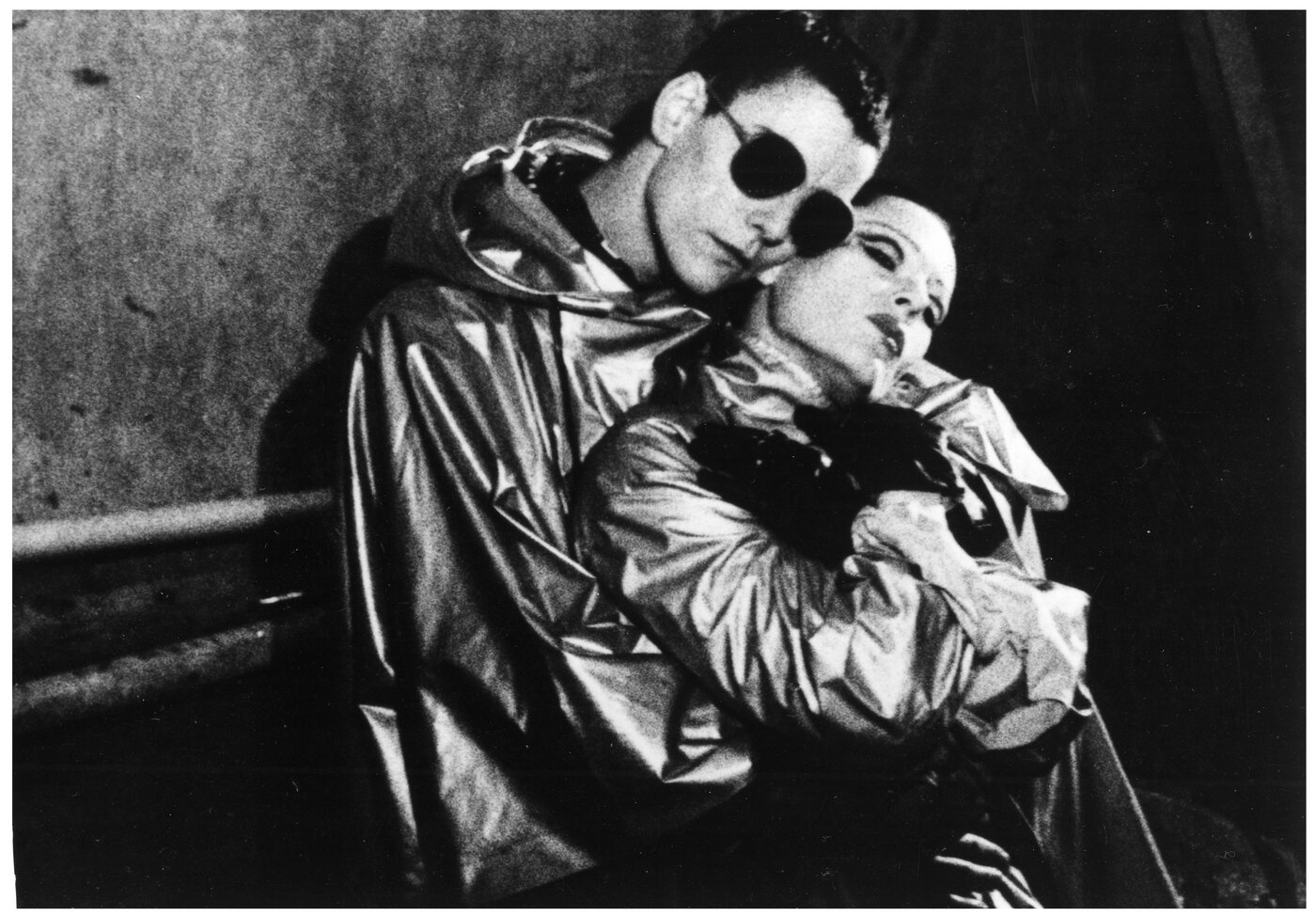
Siren Island (Isa Hesse-Rabinovitch, 1981). Courtesy of Cinémathèque suisse.
Like Hanabi, Isa Hesse-Rabinovitch’s Siren Island (1981) makes disjunctive use of montage. It pieces together sequences the director shot with a group of women, primarily in New York, and opens on an image of a woman at the water’s edge, reciting a passage from the Odyssey in which Odysseus sails past the sirens’ island. Throwing us into the midst of the hero’s journey, the film continues in an unpredictable, nonlinear mode. I thought, in one scene, of Julia Kristeva’s theory of “women’s time” as cyclical, spiraling. In a room of many mirrors, a woman tries on dress after dress; the footage plays in reverse and it gives the garments an eerie life of their own: leaping into the air, crawling up to wrap around the body.
Queer and feminine imaginaries proliferate throughout the film. Through jagged match-cuts and double exposures of rhyming images, blooming flowers mirror singing lips mirror pulsing labia; curving caves echo the contours of the womb. Hesse-Rabinovitch does not see the sirens’ song as a fatal trap set for men. Instead, she reclaims it for the sirens and their shape-shifting stream of consciousness. In its defiantly irrational splices, her film refuses patriarchal narratives, removes Odyssean wax from the ears, and invites us to listen in ecstasy.
I like those wild, rapid-fire edits, yet I find as much joy in quiet, lingering images that stretch my body’s sense of time. In Umair Bilal’s As Light as Air (2026), which depicts a pilgrimage to Sehwan, a Sufi town in Pakistan, time is often suspended. A colorful, vital scene suddenly drains of color and freezes into a static image, or, conversely, a black-and-white still slowly saturates with rich hues and springs to life.
Rather than disguising transitions, the film reveals and amplifies them. In one scene, double exposure merges an image of a tranquil sea with crowded streets of pilgrims; in another, a man whirling overlaps with a fairground ride giving off a neon glow. Shirtless men beat their chests and chant in yet another powerful scene, with the camera clinging closely to their bodies. The hypnotic intensity becomes almost suffocating until the film abruptly, briefly cuts to a negative still of the men’s backs, all scarred with blade marks, while the chanting rushes on uninterrupted. These splices continuously pull us in and out of the trancelike state of the pilgrimage: at times, in the thick of the ritual; at others, jolted out of it, reminded of where we stand as viewers, and how we watch.
I have watched for scars, leaps, enjambments, and now other sounds and images are falling into the cracks of these transitions: running beneath the scorching sun between screenings, grabbing quick food, drinking mediocre coffee. I know I will remember this August in Locarno. Or rather, I will remember those sounds and images that have been spliced together. “They have substituted themselves for my memory. They are my memory.”
Catherine Weng
***
“Stay in the moment. Not everything needs to be recorded.” Every film screened at Locarno this year was preceded by this warning against media piracy. Juxtaposed with some of the works screened at the festival, that benign, functional message rang ironic. A surprising number of films—two of which stood out—incorporated fragments that owed their existence to someone recording “the moment.”
Take, for instance, the opening shot in Bani Khoshnoudi’s short Elegy for the Forgotten, on an Endless War (2026). A vertical phone recording shows several groups of people running or limping toward the camera; in the background, a suspension bridge is engulfed in clouds of dark smoke. It is, as the subsequent intertitle reads, an “Iranian home movie.” Drawing on the violent protests that erupted in response to worsening living conditions in Iran, and the national instability caused by the US–Israel attacks, the film traces and stitches together comparable moments in Iranian history.
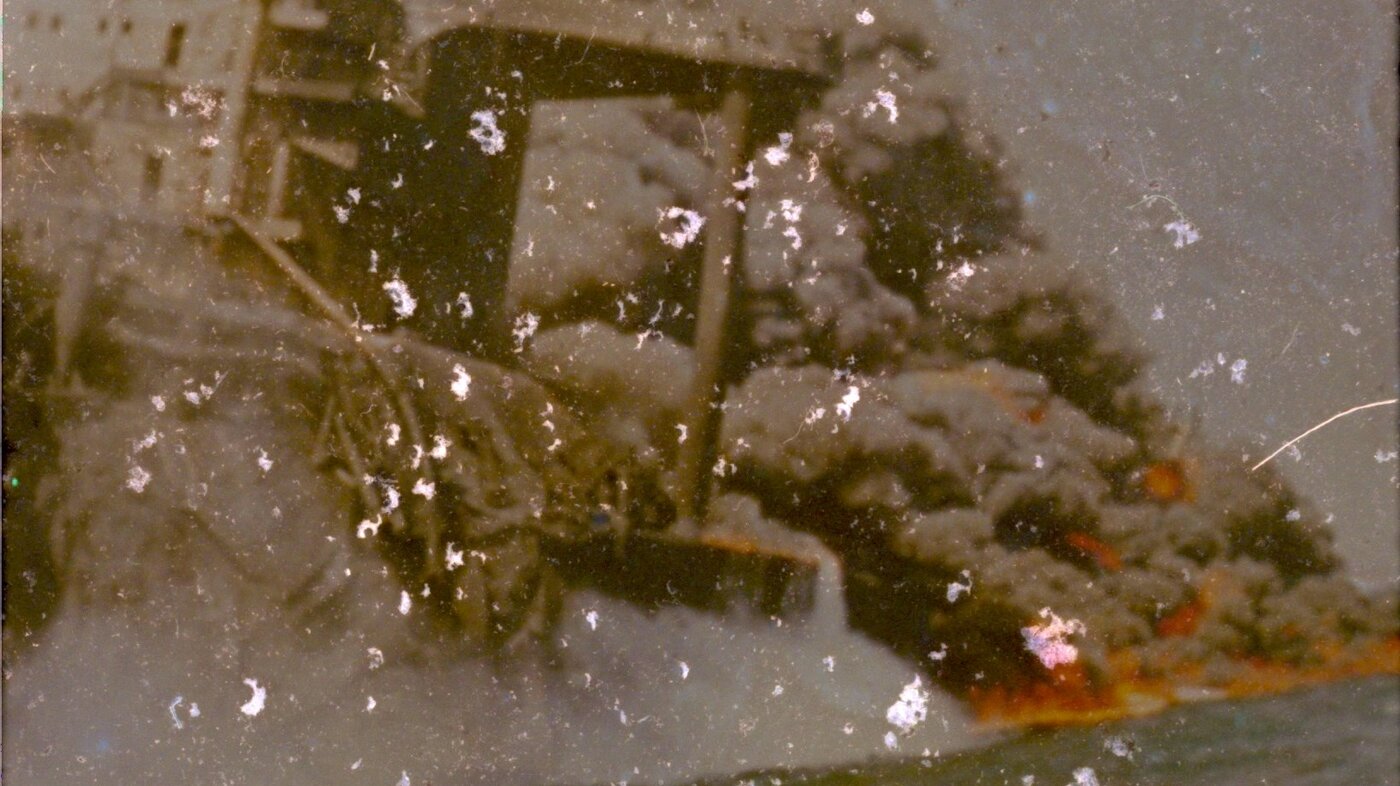
Elegy for the Forgotten, on an Endless War (Bani Khoshnoudi, 2026).
Through photographs from the past and videos of the present, Khoshnoudi’s film elaborates on different modes of propaganda fabrication and contrasts them with images of real suffering. An anonymous thumb scrolls through low-resolution videos of deceased people of all ages piled in the streets. An anonymous hand flips through the pages of “The Imposed War, Defence vs. Aggression,” the official Iranian records on the 1980–88 Iran–Iraq war. Alternating between succinct Farockian ideas—“Images change meaning, depending on who uses them and when,” reads one intertitle—Khoshnoudi otherwise adheres to an elusively poetic voice.
While temporally disparate, the film’s sutured-together fragments stress the similarities between the Iraqi invasion four decades ago and today’s conflict. In a manner vaguely reminiscent of Maryam Takafory’s work, Khoshnoudi concatenates 16mm images of flowers with video recordings of women mourning, dancing, or painting. Over the last few decades, strategies of propaganda have been an integral part of war’s visual machine: Think, on the Iranian side, of women painting murals that depict Ayatollah Khomeini, and the next generation painting their missiles in pink. As Khoshnoudi digs through war’s remnants, her gaze does not focus on condemning those who produced such images and myths. Instead—and especially toward the film’s end—she tries to find the forgotten people who exist beyond propaganda, those who didn’t ask for war but were killed nevertheless.
Mohanad Yaqubi’s Revolutionaries Never Die (2026) similarly (re)captures “the moment.” Structured chronologically, the film responds to an unanswered email from Jocelyne Saab, the Lebanese filmmaker known for documenting the ruins of war. Following her death in 2019, Yaqubi was entrusted with cataloguing and restoring archival material from the first part of Saab’s career. Spliced together from contact scans and digitized material, passages from her films are interposed with paragraphs of Yaqubi’s concise and personal musings on Saab’s work and his own life.
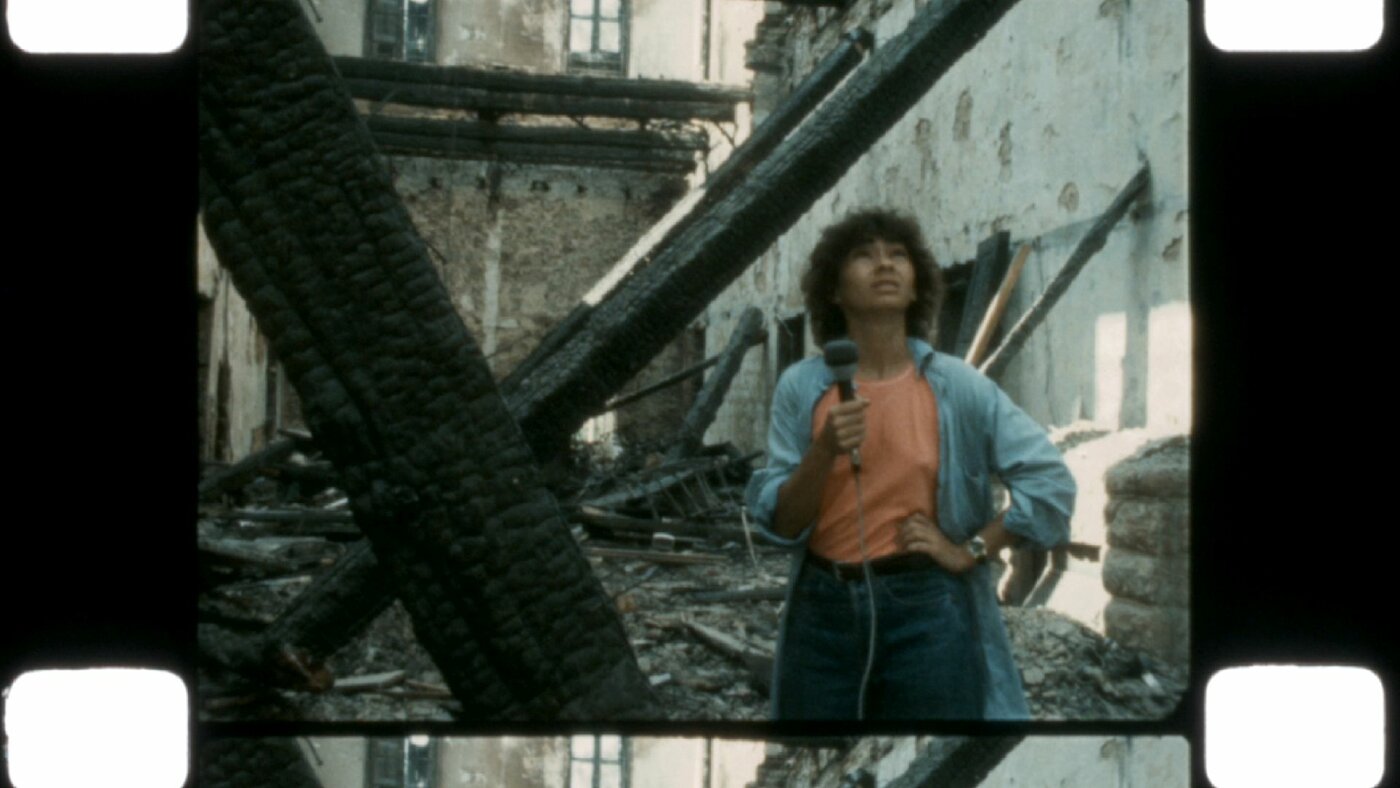
Revolutionaries Never Die (Mohanad Yaqubi, 2026).
Having followed Saab’s filmography with care, Yaqubi comments in the film on the multifaceted experiences detailed in Palestinian Women (1973), noting points of connection between the 1970s and today. He then parallels the destruction of Saab’s house in Beirut, My City (1983) with the bombing of his own house in Gaza in 2024. As Yaqubi establishes a dialogue between the personal and the historical, archives are, as he notes at the end of the film, "activated." In Revolutionaries Never Die, Saab’s archives are activated to work against a forgetting that erases recent struggles from collective memory, causing their needless repetition.
Both Khoshnoudi and Yaqubi bring together different moments in time, then: Khoshnoudi resignifies propaganda media from the past and ties it to the phone recordings of the present; Yaqubi reactualizes Saab’s work through montage, but by adding personal notes, too. In their hands, the camera is a mode of self-preservation and self-defense.
In the small Swiss town of Locarno, posters that feature white doves—that universal emblem of peace—are scattered on billboards, on buses and trains. Is Swiss neutrality still possible in the face of global conflict and militarization? Staying out of the moment is, it seems to me, the privilege of a place that does not need recordings as evidence of survival.
Alex Petrescu
***
Watching films at a festival produces a peculiar form of misremembering. By my third day in Locarno, the films I had seen were beginning to bleed into one another. Through the sheer density of images, a morning motif folded into an evening silhouette, and a line of dialogue acquired the phantom inflection of another film. In memory, the consecutive dissolves into the simultaneous. I found myself drawn to films that seemed to work with this instability—pulling experience apart, rearranging the debris, and holding those disparate fragments up to the light.
Albert Serra’s hermetic concert film, Sixteen Moments of My Life (2026), does this with an almost perverse literalism. Across sixteen songs at Paris’s Théâtre des Bouffes du Nord, Ingrid Caven takes us through various phases of her life. While the lyrics move between themes of childhood, love, aging, and grief, the camera follows her body getting progressively spent with each song, punctuated by applause from an unseen audience. I noted the enthusiastic clapping after each song in my pocket notebook, trying to differentiate its textures, but there is little emotional variance in two hands coming together. Its function is structural: Applause confirms that one song is over. Onstage, magnetic reds and blues make way for magenta and white. Caven pauses, her exhaustion accumulating with everything that has come before: song, life, remembrance. But just when it seems as though the performance seems over, she descends into falsetto again.
Between her shrieks and groans, and with a tight grasp on a red rose, Caven—while still singing—collapses onstage, her writhing form recalling the rattling backstage cough that opened the film. As one media scholar has noted, the concert film is traditionally structured by the temporal distance between the audience in the auditorium and the viewer watching the screen. However, with the venue’s crowd reduced to a sonic backdrop in Serra’s film, other defining tensions emerge. Equating the span of a concert with the span of a life, Serra and Caven not only explore the blurred line between performance and reality, but also insist upon the somatic toll of living and performing.
An hour later, I watched François-Christophe Marzal’s Happiness Is So Close! (2026), which tells of another actor whose body has become an inconvenient archive. Jean-Luc, this tragicomic film’s protagonist, is preparing to play Don Quixote: the role of a lifetime, if only he could remember the lines. Again and again, he leans blankly on an alpenstock, waiting for the words to return. His inability to embody Don Quixote stood in stark contrast to Caven's rousing performance.
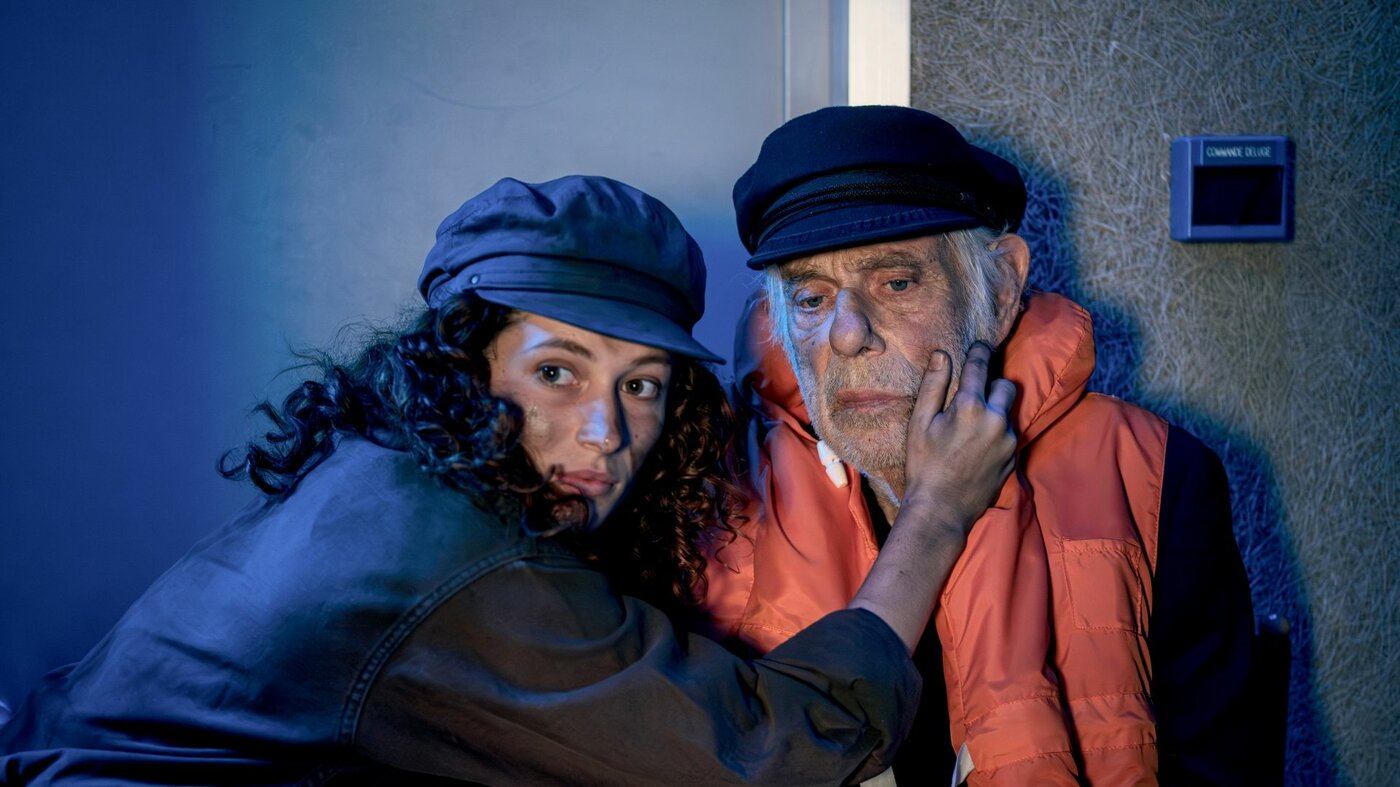
Happiness Is So Close! (François-Christophe Marzal, 2026). Courtesy of Kyra Dowling.
Jean-Luc’s paranoia crystallizes the moment the producers hire an understudy named Gilles. Convinced his position is precarious despite the team’s assurances, he stalks his nemesis across the city, at one point adopting a clown disguise. This erratic behavior exposes the core of his affliction: While Caven looks backward, gathering up a life that is already disappearing, Jean-Luc is frantically gripped by the terror of his own erasure, obsessing over an end that has not happened yet.
After these meditations on the deliquescent past and the imminent future, there was then the uncomfortable present of Lê Bảo’s Hearing (2026). Ninh, this film’s protagonist, is a technician whose clients have him install sound-level meters across a dystopian city that is consumed by noise. Swamps, houses, pubs, nightclubs: Everywhere, sound is something to be measured. There is little dialogue in the film, which instead makes a world out of ambience: chirping birds, fingernails peeling at an eggshell, a ladle scooping up custard. At night, the meters emit visual halos colored violet whenever the decibel limit set by clients is breached. The triggers range from the loud quarreling of monkeys to softer, quotidian conversations between estranged couples—the latter of which are, in this fictional realm, the source of the city’s most urgent complaints.
Even this strange reticent world cannot resist a literal stage. As an unhappy couple rehearsed an ostensibly traditional opera before the film cut to their quiet bedroom, I found myself thinking of the silences that await Caven and Jean-Luc after they leave the stage. Quiet, silence, peace—Lê Bảo probes the thin, permeable boundaries between sounds and our understanding of them. In Hearing, the city’s men and women counteract their quiet days of labor with rowdy nights at the club; it is all about balancing the two extremes, they tell Ninh. Ultimately, the visceral impossibility of silence was what lingered with me most from this film. In the absence of pub chatter and dance music, a simple sigh can expand to fill an entire room.
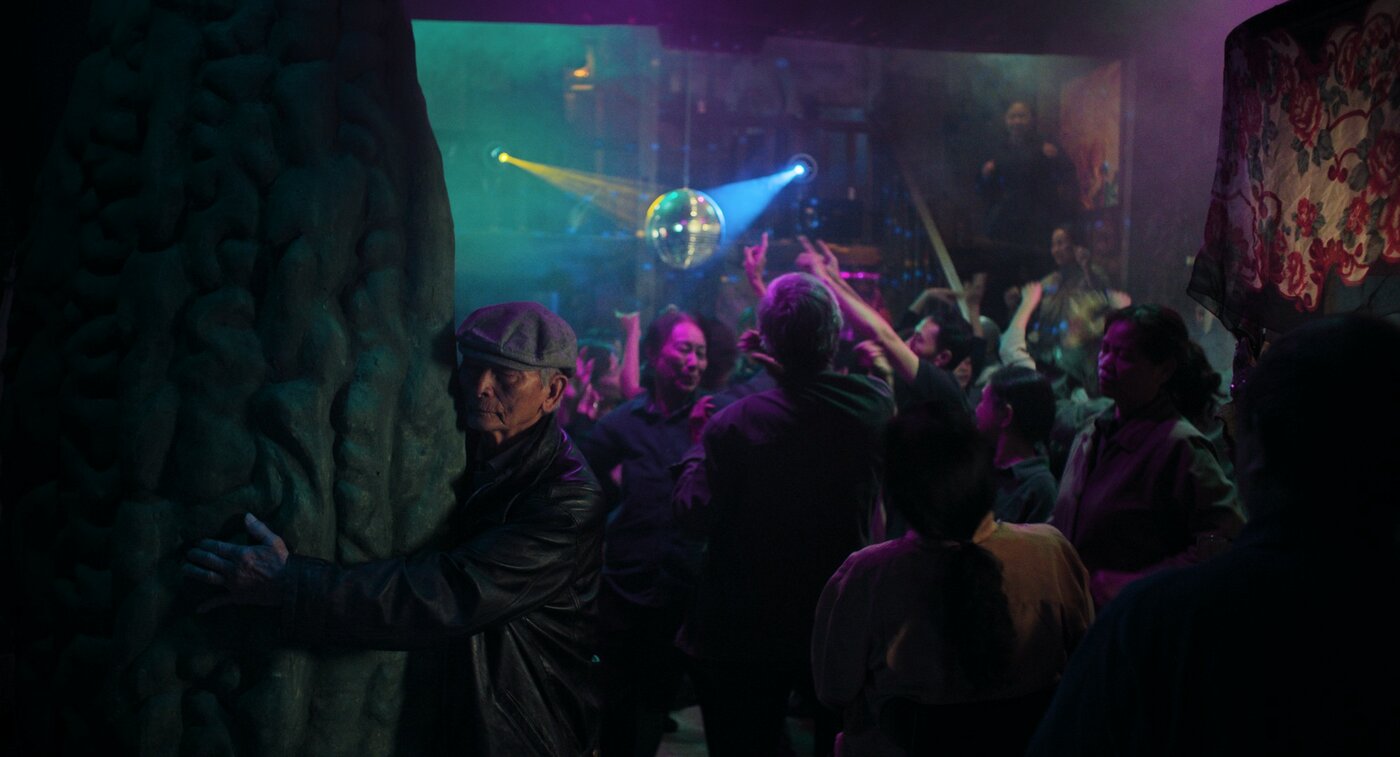
Hearing (Lê Bảo, 2026).
Perhaps what makes the splice so unsettling is that it brings things together without necessarily reconciling them. Some cinephiles like to imagine criticism as an exercise in cool recollection. But is that possible at a festival? Sitting through a day’s fourth screening, eyes burning, reveals a more volatile truth: We do not always go to the cinema to encounter intact structures. Sometimes we go to inhabit the fault lines, to write about the exact moment the ground beneath us gives way.
Manahil Tahira
***
“Cut!” begs Noémie Merlant in the final moments of Bertrand Mandico’s Roma Elastica (2026). Kneeling before a camera and clutching at the yielding body of her costar Marion Cotillard, she insists on a premature end to the film’s delirious mise en abyme.
Roma Elastica opens on a movie set, somewhere in dusty California. Merlant is Valentina, a makeup artist and confidante to Cotillard’s leading lady, a Hollywood actress whose name, Eddie Mars, is borrowed from the villain in Raymond Chandler’s The Big Sleep. The pair are taking their time in the dressing room, holding up the shoot. Valentina regales her glamorpuss superior with gossipy stories of this and that as she leisurely applies Eddie’s makeup. Eddie, once primed, will shoot a scene in which she straddles and strangles a man in bed. In this struggle, she will be splattered with blood, but come out on top.
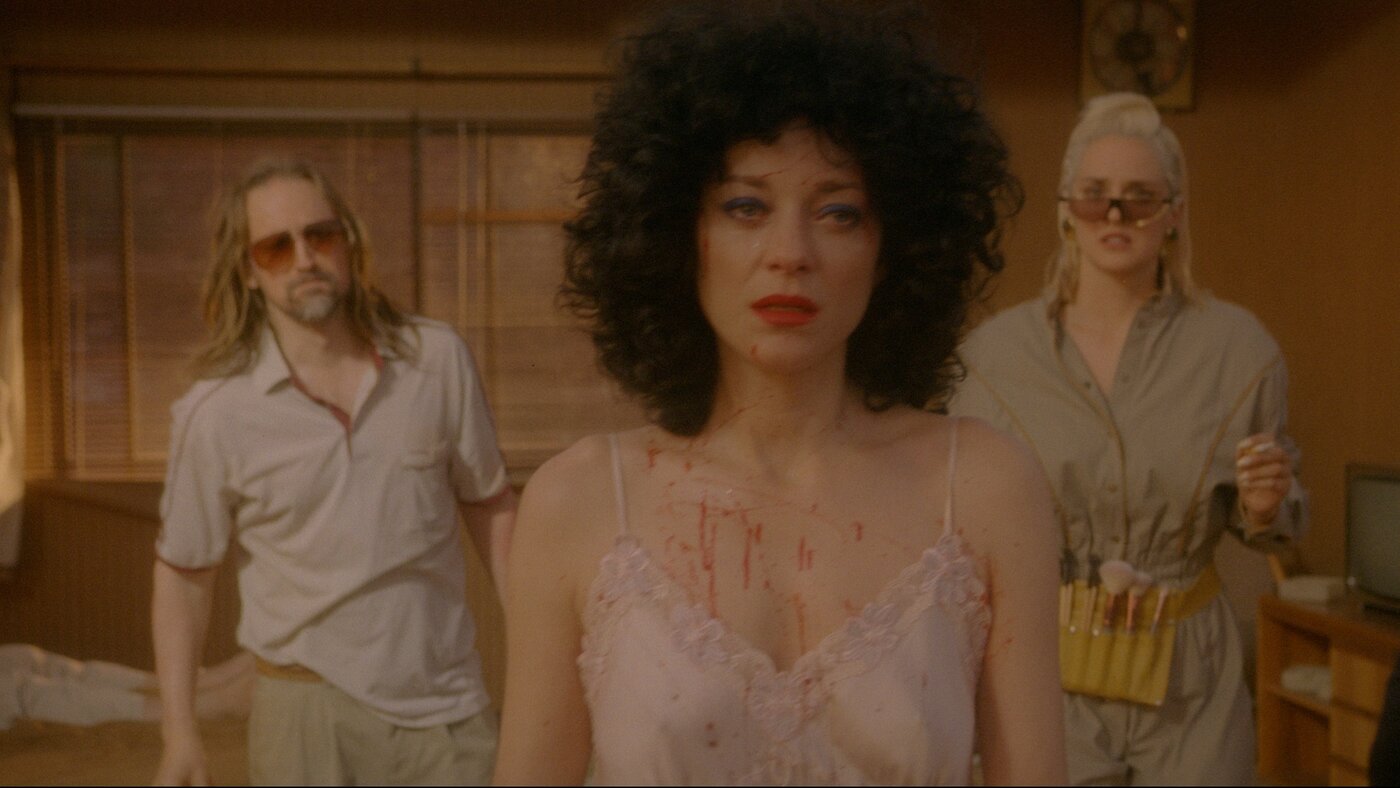
Roma Elastica (Bertrand Mandico, 2026).
Cut. Speaking at a Locarno masterclass about his infernal bullfighting documentary Afternoons of Solitude (2024), Albert Serra boasted of creating images that had never been seen before with human eyes. According to him, even the matador, who faces the beast head-on, is subject to the clutter of his peripheral vision. Only with the close-ups that Serra’s tight frames create can we see the bull, and the bull alone.
Where Serra spotlights and isolates, Mandico looks at his subjects as if through a kaleidoscope. His characters are often shape-shifters, gender benders, artists, and freaks. With each new film, Mandico refines his use of traditional practical effects—double exposures, lens filters, handcrafted props—decorating each frame with extraordinary oddity. I want to call this approach anachronistic, but Roma Elastica feels like it was placed in the wrong world, as well as the wrong time.
After learning from her doctor that she has a tumor on her brain, Eddie agrees to take a job she otherwise wouldn’t. She must keep working; after all, the movies, even B-rate movies, are her ticket to immortality.
It’s a career move that could be likened to Elizabeth Taylor’s secondment in Italy—not in 1961, when she famously resumed the filming of Cleopatra (1963), but a decade later when she found herself in Rome shooting The Driver’s Seat (1974). Then at her nadir, this was a last resort for Taylor. Like Cotillard’s Eddie, her character in this film is strangely motivated by death, and Rome is the final stop on her manic goodbye tour. Speaking about The Driver’s Seat, Taylor reputedly said, “It takes one day to die, another to be reborn.” In Roma Elastica, Eddie hears the same sentiment almost word for word, and it's this logic, drenched in cliché, that helps justify her crossing the pond.
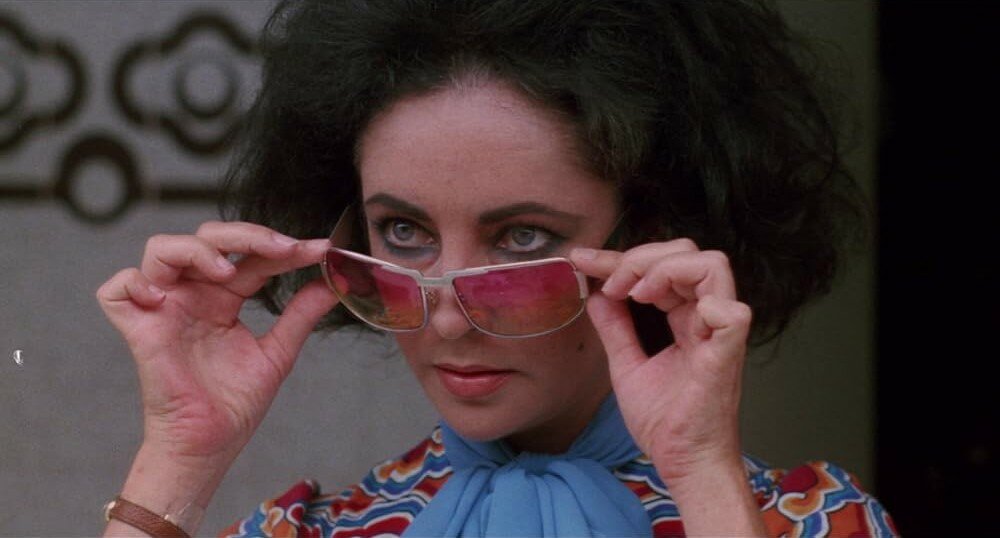
The Driver's Seat (Giuseppe Patroni Griffi, 1974).
Accompanied by her so-called “guard dog” Valentina—seen in one moment to bite a man who gets too close to the actress on the plane—Eddie heads to Italy to star in a project titled “Roma Elastica.” The two are greeted at the airport by the Cavalli sisters, the eccentric directing duo of this film within a film, one of whom can see the future. While Mandico’s film is set in an imaginary 1982, “Roma Elastica” is set in our present day. Like the movie we’re watching, it’s an overly stylish, often incoherent European art film losing a wrestling match against its own high-minded ideas about creation and destruction. Eddie is to play Rowina, an avant-garde sculptress who, in the year 2026, will be assassinated by neofascists for being too ahead of her time.
“People like women who suffer, they even win awards,” Eddie is told by way of reassurance. This much was true for Cotillard when she was awarded the Best Actress Oscar for her starring role as Edith Piaf in La Vie en Rose (2007). Piaf suffered great tragedies: childhood neglect, substance addiction. In Olivier Dahan’s hoarse biopic, there was as much kicking and screaming as there was singing.
Cut. As another chanteuse, Peggy Lee, sings “and it's me and my shadow” on the soundtrack, Eddie discovers what she believes to be a wound on the back of her head. Approaching the mirror, she finds that it is in fact a second face. She is horrified by her own reflection, screaming and writhing in pain. Eddie has taken the form of Janus: an actress in Rome turned Roman myth. With her two faces, she is simultaneously looking forward to the future and backward to the past.
Cut. During a Locarno press screening, I watched as a woman walked backward down the aisle, her eyes still fixed on the projection, her desire to continue watching the film contending with her desire to leave.
Cut. After threatening to leave Rome, Valentina abandons Eddie, who has become reckless, falling in with a crowd of drug-addled greasers squatting in the room next to her suite. Eddie, distressed, searches far and wide for her handler—and here Cotillard, with an almost dancerly theatricality, backs away from Mandico’s camera, walking into a horde of people. She is being led by another force, her other face.
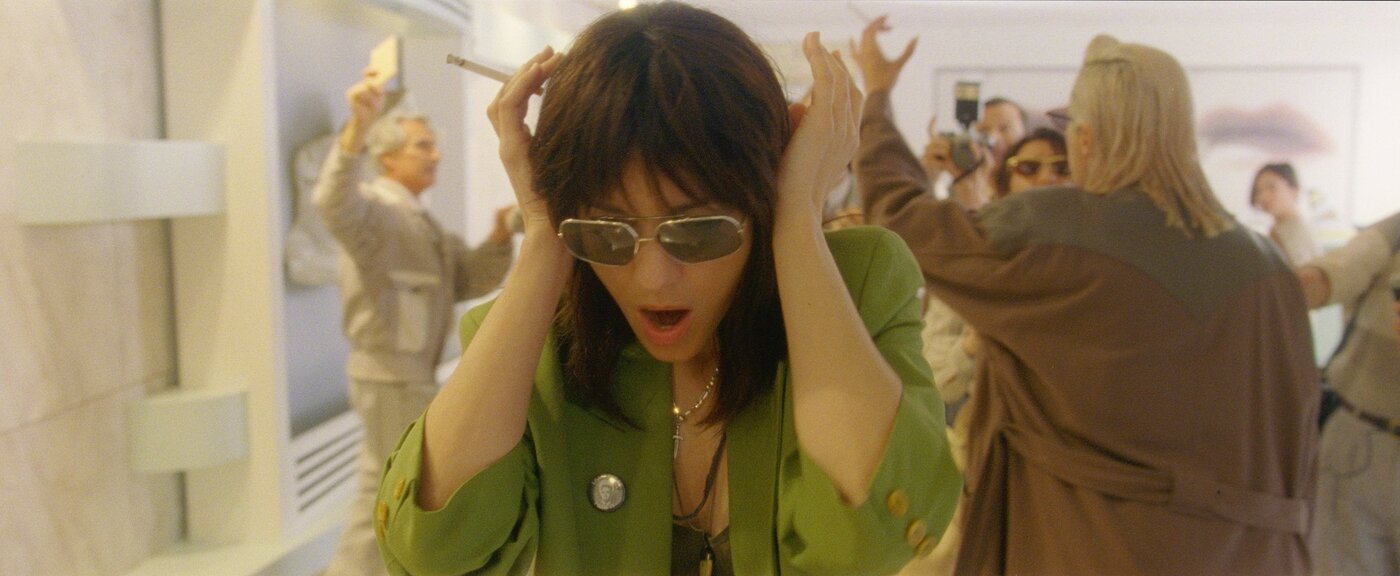
Roma Elastica (Bertrand Mandico, 2026).
With its fascination for dualism, Roma Elastica takes pains to contemplate itself. The most overtly self-conscious of Mandico’s works to date, the film imagines itself as an unmakeable movie. I was struck by a line from the Cavalli sisters, who—having lost sight of the guiding vision for their film—confess to having lost “the essence of the future.” At this point, Mandico also seems to have lost his grip.
Cutting between color and black-and-white with each faltering take, Roma Elastica and the film it houses take a wild, downward spiral. Before long, Mandico’s misfit objects and dreamlike sets, once charismatic, turn fulsome and immature. Take, for example, the bizarre intrusion of Rowina’s turd-shaped prop gun, a secret weapon she must make defecate in her fight against the neofascists. In her tailspin, Eddie encounters a man on set who has sadness in his eyes: “I do quality work too, you know,” he says under his breath. “Please don’t judge me for this.”
On the defensive, the artists in “Roma Elastica” repeatedly refer to themselves as “martyrs in the postmodern world.” It feels as though Mandico would like us to think of Eddie as such; her death comes too soon, arrives even before her character Rowina can be killed off as planned. Wounded by its own creative misfires, Mandico’s film also meets an undignified end. Misquoting Greta Garbo in the film’s opening lines, Eddie’s costar declares, “One must know how to make a graceful exit.” I dare say—and dare say Garbo would agree—that one must know how to make a graceful cut.
Charles Carrall