Amsterdamned II (Dick Maas, 2025)
A rich American couple takes a romantic cruise through Amsterdam at midnight. The mood, despite champagne and string lights, is anything but amorous. The canals stink, the houses are tiny and old, and the woman, for one, can’t wait for them to fly on to their next destination: Dubai.
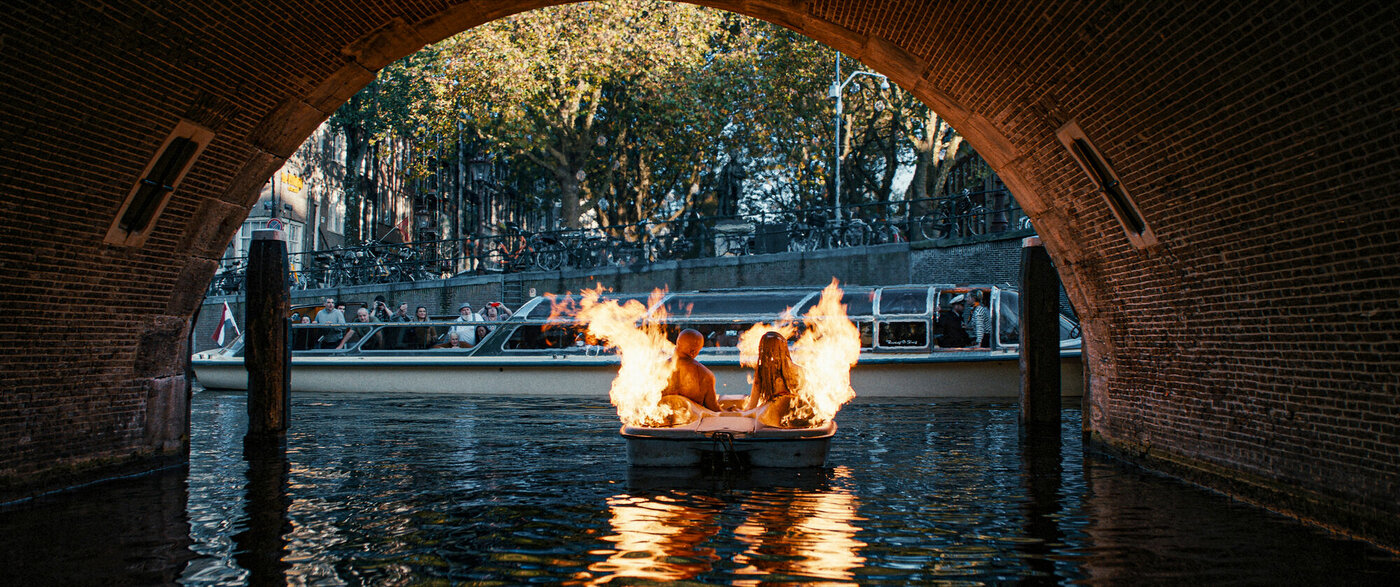
The couple keeps complaining until they notice that the skipper—previously seen behind the wheel, listlessly sipping a can of Heineken—seems to have abandoned the ship. The woman peeks overboard, but when she turns around, her partner is gone too. A knife suddenly pierces the bottom of the boat, rapidly filling it with water. The woman grabs hold of an old lamp fixed on a passing bridge as the vessel sinks, her cries for help drowned out by a teenager revving their motorcycle on the street above. Then, an arm covered in neoprene pulls her down into the muck, and everything goes quiet.
This is the opening scene of Amsterdamned II (2025), the latest film by Dutch director Dick Maas, and like its 1988 predecessor, the plot once again centers on a serial killer in a scuba suit, striking from the shadows of the city’s labyrinthine canal system. The original film was a veritable phenomenon, going down in history as the Netherlands’ first—and for a long time only—homegrown action blockbuster. Meanwhile its sequel, which premiered in December last year, proved a commercial hit but a critical disappointment, coming and going without making as much as a splash. If the first Amsterdamned showcased the potential of the Dutch film industry, Amsterdamned II is both a result and a symptom of its long-standing stagnation.
The first Amsterdamned opens from the perspective of the killer, their head popping in and out of the water, their breath labored yet metronomic. An ominous synth score—composed by Maas himself and evocative of John Williams’ music for Jaws (1975)—accompanies the figure as it drifts past the back of a Chinese restaurant in search of a large, sharp knife. In this film, the first victim isn’t some wealthy tourist, but a sex worker from the Red Light District, walking home after her shift. A homeless woman witnesses the killer emerge from the canal, but the police—including detective Eric Visser, played by Maas mainstay Huub Stapel—won’t take her seriously.
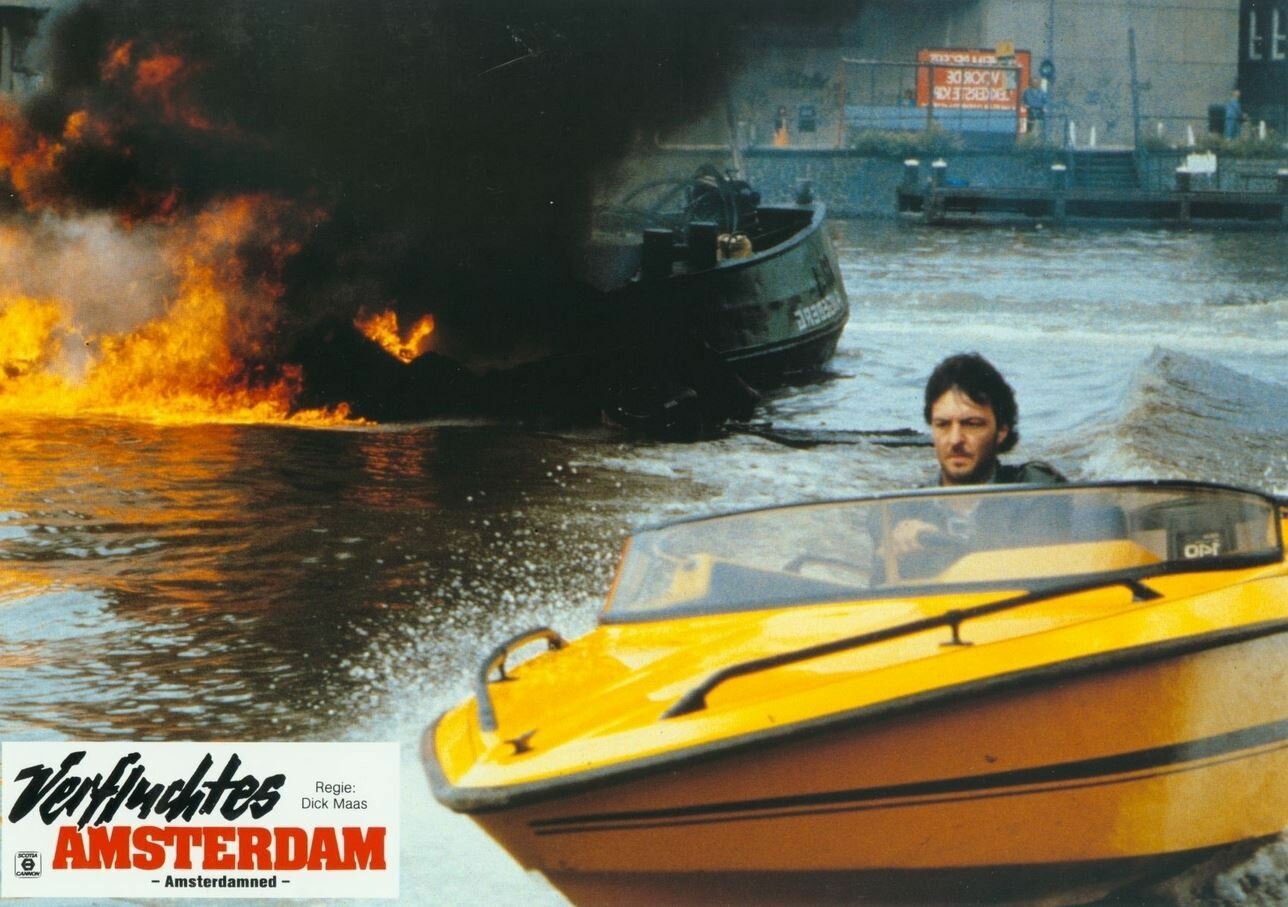
Luring more than a million Dutch people to the cinema, Amsterdamned was one of the country’s most critically and commercially successful films at the time. Looking back, its popularity can be attributed to a variety of factors, from Stapel’s star power to the broad appeal of Maas’ genre-bending script, offering laughs, thrills, scares, and romance. The murderous diver, hidden from full view until the finale, provides a source of genuine suspense, while Visser—handsome, charismatic, and nonchalant in navigating the dangers of his job—at times resembles a Dutch James Bond. True to its 007 influences, Amsterdamned also features a number of Hollywood-grade stunts, from a motorcyclist attempting to jump over an opened draw-bridge to an extended inner-city speedboat chase, the latter of which is still recognized as the single most impressive action sequence in Dutch film history.
The trailer for Amsterdamned (Dick Maas, 1988).
Like the American summer blockbusters it emulated, Amsterdamned was not a film so much as an event, permeating Dutch culture in a manner few Dutch films ever have. Its theme song of the same name, performed by the rock band Loïs Lane, topped the music charts, and remains a regular sound in Amsterdam’s bars and nightclubs to this day. Many people credit Maas for imparting them with a lifelong fear of the city’s canals, as well as enriching their vocabulary with made-up insults like “beschuitlul” or “biscuit dick.” Hurled at Visser when he leaves his Alfa Romeo in the middle of the road to save a bakery held at gunpoint, this word in particular has become so widely used that multiple reviewers took note of its blink-and-you-miss-it return in the sequel.
Following in the footsteps of two previous critical and commercial hits—The Lift (1983), a campy horror-comedy about a murderous elevator praised for its (by Dutch standards) unprecedented production value, and Flodder (1986), a generation-defining, franchise-spawning comedy about a poor, dysfunctional family that moves into an upscale neighborhood—Amsterdamned solidified Maas’ reputation as one of his country’s leading filmmakers. In hindsight, though, the film turned out to be the pinnacle of his career, with none of his subsequent films proving as acclaimed or profitable as what had come before. The film he made before Amsterdamned II film, Prey (2016)—another horror-comedy, this one about a lion escaped from Amsterdam’s ARTIS zoo—received the harshest reviews and lowest attendance of his entire filmography. In interviews, the director attributed Prey’s poor performance not to its uninspired script or unconvincing CGI, as several Dutch critics did, but structural issues with the Dutch film industry and its market.
Plans for a sequel to Amsterdamned—set in the Dutch city of Rotterdam and titled “Rotterdoom”—had been floating around as early as the nineties, but were placed on the backburner as Maas set to work on the second and third Flodder films, followed by other projects. By the time the director finally got around to revisiting the old idea—egged on, he says, by Stapel and others—nearly four decades had passed. Ultimately, the sequel did not enter production until 2024, its theatrical release conveniently coinciding with Amsterdam’s 750th birthday celebrations the following year. Considering this event is referenced in the opening scene, it’s not unthinkable that the municipality might have played a hand in saving the film from limbo. At the very least, this would explain why it abandoned the Rotterdam setting in favor of returning to the capital.
Mirroring its production, the story of Amsterdamned II takes place nearly 40 years after the events of the original. Stapel’s Visser—now grey-haired and living out his sunset years in the pastoral Dutch province of Limburg—is called out of retirement to solve a murder case that looks an awful lot like the one he solved back in the eighties, this time in collaboration with a young female detective who’d much rather go at it alone.
Amsterdamned II (Dick Maas, 2025).
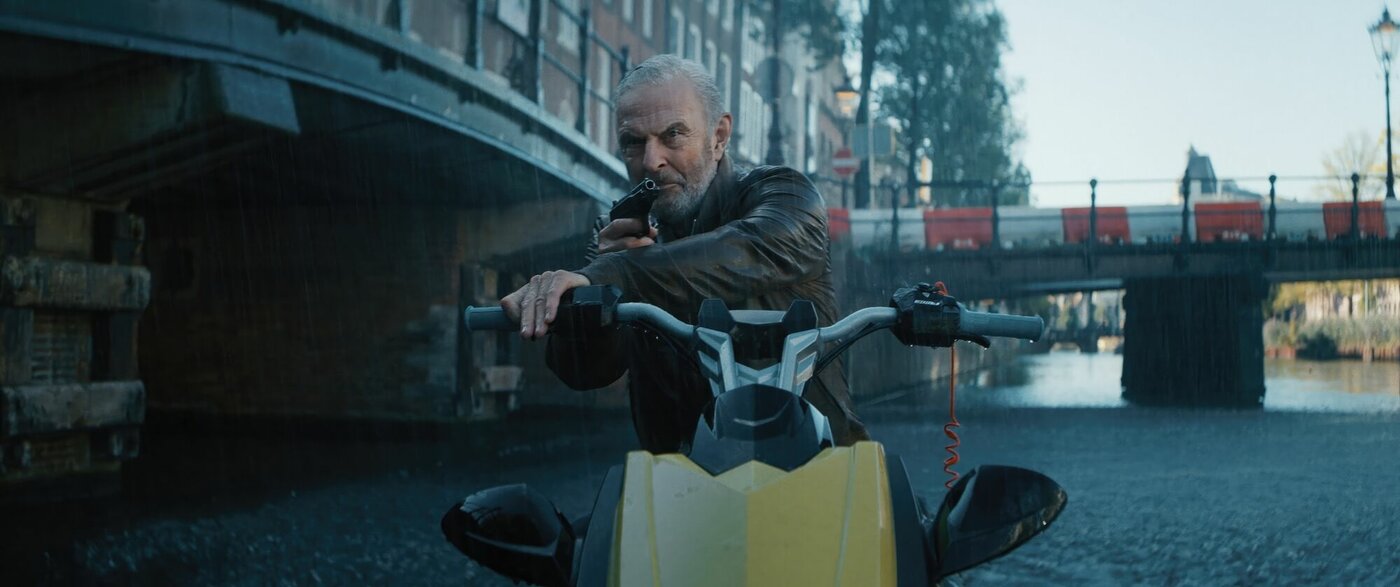
Despite the film’s commercial success, reviews range from mixed to negative. Among other things, critics and general audiences alike have accused the sequel of nostalgia baiting. Callbacks to the original are manifold, but seldom serve a thematic purpose and often force the plot to bend over backwards to accommodate them. Visser is back, despite his bad back and incompetence with modern technology. Also along for the ride are his Alfa, the galleries of the Rijksmuseum, and the aforementioned beschuitlul. The latter pops up in seemingly random context, without a bakery in sight—a reference to the insult’s newfound popularity, or just a reference? The sequel even has its own chase sequence through the canals, the only difference being that this time Stapel drives a jetski.
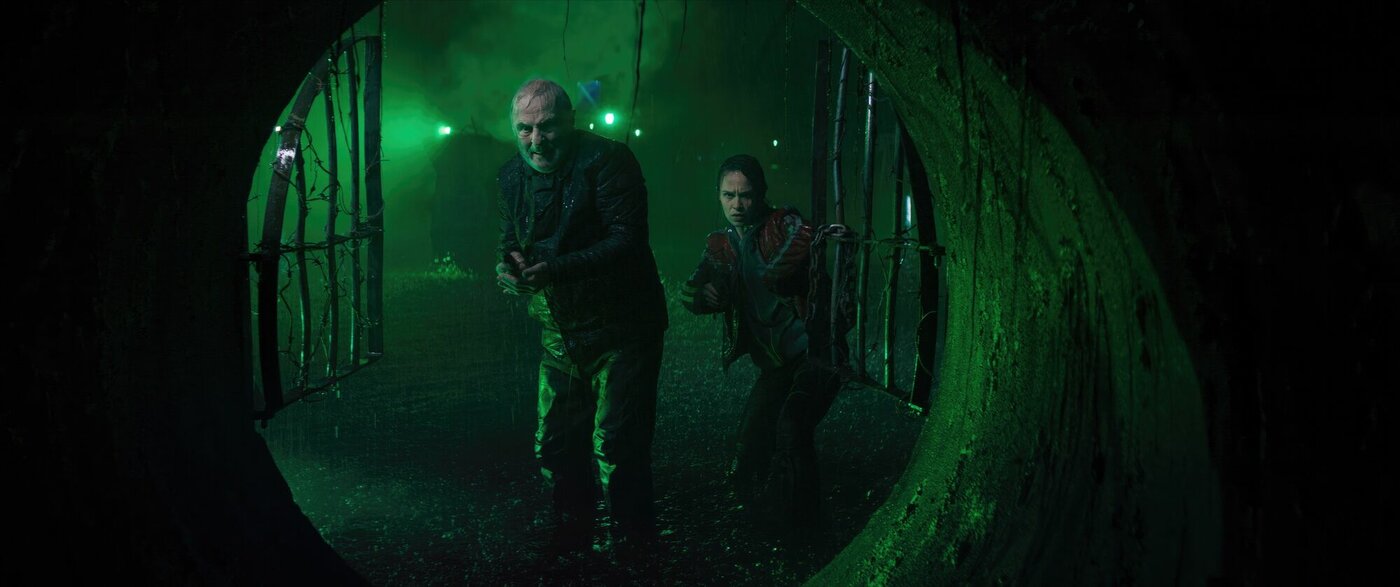
Like many sequels, reboots, and remakes that lean too heavily on the legacy of the original property, Amsterdamned II fails to recapture—let alone surpass—what made its predecessor such a success in the first place. The chase sequence is neither as impressive nor as groundbreaking. The murder scenes generally lack the pacing, framing, and especially spatial clarity that made the ones in the original so suspenseful, and where the first film mixed genres early on, thereby successfully managing the viewer’s expectations, the second concludes with a sudden turn towards the supernatural that shocks and surprises at the expense of cheapening the overarching mystery.
The differences between the two films are perhaps most glaring when it comes to characterization. Where the original devotes a considerable part of its first act to fleshing out its protagonist, the sequel skips this set-up and rushes headlong into the action. Though technically only a supporting role this time around, Visser is given a more extended (re)introduction than his new colleague (played by Holly Mae Brood), whose personality hardly extends beyond her role as a hard-boiled detective.
Overshadowing issues of style and substance are questions concerning the sequel’s raison d'être. Throughout his career, Maas has insisted that he makes films simply to entertain, and so discourages viewers from searching for a deeper meaning or hidden message in them. “Boodschappen doe je bij Albert Heijn,” is his personal motto—food (for thought) you get at supermarkets, not cinemas. But Amsterdamned II, perhaps more than any other entry in his filmography, begs to differ. The killer’s victims—tourists, drag queens, young urban professionals with tiny, electric cars—follow a clear pattern, albeit one that is, ultimately, irrelevant to the case. Visser, now more of a mouthpiece than an actual character, grimaces at his grocer’s array of plant-based proteins, wishes he could hit on women the way he used to back in the eighties, and generally feels at a loss in a world that once revolved around him. “A city in decline becomes vulnerable,” comments another mouthpiece, a college professor turned conspiracy theorist played by legendary Dutch actor Pierre Bokma. “It was a nice place. Too bad.”
Amsterdamned II (Dick Maas, 2025).
If Amsterdamned II has a message or “boodschap,” it amounts to little more than a lamentation of change and progress. The film’s underlying sentiment also helps explain its disconnect with audiences. If the original showed a young director capturing the zeitgeist with energy and enthusiasm, the sequel feels at times like an older one expressing bitterness at his own inability to keep up with the times.
What Amsterdamned II lacks in the story department, it makes up for in technical craftsmanship. Its production value is impressive, arguably more so than the original considering the current state of the Dutch film industry. The first film released in the midst of a cinematic golden age, when an unprecedented string of critical and commercial successes—including Paul Verhoeven’s Soldier of Orange (1977), Fons Rademaker’s The Assault (1986), and Alex van Warmerdam’s Abel (1986)—created an investment climate where the prospect of creating a film as big and expensive as Amsterdamned was not just thinkable, but attractive. Today, by contrast, Dutch cinema exists in a state of arrested development. On the consumer side, attendance has plummeted to such a degree that Dutch films which manage to sell more than 100,000 tickets are considered hits and given the Gouden Film or “golden film” award by the Netherlands Film Fund—a far cry from the golden age, when attendance was counted not in thousands but millions, and films like Verhoeven’s Turkish Delight (1973) and Maas’ Flodder drew more eyeballs than The Exorcist (William Friedkin, 1973) and Jurassic Park (Steven Spielberg, 1993).
On the production side, the tonal and stylistic diversity of the golden age has since given way to a release schedule dominated by comedies, romcoms, and children’s films—safe, low-cost genres with broad commercial appeal, written and filmed in assembly-line fashion without a hint of personal touch in writing or direction. The only other Dutch films playing at Amsterdam’s Pathé Arena—one of the largest cinemas in the country—the day Amsterdamned II premiered were In a Pickle by the Sea (Frank Lammers, 2025), a comedy about a man who inherits a resort on the formerly colonized island of Bonaire; De Tatta’s 3 (Jamel Aattache, 2025), a comedy about a white, formerly rich family forced to move into a poor, predominantly Moroccan neighborhood; and two different movies about Sinterklaas, the Dutch equivalent of Santa Claus who up until recently was canonically assisted by a legion of acrobatic minstrels in blackface.
In this extremely homogenized and constrictive landscape, regardless of quality, a big-budget, genre-bending, auteur film like Amsterdamned II stands alone as both a relic from and failed attempt at resurrecting the legacy of a long-lost past. But how did it die? And who killed it?
The trailer for Amsterdamned II (Dick Maas, 2025).
Halina Reijn, one of the most prominent contemporary Dutch directors, pointed the finger at Dutch society. The director of the New York-set, Nicole Kidman-starring thriller Babygirl (2024) remarked on an Amsterdam-themed episode of the MUBI Podcast that the Dutch seemed to have become disinterested in patronizing cinema made on its own turf. “We don’t like to see our own movies,” said Reijn, who herself grew up in a house without TV, “we don’t like our own language, and we don’t want to see ourselves.” Maas agrees on at least one point, telling journalists he finds English a “more appropriate language” for film than Dutch. I myself am reminded of when, upon leaving Pathé, I was approached by two journalists who—to my disappointment—asked me not what I thought of the film, but who I was supporting tonight (the cinema’s namesake, the Johan Cruyff Arena, sits across the street, and Amsterdam football club Ajax was playing).
Although evolving tastes and cultural sensibilities doubtlessly play some role in the stagnation of Dutch cinema, as some have claimed, it cannot be the deciding factor. If it was, the golden age would never have happened in the first place, nor would we see considerable interest in the occasional indie hit like Our Girls (2025), directed by Van Diem and based on a best-selling book by Heleen van der Kemp.
Nor can the industry’s stagnation be blamed squarely on the size of the Dutch-speaking market, which many an insider has described as being too small for investors to earn back their money on films made for more than a shoestring budget. If this were so, the original Amsterdamned—made for an at the time record-breaking budget of 6 million Dutch guilders, roughly triple the cost of Soldier of Orange—would never have turned a profit. Moreover, this argument ignores the fact that even smaller countries like Ireland, Sweden, and Denmark have all managed to cultivate large, vibrant, and internationally recognized commercial film scenes inside their own borders. The Netherlands is the seventh largest country in the EU in terms of population and fourth in GDP per capita. It’s one of the most densely populated and urbanized countries in the world, and has only grown denser and more urban since the 1980s. If the number of people is a deciding factor, the Dutch film industry should have flourished, not shriveled.
Promotional card for Amsterdamned (Dick Maas, 1988).
Filmmaker Esmé Lammers—who is married to Maas and in 2015 founded Afdeling Filmzaken, a platform which advocates for structural changes in the Dutch film industry—blames a mix of policy and bureaucracy. Communicating via email, she identifies a wide variety of developments that in her eyes helped bring the golden age to a close. These include, but are not limited to, the 1993 merging of two different public funds into the aforementioned Netherlands Film Fund, concentrating the authority to decide what gets financed and why into a single entity; the appointment of producers as the primary liaisons between productions and the Film Fund, limiting the creative autonomy of writer-directors; the increased paperwork required to receive money from the Film Fund, complicating development schedules and eating into already meager budgets; and, finally, the rise of domestically produced reality TV, which now dominates the Dutch entertainment landscape and sucks up a large portion of talent.
“The films we see in theaters,” Lammers writes, “are usually logical choices for production companies: on-brand, in-network, commercially safe, inoffensive in tone, target audience, and marketing. This explains why Dutch commercial film has come to rely so heavily on feel-good films, family films, and literary adaptations—now, with social media-informed casting decisions.” All the while, “filmmakers have become more dependent, not independent. The auteur—the creative motor—has ended up at the bottom of the chain, not at the top.”
Today, many regard the Film Fund as a hindrance rather than a help—an institution that exists not to assist filmmakers so much as shape the industry in the image of its own board members. Maas’ memoir slash filmmaking manual, Buurman, wat doet u nu? Films maken in Nederland (2017), contains more than a few complaints about the Fund and the working environment it has created. In this, he is far from alone. “Almost every Dutch director, even Verhoeven, has at one point or another butted heads with the institution,” Gert Jan Harkema, who teaches Film and Media Studies at the University of Amsterdam, tells me over Zoom. “For Dutch film to thrive, we need to come to a point where people don’t need to fight for funding.”
For some, this struggle eventually ceases to be worth the effort. Frustrated and alienated, they leave the Netherlands behind to try their luck abroad, in other parts of Europe (like UK-based animator Michaël Dudok de Wit) or across the Atlantic (like Verhoeven and Reijn). Maas—coming off his poorly-received, English-language, Amsterdam-based thriller Do Not Disturb (1999)—traveled to the US at the turn of the millennium to direct Down, a remake of The Lift, set in a Manhattan skyscraper and starring James Marshall and Naomi Watts. Unlike Verhoeven, he didn’t stay for long and eventually returned home—partly because the remake disappointed both critically and commercially and partly because, as Harkema puts it, “his dream was never to go to Hollywood; it was to bring Hollywood to the Netherlands.”
Whether this dream will one day turn into a reality remains to be seen. Despite fierce criticism from individual filmmakers and groups like Lammers’ Filmzaken—not to mention wide-spread concern over the present and future profitability of the Dutch film industry—the powers that be are unlikely to enact changes of the necessary scale and scope. The Film Fund’s action plan for 2025-2028 promises “more creative freedom for creators,” but fails to explain in concrete terms how this freedom will be guaranteed. Moreover, the institution’s promise to put “quality above quantity”—in other words, invest in fewer films—suggests that filmmakers will have to fight even harder than they have before.
Curiously ignored, Lammers reminds us, is the question of who gets to decide what “quality” means. Maas, who has clashed repeatedly with the Funds in recent years, certainly appears to be of the opinion that no single person or group of people should have the power to pass judgement on the ultimate worth or larger significance of a film. After all, boodschappen doe je bij Albert Heijn.