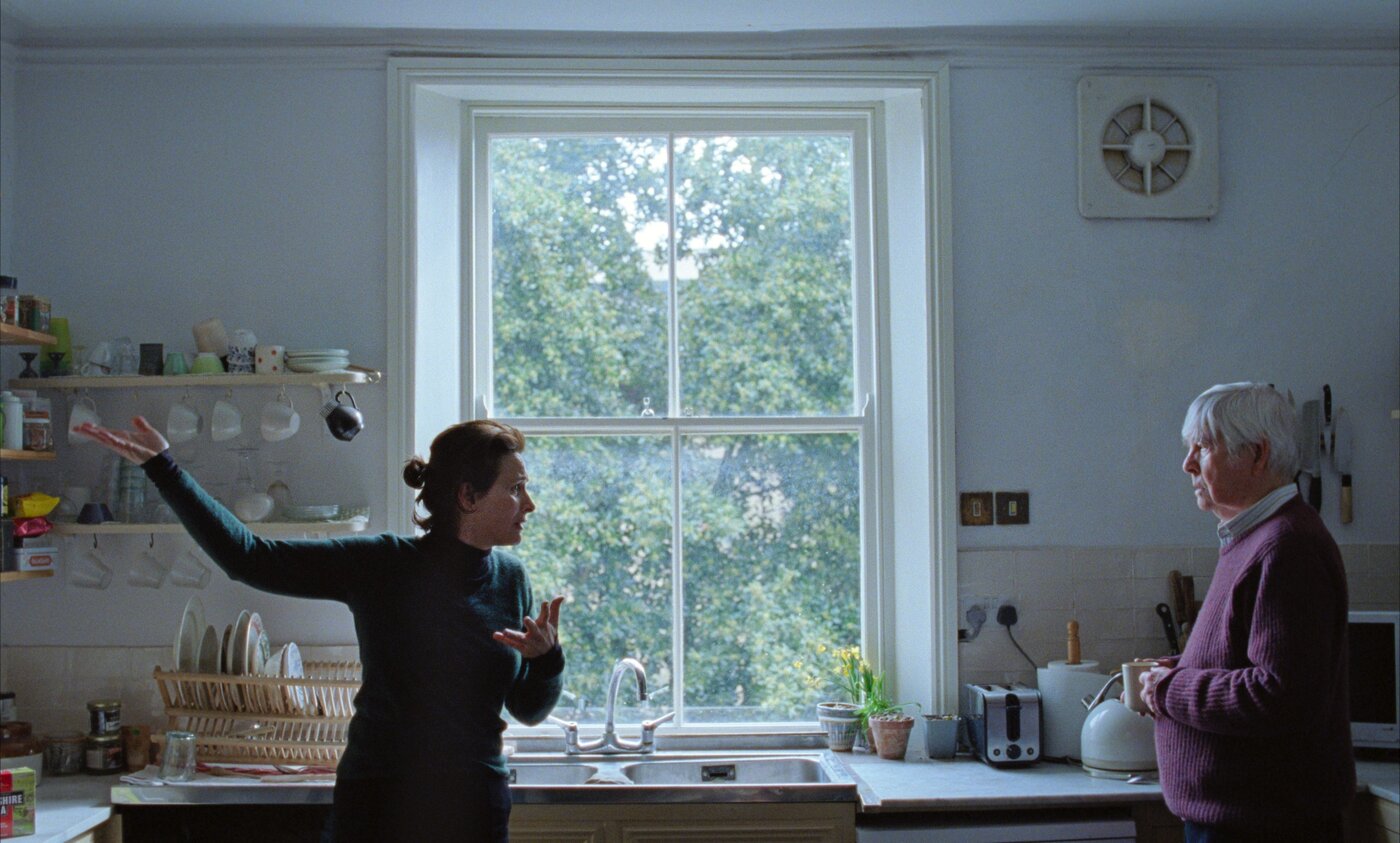
Juliette Binoche and Tom Courtenay in Queen at Sea (Lance Hammer, 2026).
With Queen at Sea (2026), American filmmaker Lance Hammer returns to direct his second film nearly two decades after his remarkable debut Ballast, which won the Grand Jury and directing awards at Sundance in 2008. Premiering in competition at the Berlin International Film Festival, the new film deservedly took home awards for Hammer’s direction and for actors Anna Calder-Marshall and Tom Courtenay, who play a long-married elderly couple. Leslie (Calder-Marshall), who suffers from dementia, is cared for at home by her husband Martin (Courtenay), who intentionally continues their sexual relationship even after it seems like his wife cannot consciously consent. When caught and confronted by Amanda (Juliette Binoche), Leslie’s daughter and Martin’s stepdaughter, he defends his actions as acts of love that offers his wife succor. Aghast at Martin’s treatment of her mother, Amanda intervenes to stop what she sees as abuse, a decision that brings upon the intimate family the scrutiny of both social services and the police.
Queen at Sea dramatizes an anguished, deeply human experience: the solutionless pain and sorrow surrounding the mental decline of a family member, and all the attendant ambiguities of self-determination and familial (as well as social) responsibility. Hammer bravely shows it as a circumstance that offers no easy answers but reveals the depths and fractures of love and care. Upon the theatrical release of the film in the United States, Notebook invited writer and director Lance Hammer to answer a round of quickfire questions related to his filmmaking practice and beyond.
What was the last thing you said out loud?
I love you (to my daughter).
What is a piece of advice that you often return to?
Thoughts manifest themselves.
What is a song that gets stuck in your head?
“Desire,” by Talk Talk.
What is the last great movie you watched, and where did you watch it?
In-I in Motion (2025), directed by Juliette Binoche, at ICA London.
What is a line from a film that stays with you?
“1+1=1,” from Andrei Tarkovsky’s Nostalghia (1983).
What is a question that you ask yourself when looking at a draft of your work?
Are the emotions truthful?
What’s a subject you’d like to make a movie about?
I’m a bit too superstitious to talk about that.
How do you like to relax after work?
I spend time with my daughter. Nothing allows me to be in the present moment more than being with her. Swimming is also nice.
If you had to encapsulate your new film in one image, could you describe that image for us?
In the first shot of the film, Tom Courtenay and Anna Calder-Marshall climb the stairs of a bridge that spans some train tracks. We’re below and behind them, watching as they ascend toward the clouds. Due to their advanced age and frailty, it’s a very difficult climb, but they proceed patiently, arm in arm, with great care for each other. At the top of the stairs they disappear from view, as if they’ve evanesced into the heavens. For me, this shot captures the feeling and tone of the film in its totality. I can’t articulate how it does this, but that’s why the image is so important for me. It contains the energy of metaphor—one that I feel viscerally but don’t fully understand—and its meaning can only be conveyed through image.
What is your favorite thing about making movies?
The meaning derived from watching a fragile, abstract idea transform into something physically tangible.
What is the last dream you remember having?
I think I was hurtling downhill on a luge or bobsled, feeling that I might be somewhat out of control.
Where, outside of movies, do you look for inspiration?
Life, my family, music.
What characteristics do you look for in a collaborator?
Artistic passion, courage, openness, and a drive to explore new territories.
What is the last good book you read?
Angel Down, by Daniel Kraus.
What does your family make of your movies?
I think my parents scratched their heads at first but through the years they came to understand the nature of art house cinema and could speak with considerable nuance about the ideas I have pursued in my films. My wife is a filmmaker and was a student of Béla Tarr so we’ve always understood each other’s movies.
Who is your favorite filmmaker and why?
There are many filmmakers I might consider my favorite depending on the day. But by listing only a few names here I feel it would be disrespectful to those I didn’t list. I will say, however, that the film that first filled me with the passion to be a filmmaker was Wings of Desire (1987), which is a masterpiece.
Who are your dream dinner party guests, living and/or dead?
David Bowie, Joan of Arc, Shakespeare.
How and where do you collect and develop the ideas for your work?
It usually begins with something I’ve heard from a real-life situation, and because it’s real and therefore unassailably true, I feel a kind of confidence to build fiction around it.
Who is the first person you discuss an idea with?
It varies. Usually it has been my partner, and sometimes my father.
Where do you prefer to sit in a movie theater?
Middle seat, seventh row.