Notebook, in partnership with the Locarno Critics Academy, presents a series of critical correspondences in which this year's participants look back at the Swiss film festival. In this first installment, letters exchanged between three critics contour what was on screen—broken relations, recalcitrant presences—with their experiences of Locarno beyond the frame.
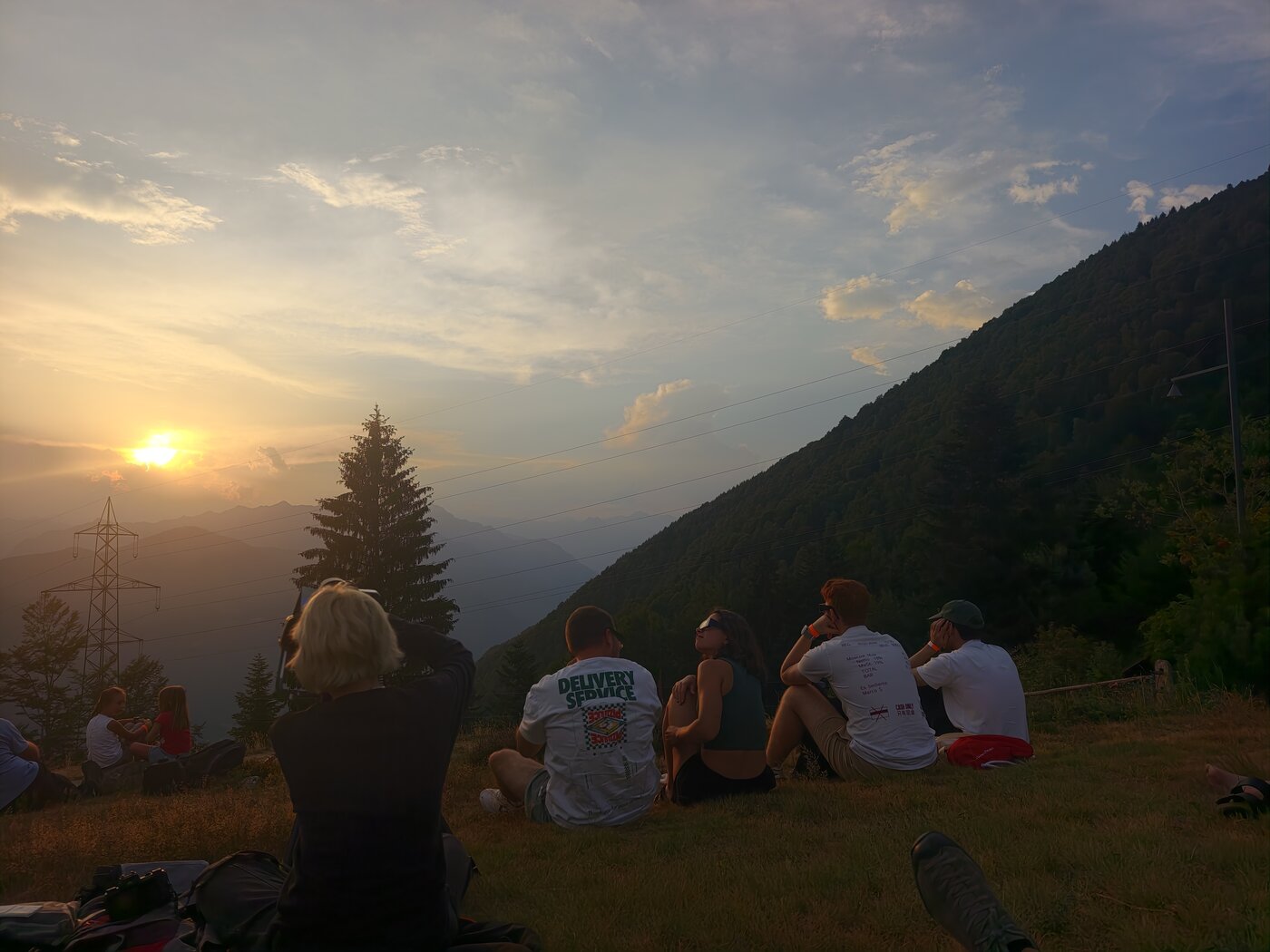
Photo by Alyssandra Maxine.
Dear Vedant and Max,
I’m writing you from the real world, which is to say, from my desk in my apartment in Brooklyn. The first few days of the festival seem very far away now, as they did even when I last saw you only five days ago. During a festival, time tends to go by like that: very quickly and also very slowly, so that ten days actually seem like two months that went by in the span of half an hour. To think back to the beginning of our time in Locarno is not unlike remembering a movie, all those images frozen in time.
For a couple of weeks, reality suspended and gave way to a fantasy world contained within three or four hilly streets in a valley. This world revolved in large part around the GranRex theater, where we watched several films written, directed, or performed by Hollywood figures who got in trouble with Joe McCarthy for flirting with communism. At the start of the festival, I was struck by how, in some of these films, the male protagonists’ thirst for power and control manifested in their relationships with the women who get caught in their schemes.
Take Edgar G. Ulmer’s Ruthless (1948), which opens on a stunning close-up of Diana Lynn’s face. Here, she’s playing Mallory, though she appears in the film mostly as the coveted Martha, the object of desire of childhood pals Vic Lambdin (Louis Hayward) and Horace Vendig (Zachary Scott). Martha rejects Vic in favor of the sultrier, sexier, taller Horace, who only reciprocates her love inasmuch as her father is willing to pay for his Harvard education.
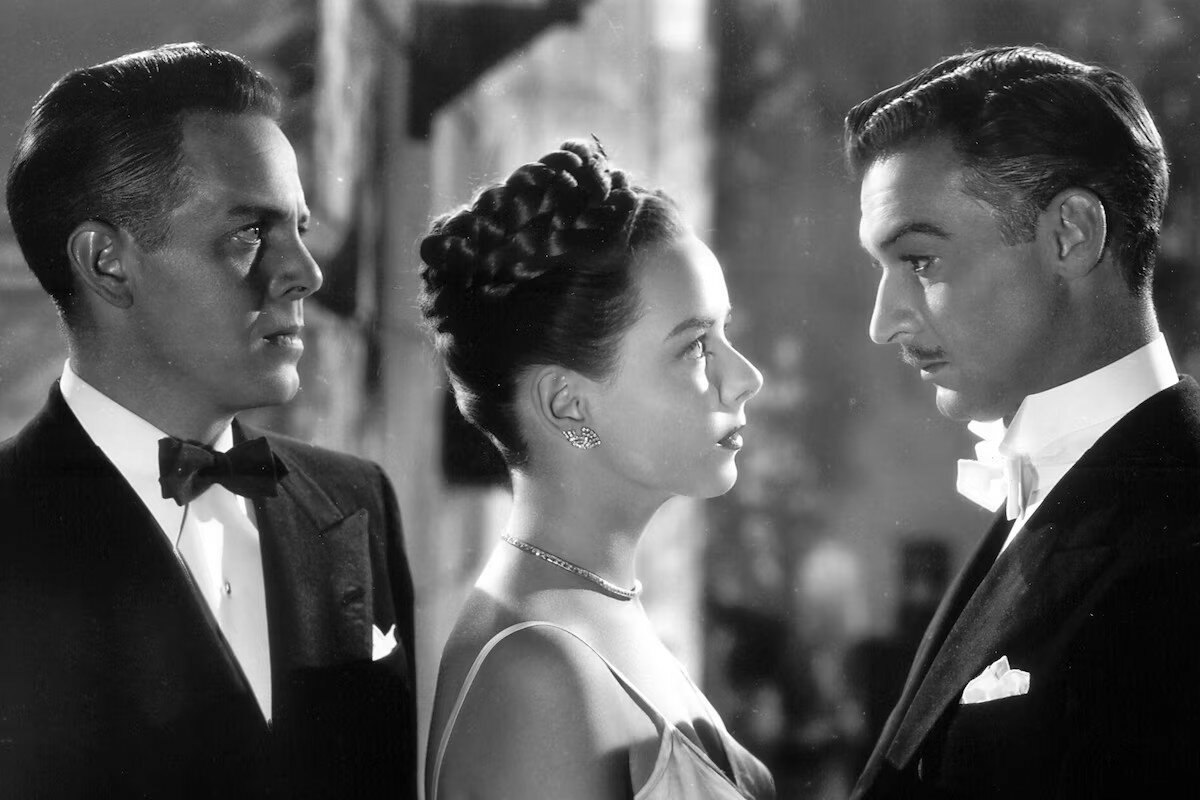
Ruthless (Edgar G. Ulmer, 1948).
Martha may be half-blinded by love, but she is no fool. However broken-hearted, she doesn’t pine for Horace once his insincerity becomes clear. She is guided by self-respect: Stung by Horace’s selfishness, she never shows up in the story again, at least not as herself. It’s a kind of self-preservation, the same instinct that, in Horace, translates as—what else?—ruthlessness.
I have nothing but admiration for women who save themselves. But as a fan of hardboiled noirs, I was itching for a cunning, glamorous dame. I got my femme fatale in Joseph Losey’s The Intimate Stranger (1956), in which Reggie Wilson (Richard Basehart) is hounded by one Evelyn Stewart (played with pep by Mary Murphy). The film kicks into gear once Evelyn—whose mischievous position in relation to Reggie is the polar opposite to Martha’s sensible approach toward Horace—is allowed to be openly self-serving, manipulating Reggie’s indiscretions to her own benefit.
Outside of the retrospective, Max and I watched a film that directly addresses the broken relations between men and women; or, more specifically, the broken relations between boys and girls. Like Ruthless, Wayne Wapeemukwa’s Manhunt (2026) orbits a pair of childhood buddies whose relationship is strained by the presence of a woman—in this case, a girl, one of two Austrian sisters that Joey (sensitively played by Harris Lowe) and Kit (Landon Tunold) meet on a hiking trip through Canada. Joey becomes involved with Dani (Dilara Foscht), which angers Kit, who may or may not be in love with his friend. Wapeemukwa foregrounds the fact that Joey and Kit’s closeness is forged at the expense of their ability to relate to girls in any humane way. Joey tries, but ultimately capitulates when what Kit had been trying to convince him of turns out, in his eyes, to be true: Girls are evil liars.
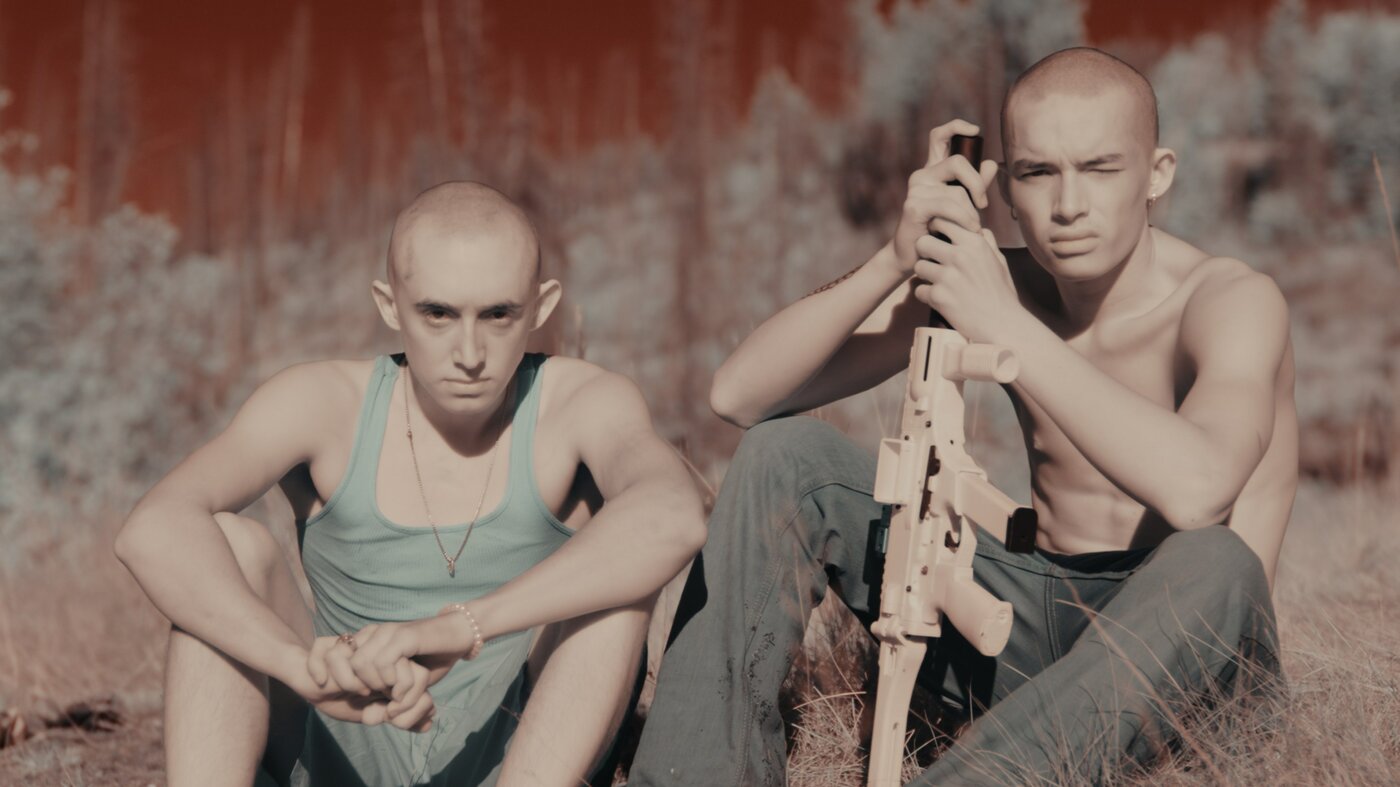
Manhunt (Wayne Wapeemukwa, 2026).
Dani is, obviously, not an evil liar in any sense, least of all in that irresistible Barbara-Stanwyck-in-Double Indemnity way. Instead, she serves a pretty straightforward narrative function, which is to reflect Joey’s brokenness. The same goes for her sister, Becca (Bianca Foscht), who bears the brunt of Kit’s gun-slinging, slur-spewing, manifesto-writing anger. Max and I talked it out on the walk back into town. Surely there is value in Wapeemukwa’s honest portrayal of apathetic boys who have lost the ability to relate to the wider world. But rather than explore the conditions that pushed these young men to incorrigibility, the film is content to simply identify them as “bad.” That doesn’t tell us anything much—not about the characters, and not about the world from which they come. It’s not cinema’s responsibility to cure any social ill, or to provide us with definitive answers, but what it can and must do is attempt to understand the people it sets out to depict.
The opening line of Joan Didion’s novel Play It As It Lays rattled around in my head as I made my way back to my room: “What makes Iago evil? Some people ask. I never ask.” I can’t help myself—I always do.
Max and Vedant, I can’t wait to hear from you.
Warmly,
Rafaela
***
Dear Max and Rafaela,
I too am slowly fumbling my way into what we might call the real world. As you rightly point out, Rafaela, time both stretches and contracts when I think of the last two weeks: Memories seemingly frozen in time also lilt and sway in my mind.
I suppose my way of getting to know Locarno was similar to how I’ve befriended most cities: through long saunters, which I’d embark on each night after a busy day of screenings and talks. And yet, I was far from the romanticized figure of the flâneur. Bundled over with exhaustion and surviving on Coop sandwiches, with muscle cramps and a spreading shoe bite on my foot, my walks were imprinted with an uncomfortable profusion of sensations. The U-shaped promenade surrounding Lake Maggiore, with its cool breeze at night, was easier to maneuver than the cobbled pavement of the Piazza, stuffy with bodies huddled in front of the enormous outdoor screen.
Midway into the festival, I attended a talk by the artist Ishita Chakraborty, who touched on how basil—the wonderful gelato flavor introduced to us all by Max—had a long history of travel from Asia to Europe. Though basil has been wrested away from its original habitats, domesticated to new surroundings and estranged from its earlier religious and medicinal purposes, Ishita imagined it as endowed with an agency of its own.
Something of this disorientation stayed with me as I watched Albert Serra’s Sixteen Moments of My Life (2026). The film revolves around a live performance of sixteen ballads by the screen legend Ingrid Caven, who is accompanied here by The Molforts, Serra’s longtime musical collaborators. Shot mostly in undulating close-ups, and framed against incarnadine reds and velvety blues, Caven assumes an otherworldly persona, looking almost reminiscent of a Francis Bacon painting.
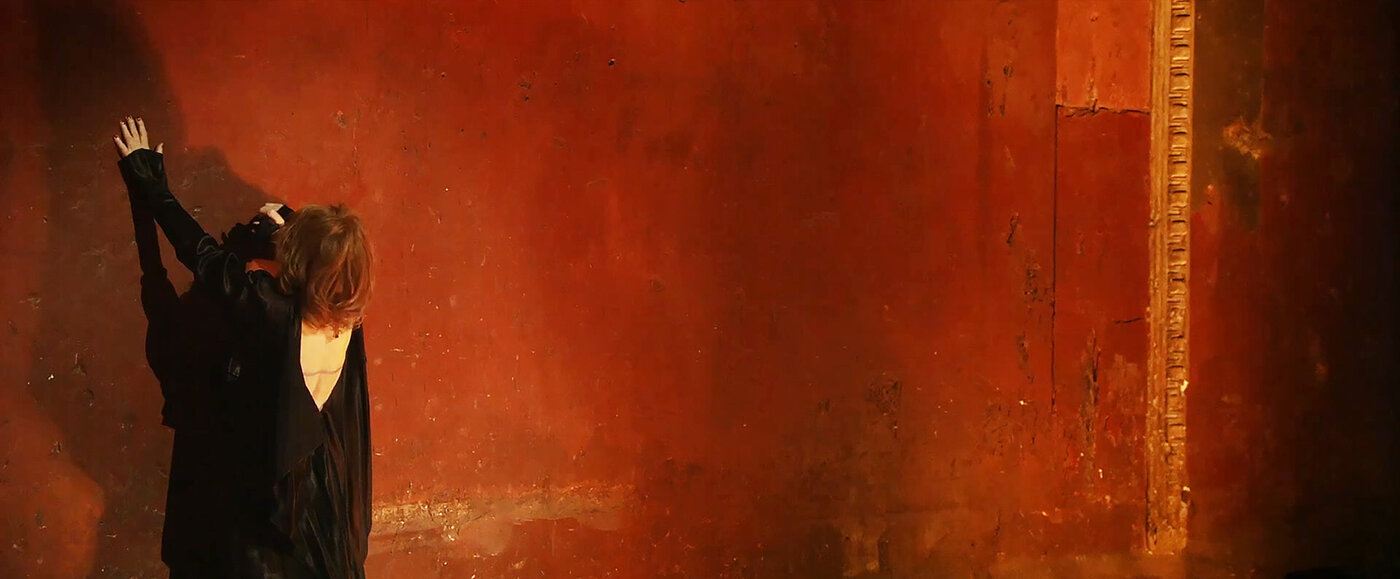
Sixteen Moments of My Life (Albert Serra, 2026).
I hadn’t heard much of Caven’s singing before. There was such force, such brute intensity in the guttural atonality of the music that I was, in a flash, struck by a vision of her iridescent onscreen history. Erika Balsom perhaps captures it best, referring to Caven as a “celestial creature of glorious artifice and terrible glamor: a rupture, a fantasy, a visitant.”
Walking out from the screening, I found myself thinking of Serra’s 2018 installation piece, Roi Soleil, in which a writhing and moaning Lluís Serrat Masanellas—one of the great visages in cinema history—enacts Louis XIV’s agonizing death. There is something about a live performance that seems to echo Serra’s own alchemical style of filmmaking. It’s less about narrative than about capturing a continuous, live unfolding of energies and vibrations, movements and textures. His works—as Serra himself alluded to during a masterclass— activate a reality continually slipping beyond realism.
A few days later, I encountered a similar slippage in Umair Bilal’s As Light as Air (2026). Bilal spent months attempting to capture the reality of Sehwan, a town in Pakistan renowned for its Sufi shrine, and yet something resisted that ethnographic gaze. It was only when he surrendered to the logic of the place—to the extent that the team began to shoot in streets they felt were “calling” them—that the film began to acquire its singular shape.
As Light as Air eschews plot and exposition in favor of synesthetic immersion: music, lamps, and incense, collective prayers and the rapture of dhamaal (a ritualized form of devotional dance) are less subjects to be explained than materials through which the film discovers its own rhythm. Its arabesque form, meanwhile, leaps from color to monochrome, from freeze-frames to pans and tilts, from slow dissolves to elliptical cuts, progressing through emotional states and affective terrains.
While the title invokes a transcendental state, it also recalls Lal Shahbaz Qalandar’s miraculous ability to fly (the saint’s name translates quite literally to “red royal falcon”). The metaphor extends equally to the viewing experience: Watching it, I felt myself gradually entering a state of willing surrender, attuned to invisible longings and unions, ecstatic thresholds and crescendos—all viscerally felt before being rationally understood.
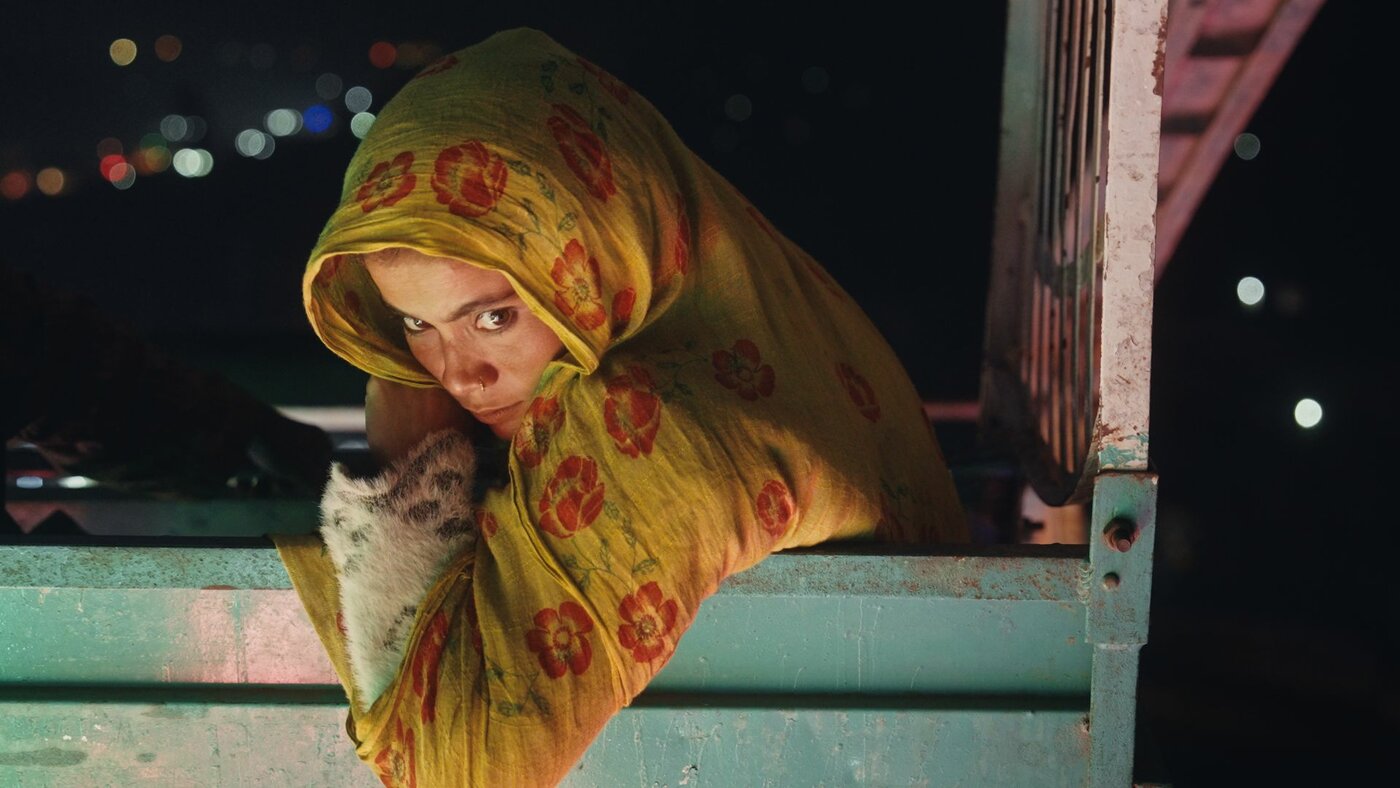
As Light as Air (Umair Bilal, 2026).
Reading your letter, Rafaela, I kept returning to the question of possession: of women by men, of places by filmmakers, and of subjects by the camera. What struck me was how differently that question plays out in these two films than in those you mention. Sehwan resists Bilal’s vision until the filmmaker stops trying to impose one; Caven’s persona, similarly, resists reduction to any single image. Perhaps this is something we are both circling: a cinema that gives itself over only on its own recalcitrant terms.
In retrospect, I understand something of the pull these works had on me. I too belong to a tradition of music—Indian classical—that is highly intricate and prone to improvisation. But beyond their evident musicality, how these two works reveled in the epidermal pleasures of the surface, and, through the very thickness and grime of film matter, transposed their shifting realities onto the nervous system, mirrored my own beleaguered and at times transfixed state during the festival.
As I write this letter, I am reminded of Danièle Huillet and Jean-Marie Straub’s Cézanne films, and how fond the duo were of Cézanne’s famous quip on Mont Sainte-Victoire: “Look at this mountain—it was once fire.”
Here then is perhaps an apt summation of my Locarno experience: Look at this film—it was once matter.
Warmly,
vedant
***
Dear Rafaela and Vedant,
Look at this woman—she was once beautiful. “Yes, I always knew that life could be beautiful with you,” croons Ken Conway (Lee Bowman) in the beginning of Smash-Up: The Story of a Woman (1947). Cowboy hat discarded, Ken is singing live in a radio station’s recording booth, accompanied by his ride-or-die pianist Steve Anderson (Eddie Albert). The pair dedicate their first original ballad to Ken’s wife, Angie Evans (Susan Hayward), currently in labor.
Because the public loves an incorrigible husband graced with a velvet baritone, Ken catapults to stardom, while Angie spirals to the bottom of bourbon bottles. She’s unable to find her place in Ken’s new life or fulfillment in her own career, having surrendered warbling herself to marry the love of her life…the one now disgusted with her deterioration, unable to parse her trajectory. If love can come any time, then it may also depart at its own discretion.
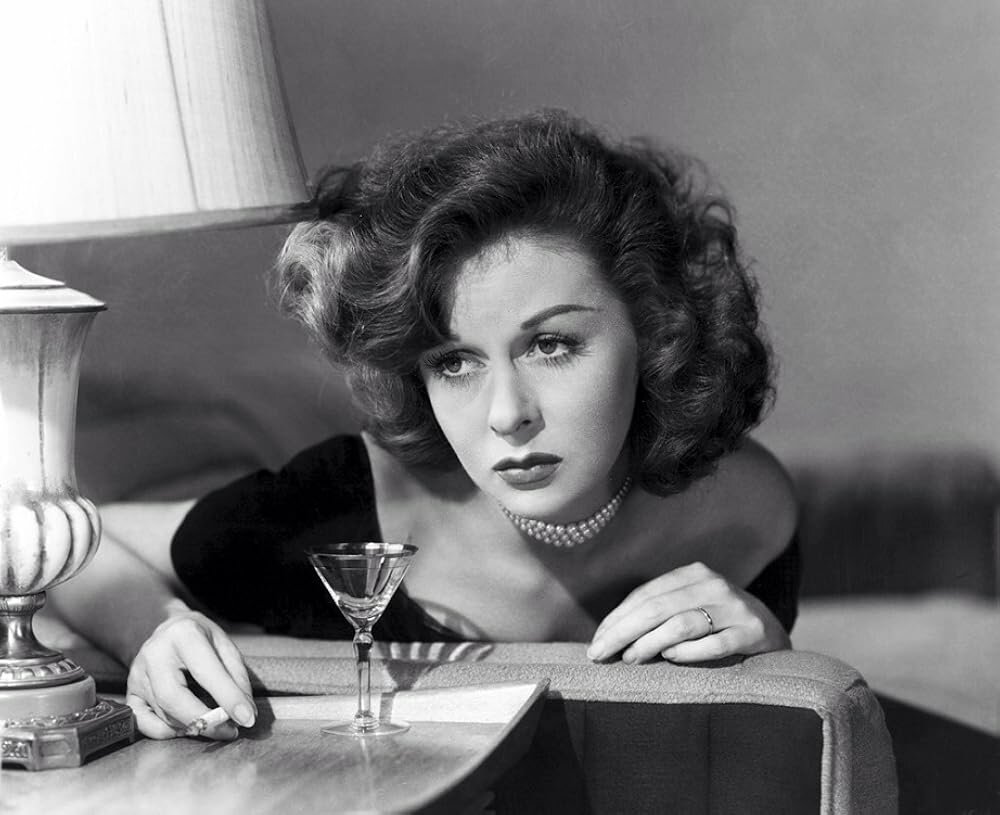
Smash-Up: The Story of a Woman (Stuart Heisler, 1947).
Hungover Angie cups her face in her hands, teetering towards another woman (Martha Gray) at a house party. Perhaps we could program this film someday with Manhunt, Rafaela. Alienations of different genders. Two eras, decades apart. Discounting the heart you gave it on Letterboxd, I think you admired Smash-Up for how thoroughly it depicted a wayward, vulnerable soul. Did you?
This is an uncouth way to start a letter. Salutations and inquiries to your healths have been excised. ¿Cómo estás? My circadian rhythm’s stuck in Zurich time. I write this letter at 2:40 a.m., consummating madness within this bonfire of words.1 I have yet to go on a bender or set tenements aflame. I shall if nothing substantial emerges in 800 words (or more; sorry, Laura).
One of our Academy peers joked about how I was among the final stragglers back to bed each night but the earliest at breakfast. I’m rarely that gung ho. An olla podrida of insecurity and the exhilaration of being in Locarno subsidized my quota for sleep. Having received a local grant to attend the Critics Academy yet not writing anything beyond our assignments—I considered pitching too late with a death in my immediate family—I felt stirrings of shame whenever I’d see Rafaela grinding away on a laptop, or Vedant declining lunch to prep for interviews.
What was I here for if not to work my ass off? Who knew when I’d return to Europe, let alone expensive Switzerland? And why, seven days into the festival, was I declining impromptu meetings with editors to swim in Ponte Brolla? Talk about the indolent Filipino.
After Smash-Up, our Critics Academy colleague Dylan and I reunited at Caffè Verbano to interview Ana Vaz for Variety. Before the publicist knocked on the door to remind us of the time, the three of us discussed the crepuscular sunset that appears midway through Hanabi (2026), her lysergic antinuclear feature premiering at the festival. “We need moments in the film that allow us to come out of this enormous anxiety of different events that succeed one after the other,” said Vaz, without missing a beat, “in order for us to tune into a different temporality.”
Ten minutes later, we’re out and about, tottering toward Ehsan Khoshbakht’s talk on his retrospectives. Then, out of nowhere, Dylan brought up the tentative plans I had proposed to our group that morning: to join the Filmmakers Academy and Basecampers for a viewing of the partial eclipse—the second time it had happened during the Locarno Film Festival since the 1990s. “My girlfriend would kill me if I didn’t do one cool thing,” Dylan admitted.
Alas, Rafaela and Vedant, you had your own plans. Meanwhile, my cowriter and I ran up the hill to reach Castello and left for Cardada, where everyone who didn’t want to hike for three hours awaited the six-minute ski lift. Critics Pierre and George tagged along, both toting eclipse glasses purchased in town for 10 Swiss Francs.
I chatted with JT, the other Pinoy in the Locarno Academies, alternating their eclipse glasses with Pierre’s to squint at the penumbratic sky. The sun squeezed through a concave dip in the clouds, looking a tinge more orange than the red sun in Hanabi.
My attention drifted. A donkey who looked like Balthazar’s understudy lingered by the fence until too many people petting it drove it off. Breeze sifted through the hillside, cooling the sweat tattooed onto my skin. It was like the best kind of durational cinema. We sat there for three hours until sunset.
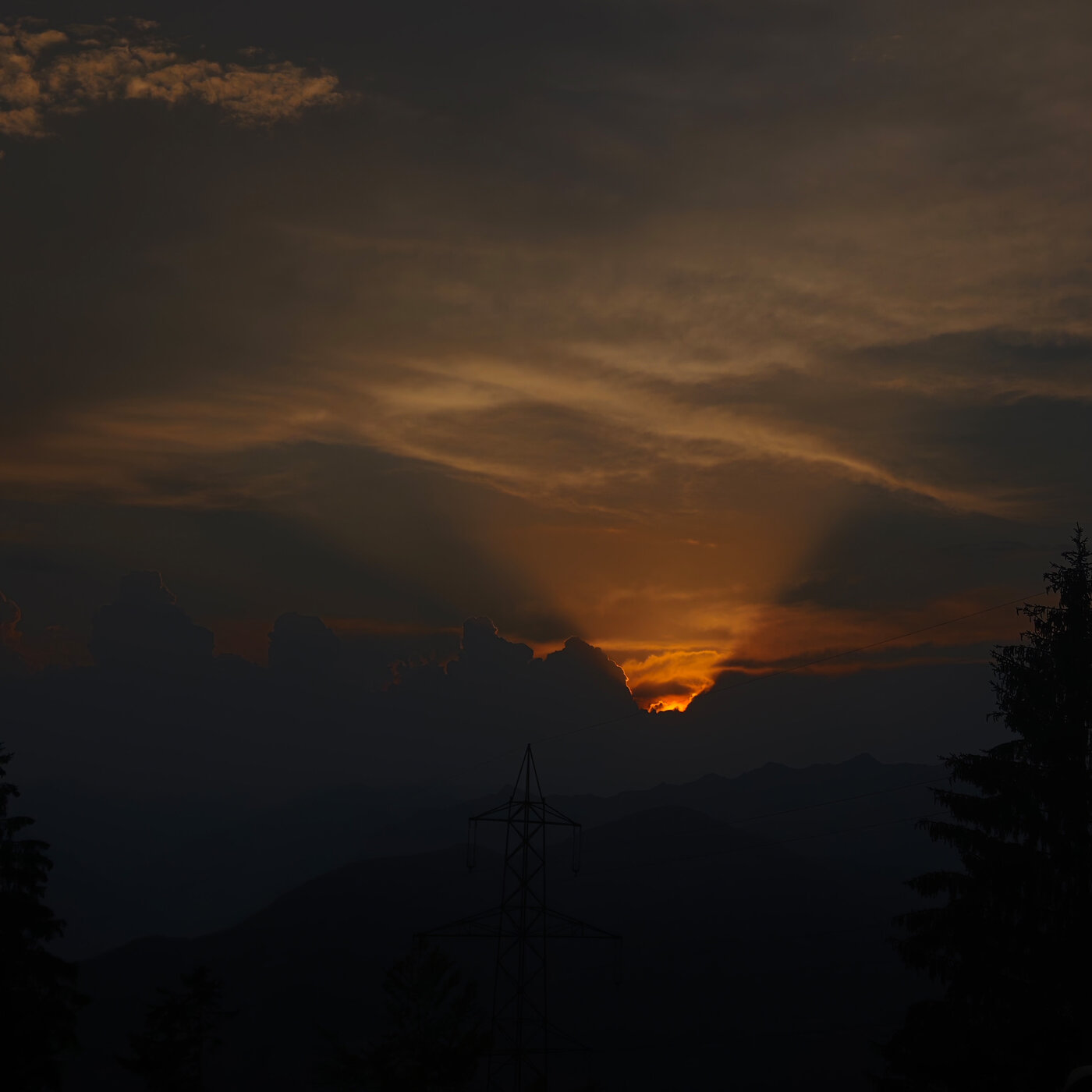
Photo by Alyssandra Maxine.
After the group hiked down to the parking lot, I approached Dylan and asked if he wanted to work on the interview now. “Nah, that would be too antisocial,” he said. “Let’s talk in the hostel.”
He would regret this decision after the winding, nausea-inducing drive back into town, though he would still write 500 words more than I did that night. I also bemoaned my decision the next morning, waking at nine o’clock for the press screening of Hong Sang-soo’s Nowhere to Lay My Eyes (2026) and another retrospective film on my watchlist, He Who Must Die (1957). You had walked with me from PalaCinema to GranRex, Vedant, after the discussion with other tenured critics about “How to Survive a Film Festival.” (And you raised a question on the tip of my tongue, too: “You’re not going to get commissions from any major publications that are willing to pay you decent money back home. So how do you translate what you learn here?”)
Fatigue and irritation sweltered within. The Variety copy emerged turgid until the nth hour of the deadline, cobbled together with Dylan’s aid. Our draft landed in the editor’s inbox, and then our final day together unfurled: the last talk; the last lunch; the last film, Frankenstein Unbound (1990); the last swim by the rocks; and the last drink at the bar.
You left the hostel early morning, Rafaela. We never said goodbye. The final stragglers were Catherine, Vedant, and me. Before I left, I caught you, Vedant, lounging by the garden with your elusive electric mandolin that you brandished upon request. “When are we going to see each other again?” you had asked. “In the next few months,” I promised. We ended up drinking together days later, on my last night in Milan. Then I chased the bus that dropped me off at a ghost town, its inhabitants all caught up in the throes of Ferragosto; I was forced back to Locarno for something affordable that wasn’t pasta (an impossibility).
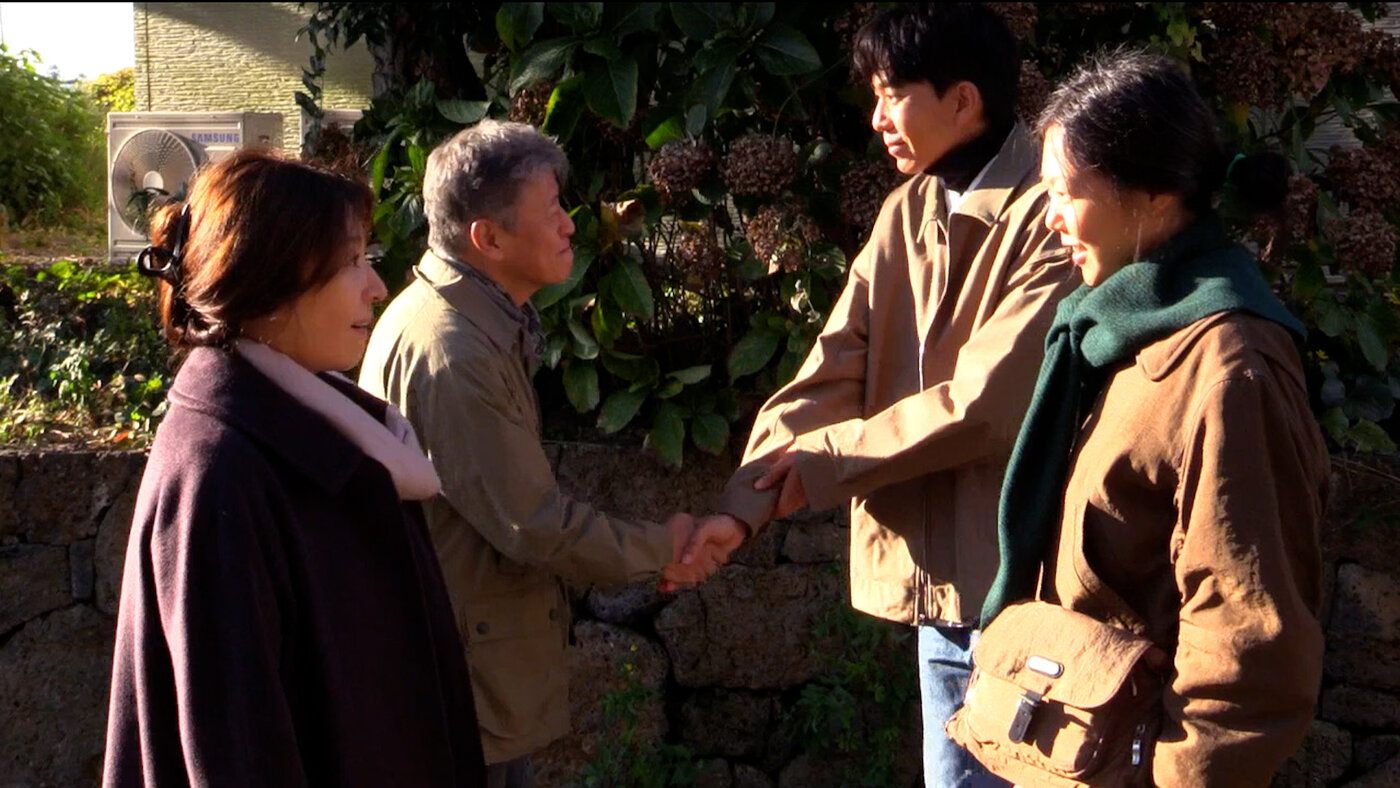
Nowhere to Lay My Eyes (Hong Sang-soo, 2026). Jeonwonsa Film Co.
Afterward, I walked slower than the father-in-law in Nowhere to Lay My Eyes around the city. I knew that the moment I’d hit the sheets, I’d have a dreamless rest and then arise, caffeinated by checklists: this letter, the grant paperwork, other commissions, more pitches, a Sisyphean slog of emails…this time without the company of new friends. I write about films because the world moves too fast to remember all the interesting stories. Locarno had offered that holy grail I had been crusading for: doing something meaningful while enjoying the process.
On the bus stop at Gordevio stood an open library. Its bottommost shelf cradled the last two entries of a series on Virginia Woolf’s letters in their 1980s editions, one entitled “Leave the Letters Till We’re Dead.” Indignant at my bleak inner monologue, I plucked them from the shelves and fluttered back to Manila. I’m fascinated by how much yet how little one reveals about themselves in lifelong correspondences with others. Will you tell us about whatever you watch next when you’re 65, Rafaela? Will you send pictures of your walks two scores later, Vedant? Even if you both never do, my memories of you and the films we watched together have melted like happy lemon drops on my tongue.
Celine Nguyen’s essay on taste closes with this: “Our tastes are how we understand ourselves—and communicating them is how we understand each other.” If words precede thoughts, then your sentences conjoined with mine engulf dark rooms with projections as shimmering as Lake Maggiore. Look at this letter—it was once blank. Look…We were…alpha, bravo, charlie, matter, glad I’m not alone—
Belatedly,
Max
1. As Virginia Woolf puts it in one of her letters: “I know much of it is sketchy and wants working out; but I had not time. … But if it stirs up thought, that is what I wrote it for. And if someone like yourself feels that there is some scattered truth flying about in it then perhaps it won’t be, as I so often feel writing to be, a mere bonfire of words.”