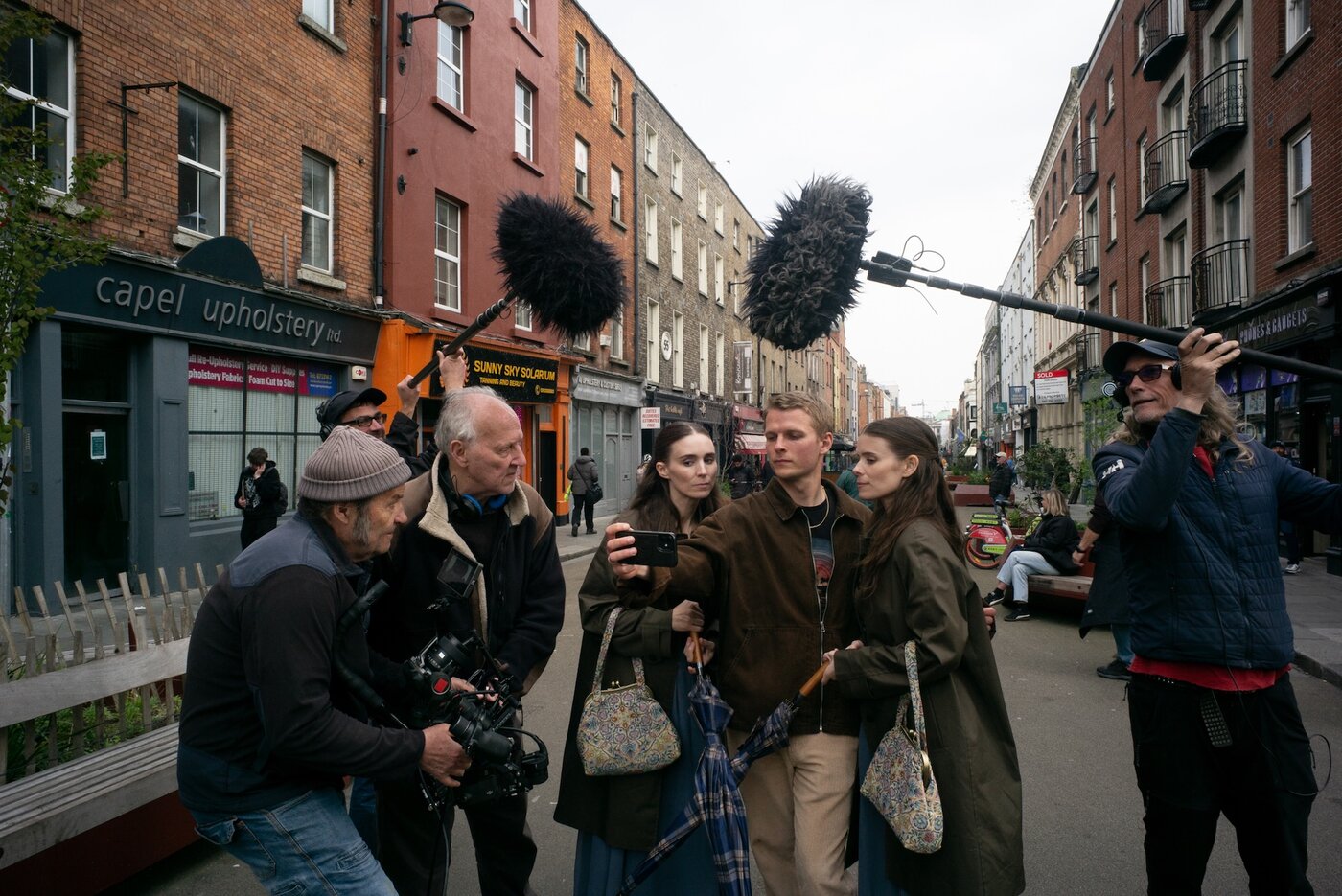
From left to right: Cinematographer Peter Zeitlinger, director Werner Herzog, and stars Rooney Mara and Kate Mara shooting Bucking Fastard (2026). Courtesy of Gateway to Orkney LLC.
Werner Herzog’s first fiction film in seven years, Bucking Fastard (2026),stands as one of his most bizarre. That’s high praise for a director who’s pulled 300-plus-ton steamships over mountains (Fitzcarraldo, 1982), hypnotized his actors (Heart of Glass, 1976), and followed “deranged” penguins across Antarctica (Encounters at the End of the World, 2007). Herzog’s entire oeuvre teems with drifters pursuing quixotic dreams, people and stories often so odd as to strain credulity. But rarely has that strangeness felt more entrancing than it does here. Like his previous foray into fiction, 2019’s Family Romance, LLC—inspired by a real-life Japanese company renting actors to stand in for any person its clients desire—Bucking Fastard dramatizes a true story into a kind of fairytale. Written by Herzog, it is loosely based on the curious case of Greta and Freda Chaplin, English twins who would dress, move, and talk like one—the only known instance of siblings who could speak synchronously.
In real life, the Chaplins rose to fame in the 1980s after a judge found them guilty of stalking their next-door-neighbor, a truck driver, and sentenced them to a month in prison. In Herzog’s hands, the two aren’t twins but sisters—played by actual siblings Kate and Rooney Mara—and their object of desire is a much wealthier cad played by Orlando Bloom, a drunk the two fall obsessively in love with only to threaten his life and property once the playboy ditches them for another woman. Hopelessly naive and idealistic, Jean (Kate) and Joan (Rooney) saunter into Bucking Fastard as wide-eyed children, but Herzog has no interest in psychologizing them. Just who or what might have caused their near-Siamese codependency—so indissoluble is their bond they cannot perform tasks alone—is something the film is defiantly unbothered by. Nor are Jean and Joan written off as victims. We watch them suffer the pangs of unrequited love but also exact their revenge on the heartless beau—which includes but is not limited to burning his SUV and mailbox—and finally, after a restraining order and a few more troubles with the law, flee their nondescript stretch of Irish suburbia to seek refuge at their aunt’s countryside home. It is here that they catch wind of an old legend: in the late nineteenth century, someone began digging a tunnel into a nearby cliff that, once finished, should connect travelers all the way to the Orkney Islands. Never mind that is physically and geographically impossible. “Aren’t you afraid of the enormity of your task?” their aunt asks. “Everybody should dig a tunnel through a mountain,” comes the unanimous reply—a line that echoes as a fabulous précis of Herzog’s own prodigious career.
None of this is to peg Bucking Fastard as narratively driven. Sure enough, lots of things do happen—most of them so bizarre that when a character mutters, “everything in this world confuses me,” you might feel just as lost. But to speak of a plot here would be too far-fetched; if anything, the whole film feels more like a setup for the Maras’ astonishing turns. There’s nothing gimmicky or tiresome about their double act. Working in unison as a kind of Greek choir, they’re an uncanny sight to behold, a duo that’s made all the more vivid and unsettling by their little individual idiosyncrasies—like the way one sister’s forehead tends to furrow while the other’s cheeks dimple, say, or the myriad other fissures that complicate their synchronous shtick. But the entire film feels profoundly, infectiously odd. Peter Zeitlinger, Herzog’s cinematographer since the mid-1990s, favors unbroken and sinuous sequences, and with the camera mounted on a gimbal floating around characters, Bucking Fastard often evokes a seasick sensibility—it’s as though the whole film was perched between a lucid dream and waking life. To parse it for allegories or metaphors would be misleading; Bucking Fastard is weird for weirdness’s sake, which may well account for its spellbinding charm.
I met Herzog in Venice, where his latest screened in the official competition. He was in good spirits: Just the night before, he’d sat in the Sala Grande for the world premiere; the day after we spoke, he would turn 84. Questions about Bucking Fastard rapidly gave way to broader ones around his creative and writing process, the “voodoo of locations,” and his attempts to find new, unfading images in our screen-infested world.
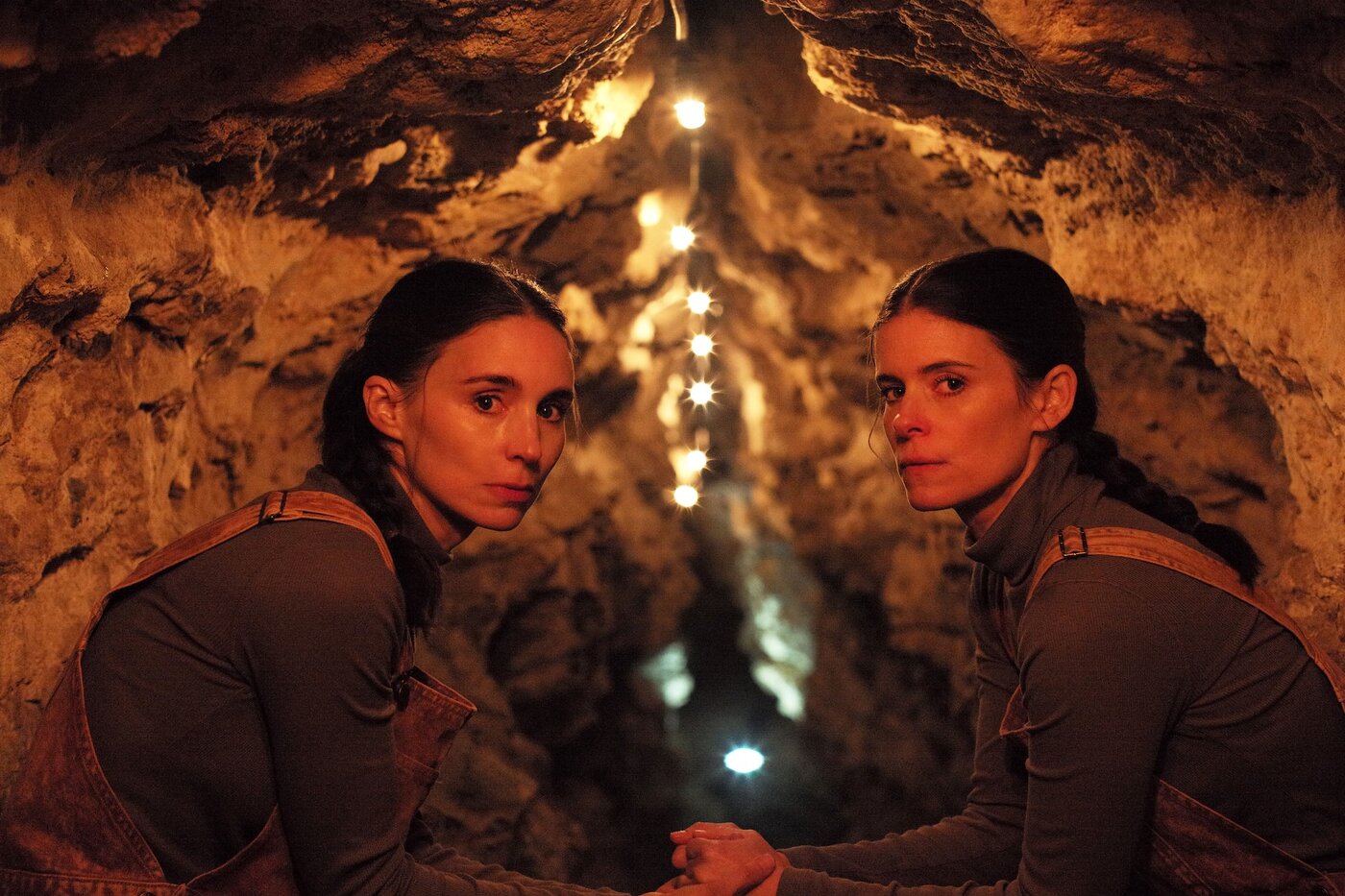
Bucking Fastard (Werner Herzog, 2026).
NOTEBOOK: Fictional as it is, Bucking Fastard still borrows from the “real” world. There’s the true-life case of the Chaplin twins, but also your decision to recruit actual siblings Kate and Rooney Mara. I was hoping we could start by discussing that casting choice, and, more broadly, the need to retain an element of reality to build an artificial story atop it.
WERNER HERZOG: It just makes the film so much more fascinating, simple as that. You see, many people advised me, “Why don’t you take a great actress and create her sister digitally?” But the film would have been dead on arrival. And we’ve seen that before. We have seen it done in other films: It’s completely uninteresting. It was the same thing with Fitzcarraldo. Hauling a real ship over a mountain brings a lot of richness into the texture of the film. Six-year-old children today can recognize a digital effect. They even know the basics, how those effects are done. But watching a film like this, you instantly know it is for real. And you can trust your eyes again.
NOTEBOOK: I was hoping to hear more about your writing process, and how that might have changed through the years. You wrote the script for Bucking Fastard super-fast, in five days…
HERZOG: Oh, but that’s not super-fast. Aguirre [the Wrath of God, 1972] I wrote in two and a half days. Five, six days—that’s usually the average time I spent on my screenplays. It’s easy to write twenty pages per day. That way, in five days, you end up with a hundred... But it’s not that I work uninterrupted. I mean, with this one, for example, I took a break and spent one full afternoon doing my tax returns and things like that… [Laughs.] Then I returned to the script.
NOTEBOOK: And what do the scripts look like, on the page? Do they still have that prose-like quality, as you once said they did in works like Aguirre?
HERZOG: Well, those were the early ones. I had never seen a screenplay in my life. And I would write a script in a way that you—the reader, or the actor whom I wanted to work with—would immediately recognize it as a film. You saw the film by reading the text. But there are all kinds of conventions around how to write screenplays with dialogue. And my approach made everyone confused. The actors, the financiers, the insurance companies—everyone. In the end, I realized it didn’t really matter in which form I wrote, and my scripts became a lot closer to what a standard screenplay looks like.
NOTEBOOK: I asked because I recently started reading your novel, The Twilight World, about Onoda, the Japanese soldier who refused to believe his country had surrendered to the US at the end of World War II and continued fighting all alone in the jungle until 1974. The book almost reads like a screenplay: The prose is very efficient, very succinct, as though you were giving out instructions to your collaborators. It made me think about how these disparate art forms, cinema and writing, can nonetheless influence each other.
HERZOG: That’s right, but when you look at The Twilight World, that’s text—nothing but writing. It’s literature. Of course, I had thought about making a film about Onoda, a feature film with him as a central character. But I didn’t want that. I felt his story as a text. And there are passages in the text that are completely non-translatable into movies.
NOTEBOOK: What’s most striking about Bucking Fastard is the way the film gradually morphs into this strange, immensely romantic fairytale. We begin with the two sisters standing trial somewhere in Ireland and end up in a realm that’s a lot harder to define.
HERZOG: Yeah. Well, that has to do with the dream of love, where a pure world is impossible, so it must be a different one altogether. Arcadia, Atlantis, the Orkneys... By the way, I hope the Orkneys like the film! [Laughs.] These are landscapes of the soul. And what remains for the audience is—well, the film doesn’t give you any information. It’s not that kind of film. It’s not about an issue. It’s not journalism. It’s just a movie, and it has this tremendous joy for storytelling which you sense in every moment. At the same time, you know you’ve never seen anything like it, and you never, ever will again. It’s unique. There’s no precedent in film history. And I like it because so much of what you see today is like the fifth, sixth, seventh repetition of the same old film.
NOTEBOOK: In a world that’s so saturated with screens, in which images come at us from all angles, it’s difficult to find something that’s radically new.
HERZOG: And yet you have the perfect example in Bucking Fastard! [Laughs.]
NOTEBOOK: Right, but I’m curious: how exactly do you search for these images? Do they already exist in your mind before you start writing, or do they reveal themselves to you as you go?
HERZOG: No, they come at me with great vehemence. See, that’s why it’s easy for me to write a screenplay. Because I see the entire film the same way you might see it projected on a screen. I’m just sitting there, writing quickly; I have to copy what I hear. What are all these voices saying? They never really stop, and I have to be fast to keep up.
NOTEBOOK: You’ve often spoken about the “voodoo of locations.” I wonder if the places themselves might be responsible for some of these images. Like those caves in Slovenia that you filmed here, standing in for an Irish location.
HERZOG: Ah, those caves… By the way, did you know they’re only a one-and-a-half-hour drive away from here? Postojna, not far from the border with Italy. They’re so phenomenal. I had looked into caves in Mexico and other countries, but what we found in Slovenia seemed to me like the real world of imagination. And to see that imaginary world all of a sudden interrupted by a real train that’s passing through with tourists!
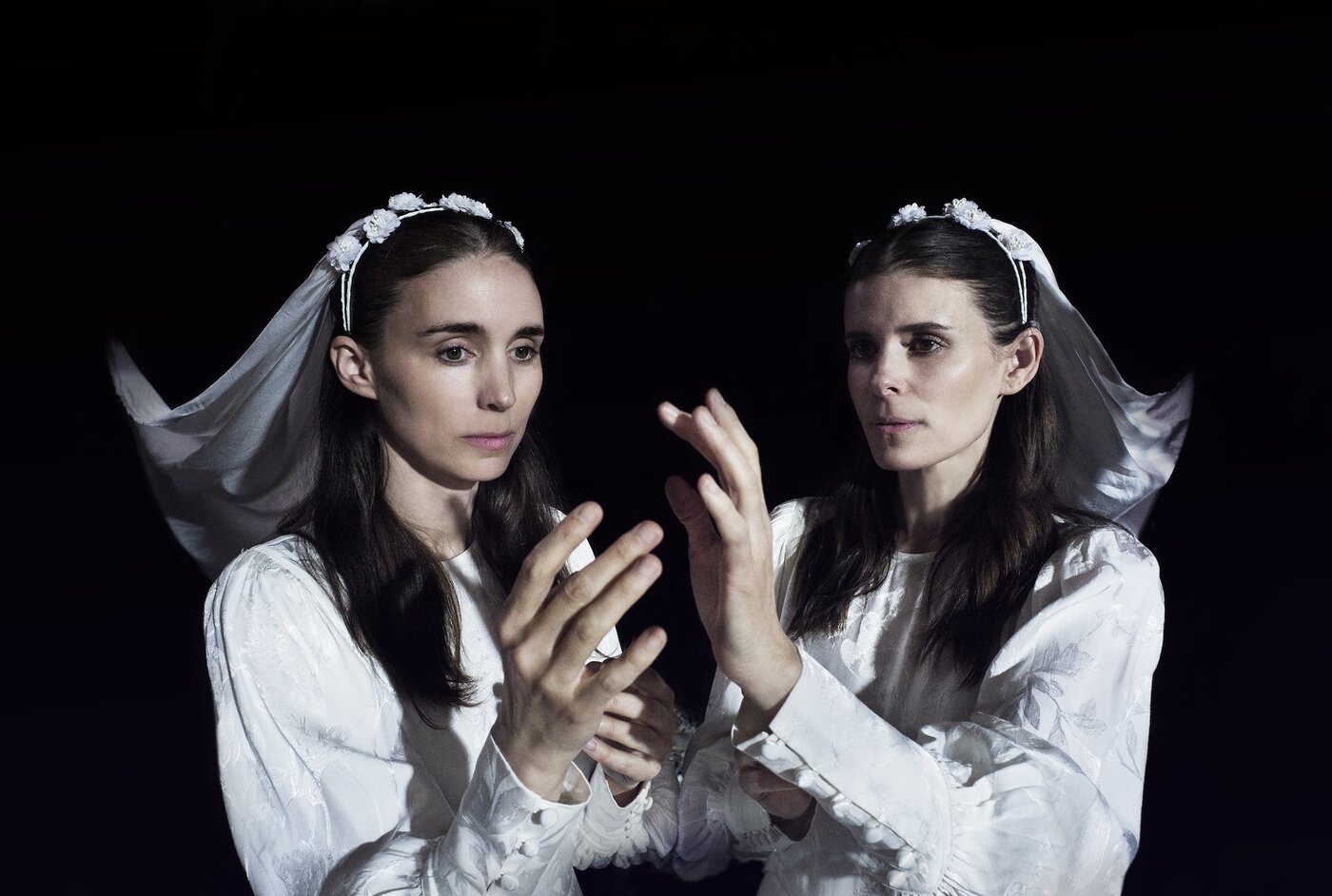
Bucking Fastard (Werner Herzog, 2026).
NOTEBOOK: It’s such a beautiful moment: reality piercing a dream. Then again, with its uninterrupted, meandering camera movements floating around characters, Bucking Fastard often looks like a dream itself. I’d love to hear more about how you and Peter Zeitlinger achieved that aesthetic.
HERZOG: Oh, but I don’t know anything about aesthetics! And I do not want to give any aesthetics to my films. It comes on its own. It imposes itself. And it’s the same thing, you see, when I look at your handwriting… [Points at my notebook.] You never think about the aesthetics of your handwriting, right? Still, it has a certain aesthetic. There’s no doubt. But if you started to think about aesthetics, you would not write beautifully anymore.
NOTEBOOK: So what does your collaboration look like in practice?
HERZOG: We are very physically together. By now we have worked on many films, and we have a very short, very easy way to communicate. And he knows. He knows my eyes and I know the lenses. I know light. So it’s all very, very fast. Our setups are quick. Rehearsal time is short. And we operate as a one-camera guy. There are few directors working like that. Christopher Nolan, I think, is another one-camera guy. I like these one-camera guys who trust in their vision. We shot very few takes here—even in such a complex film, with two sisters speaking in perfect unison. We would have two takes and that was it. Orlando Bloom only had one. I was told that he was upset about it! [Laughs.] He loved working with me so much but did his scene in just one take. So I brought him right back and gave him three more. They were all good. The first one was still the best.
NOTEBOOK: Your birthday is tomorrow.
HERZOG: That’s right. Eighty-four.
NOTEBOOK: I find it curious how, once a filmmaker reaches a certain age, conversations around their filmographies almost inevitably begin to orbit the question of late style—basically, that idea that late films should stand as distillations of one’s craft, stripped down until the final result is almost impenetrable. I just can’t square that with a film as playful as Bucking Fastard.
HERZOG: That’s because all my films are in Egyptian style! [Laughs.] No, there’s no such thing as late style. My films, they keep getting wilder. And it’s the same joy as always. Dream big, but do the doable. That’s the mantra I preach to the young filmmakers with whom I do workshops. Dream as big as you must, but remember you have to do the doable. Even moving a ship over a mountain in the middle of the jungle—it has to be doable. You do not waste your life in something that is clearly not doable.
NOTEBOOK: Animals play a prominent role in Bucking Fastard, and though I wouldn’t go as far as to call any of them cute, it’s difficult to reconcile their benign presence in this film with some of your older, bleaker thoughts about the animal kingdom.
HERZOG: Well, there’s a fox and, as you say, it’s not cute at all—it’s strange and enigmatic. And there’s a deer, too—that’s just very mysterious. Why does a deer suddenly enter the cave and sniff you out and look at you and wander around? Cut! End of the scene. That’s something that can only happen in cinema. It’s completely mysterious; there’s something so strange and magical about it. And it was not in the script. I happened to come across this animal through the same wrangler who gave us the birds you see in the opening scene. He said, “Oh, would you like to see my deer?” And I said, “Sure, why not?” [Laughs.] He whistled, and the deer came over. Completely domesticated.
NOTEBOOK: Speaking with Roger Ebert many years ago, you talked about the need to find adequate images for our civilization. I know this is a big question, but I wonder what you think those might look like today, an age in which AI-generated visuals are flooding our screens and consciousness.
HERZOG: I have a simple answer: Shut down AI and watch my movies! [Laughs.] You see, whatever comes from AI is always dead on arrival. So, if you want to see real wild life—and I don’t mean wildlife like lions and giraffes and so on, I mean life at its wildest, at its most imaginative—just watch Bucking Fastard. And read. Read more. This is something else I like to say to aspiring filmmakers. But in film schools these days—this is pretty much worldwide but in America in particular—nobody reads. Only a small fraction of them actually become filmmakers, three percent or so, even in the most prestigious film schools. Statistically, it’s not very favorable. But if you do not read, even if you get to become one, you’ll be a mediocre filmmaker at best.