
Late Fame (Kent Jones, 2025).
Kent Jones’s Late Fame (2025), like Diane (2018) before it, is about a middle-aged protagonist coming to terms with their younger self. In the earlier film, Jones’s narrative feature debut, the sixty-something title character (Mary Kay Place) spends her days helping others while dealing with past mistakes that have estranged her from her drug-addicted son. His second feature follows Ed Saxberger (Willem Dafoe), a New York City postal worker whose poetry from the late 1970s is suddenly rediscovered by a coterie of young writers. That the films are of such a piece thematically, yet so tonally distinct, speaks to the 65-year-old Jones’s preoccupations as a late-arriving artist in his own right. Best known as a film critic and programmer—he was for many years a correspondent for Cahiers du Cinéma and a contributor to Film Comment and Cinema Scope, and he ran the New York Film Festival from 2012 to 2019—Jones cut his teeth behind the camera with Martin Scorsese on a number of his documentaries about cinema, as well as with Arnaud Desplechin as a cowriter of Jimmy P: Psychotherapy of a Plains Indian (2013). In 2015, Jones made his own documentary about film history, Hitchcock/Truffaut, before pivoting to filmmaking full-time with Diane. Patience imbues every facet of Jones’s practice, lending his films a maturity and perspective not dissimilar to those of his protagonists.
Adapted by May December (2023) screenwriter Samy Burch from a posthumously published novella by Arthur Schnitzler—whose Dream Story provided the basis for Stanley Kubrick’s Eyes Wide Shut (1999)—Late Fame transposes the Austrian author’s story from nineteenth-century Vienna to present-day New York. As the film opens, Saxberger is sought out by self-styled poet Wilson Meyers (Edmund Donovan), who lavishes praise on the older man and invites him to meet his friends, who call themselves the Enthusiasm Society. Despite the group’s pretensions and lack of credibility—they’re not so much staunch intellectuals as romantic rich kids—Saxberger agrees to take part in an upcoming reading, which will allow him to spend more time with the strikingly coutured Gloria (Greta Lee), the collective’s one female member and its only true eccentric. Saxberger, like Jones and Dafoe—the latter a founding member of the experimental theater troupe the Wooster Group—is a product of 1970s New York, to which the film pays tribute through references to a variety of the era’s writers, as well as music lifted from Lou Reed’s Coney Island Baby and the Brian Eno–produced No New York compilation. Where the aging Saxberger fits in with this current crop of artists, and to what extent he can reconcile his past life with his current self, forms the crux of this keenly observed drama, which sidesteps the cynicism and condescension that tends to plague movies about art and the generation gap. In Late Fame, nostalgia isn’t a curse so much as a reminder that the past is often better remembered than relived.
A couple weeks after Late Fame’s premiere at the Venice Film Festival, I caught up with Jones over Zoom to discuss his early years in New York, his approach to working with an adapted screenplay, and how creative misreadings of the past are not a generational phenomenon, but a human one.
NOTEBOOK: How did you come to Samy Burch’s script? Did she bring it to you or was it proposed to you?
KENT JONES: Pam Koffler from Killer Films called me and asked, “Do you read other people’s scripts?” And I was like, “Well, I don’t know. What is it?” She described it to me and it sounded intriguing. I knew of Samy because of her script for May December, which I really admired.
But before they sent me the script, I went out and made sure I found a copy of the Schnitzler novella, and I read it. And I certainly liked it. I know a little bit of Schnitzler. Obviously, if you’re a film fan, you know Dream Story. But when I got the script, I had the same sensation that Willem did when he read it, which is that we both preferred it to the novella—in the sense that it was warmer, it was more surprising, and the sense of humanity was more varied. And then Samy and I met, and we hit it off immediately; she really wanted me to be the one to make it. That was the beginning.
NOTEBOOK: I’m wondering, since this is an adaptation, if the New York backdrop—and in particular the narrative’s retrospective feel for 1970s Manhattan—was your way into the material from a personal standpoint?
JONES: I’ve adapted novels for other people, and I’ve worked on adaptations for others and even had adaptations in mind for myself. That’s why it was a refreshing thing for me to read something that was really adapted—meaning the script was a real transposition. I found that interesting. Just the very idea of it: that it was that story that Samy decided to update.
I immediately saw something that was in latent form in that first draft—namely, things that I observed in younger people that struck me as resonant. But there was also something I felt in relation to myself, in the sense that in movie culture, the idea of reclaiming a lost hero was and still is a rather popular move. In my own case, I went through it very early on with Monte Hellman. I was thinking about this interview that I did with him when I asked him one of those ridiculous questions like, “Looking back on your career…” And he said, “Well, I can’t, because I'm still in the middle of it.” And I was like, “Oh, yeah.”
Of course, the idea of someone who was a poet is very different, because nobody’s ever made a living writing poetry, except maybe Rod McKuen, where the poetry is incidental to other things. When Willem and I discussed that aspect, there was no problem figuring it out. It’s just sort of like, the moment arrives, the moment ends, and then you have to make a living. Either you become a college professor, like Edmund says at one point, and get tenured and do some residencies; or you try and figure it out another way. Or you just stop writing. That was very compelling to me.
It was also compelling for me to get into the world of poetry, because my best friend in the world, Peter Gizzi, is a poet. The film is actually dedicated to him. He appears at the end of the film—he’s the guy in the back of the room reading. You can tell from that scene he's not an actor. He’s in Diane, too. He had a little moment in that film—he and my son, who’s his godson.
When Willem got involved, we talked, and I realized that both of us came to the city around the same time. Originally, the script called for someone a little bit older. So the reference was like the late ’50s, ’60s, and early ’70s. The shift to the late ’70s was very personal for me. Originally in the script, the walks that Saxberger would take were through the West Village, but I thought it was more fitting, for someone who came to the city at that point, to have SoHo as the reference. The West Village has changed, but it feels a little bit like a museum of itself or something like that. SoHo is different. SoHo feels unchanged physically, but obviously completely changed in terms of who gets to live there, what’s behind all those facades. It used to be lofts and galleries and stuff. Now it’s just multimillion-dollar clothing brands. And it’s people with vast amounts of money who live in those lofts. I'm always struck when I walk through SoHo—how much it feels the same, and how different it feels at the same time.
So all those elements became important. And then something like the bar where Greta sings “Surabaya Johnny” in the film—I don’t know how much longer those kinds of bars are going to be around. Elements of a New York that is either almost lost or lost, but still exist in memory, and that younger people have a kind of an outsized, unrealistic version of in their minds.

Late Fame (Kent Jones, 2025).
NOTEBOOK: Can you talk a little about your own experiences in that era? Were you into poetry, or cinema, or just art more generally?
JONES: I came to New York in 1980 with Peter. We both went to NYU. I studied film; he studied literature and took film classes. I was already interested in avant-garde cinema, but when I got there, I got really into it. At the time, I came down with a very romantic idea of studying with Nicholas Ray, because he was teaching at NYU, though he was dead before I arrived. But I studied filmmaking, then shifted to cinema studies. I was absolutely unsatisfied with both of them. I didn't enjoy it, except for one teacher in cinema studies, Noël Carroll.
I dropped out at a certain point, but by then I was deeply enmeshed in the world of filmmaking. I worked at what was pretty much the first video store in Manhattan, on MacDougal Street, New Video. We had all these customers like David Byrne and Jerry Harrison and Cindy Sherman and Robert Longo. It’s where I met Julian Schnabel for the first time. During this time, Peter and I would get together and stay up all night—by various means—and just talk a lot. He would go on and on about 8½ [1963], and I would go on and on about other films. We would read poetry to each other. We talked a lot about Ezra Pound and The Cantos, which is interesting because Pound was always a controversial figure, but he was also a revered figure by everyone—including Pasolini and Ginsberg. So all those things were very important, as was William Carlos Williams. It all kind of blended together: Godard, Marty’s Raging Bull [1980], avant-garde cinema, poetry, and music. It all seemed to kind of coexist.
NOTEBOOK: What can you tell me about the opening montage? It really sets the scene and gets the viewer in the late-’70s avant-garde mindset with the Mars song on the soundtrack and the black-and-white footage of the art scene at the time. Where did that footage come from?
JONES: There are a couple of images from films of the time, but the images of the poets— Anne Waldman, Ted Berrigan, Bernadette Mayer, and Lewis Warsh—are from public-access broadcasts.
It’s interesting, the Mars song. I was a huge Brian Eno fan. And when that album [No New York, 1978] came out, like most people, I found the majority of it extremely difficult to listen to. I mean, I could see the Contortions had an act that was kind of cool. I remember seeing the Contortions at Max’s Kansas City. But “Helen Fordsdale” was different. That was something else. That one really stuck with me. It was the only song on the album that I went back and listened to over the years. It was all interesting, but that song, just from a more conceptual standpoint, was one that had this real force to it. And it was a force made by people who were artists and, like a lot of the musicians of the time, nonmusicians. At first I thought about using a John Cale and Terry Riley song, but that seemed too early. And then the Mars song came to me.
NOTEBOOK: It’s a disorienting opening, especially if, tonally, you’re expecting something more along the lines of Diane.
JONES: Yeah, I wanted it to be disorienting. And then you’re lulled into something else, so that you just have a sense of the energy that Saxberger came out of. And then it’s refracted in the poem that he reads at the end of the film. So that was the idea: to place you in his past and then pluck you right down in the middle of his present.
NOTEBOOK: Can you speak to what Willem, who comes from this scene, brought to the role that maybe wasn’t on the page?
JONES: It’s like the old Alexander Mackendrick maxim: Scripts aren’t written, they’re rewritten. So it’s constant. Everything with every actor was changing, and all of those actors are brilliant improvisers. There were moments when Willem had very specific things he wanted to say, but once the momentum starts, then everybody’s really involved.
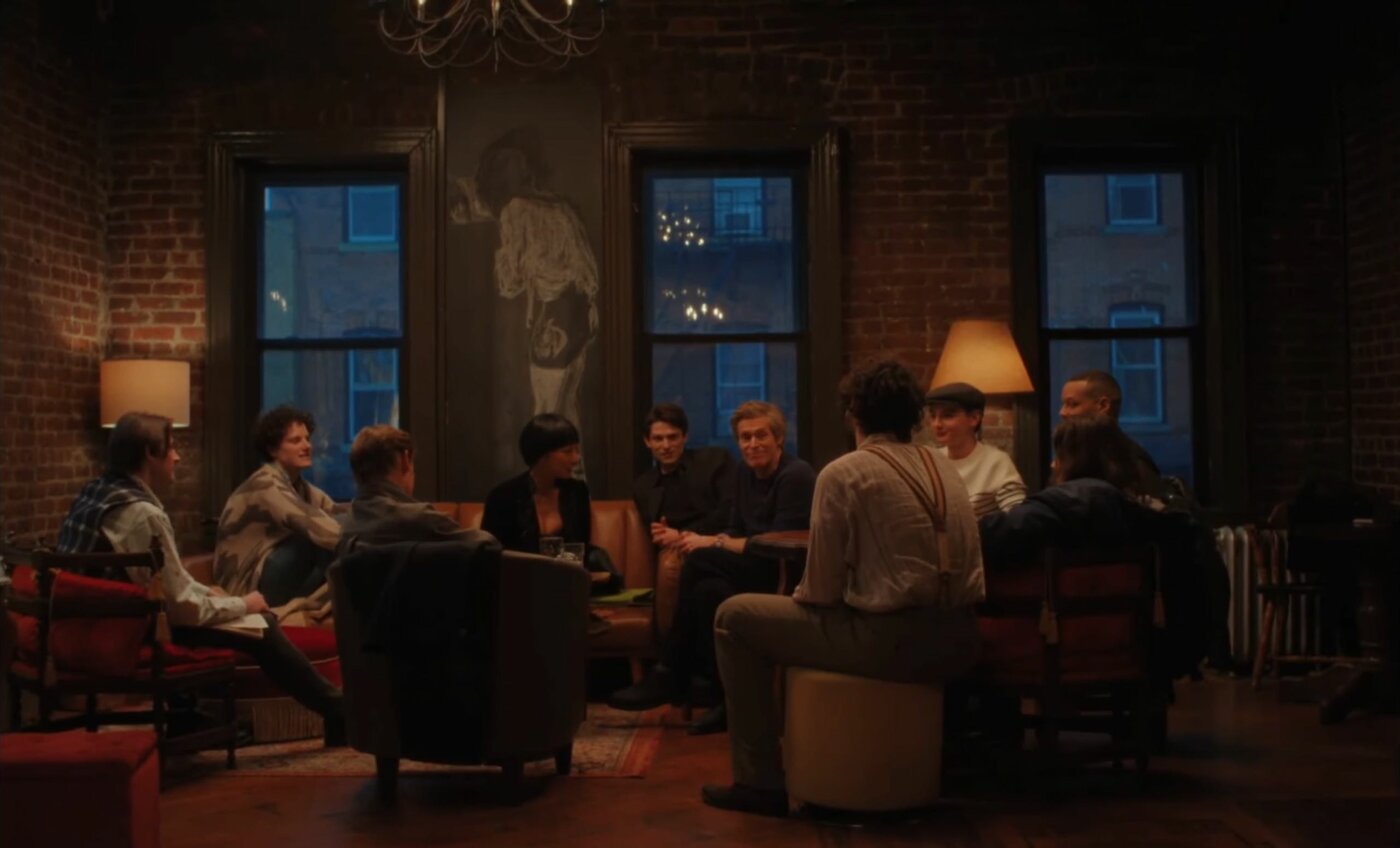
Late Fame (Kent Jones, 2025).
NOTEBOOK: What’s interesting is that depending on how much you know about everyone involved in the film, it can feel personal from a variety of vantage points.
JONES: I wanted the film to be powered by the energy of the actors, and almost lit by their faces. Because that’s the rhythm of their interchange. I knew that with the young artist characters—their gatherings, their watering holes—they had to work as a whole group. Meyers is a very distinctive character, distinct from the rest of them. But when they’re together, they’re functioning as a whole group—or not functioning, as the case may be—just constantly looking at each other, raising their eyebrows. It’s the idea of a group that isn’t really a group. It’s a kind of grand idea that only a bunch of people with a lot of money and time on their hands could come up with. But there’s still grandeur to it. Or at least that’s the way it is for me, as a filmmaker with the people on screen, the reality of what is happening. Who these people are at the moment of filming is really important.
NOTEBOOK: Would you say that the film’s a subtle—not critique, but maybe a comment on nostalgia and how younger generations romanticize previous eras of art and culture?
JONES: I don’t know if it’s a critique so much as an observation of what I see. When I was young, I had the same kind of—what did Harold Bloom used to call it?—a creative misreading. It’s like a creative misconception of the past—or, for that matter, of the present. For example, when all those films were being made by Edward Yang and Hou Hsiao-hsien and Tsai Ming-liang in Taiwan, I was not alone in imagining Taiwan as being this paradise of cinema. And it’s, like, well, no—it was just as difficult, if not more so, for them to get those films made. Which was also true of John Cassavetes and the difficulties he faced to get his films made. It’s just that we all see them through this lens. It's a pretty common thing. It’s a very human thing.
I was just looking at an interview with Monica Vitti where she was talking about L’avventura [1960], and you take it for granted when you see it—it’s like, oh, the Golden Age of Italian cinema. But she said, “Well, we were on a yacht, and I got off because Michelangelo and I had had an argument. We talked about it for a couple of years, and then he wrote a script. And then he took it around and everybody was like, ‘Are you kidding? We have to find out what happened to the woman.’ And he’s, like, ‘No, that’s not the point.’” And then she said that some guy, who wasn’t a real film producer, just gave them a little money and got them started. It’s a real struggle to make films in any context.
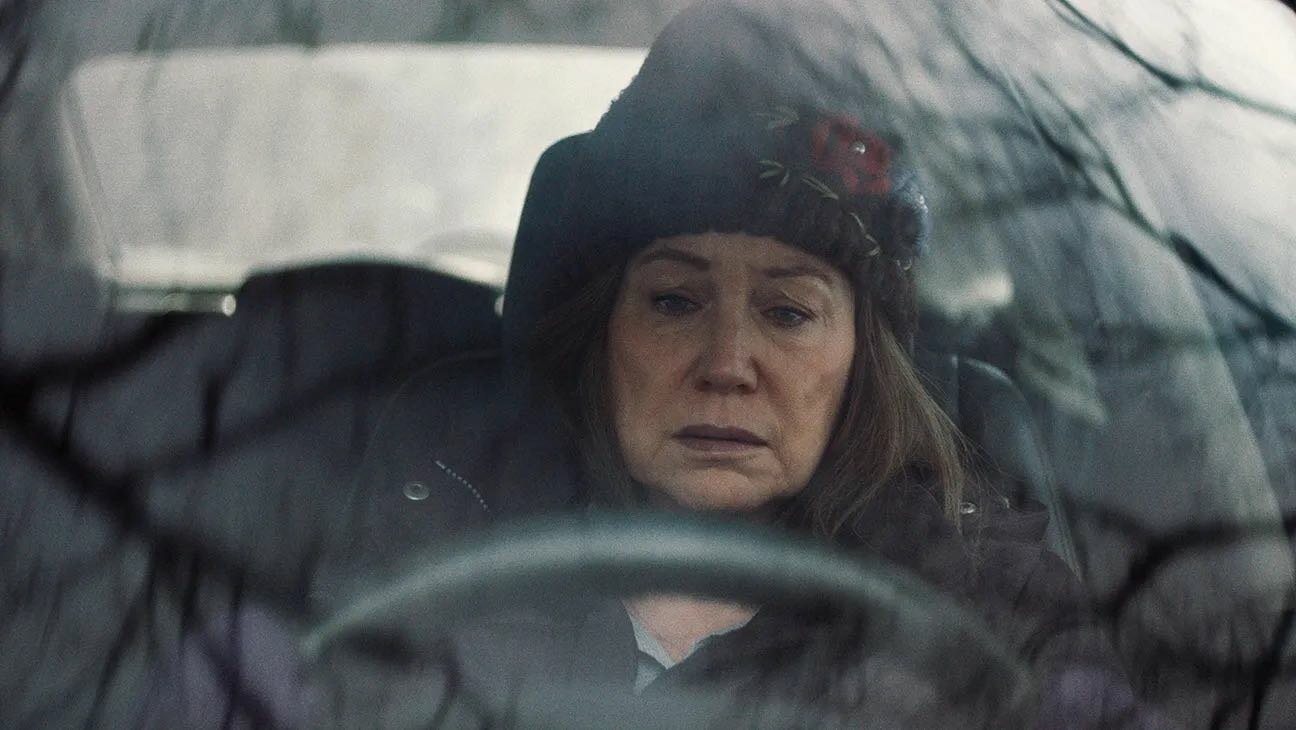
Diane (Kent Jones, 2018).
NOTEBOOK: Both Diane and this film deal with family members of the main character dying. In Diane, it’s the protagonist’s son, who’s a drug addict, and here it’s Saxberger’s brother, whom we never see.
JONES: When Welker White, who plays Saxberger’s sister—she was Jo Hoffa in The Irishman [2019] and the babysitter in Goodfellas [1990]—says, “You know, family is the most important thing,” and Willem says, “Who says?” He means it. I was extremely happy with Willem’s reading of that line, because he really means it. For him it’s just water under the bridge: I don’t want to cross it anymore. I’m too old. It’s too late.
As it pertains to the son in Diane, I wasn’t really thinking about the opioid crisis or anything like that. I had a friend who went down that road, and a lot of the dialogue that Jake [Lacy] speaks in the film comes directly from stuff that my friend said at the time. I just tried to do it as much justice as I could, and I was very happy when people came out of the woodwork and started saying to me, “I went through that with my son or with my mother.” That was really nice.
NOTEBOOK: I’m wondering if you can talk a little bit about Greta Lee’s character and how much of the character’s look and demeanor was on the page, and how much she may have brought to it? A lot of critics have compared her to Sally Bowles.
JONES: Originally, the character of Gloria was going to do a striptease in a kind of modern burlesque club in Bushwick or something. And Greta and I were talking, and I was like, “I don’t know about that. It just doesn’t feel right to me.” The character evolved in a very interesting direction, I think, into a serious artist looking for a way to practice her art in a city that would have welcomed her twenty years earlier. So I was just thinking about it and I said, “I would kind of like you to sing ‘Surabaya Johnny,’” and she said, “Stop [waves hands]. Now that you’ve said it, you can’t unsay it. I have to do it. I love that song and I have to sing it.” And she immediately got to work with a vocal coach. She got a pianist to record the track. She went to New York to work with my wife, Carisa Kelly, on the costumes. And together they looked at pieces that Marlene Dietrich wore in Shanghai Express [1932]. Sally Bowles is in there, too, sort of. There’s the hair, of course, but Sally Bowles is already in the orbit of Marlene Dietrich and Lya De Putti, who Liza Minnelli is emulating in Cabaret [1972]. Cabaret, by the way, had a huge effect on me when I was a kid. It really drew me into understanding what a director did. I still think it’s great.
But Greta was thinking about a wig like that, and then Carisa found that incredible green bodice. And I wanted the feathers. That’s the Shanghai Express part of it, because of the way that the wind blows them and what that could do for her character. Greta was game for all of it, and I loved working through all that with her. We shot the musical number very quickly and recorded it live. I’m very happy with it.

Late Fame (Kent Jones, 2025).
NOTEBOOK: Speaking of other movies, I’d be remiss not to ask if you were thinking about any other films in relation to what you wanted to do with this story, whether visually or just thematically?
JONES: I’ve said this to a couple of people, and I’ll repeat it to you: I started late with narrative cinema. I even started late with documentaries. But in retrospect, I’m glad that I skipped past the movies that I would have made in my twenties or my thirties, because they would have been like, you know, an homage to whoever. But I think that coming at it from the other angle, or when I did, I had that behind me and I understood that making movies is something different.
Obviously, having the storehouse of knowledge in my head is absolutely beneficial. But when I’m telling Carisa and [cinematographer] Wyatt Garfield, “Okay, let’s look at a little bit of Shanghai Express, or a little bit of Blonde Venus [1932],” it wasn't because of any overall influence—though I love Josef von Sternberg—but just as a visual reference and very specific visual reference. I told Wyatt that I wanted him to look at Nil by Mouth [1997] by Gary Oldman—not because I admire the film, which I do, a lot, but because of the way that Oldman used the handheld camera, the 16mm, and how he shot people in motion—it felt really right to me. Wyatt also shot Diane, which is very different visually, but for this film I wanted something that was more spontaneous and reactive to the actors. I thought about Love Streams [1984] in relation to this question of the actors’ faces being the main cinematic event. So these are all things I thought about, even if it’s not quite the same thing as influence.
NOTEBOOK: You mentioned him earlier, but can you tell me a little bit more about your relationship with Peter Gizzi and why you wanted to dedicate the film to him?
JONES: Anything that I know about poetry comes from Pete. It all started with him. When people talk about the poetry world, what they really mean is a lot of different poetry worlds. The one that felt most specific to me, to New York, was the one that grew out of the scene that Pete was part of, which was language poetry, which came out of John Ashbury and James Schuyler—and, reaching further back, Pound, Williams, Wallace Stevens, Jack Kerouac—even Ginsberg, who was around at that point. So I wanted it to reflect that. As I said, Pound was controversial, but he was also crucial. So it’s these people, as opposed to T. S. Eliot, who somebody like William Carlos Williams was always very down on. Now we can put all that behind us, but I think that the scene at the time really came out of that mindset. So my knowledge of all this stuff, my interest in it—I’ve read Robert Creeley cover to cover—that all comes from Pete, and seeing him read over the years. It’s been a long relationship.
NOTEBOOK: Maybe we can end by talking about the state of film festivals, which is something you’ve written about in the past. Where do you think Late Fame fits in the festival ecosystem? It’s on a more high-profile trajectory so far than Diane.
JONES: For a while there it seemed like there was a film festival on every block and they all had a theme, and the theme was invariably oriented around societal advancement or something like that. It’s like, okay, if that's what you're into, but that’s not film. It’s still a little too common.
However, film festivals are serving—arguably now more than ever—a really crucial role because everything is very up for grabs. The question of the worth and value of art is commonly derided, made fun of, used as a figure of fun and characterized endlessly as “elitist.” If you want to be accurate about it, it’s how Leonard Bernstein described things: Is it elitist? Yes, but it’s an elitism of curiosity. It’s not an elitism of superiority.
Unfortunately, if it’s misread as that, then there’s nothing that the people who are engaged in the curiosity can do about it. I think that film festivals wind up being an equalizer, in that sense. I was particularly happy to be going to Venice, because I feel like Venice through these last few years has really stuck to its guns and stayed very true to the idea of cinema. It’s been a tough moment, in a lot of ways, with people feeling like they have been pulled in a lot of different directions. But I think that Alberto [Barbera] and the programmers at Venice have really done a great job. And I’m happy to be going to NYFF. Not just because I used to run the festival, but also because it’s a festival that's based on curating. It’s not based on anything else. And that’s important.
Keep reading our fall festival coverage.