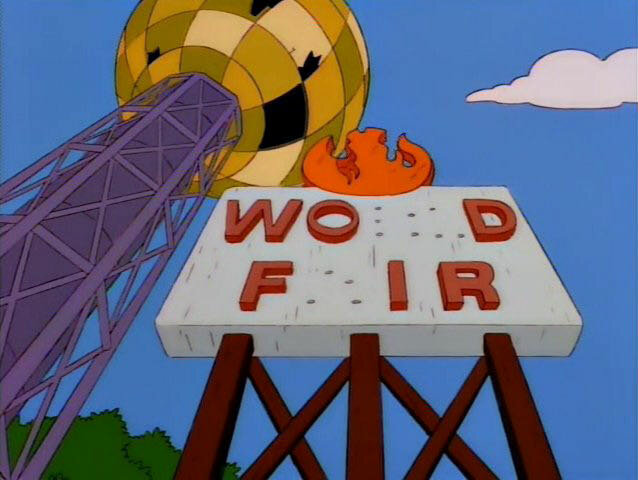
“Bart on the Road,” season 7, episode 20, The Simpsons (Swinton O. Scott III, 1996).
Locals like to joke that the best view in Knoxville, Tennessee, can be had from the Sunsphere—the 26-story cantilever tower topped with a golden disco-ball finial that was constructed for the 1982 World’s Fair—because it is the only vantage from which you cannot see the Sunsphere itself. Actually, the view’s not great, as the observation deck’s 24-karat windows serve to desaturate the splendor of the Tennessee River and the Great Smoky Mountains beyond. But I like the tower, which achieves the appropriate combination of hubris and pathos in its meager offering to the sun. At its base sits the Tennessee Amphitheater, an impressive tensile fabric construction, the only other surviving structure from the fair, its suspended white awnings now marbled with mildew. Between these artifacts of futuristic imagination is a kind of moat, whose whimsical contours and greenish waters contribute to the sense of an amusement park concourse abandoned to the administration of a cash-strapped municipal government.
My trip to Tennessee was occasioned by the third edition of Film Fest Knox, dedicated to showcasing American regional cinema—defined as that which is made outside of Los Angeles and New York City. It’s an increasingly endangered category at a time when the culture industry is consolidating, automating, and vertically integrating itself into a monolith of entirely inoffensive and precisely dislocated content. The festival is programmed by Darren Hughes and Paul Harrill, cofounders of The Public Cinema screening series, in collaboration with Visit Knoxville, the local visitors bureau. Its centerpiece is a five-film competition, with sidebars for revivals, films made in Tennessee, and a selection of highlights from across the festival circuit, as well as a pitch and proof-of-concept competition, plus panels on festival submission and distribution strategies for emerging filmmakers. Each screening is preceded by a Tennessee Entertainment Commission spot, which asks us to consider the tax incentives of shooting our next production in the state. A much longer sizzle reel for PopFizz, a local content creation agency, gives a sense of the scale of local productions, mostly commercials and promotional documentaries for such properties as AutoZone, Jack Daniel’s, and Dollywood. The block in front of the Regal Riviera was closed to cars for the weekend, less out of necessity, it seemed, than to generate the unmistakable buzz that accompanies any change to a traffic pattern.
Knoxville is a city on the make, vying to attract overflow business from the booming Atlanta entertainment industry. As surreal as the fairgrounds may be, they are not nearly so decrepit now as they had become in the mid-1990s, when The Simpsons had Bart and friends arrive fourteen years too late to find anything but a wig emporium and a pull-string Al Gore doll. Though the memory of the fair continues to hold an outsized position in the city’s skyline, the East Tennessee Historical Society devotes only one panel to the event, tucked away at the end of the exhibit, just beyond materials on the Tennessee Valley Authority’s public utility program and the top-secret uranium enrichment and plutonium production for the atom bomb in nearby Oak Ridge. (The latter is the subject of a harrowing short, Born Secret, by local-boy-made-good Riley Fitchpatrick, winner of Best Film in the Made in Tennessee section.)
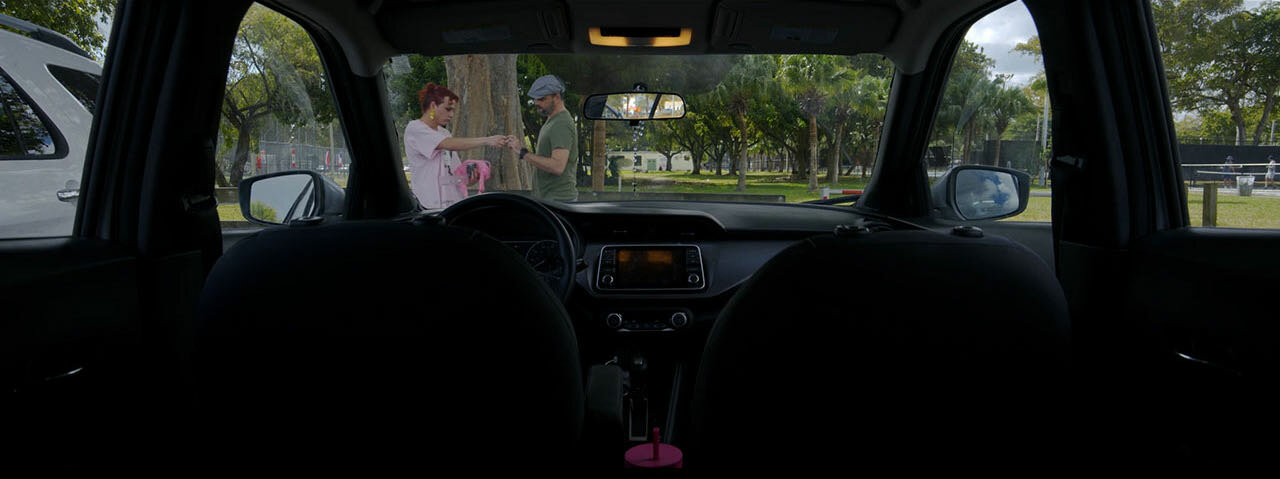
Tropical Park (Hansel Porras Garcia, 2025).
The most remarkable films in competition engage in an intimate, unusual portraiture, finding instances of American life at the margins of population centers, on their way in or out, and often in their cars. Hansel Porras Garcia’s Tropical Park (all films 2025 unless otherwise noted) was improvised from a thirteen-page treatment and captured in a single shot and a single take, after only a single rehearsal. Its static camera sits in the backseat of a car as an older brother, Frank (Ariel Texido), administers a driving lesson to his sister, Franny (Lola Bosch), arrived in Miami from Cuba a month prior, in the wake of their father’s death. “The worst thing about this city is the traffic,” he grouses in the opening minutes, before inveighing against public transportation as “communist crap.” His sermon is inflected by the jumbo-size Trump 2024 flag we have seen waving from the front porch of his family’s home.
As Franny trepidatiously makes the rounds of the titular public amenity’s parking lot, hitting every pothole but heeding Frank’s exceedingly patient instruction, their conversation turns toward more intimate subjects. When Frank picked Franny up at the airport a month ago, they hadn’t seen each other for twenty years; he had been expecting the little brother he had left behind, not the woman she has become. She soon parks the car so they can speak seriously. Her longtime boyfriend will be arriving in Miami soon—can he also stay with Frank and his family? But Frank has his own disclosure: It’s time for Franny to find her own place so he can start having his conservative in-laws over for Sunday dinners again. He points just beyond the windshield to a passing man and two boys, who are not aware of being in this film. “That proud father walk,” he says, has become the highest ideal of his life, and he is desperate to restore equilibrium in his home. “If I have to disappoint someone, it has to be you. Forgive me.” Texido makes the most of the sedan-sized film set’s porous boundaries, hanging much of his character’s motivation on this small, unplanned encounter. Their conversation is laced with accusations and revelations, not progressing linearly, as a scripted drama might, but often doubling back on itself in frustrated repetitions, as our own quarrels often do.
Bosch’s and Texido’s performances are all the more impressive for being conveyed, as the programmer Hughes observed in the post-screening discussion, without “the most powerful thing in cinema, which is the actor’s face.” Their dialogue, absent its most expressive feature, invites conjecture and transference, becoming a sort of parable of estrangement and reconnection nested within a structural device. James Benning and Bette Gordon make use of a fixed backseat camera in The United States of America (1975) to catalogue a cross-country road trip from Brooklyn to Los Angeles, periodically switching drivers, paying tolls, filling the tank, and consulting their atlas. For La Région Centrale (1971), Michael Snow fixed a camera to the end of a robotic arm and hid behind a rock while it surveyed a barren landscape for three hours. Here, Garcia has likewise prearranged the camera’s movements but not all of what might occur in front of it. Next to these landmark works of structural cinema, Tropical Park is more modest, perhaps, but no less attuned to the psychogeography abetted by the motion-picture device. In real time, the film finally closes its loop. Frank and Franny continue to speak, nearing understanding, if not resolution, as they return to the home in Coral Gables draped in Trump regalia—borrowed from Garcia’s father, incidentally, in the immediate aftermath of last year’s election. Despite this floating signifier, the film is devoid of any strident political statement; it wonders instead after the bonds of familial love, and the difficulty by which they are renewed.
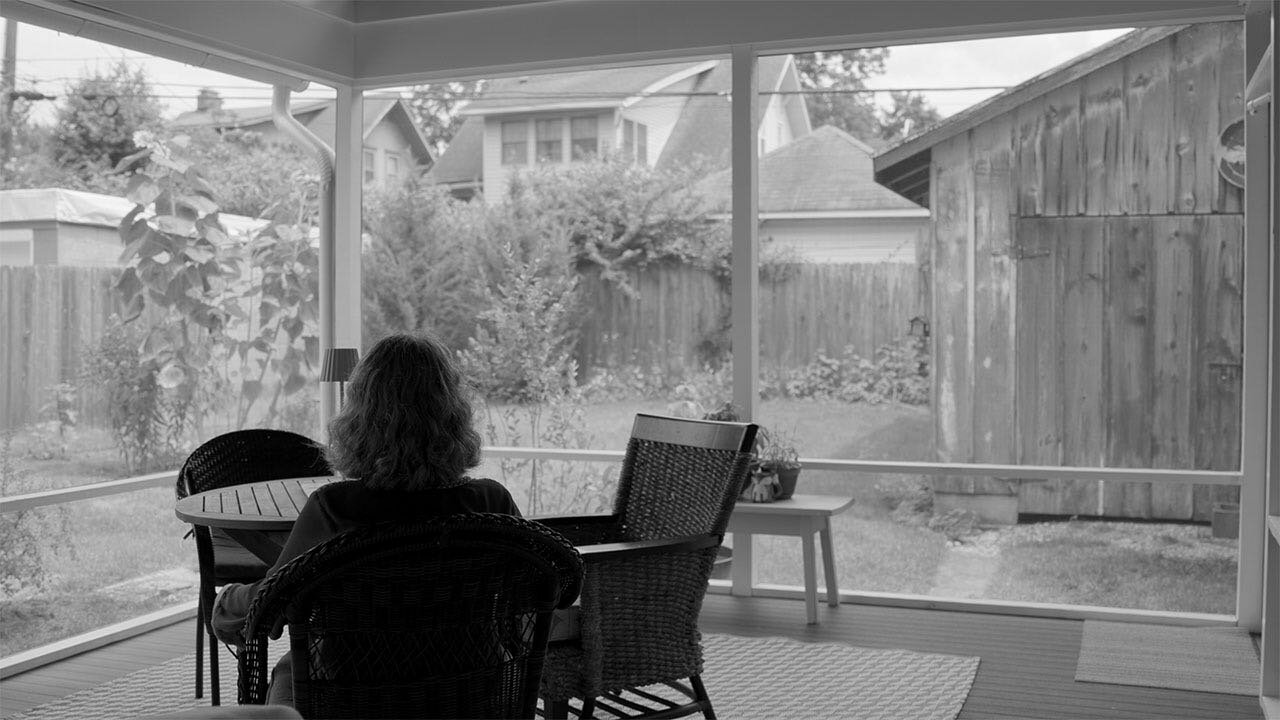
Other Houses (S. Cagney Gentry and Thomas Sutherland, 2025).
S. Cagney Gentry and Thomas Sutherland’s Other Houses, another improvised feature, is one of three Southerland has made with the poet Katerina Stoykova, after Proud Citizen (2014) and Fort Maria (2018, codirected with Gentry). Here she plays Radka, a middle-aged woman in the process of selling her house in Lexington, Kentucky, so she can return to Bulgaria, the country of her birth. In the course of a day, dozens of strangers imagine themselves living in the home she has made, opening the closets and testing the water pressure. One of them, Victor (Jude McPherson), is eager to buy, but even more eager to see Radka again, whom he discovers on the back porch, eating cucumber. (“Didn’t they tell you it’s better if you’re not here?” scolds the realtor.) They have a fling, share an idyll of suspended time, between old lives and new ones.
Having been “a wife, a mother, a teacher,” Radka tells a friend that she now wishes to be an actress, an errant but charming metatextual nod in a film which seldom calls attention to its making. For now, she instructs a community poetry class (defining the art as “personal work for public consumption”) and delivers eulogies at the graves of those who have died with no one but the pastor to mourn them (part of a program called Lonely Passage, in which Stoykova is actually involved). In one of these, she imagines rooms that “disappear and reappear,” banishing their sole inhabitant, a metaphor as applicable to the scenes of a film as the procession of days.
The film does well not to put too much of its weight on a will-she-won’t-she drama of departure. “I have the feeling I’ll regret it either way,” Radka says more than once, and later, “Even now I could be convinced to stay,” but an inertial force, at work since long before the film begins, draws her inexorably away. In a Bulgaria-set epilogue, the black-and-white cinematography switches to color, as though her stuffy walk-up apartment were Oz. Meanwhile, back in Lexington, the film takes its title from the places Victor cannot imagine himself: the homes that are not hers. In Tropical Park, Frank advises Franny that the car will be “an extension of your home.” As Radka parts with her own car, affectionately named Cristina (“aka Pussy Magnet”), she severs the last of her material ties to her adopted country, though the film seems to ask if such a loss need be tragic, or if the making, unmaking, and remaking of home is more simply part of the possible and plural textures of life.
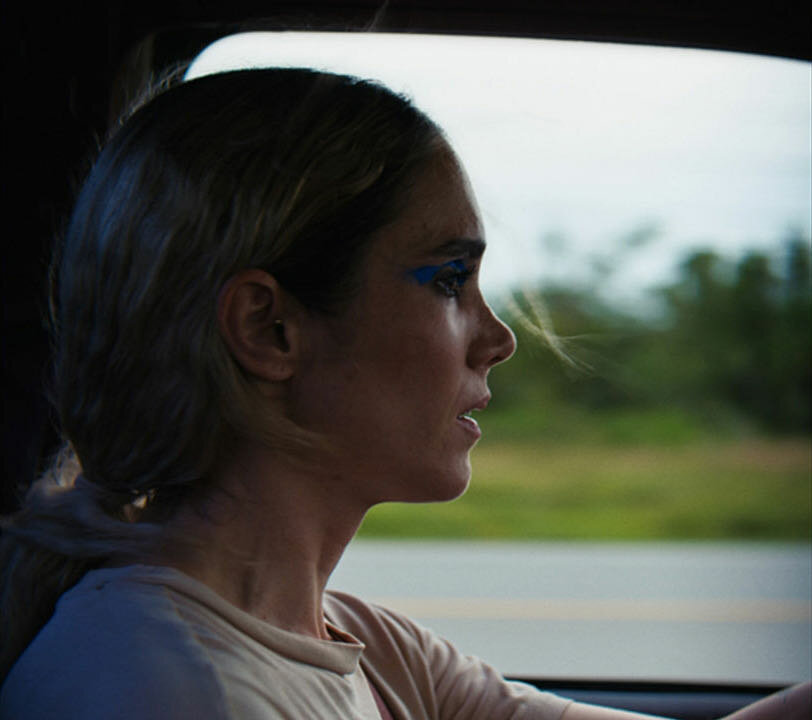
Charliebird (Libby Ewing, 2025).
In Libby Ewing’s Charliebird, a third highlight from the competition, screenwriter Samantha Smart stars as Al, a music therapist at a children’s hospital in the suburbs of Houston. The audience finds its onscreen proxy in a recent hire, balking at Al’s long, handwritten list of “bereavement kiddos,” terminal cases for whose deathbed vigils the staff will perform final requests after producing a recording of the child’s heartbeat. Al throws herself into the work as only those who would otherwise throw themselves off a bridge will do. As she leaves the hospital, her light quickly dims: The commute takes her beyond the country music station’s service area to a gravel driveway and a double-wide trailer, where she watches recipe videos while eating microwaved noodles in bed.
One patient, seventeen-year-old Charlie (Gabriela Ochoa Perez), at first appears destined for the “difficult customer” archetype, Al charged with slowly earning her trust, but those plodding beats soon melt away alongside Charlie’s prickly exterior to reveal a far more interesting dynamic: a fast intimacy that threatens to cross the boundaries of professional propriety into a mutually dangerous attachment. Finding her new patient on Instagram, Al clicks through to a GoFundMe campaign, still far from meeting its extravagant goal. Charlie “just got a new kidney,” says a hospital administrator; she’s “seeing if it’ll take,” having already spent the majority of her teenage years in and out of such hospitals. In the meantime, she sees and speaks with the candor of the condemned, seeming to remind Al of a childhood trauma, hinted at in hazy flashbacks.
Like Tropical Park, Charliebird works under a curious formal constraint: Its frame is cropped to a squarish format, not quite as tall as the familiar dimensions of our phones, but narrow enough that the characters must be either isolated or overlaid at the center of the screen. These compositions lend a peculiar charge to the standardized units of care in its institutional setting, evoking in medium shots the trespass that often precedes transformation and, in close-ups, the unknowable deposit of grief beneath a fixed smile. This film is trying to break your heart, and if it succeeds it is because it paints life’s largest themes on a disarmingly small canvas, rendering grief ordinary where it might have been maudlin.
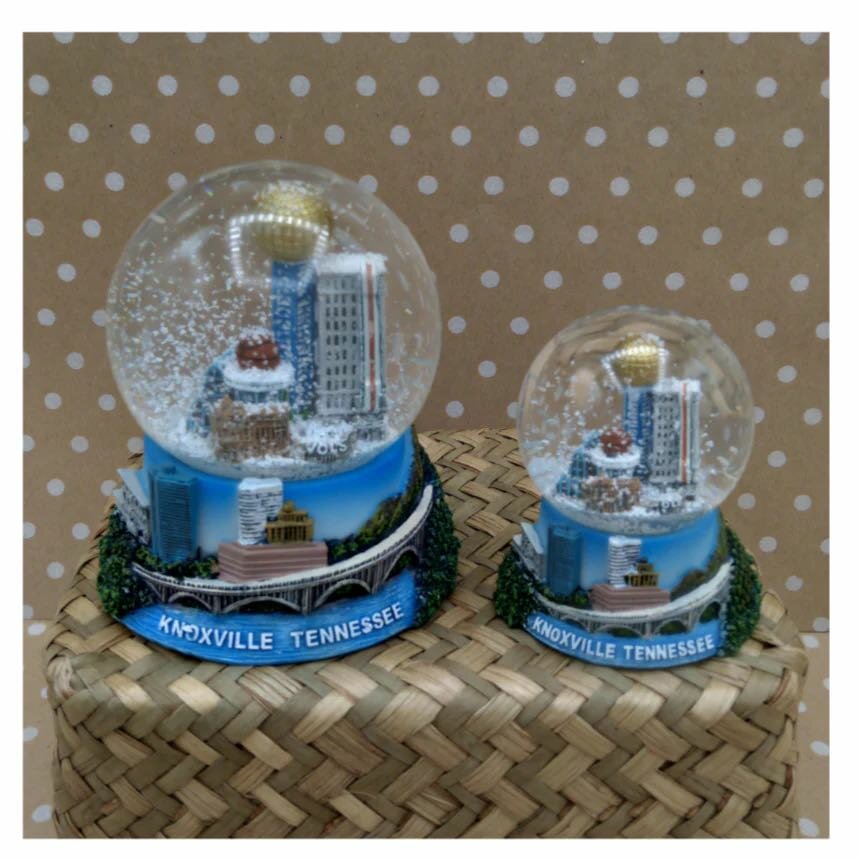
Sunsphere souvenirs available in the gift shop.
Each of the five days I was in Knoxville, in all weather, from morning until night, a woman in a power chair parked herself on a street corner near the Regal Riviera to play such traditionals as “Frère Jacques,” “Yankee Doodle Dandy,” and “America the Beautiful” on a melodica, removing her lips from the mouthpiece only to bless anyone who tipped. The songs carried for blocks through the unseasonably cold air, giving the historic downtown the feeling of a music box, which finally became a snow globe as the temperature dropped below freezing and flurries began to fly the day after the festival concluded. Her defiant ditties introduced a certain charge into the atmosphere, a sort of battle hymn for the undercurrent of oddity that the forces of homogenization seek to trample.
The last time the world came to Knoxville was now over 40 years ago, and it was the region’s energy production they were interested in. Film Fest Knox plainly hopes to convince visiting filmmakers to return with their cameras, crews, and production dollars. As the mass-market American film industry continues to work itself through irrelevancy and into oblivion, it seems right that Knoxville would be the site of a renewed focus on a regional, independent American cinema, inviting those from outside the metropoles to put their visions of the country on the screen, so that we might see it more clearly.