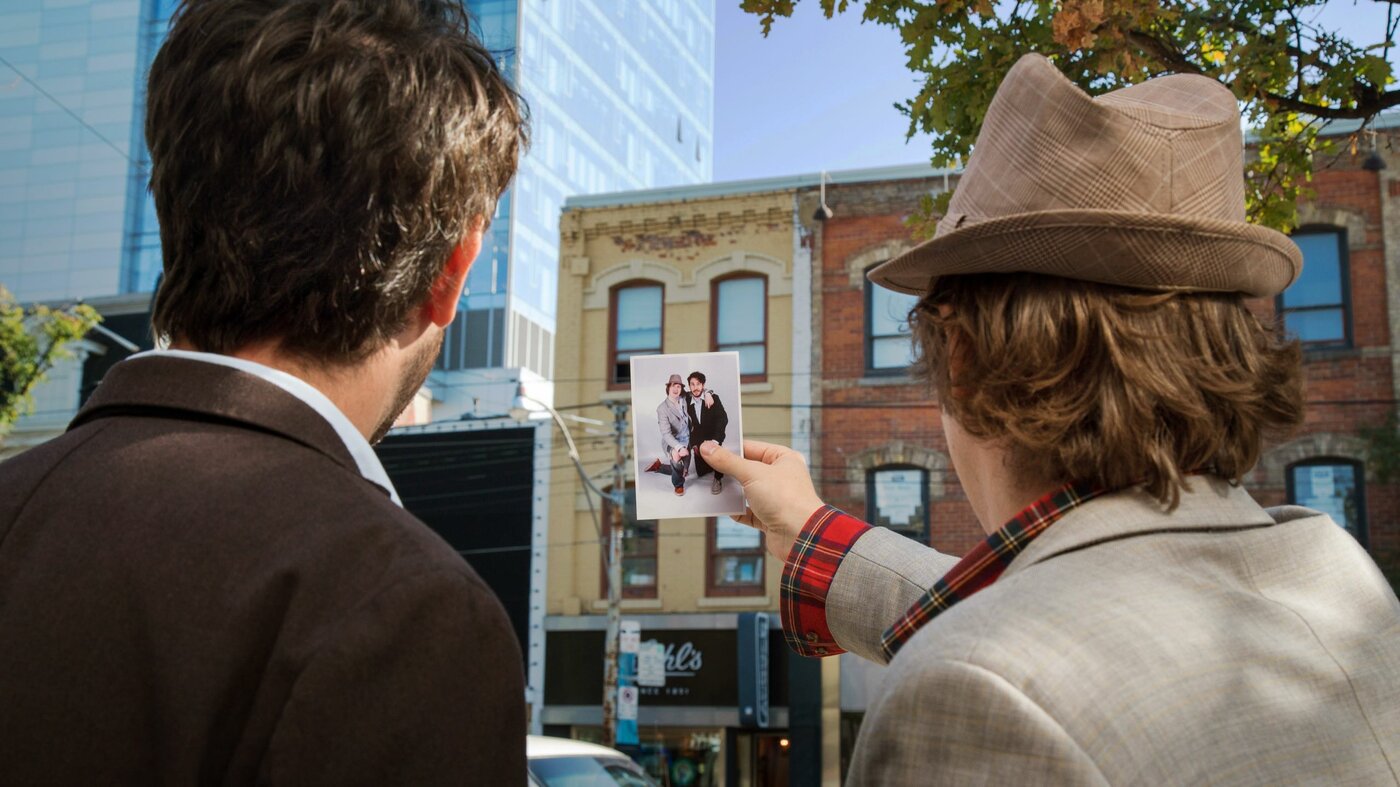
Nirvanna the Band the Show (Matt Johnson, 2017–).
“It had a zany flavor about it, reminiscent of the silent comedies of the day.” So wrote historian Pierre Berton of the circumstances around Canada’s infamous plan—hatched in the aftermath of World War I by the enterprising Brigadier General James “Buster” Sutherland Brown—to invade and occupy a series of American cities from Albany to Spokane. As its name suggests, “Defence Scheme No. 1” was not a proactive proposition; the purpose was to be prepared for a potential incursion from a superior military power (the US having been making its own preparations for pitched battle against the British Empire). Better safe than sorry, after all, and if defending Canadian sovereignty meant sending a set of plainclothes lieutenant-colonels to Vermont on a series of reconnaissance missions, so be it. The main takeaway from these expeditions was that a vast number of Americans, their palettes parched by Prohibition, were craving a few small beers from their upstairs neighbors.
Flash forward one hundred years or so, and Brown’s anxieties about his home and native land’s vulnerability to US imperial aggression have come a cropper, both as headline news and pop-cultural punch lines (as if there’s a difference these days). Between the sitting President’s threats to levy tariffs and literally tear down bridges to whispers of incipient separatist sects in Alberta, the situation is dire. Not helping matters was The Hollywood Reporter’s review of Nirvanna the Band the Show the Movie (2025), which irresponsibly fanned the flames of Canadaphobia. “No disrespect to the unrealized 51st State,” wrote Frank Sheck before delivering the verdict that Matt Johnson’s new film was best—and perhaps only—enjoyed as an acquired taste on par with (get this!) poutine.
“A Patience-Testing Canadian Mockumentary,” snarked the piece’s headline, as if such grueling hybridity weren’t a staple of the national cinema that produced Arthur Lipsett, Guy Maddin, and SCTV’s The Canadian Conspiracy. The real joke, meanwhile, is on the perilously narrow frame of reference of a critic who parochially invokes Bill and Ted and Borat in his analysis when the truer analogues for the Tragic Hipsters played in the film by Johnson and Jay McCarrol—as ever, using their own names and adopting only the barest pretence of technique or professionalism—would be the snot-nosed, folkie wannabe Peter Kastner from Don Owen’s seminal and slightly patience-testing NFB classic Nobody Waved Good-bye (1964), about a rebel without a clue running wild through Center Island and the TTC. Or the cursed, road-tripping punks of Bruce McDonald’s Roadkill (1989), whose maker promptly promised to spend the film’s TIFF cash prize on a big chunk of hash. Or Scott Pilgrim, who once kicked the shit out of Captain America on the steps of Casa Loma.
“It would probably help to be a Torontonian,” writes Sheck at one point in his review. That’s fair enough and possibly bad news for Nirvanna’s distributor, Neon, which is trying to reverse the terms of Brown’s long-ago gambit. The best defense scheme is a good offense, after all, and Nirvanna the Band the Show the Movie is being positioned, however plausibly, to become the first English-Canadian comedy—since when? Meatballs? Strange Brew? Does Juno count?—to achieve, in the industry parlance of The Hollywood Reporter, boffo B.O. south of the border.
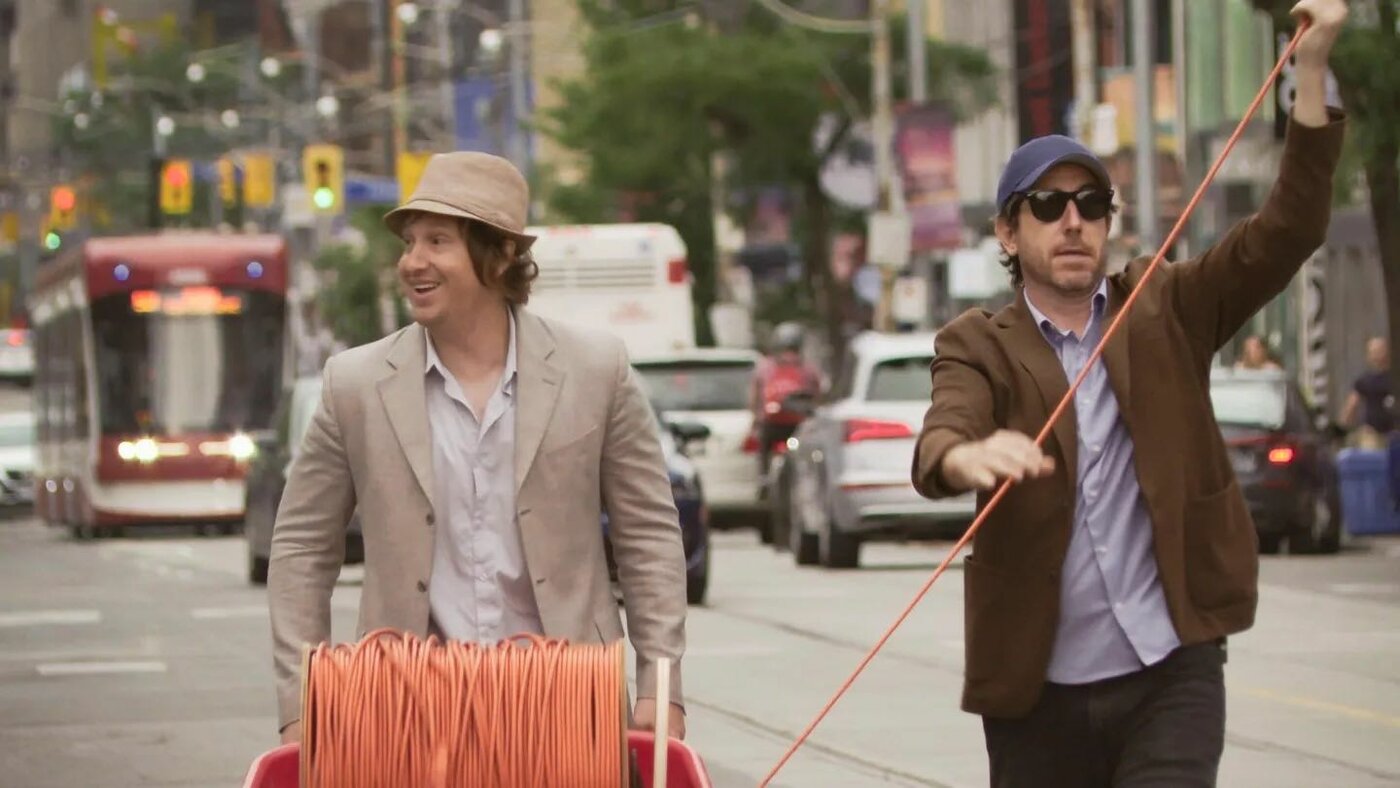
Nirvanna the Band the Show the Movie (Matt Johnson, 2025).
Leaving aside the more blinkered aspects of Sheck’s pan (has he honestly never heard of Orbitz? Or the CN Tower?), it’s hard to argue with his basic thesis: namely that a feature-length spin-off of a long-running, but distinctly niche, web and television series represents a potentially hard sell to the uninitiated. Which is to say the vast majority of potential-ticket buyers. Score one for Valentine’s Day weekend counter-programming perhaps, as the Venn diagram between NTBTS obsessives and folks eager to see Margot Robbie suck Jacob Elordi’s fingers in “quote unquote” “Wuthering Heights” is thinner than a two-dollar coin. It’s similarly hard to argue with the assertion that the movie is annoying, or that Johnson’s character Matt—hereafter referred to in quotes like “Wuthering Heights” as “Matt Johnson”—is “grating.” That’s an understatement, even as it underestimates the performative and conceptual finesse on display in a film whose dumbness is deceptive and definitive, and which takes a certain strain of arrested, perennially adolescent solipsism as its not-so-submerged subject.
Some are born to be grating, and some have gratingness thrust upon them; such is the eternal dynamic between Matt and Jay, who no less than Pete and Joey (Goin’ Down the Road, 1970) or Bob and Doug McKenzie (Strange Brew, 1983) or Bon Cop and Bad Cop (Bon Cop, Bad Cop, 2006) comprise a dramaturgical dyad. Matt’s yearning to play live music at the humble Rivoli nightclub on Queen Street West has been all-consuming for nearly 25 years now, with bandmate and pianist Jay serving—mostly passively—as his straight man and enabler. Spoiler alert: They still haven’t gotten there, and while the film version of Nirvanna finds the characters and their creators leveling up—it’s a frenetic time-travel comedy under the sign of Back to the Future (1985)—they remain on the outside looking in.
The guerilla filmmaking tactics of the original Nirvanna web series, shot on the cheap against the background of rapidly gentrifying civic pride dubbed “Torontopia” by Exclaim music critic Michael Barclay, weren’t just a cost-saving measure; they connected Johnson and his collaborators to earlier generations of hard-driving, DIY Canadian directors, including a disproportionate number of Dons: Owen, Shebib, McKellar. There are plenty of interesting entry points into the show and its legacy for those willing to suss them out, from the casually gobsmacking technical prowess of cinematographer Jared Raab and (especially) editor Curt Lobb, to Johnson’s savvy exploitation of satirical intent and fair dealing laws to stage homages to Hollywood product (an approach linking him to fellow Toronto alt-comedy-scene alumnus Nathan Fielder), to the metaphysics of post-millennial bromance, which, admittedly, are a bit played out, in alt-comedy in general and between Matt and Jay specifically. To the extent that the new film has dramatic stakes, it’s that our heroes are so sick of each other they’re willing to mess with the space-time continuum as a salve for their hurt feelings. The zany flavor of the proceedings barely conceals existential angst. Matt and Jay may not be real, exactly—ontology being another one of Johnson’s pet subjects dating back to his troubling feature debut The Dirties (2013), about a high-school media studies project that metastasizes into an IRL remake of Elephant (2003). But the push-pull buffeting the duo between extremes of earnest ambition and resigned despair allegorizes Canadian cinema’s eternal insecurity complex with deceptive eloquence.
Johnson’s gift for gab—call it explosive logorrhea—is central to his screen persona; the best and most disturbing scene in his filmography remains the cliffside interlude in The Dirties where he teases a fatal swan dive to the growing irritation—and terror—of his best friend, who finally reaches a point where he’s basically willing to watch Matt fall to his death if he would only just shut up. Nirvanna the Band the Show the Movie features an elaboration of this sequence in the already much-publicized set piece at the CN Tower (that’s the tall building next to the former SkyDome, for readers outside of Toronto), but the real talking point, I think, is what, if anything, Johnson and the gang are saying here about their characters, themselves, and their status as local heroes.
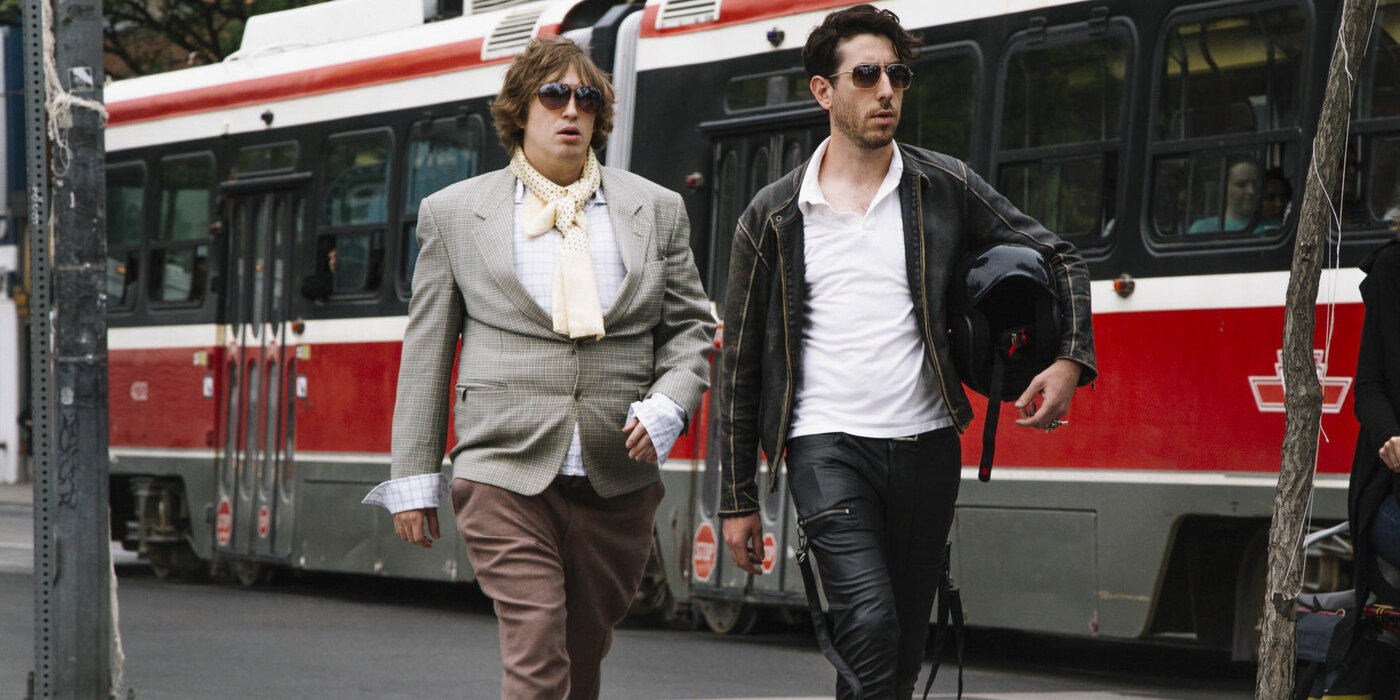
Nirvanna the Band the Show (Matt Johnson, 2017–).
NOTEBOOK: This is the first time I’ve been in your new office. Interesting space.
MATT JOHNSON: It’s an interesting building. It’s been sort of repurposed. Like, it used to be a peanut factory.
NOTEBOOK: We’re live from the peanut factory. I know that you’re recording the DVD commentary for the movie tonight, but the movie hasn’t come out yet. That’s a pretty short turnaround. How are you supposed to look back on it retrospectively before it’s been released?
JOHNSON: It absolutely is the shortest turnaround. Mind you, because the release date got pushed back so far after we actually finished shooting, it’s probably more or less even with BlackBerry [2023] and Operation Avalanche [2016].
NOTEBOOK: So when did you finish shooting?
JOHNSON: Well, that’s a bit of a Schrödinger’s cat because it’s like, what does finishing shooting really mean? We shot things that ended up in the movie as recently as three months ago. So, I guess after TIFF, after we had premiered twice. But in terms of the main shooting, and the story being complete, probably last February, or March.
NOTEBOOK: It’s interesting that you say the story’s “complete,” which leads to a more metaphysical question that I’ll ask later. I wonder with your process, though, if adding in things at the last second is common. On the one hand, the nature of the material is pretty loose, but also the writing and plotting of a feature-length movie is more precise. Did that stave off temptation to some degree?
JOHNSON: Actually, we reshot more on this movie than any other iteration of the show. I mean that, like, per capita. I used that phrase wrong. What I mean is we reshot a higher percentage of the film than any episode. And that’s because the movie is in the unenviable position of trying to explain what’s going on to people who have no idea what’s going on, without seeming cloying to people who have been watching the show from the beginning. And that’s such a ridiculous line to walk.
NOTEBOOK: It’s sort of two films in one: the same movie, but it plays very differently depending on the viewer’s familiarity.
JOHNSON: Well, it's lenticular in that way.
NOTEBOOK: That word was used correctly.
JOHNSON: Yeah.
NOTEBOOK: Does one side—or one audience—matter more? In your heart of hearts.
JOHNSON: Okay. Look, I’m always the audience for these films. And of course one side has to matter more, because I’m not experiencing it for the first time. So there’s always a balance, and I need to feel like I’m not cringing about that fact. In my heart, as you phrase it, I’m trying to make something that reaches past my aesthetic standards. But at the same time, I love doing something that’s so boiled down and simple that it’s the joke. The joke is how simplified this complicated thing is.
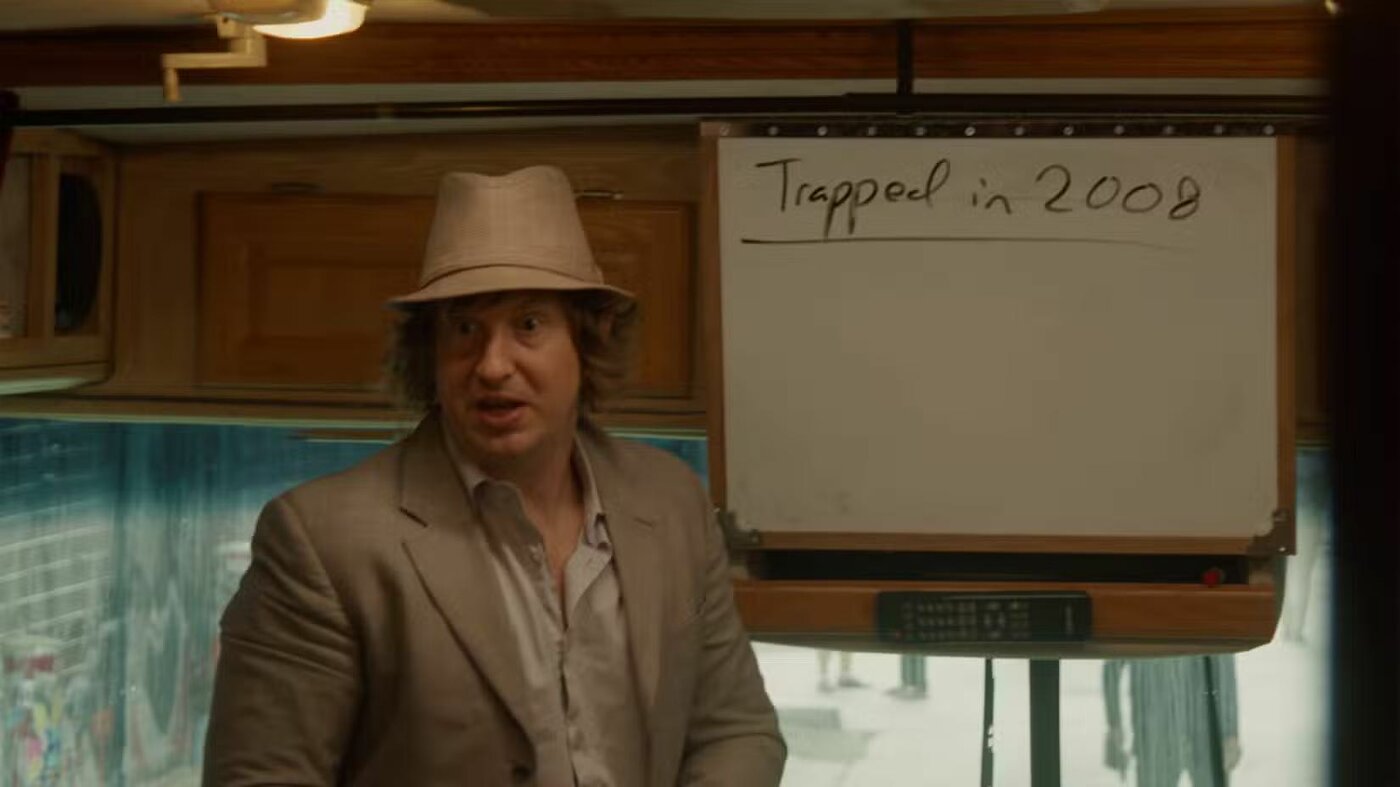
Nirvanna the Band the Show the Movie (Matt Johnson, 2025).
NOTEBOOK: You could argue that within three minutes of meeting Matt and Jay, sitting around doing nothing, a viewer is going to get it. And then Matt says, “Maybe we should jump off the CN Tower,” and I wonder if the biggest hurdle for people isn’t going to be the characters or what they want, but, like, “What’s the CN Tower?”
JOHNSON: That’s why I draw a picture of it! But yeah, when we were on tour, I met this guy who had recently become a fan of the show, and he said it’s one of the only shows where you can’t really explain it to anyone, but if you watch it for two minutes, you could basically write your own episode. There’s something bizarre about that; it’s like an ineffable experience. I sometimes can’t describe it to people either, but I do think the audience can sort of help to complete it themselves.
NOTEBOOK: You talked earlier about explaining, and beyond the fairly terrifying question of whether you and “Matt Johnson” are the same person, it strikes me that it is very much in the nature of “Matt Johnson”—the character in the film, I mean—to explain.
JOHNSON: He’s pitching.
NOTEBOOK: Yes, he’s pitching. He’s a constant pitcher, and he’s only able to pitch because of the camera. And then the question of why there’s a camera, and whether that means people should care about or listen to what he’s pitching, is what’s interesting. If a tree falls in the forest, and so on. Like, if you pitch your ideas to the world and there’s no camera, you’re talking to yourself. That’s a common feeling, maybe now more than when you started the show, or made The Dirties, which is also about a guy who’s pitching. I think the character in The Dirties was ahead of the curve; the world is full of Matts now.
JOHNSON: Yeah, and they’re talking to cameras constantly. And with nobody else in the room. Totally disembodied. They’ve abandoned their costars. When we were making the web series, I used to think that this model was really going to catch on, because it was so accessible. In film school at York University, I was in the same class as Nicolás Pereda, and we were watching this Norman McLaren film—a dance piece—and I was being really obtuse. I thought that it was so stupid, watching, like, prints of a guy dancing in Technicolor, over and over again. And our professor, Tereza Barta, asked us what was interesting about it, and in my ignorance, I said I had no idea; that movies had moved on [since then], and that we can do so much more with special effects and whatever. And Nico said that what was amazing was that McLaren was using technology everybody else already had, and doing something with it for the first time. Other people had access to these reprinters, but he did it. I didn’t think much of the comment at the time, but isn’t it bizarre that I’m still thinking about it?
NOTEBOOK: That story makes me think of the characters in The Dirties, who aren’t doing something new; they’re making copies of American movies, of American auteur movies. The Dirties is also made in a very Canadian style, the hybrid doc style, the sorts of movies that, as you say, we’re forced to watch in film school here—Nobody Waved Good-bye. But onscreen, the reference points are Gus Van Sant and Quentin Tarantino…
JOHNSON: It’s not that I didn’t know what I was doing when I made The Dirties, but I was also animated by something that wasn’t under my control. I think in some ways that I’m still reckoning with that. They did a ten-year retrospective screening of [The Dirties] in Glasgow, and it was the first time I’d spoken about it in a long time, or about some of the issues in it. And Europe, or the UK, also has a way of looking at America and defining their culture through similarities and differences to the US media machine. The distance between Canada and the United States—and the distance to Hollywood—is something I think about more the older I get. I mean, BlackBerry is literally about this. I think my childhood fascination with and sort of hero worship of American movies—and movies as an American religion—is what my films are all about, maybe more than the superficial dynamics of friendship and getting older, and all the things people usually ask me about.
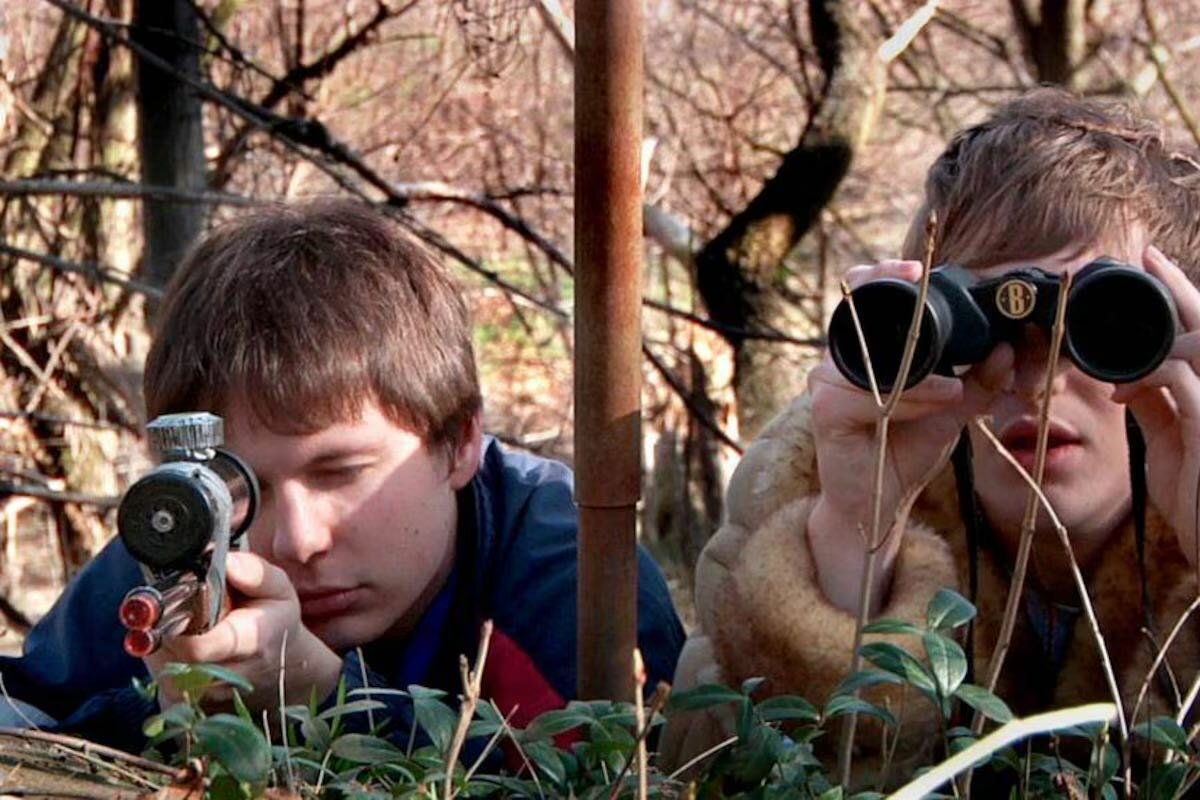
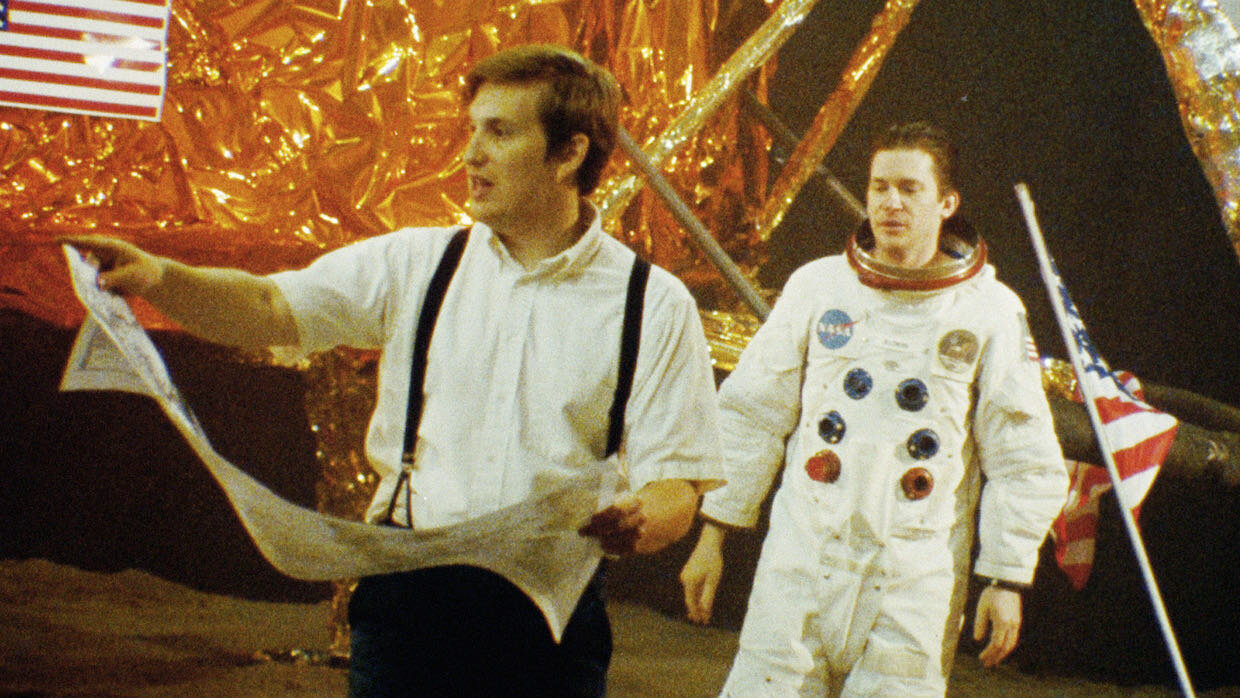
Above: The Dirties (Matt Johnson, 2013). Below: Operation Avalanche (Matt Johnson, 2016).
NOTEBOOK: The feelings about getting older just sort of accrue as we get older; it'd be weird if it didn’t show up. But to the Canada-US thing, in Operation Avalanche, Matt is trying to infiltrate the US via NASA, which is an analogue for Hollywood, or the religion of spectacle, or whatever. And then when he gets there, he does something that I can’t imagine any other polite, respectful Canadian filmmaker doing, which is he literally shakes hands with Stanley Kubrick, who’s there faking the moon landing.
JOHNSON: I think the permission I gave myself for that moment was that when you see this guy—I mean, when you see me—you’re thinking he has no idea how stupid he looks doing that.
NOTEBOOK: I mean, Kubrick is basically the monolith from 2001; all filmmakers are trying to touch him in some way, for inspiration…
JOHNSON: Of course he is. And the animating force of the movie is that Matt’s not supposed to be there.
NOTEBOOK: On that note, what is your actual relationship to the Rivoli? I mean you, not “Matt.”
JOHNSON: Essentially none. Which is crazy. You’d think that’s impossible, but it’s true. When I was a kid, I wanted to be a comedian. I’d seen the Seinfeld documentary [Comedian, 2002], the one with Orny Adams in it, and it had a huge effect on me. So I knew that the Rivoli was where stand-up comedians in Toronto would go to perform, and I figured I’d get a show there. I lied to my friends about it: I said, “Oh, last weekend I did a show at the Rivoli.” I got way in over my head.
NOTEBOOK: Did it give you some status with the other kids at school?
JOHNSON: Yeah, of course. They were like, “Aren’t you in Grade 10?” I learned some hard lessons there. But it’s funny because as I get older, the Rivoli keeps shrinking.
NOTEBOOK: There’s also this very rich, unspoken irony, which is that Matt and Jay could also use their web show to actually promote the group, but instead they’re documenting their efforts to get a live gig.
JOHNSON: It’s totally counterintuitive.
NOTEBOOK: Also, they’re obviously better at filmmaking—or their quote-unquote crew is better at filmmaking—than they are at making music, by a lot. Their music sucks but the episodes of the show all work; they have a beginning, middle and an end. Obviously, the point is that they're dumb, but they never think to just put their music out online—the way that the show itself was distributed virally.
JOHNSON: They have this perfect mechanism, and they don’t use it.
NOTEBOOK: The movie really plays up the purgatorial aspect of their situation, too. The way they’ve been at this forever, with no change in their prospects, for twenty years. It’s existentially very scary.
JOHNSON: The time machine plot came out of that. There was a scene that got cut out of the movie that’ll be on the DVD, but it makes that very clear: I’m talking to Jay, and it’s like I just realize the power of the time machine all at once. I say, “Do you know what this means? Every day, we could wake up, come up with a plan, and do it, and if it doesn’t work, we can just go back to the beginning and do it again.” And I’m just describing what our lives are like already without realizing it—describing the reality that Jay wants to escape. And the look on his face is just… It’s like I’m describing heaven and he’s living in hell.
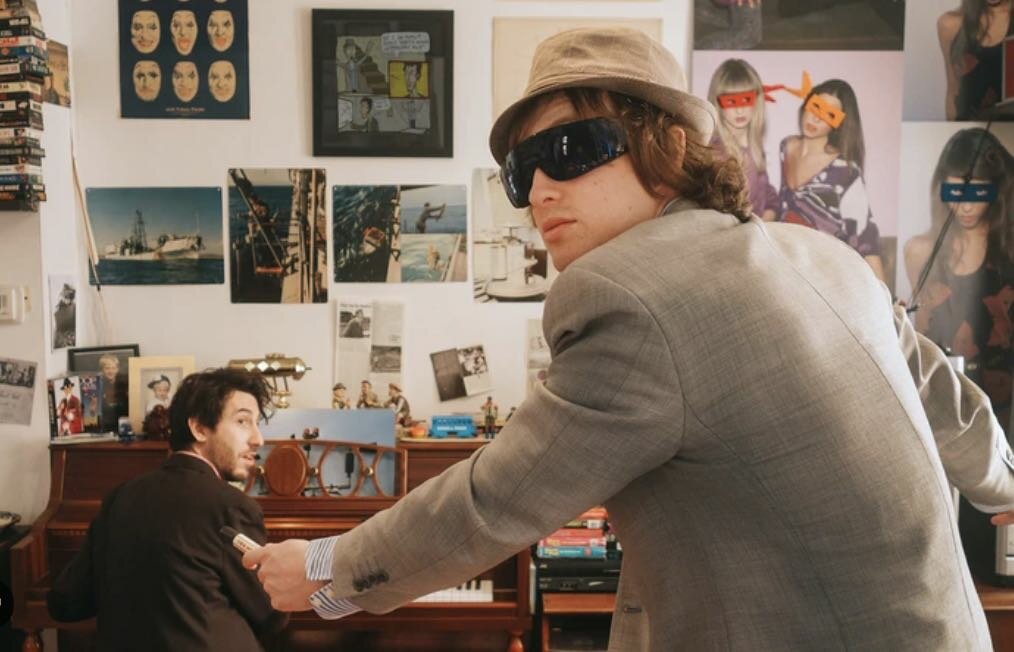
Nirvanna the Band the Show (Matt Johnson, 2017–).
NOTEBOOK: The movie goes further in giving Jay something like a sense of interiority. Which is new. He mostly exists on the show just in counterpoint to Matt, and here he has his own full storyline, and his own subjective experience.
JOHNSON: There are a lot of ways to talk about that. I have always thought of Jay as the protagonist of these stories because he’s the person who is acted upon, even though he knows better. He has a vision for his life outside of this relationship, and it sort of ebbs and flows in response to Matt’s enthusiasm.
NOTEBOOK: His life plan is to make furtive phone calls to Ottawa in the middle of the night, begging to get booked at an open mic night.
JOHNSON: “You’re saying I can go on? You’re saying I got the show?” The woman on the other end of the phone there… It’s so loud behind her; we could hear that it was a busy night at that club. Anyway, I never think of Jay as secondary. His experience is very close to the audience’s experience. There’s a view of the show, I think, where it’s like Fight Club, where Matt doesn’t even really exist. He’s just the id of this guy, this struggling musician, who thinks he could make it but doesn’t put in the work. That’s not what we’re thinking about when we do it, but it’s legible that way. And I think every episode is more about Jay coming to some kind of conclusion, rather than Matt coming to a conclusion. Because Matt never changes.
NOTEBOOK: Matt Johnson doesn’t really exist in BlackBerry. Or rather, he’s the part of BlackBerry that’s totally imaginary, but you stick yourself in there, as yourself, anyway, even if it compromises the realism of this docudrama narrative.
JOHNSON: Curt [Lobb] says this all the time, which is that the thing that makes my movies my movies is I force myself in there.
NOTEBOOK: You’re forcing yourself in there, and forcing people to pay attention to you, too. The scene in The Dirties where Matt is at the edge of the cliff, and pretending he might jump or fall, and Owen is getting furious with him, because it’s so dangerous, but it’s also so annoying—it’s hard to watch. Honestly, I saw The Dirties again last year, and it’s an upsetting movie in a lot of ways.
JOHNSON: When we shot that scene, it was one of the few times that Owen was really actually mad. That shoot was hell in general, a lot of high-stress moments, but it was the only time he fully lost his temper.
NOTEBOOK: Because you were being so annoying?
JOHNSON: Well, it’s funny. That’s my role. It’s not like I was pushing things for the sake of being sadistic. I viewed the moment as oddly neutral, or neutral for Matt.
NOTEBOOK: It’s neutral because he can’t exist without the camera. He lives to be on camera, and that’s existentially terrifying. He really does think his life is a movie, and the movie turns out to be Elephant. Or Taxi Driver [1976]. Which are not good movies to be in.
JOHNSON: They’re classics to him, though. They’re both classics.
NOTEBOOK: You say The Dirties was a high-stress shoot, running around and trying to just figure things out. Nirvanna is about that too, but now it’s framed nostalgically. Matt and Jay go back to 2007 and see the younger versions of themselves on Queen West, outside the Rivoli, putting up posters, and they’re afraid to be seen because of the whole time-travel paradox conceit, but they’re also wistful. They’re happy to encounter themselves when they’re so free.
JOHNSON: Or they see themselves and think they look pathetic. We can encounter our younger selves and see two different things.
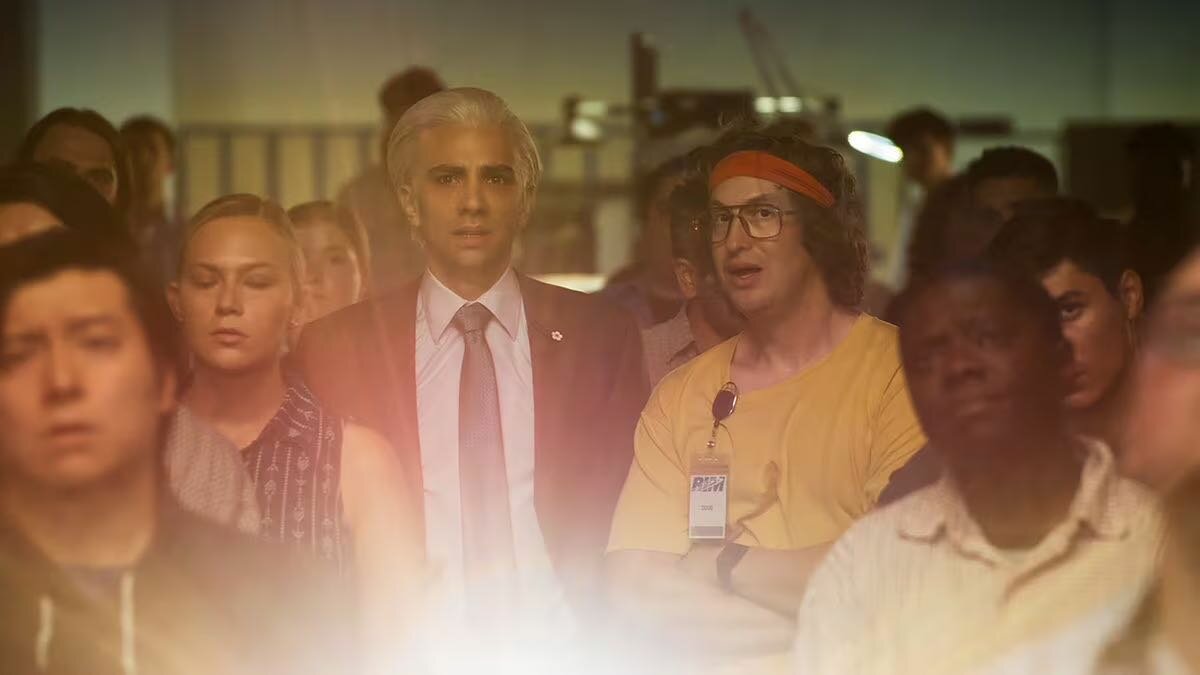
BlackBerry (Matt Johnson, 2023).
NOTEBOOK: BlackBerry is a success story that sets up a larger failure; it’s rags to riches, and I know you’ve talked about how there’s an allegory in there about you and your crew, and the idea of moving up and breaking through and worrying about selling out. But BlackBerry was a hit, and now NTBTSTM is being made from a position of strength, or it seems to be. It’s harder to buy Matt and Jay as losers or failures when they’re cult heroes.
JOHNSON: It depends on how you look at it. Matt in Nirvanna doesn’t sit at a desk writing for ten hours a day. I mean, how do we judge the lives of fictional characters who live in this world without food or oxygen as opposed to us sitting here in this office? I don’t want to say too much about it, but I do think there’s something in the movie about how recapturing childhood dreams and identity is essential to growing up.
NOTEBOOK: Do you know the movie Dear Wendy [2005], by Tomas Vinterberg?
JOHNSON: Very well.
NOTEBOOK: The line in Lars von Trier’s screenplay where we find out the main character’s favorite book is The Picture of Dorian Gray, but his copy was missing the last thirty pages… It’s just a novel about this cool guy who never gets old.
JOHNSON: I just read The Picture of Dorian Gray again two months ago, and I was howling at it; howling at how funny [Oscar] Wilde makes that period seem and sound. My girlfriend, Carly, gave it to me and said, “This is really funny.”
NOTEBOOK: The difference between aging on the outside and the inside leads me to ask: How the hell did you guys shoot and edit this movie? Or at least, how did you do the stuff with the two Matts and the two Jays?
JOHNSON: We got this great note from a board game designer in Chicago who said that the movie reminded him of a quote about magic tricks: When you’re in the audience, the reason you believe most tricks are magic is not because it’s magic, but because you don’t believe somebody would spend so much time figuring out how to do something for real.1
NOTEBOOK: I believe that this is the plot of Christopher Nolan’s acclaimed documentary The Prestige [2006].
JOHNSON: Yeah, the old Chinese magician they go see, with the huge bowl between his legs. The trick is the stuff he does when he isn’t onstage. When he’s just walking around. That’s us. There are no tricks—we just had a hundred hours of old footage. Curt and Bobby [coeditor Robert Upchurch] watched a hundred hours of footage, every single scrap. Using every part of the buffalo. We looked and found the perfect angles, and then rebuilt the locations exactly and shot the other side of each scene with our present-day selves.
NOTEBOOK: It’s interesting to talk about literal recreation on a technical level, but also to ask if making the same thing over and over again gentrifies it, especially when you’re still trying to make it look lo-fi—they go back to 2007 so it has to look like 2007, shot on those older cameras. You’re collapsing time, but you’re also at a safer distance, working with more resources and experience, and maybe that means you’re further away from the authentic thing—from the experimentation and the excitement—than you want to be. Or it means you have to fake it.
JOHNSON: We can be conscious of that, or it can seep like asbestos into the work. Or it’s like it builds up on the work, like a carapace.
NOTEBOOK: Per capita, lenticular, carapace…
JOHNSON: Lenticular is great because it comes out of game design. You want the audience to see the mechanics of the game. The beginner’s point of view and the expert’s point of view. Think about chess, where someone who knows how to play looks at the pieces completely differently.
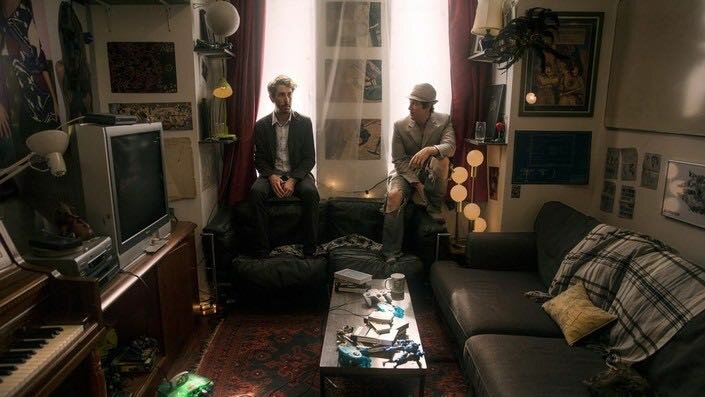
Nirvanna the Band the Show the Movie (Matt Johnson, 2025).
NOTEBOOK: Has there ever been a pitch for Nirvanna the Band the Show the Video Game? Like Spaceballs: The Flamethrower?
JOHNSON: Only as a joke, but I would love there to be one. It would fit the LucasArts era, point-and-click, single background. Matt in the show approaches things like a game, especially when it comes to consequences, because in a game, you can’t actually die.
NOTEBOOK: In Scott Pilgrim vs. the World [2010], Scott “gets a life” and gets to fight Gideon again because it’s a video game. I think there’s a lot in common between Scott Pilgrim and Nirvanna, and actually Scott faces his evil twin too at the end, Nega Scott. But he doesn’t actually reckon with his evil twin; they just get brunch.
JOHNSON: Because the authorship of it all is so on its face. We’re watching [Scott Pilgrim cartoonist] Bryan Lee O’Malley’s self-portraiture, reproduced by a loving friend. Wright’s film is more like a hagiography of that guy.
NOTEBOOK: In Scott Pilgrim Takes Off [2023], the idea is to go back to the primal scene, to 2007, and make it less of a hagiography; Scott gets obliterated in the first episode. Your movie goes back and reckons with the past differently; the problematic aspects of Toronto in the early 2000s are like a running joke. Depiction without commentary…
JOHNSON: Scott Pilgrim wasn’t on our mind, but there are absolutely similarities; the time loop and the extra life at the end.
NOTEBOOK: I think the similarity is that for the first time for you guys, it does matter what the US thinks. Scott Pilgrim’s band wants that US record deal, they want to sell out, until they don’t—but that’s the subtext. And now you have this wide American release coming up…
JOHNSON: We’ve always found ways to finance our stuff exclusively out of Canada. And then for BlackBerry, half the [funding] came out of the United States, and that was challenging. So Matt Miller and I decided to do Nirvanna using only Telefilm money, and our own investment as well. We didn’t think anybody was going to buy the movie at South by Southwest; we figured “this is it” before the screening. So it might seem like the movie is addressing an American audience, because that’s how it’s being teed up. And Neon is doing everything they can to try to make that happen. But that really is almost like the icing on the cake of us having been able to make the movie, period.
I know this sounds quite rich coming from me, but I’m not a marketer. Not in real life. Maybe because I play one on TV. The show has always had its own fuel supply, or its own oxygen supply. We’ve never had to try to shove it down people’s throats. It’s more something that people discover for themselves.

Nirvanna the Band the Show the Movie (Matt Johnson, 2025).
NOTEBOOK: Do you care that the point of these characters or these movies is easy to potentially misinterpret?
JOHNSON: Are you kidding? I mean, that’s by design. One of the delights of these movies is that I’m like a five year old, rubbing my hands together, thinking, “Oh my God, we’re going to get in so much trouble for this.” I can’t help that that’s my motivation, which I don’t understand, and which I can’t control. I think I come by it honestly. I’m sort of psychoanalyzing myself, but it’s not to make people uncomfortable; it’s more like, “We shouldn’t be eating our Halloween candy late at night, because if our parents walk in, there’s going to be trouble.” But also knowing that it isn’t, like, murder. I will say that 90 percent of the people who speak to me think I’m as stupid as the characters I play on TV. They’re right to think that, to a certain degree.
I always thought that the more I was viewed as “unserious,” then the more movies I made, the more confounding it would be that this relatively simple-minded Canadian keeps doing these bizarre meta-comedies, and that they keep circling the same point. For a young kid, that’s fun; it’s very enigmatic, it’s arrogant. David Foster Wallace has a great line about teaching, which is that 99 percent of students are trying to prove that they’re clever. And then that’s the thing you need to expunge from your obvious intent.
NOTEBOOK: Speaking of getting away with things, I know the CN Tower stuff was this movie’s biggest example of you maybe getting in trouble. I want to ask you about the CN Tower itself, though. It’s this amazing, impressive structure but it’s also so banal: it’s just tall. Going up to the top of it is amazing, but boring. And you use it for an action scene that’s built out of how banal and boring it is to go there in the first place.
JOHNSON: This goes back to wondering who the movie is for, and turning the Toronto experience into drama. The CN Tower is for tourists. Torontonians won’t go there; they won’t touch the thing.
NOTEBOOK: We all get dragged there as kids. We’ve all been up there already.
JOHNSON: It’s part of a dead city, or a dead part of the city. There’s the Steamwhistle building, or the SkyDome [Rogers Centre], like maybe you’re at a Jays game, but after that, you flee. You evacuate. I don’t know a single person who lives around there, even though probably tens of thousands of people live right there. So Matt and Jay are showing total ignorance when they think, “This is the spot.” That’s how I pitched the CN Tower on them, quote unquote, “letting us do this.” That the movie was an advertisement.
NOTEBOOK: Did they tell you what you were allowed to do on site and what you weren’t?
JOHNSON: What do you want me to say? We didn’t say, “Hey, this is Matt from Nirvanna the Band the Show.” We said, “Hey, this is Matt from BlackBerry.” That’s a different guy. I will say that we were legally invited to come and be inside the CN Tower. In the same way that we were invited to go and film at NASA.
NOTEBOOK: Well, vampires have to be invited in.
JOHNSON: Yeah.
- Paraphrasing a quote from the American magician Teller: “Sometimes, magic is just someone spending more time on something than anyone else might reasonably expect.” ↩