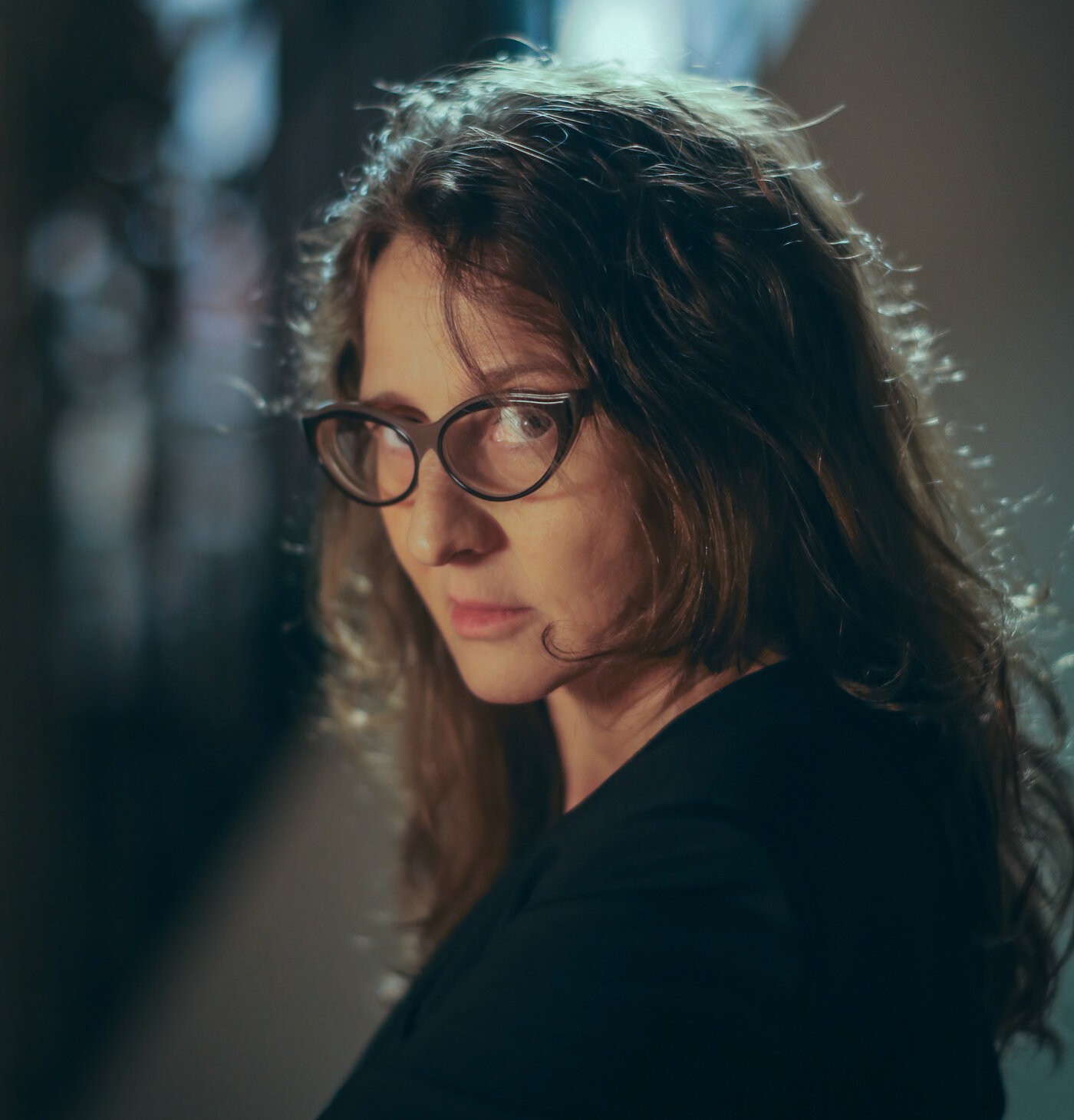
Lucrecia Martel. Photo by Eugenio Fernández Abril.
With a relatively short filmography and long gaps between projects, each new film by Argentine director Lucrecia Martel arrives with a weight of expectation. Her work is dense, observant, and visually precise, prioritizing her characters’ internal experience and the spaces they inhabit over conventional plotting. Her films are interior, attentive to texture and juxtaposition; her protagonists often feel unsettled, even disturbed, struggling to situate themselves in the world around them. In Zama (2017), her last feature, an 18th-century Spanish magistrate slowly loses his sense of self as time stretches and collapses around him in a colonial outpost. Our Land (2025), her new film and first documentary feature, is preoccupied with similar questions—identity as it relates to land, and the fragile underside of a conquering power—but with her focus turned toward the present.
Originally titled Chocobar, the film carried a kind of mythic status for years, circulating as a project Martel had been developing, shooting, and reworking over a long period of time. It both lives up to the expectations of scale created by this long gestation and undermines them with its directness. It’s a determinedly lo-fi work, diffusely structured but filled with frank, direct images. The film’s subject is massive: the ongoing struggle of Indigenous communities to be recognized, to claim ownership of their land, to access justice, to essentially become full members of Argentine society. Yet Martel successfully condenses this scope through close attention to gesture, language, and the subtle negotiations that shape the encounters in the film’s central courtroom setting.
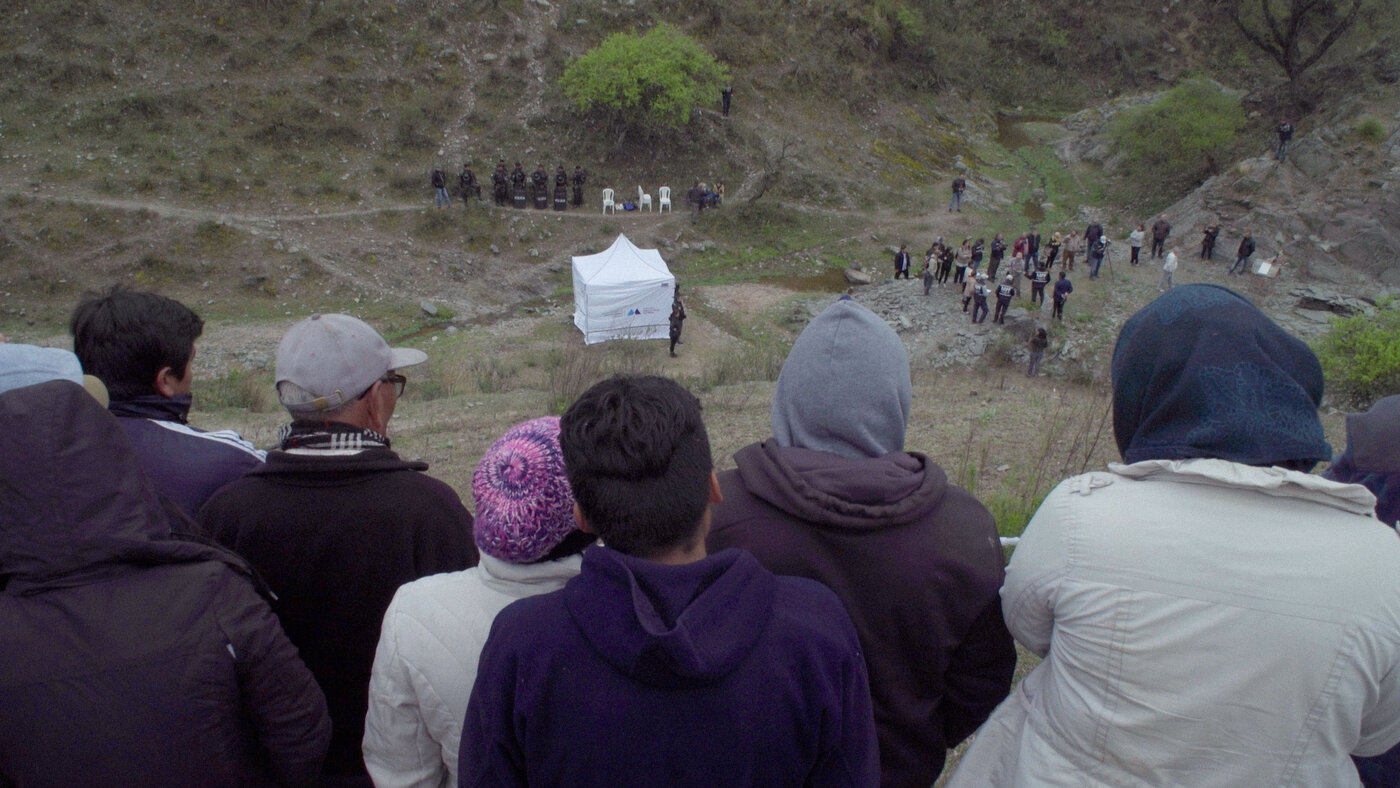
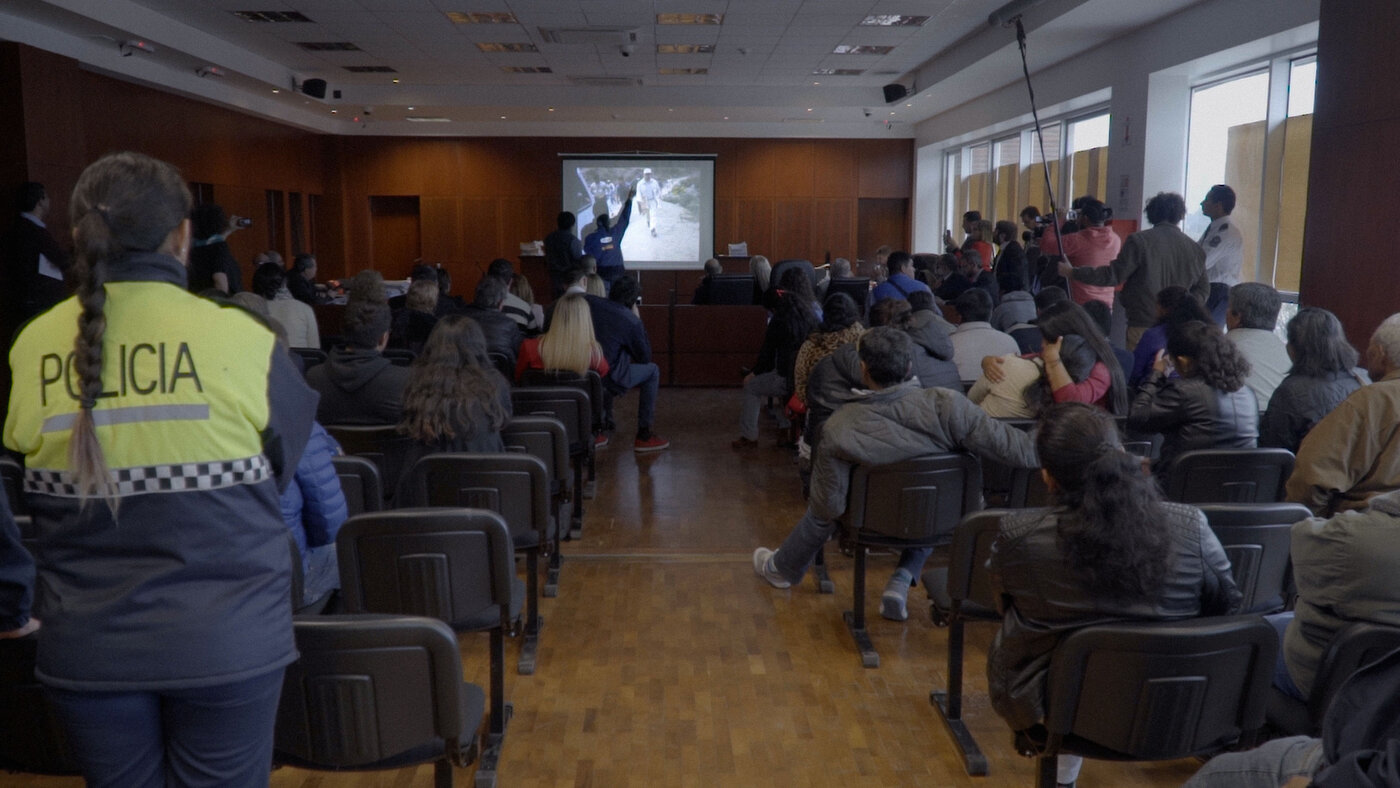
The genesis of the film came when Martel learned of the killing of Javier Chocobar, a member of the Indigenous Chuschagasta community in Argentina’s Tucumán province, in 2009. Chocobar was shot while resisting violent eviction from his land. The killing was filmed and carried out by a local landowner and two former police officers, who also injured two of Chocobar’s Chuchagasta compatriots. Our Land documents the trial— held nine years after the killing—in granular detail, and captures the proceedings’ inherent theatricality, from staged reconstruction at the crime scene (with the perpetrators re-enacting the murder) to face-to-face confrontations between one of the perpetrators and a witness, mediated by the judge. At the same time, Martel allows the courtroom scenes to splinter outward into portraits of elderly community members, pastoral drone sequences, and conversations with academics and historians. At times, the film feels almost observational; at others, more deliberately constructed.
Even within this shifting mode, Martel’s sensibility is ever-present in her attention to sound design, small, slightly off moments like a court attendant passing teacups to litigators, and the strange performance of authority. She hones in on the status of the Chuschagasta in the community, the way that the law bends and breaks and adapts to different groups, the loose sense of the government-mandated definition of justice, the heartache and uphill battles of the Chuschagasta people, and the absurdity of human nature. The film resists framing as a trial narrative, opening instead onto a much longer history of dispossession that exceeds the bounds of the case itself.
I spoke with Lucrecia Martel the day after she gave the centerpiece Amos Vogel lecture at the New York Film Festival, where she reflected on the state of cinema, the limits of storytelling conventions like protagonists and villains, and what lies ahead. With this lecture in mind, Martel and I discussed her approach to structure, understanding of time within the story of the film, approach to engaging with indigeneity, and the implications of certain narrative structures politically and in film culture more generally.
This conversation was conducted in Spanish and translated by the author.
Our Land (Lucrecia Martel, 2025).
NOTEBOOK: Because the film moves between individual voices and collective histories, how did you think about your role as a director in relation to the voice of the community you’re filming?
LUCRECIA MARTEL: I think that with people in the community, especially older people, the position of being like a daughter—looking at photos, having conversations—felt quite natural to me. Almost like a relative who is visiting and asking questions. There’s something about that familiar, conversational dynamic that’s very useful for this kind of work.
NOTEBOOK: And this is your first feature documentary after a long career in fiction. What surprised you about the process? What did you learn about yourself as a director? Was there anything you had to unlearn?
MARTEL: Yes—what really helped me from fiction was using those tools to unravel historical narratives, which are themselves a kind of fiction that becomes naturalized. It’s about convincing all Argentinians that this is our history, though clearly, many pieces are missing. Everything that happened to these communities is missing. What I also learned is the infinite number of possible structures in documentary. It’s incredible. It also means you spend a lot of time discarding structures that are good, that you like, and deciding to go in another direction. But it’s fascinating. In fiction, once you’ve shot the script and you go into editing, you don’t have that same range of possibilities. Here, when you get to the edit, you do.
NOTEBOOK: How do you represent an Indigenous community? How do you approach something so ancient from a contemporary perspective, using contemporary tools like cinema?
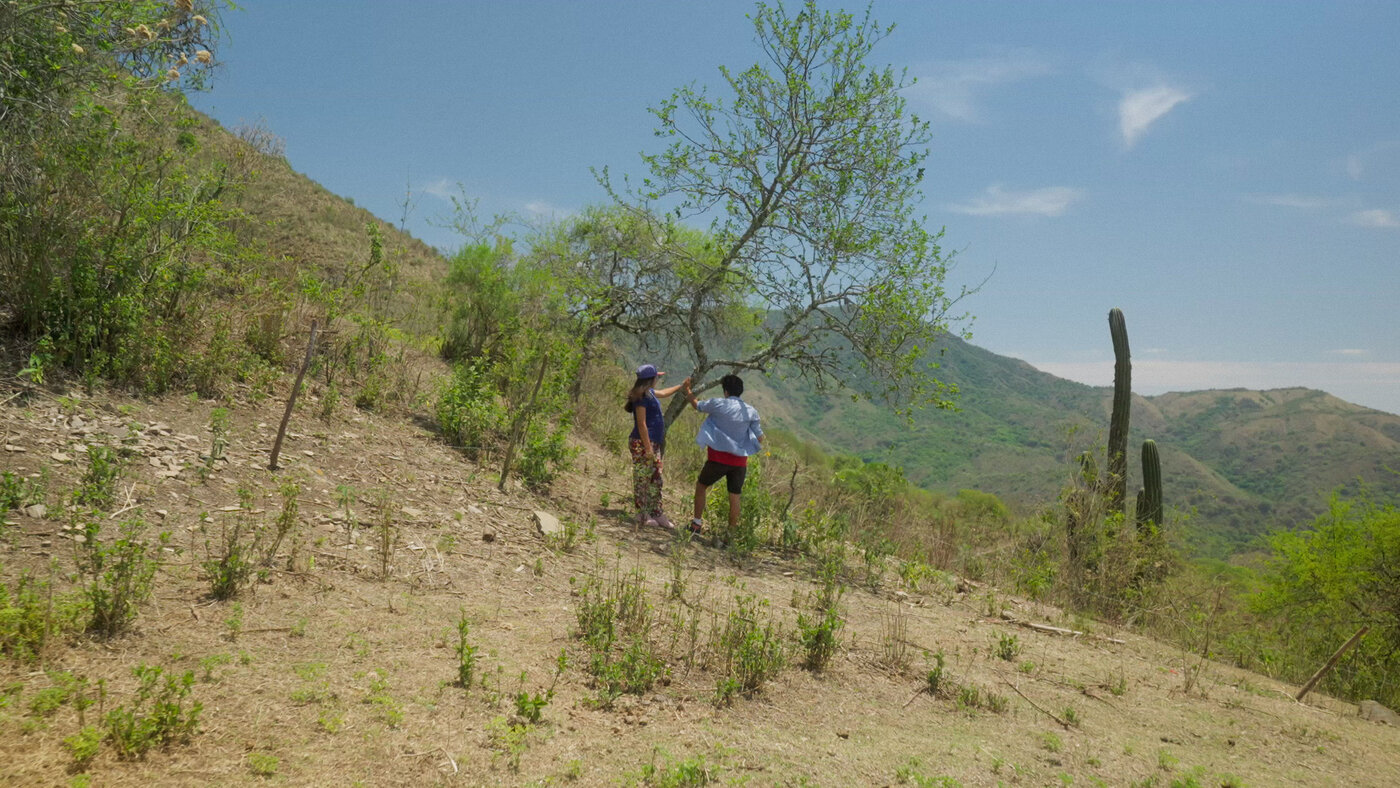
MARTEL: I’ve always had this idea, even before making the film—a conviction that the history of Indigenous communities has to do with the future of the country, not just the past. Of course the past is present, but above all it’s about the future. There are many young people who want to have a life. That was very important to me. And also, I felt I had to find a way of telling this story that didn’t demand that people remain the same as they were in the past. You know how sometimes directors [filming Indigenous communities] try not to show [modern appliances like] a refrigerator— Because they want everything to feel… Pure. That idea of purity—where does it come from? So I was very conscious that I wanted to avoid those situations. Avoid forcing tradition. And that’s why using the drone was so helpful—it allowed us to engage with space, and in a way, to connect the film to the future.
NOTEBOOK: From the beginning, how were you thinking about time in relation to the Chuchagasta community?
MARTEL: From the beginning. Even in my previous films, where people from Indigenous communities appear more tangentially, it mattered to me that they not be exoticized as something from the past. But at the same time, the past is very important, their relationship to land. But it’s not really the past. It’s something more complex. Because in these communities there isn’t a desire to return to the past—there’s a desire for the future. For their children to be better off, not to be displaced from their land. It’s more about the future than the past.
NOTEBOOK: I’ve been thinking about what you said in your talk last night. You mentioned that narratives shouldn’t assign heroes or antagonists. But this story feels morally quite clear to me, and probably to most people who watch the film. How did you work through that tension: making a politically urgent film without falling into a structure of oppositions?
MARTEL: Because really, if you manage to get close enough to people—to understand something of their proximity, their intimacy—it becomes very difficult for those oppositions to appear so clearly. We’re all made up of different things. So in this film, I would say that when “villains” appear, they’re making an effort to perform that role. I see the lawyers, for example—they’re acting. And I find that very interesting. Those who don’t have the truth tend to over-perform it. They overstate the legitimacy of what they’re saying, presenting themselves in a certain way. The discourse is that of the villain—but they themselves are performing it. It’s something quite incredible.
NOTEBOOK: Yes—it’s strange. They seem like normal people, but they’re saying pretty extreme things.
MARTEL: Exactly. And the way they say them is so exaggerated. You find yourself wondering, why? And that’s where it is: the imperative to exercise power. When you don’t really have it, you have to over-perform it.
Our Land (Lucrecia Martel, 2025).
NOTEBOOK: Speaking of those scenes, can you talk about filming in the courtroom?
MARTEL: It was a public trial. We couldn’t place the cameras freely—like in fiction, where you decide exactly where everything goes. Here it was: you can put a camera here, here, or here. That’s it. So that already limited our decisions. Within those constraints, we made small choices—zooming from one side, then the other. And I spoke with the camera operators, told them to pay attention to certain things: when people drink water, when papers move, moments of tension, glances. That’s about all you can tell a camera crew. Because I was sitting there taking notes—I couldn’t be directing them constantly. In the end, the restriction was actually very helpful. It forced me to work within those limits. At one point, the court even called me in and asked why there were so many cameras. I told them I was making a documentary, and that I felt this trial needed to be filmed—it was an important trial. And they let us continue. Later, we had about 300 hours of footage. When you start watching it, you notice so many things you didn’t even see at the time. That always happens. So we kept watching, and rewatching, with my editor, until we started to understand how to shape it.
This connects to something broader. In Western culture—especially in mainstream cinema, and even more so with streaming platforms—there’s this idea that within ten minutes you have to understand the characters, that there needs to be a turning point at a certain moment. There’s always a prescription for how things should be structured in order to be “good.” To hold attention. And it’s false, completely false. And yet the industry continues to insist on it. Every so often, someone comes along and shifts things a little—like John Cassavetes, David Lynch, or Paul Thomas Anderson—and the industry adjusts slightly. These are people who push against a system that moves very slowly. Even something as basic as changing the role of female characters—it takes a long time. But sometimes someone makes a leap and shows that another kind of narrative is possible. I’m completely convinced that the dominant narrative form is a kind of war model—it pushes the idea of protagonist and antagonist, of conflict. Everything becomes conflict. But human experience doesn’t work like that. Even when there are problems between people, you can’t organize everything around the idea of conflict. If you try to analyze a disagreement with your mother using that structure, it doesn’t hold. It’s not so clear-cut. It’s not easy to map that kind of structure onto a family dynamic. There are other forms. And those other forms are interesting—people would respond to them. But this model persists, and I think it’s a dangerous one now. It prevents other ways of seeing from emerging.
NOTEBOOK: The courtroom is set up to feel like a war model.
MARTEL: Yes, but if you listen closely, what appears in the language comes from something much older than the trial. It’s a very old cultural problem. I don’t know how visible it is, but anyone from the north [of Argentina] who watches the film understands that what’s at stake isn’t just the crime. It’s something that goes much further back.
NOTEBOOK: Many years ago, I saw you give a talk in UCLA about how you write characters as “monsters with desires.”
MARTEL: Yes, I always think about that. Because a “monster” isn’t something bad—it’s something unknown. Like when you say something is a phenomenon—it appears, and you don’t yet know if it’s good or bad. That way of thinking about characters helps you avoid being too schematic.
NOTEBOOK: Would you say that there aren’t really protagonists and antagonists in Our Land?
MARTEL: No, they exist—but sometimes only within specific scenes. We’re all used to listening to people who tell stories in different ways. We’re capable of that. But the industry tries to impose a single model, as if that were necessary. People are much more complex than that, more interesting. You don’t need one central protagonist. It’s enough that, in each moment, something draws you in. And those small gestures—like when people are drinking water—humanize everyone. Exactly. That’s why it was important to include those details: the coffee, the glasses of wine. They seem trivial, but they matter.
NOTEBOOK: I wanted to ask about that scene where the bird attacks the drone—it almost feels like the land itself rejecting being observed.
MARTEL: Yes, it was intense. We were filming as a storm was coming in, moving through a ravine toward it. The storm was still far away, but you could see the sky turning black as we got closer.
At one point, a bird hit the drone slightly. So we brought it down and [then] saw the hawks that had been circling. There had also been condors earlier, and we thought maybe we could try to follow them. So we sent the drone back up. And then, on the way back, those same hawks attacked it again and brought it down. It was a mess. We had to rent more drones. I already knew we were going to use drones a lot in the film—this was something I had in mind from the beginning. But that week—we only had three weeks of shooting total—the drone went down and we lost a big part of the budget.
The upside is that the shot, if you were trying to stage it, would be incredibly expensive. In the end, that fall cost us about $3,000. Later we found out that it’s actually quite common—birds often attack drones. We had no idea.
Our Land (Lucrecia Martel, 2025).
NOTEBOOK: Another moment that stayed with me is when the woman from the community looking at all her photographs says something like, “When I die, I don’t know what will happen to these.” There are many moments like that in the film—people looking at images, remembering. What role do you think images play in preserving—or distorting—history?
MARTEL: I think a photograph is a very delicate document. There’s who took it, their intention, what was happening outside the frame. But what’s interesting is that if you spend time with a photograph, things start to appear. It’s about waiting for that moment. I also think that this might be one of the last trials where images—recordings, cameras—still have evidentiary value. Soon there will be so much fake material that images won’t be accepted in court in the same way. Even so, there’s already so much construction behind any image. That’s interesting to me. And through sound, through duration, you can make a photograph convey something beyond what it originally was.
NOTEBOOK: I was also really struck by something you wrote in your director’s statement for the film for its premiere at the Venice Film Festival: “Deep in my heart, I envision this film for machines that require complex narratives to be kinder than us.”
MARTEL: What I mean is that now that we’re transferring our knowledge and language to machines, if we only feed them very schematic narrative models, they’ll become brutal, clumsy. So we need to think in more complex ways, so that the future—which will be partly shaped by these systems—is less harsh for us. Do you think it’s possible to resist that? I think it’s very difficult. Once a technological development exists, it’s almost impossible to reverse it. There are too many interests involved. So the question becomes how to make it less harmful for us as humans.
NOTEBOOK: Were any films that influenced you while making this?
MARTEL: Honestly no, to be honest I’m not a cinephile. I tend to focus on what I’m doing, and ideas emerge from the material itself. I know that for some people references are helpful, but for me it’s more about concentrating on the work.
NOTEBOOK: Do you see this film as a continuation of Zama?
MARTEL: They were actually parallel projects. Zama was finished first. But working on this film helped me understand certain things in Zama. It’s hard to explain exactly how, but there was a connection. But for me, it was very useful.
NOTEBOOK: At the end of the film, when people are watching images—is that from this project?
MARTEL: It’s footage from a workshop we did with the community, along with some of our own images. For me, what matters most is that people see the film and talk about it. That already happened—we screened it in the community.
NOTEBOOK: It’s a difficult moment for distribution. What do you hope for the film in Latin America?
MARTEL: From a commercial perspective, not much. But we do have a plan to show it in smaller community spaces. That’s more important to me. It’s not really a commercial plan—it’s more political. Historical, maybe.