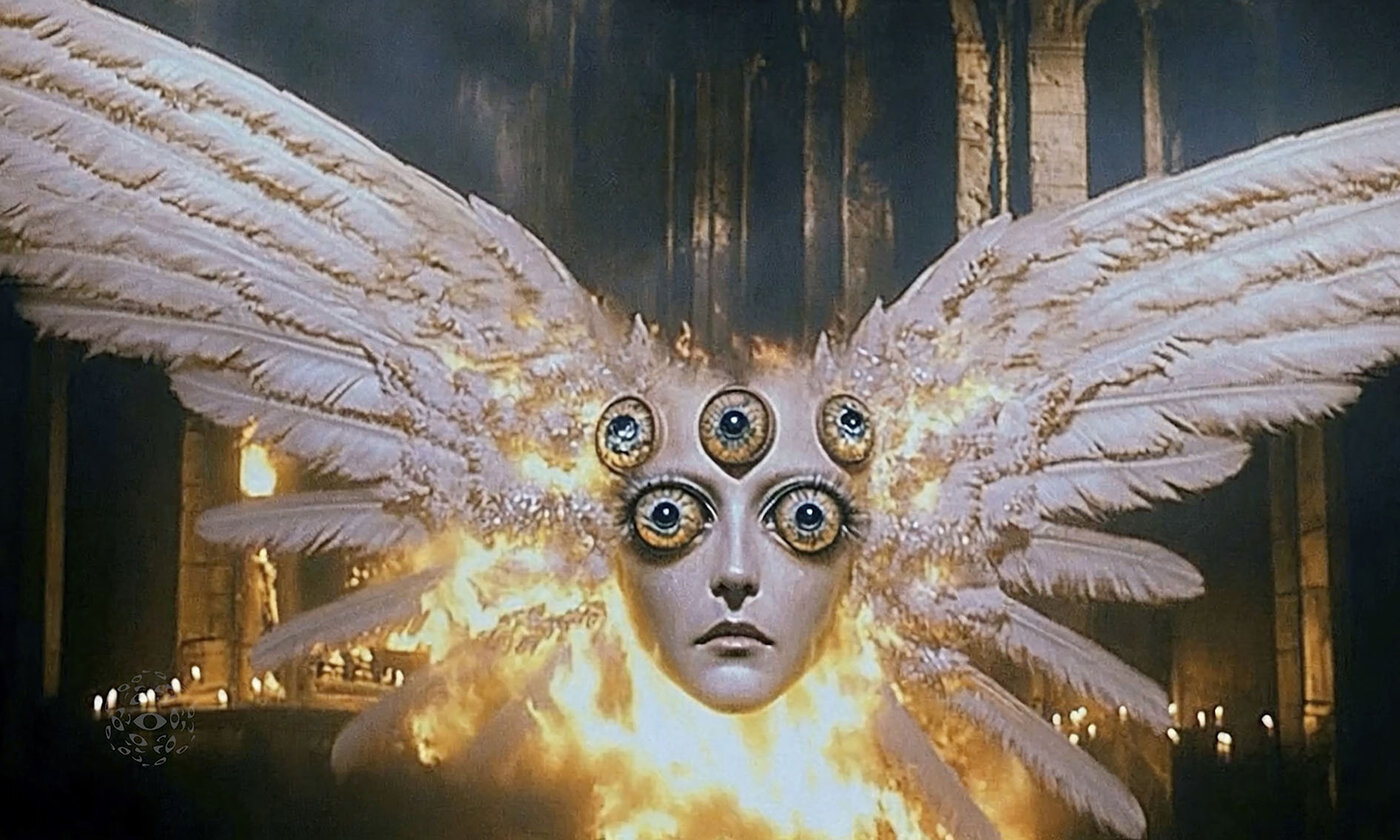
Main Stream Media Network (Jon Rafman, 2025). © Jon Rafman Courtesy the artist and Sprüth Magers.
“The world isn’t a kind place, it’s wolves and devils,” says a character in Jon Rafman’s Main Stream Media Network: Proof of Concept (2025). With its hyperactive animation, haunting soundtrack, and twisted creepypasta tales of horror, the artist’s large-scale video work is more akin to a screaming conflagration than a feature film, a two-and-a-half hour transmission from hell. Modeled after the MTV of the early 1990s, a cultural moment Rafman views as the last example of a shared reality before the world cracked, the film is an attempt to capture that elusive thing: how it feels to be alive—and online—today.
Over the last decade or so, Rafman has been exploring the various ways technology has shaped and shattered the contemporary mind, a project which has led him into increasingly fractured and unstable territory. (It has also, in recent years, earned him edgelord status, making him the darling of such fallen eminences as Kanye West and the futuristic fashion house Balenciaga.) Rafman, it could be said, is one of the most prominent artists experimenting with AI, and with his latest film the results are on full display. Main Stream Media Network is an abrasive, disorienting, violent, hysterical, hideously sublime foray into the online world as it pours through the eye of the doomscroller. In Rafman’s world, the usual compositional elements of film that help along a critic (or, for that matter, an audience) in summary—such as scene, dialogue, action, characters—are largely absent or obsolete. Landscapes surge and melt into each other in a kind of AI-assisted fugue; figures appear, multiply, and vanish in the same instant, not so much characters as avatars, a cast of mutating masks, the shifting personae of a mind in freefall through memory both personal and collective, fictive and real. Conventional narrative elements hold little interest for Rafman, who instead pushes the miasmic, amorphous potential of moving image to its limits in an attempt to express what is, arguably, the best and worst thing about the internet: that literally anything could happen.
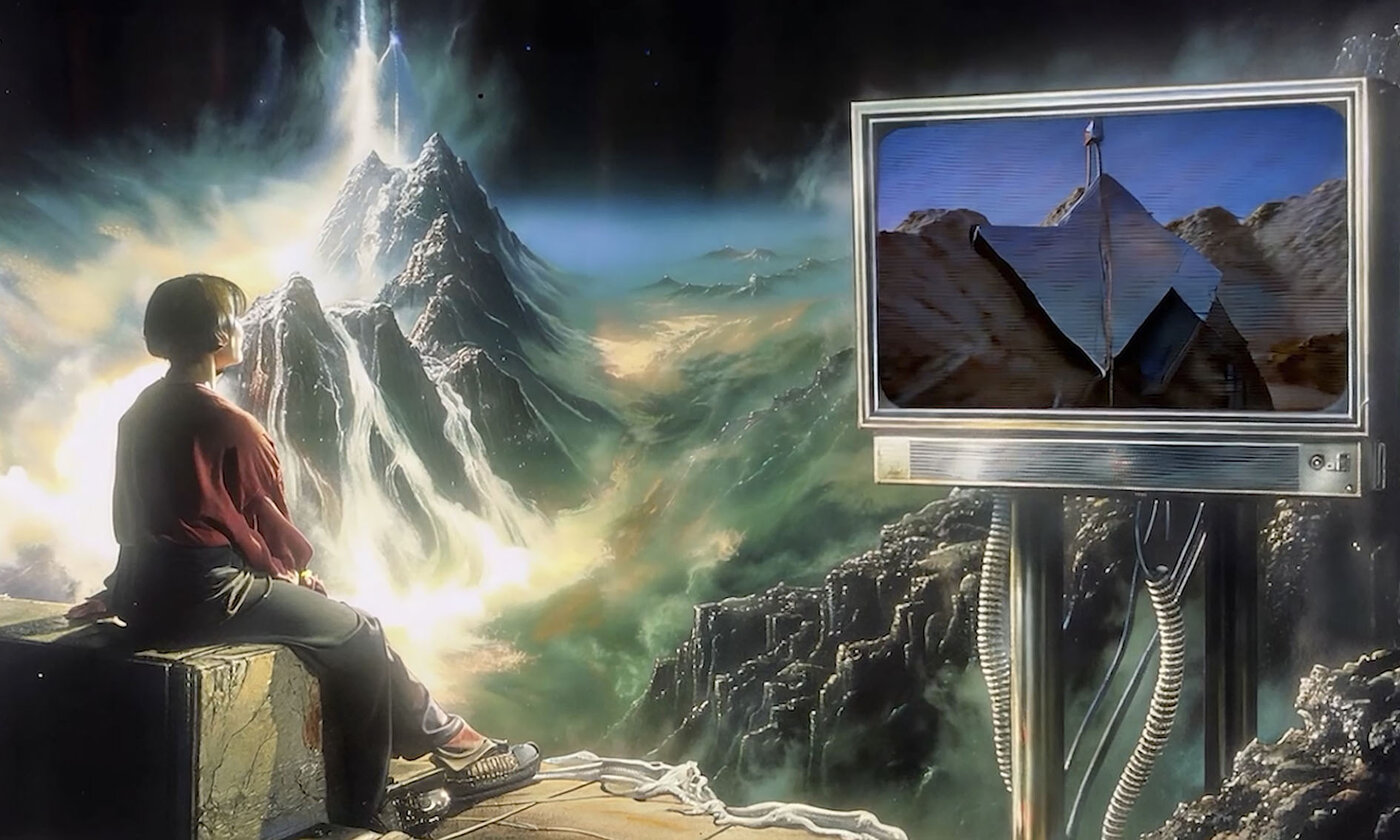
Main Stream Media Network (Jon Rafman, 2025). © Jon Rafman Courtesy the artist and Sprüth Magers.
Even his earlier works, such as Nine Eyes (2009–ongoing), a slideshow of images culled from Google Earth which range from the comical to the bizarre, betray an interest, if not a creeping paranoia, in the turbulent and uneasy mingling of the human and the digital. Images of car crashes, robberies, lightning strikes, and animals basking in the sun are interspersed with humans, their faces invariably blurred as they cry or smoke or give the camera the finger. Watching Main Stream Media Network: Proof of Concept, I was reminded of the late Gary Indiana’s blistering Village Voice report from Disneyland, a place, he said, quoting John Berger, that inspires in the viewer the same essential horror of Francis Bacon paintings: that there is nothing else. Or, to elaborate on one of Rafman’s characters: the world isn’t a kind place—it isn’t a place at all.
Like a haunted television dipped in radioactive waste, Main Stream Media Network jumps from AI-generated music videos, to frank and confessional monologues delivered by AI voices, to absurd, nightmarish dispatches from the darkest corners of Reddit, with many a jump scare in between. The film unfolds in sequences—music video, short story, animation, monologue—that depict, in their entirety, a world consumed by darkness, dread, and dopamine. Threaded throughout the film is one animated character’s journey, from birth to incarceration, where inmates are used to test military software in the form of a virtual reality game. It’s the closest thing in the film to a narrative arc, and it quickly devolves into a downward spiral. Similar to how, in the nineteenth century, brothers Jacob and Wilhelm Grimm traveled around their native Germany collecting the fairytales and poetry of local folklore in an attempt to capture evolving attitudes to the world and fundamental human experiences, Rafman has scoured the digital landscape, found its strangest material, and fed it to AI to make a flickering hall of mirrors, inviting (or daring) us to take a trip inside. With the help of writers such as the internet-fluent Honor Levy, Rafman grounds the various vignettes in all-too recognizable concerns and desires. What stories like Cinderella and Rumpelstiltskin tell us about the vagaries and vicissitudes of life in nineteenth-century Germany, Rafman seems to be saying, chat forums, video games, and “story time” YouTube videos tell us about ours: the desperation, the fear, the loneliness, the deformed self cycling through its mortifications, the assumption of an ever-present audience waiting to pass judgment over it all.
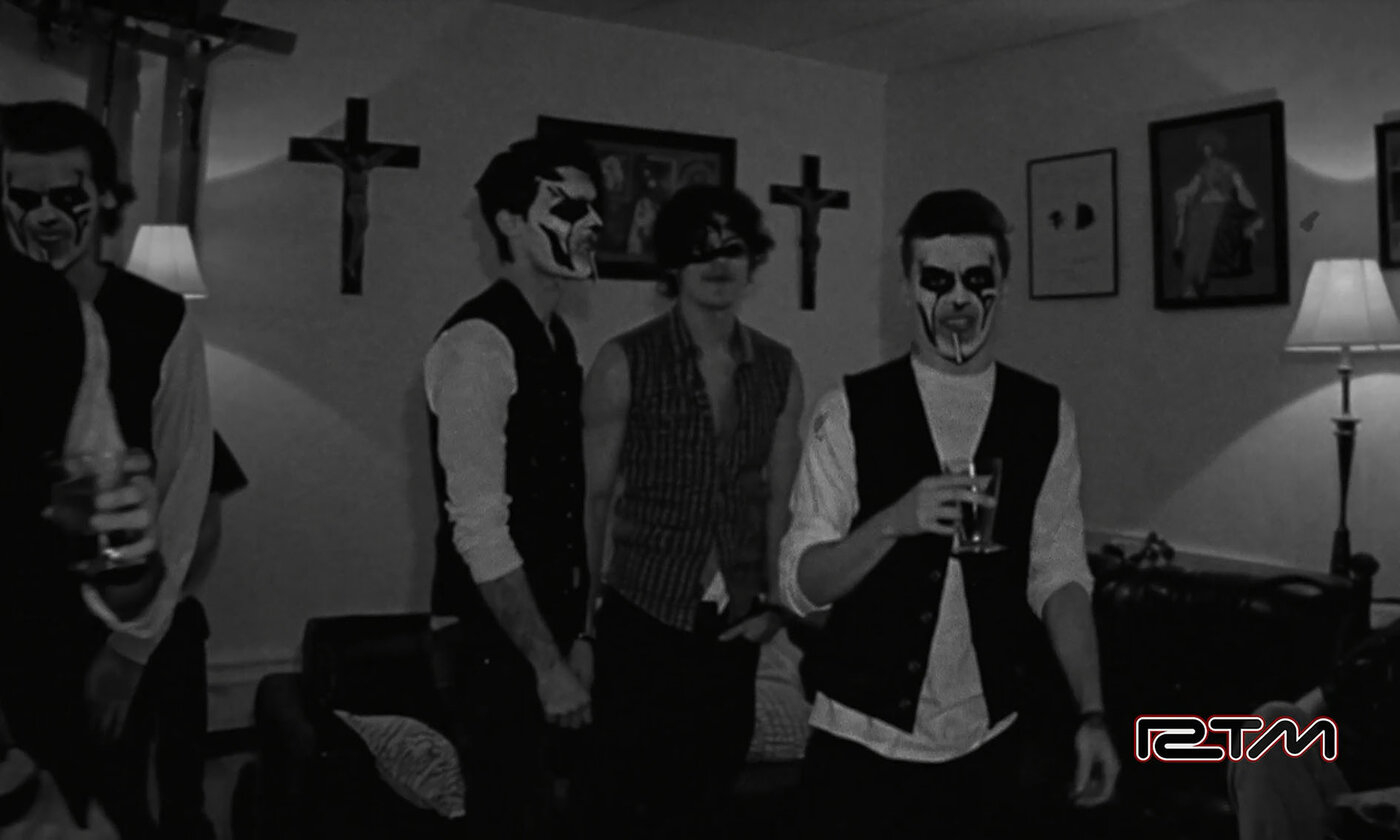
Main Stream Media Network (Jon Rafman, 2025). © Jon Rafman Courtesy the artist and Sprüth Magers.
The short stories in Main Stream Media Network are not unlike ultramodern fairytales: frequently horrible, often macabre and always surreal. One story called “Any Tips?” unfolds in a series of diary-like entries posted on an anonymous thread detailing one man’s descent into madness as he struggles to rid the house he has just bought of a spider infestation. Though it quickly swerves into uncanny territory (spider webs devour the house from the inside as the man comes to believe he is, in fact, a fly), it isn’t hard to see how this might reflect a general paranoia and anxiety many people have about housing and inheritance. Another story tells of a fifteen-year-old boy who wants to become a walrus so badly that he cuts off his arms, starts sliding around on his belly, and eventually moves to Antarctica. The surreality of these tales is compounded by the flat, matter-of-fact tone of their delivery, that toneless dictation particular to AI voices, a blend of hysteria and dead-behind-the-eyes calm that seems a distinctly modern concoction.
Rather than being organized into a coherent narrative arc, the film’s chimerical form serves to expand and deepen the realm of the grotesque, making new discoveries possible and darker shades of the psyche visible. The seemingly chaotic bizarrerie on display is brought into focus by the resonances released, as in a piece of music, through juxtaposition and variation. In one part of the film, a night-shift worker at a hotel discovers a new energy drink which, instead of making her heart beat faster, manipulates the laws of physics and slows reality down, unleashing a string of chaotic and bizarre events throughout the hotel’s rooms: A man’s head explodes, but he continues to talk to her, directly into her head; dogs walk out of a room on their hind legs and say they are “finished with room service, moving on to bigger things.” As she ends her shift “writing reports about things that can’t be reported,” she could be describing what it feels like to write about a Jon Rafman film. Consuming something you don’t understand, or didn’t intend to consume, interacting with media you can neither escape nor control, listening to disembodied voices, losing track of time, feeling like a ghoul in a looping simulation: These are experiences many will be familiar with but perhaps have not seen represented quite like this. Rendering the gradual, then sudden, shift into phantasmagoria that has become symptomatic of life’s unreality in such a vivid and emotive visual language is one of Rafman’s most impressive, and creepiest, achievements to date.

Main Stream Media Network (Jon Rafman, 2025). © Jon Rafman Courtesy the artist and Sprüth Magers.
Just as Wes Craven’s Scream (1996) prompts the dialectically inclined to correctly wonder if what they’re watching is a horror movie or a movie about horror movies, Rafman’s recent slew of AI-generated work has, rightly, given many viewers pause to ask themselves: Am I watching AI slop dressed up as a film, or a film about AI slop? Interestingly, Rafman seems to anticipate, even welcome, such debates about the integrity of the work. Various segments of the film are given over to something called “SlopTV,” fiercely ugly intermissions amounting to brash and lurid noise (imagine the most gluttonous mukbang, then explode it) that throw the entire work into a completely different register. The trolling mischief of Harmony Korine comes to mind, as do the musical vortices of Death Grips. Rafman seems to be earnestly exploring the technology’s potential for art-making and at the same time making fun of what it makes. In an interview about his earlier feature-length video work Dream Journal (2016–2019), in which his alter ego, Xanax Girl, embarks on an odyssey through various mind-bending realms filled with mythical creatures, all rendered in flat, PlayStation 2-style textures, he described the process of using AI tools as “like tossing paint and seeing where it lands.” It’s up to viewers to determine where, or even if, it does.
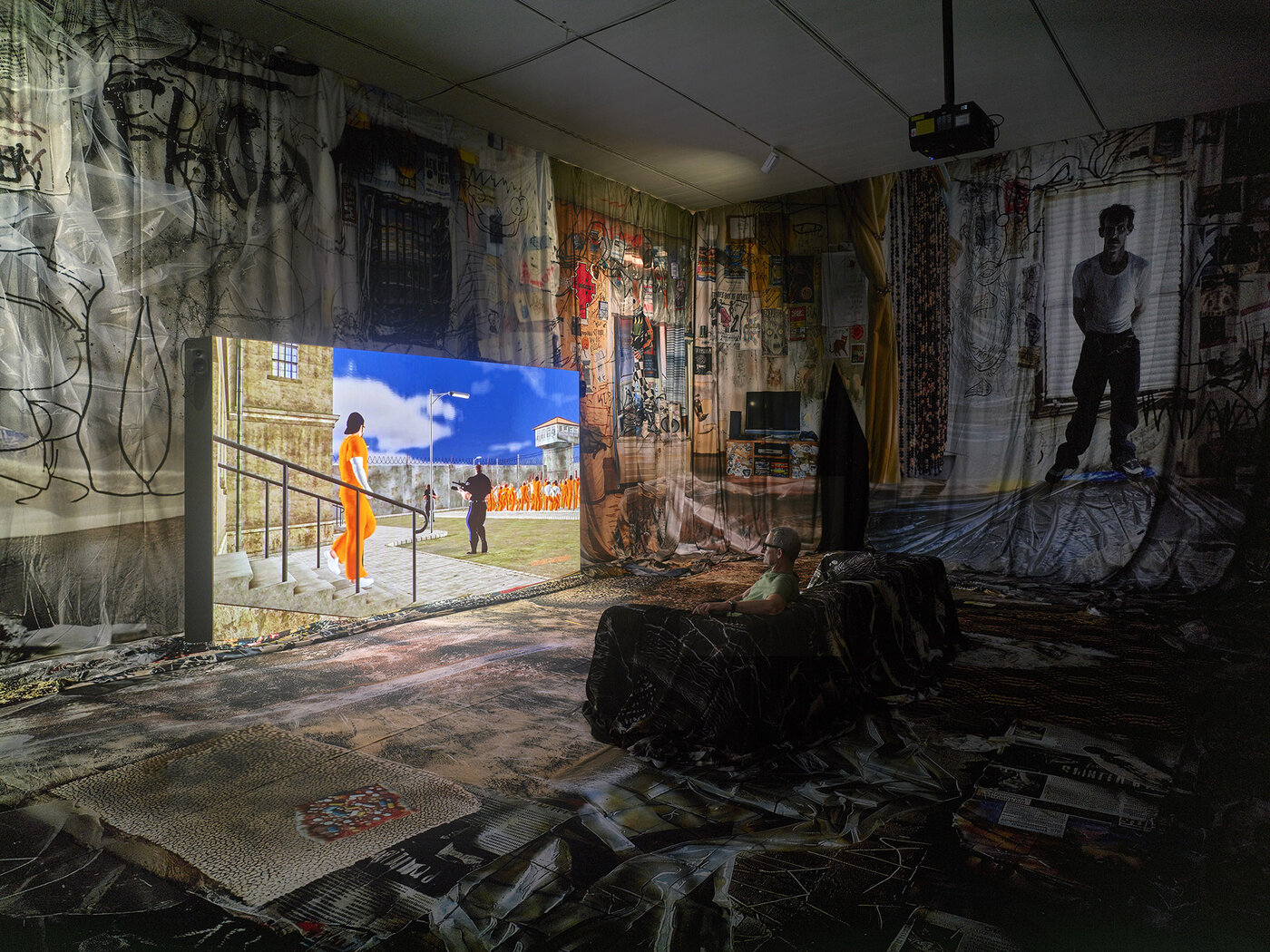
Main Stream Media. Installation view, K21 – Kunstsammlung Nordrhein- Westfalen, Düsseldorf. Photo: Achim Kukulies, Düsseldorf.
But then maybe it is a mistake to judge Main Stream Media Network in isolation. Installed as part of a large-scale exhibition mounted this summer at the Kunstsammlung Nordrhein-Westfalen in Düsseldorf, which featured floor-to-ceiling prints, Twitch-streamer style ergonomic chairs with built-in speakers, and many other hijinks designed to intoxicate, in both senses of the word, it’s a very different experience to sitting down and watching the film on your computer from start to finish. What he intended was probably something more akin to the relaxed panic of scrolling until you fall asleep.
Threaded throughout Main Stream Media Network are a series of music videos, including a triad of gothic doom anthems called “Catastrophonics,” performed by a fake band called Iron Tears. They take the viewer on a first-person drift through one apocalyptic landscape after another, a seemingly endless variation on the end. We find ourselves in the interior of a crashed car, which melts into the litter-strewn aisle of a fallen airplane, which then morphs into the rain-lashed windshield of an Uber lit up with the fairylike glow of twenty blinking phones. The road transforms before our eyes into a river. The sky blackens and crashes with dynamite storms as the car begins to flood, for we are now drifting, getting further from the shore. Waves foam in the distance, then suddenly rush the windshield. Headlights sweep uselessly across the ocean that swells around us. Then we are under water, nosing along the seafloor. These “Catastrophonics” are the film’s strongest moments and, strange to say, since they’re composed entirely of doomsday scenes, its most tender and Beckettian. Rafman shows how pessimism, when exaggerated, yields its own kind of hope, no matter how gloomy and benighted, through the dogged narration of the inenarrable, in beginning at the end, again and again and again.