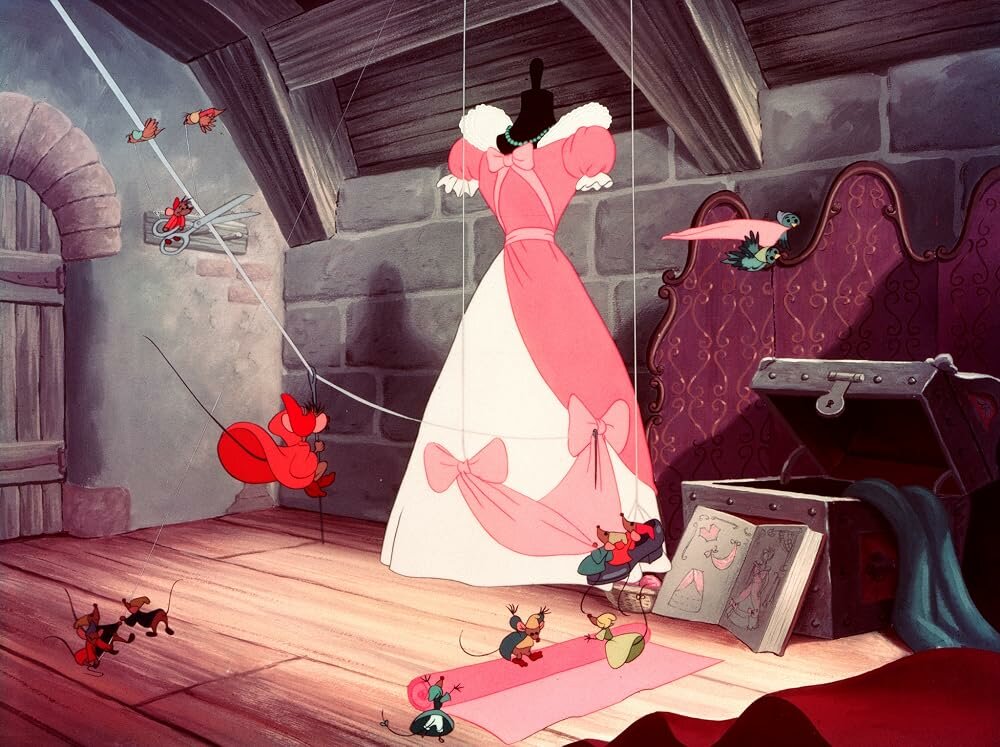
Cinderella (Clyde Geronimi, Wilfred Jackson, Hamilton Luske, 1950).
In the early 2000s, stores including Barneys and Hot Topic briefly stocked saucy T-shirts depicting classic Disney characters, including, as James B. Stewart describes it in the book DisneyWar, “an archival drawing of Tinker Bell eyeing her derriere in a mirror.” The shirts were the brainchild of Andrew Mooney, the executive brought in to revive Disney’s moribund Consumer Products division, and they so incensed Roy E. Disney—Walt’s nephew and the vice chairman of the company’s Board of Directors—that he sent Mooney a note accusing him of “positioning Tinker Bell as a prostitute.” Mooney’s job was saved by the peacemaking efforts of the company’s then-president and COO Bob Iger, and another one of his initiatives would go on to have more success: the Disney Princess.
Encompassing toys, dolls, Funko POP!s, clothing, kids’ jewelry, accessories, decor, home goods, and other categories, the Disney Princess line of products is unified by a term that would quickly enough become ubiquitous. It connects the female leads of the so-called “Disney Renaissance” of the 1980s and 90s—characters such as Ariel, Belle, and Jasmine—across the generations. It looks forward to Rapunzel, Anna, and Elsa—characters from Disney films made in the twenty-first century, following the transition to 3D digital animation—and back to the hand-drawn 2D princesses of classic Disney, to Snow White, Cinderella, and Aurora. Though in fact, the three latter princesses were in fact the only such characters in the studio’s 55-year history of feature animation before The Little Mermaid.
The Little Mermaid, released in 1989, as the studio embraced computer animation, was the first Disney film with a princess protagonist since 1959’s Sleeping Beauty. Coming at the end of a decade in which new chairman Michael Eisner revitalized Disney’s flagging stock price and park attendance, the movie was a critical and commercial smash, launching the narrative of an artistic revival at the flagship animation studio, and encouraging further variations on the princess theme.
For its own part, Sleeping Beauty had been an attempt to recapture the magic of 1950’s Cinderella, itself a desperate attempt to recapture the magic of Snow White and the Seven Dwarfs (1937) after a decade of war, labor unrest, and the financial failures of Fantasia (1940), Pinocchio (1940), and Bambi (1942). It was made expediently and restrictively: To save development time, the entire film was blocked with live actors rather than worked out from scratch with pen and paper. “This was,” write two of Disney’s longest-tenured animators, Frank Thomas and Ollie Johnston, in their 1981 book The Illusion of Life, “undeniably, a way of doing it.”
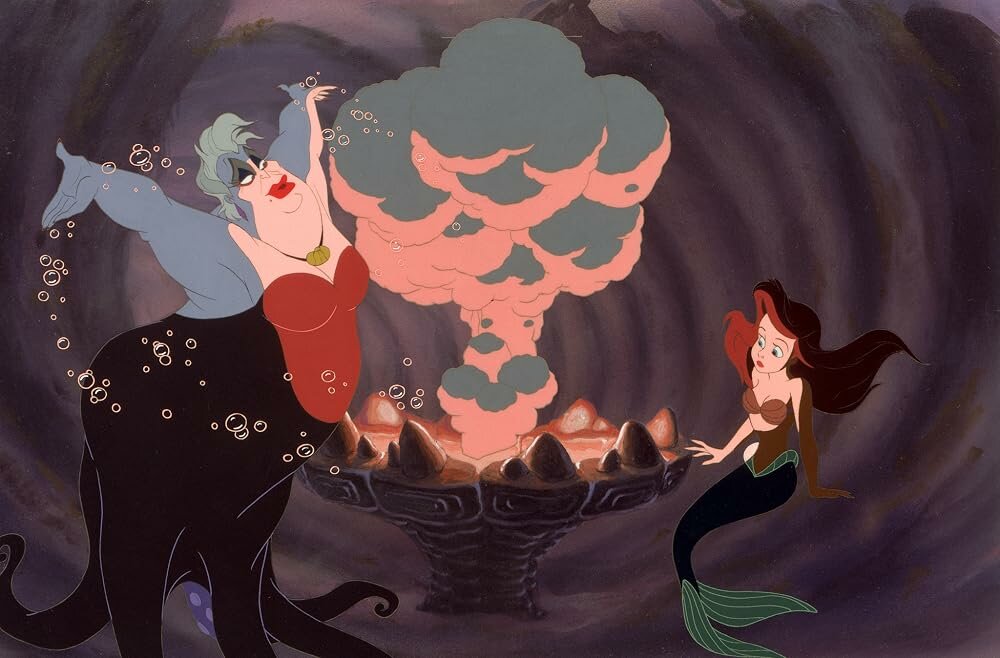
The Little Mermaid (Ron Clements, John Musker, 1989).
The past is never really past at Disney, where the breakthroughs of previous generations are kept forever young at heart with new innovations—which are often primarily economic in nature. Disney has always controlled its “vault” (the back catalog known at other studios by the more access-oriented word “library”), stoking demand for its core products by limiting supply, via selective theatrical rereleases and, later, video editions. For over a decade now it has turned to the live-action—or nominally live-action—remake of its own films. While Disney’s previous back-to-basics moments came in response to times of acute corporate crisis, the autoremake cycle comes during the long and happy reign of recently departed CEO Bob Iger, a time characterized—except during Bob Chapek’s tumultuous interregnum—by elevated stock prices and world-bestriding expansion, including the acquisitions of Marvel Entertainment, Lucasfilm, and 21st Century Fox.
Since the mid to late 2010s, the rise of streaming has made Disney’s prior strategy of limited-edition vault drops impractical, and the decline of theatrical moviegoing (and cable television, also a key part of Disney’s business) has instilled in Hollywood a permanent crisis mentality. Its own streaming service, Disney+, additionally points to a more company-specific version of the general problem: Disney’s movies are eventized throughout their commercial life cycle, but they’re also beloved de facto babysitters that have been imprinted on generations of children through repeated viewings—and they’re now available in a medium that, unlike magnetic VHS tape, does not deteriorate physically as it becomes increasingly well loved. How to be both a constant companion and a special treat? Disney has fought back against diffusing attention spans by constantly revivifying and resurfacing its dormant intellectual property, constantly turning over the soil in the form of plot point-by-plot point remakes of prior decades’ animated hits, this time with real costumes, famous faces, and fan-service subplots.
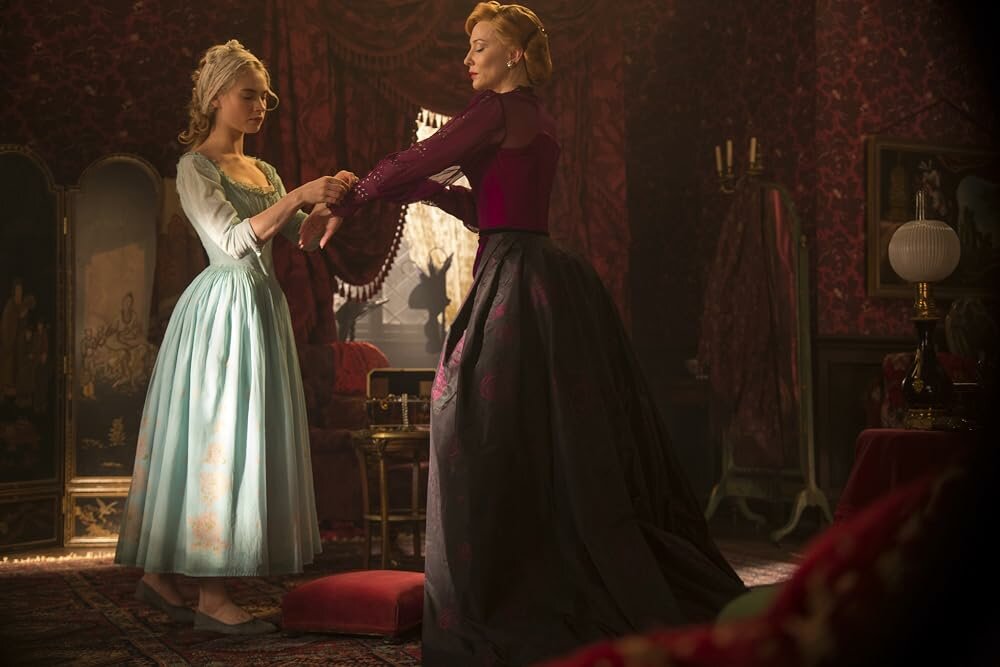
Cinderella (Kenneth Branagh, 2015).
This cycle began, once again, with Cinderella. After the financial success of Tim Burton’s reimagined Alice in Wonderland (2010) and the origin story Maleficent (2014), in 2015 Disney returned to the film whose castle serves as the studio’s logo, with a new Cinderella, directed by Kenneth Branagh, that builds out its lead character and buffs up a message of female empowerment. This Cinderella (Lily James), while still kind-spirited and humble, is also, in the preferred parlance, unapologetic: She meets her prince (Richard Madden) while out on horseback, stunning him with her boldness and defiance of convention. She gets her gold carriage and her fairytale wedding, here spun as the enlightened award of a People’s Princess who, alongside her husband, would be the “fairest, kindest rulers” her people ever knew.
Many characteristics of this Cinderella would become constants of the Disney remakes to follow, up to and including Moana (2026), just released to theaters this July, particularly its convoluted and apologetic reframing of the escapist, aspirational Disney Princess. The more than a dozen subsequent films made in this vein in the last dozen years show Disney constantly refreshing its beloved products and overwriting its own narrative, in an act of nostalgic pandering and corporate positioning: the product is an eternal childhood, the company is a never-ending brand-management case study.
***
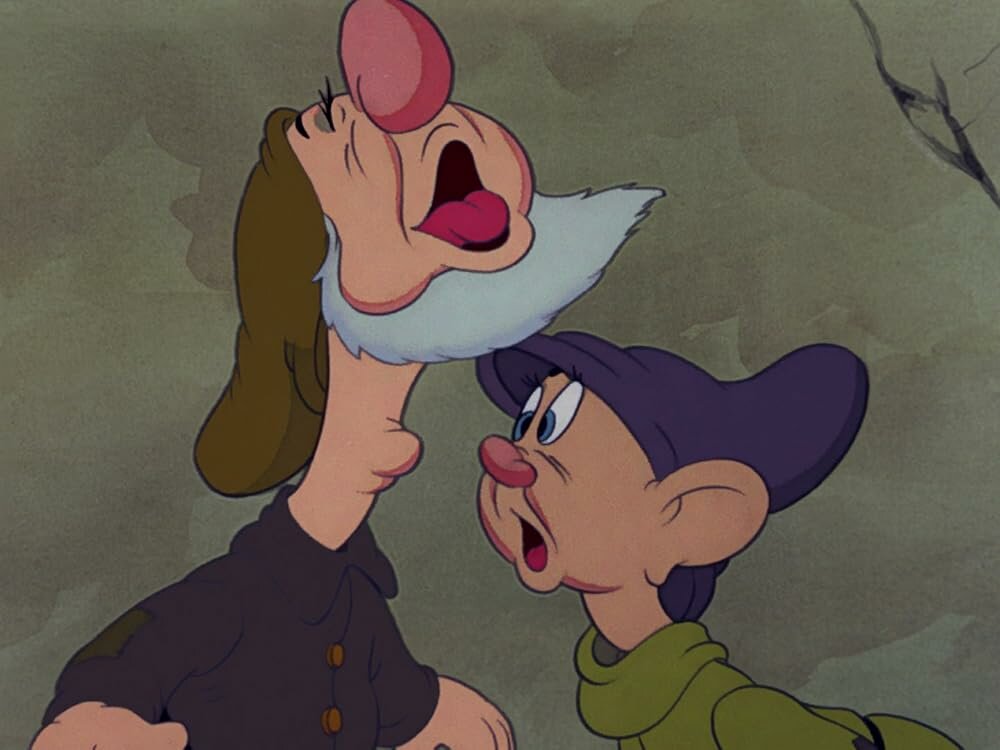
Snow White and the Seven Dwarfs (William Cottrell, David Hand, Wilfred Jackson, Larry Morey, Perce Pearce, Ben Sharpsteen, 1937).
The initial appeal of Disney animation was that it was a marvel, not a morality tale. The standard test for new Disney animators used to involve drawing a bouncing ball. As Thomas and Johnston explain in The Illusion of Life, a series of drawings simply tracking the movement of a rigid circle would look lifeless. The challenge in those early days was to imbue drawings with a sense of movement, vitality, personality, and, therefore, emotion. Techniques such as “squash and stretch”—compressing or elongating a constant volume, as with the bouncing ball—could make figures moldable and lively.
Walt Disney used the word “realism” to mean not that an animation appeared exactly true to life, but that it was communicative and relatable, even if exaggeratedly; his instincts were populist, and the medium, in its early days, was crudely expressive. Though Disney himself quickly hit his ceiling as an animator, he was a hands-on editor and micromanager. One night, before embarking on Snow White and the Seven Dwarfs, he gathered his animators together at the company’s soundstage, and proceeded to act out the entire film for them. As Neal Gabler writes in Walt Disney: The Triumph of the American Imagination, he stood, illuminated by a spotlight, “assuming the characters’ mannerisms, putting on their voices, letting his audience visualize exactly what they would be seeing on the screen,” imitating each of the seven dwarfs in turn.
The first Disney films, in the 1920s and ’30s, were comic shorts, and the animators were gag men who learned from vaudeville and silent-film comedians how to make ordinary action interesting. Thomas and Johnston reprint notes from one Snow White meeting in which Disney insisted:
Dopey isn’t cute looking in these drawings. His body should be longer and his legs shorter. […]When anything happens, Dopey runs as fast as he can and gets ahead of the other dwarfs—turns around and looks back like a kid. [Silent film comedian Harry] Langdon had that kid action. He would hold on to his hat when running along with some fellows.
Even Disney’s “story men” were animators, and when they developed character, it was by conceiving action that could be staged broadly and vividly, winning attention and wringing sympathy.
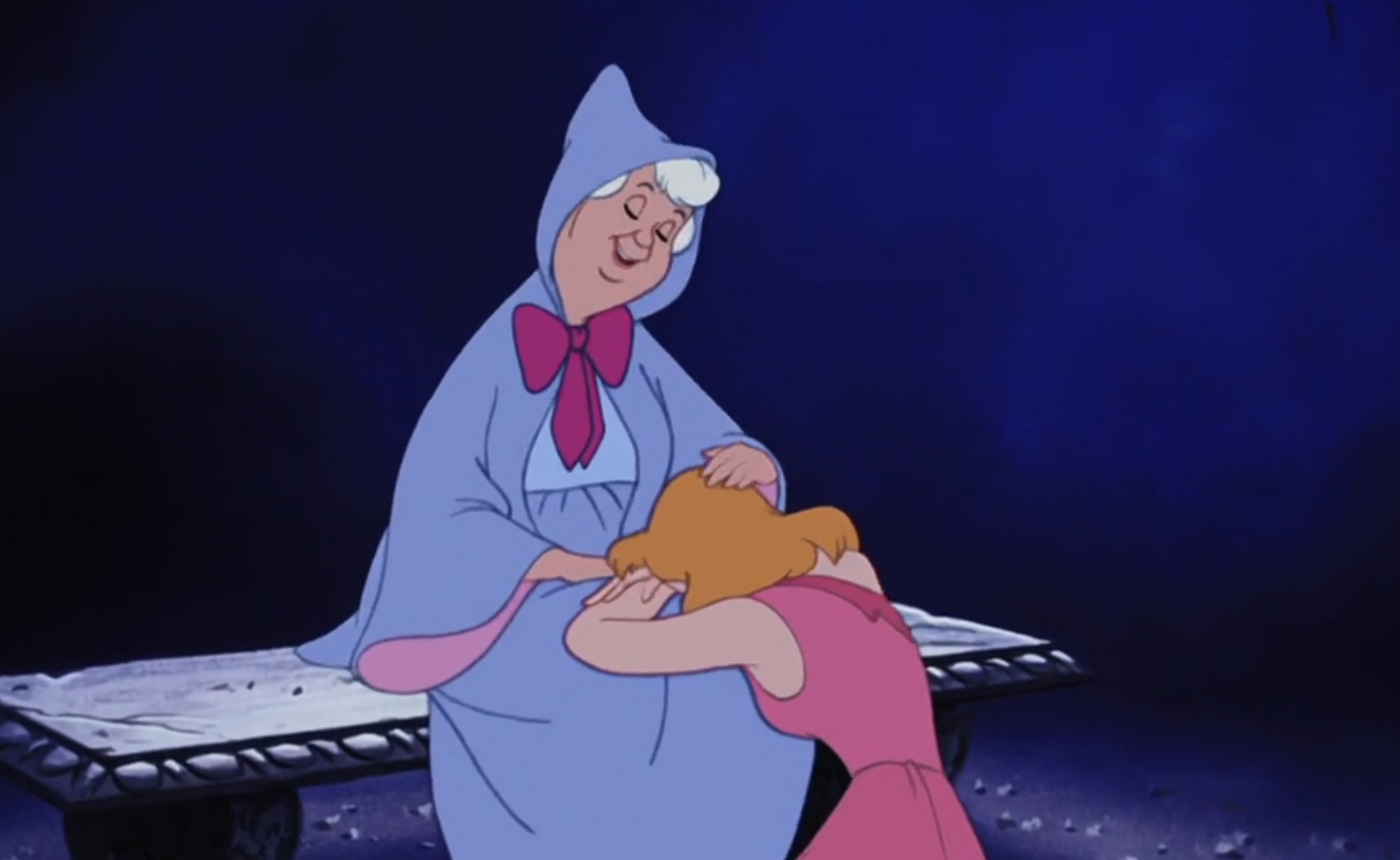
Cinderella (Clyde Geronimi, Wilfred Jackson, Hamilton Luske, 1950).
Today, when we speak of “characterization,” we mean motivation, which is the terrain of screenwriters. The 2025 remake Snow White expands its backstory: This Snow White is a “fair” princess who rules justly, even baking apple pies for her subjects, before the arrival of the Evil Queen. In new songs, by Benj Pasek and Justin Paul, that are stapled onto the old, she advocates for resistance against her stepmother’s reign of terror, in spirited opposition to the individualism of her love interest, now a rakish bandit instead of a prince; she wins him over to her side, and demonstrates her bravery in battle.
The 1937 Snow White and the Seven Dwarfs and 1950 Cinderella films are not primarily about princesses. Disney animators discovered that what appeared refined and appealing in a single drawing of a beautiful girl came off as stiff and bland in motion. They are, rather, films about those funny little fellows the Seven Dwarfs, and Cinderella’s rambunctious mouse friends, who drive the stories forward and account for much of the interest. Thomas and Johnston write that it was best practice around Disney to “tell your story through the broad cartoon characters rather than the ‘straight’ ones. There is no way to animate strong-enough attitudes, feelings, or expressions on realistic characters to get the communication you should have.”
The remakes reverse and defy this, accompanied by an equally prosaic hyperrealism in their visuals. In the animated Cinderella, the fairy godmother shimmers into view as Cinderella weeps, head in arms, so that, suddenly, the orphaned girl is sobbing in the lap of a sympathetic maternal figure; in live action, Cinderella’s fairy godmother (Helena Bonham Carter, inevitably) simply pops up out of the background.
The seven diminutive friends of 2025’s Snow White—not identified as “dwarfs” in the film, and referred to as “magical creatures” in the marketing materials—were achieved through motion-capture performances and other digital techniques. Their movements are plasticky and herky-jerky, rather than springy and liquid—they’re not squishy, they’re rubbery, straining at verisimilitude instead of appealing to anthropomorphism.
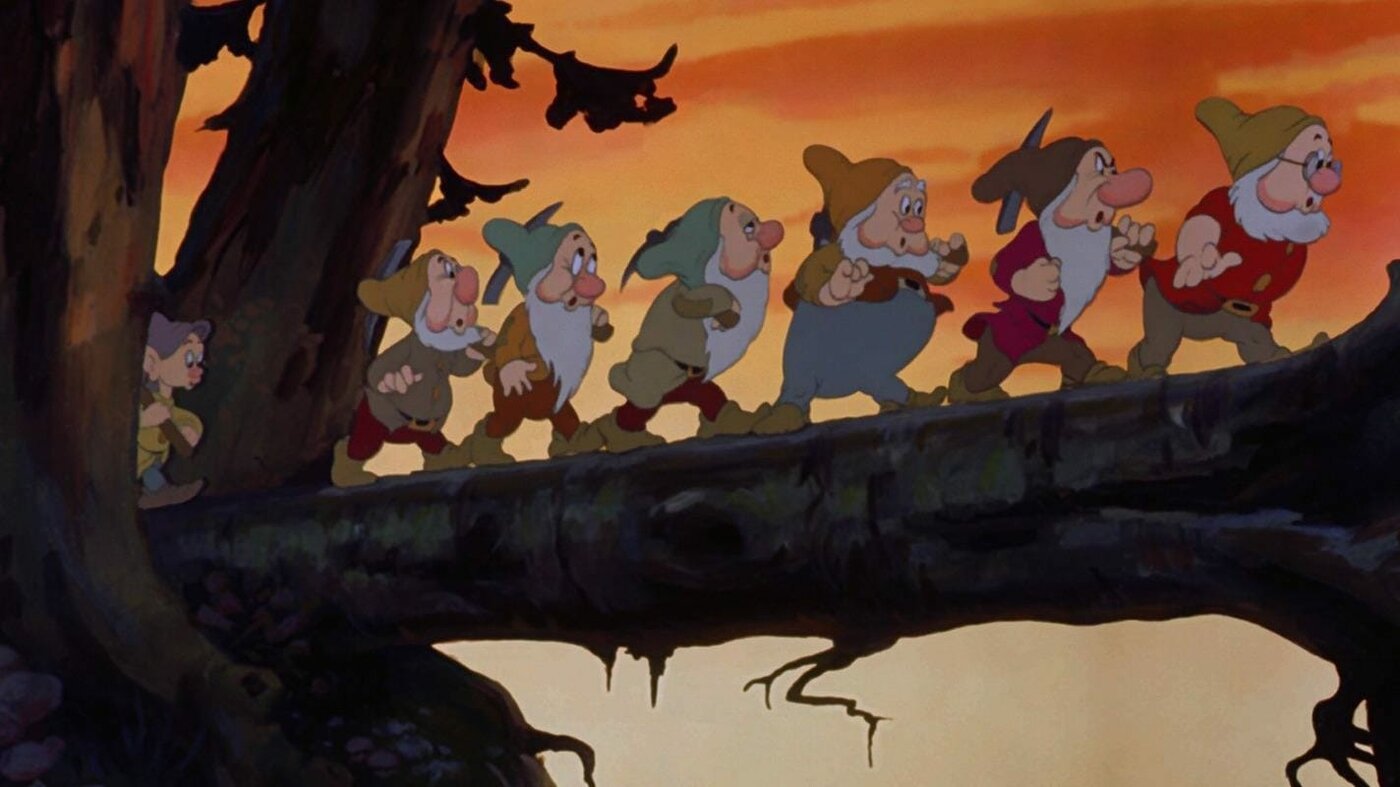
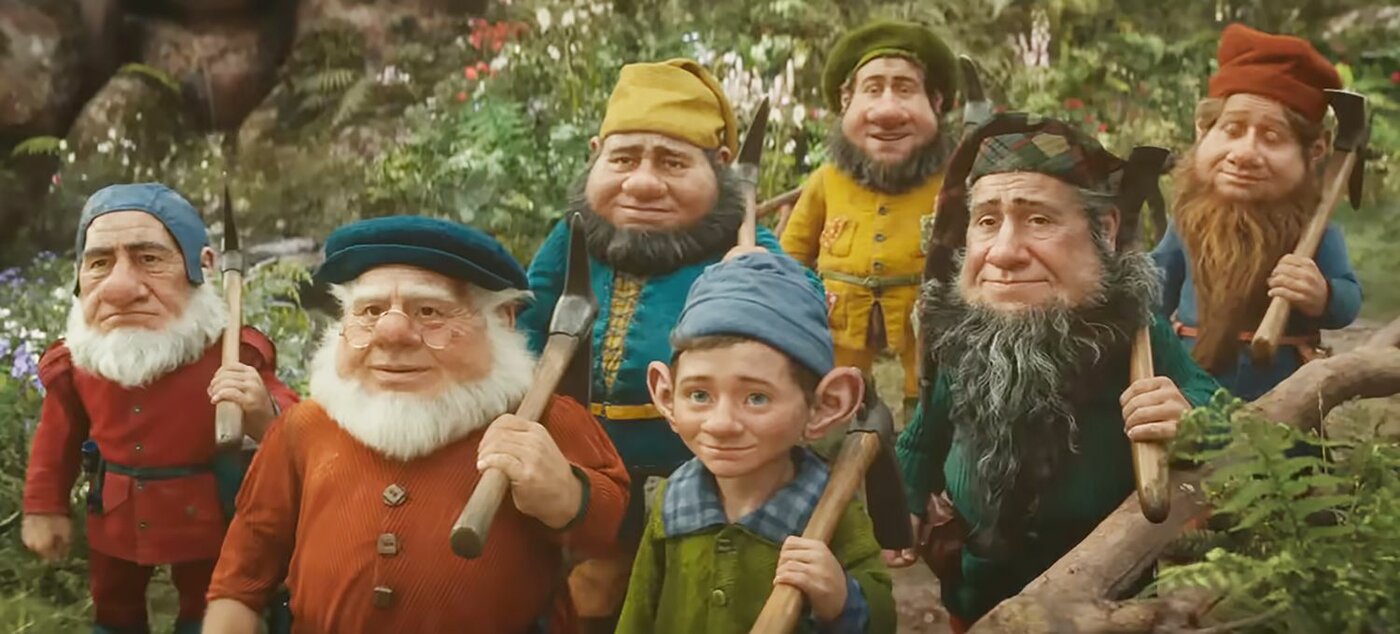
Top: Snow White and the Seven Dwarfs (William Cottrell, David Hand, Wilfred Jackson, Larry Morey, Perce Pearce, Ben Sharpsteen, 1937). Above: Snow White (Marc Webb, 2025).
To create the appearance of depth in hand-drawn cel animation, Disney, beginning in the 1930s, developed its multiplane camera that, in a staggeringly complex and time-consuming process, could photograph multiple painted glass plates in configurations adjusted frame by frame. In 2025’s soundstage production, the depth is simply there, in the sets—but instead of luxuriating in it, Snow White director Marc Webb and cinematographer Mandy Walker shoot much of it in shallow focus, with the edges of the frame blurry, in keeping with the current fad for imitating anamorphic lenses to muss up the clarity of high-resolution digital. The look is already dated—a risk when budding a received classic with an up-to-the-minute polish, and one that Disney remakes also encounter on the level of story.
Disney is all things to all people, a business model based on Walt’s humanist and opportunistic belief in universal entertainment. The Disney remake cycle coincides with an era of identity politics leveraged for corporate messaging, and in refurbishing now-problematic legacy properties with like-new sensitivities, the films often end up playing a kind of representation Jenga, assembling a teetering stack of demographic signifiers. The animated Mulan, from 1998, quite freely adapted from the Chinese legend of the girl soldier Hua Mulan, indulges in blithe orientalism, including, among other things, a dragon named “Mushu,” voiced by Eddie Murphy. The grimly action-oriented 2020 remake, which retains the melodies but not the words of the original’s songs, presents itself as more authentically Chinese, by dressing up inferior wuxia choreography with the handsomely compensated and gently utilized Donnie Yen and Jet Li. It mothballs Mushu in favor of a nonspeaking phoenix who rises from the ashes (not a Chinese concept), and downplays Mulan’s power-imbalanced romance with her superior officer in favor of a new female antagonist, played by Gong Li, who implores her to recognize her power as “a woman. A warrior.” The effect is to cheapen a foundational myth of female bravery in a male-dominated field (perhaps not incidentally: the 1998 Mulan is the favorite Disney movie of my younger sister, a neuroscientist) with triple-underlined girlboss buzzwords.
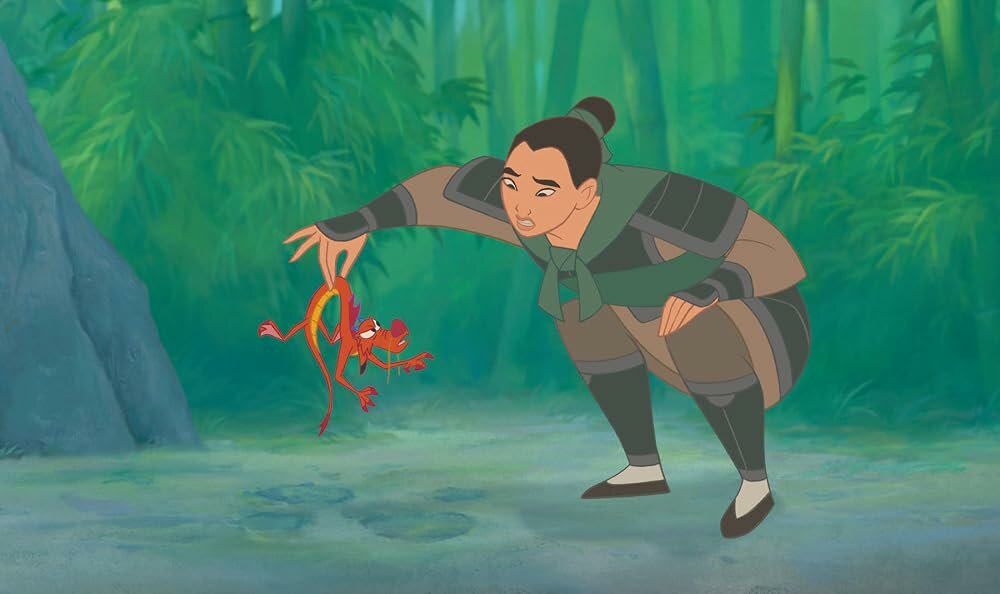
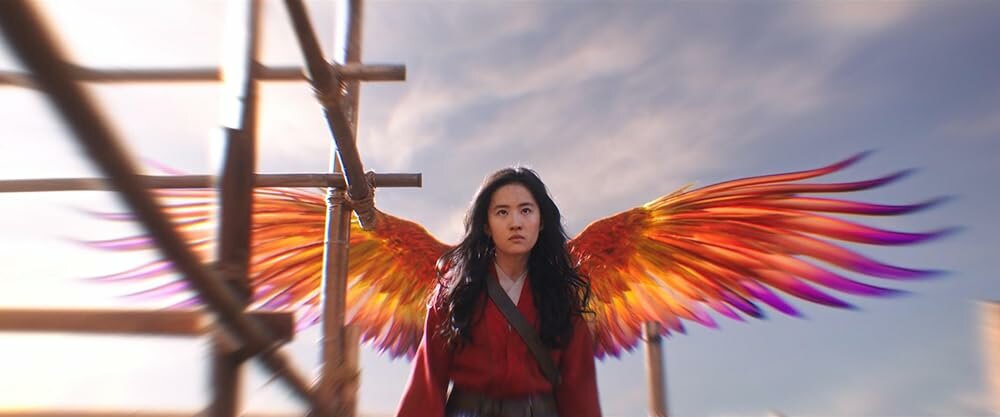
Top: Mulan (Tony Bancroft, Barry Cook, 1998). Above: Mulan (Niki Caro, 2020).
This is cynical, and it makes Disney’s remakes feel untrustworthy and primarily self-protective. The company’s well-documented triangulations—Iger fought anti-woke activist investor Nelson Peltz’s bid to join the Disney board in early 2024, then walked back DEI language after Trump’s reelection—invite audiences to be hyperattentive to the political valence of its every choice; Snow White’s financial underperformance was foreordained following weeks of bad press, and disgust, from opposite quarters, about the casting of either the anti-Zionist Rachel Zegler or the IDF veteran Gal Gadot. If the backlash against the casting of a Black actress, Halle Bailey, as Ariel in The Little Mermaid (2023), was obviously racist, other revisionist gambits have warranted more genuine scrutiny. As part of its effort to recenter a Chinese perspective, the live-action Mulan was shot partly in Xinjiang—home of China’s persecuted Uyghur minority, which raised eyebrows in concert with the story’s themes of filial and imperial loyalty.
The remakes also underestimate the flexibility of audiences, who might identify with a film for many reasons beyond demographic determinism. Sloppy and imprecise attempts to integrate Chinese concepts like “chi” into Mulan only served to remind Chinese-diaspora viewers that the director, Niki Caro, and key members of the writing and production team were no more Chinese than the makers of the original, and in any case the film performed poorly with Chinese moviegoers. As it happens, the highest-grossing foreign film released in China so far this year is another Disney animated film, Zootopia 2 (2025)—a point, perhaps, in favor of the broad-brush humanism school of populism, as opposed to the 2020 Mulan’s attempt at narrowcast pandering.
***
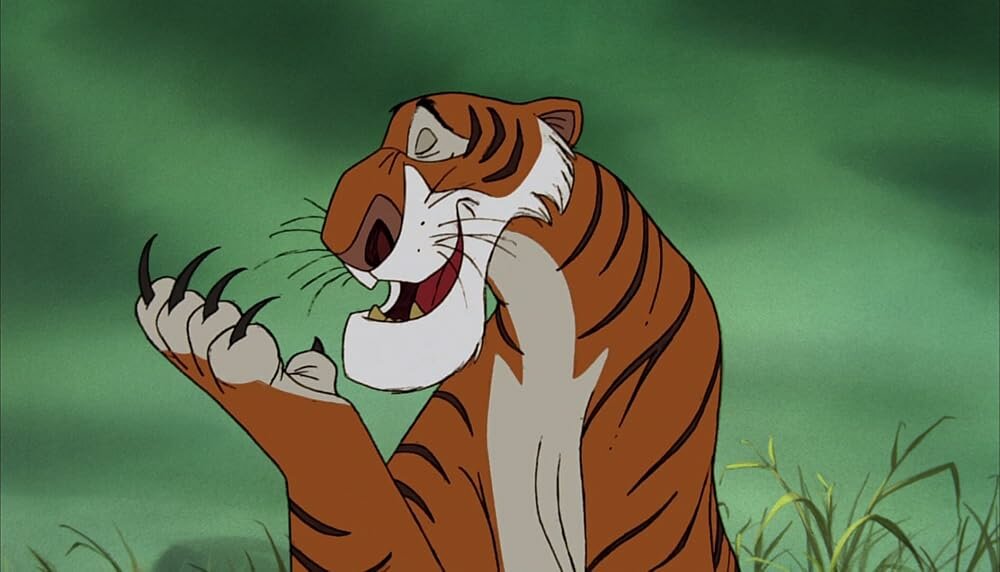
The Jungle Book (Wolfgang Reitherman, 1967).
Walt Disney was a holistic entrepreneur, a “storyteller” in the modern, advertorial sense. A cartoonist first, he became a mogul in the Thomas Edison mode; the innovative films made under his aegis were one part of an empire touching on all aspects of mass production and mass communication. After the difficult 1940s, he diversified his portfolio in the 1950s, moving into live-action filmmaking, television, and parks, beginning with Disneyland—which began the same way his animated films did, with concept illustrations, and relied on many former animators, retitled “Imagineers,” to design the narratives and special effects of its attractions.
Disney had myriad methods of coaxing, berating, and evading his employees in order to get them to execute his vision, which was clear in his head if not in his words. He was what we would now recognize as a founder: emotionally manipulative, inscrutable, and inspiring. As he grew less involved in the day-to-day operations of the animation department, processes became more streamlined, making hand-drawn animation financially sustainable beginning in the 1950s, and eventually leading to the integration of the Computer Animation Production System (CAPS), developed with the engineering laboratory Pixar, beginning in the 1980s.
Production of The Jungle Book (1967), released shortly after Disney’s death, made use of a copying technique developed by in-house wizard Ub Iwerks in collaboration with the Xerox corporation. The machine could copy animators’ drawings, enabling headcount reductions in the Ink and Paint department, but would render outlines in uniformly thick blacks, and couldn’t pick up lighter lines. As a consequence, the colors in The Jungle Book are blockier, with less shading; movement comes from accent lines (or, in the case of Milt Kahl’s design for Shere Khan, tiger stripes). Animators had long performed anatomical studies, reviewing nature footage, skeletal models, and even dissections to pick out the aspects of musculature and gait that could make, for instance, Shere Khan seem sensual and sinister rather than beefy and brutish; they allowed themselves more leeway with the eyes and ears, which communicate in a very human language of squints and scrunches.
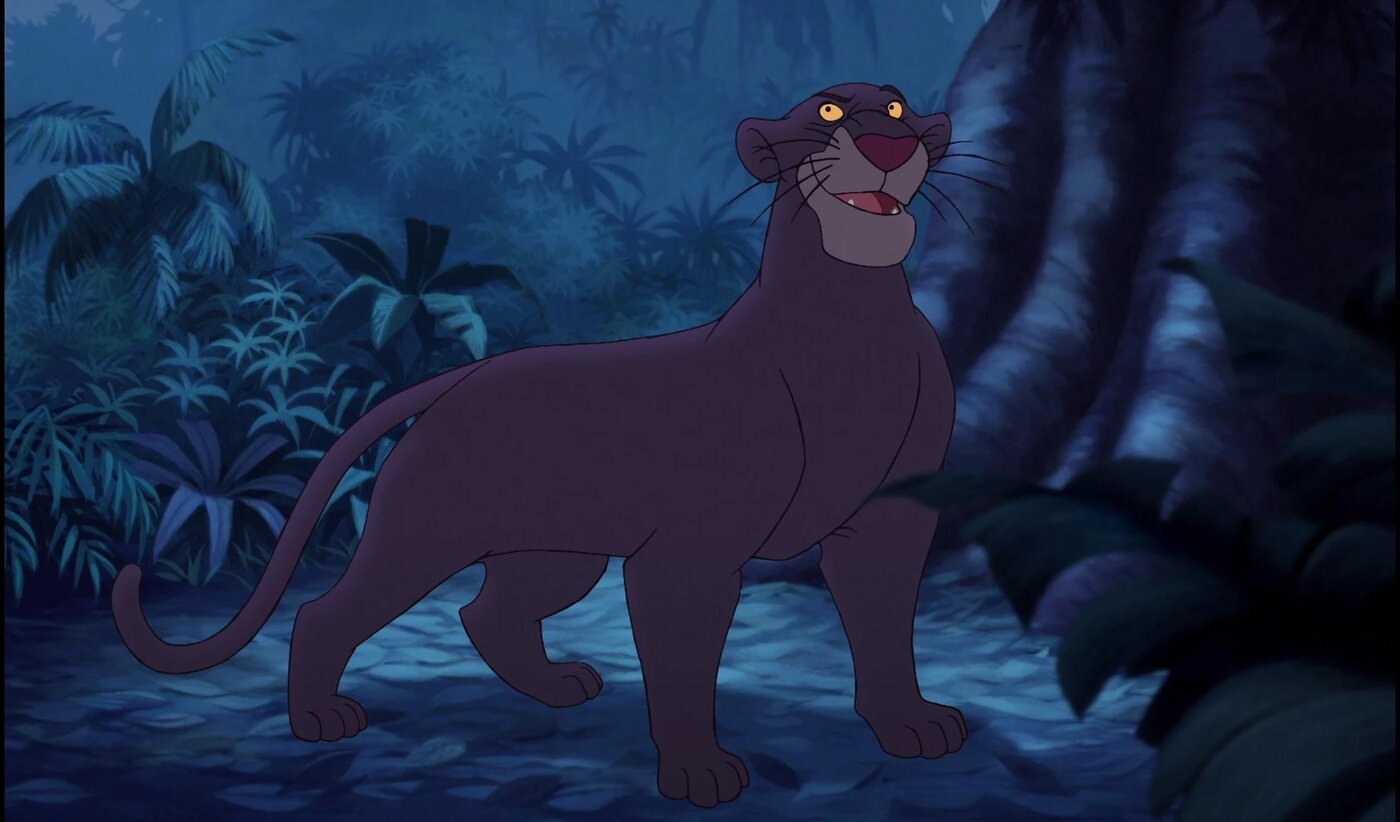
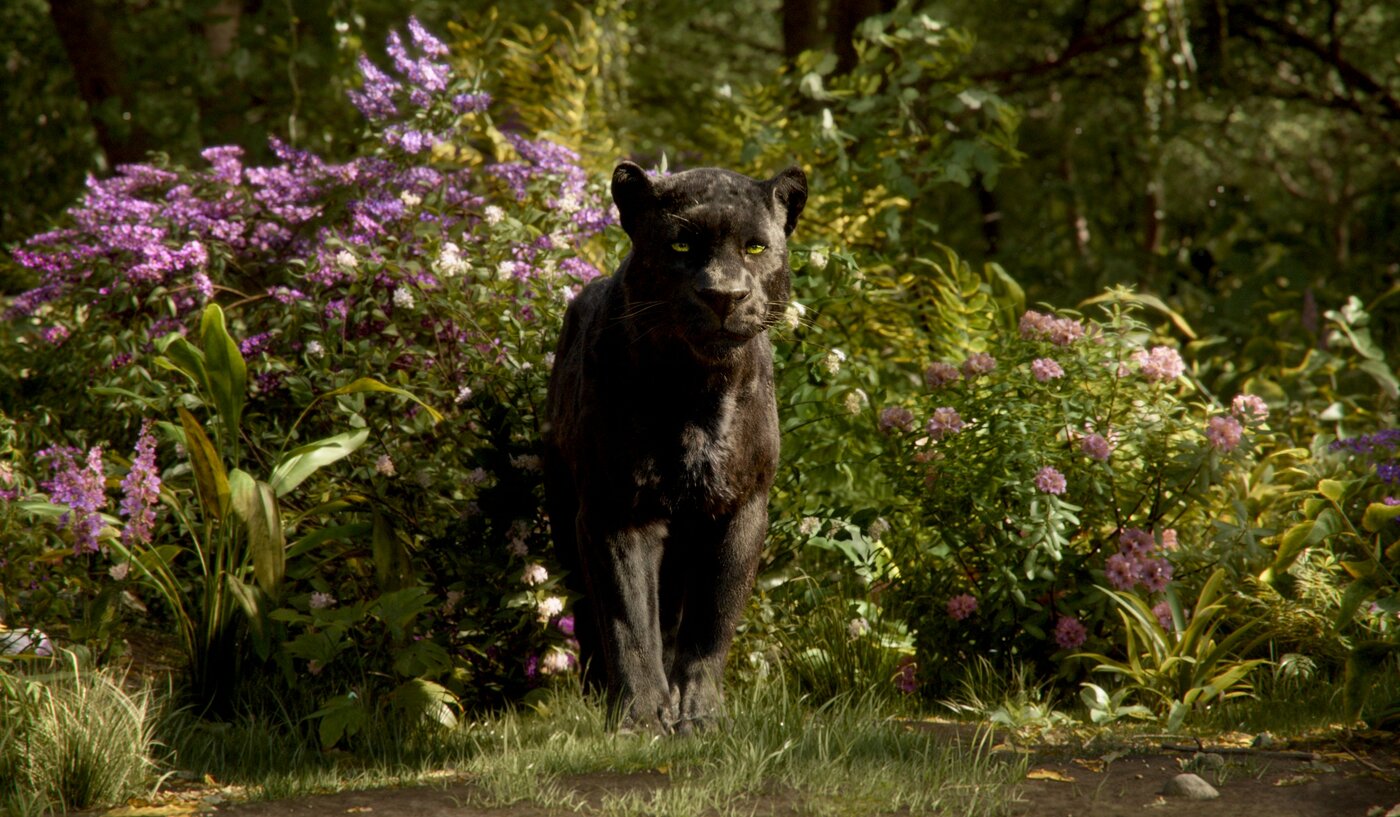
Top: The Jungle Book (Wolfgang Reitherman, 1967). Above: The Jungle Book (Jon Favreau, 2016).
Jon Favreau’s 2016 Jungle Book remake was an entirely virtual production except for the young actor, Neel Sethi, who plays Mowgli. He acted opposite puppets on soundstage, in front of a blue screen later filled in with animated backdrops derived from reference images. Conjuring the animals with a balance of relatability and accuracy, Favreau and his digital artisans faced the same challenges as classic Disney animators, and likewise used nature footage for modeling, though their definition of “realistic” is very different from Walt’s, and involves “54 species of animals and 224 unique animals with new computer programs to better simulate muscles, skin and fur,” created by effects house MPC. The panther Bagheera is fully black, as he could not be in the hand-drawn version, and as a result, changes of expression are lost in his muzzle; rather than the hand-drawn Bagheera’s pious head-and-neck poses, MPC created “subtle facial cues that don’t stray too much from an animal’s normal range,” according to supervisor Adam Valdez.
The remake hits all the main beats of the original with additions integrated from Rudyard Kipling’s stories and ingested whole from screenwriting labs: To give audiences points of identification, formulaic story hacks replace fantasy and imaginative empathy. The wolves that raised Mowgli are now his chosen family (as the magical beings would be to 2025’s Snow White). The film vacillates in tone from whimsy to beefed-up action-film grammar, with several animals enlarged to be more intimidating, and a climactic Avengers-assemble interspecies battle. The realism here is literal-minded, rather than intuitive. A flashback explains why Shere Khan—who is a tiger—fears fire and harbors animosity toward mankind.
For many of the Disney remakes, the line between live action and animation is as fine as any of the thousands of computer-generated, algorithmically controlled hairs on the squash-stretch animals of Snow White and Cinderella. It certainly is in 2019’s Aladdin, a film concerning a genie who can conjure digital special effects.
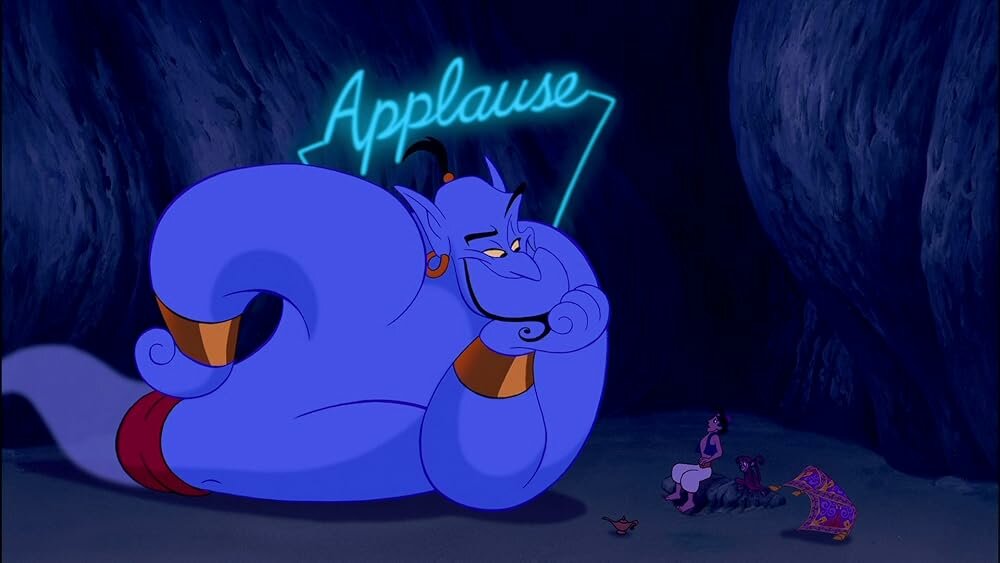
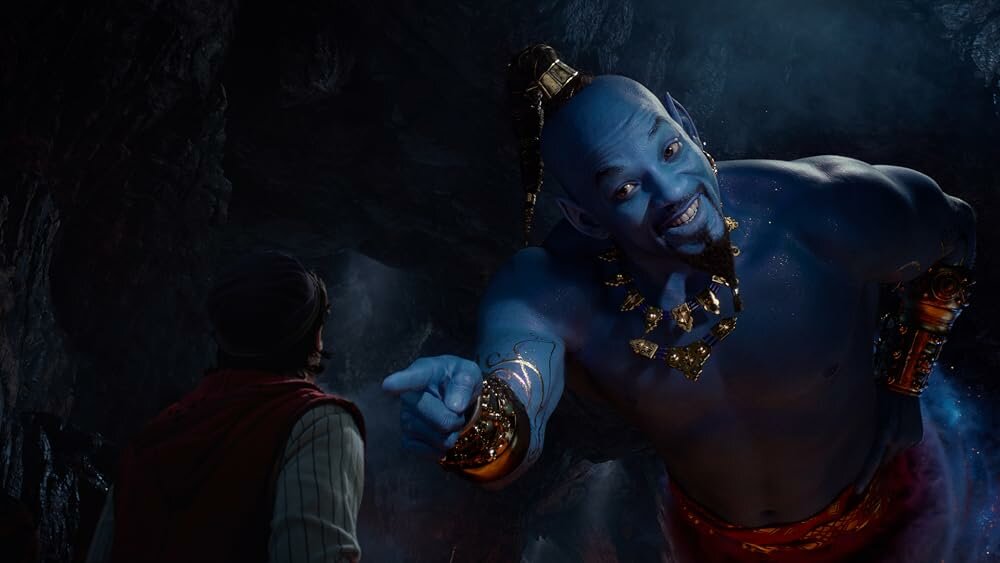
Top: Aladdin (Ron Clements, John Musker, 1992). Above: Aladdin (Guy Ritchie, 2019).
It was not until the Eisner years that Disney animated features began to be developed from a script first, rather than iterated by animators, but 1992’s Aladdin was unique in that Robin Williams, as the genie in the lamp, was given license to ad lib all his dialogue. Directors John Musker and Ron Clements selected the choicest riffs from Williams’ sixteen hours of improvisation, much of it in his slightly old-fashioned pop-culture vocabulary, which then affected layout, sight gags, and especially the genie’s shapeshifting character design as executed by animator Eric Goldberg. Guy Ritchie’s remake tries to replicate this energy with Will Smith’s genie, but he’s still Will Smith: He gets a love interest this time, and raps the plot of the movie over the ending credits, as he did for Barry Sonnenfeld’s Wild Wild West (1999).
Like most of the live-action remakes, this Aladdin runs more than a reel longer than the original; as with most of the live-action remakes, the padding is attributable to the movie recreating everything fondly remembered about the original, while adding new material for audiences who would love to revisit a childhood favorite, either with their own children or for their own pleasure, but who today, after a lifetime of listening and learning, feel squicky about some of the dated lyrics, or the regressive gender dynamics. This Aladdin brings in Pasek & Paul to rewrite some of the racist lyrics of “Arabian Nights,” and to give Jasmine a new number in which she declares she “won’t go speechless,” but will assume her rightful place as Agrabah’s benevolent monarch.
Williams was the genie of 1992’s Aladdin, speaking animation into being; the real genies of the remake are its previz artists and visual-effects technicians, to whose magic we are rather inured to these days. If hand-drawn animation aimed to inspire wonder at what artists could create, digital animation aims to inspire wonder at what computers can do—a wonder enfolded into a more functional and industrial vision of progress.
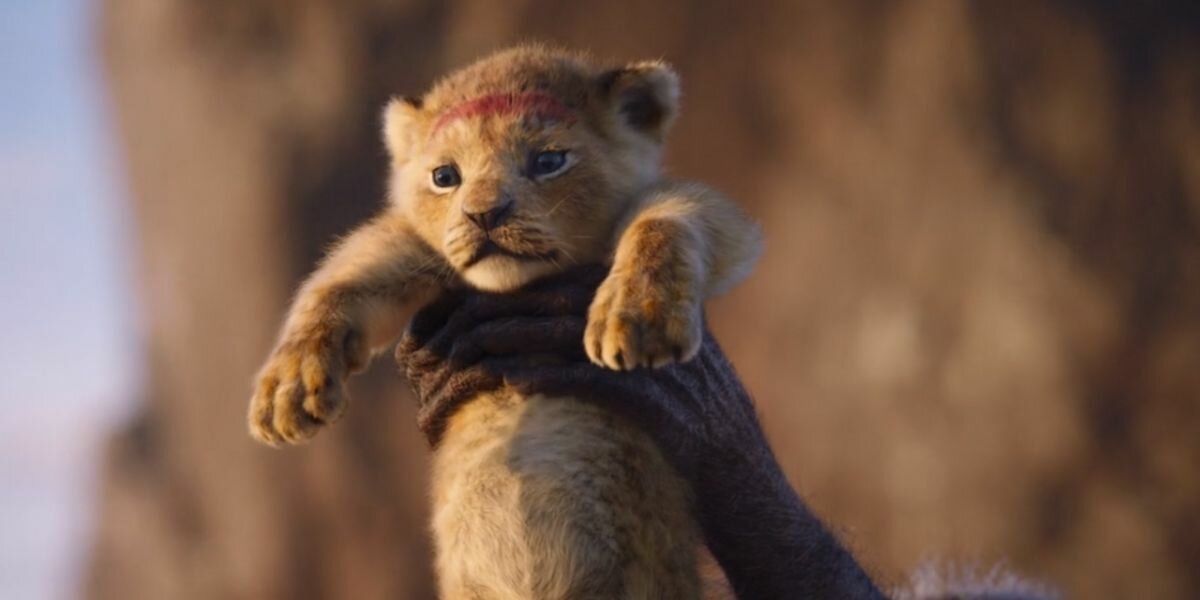
The Lion King (Jon Favreau, 2019).
Favreau’s next photorealistic remake, The Lion King (2019) is even more impressive and less expressive than his Jungle Book. The Jungle Book follows classic Disney in varying its levels of realism character by character, taking more exaggerative license with comic-relief characters—many of Baloo’s expressions, particularly around the eyes, are voice actor Bill Murray’s own, via motion capture—but the characters of Lion King are almost uniformly true to life, like outtakes from a 4K David Attenborough documentary. This type of realism is incongruous when the film’s dancing and comic choreography is equally true to the 1994 original: Yup, that really is what it would look like—the rippling of the muscles under the fur, the minuscule twitches in response to buzzing insects—if a mandrill raised up a lion cub to be adored by assembled throngs of elephants and antelopes, or if zebras at a watering hole scattered because a warthog farted.
Frame-by-frame nature footage enabled Disney animators to see “the chest working against hips, or the backbone bending around […] living examples of the ‘squash and stretch’ principles,” as Thomas and Johnston write. But these movements were too “complicated” and “subtle” to animate effectively. The 1994 Lion King was well cast (“casting” once meant something closer to character design), giving animals characteristic actions and body shapes that fit the energy of their character—the nervous and obsequious hops of Zazu the hornbill or the neurotic posture of Timon the meerkat. The 2019 animals do realistic animal things during the dialogue—lions scratch themselves, nuzzle each other, or sprawl indolently—but Favreau surrendered a certain amount of control in directing performance to an AI algorithm, trained on videos of animal behaviors associated with hunger or aggression. Virtual production supervisor Ben Grossman described the film as being almost “like a simulation.”
Three years on from Jungle Book, the facial cues engineered by MPC for The Lion King are subtle to the point of Kuleshovian: minuscule wrinklings of the nose, widening or blinking in the eyes, repositioning of the ears. Seeing the same dialogue from the 1994 version being acted out by “real” lions quickly becomes absurd—it plays like a joke dub, like What’s Up, Tiger Lily? (1966) with lions talking about fulfilling their destiny.
While the Disney live-action remakes had started as spin-offs and reimaginings, this Lion King is a high-water mark for fidelity, with cosmetically updated dialogue about Nala (Beyoncé Knowles-Carter) stepping into her power integrated into an almost shot-for-shot recreation, including replicating zooms that seem impossibly hacky outside the context of colorful 2D drawings. Hans Zimmer’s score, a reworking of his music from 1994, is soaring, awestruck, hermetic in its reverence for its predecessor.
***
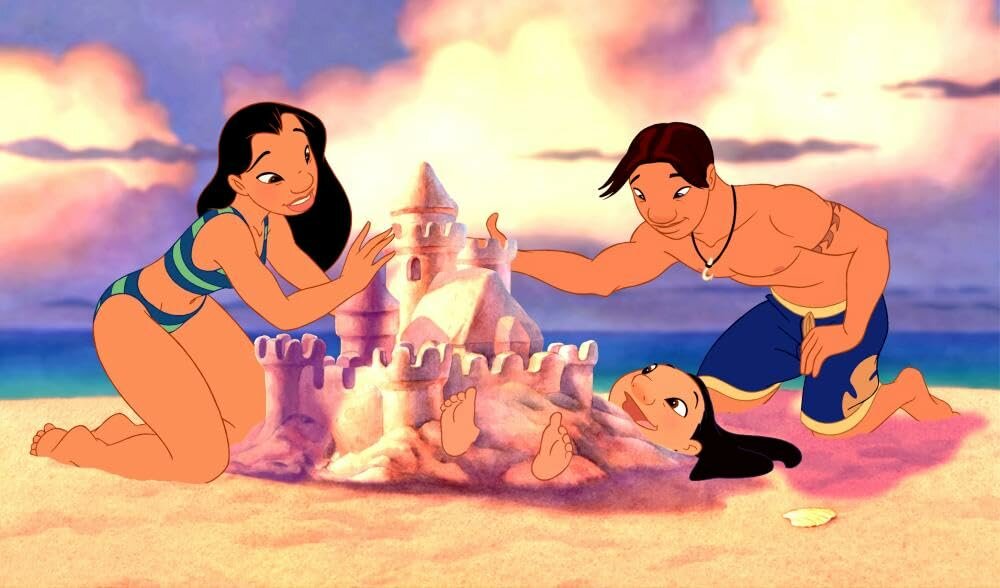
Lilo & Stitch (Dean DeBlois, Chris Sanders, 2002).
In his 1961 book The City in History, the social historian and architecture critic Lewis Mumford described the suburb as a “child-centered environment,” an idyllic space “segregated” from the environmental and economic malaise of the overcrowded city, but also from its cultural and intellectual stimulation, so that “reality has been progressively reduced to what filters through the screen of the television set.” With suburbia’s salubrious green space and emphasis on recreation, leisure, or more specifically “childhood, became the pattern for all the seven ages of man,” and life devolved into “a bland ritual of competitive spending” in which “one might live and die without marring the image of an innocent world, except when some shadow of its evil fell over a column in the newspaper. Thus the suburb served as an asylum for the preservation of illusion.”
As suburbia came to dominate the American built environment in the decades following World War II, Walt Disney became interested in urban planning. Disney based Disneyland’s walkable and close-knit Main Street, U.S.A. on his own hometown, Marceline, Missouri, as it was in his own childhood at the dawn of the twentieth century. The EPCOT theme park was originally conceived as a utopian community, with futuristic technology such as the monorail facilitating a garden city, with green belts separating residential dormitories from a concentrated commercial core—a pastoral and collectivist model, originating in the utopian socialism of the Industrial Revolution, which without central planning invariably devolved into automotive sprawl and, in Mumford’s words, “the temptation to retreat from unpleasant realities, to shirk public duties, and to find the whole meaning of life in the most elemental social group, the family.”
Both before and after the child-centered 1950s, Disney oversaw an American imaginary as manicured as a well-kept lawn, which was maintained through the related mediums of television and consumer products. In the cultural desert of suburbia, “television,” the historian Steven Mintz has written, “provided the ideal medium for reaching child consumers.” After ABC’s Disneyland broadcast several episodes based on the life of the nineteenth-century frontiersman Davy Crockett, in 1955, the coonskin cap emerged as “the first Baby Boomer fad,” with as many as five thousand caps sold in a day. This would be a rehearsal for Elvis, for Beatlemania, for Swifties: for childhood fancies, and the memory of them, vouchsafed as national icons by the power of the checkbook. Under Eisner, Disney set the goal of releasing one theatrical animated feature per year, while also acquiring direct-mail toy retailers and aggressively pursuing tie-in opportunities.
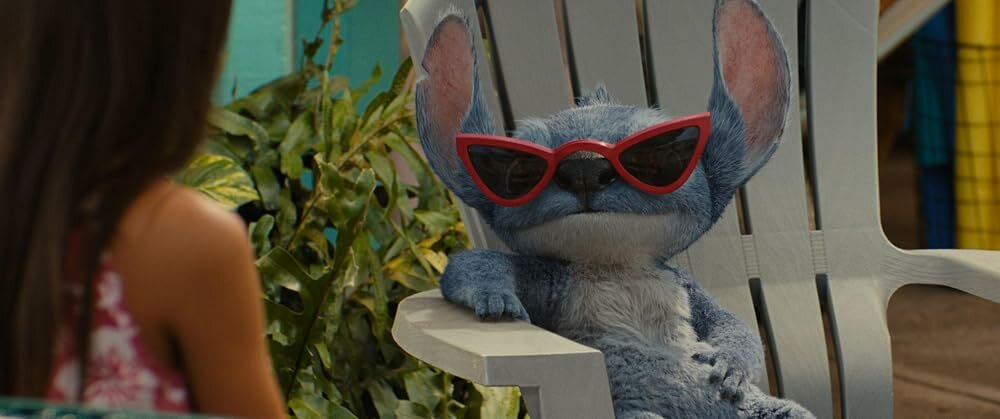
Lilo & Stitch (Dean Fleischer Camp, 2025).
Having done so much to define the childhood of its most loyal customers, the company cannot now reify new IP without incurring the retrograde anger of Disney adults, who are protective of their traditions, and upset that their history of spending has not given them more of a say in their maintenance. With its infantilized audience trapped in the amber of postwar suburbia, Disney finds itself backed into a creative cul-de-sac. “The [original] ride was great because of the nostalgia,” complained one disgruntled fan of the reskinned Pirates of the Caribbean unveiled earlier this year. Disney is always ruining somebody’s childhood. A representative article from a popular gaming website runs down some objections to 2025’s live-action Lilo & Stitch, such as that the treatment of the mad scientist who created Stitch, a cute alien bioweapon who falls to earth and is adopted by a six-year-old girl, “robs him of his arc of discarding his selfish scientific ambitions in favor of treating his creations like his children, much to the chagrin of some long-time fans.” Disney has assumed the unenviable position of remaking movies which people loved as children; people will reverse-engineer positive messages out of any work of art that gave them positive feelings as a child.
It is those childhood warm-fuzzies that animate Mumford’s “ritual of competitive spending.” In both versions, Lilo & Stitch is a sugary comedy about a troubled girl and the mischievous pet she loves unconditionally—it is essentially a film in which a little kid interacts with a plushie. In the live-action remake, Stitch, now a 3D digital animation, squashes and stretches just like the animated version does, or a well-loved doll. And so, despite the chagrin of some long-time fans, Stitch was “shaping up to be this year’s most popular toy,” it was reported in early 2025.
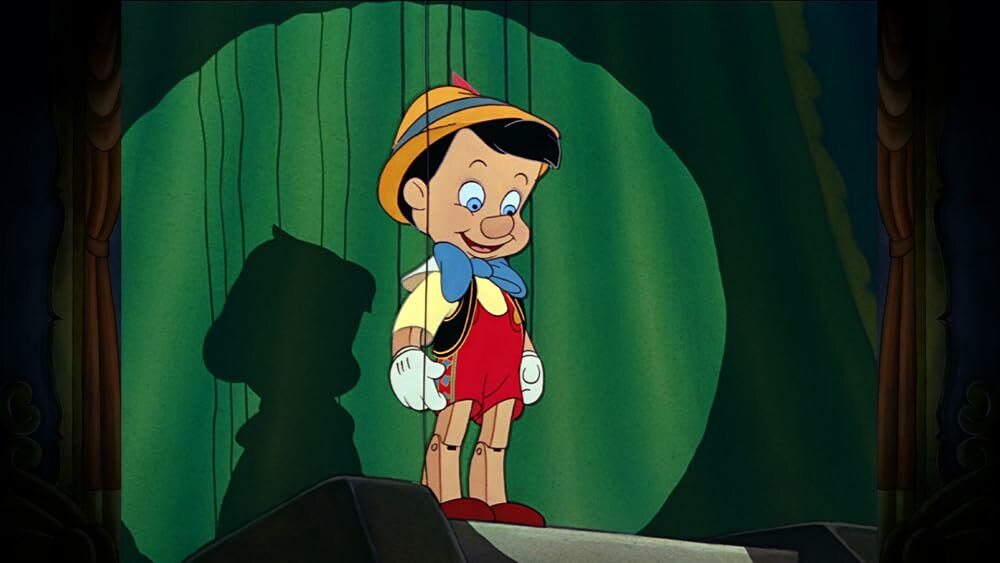
Pinocchio (Norman Ferguson, T. Hee, Wilfred Jackson, Jack Kinney, Hamilton Luske, Bill Roberts, Ben Sharpsteen, 1940).
The postwar explosion of suburbia and the rise of Boomer consumer culture were products of a time characterized by increasing standards of living and a thriving manufacturing economy; today, economic growth driven by consumer spending is fueled by escalating personal debt. There is a parallel here with Disney’s strategy of driving its stock price by plundering its old IP, rather than investing in something new. In this context, Robert Zemeckis’s Pinocchio (2022) is the most interesting film in the cycle.
The 1940 Pinocchio is revered by latter-day fans of Disney’s Golden Age for its cutting-edge effects, particularly its stunningly elaborate multiplane shots, including a legendary 45-second pan through (by my count) six background plates, in imitation of a crane shot taking us from the hills out on the outskirts of Pinocchio’s village, through the bustle of street life, and right to his front door. The virtual production environment of Zemeckis’s remake is hardly a marvel on that level, but in other ways the director imbues the film with a pleasingly elastic, Golden Age-sense of relatable, exaggerated “realism.” He stages violence with actually cartoonish slapstick timing; Pinocchio moves with a stiff-jointed knock-kneed walk and limp feet turned in awkward directions, like a puppet, or a vaudeville performer imitating one.
Zemeckis recreates story beats and even specific visual jokes with eerie accuracy and fitting embellishment. Pleasure Island, where wayward children are lured with the promise of rampant and destructive play, becomes a Disney park, which Pinocchio tours on a boat as if on a ride: first an old mill ride, then a log flume, a Ferris wheel, and a roller coaster called Sugar Mountain—a pun on Disney’s own Thunder, Space, and Splash Mountains, and also a reference to Neil Young’s eponymous Boomer lament, about a fun fair, full of balloons and candy floss, that everyone has to leave upon turning twenty.
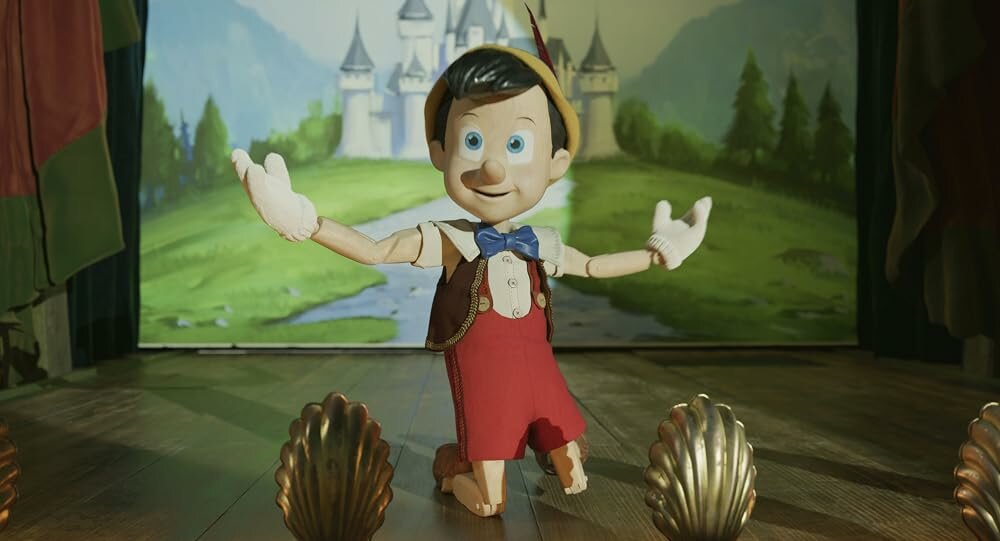
Pinocchio (Robert Zemeckis, 2022).
The script, which Zemeckis cowrote with Cinderella and (uncredited) Snow White cowriter Chris Weitz, makes Geppetto (Tom Hanks) a bereaved father who carves Pinocchio as a replacement for his dead son, but the film surprisingly avoids many of the traps it sets for itself. Pinocchio gets a love interest—not the real girl in Stromboli’s theater, whose leg brace does not thwart her love of dance, but the marionette she puppeteers. The girl marionette is elegantly integrated into a reprise of “I’ve Got No Strings” from the original film, and her facial expressiveness is more literally wooden than Pinocchio’s own, yet still appealing, clearly an “illusion of life.”
Geppetto is a prolific fashioner of cuckoo clocks, which ring all at once; each automaton is a Disney character, from Donald Duck and Sleeping Beauty to Hanks as Woody from Toy Story (1995) and Zemeckis’s own Disney/Warner Bros. crossover, Who Framed Roger Rabbit (1988). With his long-standing interest in classic texts and new technologies, Zemeckis is a filmmaker who practically lives in the uncanny valley, and the cuckoo clock gags are, like the Overlook Hotel sequence in his fellow Boomer self-mythologizer Steven Spielberg’s Ready Player One (2018), sprightly, recursive, and definitionally lifeless—which is also a description of Pinocchio himself. This imitation of a 1940 movie, itself about a doll built in imitation of a real boy, is deft about its commercial imperatives and ontological superfluousness.
***
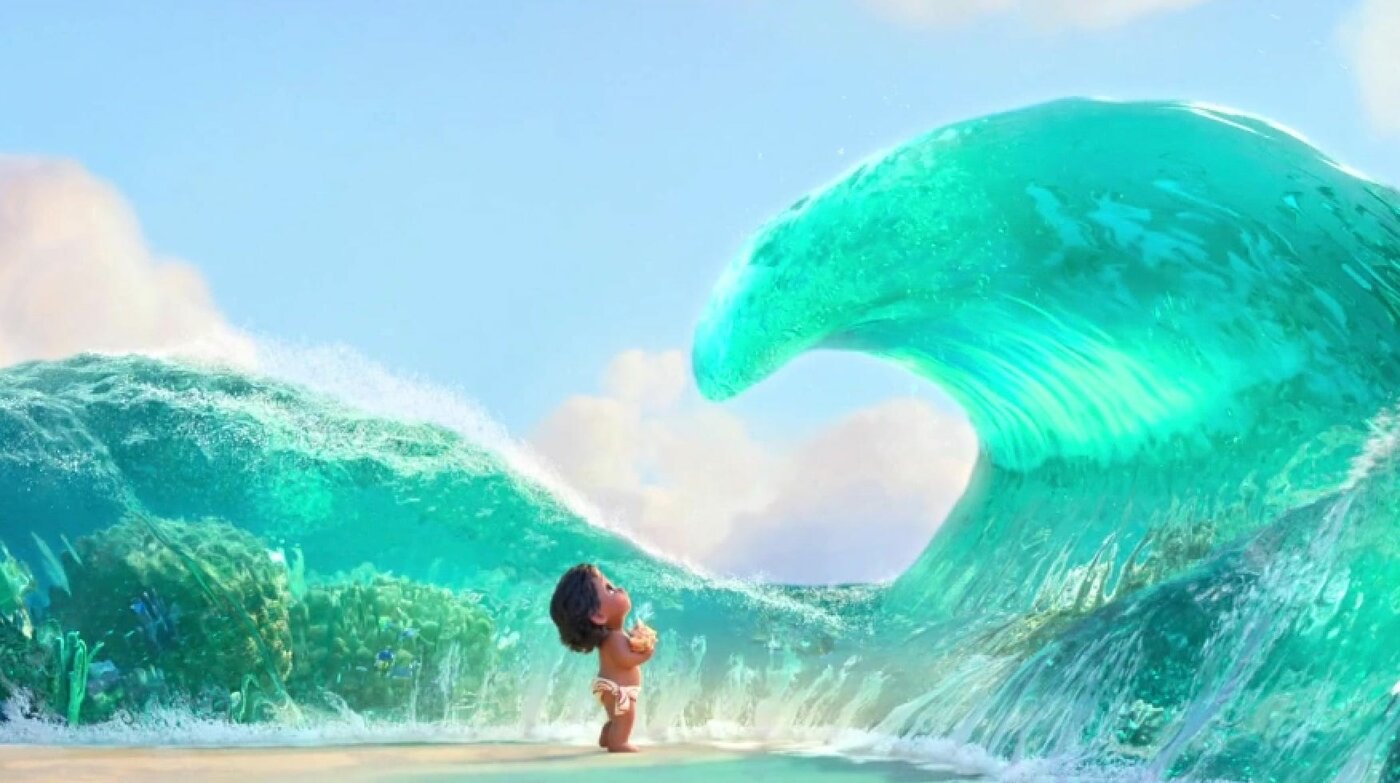
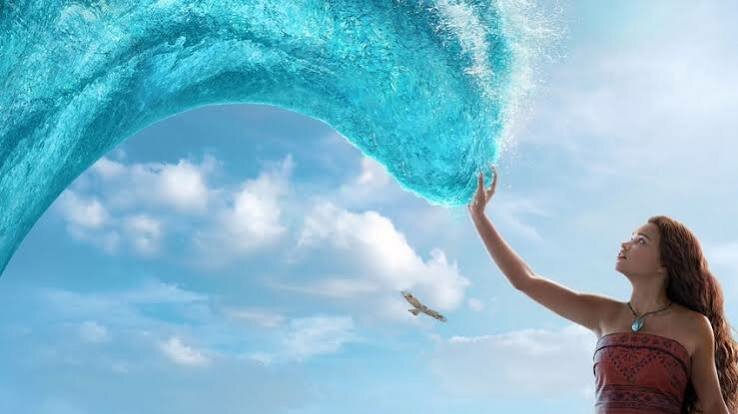
Top: Moana (John Musker, Ron Clements, 2016). Above: Moana (Thomas Kail, 2026).
Moana, released in theaters in July of this year, marks the first time Disney has remade in live action a film made with 3D digital animation: All prior originals discussed in this article are 2D animation, and all except Aladdin and The Lion King were entirely hand-drawn.
What this means, in practice, is that there is no sense of distance, no curiosity factor in seeing the same story told with a different look, or excitement at revisiting a familiar world rebuilt with new tools. To create the ocean in 2016’s animated Moana, technicians customized the visual-effects software Autodesk Maya to build out lapping waves, frothing wakes, and thousands of tiny bubbles, and created algorithms, similar to the ones used in The Lion King three years later, to randomize its movement. Autodesk Maya is used in both animated and live-action films, and the VFX water is not measurably different in 2026’s live-action Moana, though the stormy nighttime scenes and encounters with digitally animated mythical beasts, also a feature of the original, are lit darker, presumably to cover the compositing of human actors into the scenes.
Water, an eternal problem for animators, is a major component of some of Disney’s key transitional films. The animators of The Little Mermaid hand-drew some million bubbles for the underwater scenes, building on the many color tests conducted during Pinocchio on inks and highlights to create the proper iridescence of Ursula’s crystal ball, onto which visions of Ariel are superimposed, is reminiscent of the soap-bubble effects devised by Ub Iwerks for 1950’s Cinderella. Disney would be open about its use of AI in the 2019 Lion King, before as much stigma attached to the technology, but its use of CAPS to expand the color palette of Ariel and Prince Eric’s wedding was not revealed for years, until the studio had fully transitioned to computer animation, making The Little Mermaid is something like a last hurrah for hand-drawn cel animation. It makes use of many special effects devised during the golden age: Visual effects supervisor Mark Dindal looked back to Pinocchio, in particular, for its use of distortion effects, including glass plates passed between the camera and the cel for a ripple effect, and a multiplane camera was sourced from outside the studio, as the in-house camera was no longer functional. The extravagant use of these retro techniques was the basis of the “Disney Renaissance” narratives, along with the profound nostalgia of Baby Boomers, now parents, taking their young children to a movie about a Disney princess who, like Snow White, is tormented by a wicked witch with a magic mirror, and, like Cinderella, is magically transformed and given a chance to win her prince. (One difference: Ariel, with her enormous eyes, is a pretty girl finally expressive enough to carry the narrative herself, though she still has cute and caricatured animal sidekicks.)
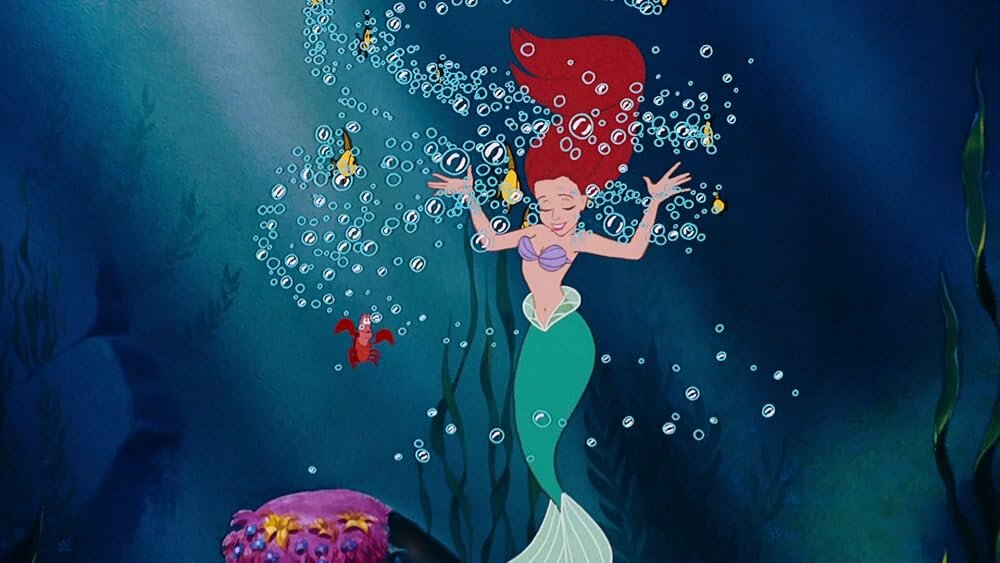
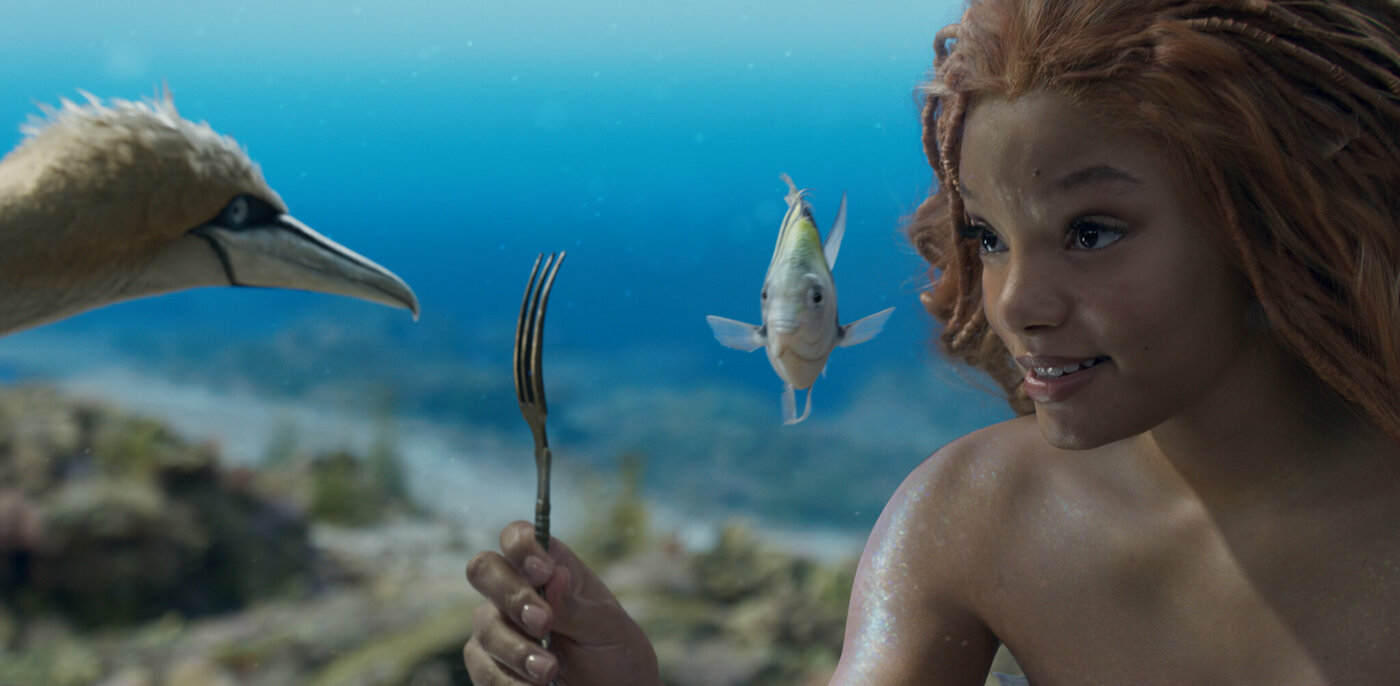
Top: The Little Mermaid (Ron Clements, John Musker, 1989). Above: The Little Mermaid (Rob Marshall, 2023).
Those million bubbles add depth and constant movement, which is essential in a film whose underwater scenes depict 2D ink-on-celluloid figures bobbing up and down in front of a painted blue background. In the live-action Little Mermaid, the blue background of the underwater scenes evokes a bluescreen, in front of which the characters were filmed on rigs, with their gliding fins animated in after. It is evident, despite their gently bobbing hair, that they are not underwater. Water is three-dimensional; in underwater photography, there is texture between the subject and the camera. In 1989’s “Part of Your World,” the bubbles suggest depth, while the traditional special effects create an impression of light shining down from above the ocean’s surface and variegated by the prismatic effects of the currents. The 2023 Little Mermaid frequently simply adjusts the blue tint of the color palette to be brighter or duller depending on the depth of the ocean in a particular scene; many underwater closeups are clearly illuminated by three-point lighting.
When the action moves to land, The Little Mermaid simply looks like any other movie. The 1989 version captivates audiences with its evident, evidently handmade artistry; the 2023 Little Mermaid aims to convince its audience that its characters are worth caring about. If, acting out Snow White and the Seven Dwarfs, Walt Disney played to an imagined American public comprised of simple folk who would react with simple laughter or tears to things that were happy or dopey or sad, his company now imagines a public that can only be needled into caring once persuaded that the characters have obstacles recognizably similar to our own.
The ending of The Little Mermaid is a boss battle with a giant Ursula; what was a challenge for the 1989 version’s traditional animators is a problem for the live-action version’s 3D digital animators, since it looks exactly like any other effects-heavy CGI spectacle. Likewise for the action set piece at the climax of this year’s Moana, with the added issue that it additionally looks exactly like its predecessor. And it sounds like it, too. The original Moana was released the year after the live-action Cinderella, and its story was evidently shaped by the same priorities reflected in Disney’s changes to its older stories: The daughter of an island chief, the princess of 2016 was already in line to become her people’s leader, as Cinderella and Snow White were reworked into being; the villain of 2016 is already simply misunderstood (during the climactic song, Moana tells it that its trauma “does not define” it). Dwayne Johnson and Jemaine Clement return as the characters they voiced in 2016; in the case of the apparently ageless Johnson, the role of the vain, charming demigod Maui was already tailored around his cartoonish but lightly borne physique.
The question of motivation—Who, at what age, are these movies for? Would anyone watch them if they didn’t already love the original? But in that case, why would they want a remake?—is never far from the surface in Disney’s live-action cycle, but the bloatware updates of previous films at least provided a plausible explanation: Political considerations, splashy stars, flashy tech. This Moana is closer to the original than any other Disney remake to date. The film proceeds scene by scene, line by line and camera setup by camera setup, with any variations amounting to a few doodles in the margins—barely enough to qualify as a dialogue pass. Few girls who were twelve years old in 2016 have children old enough to sit still for an entire movie in 2026; more generally, few parents of Disney-aged children would naturally gravitate toward a live-action version rather than the more juvenile-coded animated film which is readily available on Disney+. Perhaps a weary caregiver, worried about a child growing restless on the umpteenth rewatch of a reliable favorite, might hit Play on the remake, betting that the novelty of a second-verse-different-from-the-first take will extend its utility. Perhaps, given that the only real difference between then and now is that we’re all ten years older, Disney’s bet is simply that there’s big money to be made in eliding this difference, if only for two hours.
Disney will, it seems, keep making these movies as long as people keep watching them; industry reporters attributed Moana’s less than boffo box office to remake fatigue, but its success or failure will be determined by its staying power on Disney+. When you simply imagine what your favorite Disney Princess would look like in real life, you’re engaging with Disney IP without paying for it. Previous leadership of the company colonized that mindspace with toys, games, costumes, and other merchandise; today it’s an expanded menu of options on the company’s streaming service. Tomorrow, who knows, but it seems unlikely that OpenAI’s discontinuation of Sora, and winding down of its Disney partnership, is the Mouse House’s last dalliance with generative AI. If Roy E. Disney, protective of his family’s legacy, once accused the company of pimping out Tinker Bell, no one today seems to mind if Disney is staring into a mirror, looking up its own ass.