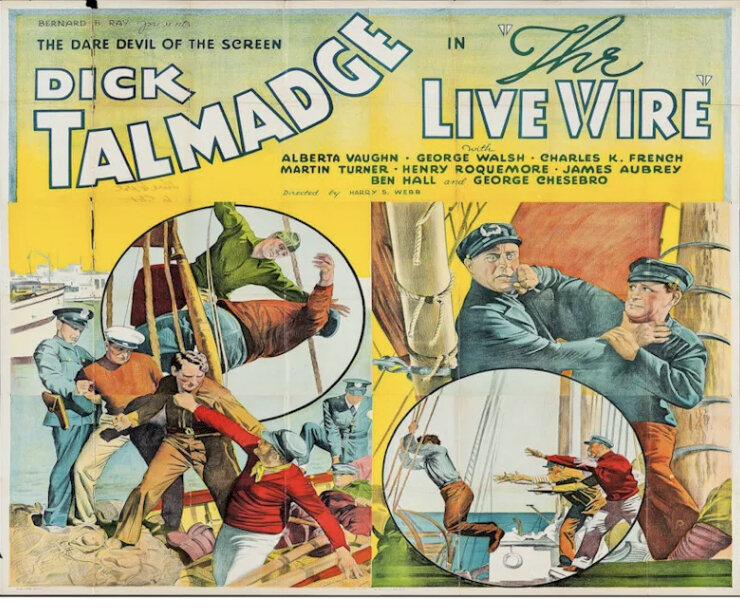
US poster art for The Live Wire (Harry S. Webb, 1935).
“The amazing athletic ‘stunts’ performed by Mr. Talmadge in this picture are actual, and are not achieved by means of ‘doubles,’ ‘dummies,’ or tricks of the camera.” — Title card at the head of Let’s Go (1923) “You can try to draw a picture or CGI of what things are. We don’t do it that way. It’s real, and you’re dealing with physics.” — Tom Cruise on Mission: Impossible – The Final Reckoning (2025)
In 1925 Richard Talmadge, “Dare Devil of the Screen,” appeared in eight action films in which the former acrobat leaped, tumbled, and brawled across the screen; in 2016 Scott Adkins appeared in eight action films in which the former martial artist leaped, spin-kicked, and brawled across the screen. Cinema had undergone vast changes over the intervening century in technology, audience, and style, but it had always kept a place for astonishing athletic feats, what Tom Gunning called (in describing pre-1905 filmmaking) “the cinema of attractions”—an exhibitionist cinema “that directly solicits spectator attention” and “is of interest in itself” outside of any narrative frame. With the continuing backlash against the use of AI in film production, there is growing demand for the realness a stunt show can provide. The marketing of Talmadge’s daredevil falls and Tom Cruise’s HALO (high altitude, low opening) jumps use strikingly similar language: this is real, it is actual, someone could die, so you should keep watching.
Talmadge doubled for Douglas Fairbanks in silent action classics like The Mark of Zorro (1920), headlined Poverty Row thrillers into the sound era, and ended his career as a second-unit director and stunt coordinator—his final credit was on the adventure telefilm The Fantastic Seven (1979). His springy climbing ability made his chase scenes look like proto-parkour, but his calling card was death-defying leaps that crash land on trains, cars, or on top of a gang of thugs. Authenticity was integral to his appeal, and the reality of his stunts was part of his marketing routine from the beginning. No one watched his films for the subject matter or the artistry of the director; they wanted to see him fall off tall buildings and go splat. He was variously promoted as “The Dare Devil of the Screen” and “The Man Without Nerves,” making his movies more like Jackass than narrative art.
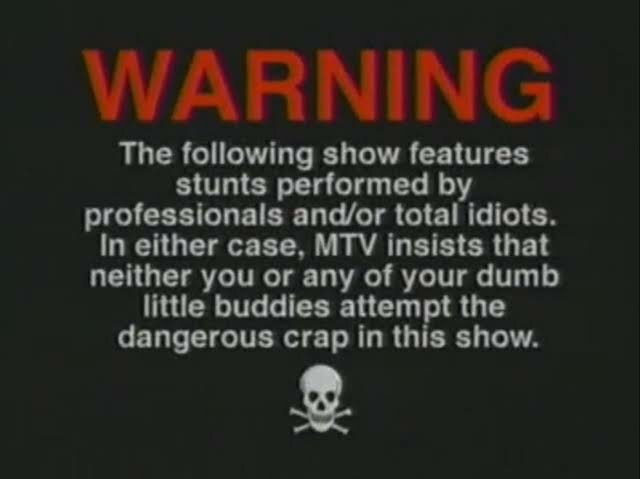
Original MTV disclaimer from the first season of Jackass (2000).
Talmadge was very protective of his professional image, and sued Popular Mechanics magazine in 1926 for $500,000 when it wrote that he used dummies for some of his stunt falls (I cannot find a report on the suit’s resolution). Much like how Cruise has built up a promise of realism around the Mission: Impossible franchise, Talmadge highlighted the danger of his very real stunts, posing with a broken neck in Pictures and Picturegoer. Touting injuries is an essential marketing technique for any authentic action star: Scott Adkins frequently discusses his torn ACL on Universal Soldier: Day of Reckoning (2012), Tom Cruise broke his ankle during a building jump in Mission: Impossible – Fallout (2018), and, most famously, Jackie Chan shows outtakes of his worst injuries during end credit sequences, including the gruesome aftermath of his shopping mall Christmas light-pole descent in Police Story (1985), during which he suffered burns and a dislocated pelvis.
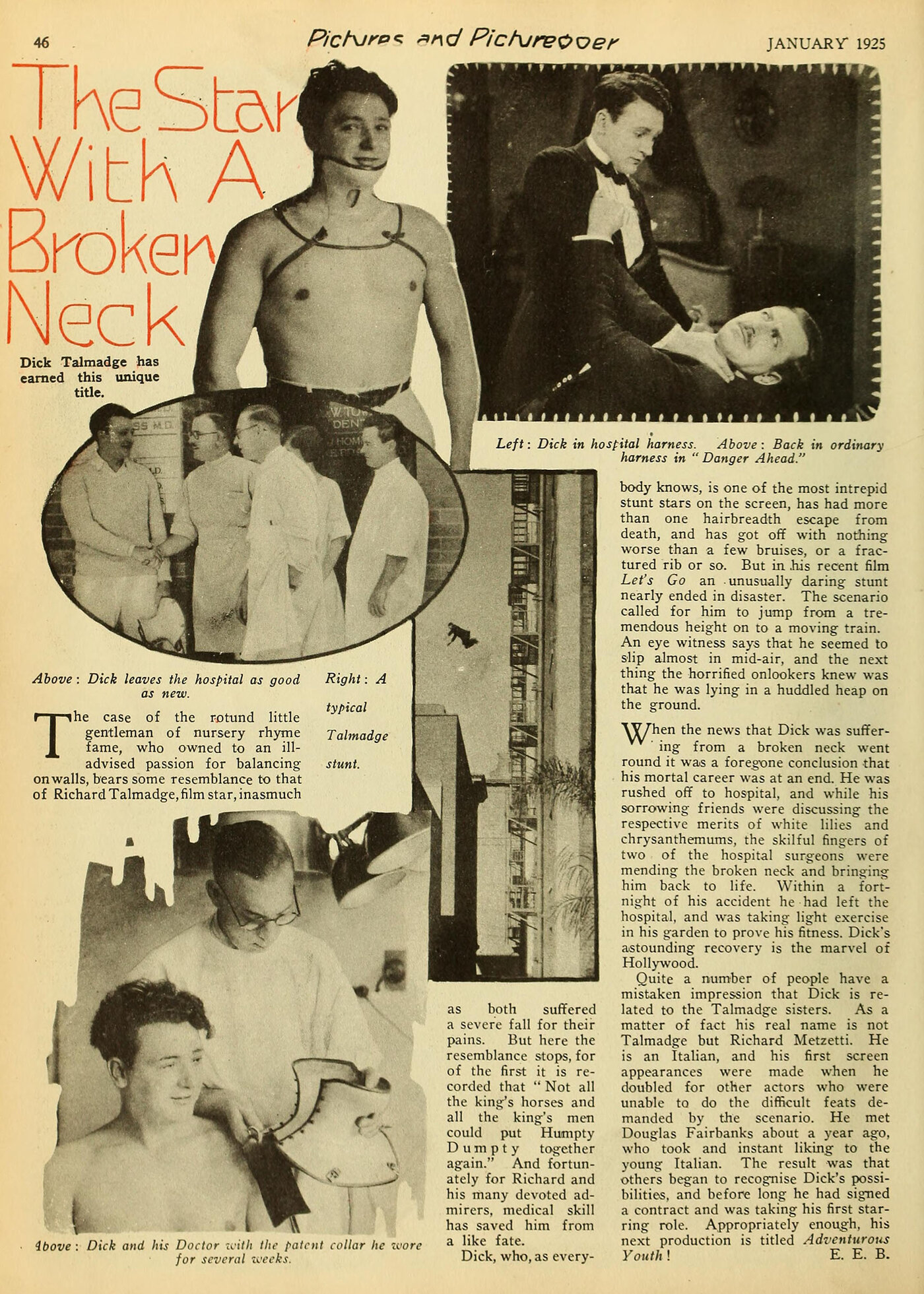
Pictures and Picturegoer, January 1925.
Talmadge was born in either 1892, 1894, 1896, or 1898 in Switzerland, Munich, NYC, or on the Swiss–Italy border. The only fact multiple sources agree upon is that he was a member of the European family acrobat troupe the Flying Metzettis and learned to leap as soon as he could walk (similar to Jackie Chan and Sammo Hung’s early training in Peking opera). As he told Picture Play magazine, “My father had trained me not to fear anything that we worked out mathematically as being physically possible.” He brought that mathematically precise stunt work to Hollywood in the early 1910s, recalling in the New York Times that: “My first picture […] was called The Million Dollar Robbery. I played the part of a fellow who makes a prison break and jumps off a four-story building. The picture was made at Fort Lee, N.J. I had to bring my own assistants. I got $20 for the job and after I was done paying off my helpers I had $4 left.” His brothers Victor and Otto Metzetti became stuntmen themselves, while his third brother, Leon, was his frequent production manager.
Talmadge was born Sylvester Metzetti, and the impresario A. Radin suggested that he should change his name to Pickford or Talmadge, to draft off these famous family names (the Talmadge sisters were silent-film stars). Soon, Richard “Dick” Talmadge, faking a relationship to Hollywood royalty, would be tapped for fame by the real thing. After doubling for slapstick comedian Larry Semon, Talmadge caught the eye of Douglas Fairbanks, Sr., the premier action-film star of his era. Known for his remarkable leaping ability (with the occasional aid of trampolines), Talmadge transferred from a galloping horse to a hanging rope to a high window in The Mark of Zorro, sprinted and leaped onto a rising drawbridge in Robin Hood (1922), and performed an iconic ride down a pirate ship sail, with his movement stabilized by a dagger, in The Black Pirate (1926). Doug was impressed with Dick’s athleticism and hired him to rehearse difficult stunts before performing them himself, so he could work out the technique and timing—the silent-film-era version of previs. Talmadge also doubled as Doug on some especially tricky stunts. Fairbanks was nursing an injury during the shooting of The Mollycoddle (1920), and Talmadge later admitted to Fairbanks and Mary Pickford biographer Booton Herndon that he performed the centerpiece stunt himself: jumping off a cliff onto the villain, who was clinging to a tree.
In 1920, billboards and advertisements started to appear in Hollywood: “Who is Richard Talmadge, The New Stunt Star? Ask Douglas Fairbanks—He Knows.” Doug is shaking Dick’s hand in one image, while in another Dick is balancing on top of Doug’s shoulders. Plans were underway to make Talmadge into the next great silent-film star, with the endorsement of Fairbanks himself. Real estate developer and Poverty Row producer Phil Goldstone ended up backing Talmadge on his earliest features, including his starring debut in The Unknown (1921), in which Dick played a businessman by day and a masked vigilante by night. Goldstone produced Talmadge’s features up to 1923’s Thru the Flames, at which point Talmadge started his own production company, Richard Talmadge Productions, for which he made some of his best work.
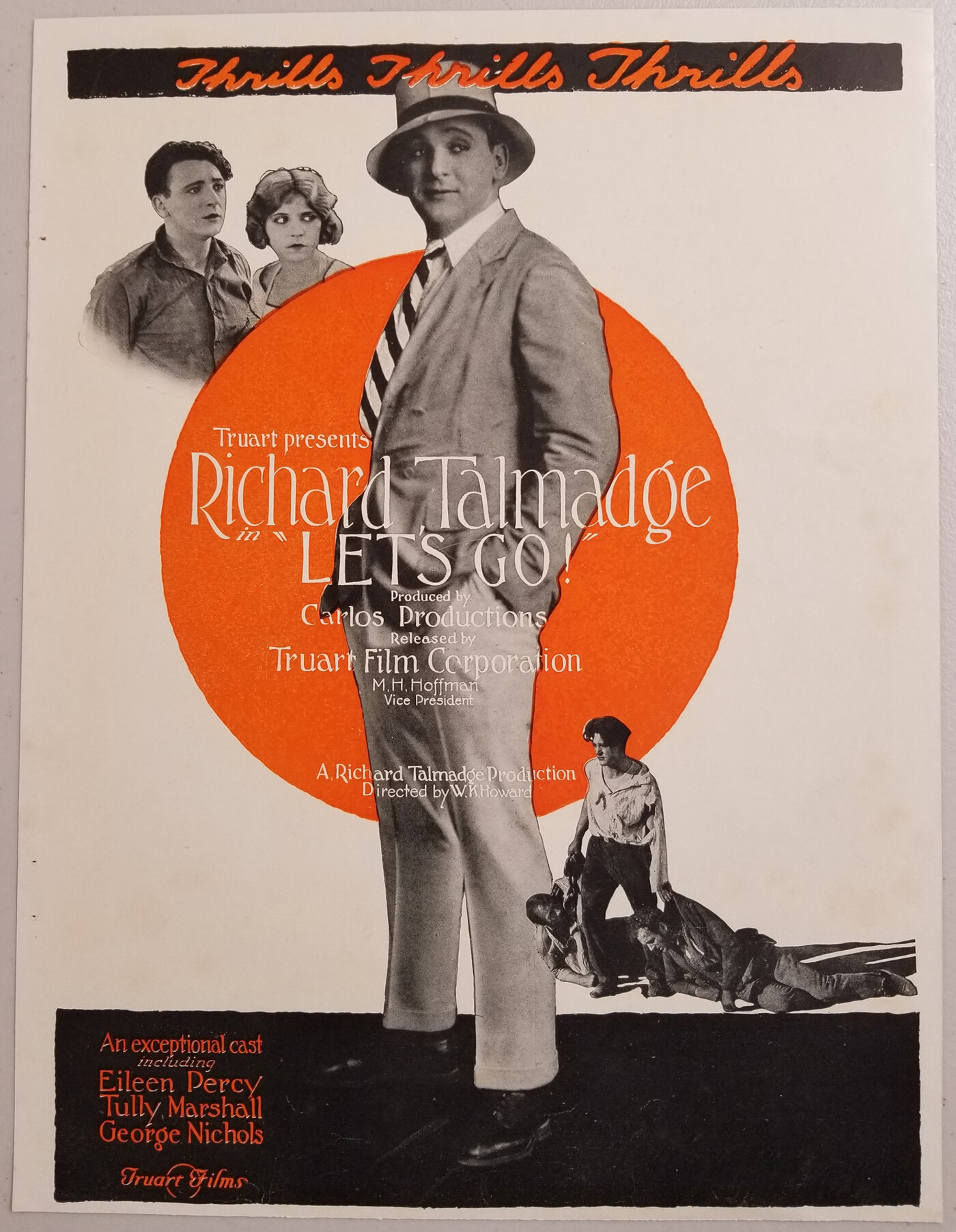
US poster art for Let’s Go (William K. Howard, 1923).
Let’s Go (1923) is the ne plus ultra of Richard Talmadge action movies, a nonstop chase that pairs him with the wildly inventive director William K. Howard. Talmadge stars as Barry Macklin, the wayward son of a cement magnate, who gets mixed up in a scheme to steal money from his dad and escapes to the backwater town of Hillsboro. He is pursued by a corrupt mayor, a gang of thieves, and the sheriff. Caught between these forces, all Macklin can do is run, jump, and crash through various inanimate objects. One of the jaw-dropping stunts occurs early on, when Talmadge jumps from the second-floor facade of a city building straight into a car and drives away, immortalized in a lobby card emblazoned with the tagline “There is a thrill in it!”
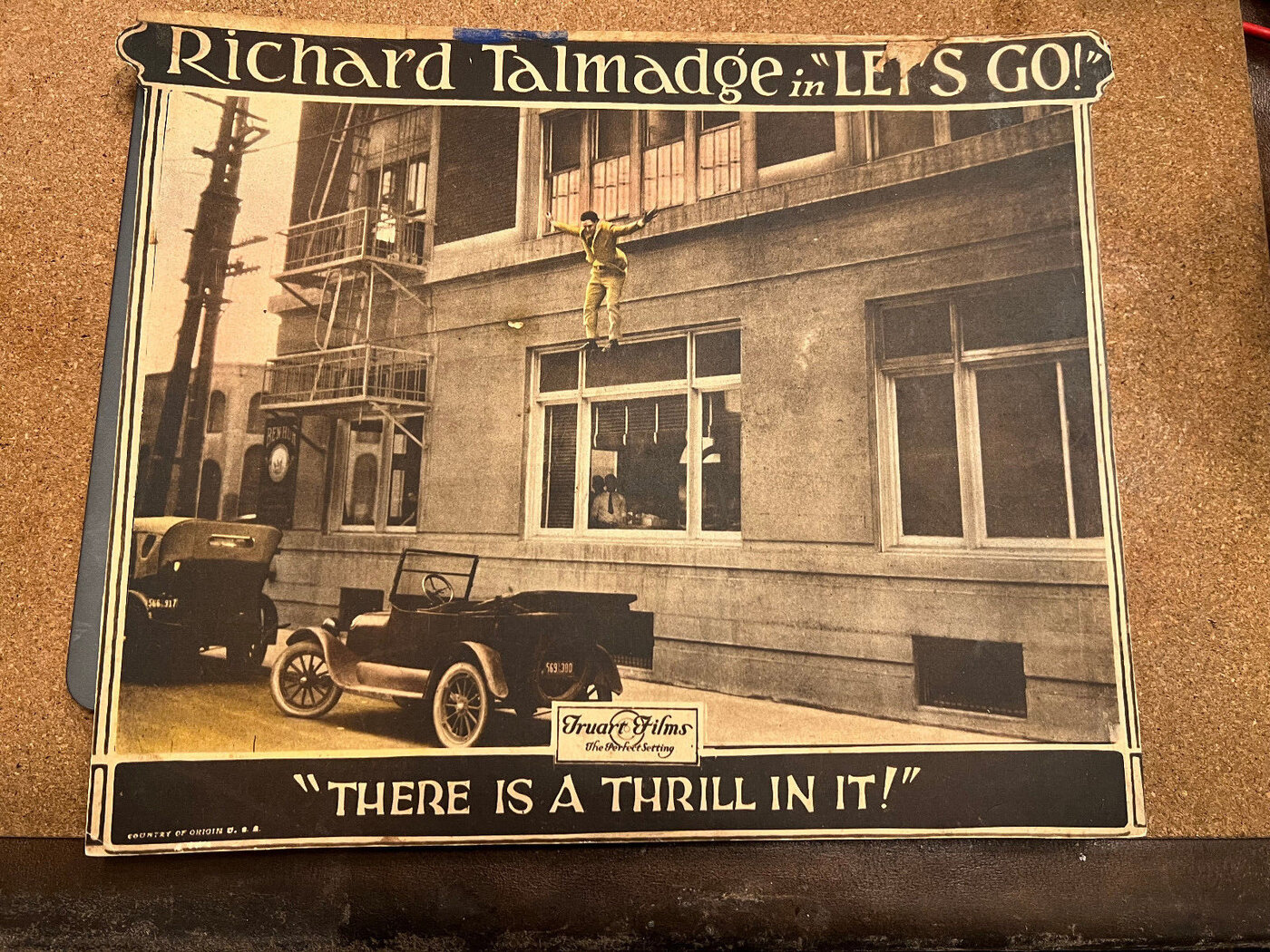
US lobby card for Let’s Go (William K. Howard, 1923).
Talmadge had never worked with a director with as many ideas as William K. Howard. MoMA curator Dave Kehr is one of Howard’s most astute critics. In the notes for a series of Howard’s work Kehr programmed at the Pordenone Silent Film Festival he writes how “Howard’s acute sense of space is defined by an innovative use of interconnected sets—rooms that open into other rooms, and other rooms and exterior views beyond them, creating a sense of a completely contained, not-quite-natural world that nevertheless possesses a depth and volume beyond simple staginess.” This comes through full force in Let’s Go, as Howard funnels Talmadge through the interconnected sets of Hillsboro, taking high jumps over wooden fences, falling off a mountainous hay bale, and ending in a crazy chaotic chase through a farmhouse, crashing through a roof window onto the ground below. The most miraculous thing about this sequence is how hard the blows land during the fight. Though he was a wonderful aerial acrobat, Talmadge took little care in staging fistfights. That is, he didn’t appear to stage them at all: His main strategy was to windmill his arms, run forward into a crowd, and hope for the best. But in Let’s Go, extra care was put into the framing and editing of each punch, allowing the audience time to absorb each impact. It is no surprise that on Let’s Go Talmadge broke his neck, a story he told until the end of his life. Even in more uneven works, there are moments of wild risk-taking. In Laughing at Danger (1924) Talmadge tussles through a beach hut on the precipice of a steep sand dune. When the hut collapses he takes an absolutely insane tumble out of the building and straight down a hill, with debris trailing after him.
Despite Fairbanks’ endorsement, Talmadge was unable to find distribution through the major studios, but he had enough success exporting his films overseas to continue as an independent. He became a minor celebrity in Russia—see the poster for Thru the Flames (1923), which highlights his cherubic face. The overseas audience made the action star bankable, guaranteeing a certain amount of profit before a film was even made, allowing more projects to be greenlit. This equation now works for independent action star Scott Adkins, whose performance as the Russian underground fighter Boyka in the direct-to-video sequels to Walter Hill’s Undisputed (2002) made him a significant star across Eastern Europe. His most recent film is One Last Shot (2024), the third part of an action movie trilogy directed by James Nunn which creates the Rope-like illusion that they are all shot in one take. In other words, they are attempts to make a nonstop action film, foregrounding Adkins’ still-fearsome physicality. They could have been called Let’s Go.
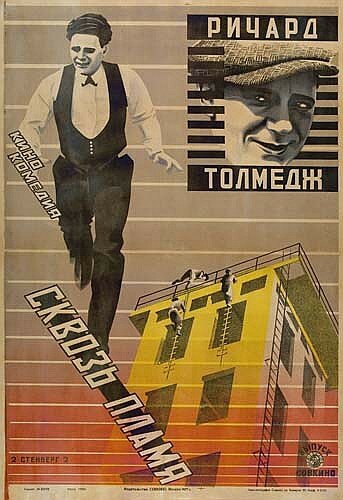
Russian poster for Thru the Flames (Jack Nelson, 1923).
Adkins made his name in the modern-day Poverty Row of direct-to-video action movies, whose audiences have been trained to expect a steady stream of spectacle. 1990s direct-to-video (DTV) outfit PM Entertainment instituted a rule, per director Richard Munchkin, that “somebody had to either be shooting, chasing, or fighting every seven minutes.” So while the major studios leaned into the fantastical worlds made possible by CGI, DTV maintained an underground source of old-school stunt adrenaline. But as the success of Jackass, Mission: Impossible, and breakout martial arts hit The Furious (2025) has proven, there is still a vast mainstream appetite for these kinds of daredevils.
Talmadge was never able to drop his Swiss-German accent, admitting that the transition to sound movies “hurt because I had a European dialect” (quoted in Split-Second, a documentary by Edward London). Films like Get That Girl (1932) and On Your Guard (1933), produced by Richard Talmadge Productions, are artless and inert when characters are speaking, but spring to life when Talmadge begins to move—such as his remarkable leap from a cliff onto a tree in the latter. Universal was equally impressed, because in 1934 it gave Talmadge the opportunity to star in the swashbuckling serial Pirate Treasure directed by journeyman Ray Taylor. It was his first time working with a semblance of a budget, but Talmadge wasn’t developing as an actor; he projected an “aw shucks” innocence at all times, as if he was still a kid actor with the Flying Metzettis. But he kept churning out crazy stunts: balancing on a plane wing and jumping into a jeep on the runway, a gnarly leap out of a car as it falls off a dock, and a deathly dangerous fall off a roof, crashing through the awning on each floor, which alter his trajectory to the ground (very reminiscent of Jackie Chan’s brutal building fall in 1983’s Project A).
Universal did not hire him again as a leading man, making Pirate Treasure his first—and only—time starring for a studio production. After that disappointment he decided to shut down Richard Talmadge Productions. Running low on options, he signed with the ironically named Reliable Pictures, a cut-rate outfit, for his final films. These were boilerplate no-budget action movies which, in their simplicity, hark back to the presentational mode of pre-1905 filmmaking. Films like The Live Wire (1935) and Step On It (1936) had creaky plots and static framings, but Talmadge, perhaps sensing that his leading-man days were nearing an end, absolutely let it rip during the stunt sequences, caroming and zigzagging through these scenes like Daffy Duck having a mental breakdown. There were breathtaking leaps from a farmhouse roof into the bed of a truck and a dangerous running leap from a dock onto a moving boat: pure stunt poetry.
His last starring role was in The Speed Reporter (1936). Afterward, he transitioned to a prolific career as stunt double, stunt coordinator, second-unit director, and director, working on films like Beau Geste (1939), How the West Was Won (1962), and Casino Royale (1967). The last stunt he performed was in The Garden of Evil (1954), when he doubled for Gary Cooper at the age of 62. Talmadge recalled: “I did a thirty-five-foot fall from a cliff. I was supposed to land in a tree, hanging head down. Cooper was watching when I did it. He said, ‘If I didn’t see it, I wouldn’t believe it.’”
With Richard Talmadge’s films, seeing is believing. His career was built on that primal lure of the cinema: to see something real—and real dangerous. His daredevil stunts suspended film narratives and carved out moments that elicited childlike shock and wonder, skills that pointed toward parkour, extreme sports, Jackass, base jumping, Jackie Chan comedic kung fu, and the DTV brawling of Scott Adkins. Action cinema wouldn’t be the same without Talmadge.