Scene Report is a series that explores a city's moviegoing culture over a month.
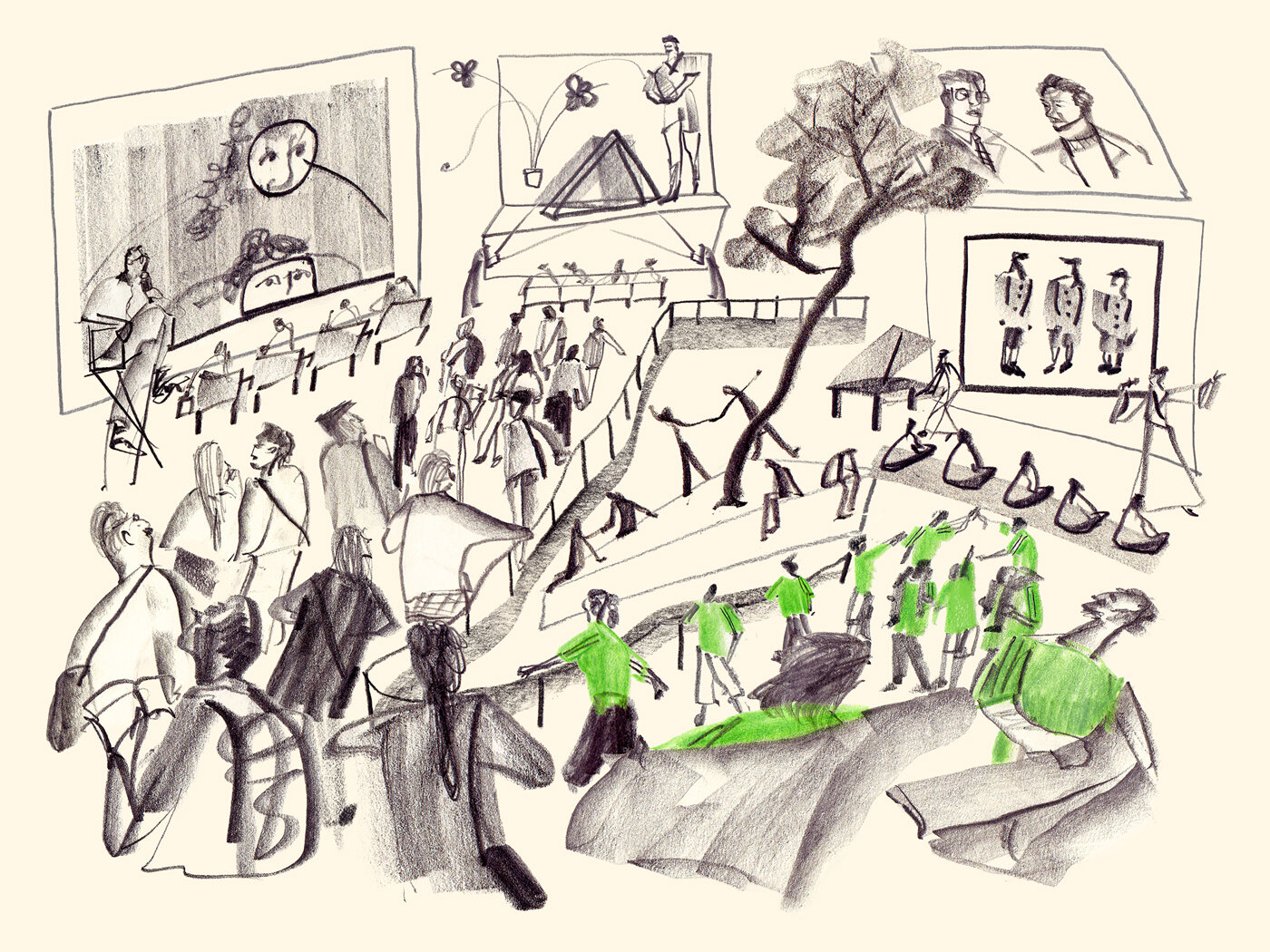
Illustration by Angelo Dolojan.
There are summers when Mexico City belongs to cinema. This was not one of them—it belonged to football. Months before the first whistle, sidewalks were being repaired with unusual urgency, facades were being repainted, metro stations acquired new signage, long-neglected public spaces suddenly became worthy of investment. Like every global mega-event, the FIFA World Cup arrived with the familiar rhetoric of urban renewal and international prestige. Whether those promises will outlast the tournament remains to be seen. What mattered during those weeks was that the city had accepted football as its temporary organizing principle.
As someone who had deliberately decided to stay in Mexico City to experience the tournament, I surrendered without resistance. I have always loved football, and the chance to watch a World Cup unfold in my own city felt like a once-in-a-lifetime experience. During the tournament, everyday routines dissolved into celebration. Paseo de la Reforma, usually Mexico City’s ceremonial avenue, became an endless procession of supporters, food vendors, tourists, and families. Public screenings turned entire plazas into improvised stadiums. Even cities that were not hosting matches seemed infected by the same festive suspension of normality, as though the tournament had quietly expanded beyond its official map to occupy the entire country.
The consequences reached far beyond sport. Contemporary art institutions commissioned projects around collective memory, fandom, and national identity. Less visibly, but perhaps more tellingly, the city’s film calendar quietly reorganized itself around FIFA’s timetable. Distributors delayed releases and festivals shifted their dates months in advance, unwilling to compete with an event monopolizing public attention while sending hotel prices into the stratosphere. International guests became prohibitively expensive to invite. For several weeks, Mexico City experienced one of its quietest cinematic summers in recent memory.
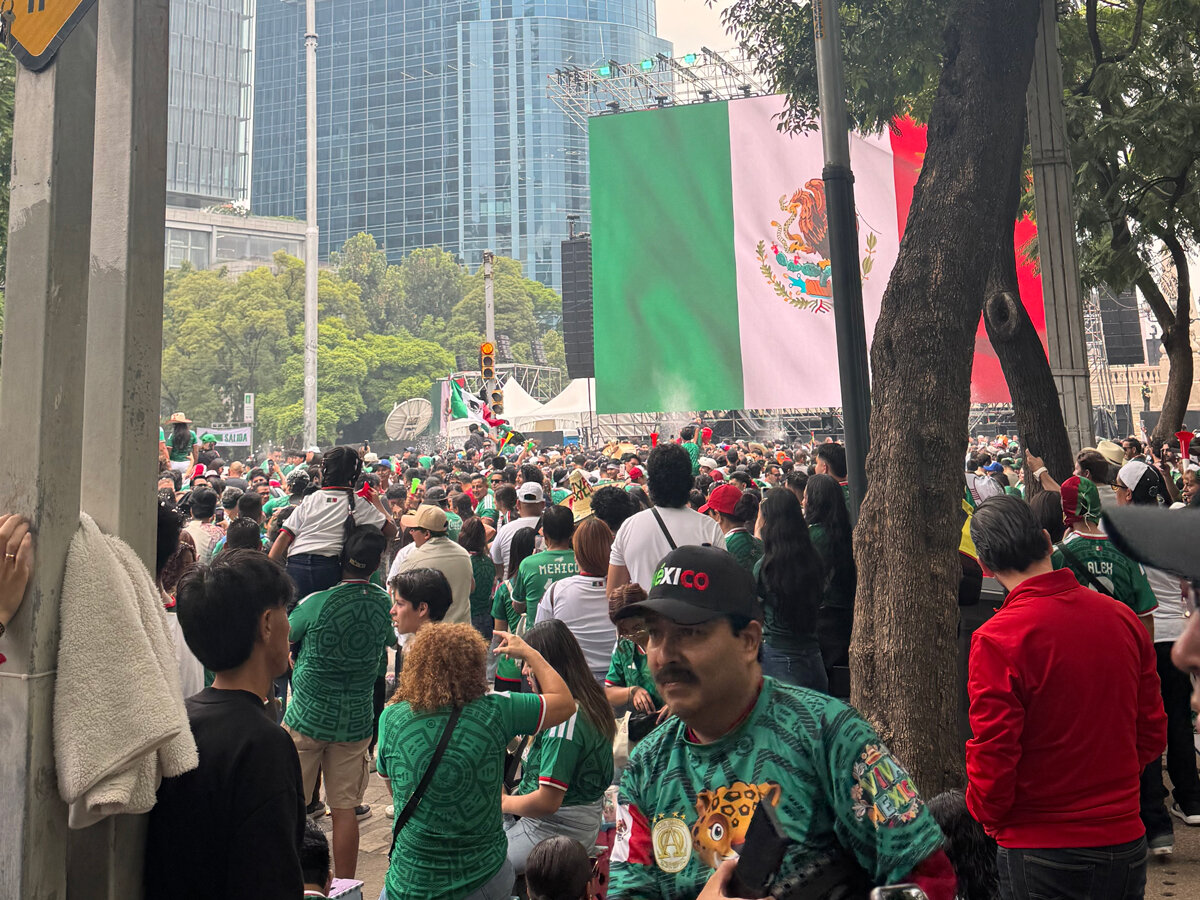
Av. Paseo de la Reforma, a major thoroughfare in Mexico City, was closed due to a large jubilant crowd that had gathered prior to the national team's tragic loss to its English counterpart.
This apparent absence of cinema coincided with my first opportunity in years to actually experience my own city. Much of the previous decade had been dictated by festival calendars. Airports, hotels, and cinematheques had become more familiar than my own neighborhood. Professional life as a film programmer had transformed seasons into festival editions and cities into screening rooms. Remaining in one place for an entire month produced the strange sensation of becoming a tourist inside my own city. I found myself wandering through neighborhoods with the curiosity usually reserved for cities abroad, paying attention to details routine had long taught me to ignore. The World Cup had temporarily changed Mexico City, but so had my prolonged absence. Perhaps that was why I instinctively began rediscovering it through cinema. Not through premieres or festivals, which had largely disappeared from the calendar, but through the spaces where film culture continued to persist beneath the noise generated by football.
The first surprise arrived inside an exhibition devoted to the World Cup. The contemporary art museum Museo Jumex had assembled an ambitious show exploring football through contemporary art, bringing together commissions, installations, and historical works that examined the sport as both spectacle and social ritual. Visitors naturally gravitated toward immersive installations, monumental sculptures and displays of football memorabilia. Hidden among them, almost discreetly, was Aficionados, a little-seen 2014 short film by Carlos Reygadas. The film itself unfolded with characteristic simplicity: A fixed shot, a living room, a sofa facing a television we never actually see. Time passes and the same family grows older through successive World Cups. Hairstyles and furniture change. Children become adults, then grandparents. Political transitions remain outside the frame yet become visible through domestic life itself. Every four years hope briefly returns, only to dissolve into ritual frustration about Mexico’s elimination from the tournament. The World Cup becomes a metronome measuring the passing of time, family life and national identity. It is a remarkably restrained film—funny as a TV ad, unexpectedly melancholy, quietly observing how collective rituals shape private lives with smart comments about class through set design. Outside the museum, the city celebrated the World Cup through spectacle. Inside, Reygadas reduced that spectacle to the intimate scale of a family living room. The tournament became less about stadiums than about sofas.
Reygadas, one of Mexico’s finest filmmakers, had made available the sharpest cinematic reflection on the World Cup only for it to be screened on one of the smallest displays in the exhibition. Visitors searching for spectacle frequently overlooked the most personal work in the building. It would become a recurring image throughout the month. Cinema had not disappeared; it simply became quieter.
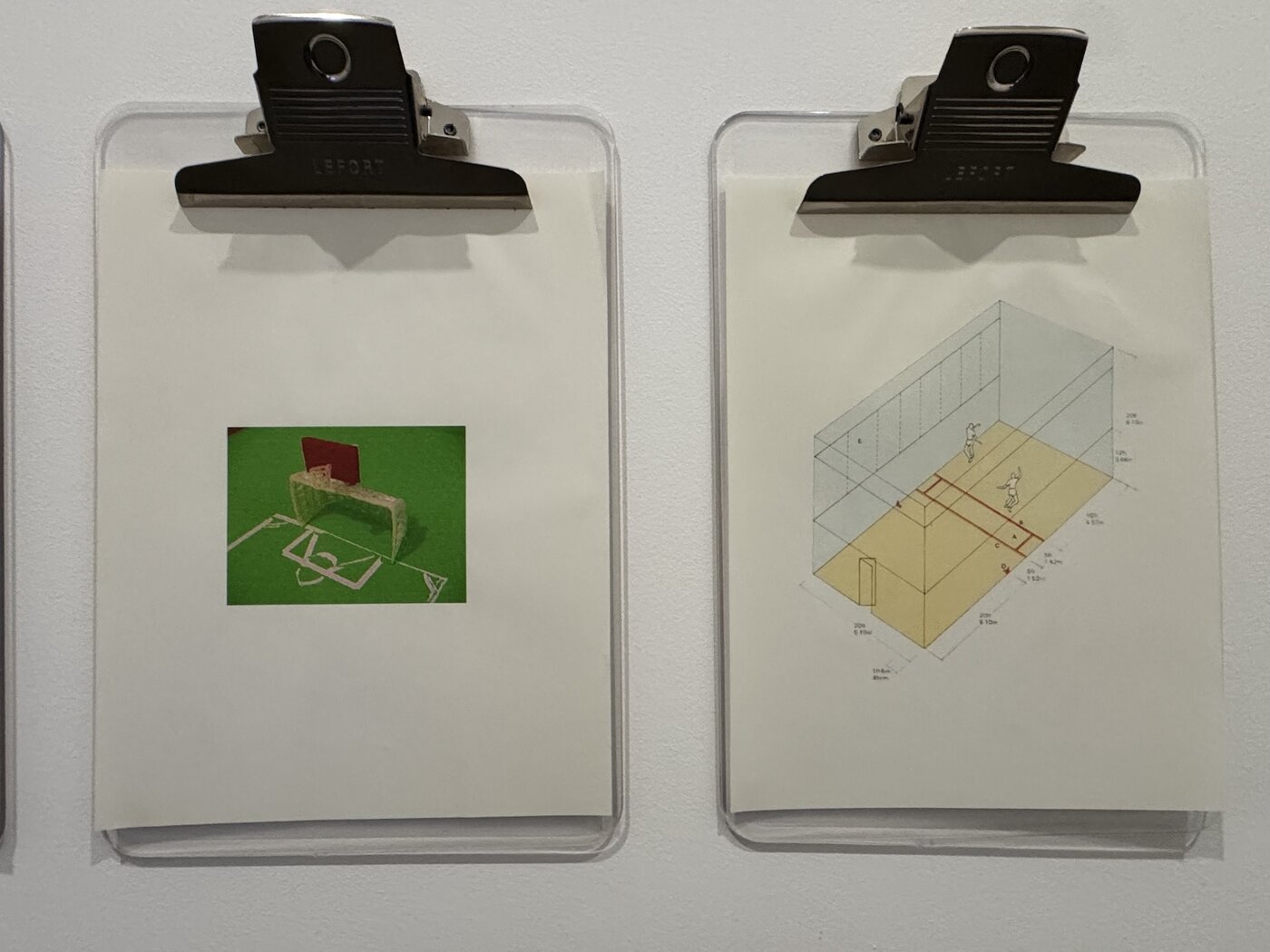
Sketches for the piece “The Rules of the Game: San Diego-Tijuana Sports Event” by Gustavo Artigas, a performance in which two Mexican soccer teams and two American basketball teams play simultaneously on the same court, creating a metaphor for coexistence and interaction between cultures along the border.
As the tournament approached its conclusion, attention gradually began returning to other cultural events. The first major cinematic gathering after weeks dominated by football was the Mexican premiere of Fernando Eimbcke’s Moscas (2026). Few contemporary Mexican filmmakers occupy the same position as Eimbcke. His films have consistently resisted spectacle, preferring emotional precision, understated humor, and the drama hidden inside ordinary gestures. Premiering earlier that year at the Berlinale, Moscas arrived carrying the expectations reserved for one of the country’s most anticipated releases.
Its presentation at Cineteca Nacional felt almost symbolic. After weeks in which football had monopolized public attention, Mexican cinema finally reclaimed one of its most important public spaces. There are few places in Mexico City quite like the Cineteca Nacional. Officially, it is the country’s national cinematheque. In practice, it functions as something considerably more complicated. Since its redesign over a decade ago, people gather there without necessarily intending to watch a film. Students spend afternoons working beneath the geometric canopy, families wander through the gardens, couples arrive for first dates—a practice so common that internet folklore speaks of the so-called “Cineteca curse,” according to which relationships begun there rarely survive. The place succeeds in simultaneously being a cinematheque, a public park, and an urban square.
The premiere itself attracted exactly the audience one might expect. Filmmakers, critics, students, regular spectators, and curious passersby gathered beneath the summer sky. The screening unfolded without incident; the conversation afterwards did not. A visibly intoxicated audience member took the microphone, intending, it seemed, to criticize the film’s lack of realism. Whatever coherent point may have existed gradually dissolved beneath repetition and increasingly rambling remarks. The room oscillated between discomfort and nervous laughter. Minutes passed. Eimbcke initially remained still, listening with remarkable patience. Eventually he decided to take control and walked up the stairs, took the microphone from the man’s hands himself and ended the exchange, not before saying “I’m not your bro.”
By the following morning, the clip had spread across social media. Ironically, the confrontation generated almost as much attention as the film itself. The episode quickly became another object of public debate. Was the filmmaker justified? Had the audience member crossed an invisible line? Was this an unfortunate anecdote or evidence of something more structural that illustrates the class gap between audience and creator?
Watching the discussion unfold, I found myself thinking less about the incident than about what it revealed. Mexico remains one of the strongest theatrical markets in the world, where multiplexes continue filling enormous auditoriums with remarkable consistency, yet independent Mexican cinema often struggles to establish sustained relationships with audiences beyond festival circuits and institutional screenings. Newspapers dedicate fewer pages to cinema than they once did, while independent criticism survives precariously online. Public conversations about films increasingly occur through fragments of social media rather than sustained engagement. The awkwardness of that evening seemed less like an isolated confrontation than a symptom of a larger disconnect.
It also marked the end of one chapter of the summer. The World Cup was over. Cinema was slowly trying to return to the city’s attention. Almost overnight, Mexico City seemed to exhale. Fan zones disappeared as quickly as they had emerged, and the sea of national jerseys gradually gave way to office clothes as the city resumed its familiar rhythm of impossible traffic and afternoon thunderstorms. The first unmistakable signs of the familiar metabolism resuming came, again, at the Cineteca. Every July, Cineteca Nacional and Fundación Japón organize programs dedicated to Japanese cinema. Over the years they have introduced generations of Mexican audiences to Akira Kurosawa, anime, Japanese horror and countless canonical filmmakers whose work has found an unusually devoted audience thousands of kilometers from Tokyo. Japanese cinema occupies a curious place within Mexican cinephilia, having long escaped the niche usually reserved for repertory programming, to become something resembling a tradition. One does not simply attend these retrospectives—one may plan vacations around them.

A goat vibing in the aftermath of the elimination of the national team from the World Cup.
This year’s Yasujirō Ozu program, running across twelve films and three decades of his career, initially looked like the sort of event that would attract the familiar congregation of dedicated regulars: retired spectators who know every projectionist by name, university professors carrying notebooks, programmers excited about the restorations to be screened, students eager to finally watch Tokyo Story (1953) on the big screen. Almost every screening sold out. Perhaps the World Cup had unintentionally helped. After weeks during which football monopolized every conversation, audiences appeared almost relieved to surrender themselves to another collective ritual, this time one defined not by goals or victories but by tatami-level camera positions and conversations around dinner tables.
Getting tickets quickly became an adventure of its own. The morning online reservations opened, the Cineteca website slowed to an almost theatrical crawl, although not everyone was chasing Ozu—the same week also saw the release of a 35mm print of Christopher Nolan’s The Odyssey (2026). Between Nolan devotees refreshing browsers with militant determination and Ozu admirers attempting the same strategy, securing a seat began to resemble buying concert tickets rather than attending repertory cinema.
Eventually, I surrendered and did what every film programmer eventually does: I called in favors. There is something mildly embarrassing about using professional friendships to obtain tickets for a film made in 1932, but cinephilia has always possessed its own peculiar economy, built as much upon generosity and mutual obsession as institutional accreditation. Besides, there was little alternative—by then the screenings had become impossible.
The retrospective began with I Was Born, But..., Ozu’s silent masterpiece from 1932, presented in a form almost no audience outside Japan has the opportunity to experience today. Rather than simply projecting the restored print, the screening recreated the historical conditions under which Japanese silent cinema originally existed. Narrator Akiko Sasaki performed as a benshi, accompanying the film live by voicing dialogue, explaining narrative developments and adding emotional nuance, while pianist Masayo Nagata provided a continuous musical accompaniment.
For many spectators, it was their first encounter with the benshi tradition. Emerging in the late nineteenth century, these performers transformed silent cinema into a hybrid between theatre, storytelling, and projection. Unlike Western silent film exhibitions, where music generally provided the principal accompaniment, Japanese audiences expected the benshi to become an active participant in the performance itself. Every screening was, in a sense, unique. The narrator mediated between image and audience, introducing characters, interpreting gestures, and even shaping the emotional rhythm of the film. Watching this nearly century-old practice unfold inside one of Latin America’s busiest cinematheques, historical distance seems to collapse thanks to the generous gestures of the artist-translator, who decided to give some local adaptations—like mentioning chilaquiles, Mexico City’s most traditional breakfast, instead of the rice dish the characters were talking about. What impressed me most, however, was not the novelty of the format but the audience surrounding it. In another city this might have been considered an esoteric event. Here, it simply felt like Thursday.
Between Ozu screenings, another ritual quietly unfolded. Friends gathered at Señorito, the Japanese restaurant overlooking the central cinematheque plaza, ordering cups of warm sake with some esquites to accompany the humid rainy heat. Conversations drifted between the films just seen and those still to come. Someone defended Early Spring (1956) as Ozu’s true masterpiece. Someone else insisted that Good Morning (1959) contained his greatest political observations. The arguments, like all worthwhile cinephile arguments, remained permanently unresolved. Outside, another tropical storm began. Rain has a curious effect on Cineteca: Rather than emptying the complex, it simply slows everyone down. Spectators linger beneath the enormous concrete canopy, postponing departures, extending conversations, allowing one screening to blur naturally into the next.
Perhaps this was Cineteca’s greatest achievement: Not programming extraordinary films, but creating the conditions for people to remain together after watching them. Cinema, after all, has always depended as much on the conversations outside the auditorium as on the projections inside it.
Mexico City’s film culture doesn’t revolve around a single institution. With more than twenty million inhabitants spread across an urban landscape that seems to expand indefinitely, going to the cinema often means crossing the city itself. A screening scheduled for seven in the evening may require leaving work before five. Rain, traffic, demonstrations or an unexpectedly stalled Metro line become as much a part of the experience as the film itself. Cinephilia in Mexico City is measured both in hours spent inside screening rooms and the hours spent traveling between them. One wet afternoon led me beneath the Estela de Luz, the controversial monument whose delayed construction and ballooning costs turned it into one of the most recognizable symbols of governmental excess in recent Mexican history. Hidden underneath it, however, lies one of the city’s most generous but discreet cultural institutions: the Centro de Cultura Digital.
It is an unlikely home for experimental cinema. Above, traffic flows along Paseo de la Reforma toward Chapultepec Park, one of the largest urban parks in the world. Downstairs, the noise softens into a permanent murmur that accompanies every exhibition, workshop, and screening. During the rainy season, another element joins the soundtrack: the unmistakable smell of deep sewer. Rather than diminishing the experience, it somehow belongs to it. For years, the venue has become one of the principal homes of Laboratorio Experimental de Cine, whose regular screenings have cultivated a remarkably consistent audience for artists’ moving image, expanded cinema, and formally adventurous work. The evening I attended centered on poetry. Affettuosa presenza (2004), a film devoted to the Italian poet Umberto Bellintani, unfolded through the correspondence he maintained with the art critic Alessandro Parronchi, allowing memory, literature, and moving images to gradually overlap. It was not an event likely to compete with Hollywood’s release calendar, nor was it trying to. Watching the audience, I was struck by how little the atmosphere resembled the anxious urgency surrounding commercial openings. People had not come because this was the film everyone was talking about—they had come precisely because it wasn’t.
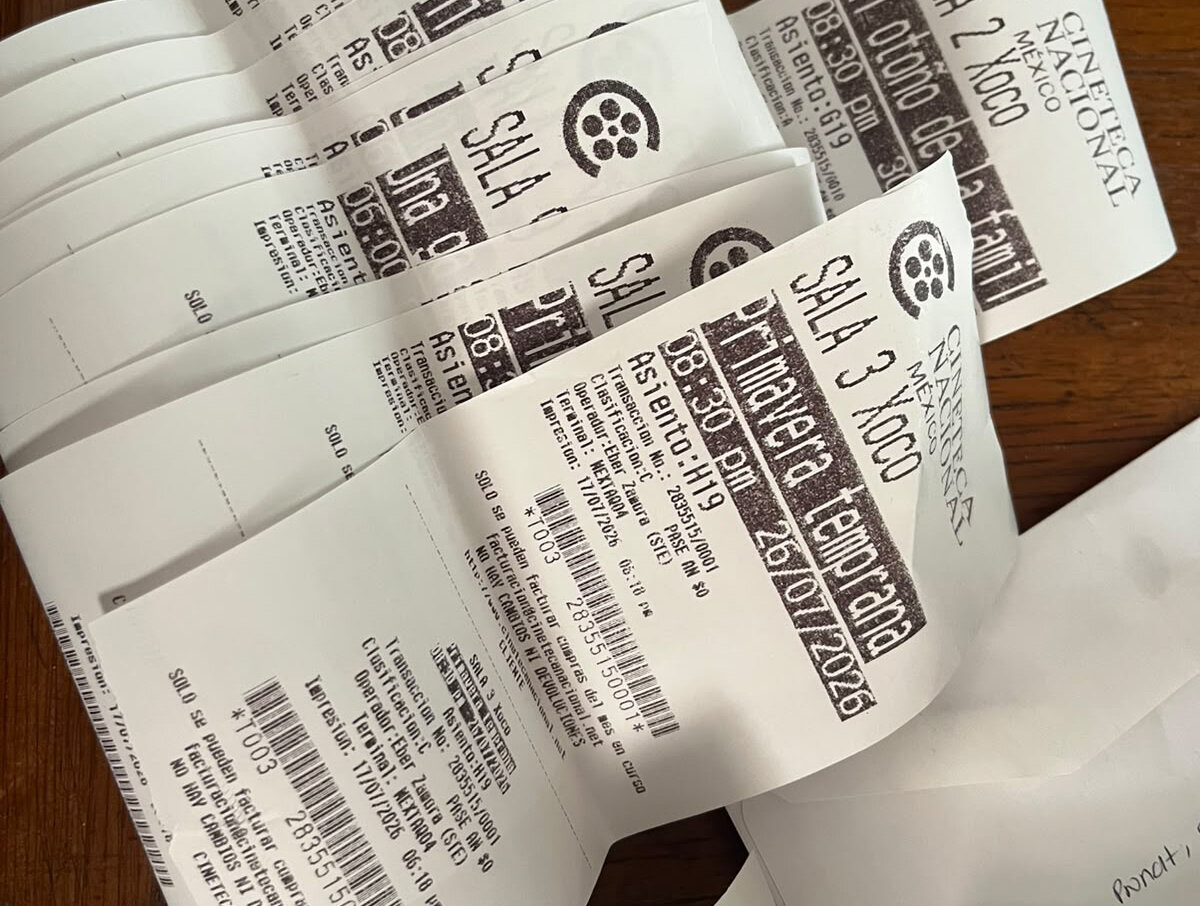
The closest thing to a wad of cash that film criticism can get you to.
A few days later, that same spirit reappeared a few kilometers away at the Centro Cultural de España. Like the Centro de Cultura Digital, it has gradually become one of the city’s indispensable laboratories for interdisciplinary artistic practice, occupying the fertile territory where cinema dissolves into performance, installation, theatre, and sound art. The evening’s program belonged to its Cinema Vivo series, dedicated to expanded cinema.
Calling it a screening would hardly be accurate; calling it a performance would be incomplete. Marcela Cuevas’ Herbario iniciático unfolded somewhere between projection, live performance, sound composition, and ritual. Divided into two movements, the work began with the discovery of a hidden book before slowly evolving into an animated herbarium inspired by the occult botany of Paracelsus and The Secret Life of Plants. Rather than presenting nature as a stable object of representation, Cuevas transformed cinema itself into a living apparatus through which vegetal life, forgotten knowledge, and speculative histories could momentarily coexist.
Around Cuevas, projectionists manually activated multiple image sources while performers moved through the space, accompanied by Daniela Solís’ immersive soundscape and Bruno Varela’s musical composition. Images escaped the traditional boundaries of the screen, occupying walls, bodies, and architecture simultaneously. Cinema ceased to function as a finished object, and no recording made by the attendance could adequately reproduce the experience. That was precisely the point. In an era where nearly every moving image eventually migrates to a streaming platform, there remains something profoundly moving about an event whose principal quality is that it cannot be watched later.
The audience that evening was small, perhaps 50 people. Some were familiar faces from other experimental screenings throughout the month. Others belonged to the city’s visual arts community—musicians, performers, and students—moving fluidly between disciplines. They represented a cinematic public almost invisible within official attendance statistics, yet one that has quietly sustained Mexico City’s experimental film culture for decades through collaboration, friendship, and an extraordinary willingness to build institutions where none previously existed.
Leaving the performance, I found myself thinking that what ultimately distinguished this unusually quiet summer was not the number of screenings available, but the communities they revealed. Once the noise of football receded, another city gradually became visible. A city sustained by programmers who refuse to abandon difficult films, projectionists who continue caring for analog formats, institutions willing to host events that will never become profitable, and audiences prepared to cross one of the largest cities on earth simply to spend two hours watching something together.
Cinema, I realized, had never actually vanished during those World Cup weeks. It had simply been waiting, patiently.