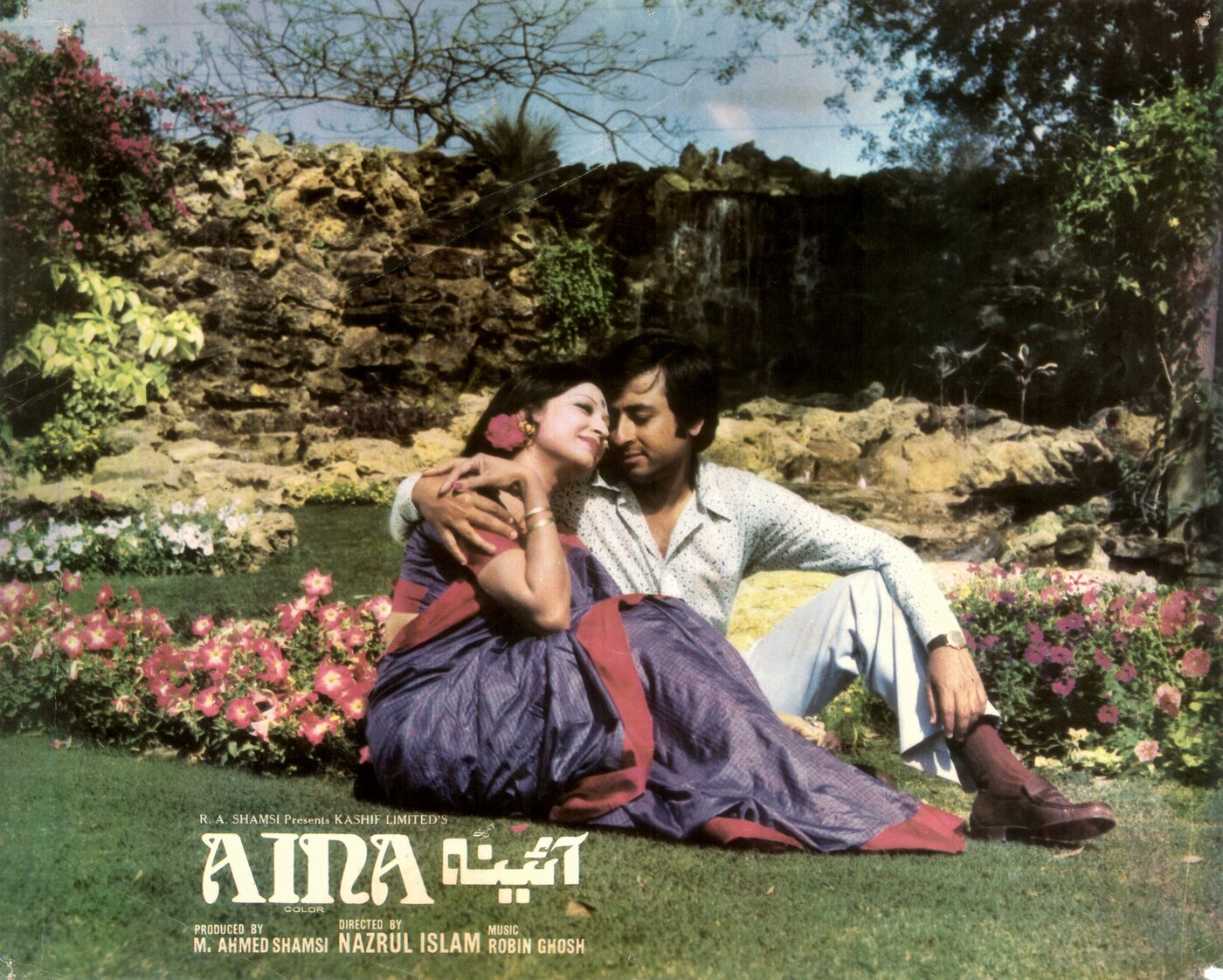
Lobby card for Aina (Nazrul Islam, 1977).
In the song “Mujhe Dil Se” from Pakistani director Nazrul Islam’s Aina (1977), Rita (Shabnam) comes out of the shower still wet. Water beads on her forehead, runs down her bare arms, gathers in her hair. Instead of a towel, a red sari swathes her body, not yet disciplined into pleats. Her husband, Iqbal (Nadeem), just awake, rises from the bed and crosses toward her in a white kurta that mirrors the pale bathroom tiles she has stepped out from, as though he, too, belongs to the soft, steamy world she leaves behind. She smiles when he pulls her onto his lap. As Iqbal leans into Rita’s neck, the film cuts away before his lips can touch her skin.
In the cinema of many countries, this moment would culminate in a kiss. But in Aina and its contemporaries, lovers never kiss. More than Muslim-majority sensibilities, this absence in Pakistani cinema can be attributed to cultural codes of respectability that date back to pre-Partition colonial India and continue to be reinforced by subsequent censor boards. If the kiss is cinema’s enduring initiation ritual for sex, Pakistani films offer a strange exhibit. Romantic duets replace kisses, whereas sex is displaced into a vocabulary of implication: flower-laden marital beds, dimming lamps, trembling vases on bedside tables, lovers dissolving discreetly offscreen before their bodies fully meet.
By the time Aina arrived in theaters in 1977, these erotics were already a fixture. Hence, between Rita and Iqbal, texture becomes the terrain of erotic possibility: moisture, fabric, skin, waking intimacy. Nowhere is this more tangible than in the recurring image of the marital bed, an unmistakably erotic site housed within the romantic duet, “Mujhe Dil Se.” Upon release, Aina became an immediate blockbuster, winning 12 Nigar Awards—the country’s premier film honors at the time—including Best Film. Its place in Pakistan’s cinematic canon was so secure that it became one of the country’s few classics to be remade twice, once in 1998, titled Nikah, and later in 2013, as Aaina. Across the three films, the marital bed and its relationship to the duet become a barometer of the industry’s changing imagination of intimacy, tracing Pakistani cinema from its commercial zenith through its collapse and into its television-shaped revival.
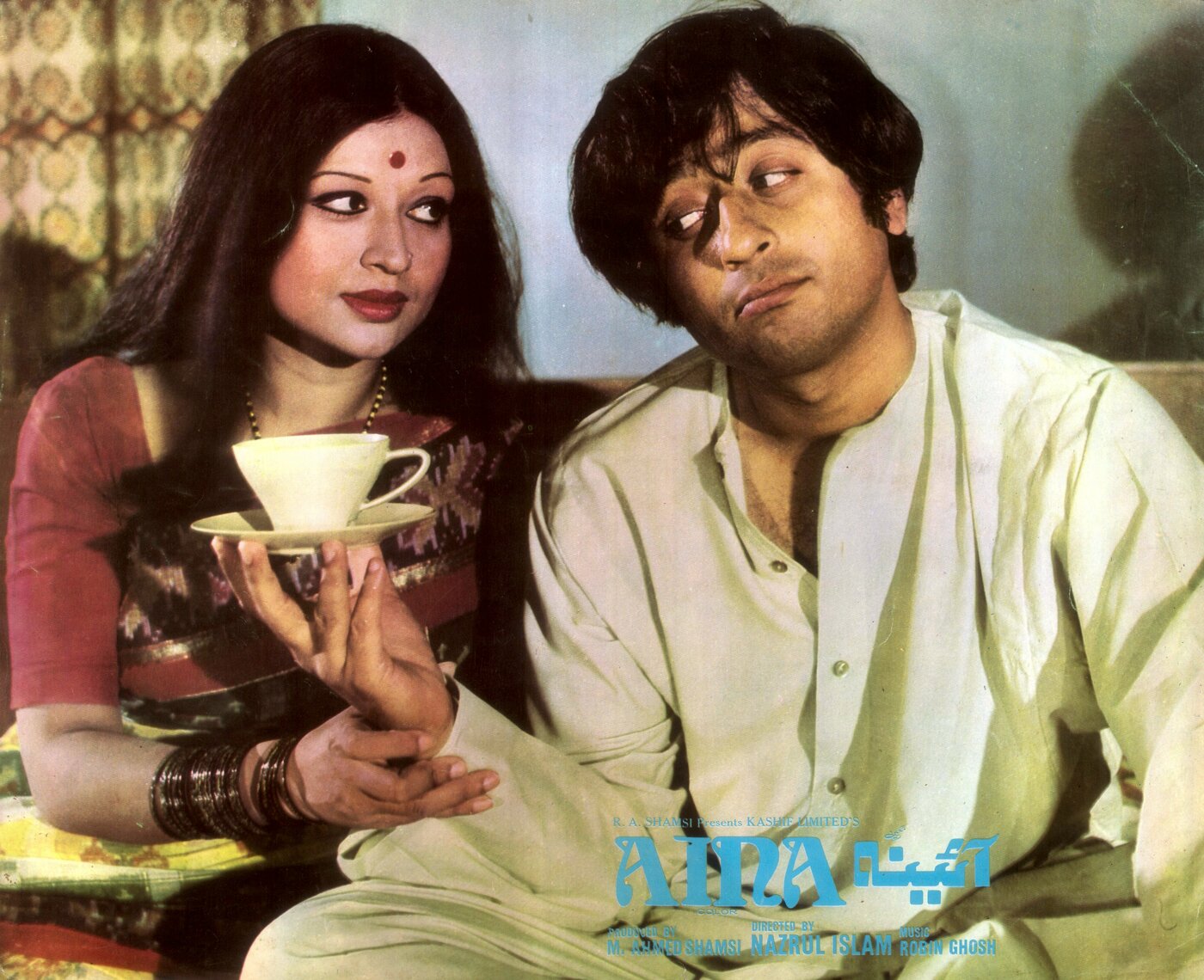
Lobby card for Aina (Nazrul Islam, 1977).
Aina’s appeal lies in its familiar premise. Rita, the daughter of a wealthy industrialist, falls in love with Iqbal, a hotel receptionist. Defying her family’s wishes, she marries him, but their domestic life is gradually undone by parental interference. Like much South Asian melodrama, the film relies on romantic duets and frontal address, but its distinctly Pakistani quality lies in the elaborate negotiation of the absent kiss and its attendant erotics. In what was a fundamentally paradoxical code in Pakistani cinema, bare midriffs were more acceptable than plunging necklines, while premarital sex could be depicted so long as “bad” women were punished. The opposite of a Shariah-compliant fantasy, Rita and Iqbal’s courtship is born out of these contradictions. Their first meeting arrives through a comic scandal: A drunk Rita floods her hotel room after slipping naked into the bathtub, and a mortified Iqbal must retrieve her with his eyes theatrically shut. A coincidental run-in at a film theater moves them toward romance proper, until a broken hotel elevator traps them together. Extreme close-ups isolate hands, hair, lips, and eyes before the camera finally reveals the lovers embracing. Set to “Haseen Wadion Se,” the song sequence exemplifies what Sangita Gopal identifies in her book Conjugations: Marriage and Form in New Bollywood Cinema as the romantic duet’s substitution for the kiss as the primary vehicle of couple formation. But Pakistani cinema extends this logic further through a subset of song, the marital duet, reserved for the wedding night, which merges the formation of the couple with that of the family. The wedding night is, thus, a license to begin a sexual relationship with the intent of procreation.
Before “Mujhe Dil Se” begins, Rita and Iqbal lie flush against one another atop the phoolon ki sej—garlands of jasmine, marigold, and rose spilling across the marital bed—dressed in their wedding clothes. The camera tracks upward from their feet to their interlocked hands. Just as a kiss seems imminent, the frame cuts to a balcony overlooking a secluded beach. The montage moves from honeymoon fantasy, beaches and parks, to the rhythms of married life. The marital bed remains its central site—it is where the couple lies entwined, where Rita emerges from the shower in the scene at the outset, where the day begins with dressing for work and reluctant partings. A distracted, lovestruck Iqbal sits at the office while an equally lovestruck Rita drifts through household chores at home. A few shots later, the two cradle a child in their arms.
“Were you having the same dream as I was?” Iqbal asks as we return to their wedding night. Rita nods shyly.
This erotic openness is often folded into a broader mythology of the 1970s as a moment of modernity under Prime Minister Zulfikar Ali Bhutto’s government and his promises of a socialist utopia. Nightclubs, liquor, and bell-bottoms are frequently invoked as shorthand for the era, even as they circulated within a regulated system of censorship and moral policing. The contrast with General Muhammad Zia-ul Haq, who overthrew Bhutto in a 1977 military coup and later executed him, has often produced a simplified narrative: of a liberal cultural sphere abruptly replaced by sweeping repression under his “Islamization” drive. Yet Aina remained in cinemas for a record 401 weeks, well into the Zia period. Censorship until Zia’s death in 1988 undoubtedly affected filmmakers and narrowed the visual grammar of romance, but the shift was uneven rather than absolute: While romancing in an elevator became increasingly unlikely, lovers still had their duets. Far from a total and lasting capture by moral conservatism, post-Zia cinema in the 1990s often turned to overt sexualization to draw audiences back into a struggling exhibition economy.
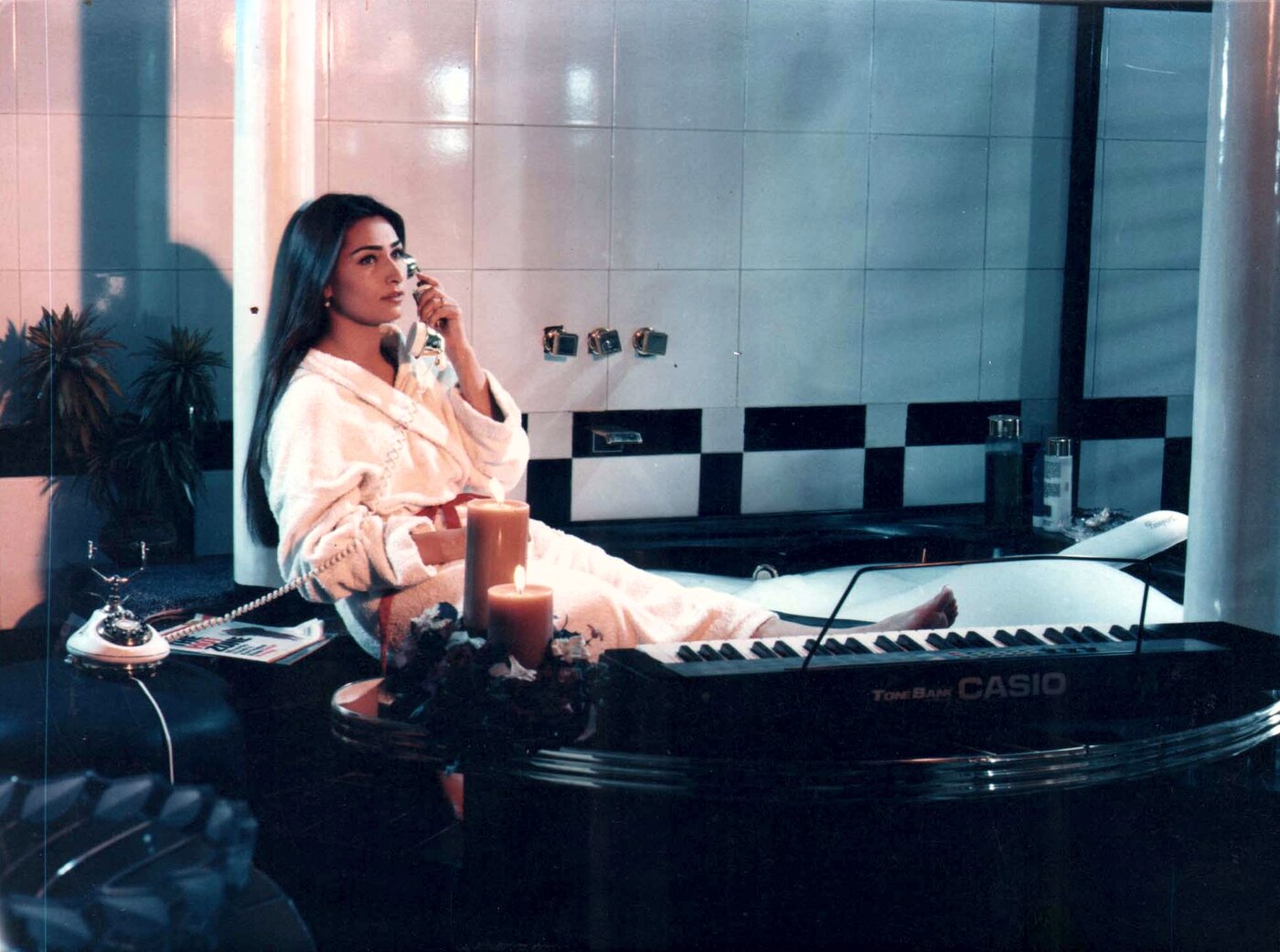
Lobby card for Nikah (Sangeeta, 1998).
This impulse is evident in Aina’s loose remake, Nikah (1998). Directed by Sangeeta, the remake transposes Rita and Iqbal’s rebellious affair onto Bisma (Reema Khan) and Faraz (Shaan Shahid), replacing the original’s sensuality with raunchy comedy. Even a minor subplot turns lurid: a full song, “Saiyaan Ang Laga,” follows a lonely wife swiveling her hips beneath a wall poster reading “I am so hot for you.” Despite its departures, Nikah’s “Main Yun Milun” is nearly identical in montage to “Mujhe Dil Se.” The song does not begin on the wedding night, but it still opens on the marital bed. In a wide, slightly tilted shot, Faraz leans over Bisma on a low bed crowded with oversized cushions, his white kurta glowing against the dim room. Beneath him, Bisma reclines in shimmering green satin as he cups her face. The two sink into an embrace before the camera cuts to a close-up; when Bisma turns away, her red lipstick is visibly smudged. Faraz’s lips brush her cheek, and the scene cuts again to a close shot of their toes curling.
Faraz and Bisma share a familiar moment after she comes out of the shower—fully dressed—before sending him off to work with a kiss on her neck. Like Rita, Bisma waits for her husband’s return, though her day is spent grooming herself rather than attending to chores. At night, she brings him a glass of milk, their lips meeting at its rim as he leans in. If the child in Rita and Iqbal’s imagination only gestures toward futurity, Bisma’s pregnancy is rendered diegetically: a time-lapse cuts from a pregnant Bisma to an operating theater to a crying infant. This visibility of erotic life signals a moment distinct from both Bhutto’s and Zia’s Pakistan. Shortly after Nikah, Samina Peerzada’s Inteha was briefly recalled for sex and nudity until the producer obtained a court order to reinstate its release, even though the Central Board of Film Censors remained formally governed by the Motion Pictures Ordinance (1979) and the Censorship of Films Rules (1980), both instituted under Zia.
Ironically, the smudged lipstick and curling toes arrive alongside a greater preoccupation with family values. Where Iqbal inhabits a small, orphaned apartment, Faraz lives with his mother and sister; Rita’s villainous father is refigured as Bisma’s conniving mother. Bisma herself is reimagined as a more abrasive figure—an acquisitive, embittered wife who abandons Faraz and their child, only to return when the boy falls terminally ill. “Main Yun Milun” also transforms Aina’s romantic duet into Bisma’s solo address to Faraz, fitting the film’s conservative politics: Her insistence that Faraz abandon his mother and sister for a job promotion is shown as a desire for the material comfort of her own parental household, just as her mother’s fixation on status destabilizes her marriage. Where Aina frames conflict as mutual misunderstanding shaped by parental interference, Nikah blames only Bisma and her mother—a residue of Zia’s veneration of the patriarch. If 1970s films cleanly separated “good” and “bad” women, 1990s melodrama compels all women to err, but allows the good ones to be forgiven by men.
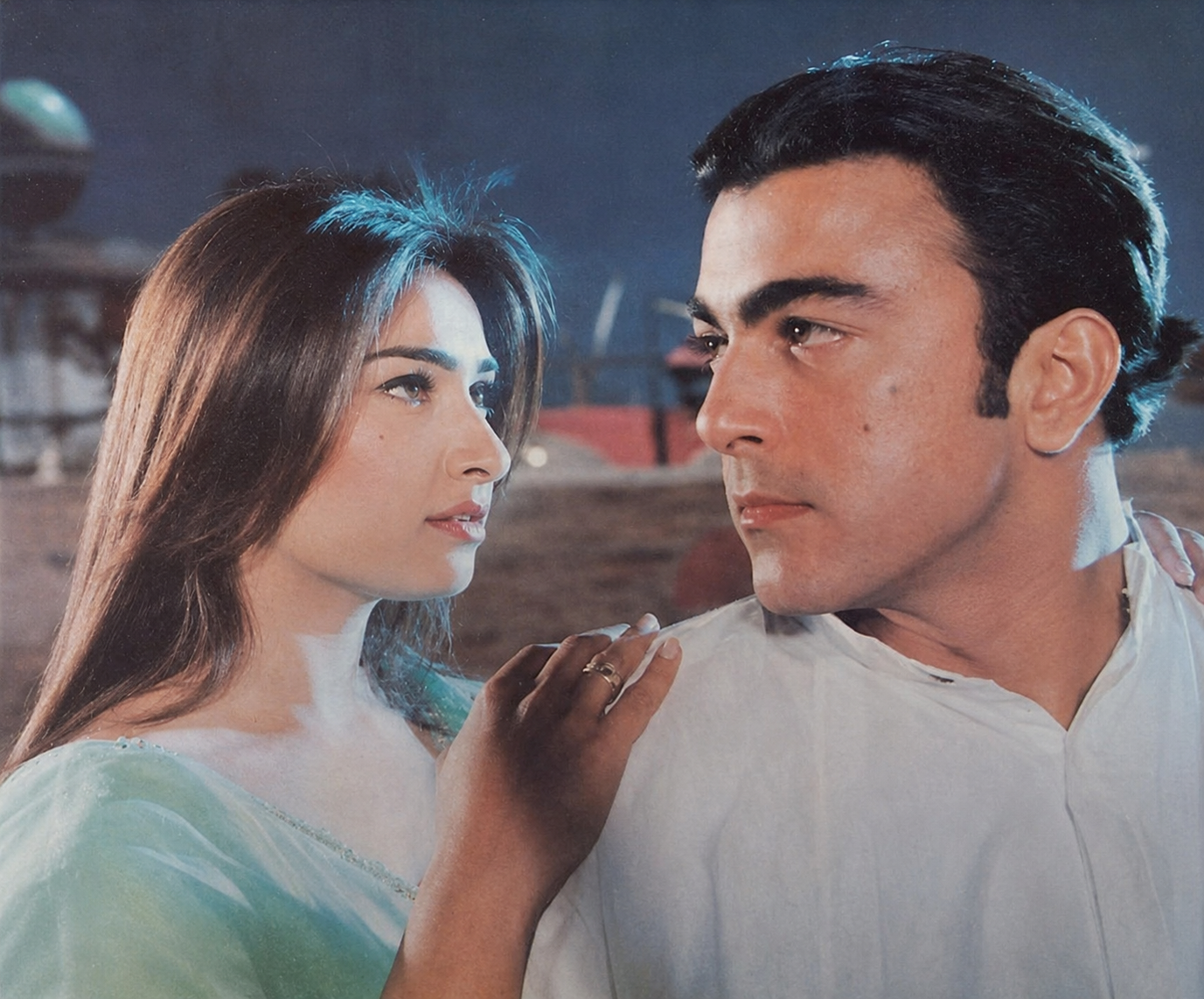
Lobby card for Nikah (Sangeeta, 1998).
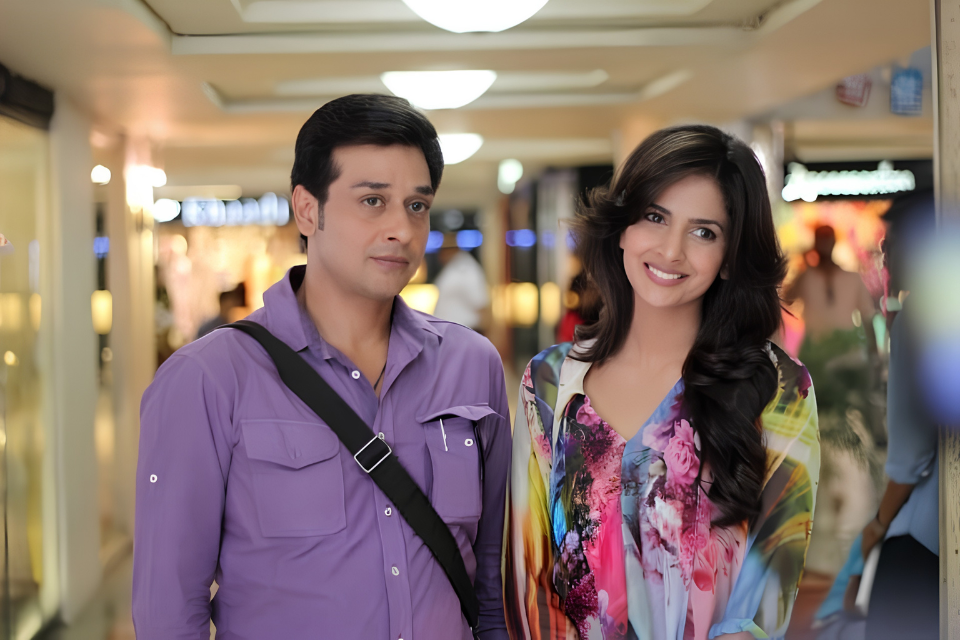
Family is a far more televisual project in 2013, when Aina is remade yet again as a telefilm. Following the neoliberalization drive initiated under General Pervez Musharraf in 2002, the private network television boom absorbed a workforce of unemployed cinema personnel, TVC-makers, and veterans of the state-owned broadcaster Pakistan Television (PTV), producing serials that hybridized Indian soaps, PTV’s storytelling tropes, flashy advertising, and Pakistani cinema itself. The remarkably undifferentiated look of Aaina (2013) demonstrates this. Under Sarmad Khoosat’s direction, Rita and Iqbal become Aaliya (Saba Qamar) and Sameer (Faysal Quraishi), with “era-appropriate” revisions: Instead of a hotel receptionist, Sameer is a struggling writer who finds Aaliya unconscious outside a farmhouse party. Aaina was among six films remade under a partnership between Geo Films and Tarang Foods, primarily a tea whitener brand, in hopes of “reviving” Pakistani cinema. A revival increasingly steered not by auteurs but by television offshoots like Geo Films, ARY Films, and Hum Films, the new visual vocabulary began to suffer from a crisis of sameness whereby television, cinema, and advertisements all resembled each other.
Khoosat’s formally uninventive Aaina is also structurally incapable of recreating the erotics of the original and Nikah. While the federal censor board is still susceptible to public outcry and moral hysteria from right-wing factions, films get away with far more than television, which is hawkishly surveilled by the Pakistan Electronic Media Regulatory Authority (PEMRA) in its drive to reorganize all media into “family entertainment.” PEMRA is also an accessible forum for the common citizen to air grievances: Its monthly catalogues of citizen complaints include, in June alone, a protest against the “portrayal of bold and intimate scenes… that are inappropriate for a family audience” and “vulgar” advertisements that preclude family viewing. Conversely, in cinema, similar scenes are greenlit all the time by the censor board and seldom prompt written complaints.
Despite the wariness prompted by PEMRA, Aaina makes no effort to push boundaries. On their wedding night, Sameer and Aaliya stand in a bedroom lit by decorative candles and roses, embracing from a careful distance. The marital bed becomes a backdrop, shrouded in shadows, and the only suggestion of sex arrives through a close shot of flickering candles. The next morning, Aaliya makes tea with Tarang whitener before the couple leaves to visit Sameer’s parents’ graves. Of all places, it is in the graveyard that “Mujhe Dil Se” begins, severing the link between the marital bed and the marital duet. (Though Pakistani telefilms rarely contain song sequences, the Geo-Tarang remake retains them as gestures of homage.)
A promotion image for Aina (Sarmad Khoosat, 2013).
If the original duet subsumed family formation within erotic fantasy, this one folds it back into consumable domesticity. At times, the montage resembles an advertisement reel more than a romantic duet: Aaliya sprays perfume in slow motion beneath a flowing white sheet, Sameer teaches her to cook, they laugh in hammocks and throw popcorn at one another. By the duet’s end, her teary-eyed gaze brightens when Sameer walks in with two cups of chai. If it looked like a tea whitener ad before, this shot does little to change that.
Insofar as television’s origins are bound up in ad revenue and what Raymond Williams called a “home-centred way of living,” a telefilm like Aaina is the perfect collusion of family and consumerism. The “selling logic” is not disguised; the Tarang logo colonizes Aaina’s title card, its frames, and the commercial breaks around it. At the same time, the shopping mall emerges as the new frontier of romance, almost as if replacing the marital bed(room)—even Sameer and Aaliya’s courtship begins there. Barring a handful of beach shots, their romance unfolds largely through consumption: cocktails, escalators, perfumes, glossy restaurants, shopping bags. To some degree, this reflects the 2010s cultural scene: In a city riddled with street crime, gang wars, and police raids extorting couples, the mall was one of the few safe places in Karachi. However, the mall also prevents the romance from escalating through its cameras and onlookers. After brushing shoulders in the mall, Sameer and Aaliya glance briefly toward each other’s lips before awkwardly looking away. So pervasive is the respectability trafficked by Tarang and the mall that even a dripping wet Aaliya at the beach can only induce a wide, goofy smile out of Sameer, as he gives her a hand, like someone roughhousing with a friend, not a lover.
Thirteen years after Aaina, Pakistani cinema’s “revival” still can’t shake the family-entertainment logic that shaped it. With the romantic duet now all but gone, new films remain afflicted by a crisis of imagination about how to circumvent decades-old censorship and cultural codes. The number of “social issue films” blocked by the censor board—Verna (2017), Zindagi Tamasha (2019), Javed Iqbal (2022)—suggests investors are willing to fund riskier projects, but only if justified as a cultural necessity. The question of how to show romance is itself incendiary, even though most audiences still flock to primetime television and cinemas for romance. As always, the kiss remains absent. Only now, so do the possibilities around it.