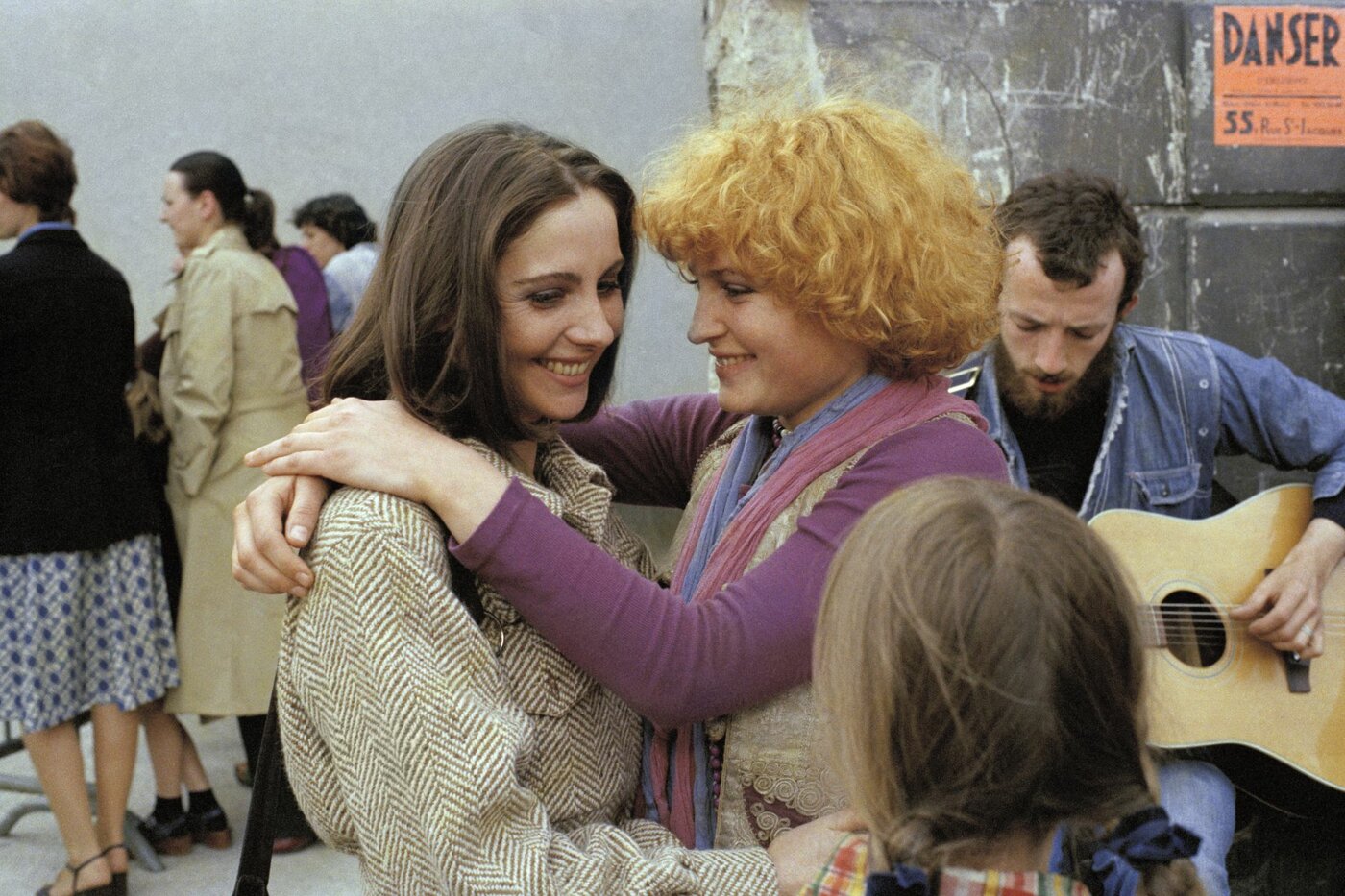
One Sings, the Other Doesn't (Agnès Varda, 1977).
In her memoir, Varda par Agnès, the French director describes herself as “une féministe de terrain plus qu’une discuteuse,” roughly translated as “a feminist on the ground rather than in theory.” Later in the book, she describes the “feminists” discussing her work, implying that she was outside this group. How feminist she reads from any angle now is unclear. Many would, for instance, find her focus on the body and childbirth essentialist. Her 1975 short, Réponse de femmes: Notre corps, notre sexe (Women Reply: Our Bodies, Our Sex), opens with this prompt: “What does it mean to be a woman?” The text is painted on glass and held up by two women: “Qu’est ce qu’être femme?” While showing a naked female infant rolling around on its back, the reply comes in her voiceover: “To be born a woman means being born with female genitals.” The next shot is of a blond adult female, naked and standing up, saying, “To be a woman means inhabiting a woman’s body.” While this is happening, Varda is heard in the background singing some kind of wordless combination of “la la la” and “da da da,” as if maybe the topic is not the topic. Or maybe her singing is a way to simply undermine the idea of a lecture. The remaining eight minutes contain many nude women, many children (some clothed), and a few tableaux of men standing in a group and looking back at women, in the collective. They seem unhappy but they are not the focus.
Tenderness may have been Agnès Varda’s primary subject, or a derivative of what now feels like her guiding principle: Be tender. Within that, Varda revisits a consistent trilogy of conditions: Raising children is joyful work rooted in the body; the enterprise of life is infinitely easier if a woman pairs up with another woman; and alone, a woman is at the mercy of a world designed for and by men. What she brings to these vectors is the tenderest possible eye, a grace she affords all of her subjects. L’opéra-mouffe (1958) contains within its chaotic seventeen minutes much of what runs through the subsequent 60 years of work. This is only Varda’s third film and her second short, but in Varda par Agnès, she writes that it was “the first film where I felt I was truly practicing the beautiful craft of filmmaking.” The film opens with footage of a naked woman, almost certainly Varda herself, then pregnant with Rosalie Varda (though there is no official confirmation in the credits). Having women be naked on screen as a matter of course, as common as cut flowers on a table, is a mission that Varda stuck to her for her entire career. Eventually, the Georges Delerue score kicks in, an antic dose of professionalism that seems to have been lifted from a different, more fully funded movie.
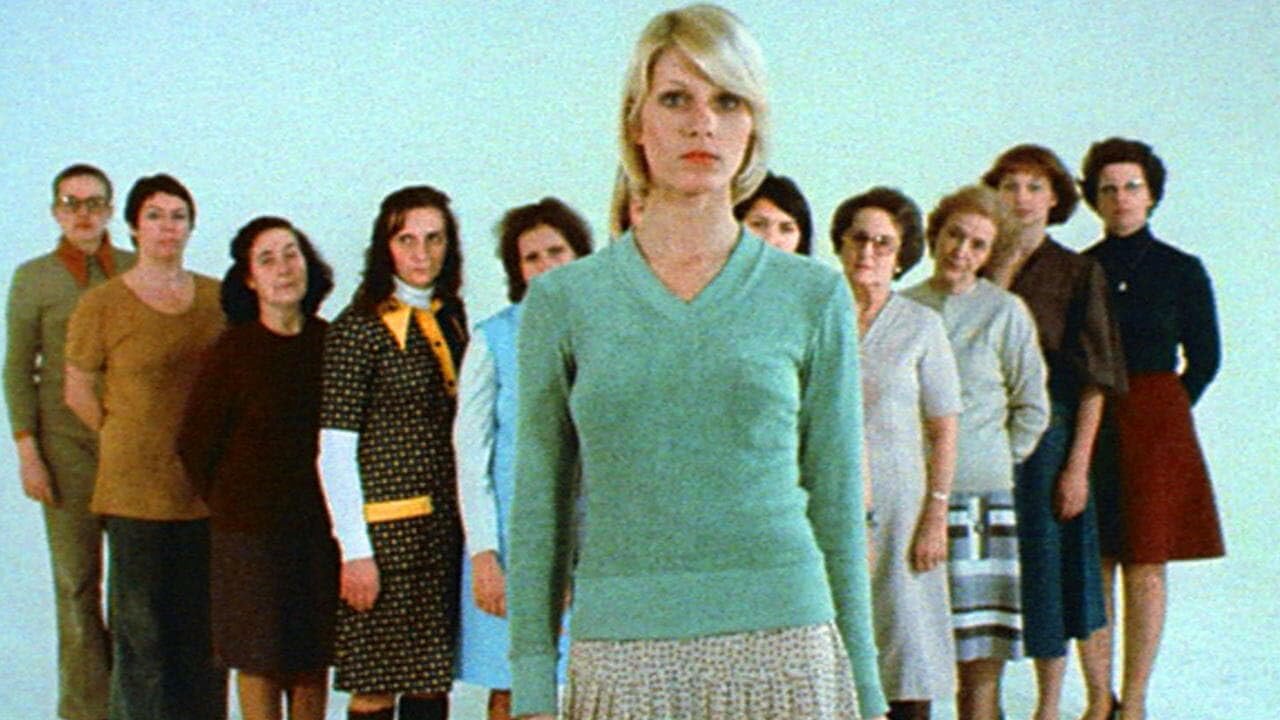
Réponse de femmes: Notre corps, notre sexe (Agnès Varda, 1975).
Varda’s 16mm black-and-white poem has no relationship to the black-tie sound of Delerue’s orchestra, which actually works, in its inverted way. Varda’s innate facility with cinematic language holds everything together. In L’opéra-mouffe we don’t yet have one of Varda’s friendship scenarios but the love in her gaze makes her films feel radically different from anything else coming from the surrounding New Wave cohort. (The aliveness, though, is common to all of the original class.) Varda’s vision of love is profound rather than decorative, essential rather than a strategy of mood. Of all the unhoused people she films in La Mouffe—the nickname for rue Mouffetard, an open-air market street—she writes that “all of them—the old, the one-eyed, and the homeless—had once been babies, newborns often loved, whose bellies had been kissed and whose bottoms had been powdered.” The unassaulted body is perhaps the demand of her politics, an assertion on behalf of tenderness in physical space.
Seeing bedraggled people on the street staring back at Varda and her camera, sitting big-bellied in a canvas chair on the sidewalk, you can feel her thinking of babies. Those who are visibly suffering are edited together with the happier, swank people doing their shopping. This is all intercut with kindergarten surrealism: a lemon slice standing in for the sun, a bird trapped in a glass, a twig in a vase. She called her set pieces “the dreamlike images of so-called marginal cinema (a premature chick slipping into a wine glass and a cabbage as nervous as a living organism).” She declared this short film a search for a cinematic form between “the truth of a Cartier-Bresson” and these roughly sketched daydream abstractions. The cut from a pregnant belly to a pumpkin being sliced open nods to Buñuel’s sliced eyeball. Cavorting between all of these images of “drunkenness” and “anxiety” (her own intertitles) are two young-ish lovers: nude, happy, healthy. The idyll of domesticity is one step away from a drunken sleep on the cobblestones with no mothers in sight. “I was filming,” Varda wrote, “thinking only of these two themes: former babies and tripe.”
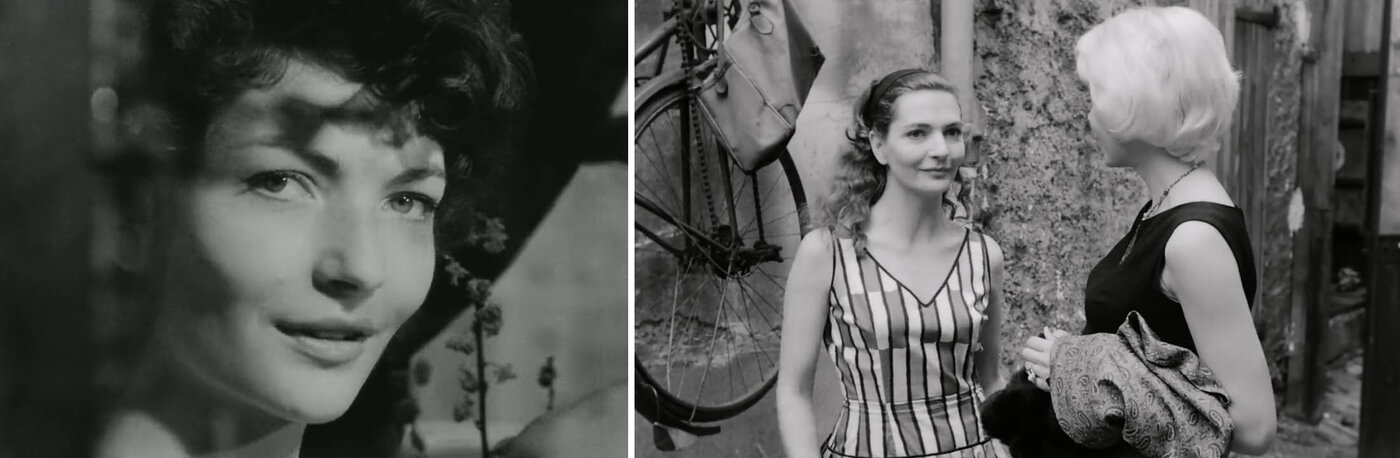
Dorothée Blanck in L’opéra-mouffe (Agnès Varda, 1958), left, and Cléo from 5 to 7 (Agnès Varda, 1962), right.
Cléo from 5 to 7 (1962), Varda’s breakout hit and still her most widely known film, shows a pop singer (Corinne Marchand) traveling about Paris, waiting for a medical test. Her friend? Dorothée Blanck, the same woman being exuberant and nude in L’opera mouffe. Here, she is a nude model who tells Cléo that her body makes her “happy, not proud.” This distinction is central to Varda and possibly explains her passage in and out of politically explicit stances. Just as she wants nudity to be no big deal, she posits a vision of life in which autonomy needn’t become the precondition for a grievance. It’s my body! Calm down! Like a real friend, Dorothée takes Cléo to the movies.
Of her 1965 film, Le bonheur, Varda wrote that the “colorful, impressionistic, family-oriented happiness” was circling an idea that is both “painful and simple,” that “each of us is unique but replaceable.” Less philosophically, Varda explained in a short filmed intro to Le bonheur produced for ARTE in 1998, “I wrote a film with two or three picnics so I could spend a month outside.” Varda calls the film “a peach with a worm in it,” for which she chose a television actor, Jean-Claude Drouot, who she discovered on the cover of Marie-Claire. He starred with real-life spouse, Claire, and their two kids. “In a world full of pre-fabricated images of happiness, it’s interesting to take apart the clichés,” she told ARTE, the clichés you would find in, say, Marie-Claire.
The saturated colors look like the ads from women’s magazines, and the affect of the movie is flat, a procession of stock images shot from middle distance. Our archetypes: The husband is a carpenter, the wife works at home. The husband quickly replaces the wife with a female postal employee, who moves from adulterous lover to wife when the first woman drowns in a lake. Replaceable, as Varda says. The evenness of tone feels like a horror movie, an early indication that Varda was paying zero attention to what would benefit her career, just as her star was rising because of Cléo. Importantly, also, this time the pregnant belly is now a small cast of kids, who are seen running around being themselves, very much the opposite of child actors. Without a friend, the wife is stranded in the sawdust of clichés and structural violence, but the kids are OK.
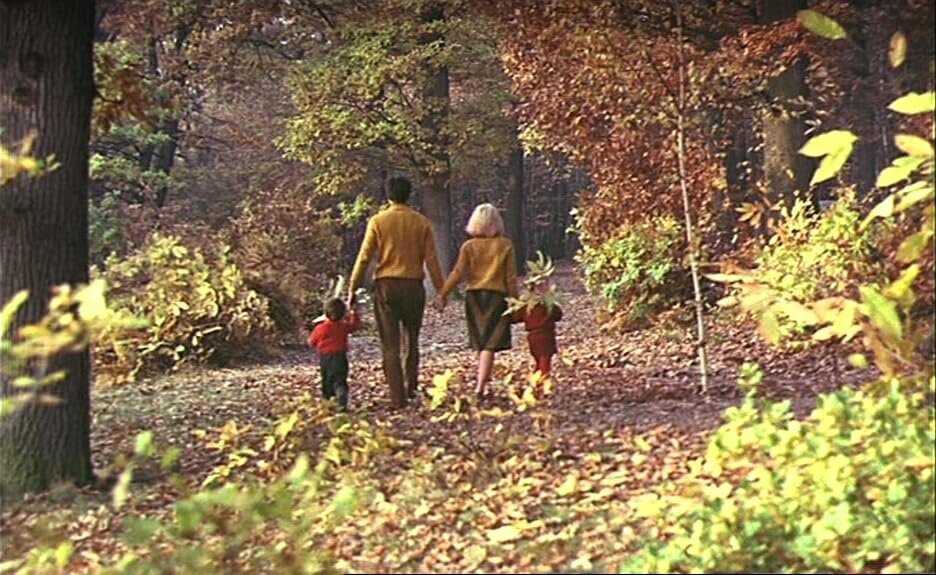
Le bonheur (Agnès Varda, 1965).
In 1972, Varda was eight months’ pregnant with Mathieu, her child with Jacques Demy, when she went with her friend, actress Delphine Seyrig, to the town of Bobigny. There, they marched and chanted in support of Marie-Claire Chevalier, on trial for an illegal abortion following her (also illegal) rape. Lawyer Gisèle Halimi defended Chevalier at the trial, calling Seyrig to testify as she was a well-known actor who had undergone an abortion without being arrested. (Chevalier got off and, in 1975, abortion was legalized, with Bobigny widely cited as a turning point.) As Varda put it to interviewer Mireille Amiel in 1975: “How can women who still want to have children be sure to be able to have them when they want, with whom they want, and how are we going to help them raise the children?” The only solution she saw, in her words, was to be a “superwoman” who manages to not abandon any of her multiple lives, a woman who is able “to not give up children, to not give up cinema, to not give up men if one likes men.”
In 1976, Varda started working on the answer to all this, the film that synthesized twenty years of thinking: One Sings, the Other Doesn’t (1977). There is no single most important film in Varda’s catalog, but this could be seen as the hinge. The incomplete songs heard in L’opéra mouffe have given birth to full-blown musical numbers, and the children in Varda’s cinema have grown and multiplied, earning spoken lines and broken bones (one male leg). Over twenty years of friendship, Suzanne (Thérèse Liotard) and Apple (Pomme, originally Pauline) (Valérie Mairesse) remain more constant to each other than anyone beyond their kids. Suzanne loses her low-earning photographer husband, who specializes in portraits, to suicide, leaving her with two kids and another on the way. Apple, a singer, helps raise money for Suzanne’s abortion. Suzanne doesn’t do exactly as she promises, getting the abortion her own way, establishing that independence is key for Varda, even within the friendships.
The men in the film are neither demons nor saviors. Apple’s husband, Darius, is an attentive companion in France but when the two move to his native Iran, Darius lapses into traditional male inaction and frustrates Apple right back to France. They end up raising two kids separately, in two different countries, though without rancor. Apple’s group, The Orchids, eventually comes to the family planning center where Suzanne works. They perform an ode to pregnant women called “The Balloon Woman”: “Oh, it’s good to be a bubble… a cell factory.” An audience member fires back, saying the right-wing anti-abortion gang could also sing the song. The dialectics are doing their thing. Varda even restages the Bobigny protest with Halimi herself, using it as a reunion point for Apple and Suzanne. As for the film’s ending, after various hippie males have come and gone, the two friends remain the central couple.
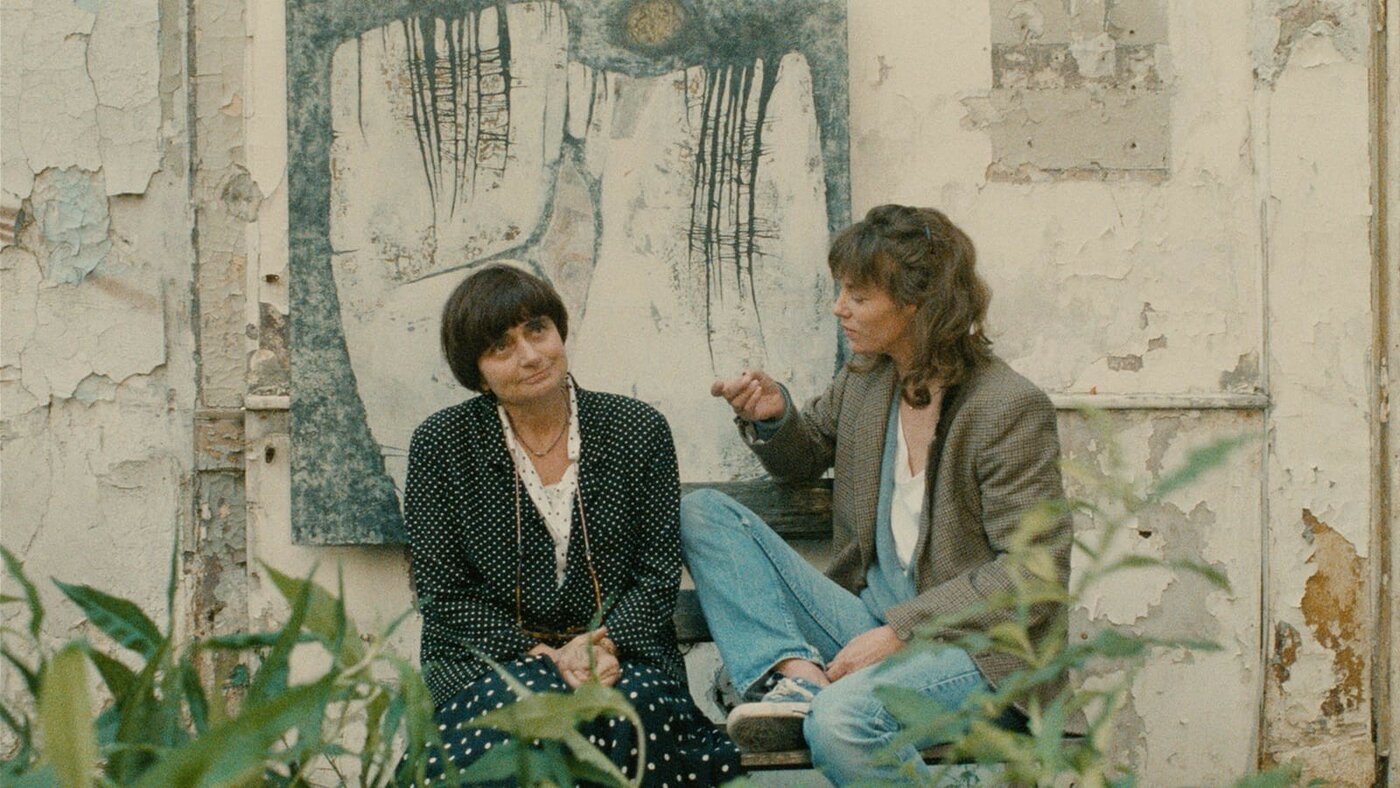
Jane B. for Agnès V. (Agnès Varda, 1988).
In later movies, the formula remains consistent. In Vagabond (1985), Mona Bergeron (Sandrine Bonnaire) drifts alone and ends up frozen in a ditch. In the documentary Jane B. for Agnès V. (1988), Jane Birkin and Agnès Varda speak as themselves and the film’s engine is nothing but friendship. The very long interview with Birkin, loving and slow, is interrupted by fantasy sequences of almost obscure purposes. Laurel and Hardy covered with flour in a bakery? Sure. Birkin as a flamenco dancer, her personal nightmare? Check. Jane does in fact sing and Agnès does not, and both quite obviously love each other and their kids—Varda even lends her own son to the production of Kung-Fu Master! (1988), a film they conceive in the middle of making Jane B for Agnès V. Varda spends much of her time talking to Birkin, asking how she feels being photographed, what the experience of being Jane Birkin is like, without it feeling like celebrity access journalism. Feminism on the ground. The film, itself, is the space where Varda can protect her friends. Tenderness does not scale—it is always small, near the skin.