
The Action Scene explores the form, history, and visceral power of action cinema through its set pieces.
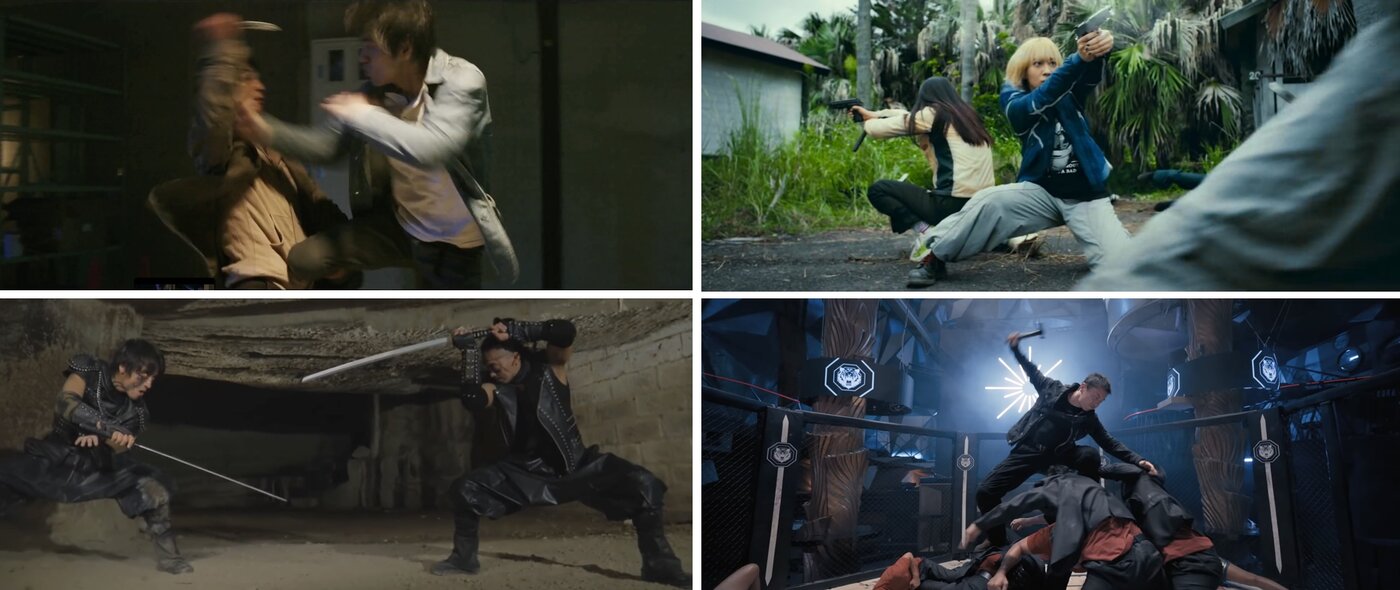
Clockwise from top-left: Hydra (Kensuke Sonomura, 2019), Baby Assassins: Nice Days (Yugo Sakamoto, 2024), The Furious (Kenji Tanigaki, 2026), Ninja Hunter (Seiji Chiba, 2015).
The Furious (2026) is the action cinema event of the year. Directed by legendary stunt coordinator Kenji Tanigaki, and featuring a murderer’s row of martial arts talent—the lineup includes Chinese DTV stalwart Xie Mao; the self-taught Brian Le from Everything Everywhere All at Once (2022); Joe Taslim and Yayan Ruhian from The Raid (2011); and a cameo appearance from Thai screen icon Jeeja Yanin—the film abounds with dizzyingly intricate fight choreography that is markedly different from typical martial arts fare. The mastermind behind the spectacle is Japanese action director Kensuke Sonomura, who is responsible for some of the most idiosyncratic fight scenes in contemporary action cinema.
Sonomura’s journey into action began with Jackie Chan. Entranced by the star’s virtuosic physicality as a youth, he enrolled in the Kurata Action Club—a training school run by the stunts agency Kurata Promotion—at 16 after seeing an ad for trainees, during which he learned some basics in striking and reacting. At 18, he went freelance and soon joined the action media production company U’den Flameworks, headed by the prominent Japanese stunt coordinator Yuji Shimomura. After a few years performing stunts and designing choreography for various projects, Sonomura landed his own gig as an action director for Ryuhei Kitamura’s LoveDeath (2006), which saw his responsibilities expanding to include areas like the camera blocking, editing, and budgeting of action sequences. Since then, his resume as action director has grown considerably, spanning television series; low-budget exploitation films; video game motion capture and film adaptations of video games; and collaborations with big-name auteurs like John Woo (Manhunt, 2017) and Mamoru Oshii (Nowhere Girl, 2015). His first foray into directing occurred with the neo-noir actioner Hydra (2019), a role he’s since reprised twice with the yakuza crime thriller Bad City (2022), starring V-cinema veteran Hitoshi Ozawa, and Ghost Killer (2024), an action comedy about a college student who becomes possessed by the ghost of a hitman, played by Hydra star and longtime friend and collaborator Masanori Mimoto.
Hard Revenge, Milly: Bloody Battle (Takanori Tsujimoto, 2009).
Sonomura’s action instincts were sharp out of the gate, but a stylistic gulf separates his recent work from his earlier output. Hard Revenge, Milly (2008) and Hard Revenge, Milly: Bloody Battle (2009), which focus on a vengeful bionic woman (Miki Mizuno) with weaponized body parts, are exercises in maximalism, capitalizing upon a fad for extreme cruelty and hyperbolic gore in Japanese genre cinema. As fists fly and blood geysers, Sonomura directs the action using forceful filmmaking that is reminiscent of anime and Hong Kong-style action. Weapons and limbs jut toward the camera; low-angle framing makes characters tower like kaiju. Rapid cutting mashes together these stylized compositions to create a whiplash-inducing graphic aesthetic, like manga panels set into motion, and the hyperactive camera rockets around, jerking with blows and impacts. Whooshing sound effects top it all off, evoking comic-book onomatopoeia.
Ninja Hunter (Seiji Chiba, 2015).
This exclamatory aesthetic continues into Sonomura’s subsequent projects like Alien vs. Ninja (2010), Bushido Man (2013), and Ninja Hunter (2015), but these shift toward increasingly intricate, intimate, and fluid choreography. In Alien vs. Ninja, which Sonomura co-action-directed with Shimomura, tokusatsu hijinks are imbued with gymnastic, Jackie Chan-style bodily contortions. At one point, the hero (Mimoto) blocks and evades sword swings while sitting or lying on the ground, like MMA ground work meets a game of Twister. Elsewhere, he parries and weaves around the bullwhip snap of a rubber-suited alien’s CGI-added tail, suggesting top-notch previsualization (previs). Ninja Hunter pushes the complexity and bodily proximity to even greater extremes. Set almost entirely in a cave and centering on an amnesiac ninja (Mimoto again) as he tries to uncover what happened to him, the film contains several epically long, multi-person swordfights exhibiting uncommonly varied and intimate choreography. Contact points range from wrist to armpit to behind the knee, and katanas swish and slide around, injecting a flowing rhythm distinct from the discrete, decisive slashes of typical chanbara action.
Nowhere Girl (Mamoru Oshii, 2015).
A key milestone in Sonomura’s style is the climax of Oshii’s Nowhere Girl, in which the heroine (Nana Seino) demolishes the paramilitary troops storming the halls of her high school. The scene provides a blueprint for the messy-yet-tactical action that will become Sonomura’s trademark. Much of the combat happens low to the floor, whether it’s crawling beneath whizzing bullets while cradling an assault rifle, using felled bodies as meat shields, or sliding between an enemy’s legs to initiate a takedown. A year later, Sonomura leaned into messiness with his choreography for Destruction Babies (2016), crafting action that feels disturbingly banal, like you’re watching a real fight break out in the street. Distant, impassive long takes frame characters as they stumble around, awkwardly swinging at each other. It’s a style that fits the film’s nihilistic portrait of a character who picks fights with passersby for no discernible reason, violating the tranquility of routine. The action in the computer-animated video game adaptation Resident Evil: Vendetta (2017), on the other hand, leans toward tactical precision, but it’s precision with a post-Nowhere Girl flourish, filled with rolling, sliding, MMA-inspired takedowns, and hyper-close-quarters gunplay in which weapons discharge inches from faces and bullets are dodged as freely as punches.
Resident Evil: Vendetta (Takanori Tsujimoto, 2017).
When it premiered, Sonomura’s directorial debut, Hydra, made a splash within action fan circles. Set in a neon-tinged Tokyo where cabals of assassins clash in the shadows, the film features two main fights whose sparse mise-en-scènes—warehouses, basements, guys in jackets and khakis—serve to distill the main attraction: choreography that resembles a kind of tactical fumbling. Combatants press up against each other, blurring the line between striking and grappling. Barely dodged punches graze clothes and hair and flow directly into clinching maneuvers. The close proximity means that limbs have minimal room to extend, replacing the wide visual arc of the classical haymaker with a cramped pitter patter of fists and knives. Through it all, fighters remain silent, stoic. We read their thoughts through their movements, which comprise a stream of constant micro-adjustments. Sonomura dramatizes the way opponents feel each other out, reacting to every infinitesimal change in the other’s stance. Captured in wider, longer takes, this impression of agitated alertness is enhanced by the Foley work, which amplifies rustling fabric and squeaking shoes while making punches and kicks sound more muted. Shifting the emphasis of conventional action design, these scenes attenuate big beats and accentuate smaller, intervening movements. In the process, they defamiliarize the art of fight choreography itself, loosening its sedimented forms to present something that feels genuinely new.
Hydra (Kensuke Sonomura, 2019).
Sonomura’s artfully untidy action belongs in the lineage of Donnie Yen-inspired fight design in Japan, whose students include both Shimomura and Tanigaki. The early aughts films that Yen action directed, such as SPL (2005) and Flash Point (2007), brought combatants up close and to the ground, infusing golden-age Hong Kong choreography with a rougher, MMA influence. “Choreograph the unchoreographed” is how Tanigaki described the Yen flavor of screen combat, except Yen’s work occupies a happy medium between the two tendencies. The fighting feels dirtier, evoking “real” brawling, but hooks and holds are executed with precision, and the editing cleanly isolates moves and impacts, heightening visceral immediacy through immaculate formal control.
Donnie Yen-style action in Flash Point (Wilson Yip, 2007).
Sonomura’s action is different. As more decisive hits are replaced by smaller, more scrabbling movements, and as the metrical staccato of Hong Kong-style fight beats yields to a more irregular rhythm, a sense of messiness becomes an overt feature of the fight choreography, something the viewer is designed to notice; in an interview with JFF Theater, Sonomura notes how his choreography for Baby Assassins (2021) is intentionally off-beat, subverting expectations by replacing the traditional “1-2-3” with “1, a short pause, then 2, then immediately 3.”1 At times, the messiness even feels exaggerated, performative. The feints, flurries of limbs, and chafing fabric Foley seem simultaneously realistic and stylized, ramping up the unruliness of real-world fighting to hyperbolic extremes.
Sonomura’s action is neither completely polished nor completely disheveled. It feels both “choreographed” and “unchoreographed,” but, unlike with Yen, we’re meant to sense the dialogic tension between the two. It’s alongside the appearance of some sharp, punctuating beats—punches, kicks, headbutts—that the general messiness feels like messiness, like something departing from the norm in which such cleaner beats would have predominated. Conversely, it’s against the background of this general messiness that these beats feel tactical, like calculated, split-second responses to situational demands. The combat’s arrhythmic micro-shifts telegraph a sense of thought: hesitation, decision, reaction, adjustment. It’s a kind of action that, despite being meticulously choreographed (Sonomura is a staunch adherent of previs, which enables a level of refinement otherwise deterred by limited shooting days2), feels improvised, like we’re watching highly skilled performers riffing on each other’s moves in real time. This sense of spontaneity generates a live-wire energy, a feeling of danger and unpredictability.
Bad City (Kensuke Sonomura, 2022).
By embedding more accented fight beats within a larger flow of movement, Sonomura loosens their sense as distinct “beats” to begin with. All beats seem to emerge from this baseline flux, and it is to this flux that they return. His action is a bit like jazz. It dances around expected notes and conventional harmonies, inviting us to unlearn orthodox shapes and progressions and embrace the potential that lies in messiness. What new beats are waiting to be formed? How can bodies occupy and move through space in ways never seen before?
This spirit of experimentation permeates the Baby Assassins series, which contain some of Sonomura’s most inventive choreography. In the series’ inaugural fight, in which fisticuffs extraordinaire Mahiro (stuntwoman Saori Izawa) takes on a posse of killers fronting as convenience store employees, the combat not only moves to the floor but over and through a mass of bodies. Early on, Mahiro has to extricate herself while being carried like a crowd-surfing pop star; shortly after, a knife fight unfolds within a dogpile of opponents. Baby Assassins: Nice Days (2024) brings the series’ action to new heights of innovation and complexity. At one point, Mahiro disarms an opponent by snagging his gun in the crook of her neck; moments later, she gives chase by sliding down a bannister into a flying kick, knocking him off balance. Elsewhere, an entrapped character, wielding a version of animal-style kung fu, escapes the stairwell where he’s being held by ramming his back into one captor then dodging a gunshot by leaping up on all fours—hands against the wall, feet against the railing, forming a bridge. The film’s exhilarating climax abounds with imaginative twists on the Sonomura idiom, whether it’s Mahiro hopping onto her opponent’s thighs to push herself out of a guillotine choke, or an entire passage of choreography organized around the gesture of the fist bump.
Baby Assassins (Yugo Sakamoto, 2021).
The Furious unites two legendary fight choreographers—Tanigaki in the director’s chair, Sonomura overseeing the action—and the result is a perfect fusion of their styles. Observing as a mute tradesman (Xie Mao) and a journalist (Joe Taslim) rampage through the criminal underworld of an unspecified Southeast Asian city in search of the tradesman’s daughter and the journalist’s wife, the filmmaking evokes Tanigaki’s (and Yen’s) past work. As fighters clash, sweeping dolly shots skate around the fray; punchy inserts convey the pounding force and tactical ingenuity of specific moves; and the Foley sounds of whooshing limbs, thudding punches, and clanging blades are noticeably amplified. The choreography, however, is pure Sonomura. Fighters slide around like hockey pucks, dogpile atop each other, and execute moves of mind-blowing unorthodoxy, whether it’s stabbing an opponent with a knife clasped between one’s feet, mid-handstand, or pushing a supine adversary by the legs like a snow shovel, plowing into two others. The individual stars supply their own unique inflections—Mao throws snappy, wushu-inspired combos and Taslim leans toward burly, judo-adjacent takedowns—but it’s all embedded within the protean flow of Sonomura’s signature movement language.
There’s something thrilling, even moving, about seeing some of today’s biggest action stars adapt their bodies to Sonomura’s choreography. Watching these genre titans partake in the artful messiness generates a feeling of veneration and validation, as if cinema’s martial masters were affirming an up-and-comer’s style through enactment and imitation. For those familiar with Sonomura’s work before The Furious, it really feels like he’s “made it.” His work, until now largely confined to lower-budget productions and regional releases, is now poised to reach a wider global audience and shape the action genre’s development as a whole.
1. "Interview with Kensuke Sonomura: From Jackie Chan Fan to Action Director of https://en.jff.jpf.go.jp/article/babyassassins/.
2. See Robert Ewing, “Interview: Kensuke Sonomura on His Approach to Action And How It Enhances Narrative and Mixing Dark Themes With Comedy,” The People’s Movies, March, 2, 2025.