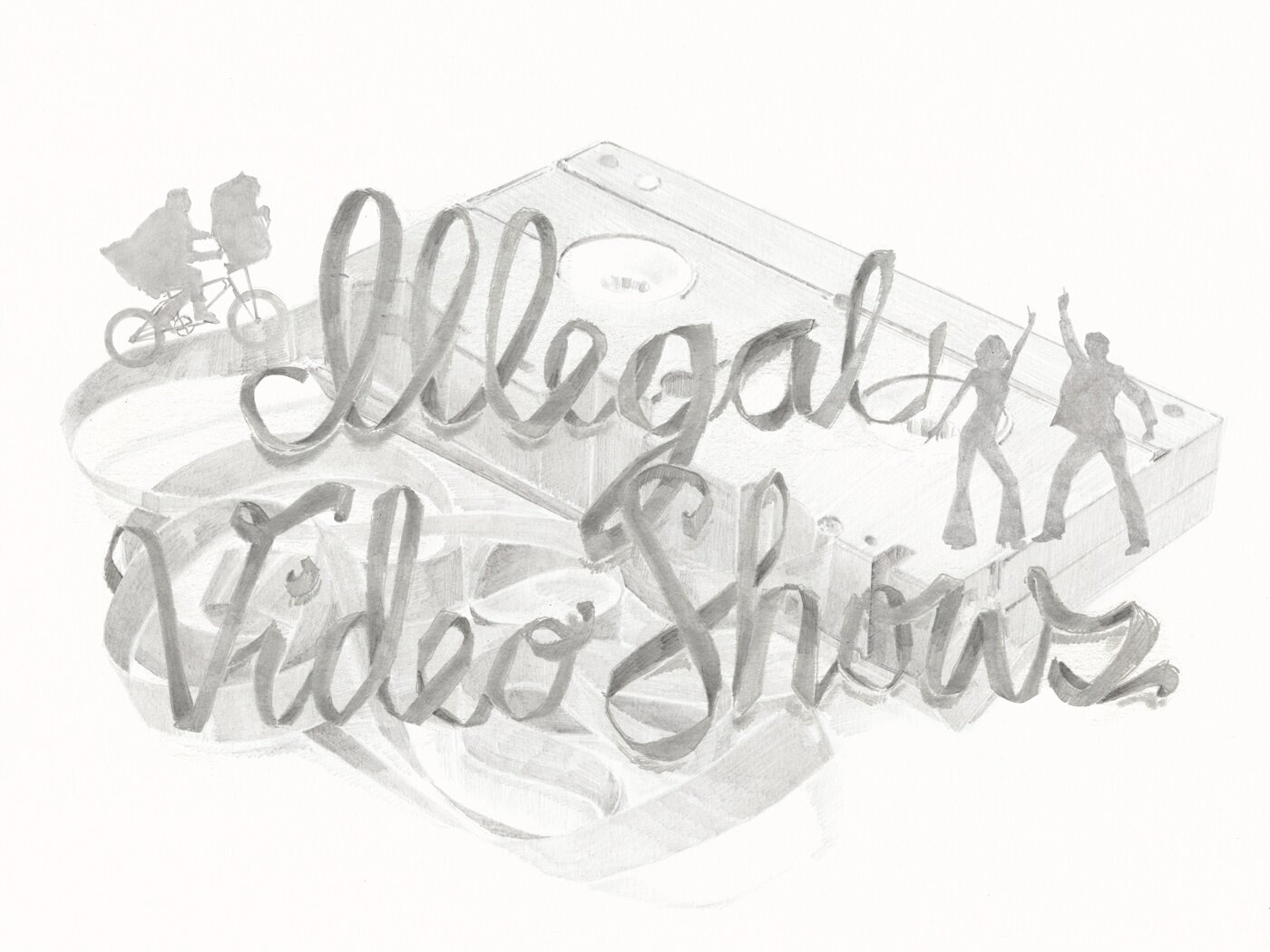
Illustration by Danny Ische.
The 1970s was a difficult decade for cinemas across Britain and Ireland as attendances continued their long postwar decline. Most of the glamorous art deco picture palaces built during the 1930s had either closed or fallen into disrepair and comparatively few new cinemas were opened after World War II until the arrival of the multiplexes in the 1980s. While these challenges were facing exhibitors in many other countries around the world, Northern Ireland’s experience of the downturn was unique. The outbreak of violent sectarian conflict in the late 1960s, euphemistically known as the Troubles, created an environment that actively discouraged cinema attendance.
Queues still formed for blockbusters such as The Godfather (1972), The Exorcist (1973), and Jaws (1975), but ongoing violence and nightly curfews made it more difficult to justify a cinema trip for more run-of-the-mill fare, with many people retreating into private spaces. This meant that cinemagoing became less of a social habit and more of an occasional activity that carried a level of potential risk. In Belfast, bomb and fire damage in the early 1970s led to the permanent closure of the Classic and the Broadway cinemas, and in 1977, IRA firebombs damaged three venues: the ABC, the New Vic, and the Curzon. Cinemas were no longer safe spaces immune from what was happening in the outside world.
The launch of Video Home System (VHS) in the mid-1970s therefore came at the perfect time for Northern Ireland’s cinema lovers, who desired entertainment and escapism but were less willing than ever to leave the comfort and relative safety of their own homes. JVC’s new VHS technology eventually beat the competition of Sony’s rival Betamax format and revolutionized the way in which people watched and consumed visual media. For the time, the power to control when audiences watched films began to shift from the exhibitors to the audience. Power shifted, too, from producers to consumers, and for the first time people could directly record films or television programs onto blank tapes and play, pause, or rewind at their own leisure.
This power still had a barrier, which was the large expense of videocassette recorders (VCRs).Yet many people purchased them in spite of difficult economic circumstances and high levels of unemployment in Northern Ireland. In 1980, for instance, an electronics shop in the Country Antrim town of Ballymena advertised a Philips VCR for the hefty sum of £495, equivalent to £2,165 in today’s money. Renting a machine was a popular alternative for those who couldn’t afford to buy a VCR outright, with the shop hiring out the same device for £18.50 per month, still a considerable expense at a time when the average gross weekly household income was £119.
By 1981, VCR ownership had spread so quickly across Northern Ireland that one newspaper report asked if home video was the “armchair answer to the Ulster Troubles,” providing an easy means of accessing the latest films without having to leave the house.1 To compete, cinemas that were already struggling financially were forced to lower prices, improve their offer to patrons, and in some cases convert a single auditorium into a multiscreen cinema. Television channels responded by programming a broader range of films to compete with the appeal of home video. By 1983, reports suggested that Northern Ireland had a higher concentration of VCRs than in any other part of the UK.
The video boom provided an extra source of income for the corner shops, newsagents, and electronic stores who rented videos to consumers. And soon after, specialist independent video shops sprung up on streets across Northern Ireland. For around £1.50 a night, film lovers could rent and take home one of the latest video releases from around the world, some of which had not previously been shown in local cinemas. American films generally dominated the rental market, but a 1982 list of the most popular rented videos in Northern Ireland also included British crime drama McVicar (1980)and the Israeli sex-comedy Hot Bubblegum (1981). Long before the streaming age, some video shops even offered subscription services, where people could pay a monthly or annual fee to rent multiple videos. Until later in the 1980s, very few people purchased videos outright, and a single VHS retailed for as much as £60. The distributors wanted to protect their product and were largely reluctant to “sell through” to the market.
For a small investment, the video boom provided local entrepreneurs with the opportunity to earn a living by investing in a video rental library. But the same technology that allowed people to record films directly from the television also meant there were money-making opportunities for those willing to flout the law by copying and selling pirate or counterfeit videos. Why spend thousands investing in a legitimate video library when you could just as easily buy a bank of video recorders and flood the market with easily copied pirate or counterfeit videos?
Before John Badham’s Saturday Night Fever (1977) was first shown at Belfast’s Avenue Cinema in 1978, pirated VHS copies of the film were shown in hotels, pubs, and clubs across Northern Ireland. In some parts of the province there was still a strong appetite for public entertainment, especially for those unable to purchase an expensive VCR. Kelly’s Golf Links Hotel in the north coast town of Portrush brazenly advertised the “first time showing in Northern Ireland” on a 10 ft screen.2 For £1.50, the same price as renting a video, people could watch the film followed by a disco. This incident led a High Court judge to ban further screenings until the film’s official release and order that all pirate copies be returned to the distributor.3
By 1981, the Royal Ulster Constabulary (RUC), Northern Ireland’s then police force, was starting to crack down on what they called “illegal video shows.” The police wanted to counter the public perception that pirating videos was a permissible and victimless crime, and the force’s anti-racketeering squad confiscated over four thousand illegal video tapes, including pornographic material, during a four-day operation. A police spokesperson said that “video piracy is not only a means whereby paramilitary organizations and criminal opportunists are able to make money, but members of the public are being conned into accepting and paying for something that is not the genuine article.”4
By 1982, the UK video black market was reportedly worth £100 million. In Northern Ireland, legitimate distributors responded to piracy by grouping together to form the Northern Ireland Video Library and Trades Association. But if the RUC were able to stop illegal public screenings of Saturday Night Fever, they found it even more difficult to counter the spread of pirate and counterfeit videos on the streets and in people’s homes.
The pirate hit of 1982 was Steven Spielberg’s E.T. the Extra-Terrestrial (with an estimated ten thousand illegal copies available in the UK in mid-August, four months before the film was released in Belfast cinemas in December 1982. In September, one reporter found copies easily available in the town of Ballymena for £5, with a source saying, “I can get you any film you want—from the class like E.T. down to the blue movies.”5 But the premature release did not dampen people’s enthusiasm to see Spielberg’s film on the big screen. It was still a massive success when it screened at Belfast’s ABC, which had reopened in 1980 as a four-screen cinema. The film then played at venues across Northern Ireland, at a time when overall cinema attendance continued to decline. Shortly after its cinema release, a magazine poll revealed E.T. as one of the top ten videos of 1982, despite not being legally available to rent or buy until 1988.
The potent impact of piracy led the RUC in February 1983 to seize up to 35,000 videos from 25 suspected pirate and counterfeit dealers across Northern Ireland in the biggest raid of its type in the UK. Prosecutions were reported from 1985 onwards, and even though this took a few dealers out of the market, it didn’t seem to act as a widespread deterrent given the high demand and relative ease of copying video cassettes. Soon after the raid, Ulster Television’s Counterpoint program dedicated an episode to video pirates, showing how they were easily able to set up backstreet factories with multiple VCRs and make thousands of duplicate copies. It claimed that the market was flooded with illegal copies, and even legitimate dealers were unable to tell if they were selling counterfeit copies. In the episode, one video dealer, who denies stocking pirates videos, dons an E.T. hat, picks up an acoustic guitar and sings the following words:
“I’m a video pirate in the true Ulster way, and I make my living legitimately. I copy the soft porn on Sundays and leave all the hard stuff till Mondays. I’m good at the Disneys, the First Bloods, the E.T.s and I’ve copied the Rockys as well. I’ve closed 20 cinemas but now I’m on the Valium. Warner Bros. they scare me like hell. My machines are well hidden in a mountain in the bracken where fraud squads can’t dwell. And if anyone copies this ballad, sure they’ll be an old pirate as well, they’ll be an old pirate as well.”
Given the ease and profitability of video piracy, it’s not surprising that in Northern Ireland paramilitaries also got into the business. In 1990, one newspaper report alleged that video piracy earned the IRA almost £1 million a year, one third of its racketeering income alongside earnings from construction and cross-border smuggling.6 Democratic Unionist Party Alderman Jack McKee warned that paramilitary organizations may be profiting from video piracy and said that “unwittingly, people could be buying tapes and helping to fill the coffers of organizations like the IRA. The money they’re paying could be used to buy bullets and explosives to kill soldiers and policemen.”7 By the 1990s, attempts to clamp down on video piracy reportedly led the paramilitaries to seek funds from elsewhere. A 1993 newspaper article claimed that the RUC Anti-Racketeering Squad’s success in cutting off funding from video piracy had led to a recent increase in armed robberies.8
The first video shops were independents with unique names, such as Toppers Video Shack in Lurgan or Zodys in Comber. In the mid-1980s these were joined by small local chains such as Star Video and Valley Video Co. Irish chain Xtra-vision first opened shops in Northern Ireland in 1989 and quickly became the largest video retailer in the region. In 1990, there were 248 “video libraries” in Northern Ireland, 72 of which were branches of Xtra-vision. Paramilitaries of all persuasions, having been clearly attracted to the money that could be made from the black market, began to target these shops. In 1990, one newspaper article claimed that “Loyalist paramilitary groups were responsible for three recent bomb attacks on Northern shops owned by the Dublin-based Xtra-Vision video chain,” with a hand grenade thrown into a Belfast shop, followed by bomb damage at branches in Belfast and Portadown. The violence that had turned some people away from the cinema was now encroaching on this alternative space. Loyalist sources were concerned that “addresses of loyalists and security force members may be in the firm’s computerised subscriber system.” A spokesman for Xtra-vision responded by blaming “loyalist racketeers irked at the loss of their lucrative illegal video copying scam because of the new competition.”9 Later reports stated that after the fall of the USSR, Loyalist paramilitaries were using funds from video piracy to import arms from former eastern bloc countries.
The arrival of purpose-built multiplexes in Northern Ireland from 1990 led to increased cinema attendance, with admissions rising from 2.3 million in 1991 to 4 million in 1998. But piracy continued throughout the decade, with films such as Terminator 2: Judgment Day (1991), Jurassic Park (1993), and The Lion King (1994)reported as big pirate hits, copies being easily obtained from open-air markets. During this time, buying videos outright became a more affordable option. Distributors dropped prices for the “sell through” market, sales increased, and video purchases started to generate more revenue than rentals. Local independent video dealers also faced increased competition from new high street chains such as Virgin Megastore, whose prominence and high visibility made them less likely to deal counterfeit videos in the same fashion as the less scrupulous independent dealers.
DVD entered the UK market in 1998, the same year as the signing of the Good Friday Agreement in Northern Ireland. For several years, video shops fared well by adapting to the rise of this new format. But so did the pirates, who shifted from videotapes to counterfeit discs. By the 2010s, the legitimate dealers eventually succumbed to the ease and popularity of streaming. Northern Ireland’s last remaining Xtra-vision store closed its doors for the final time in 2016. As piracy shifted from physical copies to downloads and torrents, there was less of a direct connection between the pirates and their consumers. In the 1980s, physical copies needed to be bought from someone and somewhere, but by the 2000s a file could easily be downloaded from many places in the world.
More recently, however, the rise of the so-called “dodgy box,” a colloquial term for an illegal or “rogue” streaming device, has reconnected the consumer with the people who install and distribute these devices. In its 2022/23 Annual Report, the Police Service of Northern Ireland’s Organised Crime Task force said that these and similar devices are now “one of the main intellectual property crime concerns in Northern Ireland.”10
Though VHS and the video shop are things of the past, the home video boom which swept the province from the mid-1970s forever changed the way people paid for and watched movies, as well as redefining what cinemagoing meant in Northern Ireland. Home video was a global phenomenon, as was the rise of video piracy. But in Northern Ireland, the Troubles created both extra demand for home entertainment and led to cash-hungry paramilitaries who found that piracy was an easy way to partly fund their organizations.
In preparation for the latest season of The Wonder Cinema podcast, which explores the history of VHS in Northern Ireland, I scoured the second-hand shops of Belfast looking for old VHS tapes. After one trip, I returned home to notice that something was a little off with my newly purchased copy of Crocodile Dundee (1986). The front looked normal, but when I turned it over, there was no barcode, and when I opened the box, a shoddy silver label on the spine of the tape simply stated the title of the film. Thirty years after the film was first released, the pirate videos that had flooded the market in the 1980s were still available on the streets of Belfast.
1. Belfast News-Letter, September 1, 1981.
2. Belfast Telegraph, August 4, 1978.
3. Belfast Telegraph, August 9, 1978.
4. Belfast News-Letter, 16 November 1981.
5. Ballymena Observer, 29 September 1982.
6. Belfast News-Letter, November 28, 1990.
7. Larne Times, March 21, 1991.
8. Sunday Life, November 14, 1993.
9. Sunday Tribune, July 6, 1990.
10. https://www.octf.gov.uk/publications/octf-annual-report-and-threat-assessment-2022-2023