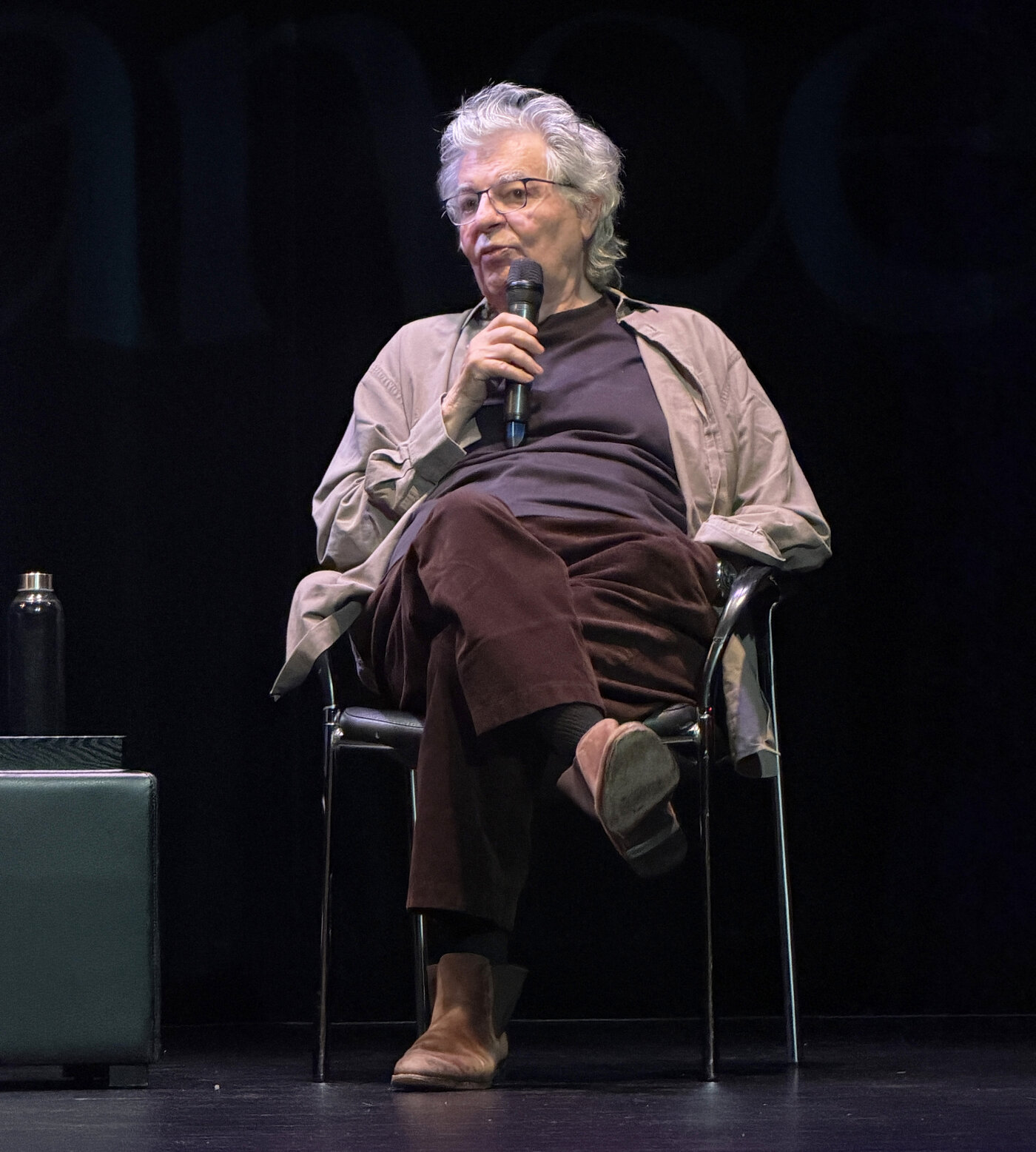
Jean-Pierre Gorin in New York. Photo by Carlos Valladares.
Throughout New York City’s electoral sweeps by the democratic socialists, Knicks game celebrations, and rumblings of World Cups and Odysseys to come, Jean-Pierre Gorin has maintained an unbothered air. He is in New York for the first time in years to present his films at three locations across the city: L’Alliance Française in Midtown Manhattan, the Roxy Cinema in Tribeca, and e-flux in Brooklyn. The now 83-year-old filmmaker and professor emeritus at the University of California, San Diego (UCSD), doesn’t heed these big events—not because he’s down on what New York is (exactly the opposite, as he marveled at Mamdanistan’s energy several times during his week-long visit, saying he would like to come back again soon—and often), but because he knows that the future of the arts will crystallize at poles that, in his words, are the size of “beetles in matchboxes.” "This affirmation by Gorin of the importance of small-scale innovation was the biggest lesson after Gorin’s week-long trip to NYC, in summer ’26. It takes a termite visionary like Gorin to reroute us out of crisis, pulling the lever so that the train tracks lead us into a different place.
“America has been reducing its language and its thought to the word Trump for ten years. It’s all we’ve ever talked about.” Gorin drawls out this typically casual yet profound observation on the stage of L’Alliance New York in his peculiar accent, using twentieth-century American terminology in a half-French accent (though the American side wins). Later, an American woman in the audience asked Gorin if he had seen the films of Sophie Letourneur, the subject of a recent Alliance retrospective. Gorin shrugged: “I don’t know her.” The audience member kept pressing the seer, insisting he should know because he is French. Gorin said, with exaggerated cheek: “I don’t see these films. I’m in San Diego and I’m an American.” Failing to pick up on his joke and now a little upset, she replied: “YOU’RE NOT AMERICAN! YOU ARE FRENCH!” What about dialectics? Porque no los dos?
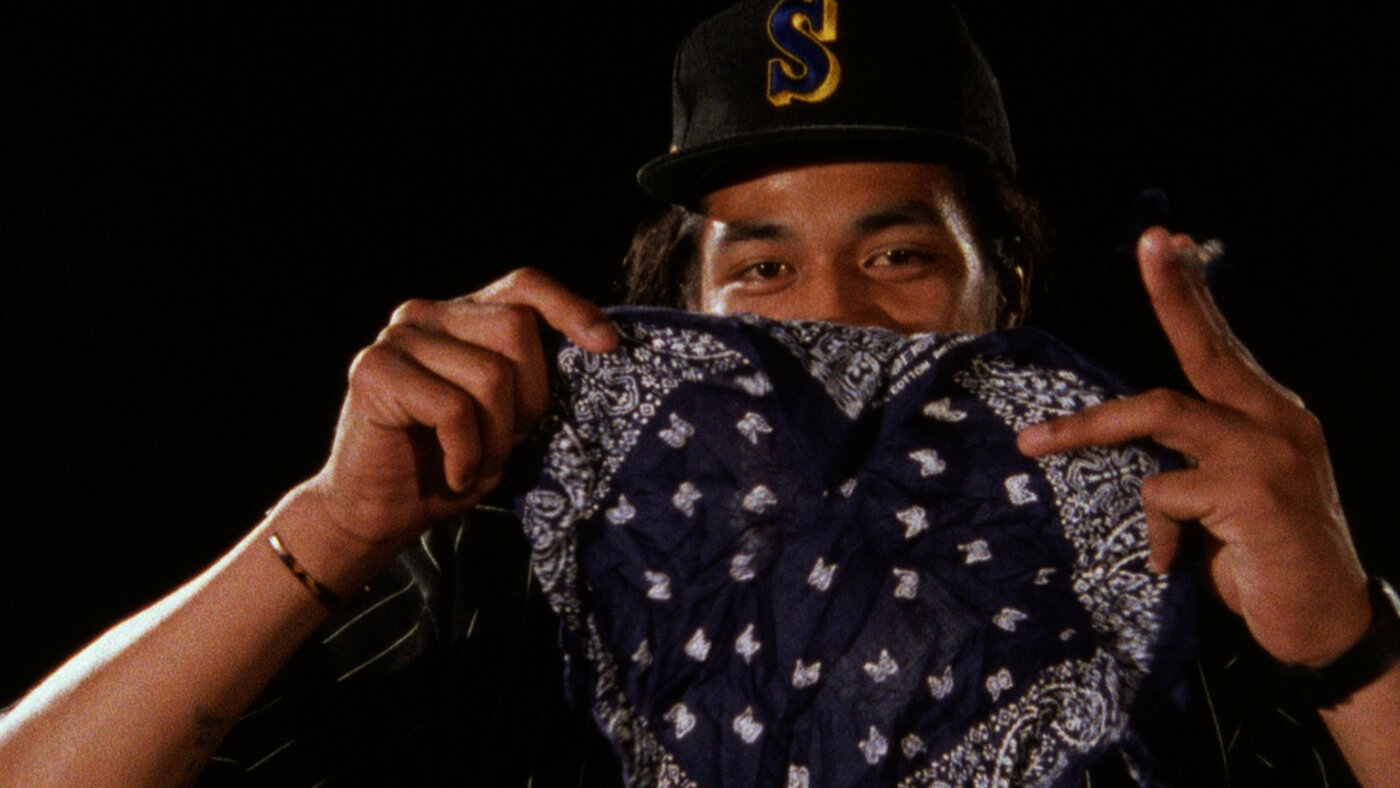
My Crasy Life (Jean-Pierre Gorin, 1992).
Born in Paris in 1943, Gorin moved to California in 1975 to teach in the Visual Arts Department at UCSD. Though he retired from the school in 2013, he still lives in San Diego, though he expressed more than once during his trip a desire to be in New York City long-term. New Yorkers would gladly accept him, for it seems as though the times have caught up with his intransigent seventies/eighties/nineties experiments in narrative, essay, and prose-filming. He has aged extremely well: not just with regard to his indelible California trilogy focused on marginal SoCal vivids, like Balzac sprung from South Central (Poto and Cabengo, 1979; Routine Pleasures, 1986; My Crasy Life, 1992), and his proto-punk dips along with Jean-Luc Godard into an exploded cultural-political culturescape with the films of the Dziga Vertov Group, but also in the way he simply carries himself, the bon mots he drops nightly before a delighted L’Alliance New York. Each of his observations received delighted laughs, applause, vocal affirmations. And to top it off, per one Letterboxd review: “There were a surprising number of young people in the audience. Maybe there is hope, after all.”
Gorin has worn many hats. He is a relentlessly self-effacing collaborator—remember those!—keen on the pas de deux, whether partnering with the author of Le Petit Livre rouge, Jean-Luc God-Art, critic, teacher, and painter Manny Farber (who invited Gorin to UCSD in 1975), or the starry-eyed student dreamers like Jorge X (19, sophomore) or Clara Z (21, senior). Imagine that: No ego! Instead, dialogue! But Gorin’s second-banana-ing had a consequence: over the years, since his first films with Godard in 1970, since his solo debut with 1979’s Routine Pleasures, a striking lack of attention was given to the man himself on what makes him so different, so appealing. Yuka Murakami—filmmaker and former student of Gorin’s at UCSD, now a stalwart presence on the downtown New York film scene—and Jake Perlin—the similarly stalwart distributor and curator, lately at the L’Alliance New York on East 59th Street—have been instrumental in bringing Gorin out of San Diego and flying him out to appear before us provincials to impart some wisdom. Among many things, he promised (threatened?) that the Dziga Vertov Group would rise again.
Who were the Dziga Vertov Group? The best duo since Simon and Garfunkel: Godard and Gorin, playfully responding to the brutal mid-to-late-1960s fact that, per the title of a recent J. Hoberman biography, “everything is now.” By this, we mean, political. Happening. In 1967, Godard pulled a Roberto Rossellini and renounced not only Hollywood cinema but also auteur cinema. The former, cinema of the first degree, he once loved; the latter, cinema of the second degree, he himself pioneered. Both were hopelessly reactionary, staid, imperialist. Down with Henry Ford, but down with John Ford, too. What opened the eyes of Godard and the generation after him was the cinema of liberation, the Third World: Solanas and Getino’s The Hour of the Furnaces (1965–68), the Cuban newsreels of ICAIC and Santiago Álvarez, the newsreel and documentary films funded by the Palestine Liberation Organization. “On our modest level,” Godard wrote at the time in his press book for La Chinoise (1967), one of his last solo films for a while, before he went on to embark on the Dziga Vertov films with Gorin, “we too should [in a paraphrase of Che Guevara] provoke two or three Vietnams in the bosoms of the vast Hollywood-Cinecittà-Mosfilm-Pinewood-etc. empire.” What was to be done? The answer lay in imagining a new organization of the human through “cinemas which are national, free, brotherly, comradely and bonded in friendship.” So Godard befriended Gorin, then a 23-year-old literary editor at Le Monde, Maoist-Althusserian activist, and cinephile, in a milieu evoked most memorably by Georges Perec in Les Choses (1966): “They would come out [of the cinema]; they would be sad. It was not the film they had dreamt of. It was not the total film each of them had inside himself, the perfect film they could have enjoyed for ever and ever. The film they would have liked to make. Or, more secretly, no doubt, the film they would have liked to live.”
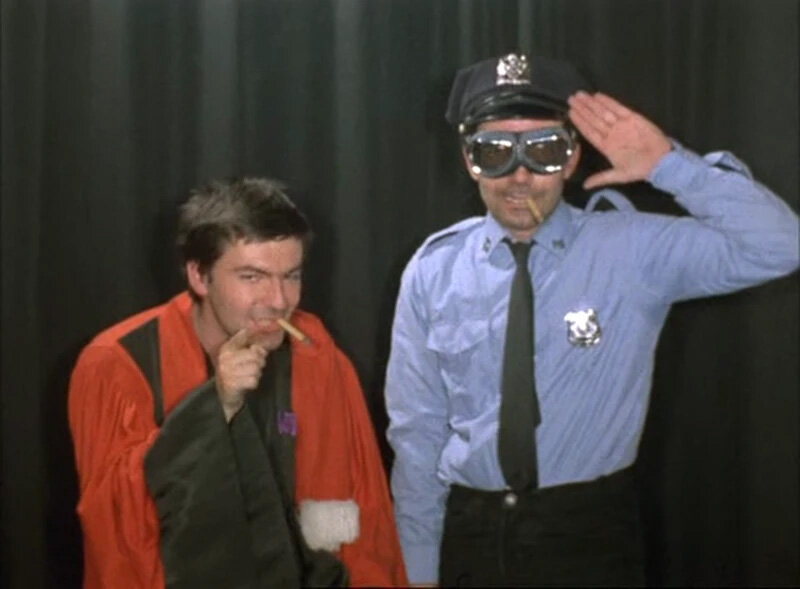
Vladamir and Rosa (The Dziga Vertov Group, 1971).
…With one major caveat. While the Hollywood films worked within a classical serenity and stability, the films that Godard and Gorin felt needed to be made did not strain for (unattainable) perfection; they embraced the mess of life, and so, the logic went, must the watchers. Life was an ever-mutating struggle of opposing forces. The dialectical struggle is messy, even tragicomic. “Jean-Luc and I were persuaded,” says Gorin before a screening of the Dziga Vertov film Vladimir and Rosa (1972), “that Laurel and Hardy were the only materialist dialecticians of cinema—and we had the temerity to venture on their path.” This would be the theme of both Godard’s and Gorin’s lives, and the films they did jointly, twinningly, including the one Gorin elected to show at L’Alliance in June: Vladimir and Rosa, a numbskull burlesque on the Trial of the Chicago 7, the seven (originally eight, until the case against one defendant, Bobby Seale, was declared a mistrial) political activists charged by the federal government with conspiracy and riot provocation at the 1968 Democratic National Convention. Vladimir and Rosa stars Godard and Gorin themselves as a Marxist Laurel and Hardy, two reporters covering the trial and mocking all of the activists with anarchic glee.As Gorin wrote in the Alliance’s program notes, “We rejoiced in cooking up a little something out of the Chicago 8 Trial and infuriating the protagonists in the process. We did succeed beyond our hopes. I am sure that the ghosts of Abbie Hoffman and Jerry Rubin appreciate Aaron Sorkin’s Trial of the Chicago Seven more, but they are wrong: We were truly funnier.” Tenderness, romance, comedy, anger, betrayal, the passionate desire for something beyond the conventions that are passed down to you: This is the brain-busting affective legacy of the Dziga Vertov Group’s films, including Pravda (1970), Wind from the East (1970), and Struggle in Italy (1971).
This was another way of making films within the morally bankrupt First World. As Gorin said on stage, “The films of the Dziga Vertov Group were dismissed as Sunday school Maoism; it is time to see them for what they truly were: garage punk experiments, DIY things.” How else could one respond except with the proposition of a new political-social-psychological organization of le people? Indeed, situating themselves proudly in the post-arte povera artscape, Gorin and Godard presage the coming of the gleaning-era Agnès Varda, Ryan Trecartin’s polyphonous nattering ensembles that work like a buzz-saw on 2000s US language (I-Be Area,2007: the internet’s Finnegans Wake), and Tony Kaye’s Humpty Dumpty X (in which phone calls, Marlon Brando’s camcorder cinematography, and delirious songs are knitted together to create a new kind of modern tragicomedy against all tendencies toward consumerist conformity). In fact, they presage all film in which detritus is magically converted into new narrative forms, now with added Tik and Tok.
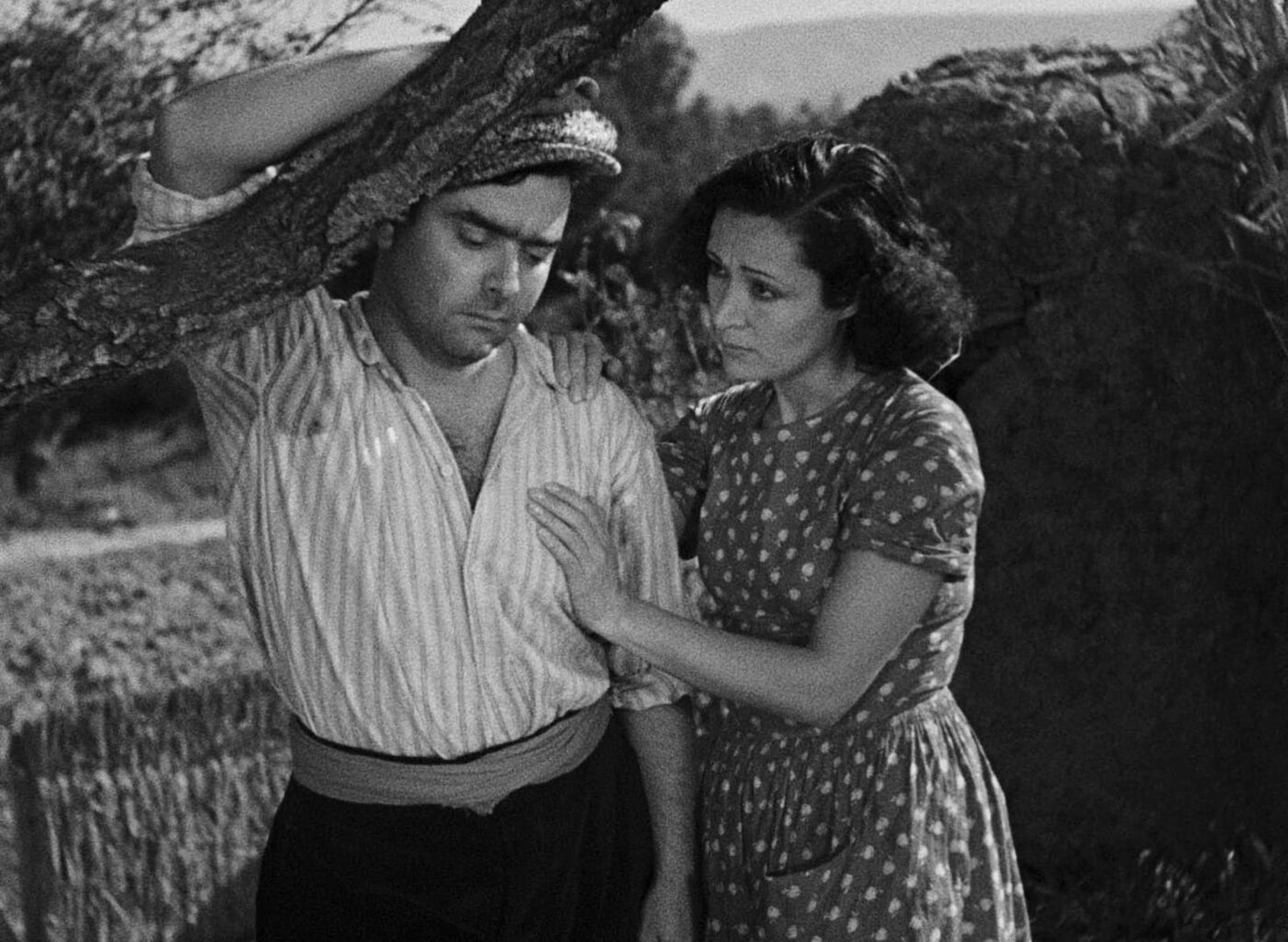
Toni (Jean Renoir, 1935).
Gorin’s relevance and contemporaneity, however, has almost nothing at all to do with his keeping up with the contemporary. He can talk for days about 1930s Jean Renoir and the motel Californias he created in his films—so has he checked out of the modern scene? On the surface, yes, but not in spirit. There’s so much stuff being made today anyway that I don’t mind Gorin tossing much of it to the wayside, or outright ignoring it, in favor of tilling at his own plot of land. (It is funny to see him bring up so many times how much he hates 2025’s One Battle After Another, refusing to dignify it even once by referring to it by its name, instead calling it “From One War to the Other” and “The Battle From Another.”) Gorin is asked after a screening of Jean Renoir’s Toni (1935) which working filmmakers interest him today—a boring enough question at a living-legend Q&A. He lists only two: Pedro Costa and Béla Tarr, who is dead. Then, he freely admits: “I don’t know.” I found this all very amusing—mainly because of the weird audience expectation that a figure like Gorin is obliged to pay attention to the cultural zeitgeist, today’s big-time objects and events. No! I respect the tortoise artist who observes with patience, who disregards the billboards on Sunset Boulevard, and who continues to work (to use one of Gorin’s-via-Farber’s pet similes) like a hectic beaver. (At the Toni A&A, Gorin relates that he is working on a new series of film essays now, without hinting at what this might entail. And he acknowledged he hasn’t made as many movies as he’d like, out of sheer “laziness,” though he is now interested in making films again; he just needs to know the parameters of the production budget: “I’ll use every one of the 50 bucks I’m given, if it comes to that.”) And working like a hectic beaver, for Gorin, means looking closely at a period that interests you (for Gorin, the 1930s is particularly alive) and using what you see in the world then to guide how you work in the world “now,” albeit a “now” that is perpetually sliding away. Later, when I caught up with Murakami, one of Gorin’s closest friends and mentees, for a debrief on the successful Gorin Week, she showed me what she was reading: Balzac’s The Girl with the Golden Eyes, a Gorin recommendation. Balzac’s narrators actively create a new world by seeing what is dead in front of them: “Listening to [the Parisian poor], I could join in their lives: I would feel their rags on my back, I would be walking in their tattered shoes; their longings, their needs would all move through my soul, or my soul through theirs.” So it is whenever Gorin picks up a camera to observe a pair of hyperactive twins at a zoo, or when Samoan gangsters in Long Beach take Gorin’s camera themselves and begin to interview each other.

Poto and Cabengo (Jean-Pierre Gorin, 1980).
Gorin does, however, keep up with the news of today. On his mind, especially in relation to his own California trilogy, was Wim Wenders, who had recently withdrawn his 1975 film Wrong Move from circulation, after years of ignored requests from Nastassja Kinski, who appeared topless in the film at thirteen. Gorin’s filmmaking methods, let us say, could hardly be further from the White Elephantine methods of Wenders and Herzog. After a screening of Poto and Cabengo at e-flux, he says, “every European filmmaker thinks that because he’s in America he has to do a road movie. I’m not a guy who grabs Nastassja Kinski in some preferable nubile state, puts her half naked on the screen, and calls it Art. Not my schtick! I came here and my version of a road movie was walking along five millimeters of road and looking at the backs of cockroaches.” His own version of a road movie could comprise a double-feature of Poto and Cabengo and Routine Pleasures, both of which take hard looks at the marginals that would never in a hundred years command a New York Times news item on page 17, let alone a headline … and that’s when Gorin, hungering for the dismissed, starts moving in with his camera. Routine Pleasures, about old white guys building model trains, with those scenes alternately juxtaposed with Gorin’s own musings on the great Manny Farber, was a challenge that Gorin, a Marxist aesthete, claimed for himself: How can American reality be filmed without resorting to abstractly political clichés, and how can politics and aesthetics ultimately and successfully be bridged in films? Gorin, after a Roxy screening of Routine Pleasures:
“I knew that conservatism was coming back in a big way [in 1979], and I was interested in not doing the same trick that lefties like myself always do: having an easy contempt for the people. I was interested in this conservative creativity, creative for no one but themselves. How much childhood remains in the adult imagination. And that’s what these guys are pursuing—an America that’s long gone. The idea that this train which made America now just moves through a landscape.”
He could just as easily be describing the landscape of today, down to his fixation with alien objects: “I like [Routine Pleasures], I must say. It’s so bizarre. It doesn’t look like anything I know. It’s a UFO and a UVO. Unidentifiable visual objects.”
It could be argued that Gorin, by refusing to make anything but UVOs, is ahead of the game, cinematically—even ahead of Old Man Spielberg, whose best film in years, the UFO masterpiece Disclosure Day (2026), is a mere classical catch-up to the breathless conjuring of modern experience already found in Gorin’s films. Around me in NYC, in the summer of 2026, a quiet artistic revolution is taking place, just the latest, surely, in keeping with Renoir’s forecast that what is needed is, as he says in his last film The Little Theatre of Jean Renoir (1970), constant “revolutions in the kitchen, in the bedroom, in the village square, since revolutions make life bearable.” Gorin’s presence in New York in June may well have been a not-inconsequential factor in this struggle. His films are the forefathers of cinematic and artistic experiments happening right now: assemblage, friendship, collective creation, cracked surfaces that are allowed to remain cracked, unpredictable mutations from person to person, disparate elements joined without any concern whether they stick except in the poetic complicity between the maker and a creatively-inclined beholder. Anything can be linked to anything, as long as it’s in the spirit of a one-to-one human connection, beyond the blind chase for capital and clout. What Gorin seeks is a montage that humanizes and politicizes in equal stealth measure.
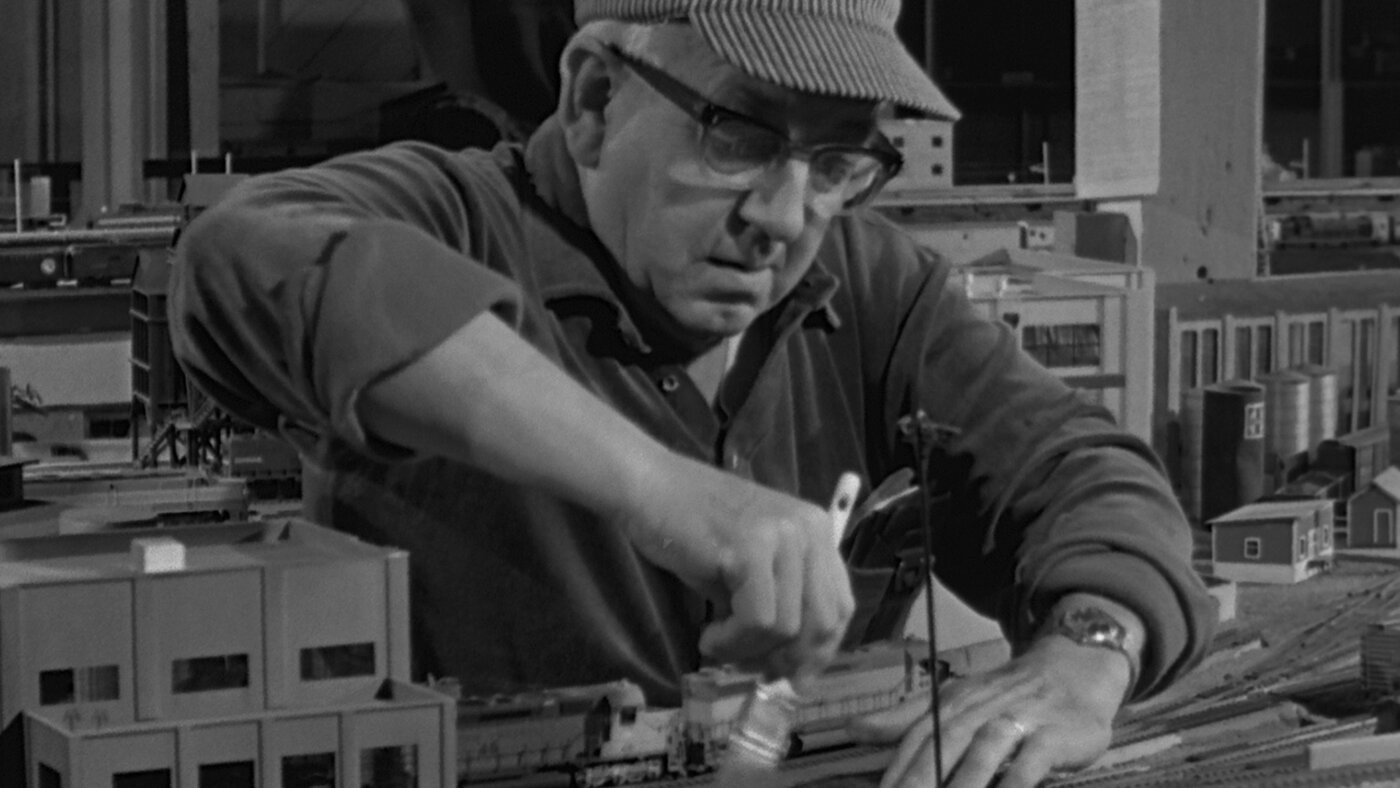
Routine Pleasures (Jean-Pierre Gorin, 1986).
One would have to go back to Rauschenberg, Ono, arte povera, Nouveau Réalisme, and Fluxus to understand what this new Cracked Combine form is, pioneered by Gorin. The link is chance: happening upon something, preserving the detritus after a blast, and leaving it as found, because it’s more honest that way. “We thought that a lack of means was a way to invention, good or bad,” Gorin said of Vladimir and Rosa. Such a principle of poverty, very much in the spirit of Rossellini, courses through the California trilogy, too: the Monk score in Routine Pleasures, the droll voiceover picking things up and putting them down, the refusal of an explanatory point to the twin sisters’ language confusions in Poto and Cabengo. Gorin wants films to move with the brutal spontaneity that our social media feeds mimic but cannot understand. Art must give these movements form, a container in which they can romp. That is why we must return to J.P. Gorin.
“There are two tribes in film,” Gorin says in his greatest piece of wisdom on his New York trip yet, at the Toni Q&A. “One are the people of the idiom. They function within established rules: film composition, narrative, et cetera, and they can do absolutely fantastic things; no one can say that Ernst Lubitsch isn’t a great filmmaker. Two: there are the people of the grammar. These are people who emerge at a moment when, socially-politically-culturally, something is changing. So they start asking, ‘What does it even mean to film? What does it mean to make an image?’ That was Renoir, who was asking, not just with Toni but with all his films: What is it to film with non-actors? What is it to film outside? What is it to film with live sound? What is it to forego all conventional technical parameters?”
An exhaustion with ChatGPT speak and AI deep-fake videos, now proliferating everywhere in the media landscape, has defined the mood of 2020s USA. People want to break it. How? Look to Gorin’s films for an answer. Follow the path of the man’s winding mind. Don’t have a mind like that? Find someone who does, whose thinking you like, and link up with them. That’s Manny Farber and Patricia Patterson’s critical precept, No. 6: “Get the edge. For instance, using the people around you,a brain like Jean-Pierre Gorin’s.”1
1. “Manny Farber and Patricia Patterson” interviewed by Richard Thompson. Film Comment, May–June 1977, 13, no. 3.