Photo by Emma Fuchs.
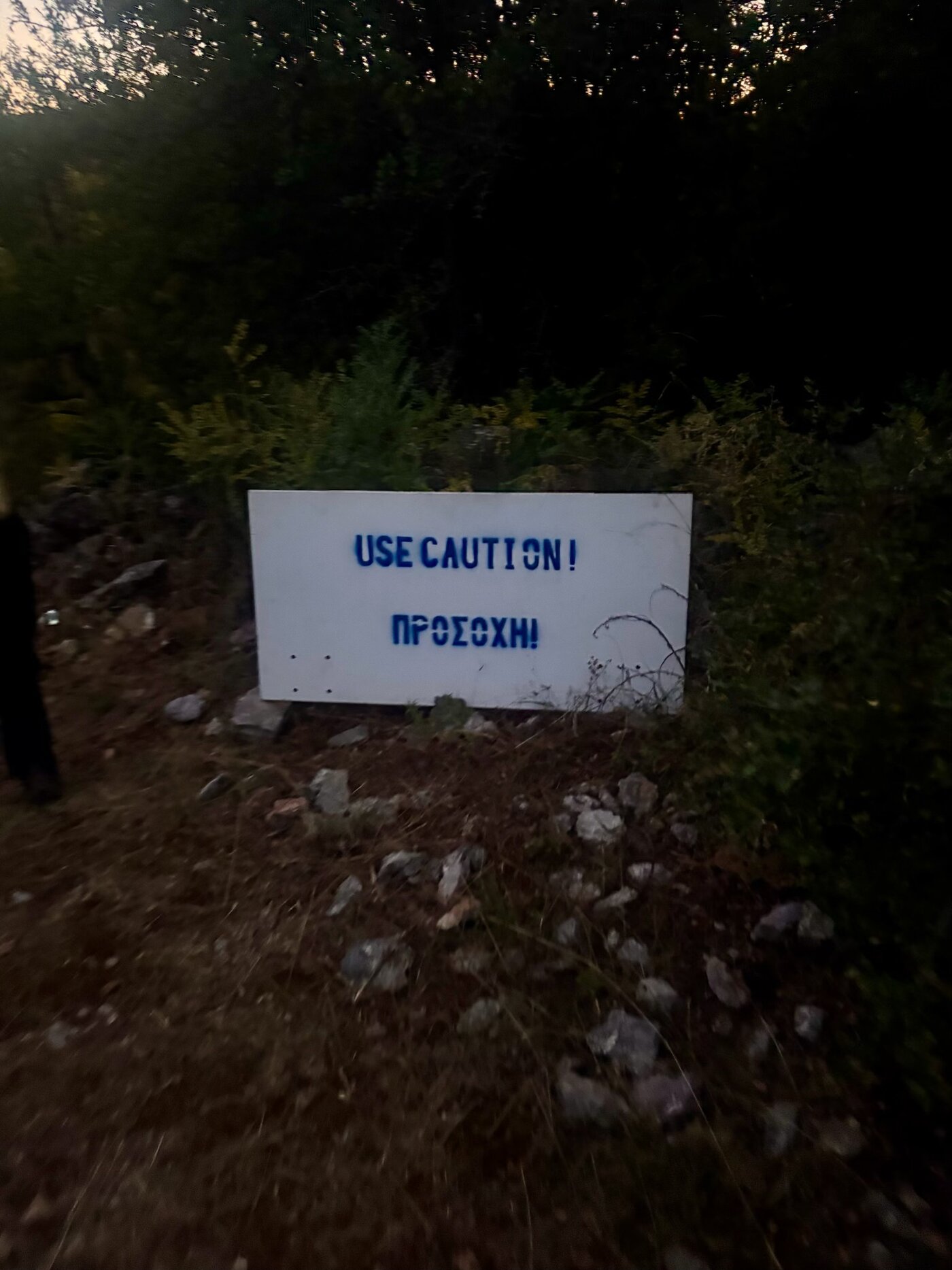
At sunset we move like a herd. Arms laden with blankets, we snake down the gravel path, as signs in blue spray paint warn “ΠΡΟΣΟΧΗ! Use Caution!” Halfway there, the trees that bracket us part like curtains. Below, stark against the green-gold valley, we can make out a small white square—the projection screen. At a fork in the path, there is a small sign with a blue arrow on it, and the word “Temenos.”
From here, the path narrows until suddenly it opens onto a clearing. In a small field, like a basin, rows of red beanbag chairs dot the ground in front of the screen, and behind them, a crescent of pink cushioned benches and a projector wait.
The restoration of Eniaios (1948–1990),the magnum opus of Greek-American experimental filmmaker Gregory J. Markopoulos, has been a gradually revealed 25-year process. The experimental film comprises 168 reels organized into 22 cycles—each composed of meticulously spliced black film leader, clear leader, and brief bursting footage from Markopoulos’s early films—and is 80 hours long. Segments of Eniaios’s restoration have been screened in the same field in the Greek village of Lyssarea at Olympic intervals since 2004. This June, over the course of four nights, the final four cycles (XIX–XXII) were screened, marking the completion of the Temenos. This name, originally meaning “a place set apart or a sacred precinct,” has come to signify both Eniaios and the open-air cinema dedicated to it—it has become an event inseparable from its home.1
This was my induction into the cult of Markopoulos. As I climbed onto the bus which would bring spectators from Karaiskaki Square, a hectic roundabout in the center of Athens, to the shrublands of Arcadia, I was asked if I considered myself “a Marko-head” too. I shrugged. I had found my way here by word of mouth.
To undertake a pilgrimage requires both boldness and suppleness. One needs an openness to strangers, and the strangeness encountered along the way, as well as a willingness to transform. Markopoulos conceived of the Temenos not only as a screening but also as a “sanctuary where one may approach Understanding.”2 This summer, I am approaching the idea that the goal is not to have completed something, but to have seen something through to the end.
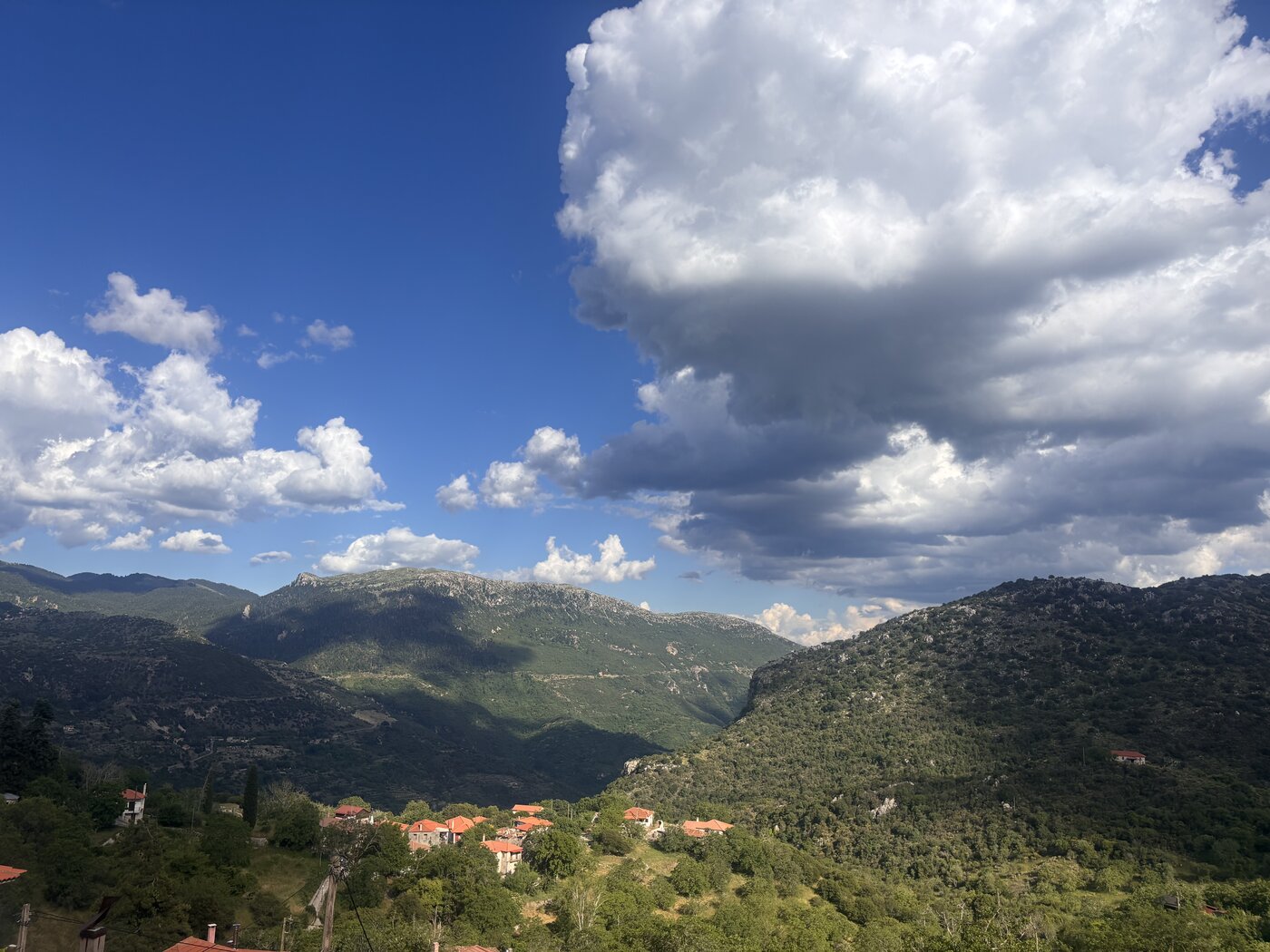
Photo by Emma Fuchs.
When Markopoulos first sought a site for the Temenos, highways hadn’t yet been carved into Arcadia. Lyssarea, his father’s ancestral village, was six hours from Athens by car. According to Markopoulos, “Here was a location upon which a dream could be built. It was never forgotten, and it was believed to be inaccessible.”3 Now, as two cream-colored coaches carry a hundred cinephiles across mountainous switchbacks to the lush and remote municipality of Gortynia, pilgrimage takes on a new form. While the site of the Temenos is not easily accessible, with certain organizational skills, it is reachable.
Before this summer, my sole exposure to Markopoulos had been the film Through a Lens Brightly: Mark Turbyfill (1967), a portrait richly saturated in warm tones and overlaid images. In a cinema in New York, I had found the short film dense, dizzying, and claustrophobic. However, Markopoulos believed that every film deserves an architect that understands its needs. Cinemas, lacking specificity, fail. In 1967, he withdrew his entire filmography from distribution, from his first short of 1940 to his completed but unprinted projects. He envisioned the Temenos as an amphitheater of screens, a projection site that would allow his work to exist in its purest form—not as entertainment, but as “film as film.” I was innocent as to the distance I would have to travel as a spectator. I was unprepared for the ethereality of Eniaios.
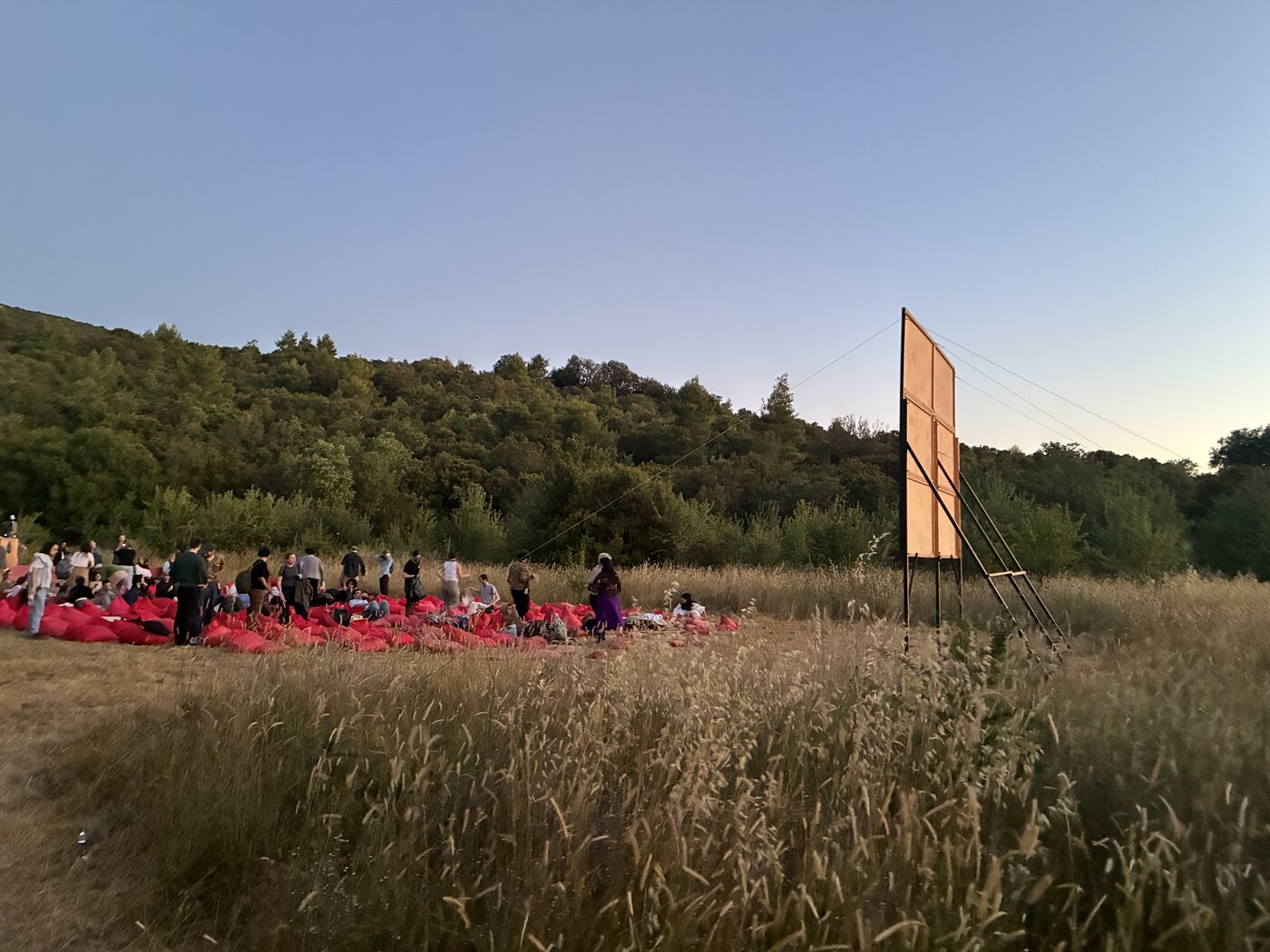
Photo by Micah Newberger.
The film is composed mainly of varying brightnesses. Segments of clear leader create a total and stinging white. Pale moths in these projector beams become bright as stars. Black leader conjures a dark screen, but as the sun sets and the sky darkens, it takes on a violet quality against the true black of night. Brief and sharp between these two modes, excerpts of Markopoulos’s early films arrive stripped of their narrative qualities. Creases in the bent elbow of a man’s tweed jacket. A strange tool. A balding head. A nude body in a shabby apartment. An arm drawn back, hand curled and brushing the jaw, as if pulling an arrow taut against a bow string. Movements barely flicker and that which moves is always gestural, sensual. When black leader follows an image, it creates a lingering, silhouetted after-image. White clears the slate, cleanses the eye, and, when it precedes an image, distills the light into a sudden form, a figurative beauty.
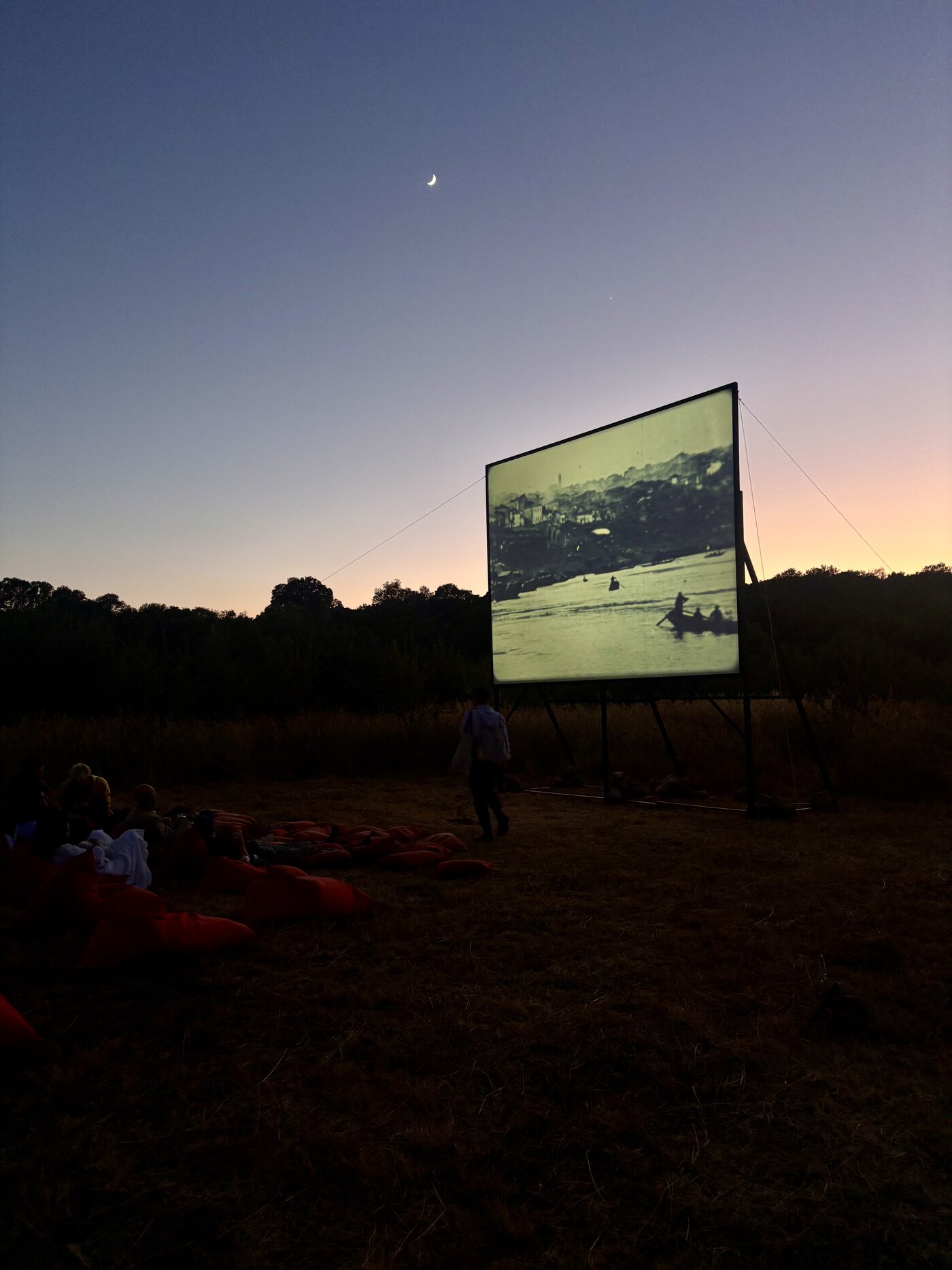
Photo by Emma Fuchs.
The reels spin these contrasts in rapid cycles. I imagine looking down from the hilltops surrounding the screening site and mistaking the screen for a strobe light. Each image rarely exceeds six seconds, and this length itself is a delicacy. Something to be savored. Most images are even more fleeting, as brief as one frame. Nearly fifteen hours of footage were screened this year—yet endurance felt easy. Suspended between images, time condenses. Each night, extremes of duration and speed combined “subdue the common meaning of Time.”4
Though the film is silent, dogs in the distance, the granular shift of the beanbag chairs, crickets, and the motoring projector score and texturize the night. On occasion, the rhythm of the film is interrupted by a loud clunk and a true dark screen. When the projector glitches on the second and fourth nights, the projectionist reveals a palm-sized flashlight and sets to fixing the machine with stoicism. Silence and bated breath, and then the reel picks up as if nothing had happened.
There is simultaneously much and little more to say, for, as Italo Calvino has written, “any interpretation impoverishes the myth and suffocates it.”5 The myth, in this case, refers to both the inspiration for Markopoulos’s early works, for he was obsessed with the tales of Asclepius and Prometheus, the Old Masters and Andy Warhol, and his tendency to mythologize and idolize himself and Robert Beavers, his muse and collaborator. Since Markopoulos’s death in 1992, Beavers, alongside his own filmmaking, has spent much of his life succeeding Markopoulos in his stewardship of their archives, the restorations of Eniaios, and their steadfast vision of the Temenos. As per Calvino again: “With myths, one should not be in a hurry. It is better to let them settle into the memory, to stop and dwell on every detail, to reflect on them without losing touch with their language of images.”6
Where I find Markopoulos’s work the most remarkable, however, is in its value of lightness, not only in the form of brilliance, but also in relation to weightlessness. How does one make a colossal, 80-hour film without creating something stone-heavy? I have turned to Calvino’s essay “On Lightness” to try and make sense of this, since he shares Markopoulos’s view that the “intensively ascetic and isolated” process of creation is a calling to “remove weight from the structure.”7 Calvino writes:
Were I to choose an auspicious image for the new millennium, I would choose… the sudden agile leap of the poet philosopher who raises himself above the weight of the world, showing that with all his gravity he has the secret of lightness, and that what many consider to be the vitality of the times noisy, aggressive, revving and roaring-belongs to the realm of death, like a cemetery for rusty old cars.8
Markopoulos viewed the world in similar conjunctions, whose hyphenated roles and merged ideologies allow one to view the world in a minuscule and modular manner, with greater attention paid to the illuminations of an image beyond language. For Markopoulos, his role was one of the filmmaker-physician. Anatomical delicacy, to Markopoulos, was the ideal approach to filmmaking, the approach that would result in the greatest clarity of his ideas. By counting the seconds of footage and meticulously measuring and suturing lengths of film, Markopoulos makes a science of his own. By reducing his filmography to brief illuminations, time itself seems to evaporate into light beams.
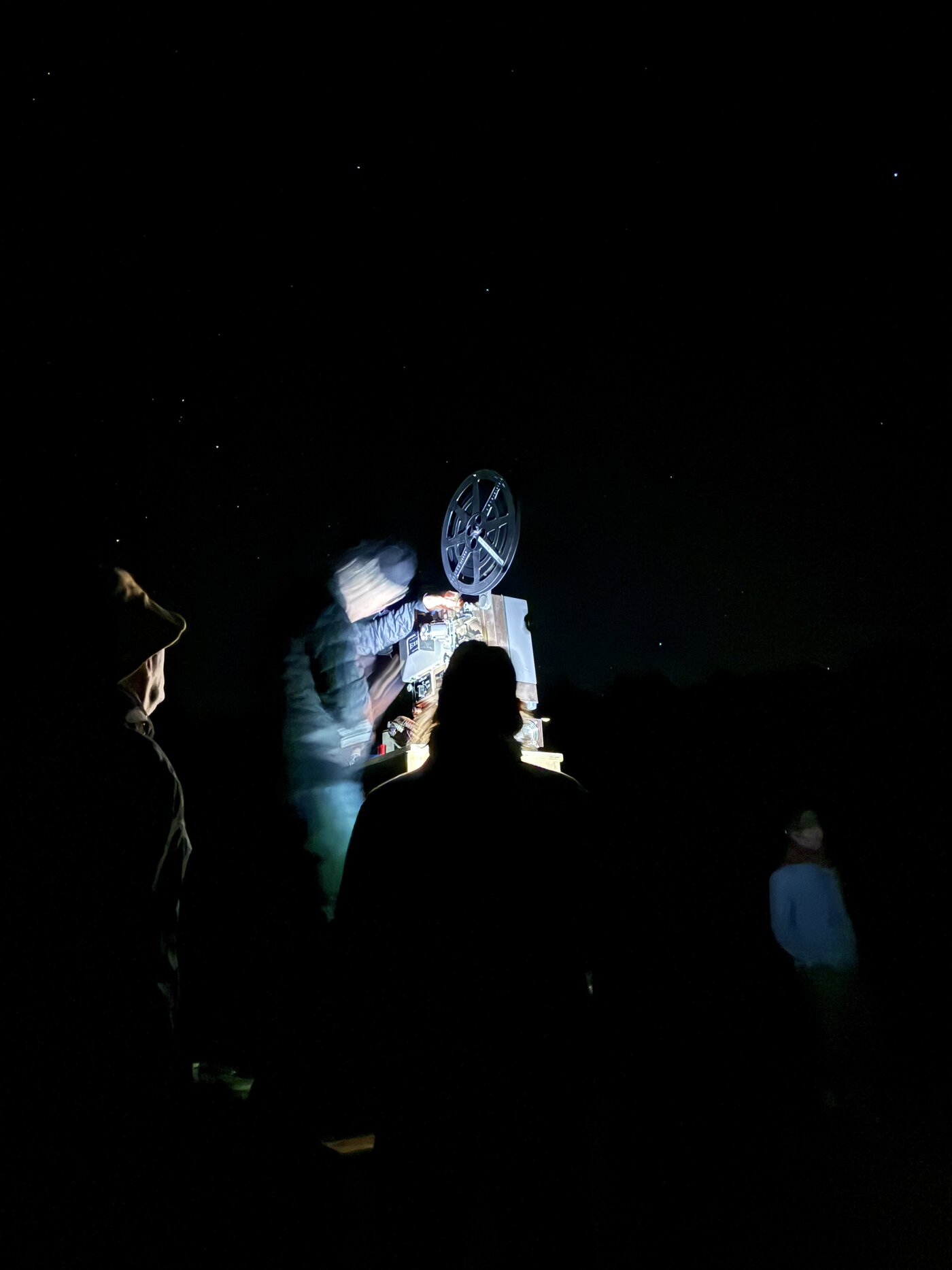
Photo by Micah Newberger.
P. Adams Sitney, the late historian of American avant-garde cinema, in his reflections on the earliest Temenos,9 referred to his friendship with Markopoulos as “clouded.” Nonetheless, he had attended every Temenos between 2004 and his passing in the summer of 2025. At the annual welcome dinner, I sat with his son, who was attending the Temenos, carrying his father’s spirit. He gestured vaguely, explaining this, and the word spirit seemed to exist on the threshold of corporeal and atmospheric.
On the third night of screenings, Beavers hosted a town hall of sorts in concentric circles of plastic lawn chairs. He sat alone in the center, and in a soft voice addressed the finality of the event while also joking that the Temenos is yet to be realized, and that the next iteration will occur in a field arranged with alabaster chairs.10
On this penultimate night, Eniaios XXI felt particularly sparse. But, vibrant against the sparsity, there was an image on the screen of a glittering fountain. The total shock of this moment’s beauty reverberated long after the image had ended. After the last reel, as we walked uphill with flashlights casting halos around our feet, there seemed to be a thread woven through the crowd, euphoric whispers of “fountain!” In the murkiness of the bus ride home, faces obscured, I heard the word “fountain!” float past me again and again.
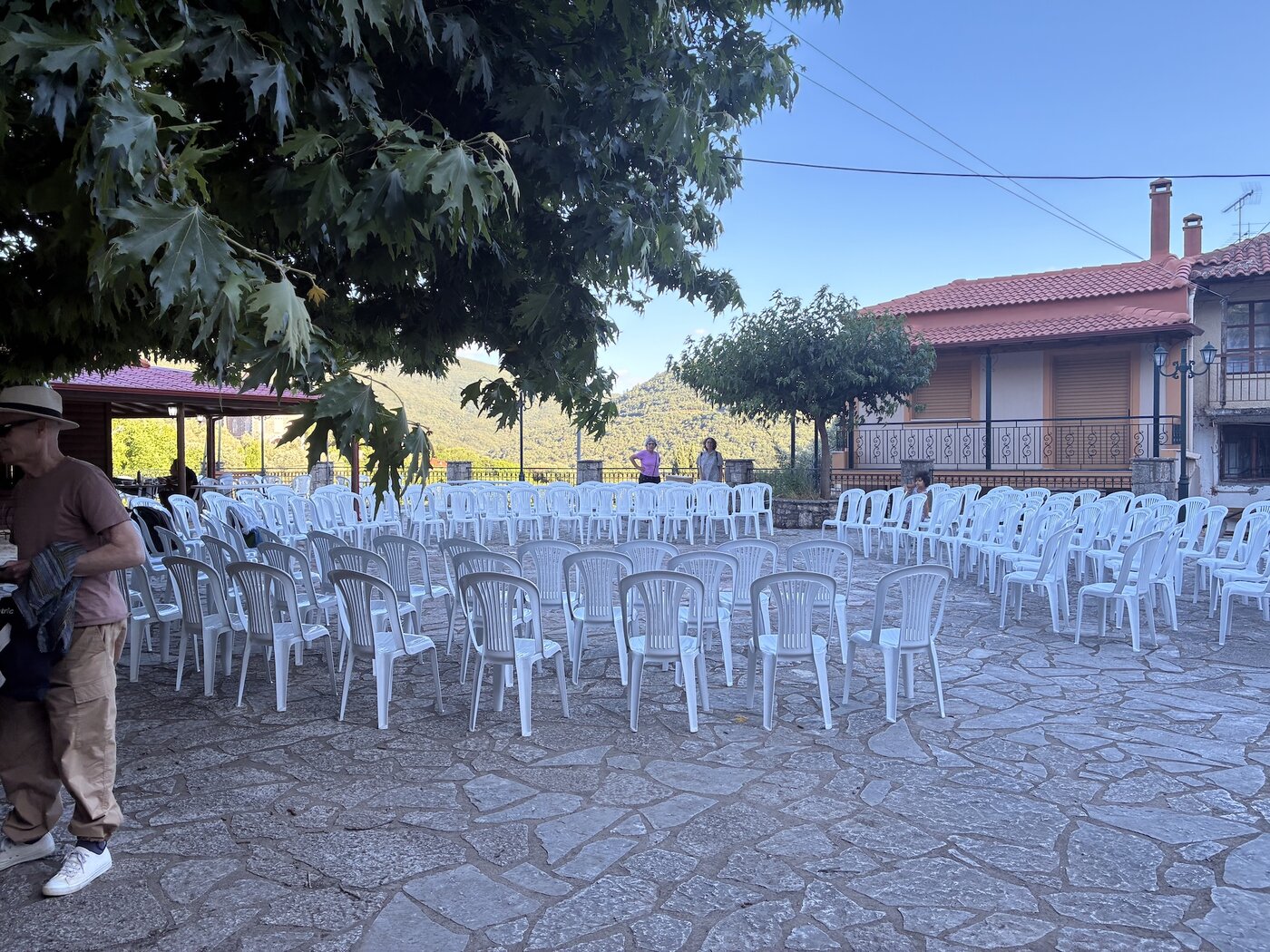
Photo by Micah Newberger.
On our final descent into the field on that fourth night, I had found myself trotting alongside Mark Webber, the editor of Film as Film: The Collected Writings of Gregory J. Markopoulos. He explained how, as a young independent curator, he had asked Beavers for permission to screen some of Markopoulos’s films. Beavers had refused his request, and this is where his curiosity had begun. Despite being an avid attendee of the Temenos, he noted that, this year, it suddenly felt absurd. Nothing much had changed since the last screening in 2024 but there was a fresh sense of silliness in walking down the hill to endure hours of flashing lights. He seemed to walk with the heaviness of anticipation. Cycle XXII has a runtime of four hours and 43 minutes, with five reel changes.
Alongside dinners and town halls, it is tradition to release large-format folios relating to each year’s Temenos. This year, embossed with a grasshopper on the cover and unfolding like a newspaper, Markopoulos’s 1992 essay “The Future of the Temenos and its Boundaries” is reprinted alongside its Greek translation in green ink. The folio also includes “Poverty & Need and Abundance & Ingenuity” in which Beavers further reflects on the Temenos’s totality, and Markopoulos’s own sparsely annotated list of the films from which he salvaged footage to build Eniaios XIX–XXII.
Those who are familiar with Markopoulos’s oeuvre use this bibliography-like list as an archeological guide to the films. To the uninitiated spectator, these notes feel as sparse as the Eniaios, like loose threads that must be pulled taut in order to locate their origin. The final image of the film is attributed to figalea, a work that never circulated. In the folio, its naming is preceded by the note: “[morning, phosphorous / the light bearer, the morning star].”11
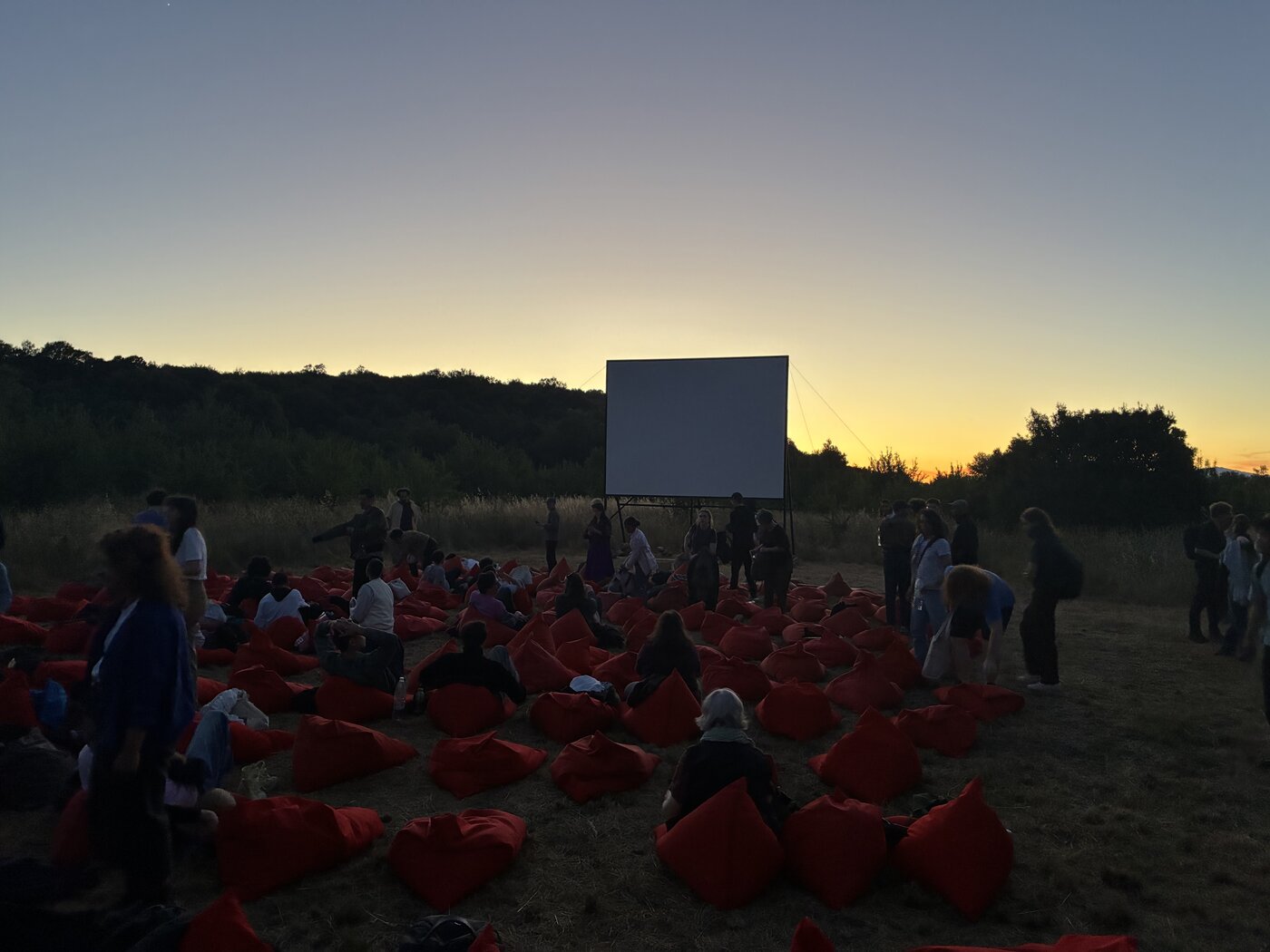
Photo by Micah Newberger.
Markopoulos wrote that ending a film is like tying an intricate surgical knot. One must make “the best knot for each work; and it is completed forever.”12 It must be clean. It is somewhere near three in the morning when the projection cuts off and, though abrupt, there is a sense of finality. Before the screening, Beavers had asked that when the Temenos ends, we hold a moment of silence. These few minutes of quiet are like a canopy. In the dark, in the absence of the projector’s hum, true silence takes on a thick feeling in the air. The screen loses its violet wash as eyes readjust. We wait, until Beavers releases a thunderous “Thank you.”
It is not yet light, but it will be soon. We march uphill in pairs and small clusters. At the top, the two coaches wait, patient and grave. Next to them is a folding table with sherbet-colored shot glasses and a large bottle of tsipouro, a Greek pomace brandy. Hands clink in the dark, and I make hazy eye contact as I toast.
The rosy fingers of dawn stretch out across the sky. The exuberant birds are already waking. We toy with the idea of not sleeping, and then we drag our bags slowly through the village streets to meet the bus one last time and complete our own cycle, which ends in Athens, at Karaiskaki Square.
1. Beavers, “A Note.” The Temenos, n.d. Accessed July 19, 2026.
2. Markopoulos, Gregory J. “A Solemn Pause...” In Film as Film: The Collected Writings of Gregory J. Markopoulos. The Visible Press, 1971.
3. Markopoulos, Gregory J. “The Future of the Temenos and Its Boundaries.” Temenos 2026,1992, 5.
4. Ibid.
5. Calvino, Italo. “On Lightness.” In Six Memos for the Next Millenium. Harvard University Press, 1988.https://designopendata.wordpress.com/wp-content/uploads/2014/05/sixmemosforthenextmillennium_italocalvino.pdf, 4.
6. Ibid.
7. Beavers, Robert. “Poverty & Need and Abundance & Ingenuity.” Temenos 2026, 2026; Calvino, 3.
8. Calvino, 12.
9. Sitney, P. Adams. “Idyll Worship: Gregory J. Markopoulos’s Eniaios.” Artforum, November 1, 2004. https://www.artforum.com/features/idyll-worship-gregory-j-markopouloss-eniaios-170123/.
10. Alabaster, the sheer and soft stone, is a recurring materiality in Markopoulos’s writing. In “Herakles” he writes, “In surroundings as marvelous as Alabaster columns, the Temenos will appear.” (Film as Film, 374) and in “The Threshold of the Frame” he writes, “[The filmmaker] perceives the glow of the true light which is seen somewhere out of the Infinite Past through the columns of the finest alabaster: that which becomes the final form of the work.” (Film as Film, 313). Markopoulos, Gregory J. “The Threshold of the Frame.” In Film as Film: The Collected Writings of Gregory J. Markopoulos. The Visible Press, 1974.
11. Markopoulos, Gregory. Temenos 2026.
12. Markopoulos, Gregory J. “The Filmmaker’s Perception in Contemplation.” In Film as Film: The Collected Writings of Gregory J. Markopoulos. The Visible Press, 1972, 356.