In advance of International Production Design Week, running October 17 through 26, 2025, we asked eight designers to discuss a single prop or piece of scenery from their work and its role in the world of the film. This feature was produced by Javier Irazuzta.
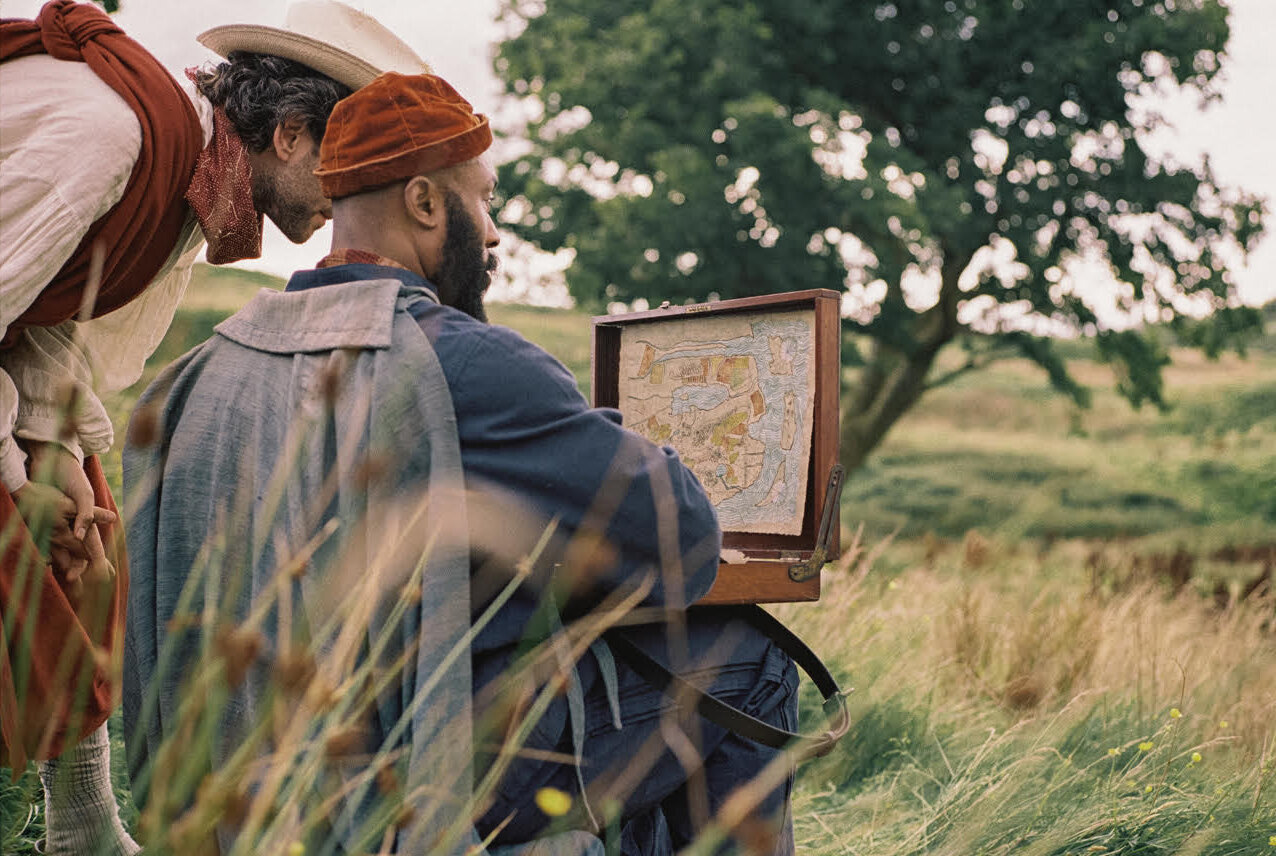
Harvest (Athina Rachel Tsangari, 2024).
On my first read of the script, the maps in Harvest drawn up by the character of Quill (Arinzé Kene), struck me as an archetypal MacGuffin. But now, rereading the criteria for such an object or device—“necessary to the plot and the motivation of the characters, but insignificant, unimportant, or irrelevant in itself”—I’m not entirely sure they fit the description in the same way that a knife or a piece of rope does (both of which also make numerous appearances in the film). Either way, the maps definitely function as a catalyst to drive the destruction of a small area of land and the people who live and toil on it, all in the space of seven days.
I was really fascinated by the idea of the maps being crafted with a certain delicacy and precision (both on and off screen), but the lines created with the gentle strokes of a feather quill were going to make something quite terrible occur in the imminent future, carving up people and land carved up in a paradoxically undelicate fashion.
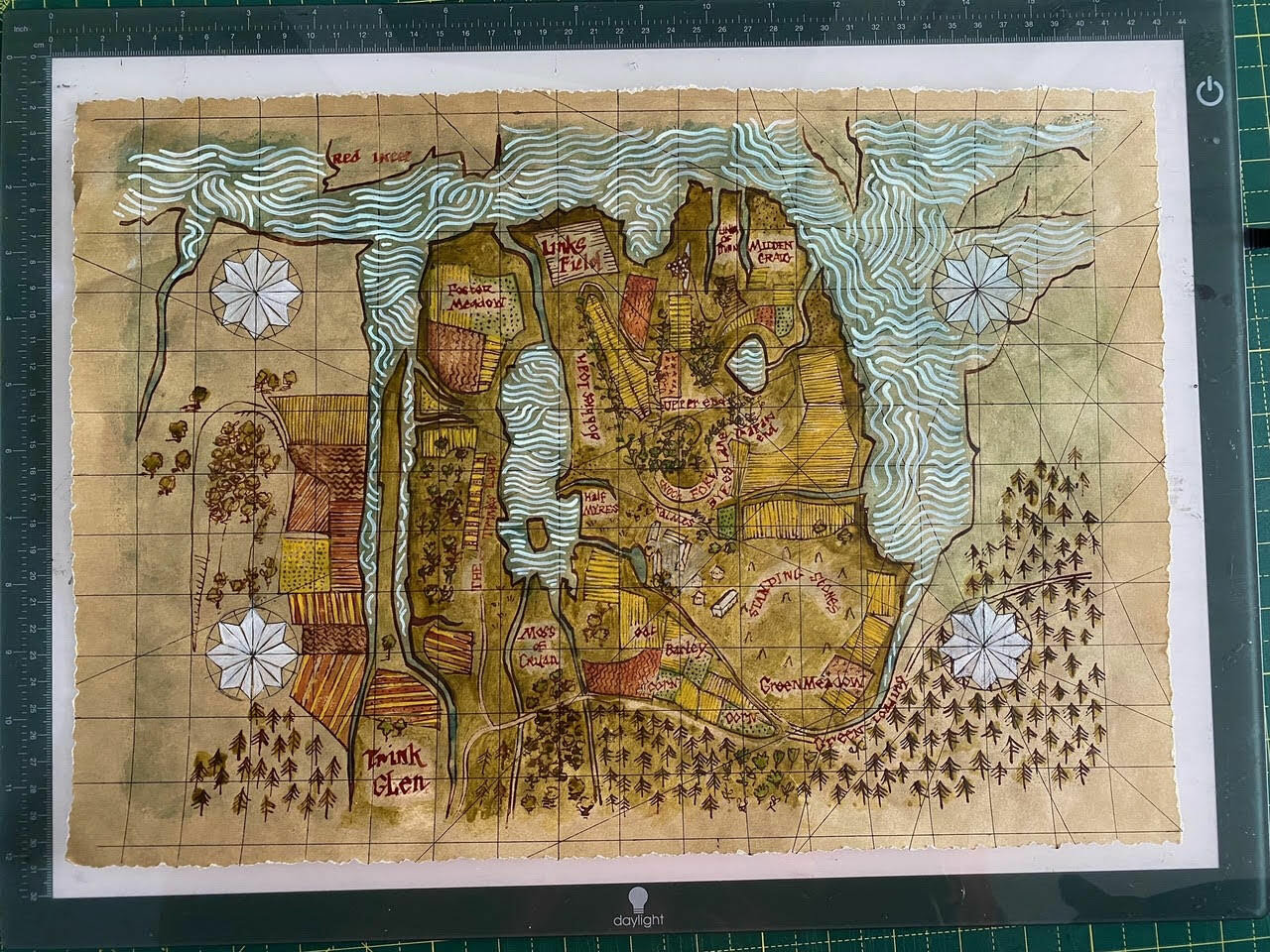
I asked my stepdad, Richard, to create the maps. This was less nepotism and more a case of someone having a rather unique skill set. When I was young, I would often visit Richard in his studio, behind a curtain at the back of the garage, surrounded by ancient books on the English Civil Wars, engraving book plates featuring weird and wonderful heraldic imagery and beasts. A boar on a Venetian balcony, why not? He also had an incredibly precise and architectural style that still allowed for imagination and some looseness, which was perfect for the cartography of Harvest.
Photograph courtesy of the author.
Richard set to work transferring the real landscape into something that met the necessities of the script. The maps then went over to graphic designer Tom Barwick, who recreated them on age appropriate paper, pigments, and inks, with duplicates for multiple takes.
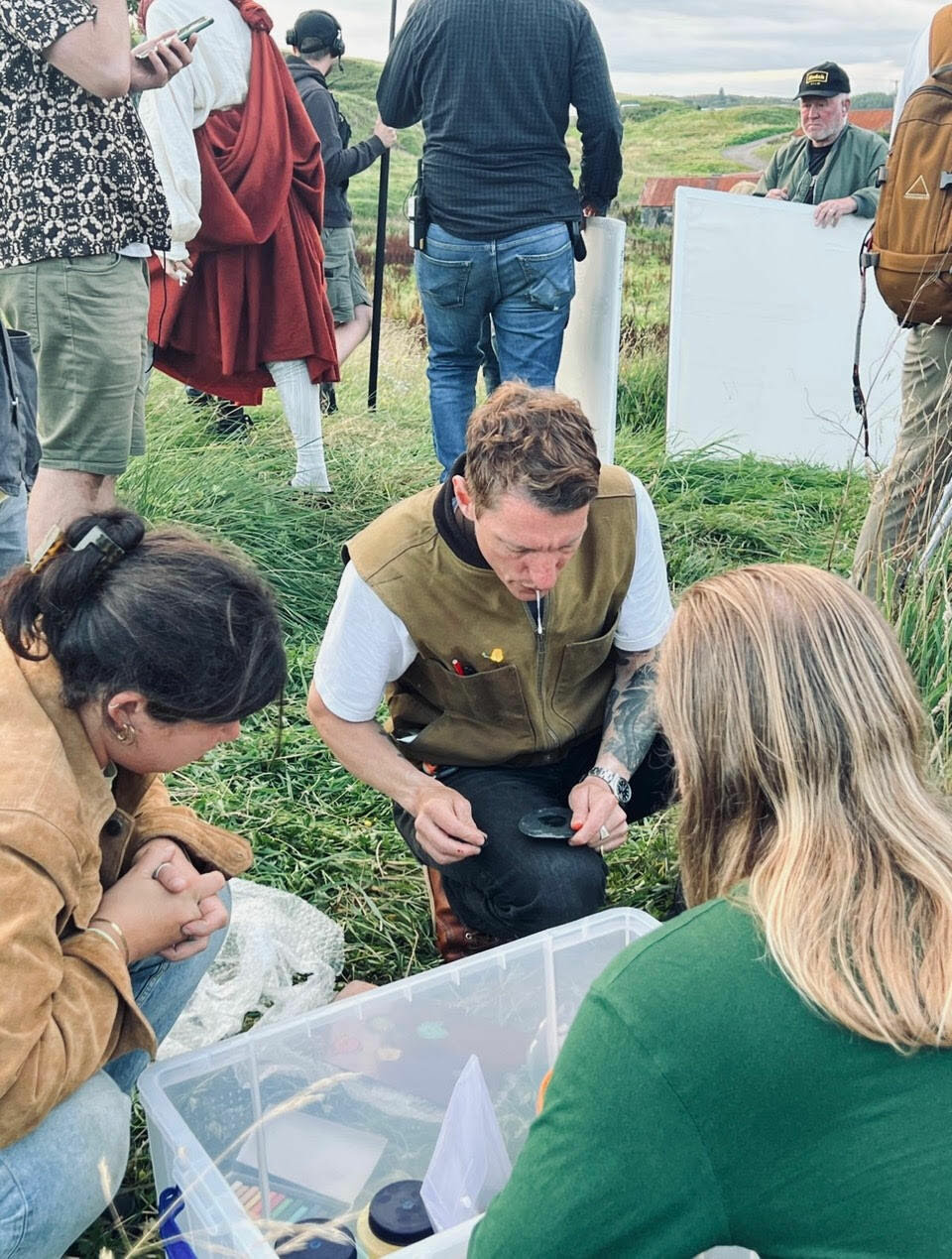
With a last-minute schedule change, they were suddenly due to appear a few days earlier than initially planned, and they were rushed to set just in time for their first scene on top of a hill surveying the fields. I was in the middle of setting up Quill’s paint box at the time and realized minutes before the take that we didn’t have any water up there, so I ended up having to spit in the pigment for the first few takes, which is probably the most historically accurate feature of the maps and their making.
Photograph courtesy of the author.
Continue reading “The Prop and the Production Designer.”