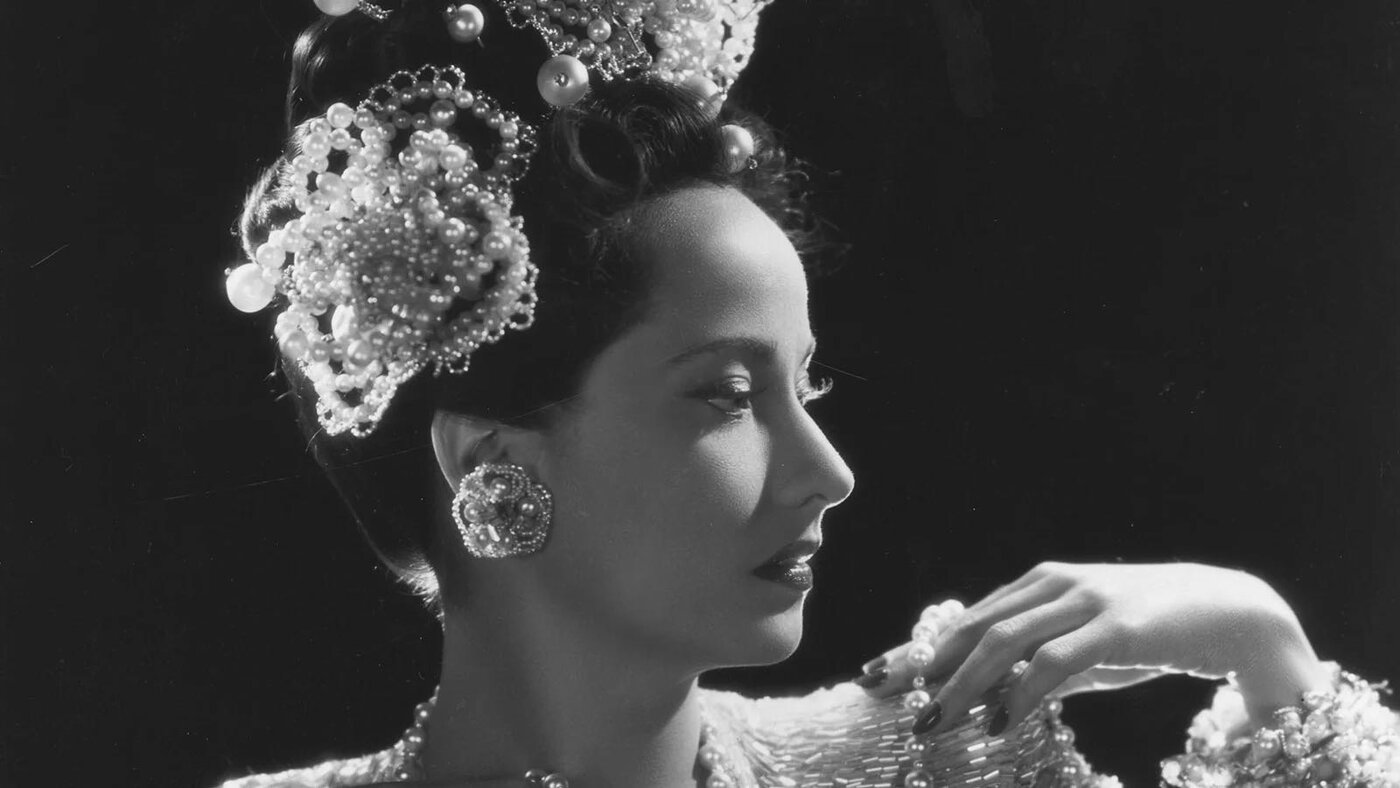
Night in Paradise (Arthur Lubin, 1946).
Acting is like a virus. You have to get it out of your system. I guess I’ll never get it out of mine.
—Merle Oberon
When Merle Oberon passed away in 1979, at the age of 68, the actress’s obituaries mourned the loss of a star who had graced the films of William Wyler, Ernst Lubitsch, Charles Vidor, and many others, playing alongside the likes of Douglas Fairbanks, Laurence Olivier, Rita Hayworth, and Gary Cooper. They relayed the same information she’d given throughout her career: that she was born in Tasmania to white parents—her father, a British Army major, dead before her birth—and raised in India before an uncle brought her to London, where she realized her childhood dreams of stardom. But four years after her death, these seemingly straightforward biographical facts were exposed as knotty fictions. As the critic Mayukh Sen attests in his recent biography, Love, Queenie: Merle Oberon, Hollywood’s First South Asian Star—which briskly, eruditely circles the question of what America wants from its stars when they come from the margins—the truth surrounding Oberon’s origins was a lifelong act of denial rooted in the bigotry of her time. “She took her secrets with her,” he writes.
Oberon was born Estelle Merle O’Brien Thompson in Bombay in 1911, likely the product of the rape of her mother, Constance Joyce, who was half-Sinhalese and half-British, by Constance’s stepfather, the British engineer Arthur Thompson, who had absconded to England. To avoid scandal, her grandmother, Charlotte, resolved to raise Oberon as her own and present Constance as her sister—a fabrication never disclosed to the child. The Anglo-Indian minority in British India, was viewed, Sen writes, as “a spurned breed … who toiled away in menial positions,” and “breathing evidence of Britain’s imperial malfeasance.” At boarding school, Oberon’s Indian peers ostracized her for her lighter skin tone, but her Hindustani accent excluded her from passing as British in society. Like many ingenues marked by difference, she found refuge in the art of performance, sometimes wandering the city dressed as a rose, posing before monuments. In 1929, an affair with the affluent English jockey Ike Edwards finally offered her a way out of India: by immigrating to London, she could, perchance, bloom.
With Charlotte accompanying her as a live-in maid, Oberon spent the following years working as a hostess, floundering in the poverty she’d so desperately sought to escape. She may have turned to sex work to remain afloat while attending auditions and occasionally booking bit parts in films she would later watch in the cinema, feebly hoping to see herself. She was relegated to the peripheries of the screen and to ethnic archetypes for which her unusual, remarkable looks were better suited at the time (“What an exotic looking creature,” a character says of her in Fascination, 1931). It wasn’t until she met Alexander Korda, the Hungarian-born producer and director (who had himself changed his name to obscure his Jewish origins), that she would receive her big break playing Anne Boleyn in The Private Life of Henry VIII (1933). “I want to see if there’s anything behind this face of yours,” Korda—who would become her first husband—said to her. But there was the fact of her origins to contend with first.
Korda’s production company, London Films, was a branch of the American Paramount Studios and operated under the Motion Picture Production Code, which objected to the depiction of miscegenation, among many other restrictions. Public knowledge of Oberon’s ancestry would have precluded her from playing leading roles for American audiences, over whose imagination the so-called “dusky peril” of the early twentieth century still held significant power, one of the factors that had resulted in the Immigration Acts of 1917 and 1924, which barred Asians from immigrating to the United States. For Oberon, then, assimilation, by way of self-erasure, was a prerequisite to participate and survive within the star system of the Western world. In return for a career that would earn her a covertly historic Oscar nomination for The Dark Angel (1935), Oberon had to forfeit integral parts of herself, assuming a new name and an amended biography. “The only way for her to do what she loved was to hide herself,” writes Sen.
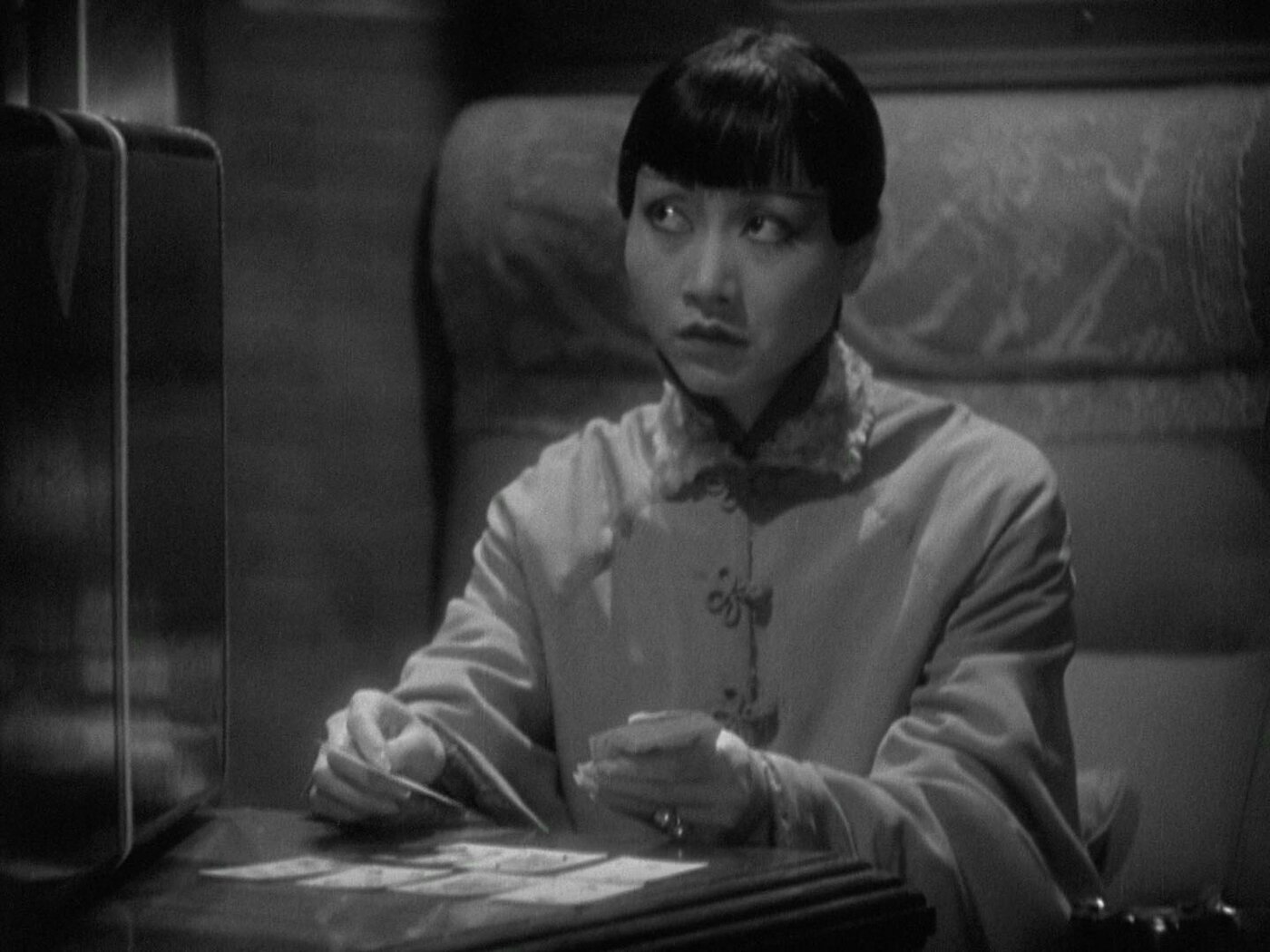
Shanghai Express (Josef von Sternberg, 1932).
A single facet of a star’s identity can hang forever over their head like a dark cloud. For such a star, whose source of shame may be as innate as, say, their sexual inclinations, their political affiliations, or the heterogeneousness of their race, the possibilities offered by the celluloid closet—of fashioning an alternate persona to publicly inhabit—allow them to enter a segregated system founded upon the production of deceptions and regulated by authoritarian control. Rather than reckon with the differences that distinguish its stars, this system flattens, writes Sen, “the valences of human contradiction to maximize virality, to make cardboard cutouts of flesh-and-blood historical figures.”
But when a star such as Merle Oberon dies and certain biographical details come to light, there is an indelible effect on how their film performances are interpreted. Suddenly, we are primed to notice moments when onscreen and offscreen performances seem to be in conversation, a friction that gives voice to the latent harmony between the character and the previously obfuscated reality of the woman embodying her. Simple exchanges of dialogue begin to drip with irony and generate insights into the performer’s consciousness. In The Hypersexuality of Race: Performing Asian/American Women on Screen and Scene, the film scholar Celine Parreñas Shimizu is attuned to a posthumous spectatorship of the Chinese American actress Anna May Wong, whose life and career exemplify “the ethical ‘burden of representation’ actors and actresses of color continue to contend with in their work.”1
Born in Los Angeles in 1905, Wong came to the fore of Hollywood playing Lotus Flower in The Toll of The Sea (1922), but, unlike Oberon, the roles she inhabited were predicated on perpetuating oriental archetypes—primarily the submissive, devoted femme fatale and the seductive, conniving Dragon Lady—that circumscribed her career, which included star-making turns as a Mongol slave girl opposite Douglas Fairbanks in The Thief of Bagdad (1924) and as the sex worker Hui Fei opposite Marlene Deitrich in Shanghai Express (1932). This myopic treatment saw her passed over for more substantial leading roles, such as the character of O-Lan in The Good Earth (1937), which went to Louise Rainer, whose yellow-faced performance won her an Oscar. “I was tired of the parts I had to play,” Wong said in “I Protest,” a 1933 interview in Film Weekly. “Why is it that on screen the Chinese are nearly always the villain of the piece, and so cruel a villain.… We are not like that. How could we be, with a civilization so many times older than that of the West?” Shimizu pinpoints the nuances enacted in Wong’s performances: “[She] left us with evidence of her rage and frustration through so many intense glances and facial expressions that convey what she did not or could not say within the films. Whether directed, self-authored, or projected by the spectator, her looks show the possible convergence of a racialized woman’s life with her acting roles.”2
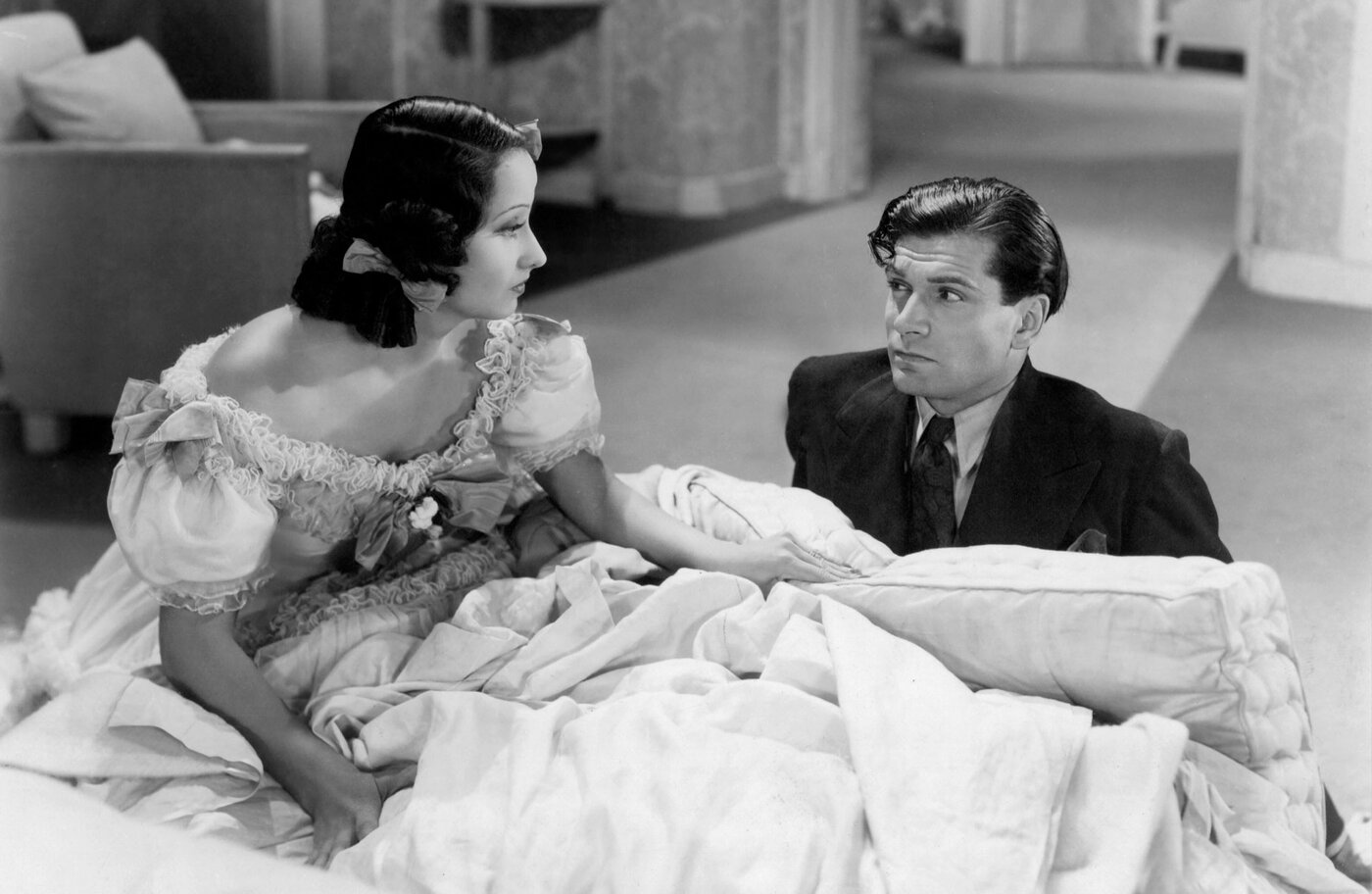
The Divorce of Lady X (Tim Whelan, 1938).
In The Divorce of Lady X (1938), a British production, Oberon plays Leslie Steele, a socialite attending a ball who finds herself marooned in a fully-booked hotel after London is engulfed in thick fog. Planning to use her charm to secure a good night’s sleep, she disregards the “Do Not Disturb” sign and creeps into the double room of the anxious barrister Everard Logan (Laurence Olivier), who is captivated yet distressed by her presence. “I’ve met too many women like you before,” he says, pointing an accusatory finger: “Utterly unscrupulous, ruthless, conceited, spoiled!” Face scrunched, she grabs hold of his finger, silencing his verbiage. “Don’t do that,” she commands. He slackens and, noticing her ring, assumes she’s married, a misapprehension she allows to continue. Her lies begin to proliferate, including a history of marriages and an imminent divorce. As they fall in love, the fear of rejection should her true identity be exposed often flashes across her heavily-powdered, mercury-whitened face.
Oberon’s performance in The Divorce of Lady X operates on two planes—the self-assurance she projects to Everard and the self-conscious reflections she visually confides in close-ups. She invites the audience to witness in a single scene her cognitive dissonance, shifting swiftly from elation to unease, from raised brows to baleful glances, from a coquettish soft-spokenness to the deeper register she uses to allude to Leslie’s truths. During a confrontation in Everard’s office, a hint of a smile briefly rises from the left corner of Oberon’s lip that she quickly suppresses, rapidly batting her eyelashes to animate her mental recalibration to new information as she formulates a change in tact.
Later, in the ballroom, after Oberon expresses a desire to marry Leslie, she becomes withdrawn, inspiring him to express how much he understands her. “You were poor before your first marriage,” he says. “He offered you everything that made life worth living … of course, the marriage failed, but a woman like you, a woman with ideals, is just like a man. She has to go on searching.” As he speaks, Oberon listens, nodding her head side to side, her dazed eyes widening, searching his face for answers to questions of self-motivation she hasn’t dared ask herself. She almost appears not to be in character: Her lost look could as easily arise from the recognition of her own marriage to Korda, who produced the film, in the false narrative Everard interprets. “One can never be sure of anything with a past like mine,” she responds, casting her gaze up to the high ceilings.
Leslie’s parents are said to be in India—an aside that is not lost on the attentive posthumous spectator—so when she returns home from the eventful evening, no longer certain she can sustain the lie, it is her grandfather (Morton Selten) who sets her straight. “What made you play the woman with the past?” he asks. “Because you hoped you could wear your imaginary adventures like a revealing costume?” Here Oberon—a master of the close-up—doesn’t have dialogue to rely on; her character’s feelings and thoughts radiate in three subtle gestures, her forehead already furrowed in confusion: as Selten speaks, she concentrates on his lips intensely, processing the weight of every syllable; then her eyes detach slightly, shifting to the side in anxious contemplation before, defeated, she deepens her frown and childishly nods—a signature move—in agreement. “The danger,” he warns, “is that, when the costume falls off, the young man may look at you and wonder what on earth he saw in such an innocent slip of a girl.”
Knowing the storied life of Oberon, one immediately recognizes the fact that, unlike her character, the actress never let that costume fall away. At the end of The Divorce of Lady X, after Leslie outs herself, she and Everard find that their bond is strong enough to weather the storm of her identity fraud. In the final scene, in his closing remarks for a divorce case, he concludes: “[She] is guilty on one count and upon one count alone! She is guilty of being a woman!” Seated in the gallery, Leslie, exonerated and free, having succeeded in her grift, smiles ecstatically.
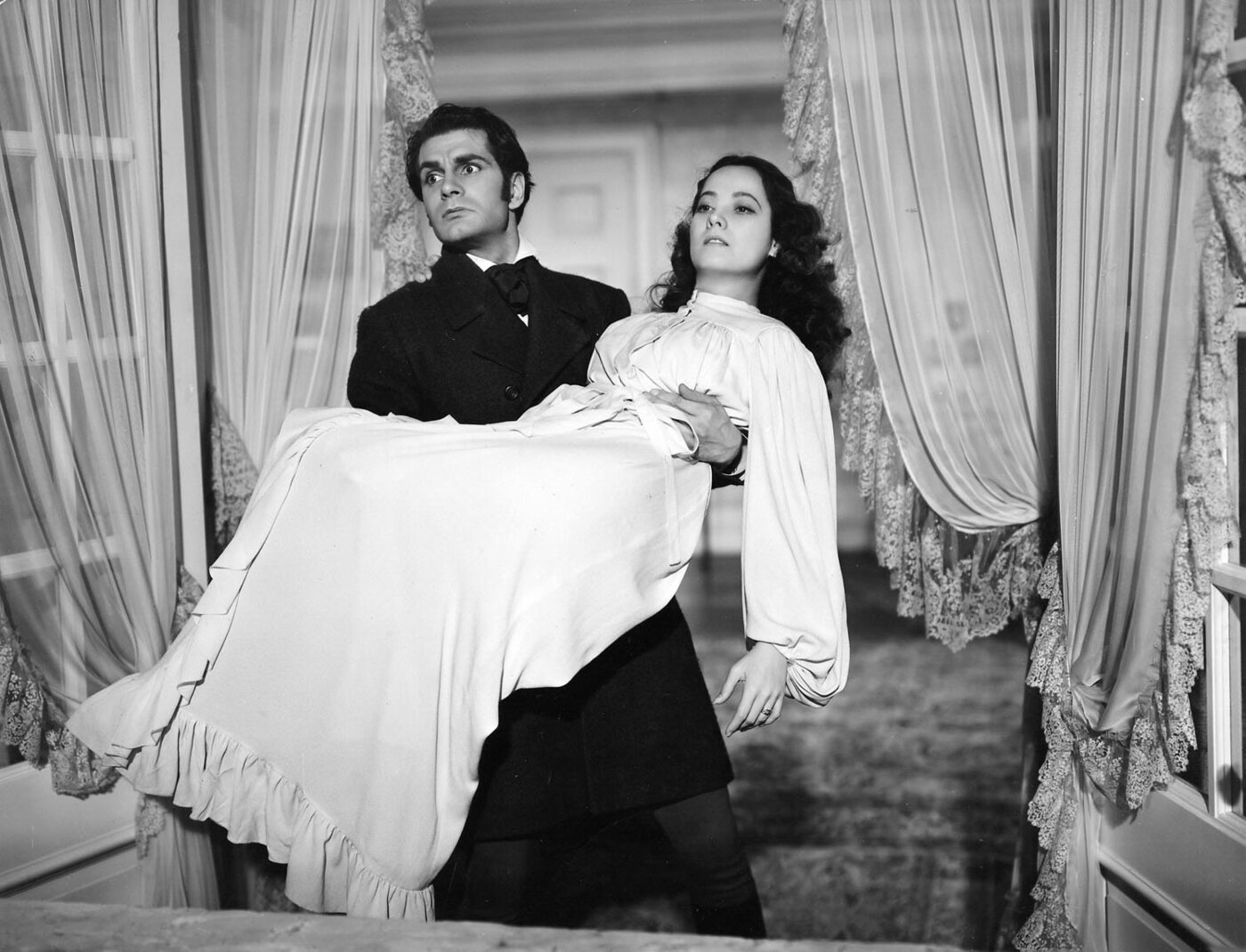
Wuthering Heights (William Wyler, 1939).
In Wuthering Heights (1939), Oberon plays Catherine Earnshaw, whose contentious relationship with her brutish brother has, since childhood, drawn her closer to Heathcliff (Olivier), a dusky orphan raised alongside them in the titular family home. After trespassing on the estate of Edgar Linton (David Niven, a passionate love of Oberon, whom she never married), and being attacked by his dogs, Catherine stays the weekend to recover in his care and becomes smitten. She returns to Wuthering Heights looking like a new woman: clean, lily-white, upper middle class, in a frilly hat and a long, flowing silk dress that so starkly contrasts the plain clothes she previously wore. When Heathcliff questions her appearance she becomes defensive, and the memory of his candid reproach and her abrupt dismissal comes to haunt her. When Edgar, now her husband-to-be, proceeds to criticize Heathcliff in his absence, she resists him. “Some of that gypsy’s evil soul has got into you,” he admonishes. “Yes, it’s true,” she cries, clasping her hands underneath her fur muff, prompting him to exit.
Now alone in her childhood bedroom, Earnshaw stands in front of a body-length mirror, where she can see what she has become through Heathcliff’s eyes, causing her to throw off her hat and coat, and tear at the dress. Her dissatisfaction with her transformation, the recognition of its inauthenticity, is palpable in Oberon’s performance, as though she’d rehearsed this sense of self-hatred all her life. A moment later, there she is, a “harum-scarum child with dirty hands and a willful heart,” running past the heather and up the crag on the hill to where Heathcliff, her true counterpart, awaits. It is in this brief journey that Oberon, hands outstretched for balance, appears most frank. “No matter what I ever do or say,” she tells him, “this is me now. Standing on this hill with you. This is me forever.” Alas, the sentiment doesn’t last long. In the next scene, she has put that divine yet despicable costume back on, the innocent slip of the girl once again hidden away.
Like Catherine, Oberon’s characters—ambitious, anxious, and conflicted modern women striving to live on their own terms—uncannily mirrored what we now know of her reality. From the young Mary Smith in The Cowboy and the Lady (1938), a politician’s daughter who yearns to experience life and, with the help of her maids, enters into society and falls in love with a cowboy while obscuring her class roots, to the title character in Lydia (1941), a charitable spinster whose past lovers visit her and collectively wonder why she never married, prompting a series of flashbacks that, as the theorist and historian David Bordwell notes, point toward the fallibility of memory and multifaceted nature of identity. “What was the real Lydia?” asks Micheal Fitzpatrick (Joseph Cotton), a doctor and her most devoted lover. “There was no real Lydia,” she responds. “There were dozens of them. Ask every woman, they know. Every woman is wise and foolish, clever and absurd, good and bad. Just as Lydia was.”
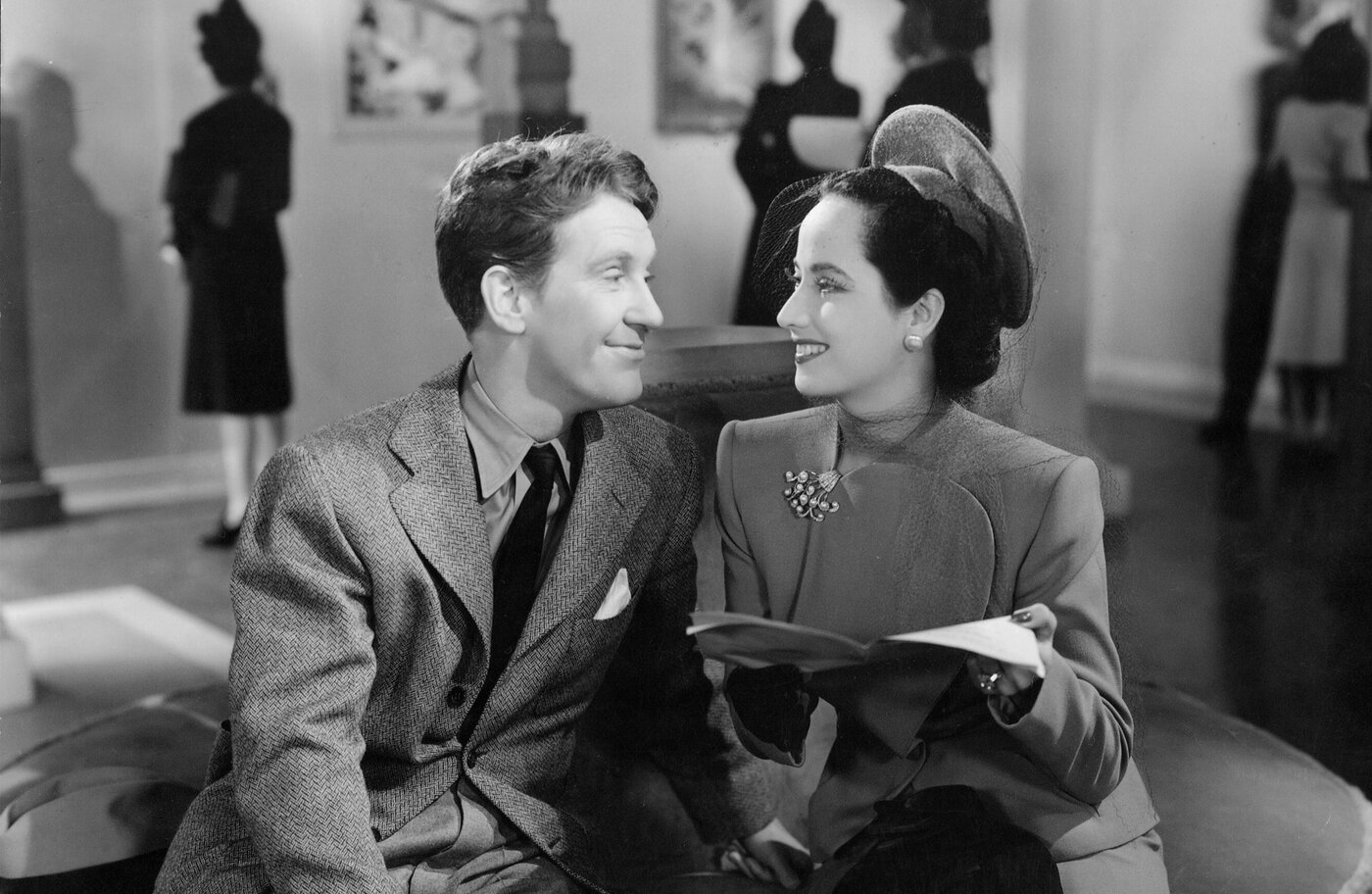
That Uncertain Feeling (Ernst Lubitsch, 1941).
Another such woman is Jill Baker in That Uncertain Feeling (1941), a housewife whose psychosomatic hiccups threaten to upend her marriage to Larry, a practical insurance salesman (Melvyn Douglas), when she falls in love with Alexander Sebastian, a curmudgeonly, contrarian of a pianist (Burgess Meredith) she meets in her analyst’s waiting room. “I’m a perfectly normal woman,” Jill states at the start of the film, but as the hiccups persist she finds herself in the office of Dr. Vengard (Alan Mowbray) and, after lying about her age (a typical Oberonism) and resisting analysis, she realizes she’s anything but normal. “Most people know nothing about themselves,” he says. “Their own real personality is a complete stranger to them. Now, what I’m trying to do is introduce you to your inner self. … Wouldn’t you like to meet you?” Deadpan, she instantly responds: “No.”
It’s impossible to resist the dynamic charm of Oberon’s performance: She allows the audience into the mind of Jill to feel her displeasure, infatuation, and anxiety, but with just enough distance to leave a sense of mystery intact—that central wound every great performer brings to the table. Her impeccable comic timing and piercing glares are on full display, as is her ability to suddenly drop into a submissive reverie or a childlike fit of laughter. “Oberon’s agitated demeanor made the predicaments of her women seem compelling in their immediacy,” Sen writes. In the end, Jill quells her anxieties with an affirmation that conclusively eliminates the manifestation of that titular uncertainty. It’s a consolation unfamiliar, and unafforded, to Oberon in her lifetime.
Early in her career, after donning yellowface to play a Japanese naïf in The Battle and playing the stereotype of a fiery Spaniard in The Private Life of Don Juan (both 1934), Oberon actively distanced herself from ethnic roles that accentuated her slanted eyes and olive skin, that oriental look to which critics, including Bosley Crowther of The New York Times and gossip columnists Sheilah Graham and Louella Parsons, persistently made furtive allusions. (In a 1934 feature, the Los Angeles Times critic Philip K. Scheuer asked Oberon outright if she was Eurasian. “I’m French-Irish,” she replied.) This impulse for damage control led Oberon to distinguish herself from Anna May Wong in a 1935 article titled “The Meaning of Glamour.” “To be exotic,” she said, “I always think of something very lush, something subtly oriental, a gardenia, a camelia, or a rare perfume. Anna May Wong is my idea of an exotic person.” Wong, who, like Oberon, began her career as an extra, found herself likewise restricted by the Motion Picture Production Code, which prompted her to travel to Europe, where she experienced some modicum of the success her talents deserved. Oberon worked in Wong’s shadow but thought of her, writes Sen, “as a useful foil, a prop she could use to establish her place in Hollywood.”
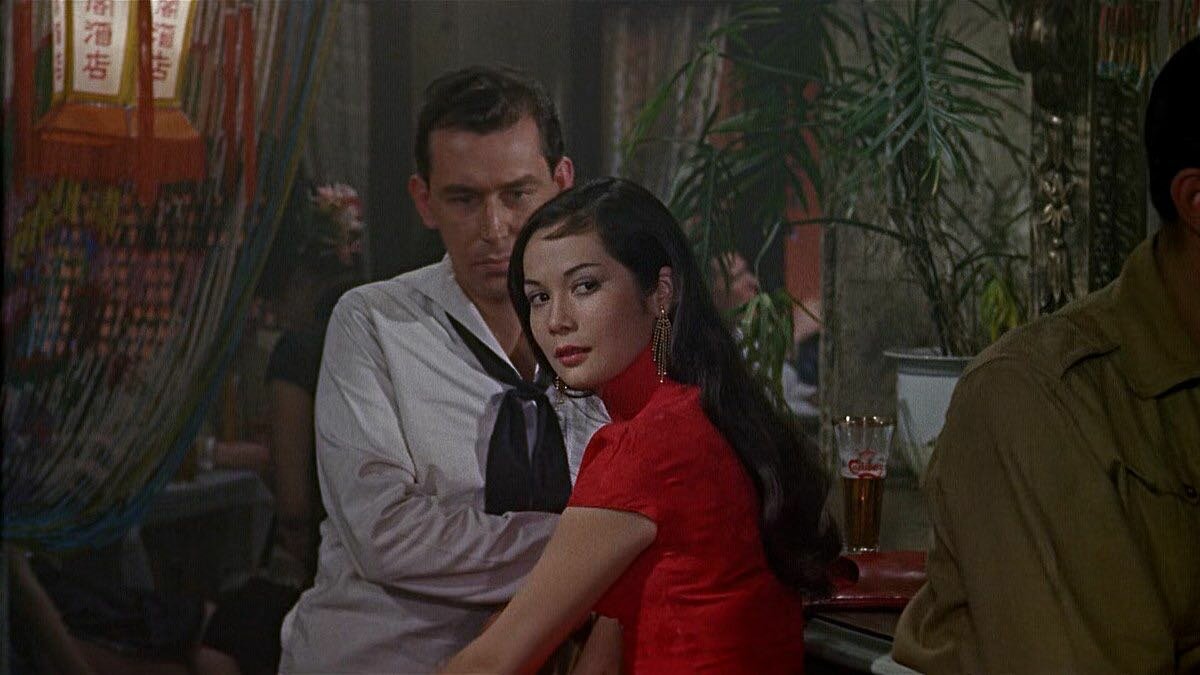
The World of Suzie Wong (Richard Quine, 1960).
Decades later, the fate of Anna May Wong reappears as an establishing prop for the actress Nancy Kwan, used to justify her artistic choices and exonerate herself from criticism. “Wong’s detractors confused her with the roles she played, often the roles she had to play because they were the only ones offered to her,” Kwan notes in her recent memoir, The World of Nancy Kwan, cowritten with Deborah Davis. “There were times when I was subject to the same kind of prejudice, like when the clueless interviewer criticized me for playing a prostitute, and journalists erased my command of English in their articles.”
Born in Hong Kong in 1939 to a British model and a Cantonese architect, Kwan trained as a ballet dancer before making her screen debut in The World of Suzie Wong (1960) as a woman leading a double life. Despite the film’s title, the world of the film is entirely mediated through the limited, outsider’s perspective of Robert Loman (William Holden), an American artist, newly arrived in Hong Kong, whose affections give Suzie the hope of escaping her impoverished circumstances as a call girl and single mother. “I was committed to creating an authentic character instead of a stereotype,” Kwan writes. When he shows her one of his paintings of her, she says, in pidgin English: “I like it very much, but not look like me.” He responds: “It’s what I think you look like. That’s the difference between an artist and a camera. An artist always tries to look deeper.” In another scene, Robert forcibly strips Suzie of the American-style dress she dons to impress him. “When I refused,” Kwan writes of filming the scene, “crying because I was embarrassed to wear something so revealing, I was reminded that it was part of the job. Were they taking advantage of my youth and inexperience? Absolutely, but I didn’t have a choice.”
This theme of choicelessness repeats like a refrain throughout the memoir. Like Oberon—who was indebted to Korda and the famed studio head Samuel Goldwyn—Kwan’s early career success was contingent on producer Ray Stark, to whose company, Seven Arts, she was contracted. In 1965, when it was announced that Kwan would be the lead in a prospective adaptation of the musical No Strings, which had starred the African American actress Diahann Carroll in a Tony Award–winning performance, it caused a public stir. “I understood both points of view,” Kwan writes. “Diahann was concerned about preserving the intention and integrity of the musical. Ray, a businessman, wanted to protect his sizable investment by making the project more mainstream. And here I was, caught in the crossfire.” But the insidious nature of the industry ultimately informed her decision to take on the role: “If I turned down a Seven Arts film, I would be suspended without salary. I learned that the hard way when I refused to play an Asian character who spoke pidgin English because I didn’t want to perpetuate that terrible stereotype. My resistance had consequences.” To her relief, the film never materialized.
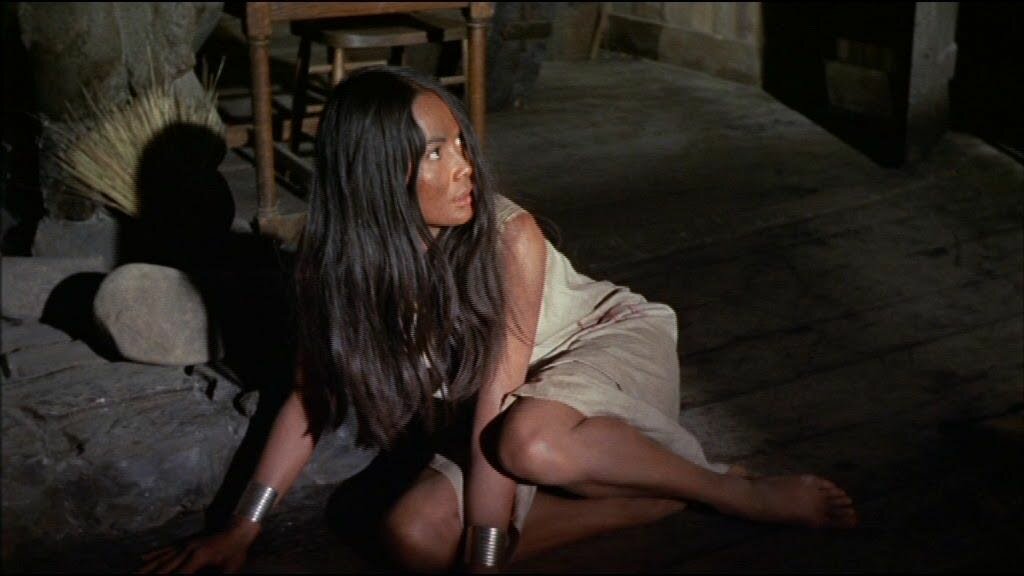
The McMasters (Alf Kjellin, 1970).
Kwan did take on the role of an Indigenous woman in The McMasters (1970), a Western starring Jack Palance and David Carradine, which found her with hair that was “long and tangled,” a face “streaked with dirt,” and a minimalist costume of rags. “I viewed the role as a valuable acting exercise because I was stripped of the niceties that enhanced my performances in other films,” she writes. This comment, though, emphasizing the Indigenous woman’s lack of glamour and welcome rawness, strikes one as contradictory when, elsewhere in the memoir, Kwan calls for an end to the practice of yellowface and for the importance of authentic representation. “I hope that one day, we won’t look at people because of color or race but for their abilities. The best person should always get the job,” she writes, echoing the studio’s justifications when casting Caucasian actors in Asian roles, then, as if anticipating backlash: “But on a parallel track, substantive roles had to be written for Asians so they would have opportunities and their stories could be told.”
The passage of time and the welcome reforms did not drastically change the way Kwan was received by the segregated star system. “I was bound by golden handcuffs, and they were starting to chafe,” she writes of her studio contract. Kwan’s career became constrained in exactly the way Oberon had feared and Wong had experienced: limited to flat, stereotypical roles in sex comedies, low-budget thrillers, spy spoofs, and, more recently, documentaries in which she is enlisted to testify as an industry veteran. Shimizu notes Kwan’s long-standing tendency to shy away from racial analysis in public: “As an actress whose constraints involve negotiating an entire industry, Kwan expresses her bondage. That is, she must become a representative, a burden impossible to shoulder. She rejects the validity of the racial critique regarding her roles in favor of prioritizing the impact of her films in terms of visibility.”3 For Kwan, bridging the East and the West, as well as Hollywood’s past and present, has always been the defining feature of her hypersexualized image, but the fault lines of this construction become apparent upon closer inspection.
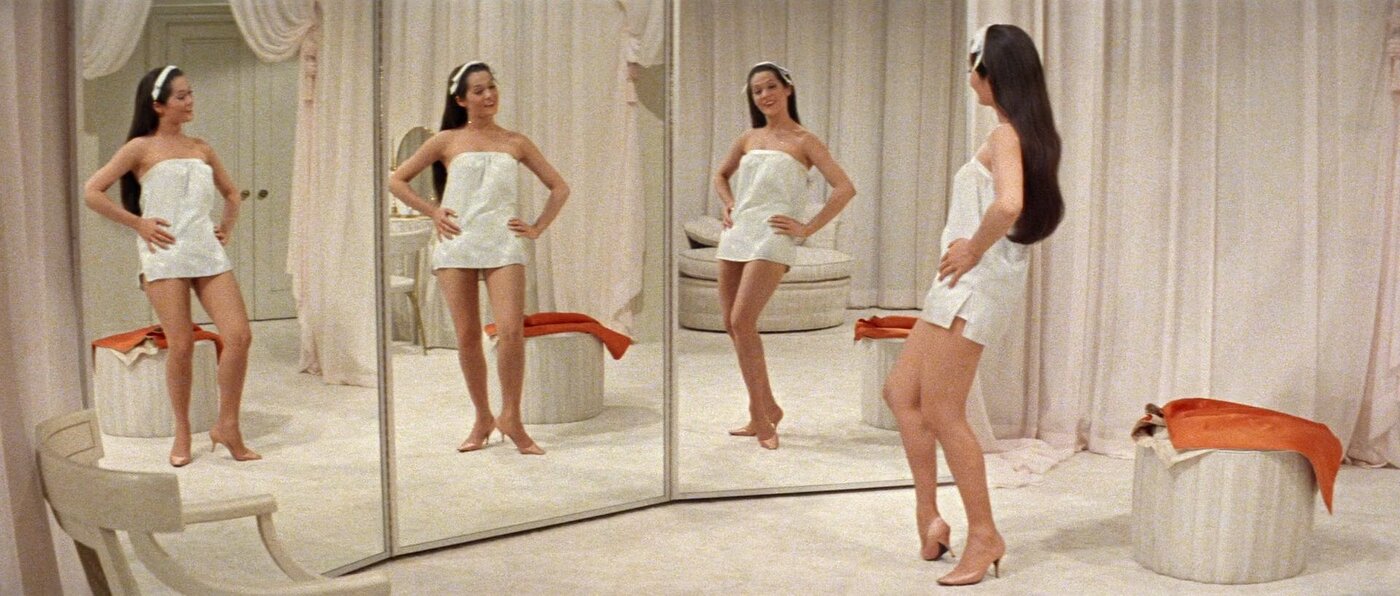
Flower Drum Song (Henry Koster, 1961).
In Flower Drum Song (1961), in which Anna May Wong was also set to star in a comeback role before suddenly passing away from a heart attack, Kwan plays Linda Low, a cabaret performer determined to be married and change her circumstances. “I want a little social security,” she says to Sammy Fong (Jack Soo), a club owner and her primary suitor. Like Suzie Wong, Linda is marked by an anxious desperation to become entangled with men who can possibly provide her the resources she cannot attain on her own without selling or making a spectacle of her body.
For Kwan, the Asian characters in Flower Drum Song align more so with American archetypes. “Instead of being demonized, marginalized, or portrayed as the ‘other,’” she writes, “our characters were attractive, appealing, affluent, and larger-than-life. We went to nightclubs, drove sports cars, spoke snappy dialogue, and sang … men who were virile and women who were independent and glamorous.” Notably absent from her description is the film’s central protagonist: Mei Li (Miyoshi Umeki), an illegal immigrant for whom marriage is not only a means of desire and upward mobility but the safety and security that legality brings, unlike Linda, whose sense of liberation is tied up with the pursuit of—as the last sentence of Kwan’s memoir so proudly states—“the true American Dream.”
In one scene, as Rodgers and Hammerstein’s music begins to play and the voice of American singer B. J. Baker’s is dubbed in for her own, Kwan, in a white silk slip, appears before a large trifold mirror and studies her own image, preparing for a date. Caressing her wrists, tousling her hair, dabbing her face with powder and her pulse points with perfume, she sings an ode to the blisses of girlhood. At one point, one of her reflected selves becomes autonomous and walks out of the frame, only to return donning a white fur muff and a floral headpiece fit for a bride. The other selves soon follow suit, reappearing in a jewel-studded orange evening gown and a yellow polka-dotted bikini, respectively. As these variations on the theme of feminine possibility sing to each other, the white-clad woman admires them from a distance until, in a single, decisive spin, they dissolve, reducing her to a blank slate: a surface that will admit almost any projection.
The Wild Affair (John Krish, 1965).
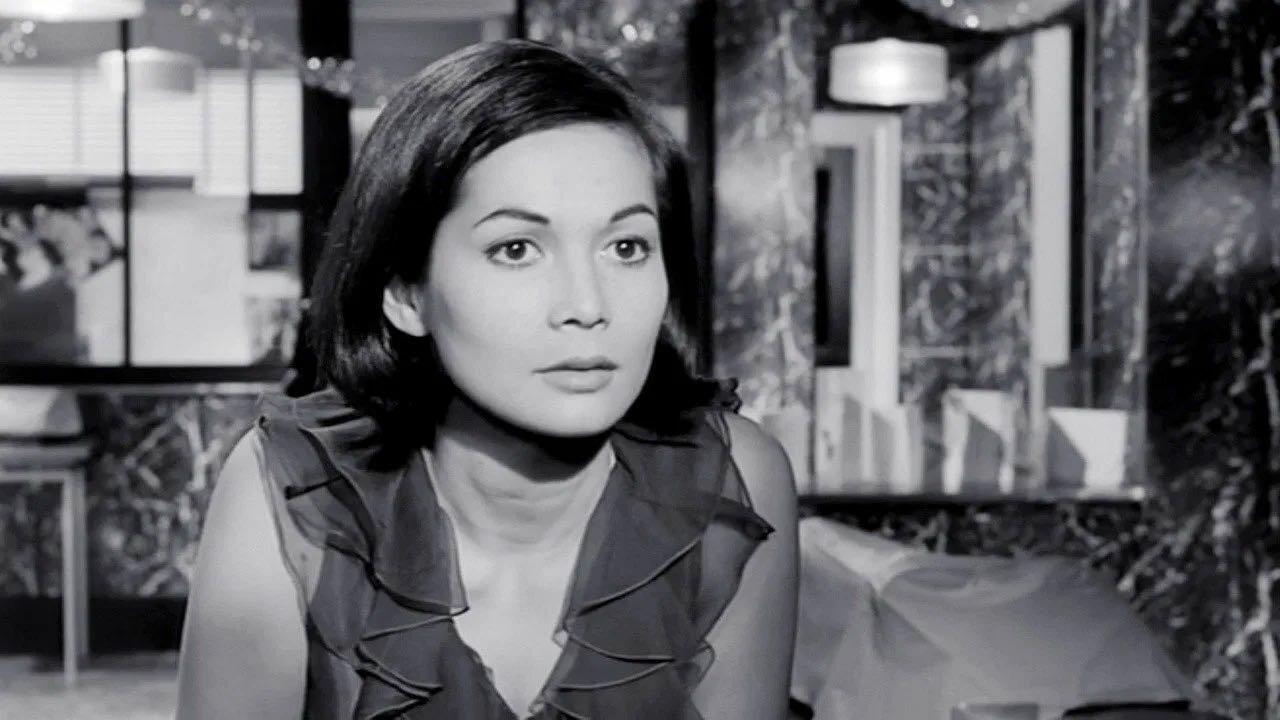
The dialectic between the actual self and a mirror self is developed in The Wild Affair (1965), a comedy about Marjorie Lee, a secretary whose final day at work overlaps with the eve of her wedding and the desire for a final fling. Early on, peeved by a conversation with her mother about the importance of maintaining her virginity until marriage, she turns sultry and begins talking to herself in the mirror: “No one has ever guessed your secret. No one has ever seen the creature you keep locked up in that frail, young, beautiful body. No one has ever known Sandra. The woman deep inside you.” Just then, the mirror self appears before her with a vampirish look. Sandra, a manifestation of Marjorie’s id, stalks her throughout the film as a reminder of her straight-jacketed self. “You look like me,” Sandra says. “Now act like me.”
It is within that very discordance between opposing selves—between the pull of impulse and the push of conscience, between the character’s intentions and the performer’s execution—that Kwan’s performances come alive. Her onscreen magnetism lies in this consequential resistance, mirroring her plight as a racialized performer under studio control. In the performances of Nancy Kwan, there is always another narrative operating behind the facade, this double life, this other voice that speaks from a darkened interiority. But, like Marjorie, just when things get interesting, Kwan is forced to withdraw. Toward the end of The Wild Affair, after the year-end office party has become a Dionysian playground, Marjorie, incensed, returns to the mirror one last time to confront Sandra. Rather than cheat on her fiancé with one of the several men who have thrust themselves upon her throughout the day, Marjorie adheres to the virtues reiterated by her mother, choosing fidelity, sanctity, purity. “I’m not with you,” Sandra says, chastising her other half. “Good,” Marjorie says: “Because you’re just not going to be with me anymore.” She turns the lights off, and Sandra falls into silhouette. Moments later, the mirror shatters into pieces that won’t be picked up.
Of the role, Kwan writes: “The bright note for me was when a critic wrote, ‘You never once bat an eye’ at the sight of Nancy Kwan playing a typical English girl.… That was my goal—to be perceived as an actor and judged for my performance, not my appearance or heritage. To me, that was real success.” In the light of Anna May Wong’s unprecedented career as an unabashedly Asian actress, and of Merle Oberon’s decision to pass as white, the legacy of Nancy Kwan is all the more confounding. Her repeated desire to flatten her Asian heritage and mobilize this ideal of universality distracts her and audiences from the remarkable qualities of her craft, where we find her negotiating the bondage she’s experienced within the performances. Rather than bridging two racialized imaginaries, she seems to wish to be on both ends at once.
Interval (Daniel Mann, 1974).
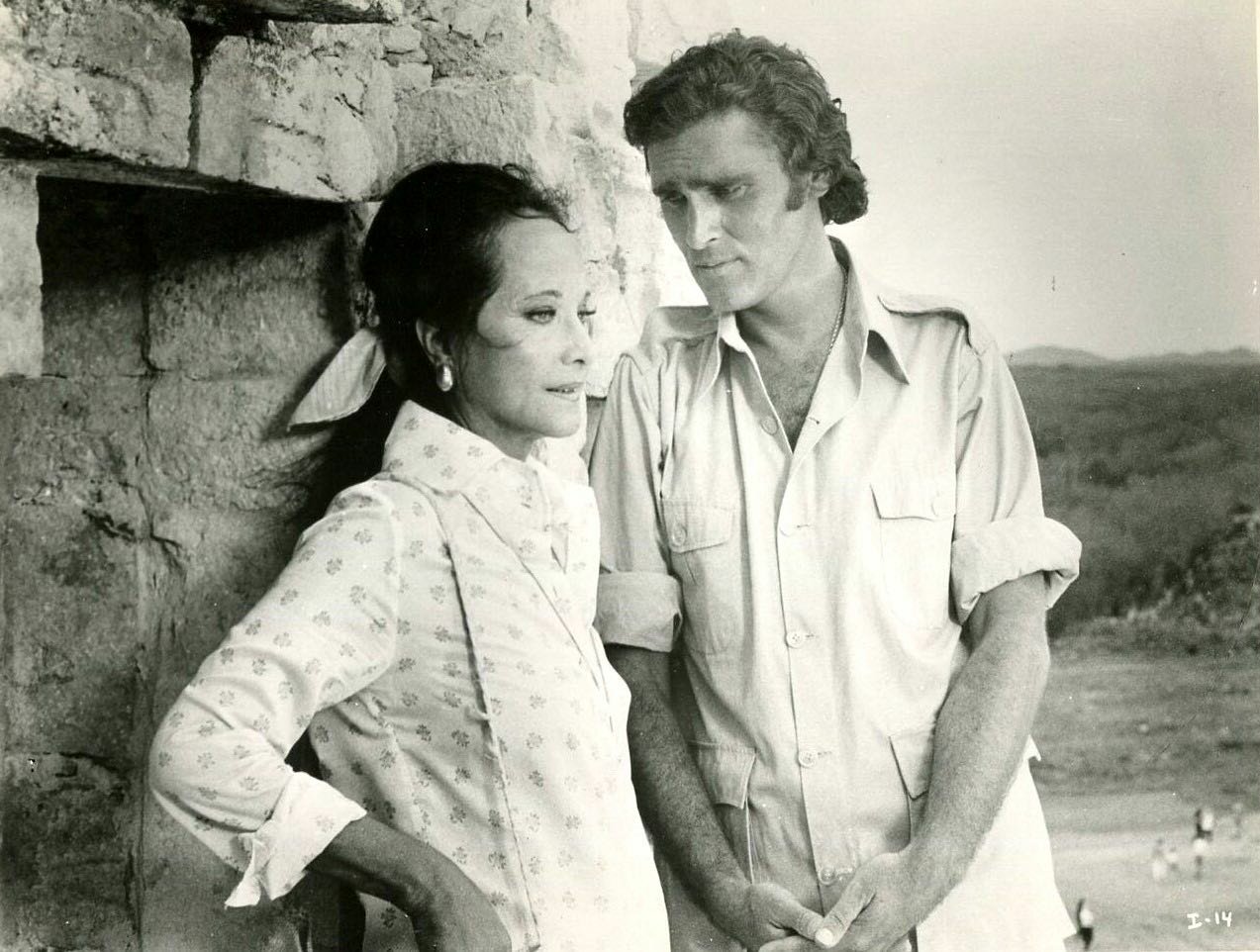
In Interval (1974), Merle Oberon’s final film, which she also produced and coedited, she plays Serena Moore, a woman of a certain age traversing the ruins of the Yucatán as she falls in love with Chris (Robert Wolders, Oberon’s fourth husband), a handsome, young artist who acts as her tour guide. In a horse-drawn carriage with him, her imagination runs wild. “This makes me feel like one of those tragic heroines,” she says. “Life was all secrets back then.” He asks her if she likes secrets. “As long as they’re never explained. A secret is usually better than the explanation.” Even here, at the end of her career, Oberon delivers this line with a straight face, letting us in on the joke. But anytime Serena experiences too much joy, or becomes too involved with the present, scenes from a trauma in her recent past announce themselves, overwhelming her with their dreadful, inescapable force and further estranging her from Chris. As is typical of Oberon’s characters, Serena’s erratic behavior appears to have mirrored Oberon’s final years.
In the fall of 1978, as a guest of the Sammy Awards, Oberon, along with Wolders, made a trip to Australia and accepted an invitation from the Lord Mayor of Hobart, Tasmania: her alleged birthplace. The Trouble with Merle (2002), a 55-minute documentary produced by Film Australia, depicts Oberon’s visit, along with the various myths surrounding her, including the local rumor she was the illegitimate child of a local Chinese washerwoman. In the film, the Tasmanian writer Cassandra Pybus explains Oberon’s significance to the people of her generation: “What I love about Merle … was that it proved to me that we were connected, there was this kind of mooring line to the centre of the world. The centre of the world had to be Hollywood.” During Oberon’s time there she developed a heart murmur and started to experience attacks of nervous tension, headaches, and fits of tears, isolating herself from the press in a nearby casino. At the reception, as Charles Higham notes in the documentary, she became agitated every time she was asked about her birth and her memories of Tasmania. She suddenly felt faint, creating a scene, and had to be escorted out of the room. “The trauma from years of anguish, spent hiding in shame, seemed to pour out of every crevice of her skin,” Sen writes of the sojourn, after which her health began to steadily decline.
A Song to Remember (Charles Vidor, 1945).
Here was someone who was intimately familiar with how trauma manifested itself in one’s consciousness: abruptly, vividly, perpetually catching up with you. Toward the end of the film, the flashbacks from the past, having been confronted, cease, and in a masterful reversal, as she confesses her love to Chris, what flashes onto the screen instead are the recent, amorous memories she has accumulated throughout the film: the beauty of the present overriding the violence of the past. In a sense, Interval is the most intimate, most accurate portrait of Oberon’s state of mind we have, essentially authored for her and by her, one that ends tragically, with her plunging to her death in a cenote, her secrets left to be deciphered by the posthumous spectator.
Shimizu posits that Anna May Wong “became Anna May Wong by playing these roles,” and we can, in revisiting their respective bodies of work, also begin to see and hear the ways in which Nancy Kwan and Merle Oberon utilized the characters they played in order to become cultural icons and to live out their repressions on screen. Kwan’s performances comment on the pressures that she faced as a sexualized and racialized figure, whereas Oberon’s offer sly, self-referential critiques to the system that made and unmade her.
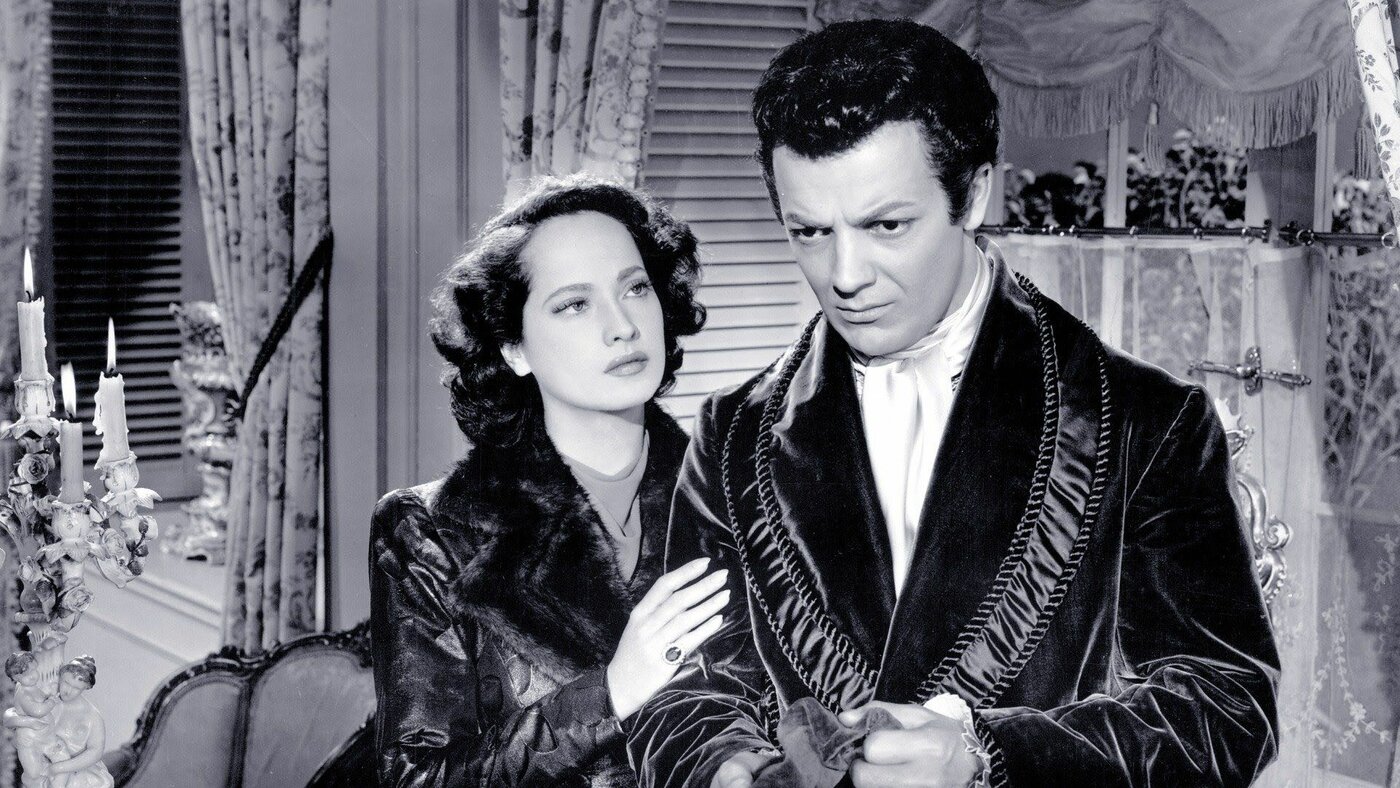
“No one knows this human jungle better than I,” Oberon, as George Sand, says in a monologue near the conclusion of A Song To Remember (1945). As she speaks, her eyebrows leap up, she grinds her teeth, her eyes open wide. When her speech intensifies, her head starts to jerk back, as though struck by the viscerality of the sentiment, and her voice booms, competing with the music. “Maybe you think it didn’t cost a woman something to do it, year after year, in the face of contempt and slander. But there was the reward to remember! I ruled my own life, and what I set out to do, I did,” she declares. Here, for a moment, writes Sen, the character and the actress had become one. For a moment, then, a flicker of that young girl dressed up as a rose, wilting.