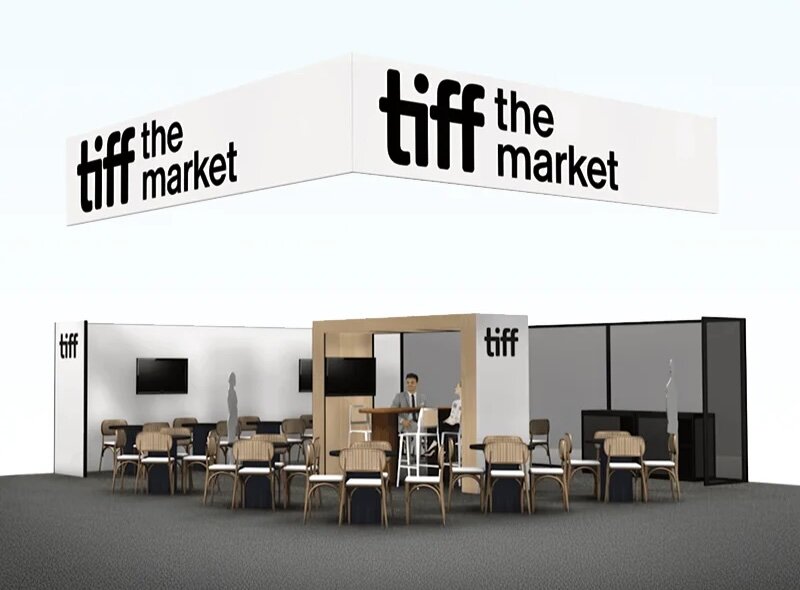
TIFF: The Market exhibition booth option.
At the 51st Toronto International Film Festival (TIFF), which saw the inaugural edition of its official content market, the atmosphere was unmistakably different from its jubilee year. The spirit of nostalgic celebration and victory lapping from 2025's "TIFFty" celebration had evaporated, leaving behind the gritty residue of cinema as a commercial product. Lacking the elegance of “Marché du Film” at Cannes and the specificity of “European Film Market” at Berlinale, for their new industry initiative TIFF settled on a name that evokes the absurdity of local hero Matt Johnson’s Nirvanna the Band the Show the Movie (2025). Its sans-serif, all-lowercase stylization will transport some Canadians to the grocery aisle, recalling Loblaws mogul Galen Weston’s “No Name” brand, a proudly generic grocery chain that prides itself on serving its customer base during tough economic times (while price-gouging them to death).
“TIFF: The Market” attempted to do the same, stimulating the global screen sector amid layoffs and mergers through a $16.9 million investment from the Canadian Federal Government over three years. But amid all the fanfare about transitioning a starry “people’s festival” into a formal marketplace, what actually changed? TIFF has long served as a destination for business meetings and transactions, and industry offerings have existed in various forms—from talent incubators to discussion panels—for over a decade. Was this merely a branding strategy to access public funding for existing programs, or did the organization perform due diligence to build a meaningful infrastructure for its 7,010 market delegates? At first glance, I noticed only surface modifications, if any. The Industry Conference was renamed loftily as the Summit, with two additional days of programming; the creative labs for directors, screenwriters, and series creators persisted in their exclusion of nonfiction projects; and press and market screenings for festival selections were reduced to one slot per film, with the exception of select Canadian features, probably to accommodate paid screenings. Most industry activities carried over from previous years, for better or for worse.
My first interaction with the market wasn’t promising. On the advice of an email to delegates, I went to the Metro Toronto Convention Centre (MTCC) to retrieve my badge before the festival began—an advantage of operating on home turf. Replacing the conveniently located Hyatt Hotel along the short stretch of King Street West cheerfully dubbed Festival Street (with traffic diverted during opening weekend to further heighten Toronto’s internationally renowned gridlock), the new industry hub was now a 15-minute power walk away from Scotiabank Theatre, where most press screenings were held. The remaining press screenings were hosted in the bowels of the MTCC at the 1,232-seat John W. H. Bassett Theatre, a better venue for watching Canadian Idol tapings than for DCP projections. While I was fortunate to only spend 90 minutes queuing in the lobby, some aspiring passholders waited upward of three hours when they found out their badges hadn’t been printed, and were then directed to another line. One volunteer suggested that we could download digital passes onto our mobile wallets, but it was quickly discovered that a glitch prevented users of Microsoft Outlook from opening the link.
Technical difficulties notwithstanding, the main attraction at the market was the Innovation Hub, a curated showcase of interactive experiences, demonstrating TIFF’s embrace of storytelling across formats, or at least its eagerness for a seat at the virtual reality table. On the ground floor of the MTCC was Dutch artist Iris van der Meule’s Lesbian Simulator (2025), a game that prompted players to navigate the world as a neon-licked cartoon sapphic. (The David Cronenberg of Videodrome [1983] and eXistenZ [1999] would surely approve.) Over the next 40 minutes, I accumulated carabiner points by flirting with women at a rave, protecting my fictional girlfriend from homophobes on the subway, and firing queer joy via cannon at unsuspecting pedestrians. Beyond surrendering my vision and movements to the game, I was required to lend my voice to one particularly immersive simulation, forced to repeatedly declare “I’m gay” aloud on the quiet floor of the exhibition space, a taste of the never-ending process of coming out. Satirical, tongue-in-cheek moments like this provided necessary relief to Van der Meule’s earnest and, at times, didactic efforts to impart her personal experience—and to the grueling routine of festival life as a whole.
In the same building, the Summit staged keynotes, panels, and fireside chats exploring the usual topics—co-productions, adapting shorts to features, film financing—as well as new ones, such as “For You Feed to Feature Film,” a session presented by TikTok. For “The Global Sales Playbook,” Roeg Sutherland (CAA) and Glen Basner (FilmNation) spoke of begging for money to finance independent films in the absence of cushy studio jobs, and reminisced about career highlights and flops (Black Swan [2010] and Surfer, Dude [2008], respectively). Among the talk of pre-sales and box office figures, I was encouraged by Basner’s romantic view of his role as a sales agent, someone who solves problems and brings moving images to life with a creative thumbprint. He emphasized the importance of trusting one’s instincts, of disregarding market intel and equations that assigned dollar values to artists in favor of a human touch. Reminding us soberly that we were gathered for show business, TIFF’s Vice President of Market Programming Geoff Macnaughton steered the discussion back to the realm of data, asking the panelists whether they used AI to inform their decision-making.
The subject of AI resurfaced during “The State of Distribution,” a panel featuring Michael Barker (Sony Pictures Classics) and Noah Segal (Elevation Pictures). After Segal shared stories about beginning his career as a door-to-door VHS sales rep to understand consumer tastes and surveying his staff about their targeted ads during weekly meetings, TIFF’s Head of Market Charles Tremblay brought up Google DeepMind’s $75 million investment in American film studio and distributor A24, and wondered how AI influenced the panelists’ own businesses. While Segal said he was open to it as a tool, he responded that Elevation was “entirely built on what’s fresh” and expressed doubts over the technology’s ability to mine a catalog for new content. Skepticism toward AI also appeared in public screenings, where Danny Boyle was asked about—and heckled for—its use in his film Ink (all titles 2026 unless otherwise noted) during a Q&A. Defending himself, the British filmmaker claimed that generative AI was responsibly used for visual effects and assured the audience that no actors had been replaced, though he made no mention of how working visual effects artists might be affected.
Upstairs, where TIFF envisioned negotiations being made, the stands and booths rented by independent producers, sales companies, and national film bodies for $3,500 to $40,950 were noticeably low-traffic. A food court sold overpriced, prepackaged culinary delights with themes such as “Flavours of Asia” and “From the Islands” to no one. The busiest area was the Lavazza activation in the centre, where the long line for free cold brew and espresso led to introductions and spontaneous encounters. In lieu of accessible “first-come, first-served” roundtables and one-to-one pitch sessions with programmers, distributors, and decision-makers, this was perhaps the best networking opportunity that early- and mid-career filmmakers could hope for. (As in past years, top-tier companies rented out premium rooms and suites in the Ritz-Carlton and the InterContinental to avoid precisely this kind of run-in.) Instead of a bustling international pavilion that promised to drive the future of entertainment, the deserted labyrinth, with its carpeted floors and fluorescent lighting, recalled the liminality of Backrooms (or maybe the Overlook Hotel). This physical manifestation seemed to reflect TIFF’s internal state of ambiguity and transition: it has been slowly but steadily shifting from an audience-focused festival for film lovers to a combination festival/market that had the impossible goal of serving all audiences and professionals at all stages of their career across all forms of media.
Despite a robust slate in the TIFF Docs section, nonfiction filmmakers were largely overlooked in market offerings. Gone was the unofficial “doc day,” which offered a discounted conference pass to a single day devoted to documentary topics; this year a handful of relevant sessions were scattered across the week. Documentary projects were ineligible for all labs, pitches, and funds, ignoring a significant sector of the screen industry that could benefit from institutional support. Given the recent collapse of Hot Docs, resulting in the major loss of industry programs and grants, it was disappointing that TIFF didn’t step in to lift its local documentary community with a dedicated program like the European Film Market’s DocSalon or Cannes Docs, with fellowships, showcases, and delegations.
How did TIFF perform as a marketplace? Though some have observed that only a handful of acquisitions took place, it should be noted that the success of markets shouldn’t be defined by the volume of publicized sales, especially in this industry environment. Business deals take time to finalize, and ones that are announced during festivals were often completed prior, in order to maximize press coverage. That there were any headlines concerning territories and rights for Babies, The Surgeon, and Sunburn attests to the industry’s belief that TIFF has maintained its ability to draw international attention—and the festival’s hopes that the media would play ball with its new narrative. Following last year’s historic $15 million deal for Obsession, Blumhouse and Universal’s acquisition of River this year confirmed Midnight Madness as a coveted section to sell genre films, its loyal and energetic crowds easily convincing buyers of audience demand. As a talent incubator, it’ll be a case of tracking projects over the next few years to assess the matchmaking sensibilities of behind-the-scenes industry staff.
Even if the general sentiment around the market was one of mild disappointment, it was usually accompanied by forgiveness. Many seasoned industry professionals noted that hiccups were expected, and were optimistic that things would only improve from here. Despite competition with the American Film Market in November, TIFF maintains the advantage of existing alongside a festival at the beginning of award season, drawing in a reliable crowd already attending for their selected films. With the first edition under everyone’s belt—buyers ready to adjust their budgets and schedules, and organizers prepared to deal with technical issues and demand—hopefully next year isn’t business as usual.