One Shot is a series that seeks to find an essence of cinema history in one single image of a movie.
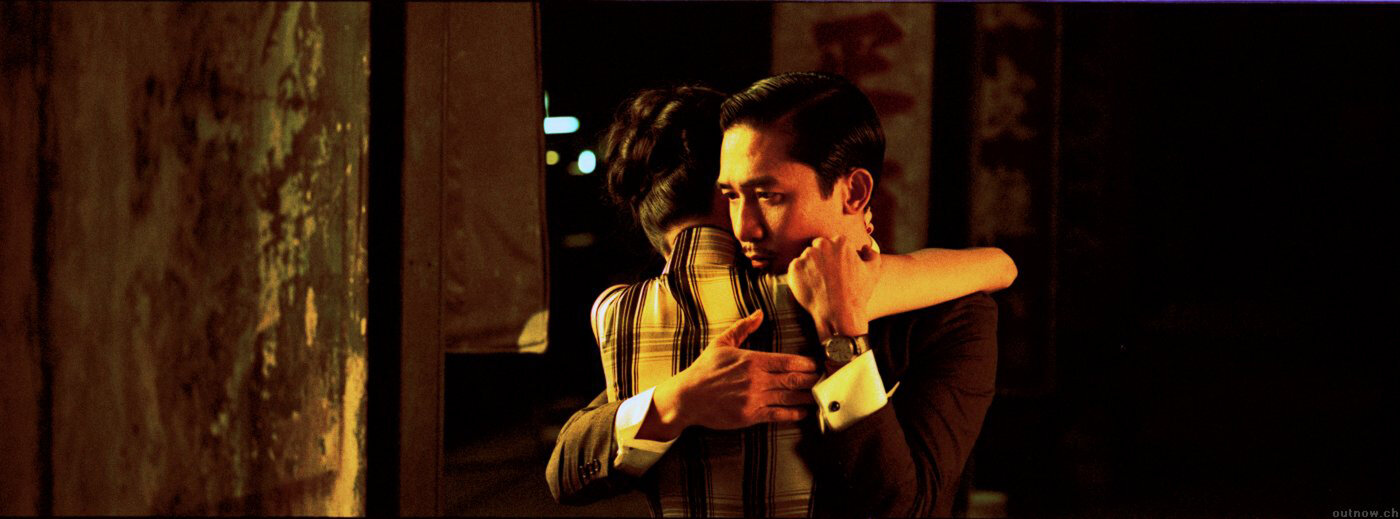
2046 (Wong Kar Wai, 2004).
Tony Leung Chiu-wai’s body language gives just enough, but never too much, to keep the audience guessing. He balances the art of showing and withholding, just like the undercover agent he played in Infernal Affairs (2002), seducing the audience into trying to pin him down.
This shot from Wong Kar Wai’s 2046 (2004) captures Leung’s signature half-frown, as if deep in thought, as if in hesitation—never fully satisfied. Leung plays the writer and journalist Chow Mo-wan, a man entangled in a series of romances. In this moment, he embraces Bai Ling (Zhang Ziyi), a cabaret girl who initially agrees to keep their relationship purely physical, only to find herself falling head over heels in love.
In contrast to the affectionate Ling, who leans in warmly and tightly wraps her arm around him, Leung remains calm, composed, and in control. His rigid gesture and enigmatic gaze reveal an interiority hidden beneath the self-proclaimed freedom and solitude of what Leslie Cheung’s playboy in Wong’s 1990 film Days of Being Wild called himself: a “bird without legs.” Leung is the kind of soul that won’t settle, despite his adoration for the spicy-sweet beauty next door. Under Wong’s nostalgia-swathed yellow lighting, Leung appears cold and melancholic, closed-hearted and vulnerable all at once, opening his psychological world to contemplation. His ambiguity is precisely what makes him so alluring and irresistible as one of Hong Kong’s most renowned movie stars internationally.
After first gaining international recognition of Hou Hsiao-hsien’s A City of Sadness (1989), Leung has played many roles, variously a disillusioned lover, a husband contemplating an affair, a loyal police officer, and a double agent. Leung’s characters are often quiet, contemplative, and hard to decipher. With a career winning some of cinema’s most prestigious accolades, and making modern classics that witness Hong Kong before and after the British colonial era, Leung is one of the last of the kind of movie star who represents not only the characters he plays, but also the transformation of the culture he comes from and its intergenerational memories. Ultimately, the actor seems transmutable, much like how 2046 mixes the lost loves and memories from Wong Kar Wai’s previous film characters across time and space.
Moments of diverted gazes—staring just off-screen, looking downward, or in the distance—become the true substance of his performances. Instead of changing and adapting himself to each role, he internalizes his characters, turning them into versions of himself across parallel universes—a man at once sincere and deceptive, resistant to being fully understood. The audience is left to project their own interpretations onto him during these suspended silences. In an interview, he once said, “People won’t find out it’s my emotion. They think I’m acting as someone else. But it’s actually me.”
In contrast to the confidence and decisiveness he exerts, Leung’s expressions always reveal a softer, more vulnerable interior—complex emotions that resist clear labels. He leaves the audience imagining: What if it could have been something more?
The retrospective series The Grandmaster: Tony Leung will be screening at Film at Lincoln Center from April 29 to May 7.