A New Substantiation Of Auteurism: Sometimes the movies that are making money and the movies that are worth talking about are the same movies. Thanks, I guess, in part to myself, and to my esteemed colleague Jim Emerson, the conversation about Avatar isn't quite over yet. Threads on various sites and blogs, my own included, are all about the current box champ, Shutter Island, with comments covering everything from its plot twist to its putative continuity errors. And while the picture itself is only in a small number of theaters at the moment, The Ghost Writer is being hailed as a welcome adult thriller, and its signer is being considered as a filmmaker first, as opposed to history's greatest monster.
What do these pictures have in common? Well, I reckon you know the answer. Like them or not, all three are what you might call auteur pictures. Films by strong, well-known directors with definite directorial signatures or at least traits. More than being interesting in themselves, the films are interesting in the way they link to each director's body of work. In the case of James Cameron's Avatar, it answers the "can you top this" question with a resounding yes. The topping being done in both the technical and box office departments. The Preston-Sturges-inflected-dialogue department doesn't even apply here. In the case of Roman Polanski's The Ghost Writer, we see a triumphant return to the contemporary-thriller genre, which for some Roman-watchers constitutes what they call a "return to form." With Shutter Island, it's another episode of Martin Scorsese's Adventures In Big Budget Commercial Filmmaking.
Right now I want to talk a little more about Shutter Island. I saw it for a second time last Wednesday, and I recommend that admirers of the picture do the same. First off, on the subject of budgets, while $70 million ain't cheap, the picture looks as if it could conceivably have cost a good deal more than that. Also, seeing the film a second time, noting how the film's plot resolution is set up—the various line deliveries (the much-mocked "evaporated" dialogue from Kingsley is in fact delivered exactly as it ought to be) and exchanged glances—reveals how layered of a picture it is, and it's plenty layered. Finally, a second viewing enables one to really see the personal dimension of this film, and how it fits in with Scorsese's other films concerning one of his great subjects: the compulsively self-wounding man. And, finally, a second viewing gave me a new perspective on and admiration for Leonardo DiCaprio's lead performance, particularly the aspect of it that has nothing to do with accents or line readings. DiCaprio's measured walk at the film's very end is as eloquent a bit of physical acting as Sean Connery's rush to the ocean liner swimming pool in Marnie.
To reiterate: an auteurist film is an interesting film. What other pictures in commercial release right now are you actually interested in talking about?
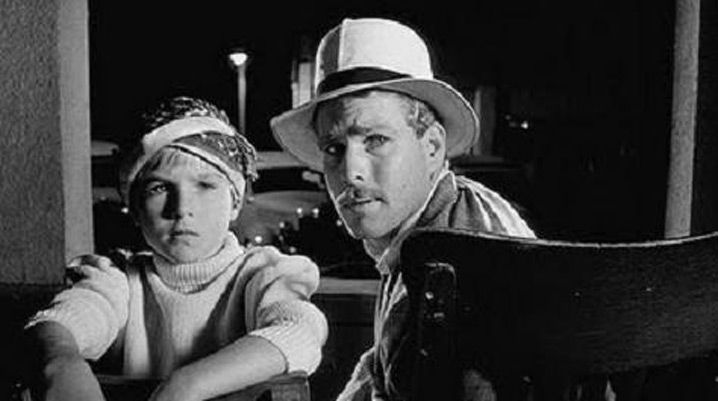
Watch The Language: So a ten, or maybe 13, year-old girl cusses up a storm in the upcoming graphic-novel-adaptation Kick-Ass. Movie's not even out yet, and the self-proclaimed gatekeepers of public morality are already het up about the cussing in the film's "red band" trailer. Because anybody can see the "red band" trailer, you see. And also, there should be a limit of what we allow children to do in movies. Well, there are limits—that's why there are child pornography laws. Watching what is passing for debate on what is essentially a non-issue, I yawn; as I am 87 years old, I vividly recall the release of Peter Bogdanovich's Paper Moon, and the outrage over the salty language articulated by young Tatum O'Neal in that picture. Well, whatever problems Tatum had in later life, I'm inclined to believe that few of them were directly related to her doing some cussin' in a picture.
This non-issue gets my Jake LaMotta "I Putchyazs Boat In Da Ring" Award; that is, I think both sides are full of it and oughtta drop dead. The makers and promoters of Kick-Ass who think it's so edgy to create a potty-mouthed homicidal "Hit Girl" and the official concern trolls and their "what about the children" posturings. However. This "controversy" comes at a very particular moment, one in which the potential forces of repression/oppression appear to be getting the upper hand. To dismiss those stirring up shit about this as "people who don't count and don't matter," as one prominent Douglas-Sirk-hater does, is to play very much into those people's hands. It would be both appalling and in a way entirely apt if the war over free cultural expression's tide was turned over a piece of work as potentially insubstantial and meretricious as Kick-Ass, huh?