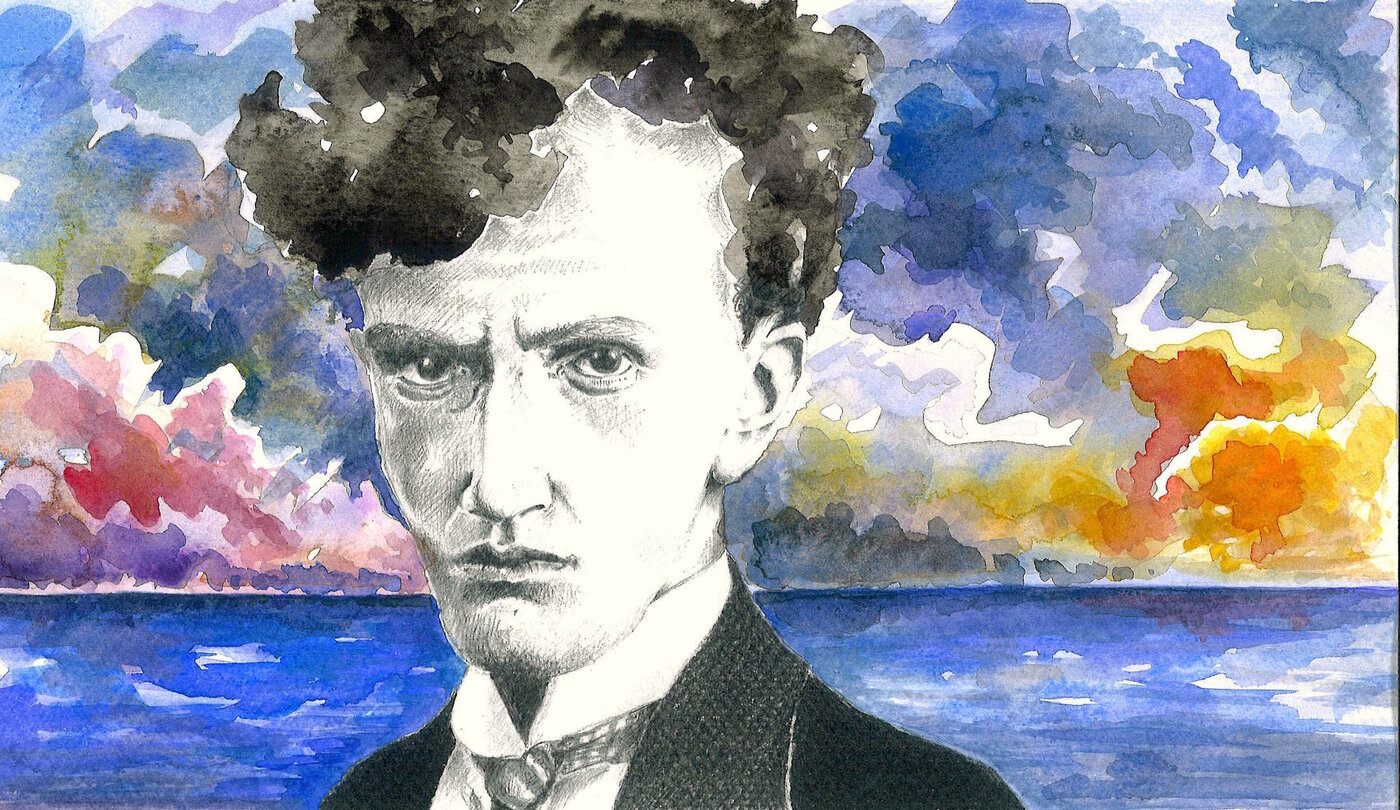
Jean Epstein. Illustration by Leonardo Goi.
Jean Epstein was an aquatic filmmaker, an artist who saw water as embodying the kind of cinema he aspired to create: fluid, tempestuous, unpredictable. Like the roaring seas he immortalized over a three-decade career, from Marseilles to the windswept islands off the coast of Brittany, his works are constantly moving, and everything moves within them; their very form—so open to distortions, fractures, and jumps through time and space—always seems to suggest something in a state of flux. That’s why you cannot step in the same Epstein film twice. A firm believer that the camera was an intelligent machine—not a robot but an instrument of revelation capable of altering the way we see the world on and off the screen—Epstein was that rare filmmaker whose works do not just threaten to change the way you perceive your surroundings but also seem to shapeshift at each rewatch.
It is also why, almost a hundred years since most of his films were first released, they still feel so prodigiously fresh. A doyen of French cinematic impressionism and the 1920s avant-garde, Epstein was one of the medium’s early pioneers. But conversations around his oeuvre all too often concentrate primarily on his most famous film, The Fall of the House of Usher (1928), while retrospectives have been all too rare and patchy. Which makes the one held at the Viennale and the Austrian Film Museum last fall especially significant. Emerging from this career-spanning foray is a man of many facets: a director who cut his teeth with studio gigs only to flee from the shackles of mainstream cinema and find new inspiration at the country’s edges. Mostly though, there’s a sense of an artist finding himself through his symbiotic relationship with an element—a man who grew convinced of his art’s capacity to grant that element a voice. “The sea speaks!” says an intertitle in one of his earliest Breton films, The Sea of Ravens (1930), but that’s true for all Epstein’s works. Even those set far from the shore have an oceanic sensibility: a keen eye for the unstable and the irrational, and a belief that the camera can act as a portal into those mysteries.
Born in Warsaw and raised in Switzerland, Epstein was a film theorist before he became a filmmaker. The three pugnacious essays that make up his first text on the seventh art, Bonjour Cinéma (1921), reveal a modernist thinker convinced that the medium should shed all concerns with plot, cogent stories, and linear chronologies to become, “gradually and in the end uniquely, cinematic; to employ, in other words, only photogenic elements.” Exposition was illogical, the unraveling of plot “nothing more than a transition from knot to knot.” But the first film he made once he moved to Paris, Pasteur (1922), a silent biopic of the scientist, landed him a ten-year contract at Pathé, then one of the biggest studios in France, and his earliest features all thrive from the tension between the demands of commercial filmmaking and a director struggling to defy them. The Faithful Heart (1923), his first for Pathé, is a maritime melodrama that couches a shabby love triangle in an avant-garde idiom. Young barmaid Marie (Gina Manès) is in love with gallant dockworker Jean (Léon Mathot), but her adoptive parents want her to marry brutish lout Petit Paul (Edmond van Daële). Epstein, who claimed he wrote the script in one night, shot around the docks of Marseilles, and turned to the sea for some of his most sensational sequences, in which superimposed close-ups of Jean and Marie’s faces seem to magically float over the Mediterranean. But the whole film has a kind of seasick energy. In an essay in Bonjour Cinéma, Epstein dreamed of shooting on an airplane or a merry-go-round; in Faithful Heart that wish came true. Halfway through, Petit Paul and Marie drop by a village fair and hop on a carousel, and in a feat of rapid editing Epstein dizzyingly cuts between shots of the couple whirling to glimpses of the blurred background, deconstructing their ride into something abstract, a sort of Futuristic painting in motion. When Marie jumps on another merry-go-round at the film’s end—this time with Jean—the sequence culminates with abstract images flickering on a kaleidoscope. A formulaic romance is Frankensteined into a visually brazen journey; from mainstream to avant-garde in a single gasp.
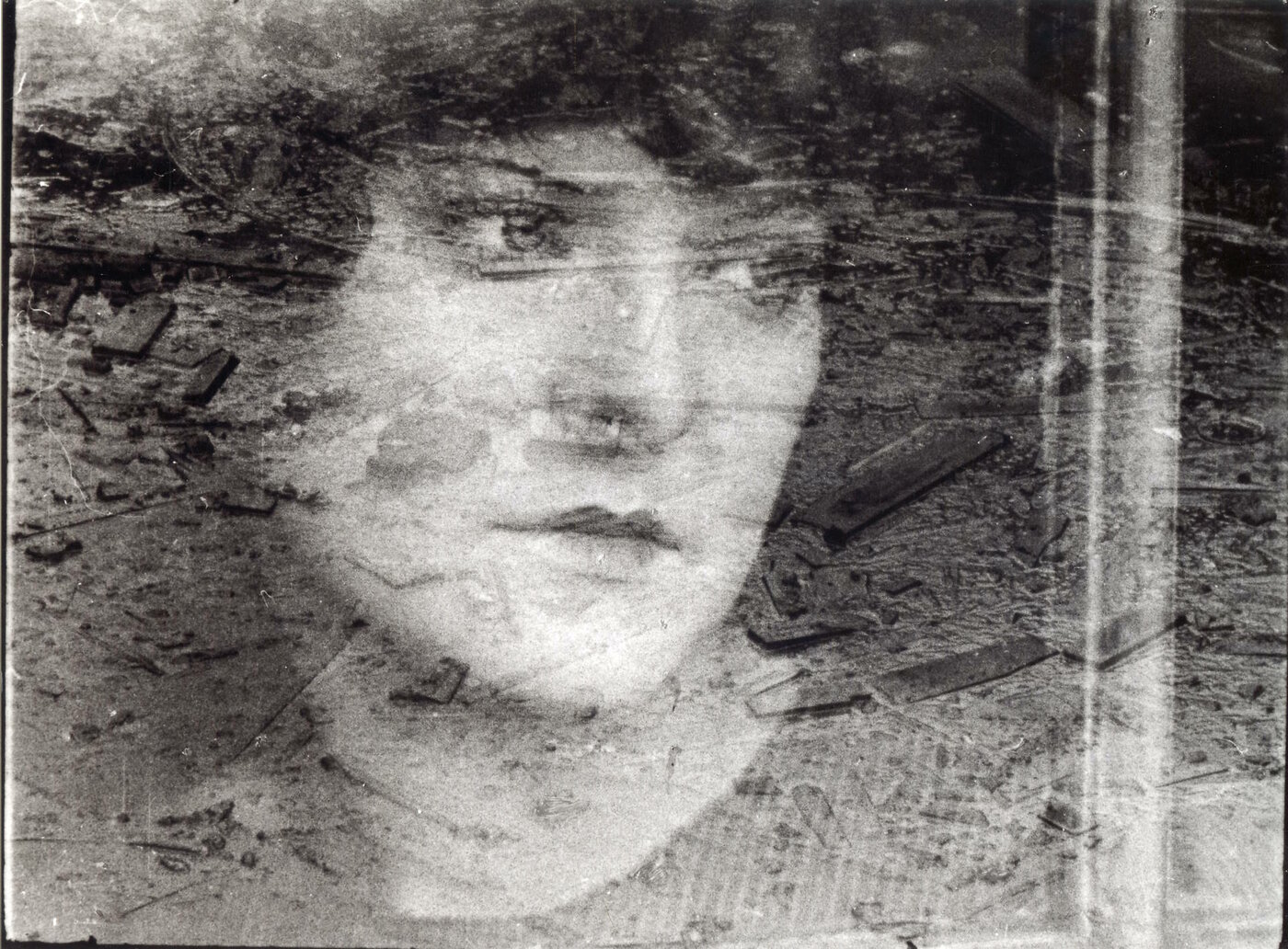
The Faithful Heart (Jean Epstein, 1923). Photo: Collection Austrian Film Museum, Vienna.
To revisit Epstein’s early studio films can sometimes feel like watching a director readying to metamorphose into his final, ideal stage, like a chrysalis into a butterfly. Even one of his most conventional, The Beauty from Nivernais (1924), a spiritual mother to Jean Vigo’s L’Atalante (1934), is peppered with wondrous flourishes. The story, about an abandoned boy who’s adopted and raised by a bargeman and winds up falling in love with his daughter, is as banal as The Faithful Heart’s love triangle, but there’s a productive conflict between Epstein’s writing and directing. Water plays a cardinal role; as the titular barge sails up and down the Seine, we’re offered lyrical shots of the river, the poplar trees gesticulating from its banks, and Epstein’s double exposures. In the most sublime of those, the boy, lying feverish and lovesick in bed, gazes at a portrait of the Virgin Mary cropped from Leonardo DaVinci’s The Virgin and Child with Saint Anne, and Epstein layers over it a close-up of the lad’s beloved, framed in the same pose. It’s as if the film sat somewhere between the realism of its script and the more magical realm the visuals evoke.
But nowhere do the tensions between avant-garde filmmaker and gun-for-hire feel more palpable than in The Lion of the Moguls (1924), the first Epstein made for Films Albatros, a studio largely made up of White Russians who had flocked to France after the Revolution. Epstein’s most lavish picture is an exotic reverie centered on a prince who’s forced to flee Tibet after he falls in love with a woman desired by the Khan; having made his way to Paris, the young aristocrat is hired as an actor by a local film company, only to court more trouble once he falls for the lead actress and the producer’s lover. Everything about The Lion rings false and artificial: the extravagant décor, the ostentatious garments, the sight of exiled Russian star-cum-writer Ivan Mosjoukine prancing about in golden tights as the prince. Far more conservative in form than The Faithful Heart, The Lion nonetheless remains a fascinating case of aesthetic schizophrenia; there’s a striking dissonance between Mosjoukine’s staid plot and Epstein’s visual experimentalism. In the dreamy double exposures and the occasional surreal detours—a rowdy bender and, later, a breakneck taxi ride across Paris—you can sense a more fantastical version of The Lion pushing to break free from the conventions Mosjoukine foisted upon his own production.
***
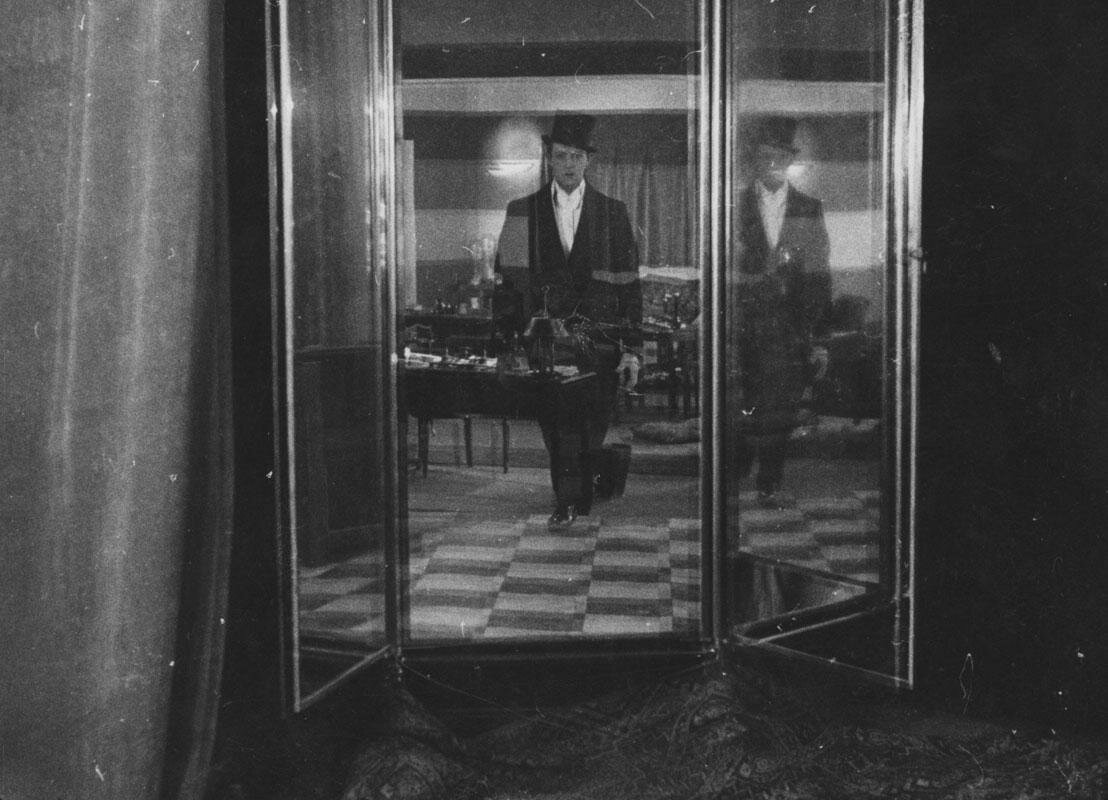
The Three-Sided Mirror (Jean Epstein, 1927).
For all these films’ formal bravado, the creative straitjacketing Epstein suffered at Pathé and Albatros convinced him to set up his own production company, Les Films Jean Epstein, the studio that spawned some of his most singular works. Named after the size of the Kodak photograph that proves crucial to the film’s central mystery, Six and a Half by Eleven (1927) concerns two brothers who part ways after one falls in love with a singer (Suzy Pierson). But the feelings aren’t mutual, and once the heartbroken younger brother (Nino Constantini) commits suicide, the older (Edmond Van Daële) becomes obsessed with finding out the truth behind his sibling’s death. Watching Epstein’s oeuvre chronologically, Six and a Half stands out as a catharsis—a film made by a director who, no longer beholden to the capricious demands of the studios he toiled for, could finally pursue his idea of cinema and throw his entire repertoire at the screen. Soulful close-ups, fast cuts, tracking shots, and evocative superimpositions crop up throughout, none more remarkable than when, early on, Epstein follows a car racing to the south of France and grafts over it shots of waves: two lovers parting the sea. So tall are the stages where the interiors were filmed that dining halls and bedrooms loom as large as cathedrals, and there are times when Epstein abandons the “action” to linger on seemingly irrelevant things, as when the camera, instead of dogging the main characters in a particularly suspenseful scene inside a theatre, ditches them to focus instead on a performer juggling a few balls in the background—presumably for no other reason than the routine is fun to watch.
And fun is the film’s operating principle. Everything about Six and a Half suggests a desire to experiment, all rules be damned, with the most subversive ruptures concerning movement—not in space, but time. The older brother’s investigation triggers a rivulet of flashbacks to his sibling’s romance, in a fractured structure that echoes his other 1927 film, The Three-Sided Mirror. Here too, the story is almost skeletal: three women all love the same man (René Ferté), who loves nothing and no one more than his scintillating Bugatti sports car. Mirror is a portrait of the fatuous cad as told from the perspective of his three mistresses, whom the man stands up for what turns out to be a fatal solo ride in the country. The crash is itself extraordinary: a cubist-like splintering of the event through a concatenation of images that come at you like glass shards. But the film’s most hypnotic sequence takes place earlier on, as the man drives his Bugatti out of a garage that sits atop a multi-story parking lot, and Epstein, having fastened his camera to the car, follows it as it descends through the building in a single unbroken shot, with the background growing more abstract and eerie at each floor.
Such experimentalism would find its apotheosis in The Fall of the House of Usher (1928), so revered by director Georges Franju and archivist Henri Langlois it was the very first title they bought in a collection that would become known as the Cinémathèque Française. An amalgamation of two Edgar Allan Poe’s short stories—“The Oval Portrait” and “The Fall of the House of Usher”—the film is the summation of years spent stress-testing the medium’s limits. Owing to a “curious hereditary flaw,” the wealthy Roderick (Jean Debucourt) is compelled to paint his wife Madeleine (Abel Gance’s sister Marguerite), but the closer the portrait comes to completion the more lifeless she becomes—until the final brushstroke spells her untimely death. Usher is concerned with the boundaries of perception, and its form is entirely in service of that theme: the whole film hangs in some crepuscular world where characters and décor are often cloaked in darkness, fog, and mist; where shots refuse to match smoothly, and everything from the billowing curtains to the tableaux vivants intimate a sort of séance. Water may not be as prominent in Usher as it is in works like The Faithful Heart or The Beauty from Nivernais, but all Epstein’s films—so at home in the unfamiliar, the viscous, the unwieldy—have a kind of liquid quality. Powering his cinema is a belief that nothing is ever truly fixed, and that the camera can help us uncover those infinite movements. Is it any wonder that the encounter with the ocean proved so revelatory?
***
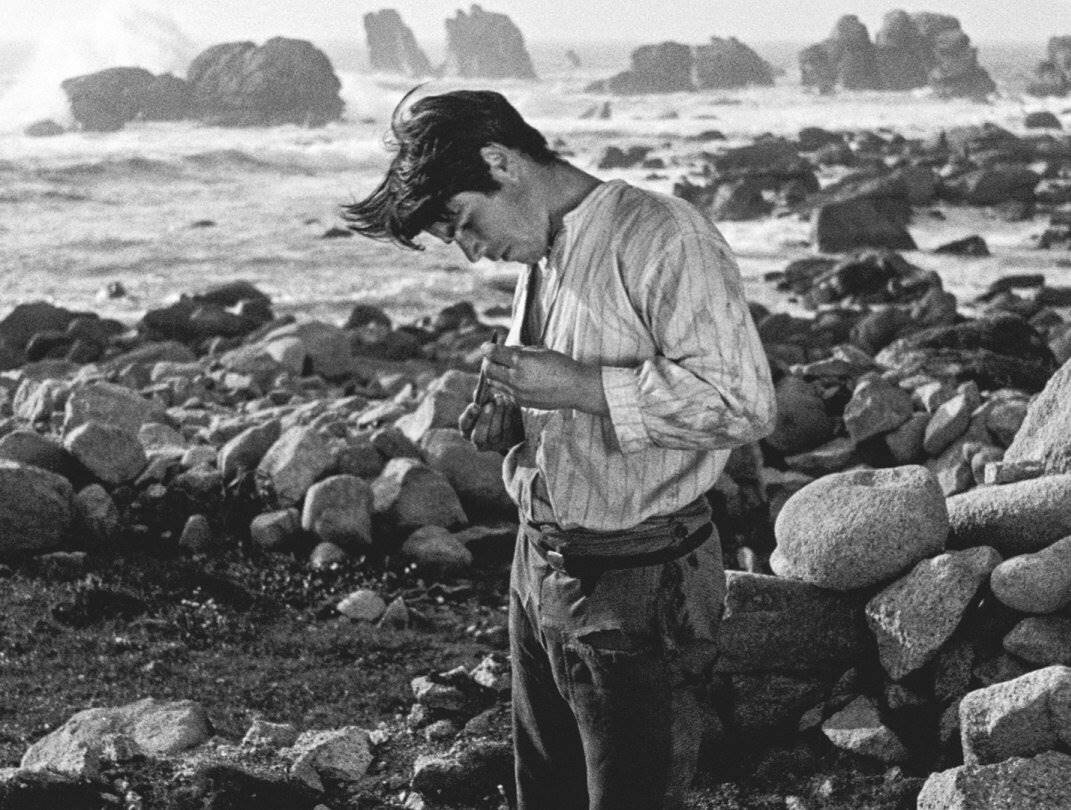
End of the Earth (Jean Epstein, 1929).
Brittany came to Epstein as an epiphany. “Difficult to access for tourists,” he wrote after his first visit in 1927, “this is virgin terrain for cinema.” And indeed, watching his Breton works feels like following an astronaut into some extraterrestrial voyage—both the films and the landscape that spawned them have an alien beauty to them. Out on the desolate islands dotting the Atlantic where Epstein brought his camera, nature reigns supreme. People do not live in Ouessant, Bannec, or Sein; they’re simply trying to survive them. Nine-foot tidal differentials, biblical winter storms, deafening winds and vertiginous waves: Epstein saw those unforgiving places as an apocalyptic outpost, and found communities virtually untouched by industrialization who were held together by ancient myths and superstitions. All the works that emerged out of those turbulent waters are drawn to the mysterious, and their director, who believed the fantastic should be unveiled rather than manufactured, did so through films perched along the border between magic and documentary.
Take End of the Earth (1929). With the exception of The Woman from the End of the World (1938), Epstein’s Breton films all starred local, non-professional actors, and his first concerns a quartet of kelp gatherers stranded in the barren island of Bannec. But the film seems less preoccupied with the fictional foreground than the non-fictional background. Time and again, Epstein forsakes the thin plot—the youngest of the four falls ill and the others arrange his rescue—to turn to the bleak locale. It’s as if humanity took a step back and the film invited us to commune with the landscape itself. There’s something spectral about the ribbons of smoke rising from mounds of burning algae along the shores, the sight of a lighthouse jutting out of the ocean, and the thick fog turning the isle into a ghost land. Epstein’s Breton films like to tug your attention sideways, away from people and toward the non-human backdrop. Mor Vran (1930), his second in the region, is a portrait of life on three islands—“Isle of Horror” Ouessant, “the proud and miserable” Molène, or the lugubriously empty Sein—where life seems all but unthinkable. We see storms battering the docks, ships crossing the ocean, widows mourning loved ones lost at sea. And the camera is alive to the omnipresent peril: there are shots where the waves crash dangerously near the lens that communicate genuine dread and excitement for that terrifying world.
Brittany provided an ideal laboratory for expanding the techniques Epstein had toyed with in the capital. Away from Paris, studios and stages, he could finally combine his avant-garde approaches with realist subjects. Another fictionalized documentary, The Gold of the Seas (1932) isn’t a film about people living on the island of Hoedic so much as one made with them. Epstein showed up with no script and asked the islanders—as he often did throughout his maritime cycle—not just to play themselves but help him write it. A penniless sailor finds a treasure washed ashore, and the fortune earns him the envy of his neighbors. Gold is a work of astounding lyricism, in which slow-motion sequences trigger the same stupefying effects they elicited in Usher, diluting time and imbuing gestures with an otherworldly grace, as when the man’s young daughter falls into a quicksand and Epstein cuts between shots of the rising tide and extreme close-ups of the girl’s visage crying out for help.
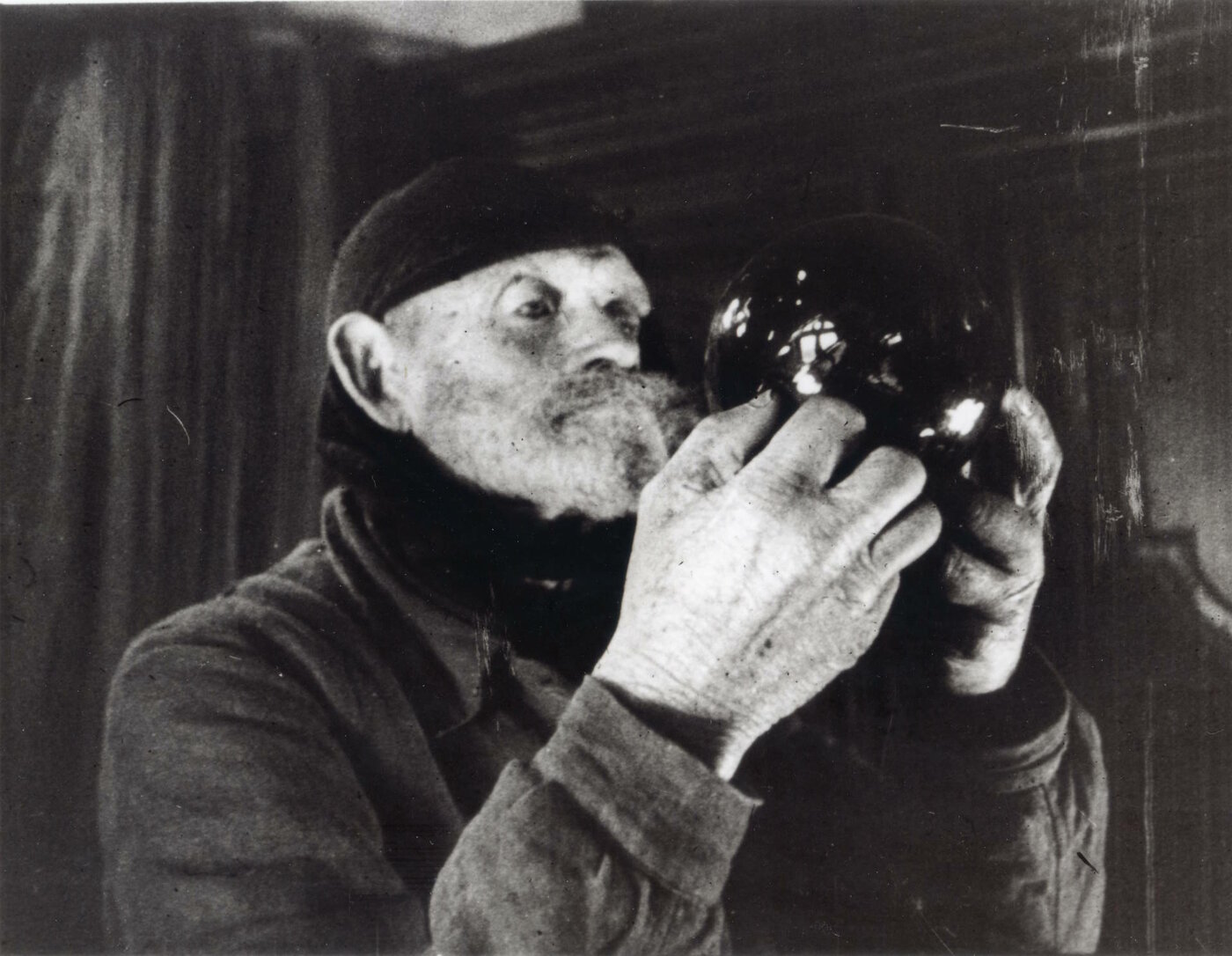
The Tempest: Poem on the Sea (Jean Epstein, 1947). Photo: Collection Austrian Film Museum, Vienna.
Even more musically-minded works like The Cradles (1931) and Song of Armorica (1934) boast a similar playfulness. The first, a music video avant la lettre, uses glimpses of life across Brittany to accompany Gabriel Fauré’s titular song. We hear about cradles “rocked by women’s hands,” men “seeking enticing horizons,” and the short keeps oscillating between scenes of domestic bliss and majestic vessels shipping out into the Atlantic, making it seem as if the images sprang out of the ballad’s lulling rhythms. A mid-length feature orbiting the umpteenth doomed loved triangle (he’s poor and in love; her parents want her to marry well), Song of Armorica was commissioned by the regional daily L’Ouest-Éclair as a kind of “tourist propaganda film” designed to introduce Brittany to the rest of France. It’s a love letter to a foreign land from her adoptive son. The first film in the Breton language, Song radiates a tangible affection for its subjects, and an avid curiosity for their rituals, lore, and traditions. Epstein stands as a custodian of a universe on the brink of extinction; as with the twenty-first-century snapshots of anachronistic Cornish lifestyles from fellow maritime cineaste Mark Jenkin, his Breton films all double as archives of the very worlds they capture. And Song does so while manifesting its maker’s knack for indelible shots, among them a final double exposure that turns the body of a drowned woman into a pre-Raphaelite Ophelia.
Pitted next to such flamboyant yarns, The Woman from the End of the World (1938) makes for a stark outlier. We’re still in Epstein’s turf: in this adaptation of a 1926 novel by Alain Serdac, a Breton island stands as a corner of Antarctica, and the story concerns seamen who travel to the rock to dig up radium, only to realize the metal is nowhere to be found and fall bewitched by the siren-like matron of the isle’s only bar. But the film feels almost classical in its style, and almost entirely free from Epstein’s visual tricks. Like The Lion of the Moguls, it’s a work that arises from the confluence of conflicting stylistic currents: Epstein’s jazzy, improvisational filmmaking and the demands for legibility and coherence of more commercially-minded cinema from the decade. It would take Epstein almost ten years to make something that lived up to the aspirations he’d laid out for himself and his art in the early 1920s. The Tempest: Poem on the Sea (1947), his first post-war film, is in many ways a journey back to the heyday of his experimentalism; per Epstein, “my first avant-garde film since The Gold of the Seas.” The difference this time lies not in the visuals or locale, but in the astonishing soundscapes. Epstein recorded the roar of the ocean with instruments he’d shipped from Paris, and played it in slow motion, backward and forward, at four different speeds. A winter storm is fractured into a myriad sounds different from one another: howls, explosions, rumblings, a perturbing symphony that echoes like an inexorable collapse. In The Tempest, human and non-human perspectives converge; the plot, about an old man who can calm the wind by blowing into a crystal ball, draws from the kind of myths that convinced Epstein these forgotten islands enjoyed a deeper connection with the supernatural. If Usher is his most celebrated, The Tempest is his true masterpiece, a film that gradually elides humans to let the sea tell the story, until it becomes difficult to tell who’s doing the looking—if it’s us gazing at the waves, or the ocean staring back.
Asked about what attracted him to making maritime films, the director once said he was motivated by fear—fear of the sea, yes, but also and more significantly, “fear that demands we do what we fear to do.” That his films have lost none of their electricity is precisely because of their proclivity for risk, their willingness to demand more than what we routinely expect from cinema—to refuse to treat the camera as a mere extension of our retina. Epstein courted the unknown as assiduously as his protagonists did death. And in the ocean, he found an ever-moving, ever-changing being that was both an endless source of inspiration and a kind of refuge. I cannot think of many filmmakers who enjoyed such a molecular and long-lasting connection with water. The Tempest, together with a UN-commissioned project, The Fires of the Sea (1948), were his last two films. Epstein died of cerebral hemorrhage in 1953, aged 56. The day before he passed, he asked his sister Marie to take him on a final trip, but did not survive the night. He’d asked, of course, to see the sea.