Illustration by Franz Lang.
On the evening of August 6, 1932, a crowd of aristocrats gathers in the grand hall of the Excelsior Hotel. They’ve all been invited to the Lido by one Giuseppe Volpi, freshly minted count of Misurata and president of the Venice Biennale. In their number are the future (and final) king and queen of Italy, Umberto II and Marie-José of Belgium; the former king of Spain Alfonso XIII; and Edward, Prince of Wales. They sit before a white canvas that stares back at them like a blank page. “As the lights dimmed out and a title appeared on the screen,” a reporter will write the next day, “the organizers murmured in Venetian dialect: ghe sèmo.” We’re on.
The first Exhibition of Cinematographic Art, as the Venice Film Festival was known at its inception, was designed to cement the status the medium had gained thus far in the young century. “Cinema has become universal,” Volpi proclaims in his opening speech, “an everyday necessity,” before crediting Prime Minister Benito Mussolini as the man solely responsible for an event that will span sixteen nights and sell 17,453 tickets. In fact, Mussolini himself is nowhere to be seen. It will take a few years for the regime to take note of the festival and turn it into a propaganda machine; for the time being, Il Duce is only invoked by the faithful party lackeys in attendance.
It’s funny now to think that the anointment of the youngest of all arts should have been officiated by throngs of crusted patricians. Cinema is a spectacle most of them are unfamiliar with, but no screening is met with silence—“people either clapped, sometimes in the middle of a scene,” another writer observes, “or showered the films with implacable boos.” A thunderous applause welcomes the opener, Rouben Mamoulian’s Dr. Jekyll and Mr. Hyde (1931), which apparently shocks less for Fredric March’s ghastly transformation than a glimpse of Miriam Hopkins’s naked leg. A few days later viewers are stunned again by Nikolai Ekk’s Road to Life (1931), which climaxes with a shot of a train draped in Communist flags scored to “The Internationale,” and again by Leontine Sagan’s Girls in Uniform (1931), a same-sex love story between a student and teacher at an all-girls boarding school (the audience loves it, the Vatican press a lot less; a few weeks after the premiere, the Catholic daily L’Osservatore Romano will accuse it of instigating female perversion and warn that it should not be dubbed into Italian). But the most anticipated title—one that triggers a “morbid curiosity” among attendees—is James Whale’s Frankenstein (1931). Dispatching for Ventuno, a fascist university magazine, one critic claims Boris Karloff’s turn as the creature “haunted many a spectator’s dreams.” Monsters, blue bloods, despots: The world’s first film festival begins.
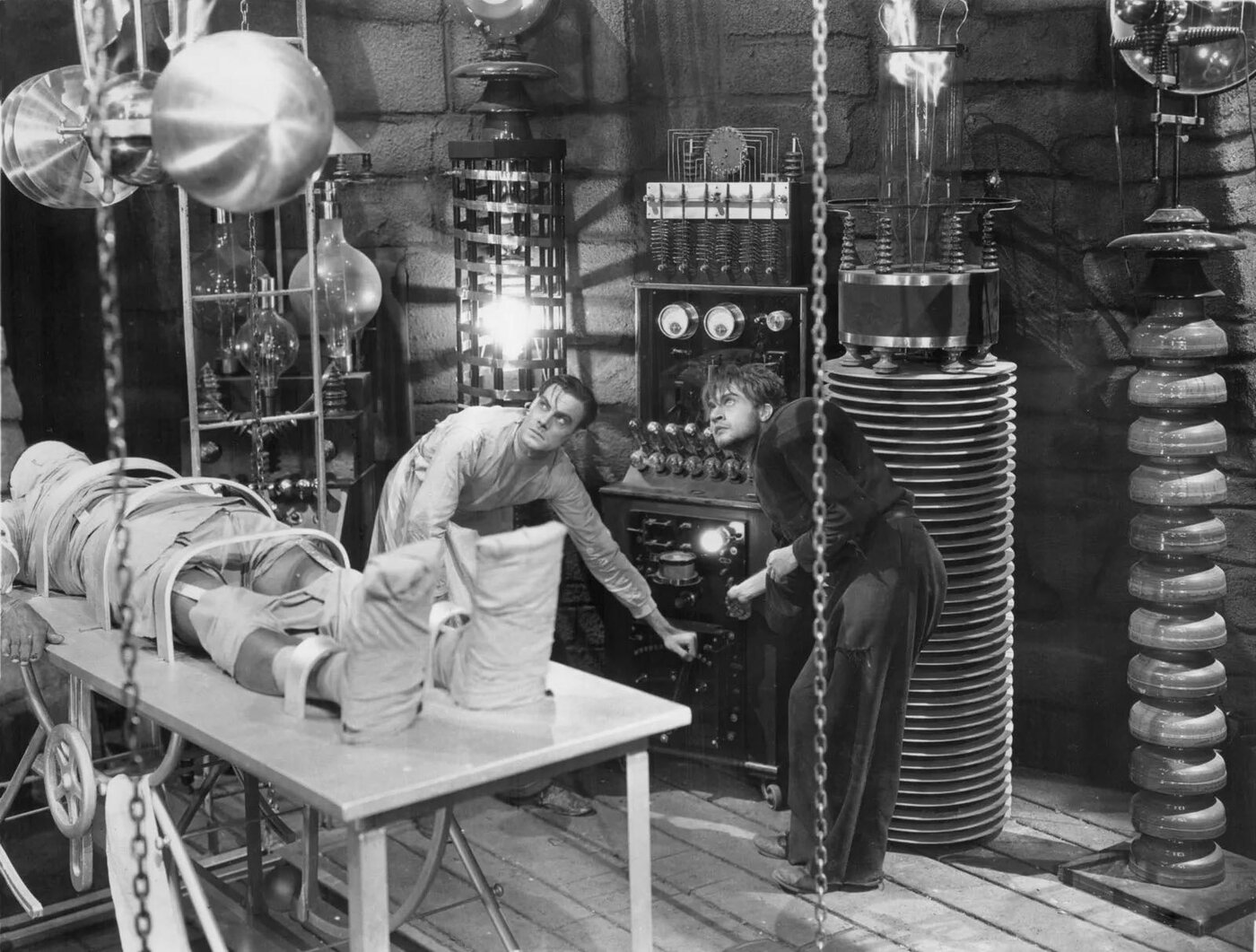
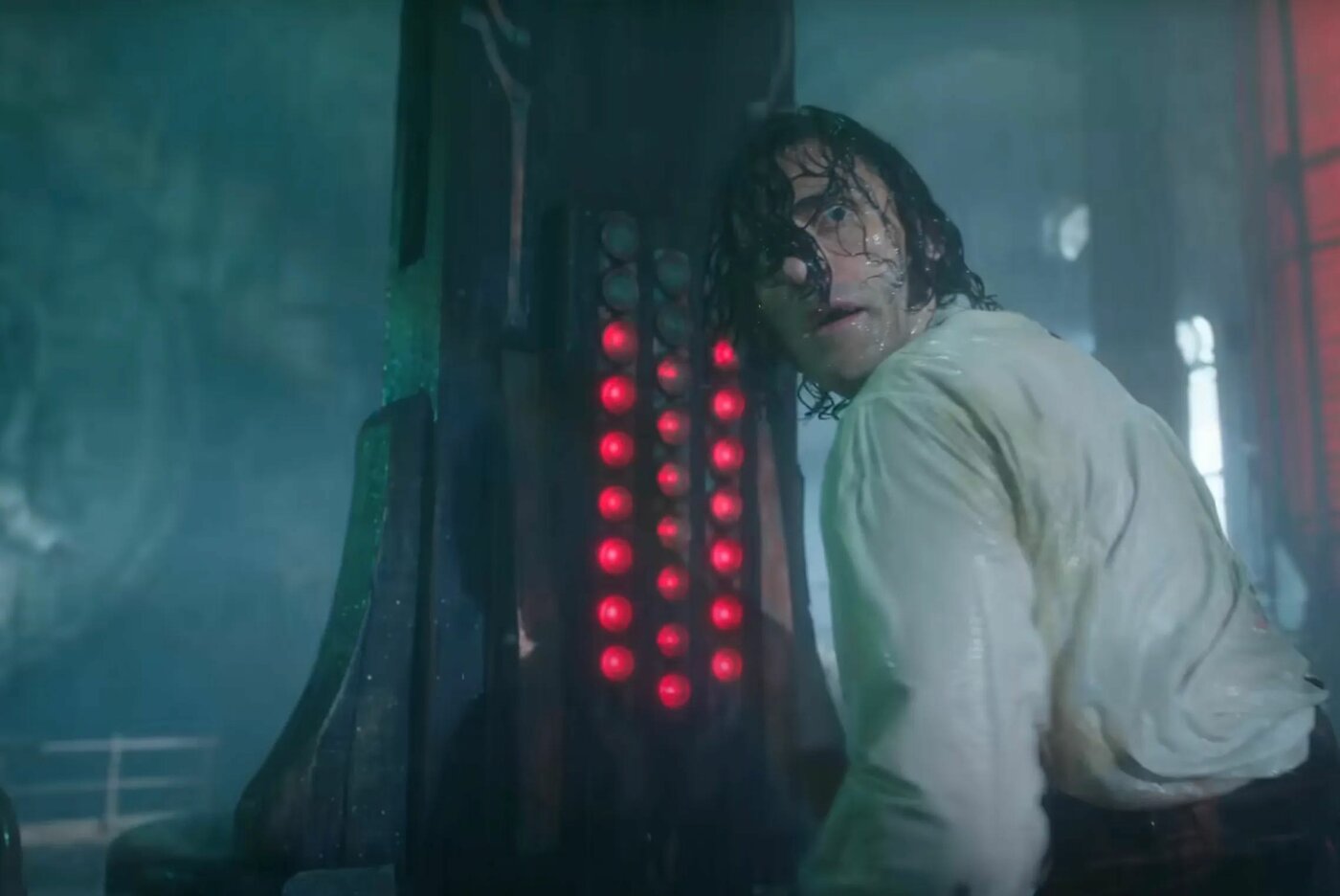
Top: Frankenstein (James Whale, 1931). Bottom: Frankenstein (Guillermo del Toro, 2025).
Almost a century later, the Excelsior is now home to the Venice Production Bridge, the Lido’s answer to Cannes’s Marché du Film; the festival screenings take place inside the many halls scattered in and around the Casino Palace, a vestige of fascist architecture a stone’s throw from the hotel; and the royals have been replaced by movie stars parading the red carpet by the Sala Grande. The 82nd Venice Film Festival featured another take on Mary Shelley’s novel, this one from cinema’s preeminent monster-maker, Guillermo del Toro. His Frankenstein (all titles 2025 unless otherwise noted) feels like the kind of film he’s been working toward his whole career. Which it technically is: In a pre-premiere interview with Variety the director admitted it took 30 years to fulfill his dream: “It’s a movie I wanted to make before I even had a camera.” It is also a summation of many of his ongoing concerns: the way family traumas are inherited like genes, and the all-conquering empathy for the Other that animates works like The Shape of Water (2017), his last official competition entry, awarded a Golden Lion and then a Best Picture Oscar just a few months after. In a stark departure from the 1931 version, the film grants Dr. Victor Frankenstein (Oscar Isaac) his own genesis story, tying his descent into madness to the abuse he suffered at the hands of his oppressive father (Charles Dance). This configuration of a family unit—a heartless dad and a distant mother, now dead—has long been a throughline of Del Toro’s cosmogony. But Frankenstein is a diptych, as interested in Victor’s tale (part one) as it is in letting the creature tell his own (part two), and so tracking how the man becomes a monstrous parent to the “son” he cobbles together (Jacob Elordi).
This was the sad arc of Shelley’s book, but it’s a pity to see Del Toro translate it with such literalness. His script wastes no opportunity to wag a finger at Victor’s hubris or cherish his creation’s childlike innocence, leaving the cast to churn out clunky platitudes about the man’s inhumanity and the price you pay to play God. When Mia Goth’s Elizabeth—Victor’s sister-in-law-to-be—tells the scientist that he is the monster, late in the film, she’s only reiterating a point Frankenstein has hammered on for the past two hours. “Stately” and “stuffy” aren’t descriptors I expected to throw at Del Toro, but Frankenstein features none of the lunacy and surrealism that made The Shape of Water transportive—and I wonder how much of that is because mute Sally Hawkins and the alien fish she rescues cannot resort to words to express their love. I’m not immune to Del Toro’s cornball earnestness, but this is the rare film of his in which that quality feels unearned; there’s a ponderous, declarative quality to the dialogues that saps Frankenstein of all dramatic energy.
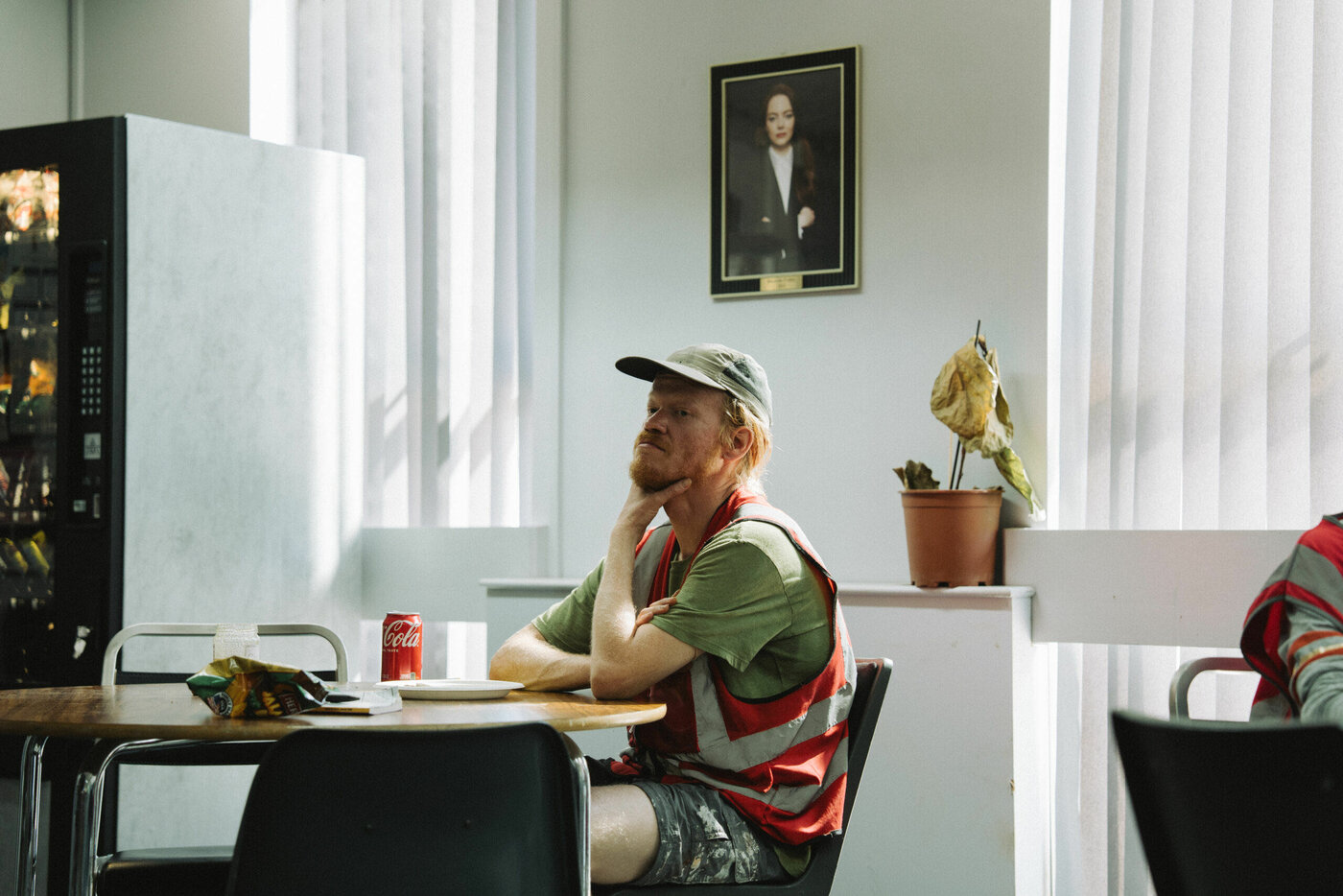
Bugonia (Yorgos Lanthimos, 2025).
Because of Elordi’s cognitive evolution from man-child to more articulate being, more than once I thought of another Frankenstein spin and Golden Lion winner, Poor Things (2023). Yorgos Lanthimos was again on the Lido with Bugonia, his third film in three years, and his fourth with Emma Stone, here playing the CEO of a chemical company abducted by two lunatic cousins (Jesse Plemons and Aidan Delbis), who are convinced that she’s an alien from Andromeda on a quest to eradicate humanity. It’s also Lanthimos’s fourth shot by Robbie Ryan, though Bugonia features little of the visual histrionics of their previous collaborations: There are no fish-eye lenses à la The Favourite (2018), and no computer-generated backdrops of the kind Stone saunters into in Poor Things. That a film speaking to our anxieties around rape culture and toxic masculinity took home the top prize isn’t all that surprising. But if Poor Things registered as a “liberal echo chamber movie,” Bugonia is about people stuck in such a chamber. Teddy (Plemons) is a thirty-something outcast whose single mother is dying as a result of a study of an opioid-withdrawal drug manufactured by Stone’s company—for which Teddy works. Grief and frustration have turned him into a sociopath convinced that the only way to fulfill his mission—kidnap Stone’s executive and convince her to negotiate her species’s retreat from Earth—is to clear his and his cousin’s “psychic cache” via self-administered chemical castration.
This would all sound very far-fetched were it not that we live in the 2020s, where freaks like Teddy and Don (Delbis) aren’t outliers but commonplace products of our conspiracy-friendly zeitgeist. Like Poor Things, Bugonia is a state-of-the-nation manifesto, and if it doesn’t feel as self-congratulatory as its predecessor that’s less a function of the script (penned by Will Tracy) than Plemons’s performance, which complicates a character a lesser actor might have reduced to a caricature. Much of the action takes place inside the cousins’ isolated home—a conceit that harks back to the claustrophobic confines of Dogtooth (2009) and morphs the film into a sort of chamber play. But I’m not entirely sure Bugonia amounts to much more than empty slogans and talking points (“There is no America!” Don quips. “There is no global democratic order!”). Lanthimos’s latest unfurls as a series of deranged conversations between a handcuffed Stone and her two captors, only to underscore the impossibility of entering a dialogue with someone stuck in an endless loop of internet-fueled paranoias. That’s a faithful précis of the bilious times we live in, but there’s a difference between describing our post-truth era and genuinely reckoning with it. Even a late and, in retrospect, inevitable twist doesn’t dispel the feeling that Bugonia belittles the subject position of the kidnappers, or the suspicion that it exists in a bubble of its own—a film that tells us little beyond what we want to hear.

No Other Choice (Park Chan-wook, 2025).
For a film that did have something meaningful to say about our fallen era, see Park Chan-wook’s No Other Choice. Based on a 1997 novel of the same name by Donald E. Westlake—already adapted by Costa-Gavras as The Axe (2015)—it takes the idea of cut-throat competition to a devilishly literal degree, following an engineer, Man-soo (Lee Byung-hun), who’s unceremoniously sacked from the paper company at which he’s worked for 25 years when it is bought by an American firm. Unable to land a new gig, the family man puts out an ad for a similar position to the one he has lost, only to murder the candidates he sees as more qualified than himself. It’s a premise ripe for some grand-guignolesque spectacle, and though macabre images do crop up—none more beautifully morbid than a shot of a corpse bonsai-ed into a cube of flesh—No Other Choice testifies to Park’s ability to seamlessly merge different registers into a cogent and delirious ride. There’s a slapstick energy to Man-soo’s odyssey, reverberating from his comically clumsy attempts to neutralize the competition as much as the physical environment that strangles him. I’m always stunned by the way Park weaponizes his films’ architecture; here, a beam of sunlight bouncing blindingly off a skyscraper and onto Man-soo’s face turns a job interview into something closer to a police interrogation. But for all its humorous and horrific flourishes, No Other Choice gradually reconfigures itself into a tale of profound melancholy. Park posits Man-soo as the last defender of a world on the verge of extinction. “For those of us who make it,” our hero muses halfway through, “white paper is a kind of art.” In our screen-infested present that art is well on its way out, which makes the title a tragic mantra. No Other Choice doesn’t just take bitter aim at the zero-sum logic of 21st-century capitalism; it also tackles the impossibility of imagining ourselves outside the roles we occupy in the job market.
But if title and narrative indicate a rigid determinism, the actual experience of watching the film suggests a director eager to experiment with form and genre tropes. Park relishes in the plasticity of the medium, and in keeping with the rest of his oeuvre, No Other Choice is a malleable, porous work. Decision to Leave (2023) demonstrated a readiness to open up his cinema to modern-day technologies, and his latest builds on that, weaving into Man-soo’s pursuit Instagram stories and video calls. (“Korean people call smartphones ‘handphones,’ and I think it quite literally expresses how the phone is an extension of one's body,” the director said in an illuminating chat in these pages a couple of years ago). Teaming up again with cinematographer Kim Woo-hyung, Park illustrates Man-soo’s desperate quest by inventive use of the world around him: There’s a chase framed through convex traffic mirrors, and for another shot the camera is stuck to the bottom of a drinking glass. As the film marches to its gruesome climax, storylines and images do not cut so much as spill into each other. Here, as in the best of his works, Park welds a bristling social critique to a playful cinematic intelligence, and the results are often exhilarating.
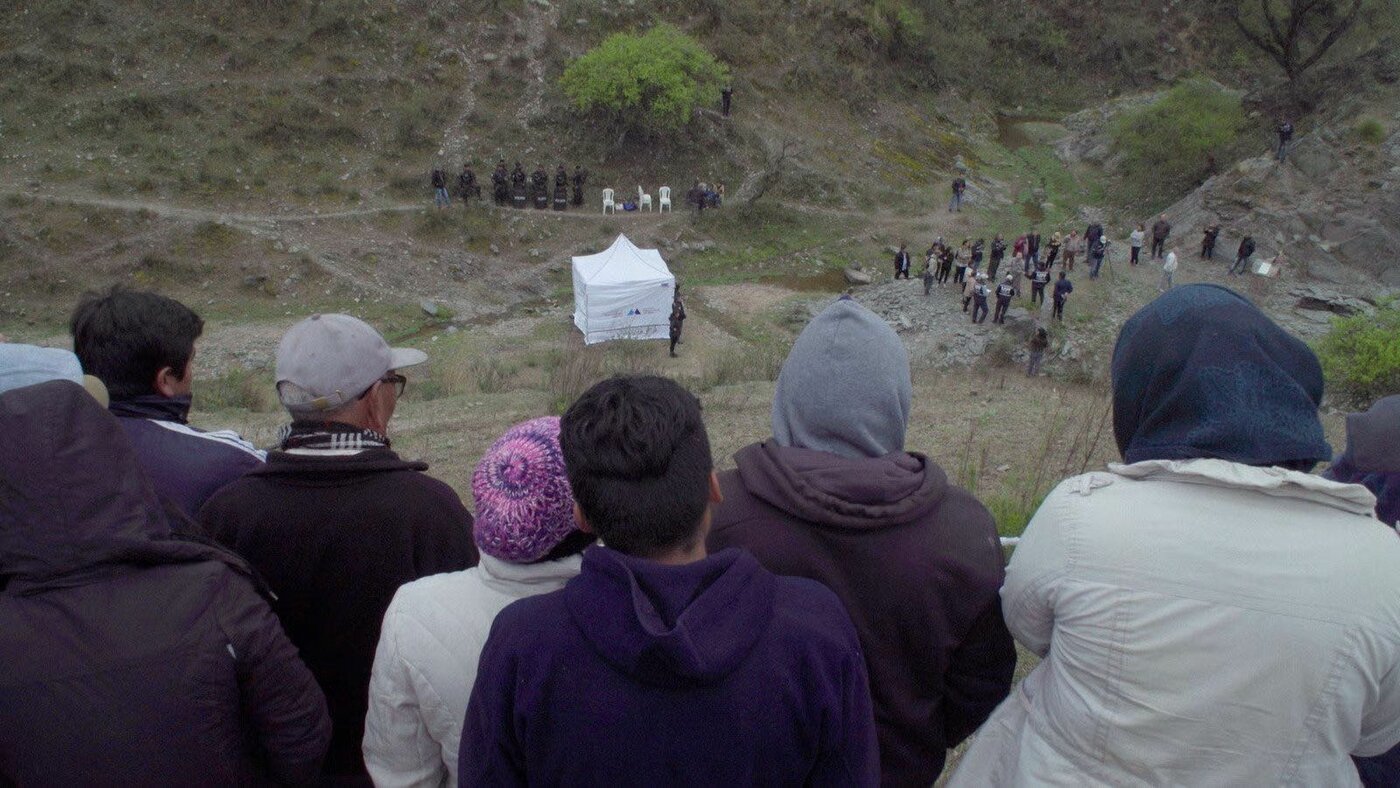
Landmarks (Lucrecia Martel, 2025).
Premature as it may be to say with only half the festival behind us, No Other Choice was among the very few highlights in an otherwise underwhelming official competition. More reason to ditch it for the parallel sidebars, which this year included Lucrecia Martel’s Landmarks, a documentary chronicling the trial of a landowner and two former police officers for the 2009 murder of Javier Chocobar—a member of the indigenous Chuschagasta community in Tucumán, Argentina. This is Martel’s first nonfiction foray, but to harp on the alleged break from the rest of her oeuvre would be somewhat misleading. The trial, which stretches across a sizable chunk of the film’s two hours, was open to the public, allowing Martel to camouflage among other reporters and record it from start to end. As stitched together in Landmarks, however, the whole thing swells into a kind of theatre play. We watch the three white men responsible for Chocobar’s death defend themselves amid humiliating interactions with the Chuschagasta who witnessed the assassination firsthand, the proceedings plagued by logistical screw-ups (no mic in the court seems to work). In one of the film’s most uncomfortable moments, the judge invites one of the ex-cops and a community member to sit in front of each other and debate their versions of the event—a hopeless battle for the young Chuschagasta, who lacks the linguistic and cultural capital of the white man. As the action moves away from the courthouse and back to the crime scene, Martel follows the native Tucumán residents and the three outsiders as they reenact the confrontation that led to Chocobar’s death. Landmarks is still a work of fiction, documenting the recreation of the murder at its center and questioning the imperialist narratives that have historically justified such horrors.
That fraught dynamic between core and periphery—between haves and have-nots, between Argentina and Europe—has been a cornerstone of Martel’s cinema since La Ciénaga (2001), but the film’s visual language is a major departure. Landmarks opens in outer space, tracking satellites orbiting the planet, before protracted drone shots survey the mountainous landscape of Tucumán. This is a new camera movement for Martel, a prelude to a film that expands her vocabulary in radical ways. Landmarks charts a history of the Chuschagastas through the decades. Time and again, Martel intersperses her courtroom drama with archival photographs of Chocobar and other community members. But she scores those snapshots of faces and places with faint sounds of the actions embalmed therein: We see a piñata popping from a tree and hear the snap echoing from the image; people dancing at a party and their chatter mixed with music. These noises were not recreated through Foley wizardry—the way Sergei Loznitsa has done in his own Soviet-era documentaries. Rather, Martel meticulously matched the audio from hours of low-quality phone videos provided by members of the Chuschagasta community to their photographs, breathing life into ostensibly static material. Some of the film’s other footage, she told me, was shot not by her cinematographer, Ernesto de Carvalho, but by the Chuschagastas themselves, which lends Landmarks a collaborative quality, a communion between filmmakers and subjects.
It’s no spoiler to say that the trial concluded with a Pyrrhic victory for the prosecution, but the film itself ends on a more hopeful note. Spread across rows of plastic chairs, a sea of stars twinkling tremulously above them, dozens of Chuschagastas sit before a canvas watching footage recorded by members of their own community. Nearly a hundred years before, a very different audience wondered if cinema merited a spot among the other disciplines enshrined in the Biennale. L’Osservatore Romano seemed doubtful. No, “a cheap byproduct of those arts” didn’t deserve the honor. Anxieties around its role and significance have haunted cinema from the get-go. But moments like this one—a group of people watching shards of their own life and history beamed back at them—corroborate Volpi’s idea of cinema as an “everyday necessity,” narrowing our distance from that night in early August 1932, when people sat before a screen, unsure as to what would appear, and how it might change them.
Keep reading our fall festival coverage.