
Illustration by Franz Lang.
The awards ceremony at the Venice Film Festival is an invite-only affair officiated in the sumptuous Sala Grande; members of the press can follow a livestream in the neighboring Casino palace. This is the closest the festival experience comes to watching a football match. Starved and sleep-deprived, critics gather to cheer and shout insults at the screen. The exact recipe for a Golden Lion is an arcane mystery, but the key ingredient has long been a certain degree of topicality. The statuette has recently gone to a portrait of 21st-century itinerant labor (Nomadland, 2020), an abortion drama (Happening, 2021), a documentary about an artist-turned-activist who took on the pharmaceutical giant behind the opioid crisis (All the Beauty and the Bloodshed, 2022), a woman’s journey of sexual self-discovery (Poor Things, 2023), and a study of assisted suicide (The Room Next Door, 2024). Which explains the murmur of surprise that spread through our screening room as Alexander Payne’s jury handed out the top prize to Jim Jarmusch’s Father Mother Sister Brother (all films 2025 unless otherwise noted).
An anthology film of three parts centered on dysfunctional families trying to reconnect, Father Mother Sister Brother didn’t seem a likely winner, especially in a year when so many Golden Lion hopefuls spoke more directly to our troubled times. Yorgos Lanthimos’s Bugonia and Park Chan-wook’s No Other Choice tackle conspiracist echo chambers and the cutthroat logic of late capitalism. Olivier Assayas’s The Wizard of the Kremlin depicts Vladimir Putin’s rise to power. Kathryn Bigelow imagines a nuclear missile heading for Chicago in A House of Dynamite. But no film felt more pressing and incendiary than Kaouther Ben Hania’s The Voice of Hind Rajab.
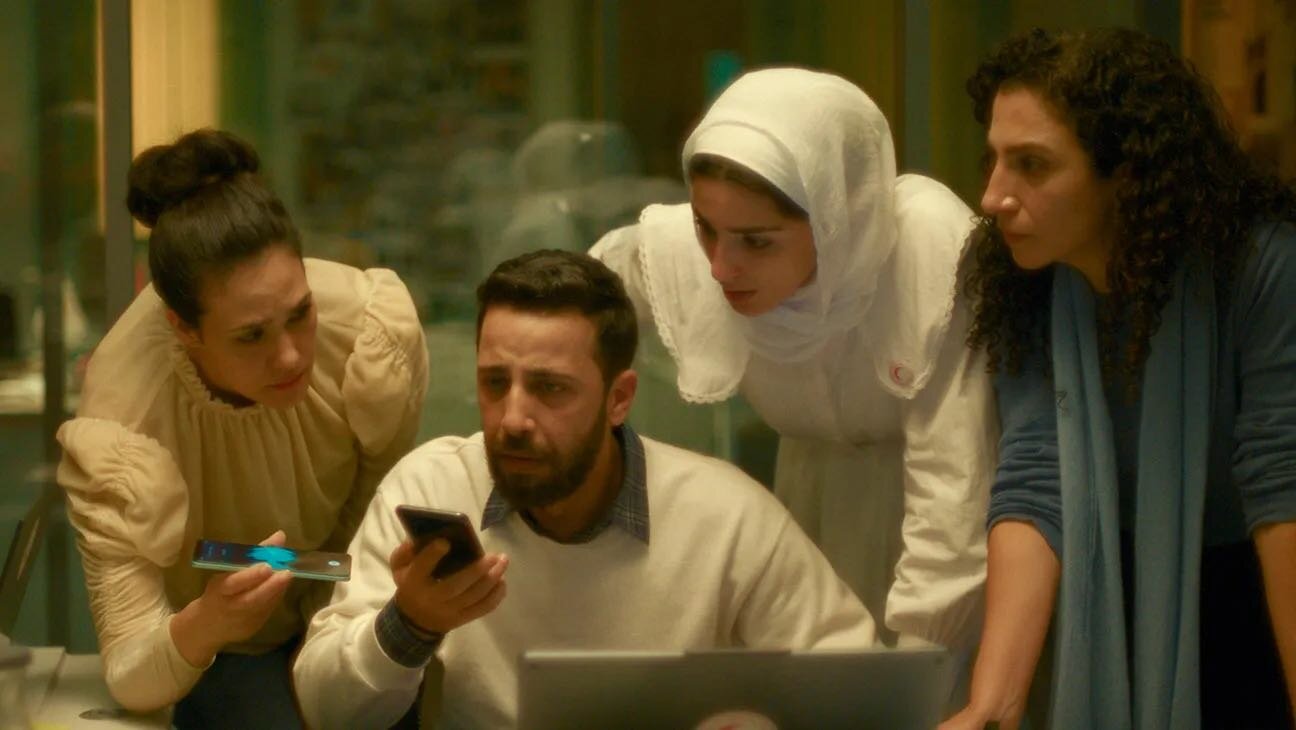
The Voice of Hind Rajab (Kaouther Ben Hania, 2025).
On January 29, 2024, a six-year-old girl from Gaza City called the office of the Palestine Red Crescent in Ramallah. The Israeli army had opened fire on the car she had been traveling in with her family; by the time she phoned for help, her uncle, aunt, and three cousins lay dead next to her. The child’s name was Hind Rajab, and Ben Hania’s film reconstructs the events of that day by combining the real audio recordings of her calls with reenactments of the actions of four workers who tried to arrange her rescue from afar: Omar (Motaz Malhees), Rana (Saja Kilani), Mahdi (Amer Hlehel), and Nisreen (Clara Khoury). In the eleven years I have been covering Venice, no other film has triggered as visceral an emotional response as the one that swept over me as the credits rolled. (I saw Hind Rajab at the morning press screening; that night, the world premiere ended with the festival’s longest standing ovation and chants of “free Palestine.”) There is obviously great merit in forcing an audience to confront, for ninety horrifying minutes, a tragedy as unconscionable as Hind’s, especially in light of an ongoing genocide that has claimed the lives of over 18,000 other children. Ben Hania’s film demands to be seen in a theater, if for no other reason than because that is the only setting one won’t be able to pause or look away from its horrors. Whether Hind Rajab successfully mixes real and fictional material is a thornier question.
It’s no spoiler to say that the rescue mission ends in failure: Both Hind and the ambulance staff dispatched to save her are murdered by Israeli soldiers. And yet I cannot entirely shake off the suspicion that Ben Hania might be milking her story for suspense. Hind Rajab plays as a one-set thriller; the frenetic editing and Juan Sarmiento G.’s roving handheld camerawork conjure a breakneck race against time. Never leaving the Red Crescent’s Ramallah headquarters, the film often lingers on the technology connecting us to Hind and to Gaza City. We don’t just hear the girl’s voice but watch it pulsate, over and over, on a computer screen, the audio bars fluctuating like a heart’s beat on an EKG machine. In the most excruciating sequence, the Red Crescent workers stare at a digital aerial map of the city as an icon of the ambulance inches ever so slowly toward the street corner where the child awaits her would-be rescuers. If these flourishes feel somewhat jarring, it’s because they aren’t necessary; there is no need to heighten the emotional power of Hind’s harrowing pleas. But Hind Rajab cannot quite resolve a friction between its original material and the genre grammar grafted onto it.
This isn’t to detract from its soul-crushing wallop, or the cast’s tremendously affective performances. It is possible to commend Hind Rajab’s full-throated urgency and question the means Ben Hania uses to trigger it. For the record, the project was made in collaboration with and with permission from Hind’s family, and has recently enlisted several industry activists as executive producers, among them Brad Pitt, Joaquin Phoenix, and Jonathan Glazer. Awards do not necessarily translate into greater exposure—even after No Other Land (2024) nabbed an Oscar for Best International Film it still struggled to secure a large US distributor. But I hope Ben Hania’s Grand Jury Prize and the buzz that has spread like wildfire since the film’s premiere will help it travel long and far beyond the festival circuit. Hind Rajab isn’t just an extraordinarily effective piece of agitprop. It is also a very perceptive foray into the power structures that allow the genocide in Palestine to continue. Throughout, the director trains her camera on the frustrating efforts of the Red Crescent to coordinate a safe passage for the ambulance. It’s an impossibly difficult task: The Red Cross and the Israeli army must both approve. It would only take the vehicle eight minutes to reach the child; it takes hours for the Red Crescent staff to arrange. In its emphasis on the grotesque barbarity of this administrative protocol, Hind Rajab drives home a terrifying point: These bureaucratic hurdles aren’t a bug, but part of a calculated plan to wipe out an entire people.
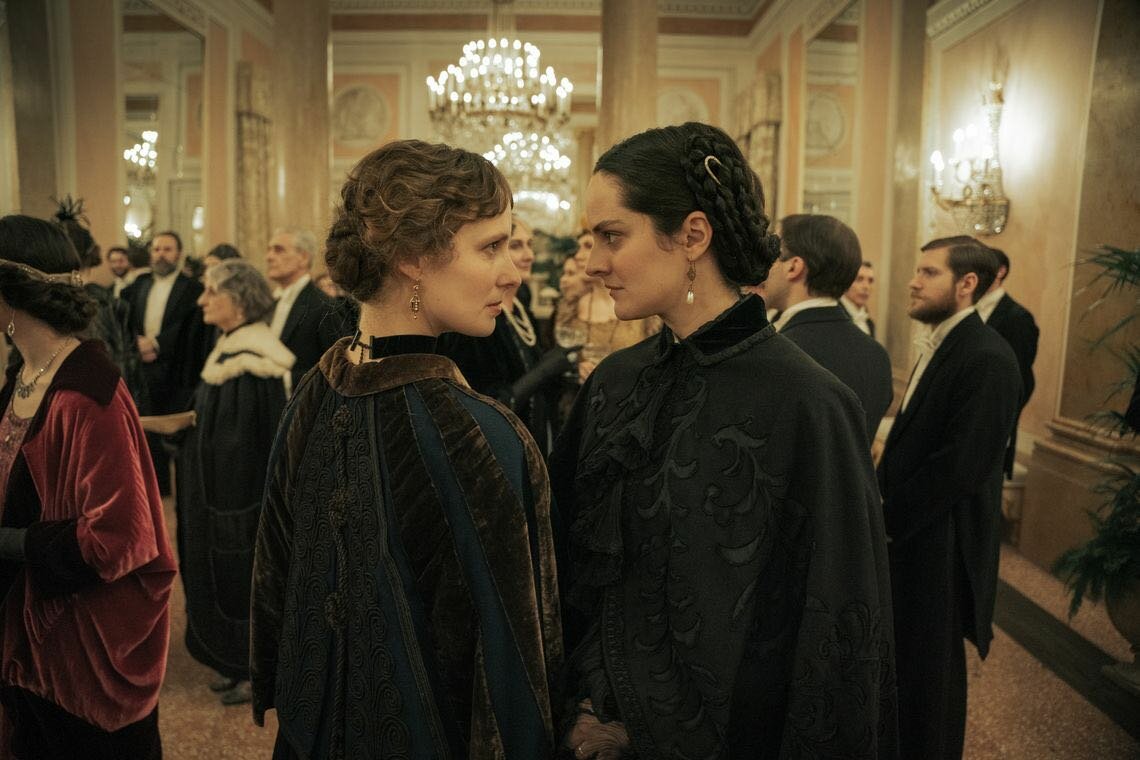
Duse (Pietro Marcello, 2025).
Elsewhere in the competition, big of-the-moment titles sat next to smaller studies of people coming to terms with their obsolescence. Toni Servillo was crowned best actor for his turn in Paolo Sorrentino’s La Grazia, in which he stars as a fictional president of Italy who spends the last months of his mandate mustering the courage to sign an euthanasia bill, while George Clooney riffed on his real-life persona in Noah Baumbach’s portrait of an aging, melancholic movie star, Jay Kelly. In Pietro Marcello’s Duse, Valeria Bruni Tedeschi is the legendary Italian theater actress Eleonora Duse, who won’t accept that her times and country are a-changin’. We begin in 1921, just as she prepares to act in Ibsen’s The Lady from the Sea, returning to the stage after a twelve-year absence. Marcello imagines the play’s opening night with then MP Benito Mussolini and Sarah Bernhardt in attendance. Why keep staging the mummified stuff of the past, the French actress needles Eleonora the next day, after something as earth-shattering as the First World War? Duse returns to the conflict via clips from Gloria: Apotheosis of the Unknown Soldier (1921), a documentary that tracked the journey of the casket of an unidentified private fallen in the Great War to his final resting place in Rome. Weaving archival footage into his own has long been Marcello’s signature move, but here the results are less entrancing than in Martin Eden (2019).
Time is never fixed in Marcello’s cinema; anachronisms abound. In adapting Jack London’s 1909 novel, Marcello traded Martin Eden’s original setting—turn-of-the-century Oakland—for the city of Naples, only to fill it with temporal incongruities. If the costumes suggested the 1930s, television sets and other décor pointed to much later decades, with Italian pop songs on the soundtrack to further scramble your bearings. The only similar discontinuity in Duse is the sporadic use of a propulsive electronic track echoing over the early-twentieth-century locale; here, the archive is used less for chronological mind games than to blur the line between the film’s fictional world and its historical backdrop. Throughout, Marcello provides glimpses of the funereal train ride and archival footage of early-1920s Italy, but those insertions are few and far between. In Martin Eden, Luca Marinelli’s sailor-turned-aspiring-novelist was only one part of a larger tapestry woven from class warfare and sociopolitical tensions. In Duse, the director seems too beholden to the biopic formula to zoom out of Eleonora’s struggles and meaningfully engage with the world around her; Bruni Tedeschi is Duse, and the film bends around her like a magnetic field. But Eleonora herself remains shrouded in mystery. Marcello declines to show his protagonist at work, which spares Bruni Tedeschi from having to recreate her performances. But without some proof of her genius, the adulation she receives from crowds of admirers feels a little unwarranted. Late in the film, Duse’s creative and sentimental partner, Gabriele d’Annunzio (Fausto Russo Alesi), addresses throngs of fascist militia from a palazzo in Milan. Marcello overlaps Russo Alesi’s voice with the actual recording of the poet’s speech from over a hundred years ago. It is one of a few moments in which Duse doesn’t feel bound to its protagonist but allows fact and fiction to collide, triggering the kind of disorientation that makes Marcello’s best work so mesmeric.
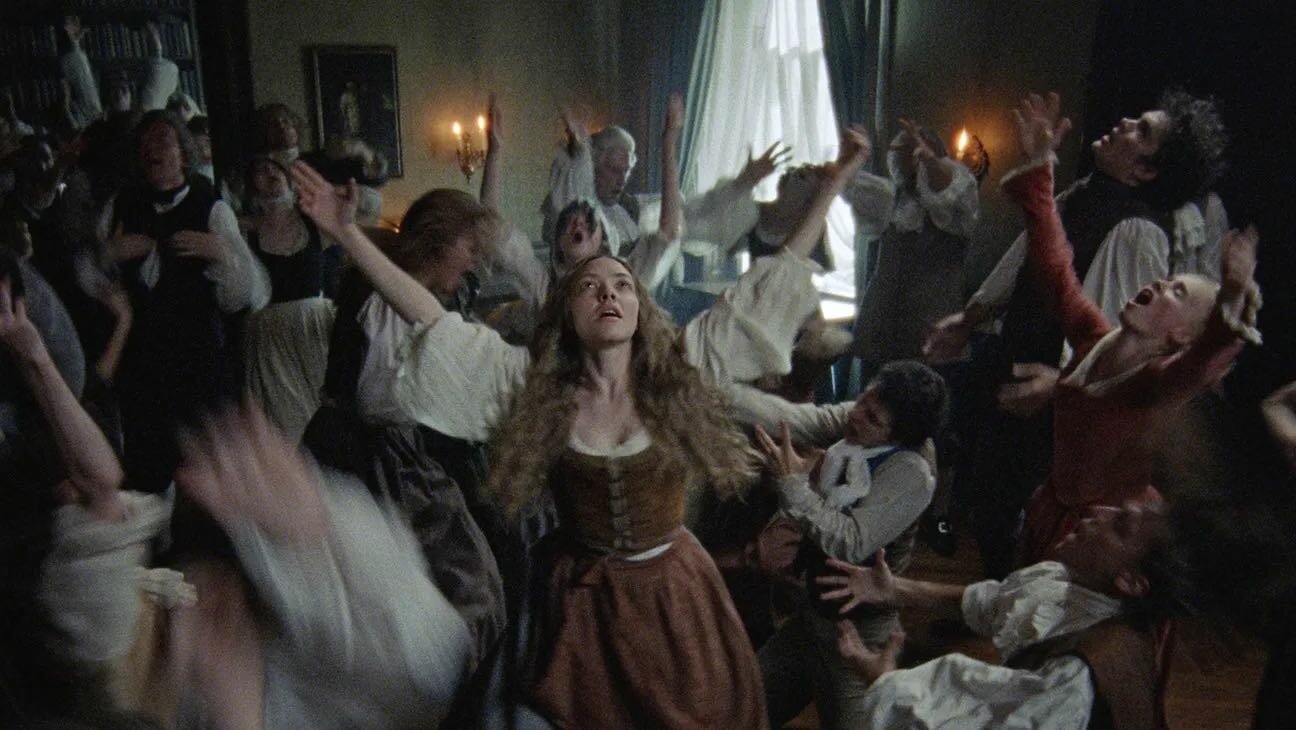
The Testament of Ann Lee (Mona Fastvold, 2025).
Another film about a woman venerated by hordes of disciples, Mona Fastvold’s The Testament of Ann Lee reimagines its titular heroine’s life as a grandiose musical. That’s a fitting way to approach the founder of the Shakers, a religious sect best known for worshipping through song and exuberant movement. It also allows Fastvold to offset the film’s linear, birth-to-death journey with exquisitely designed set-pieces. Amanda Seyfried plays Ann Lee, an eighteenth-century missionary who thought herself the female incarnation of Christ and brought the Shakers from her native turf of Manchester to upstate New York and eventually across the American Northeast. And nowhere does her connection with the otherworldly feel more tangible than when The Testament recreates her kinetic prayers.
Aided by choreographer Celia Rowlson-Hall and composer Daniel Blumberg, Fastvold reworks original Shaker hymns into moments of ecstatic rapture. That’s no hyperbole. Nothing in The Testament feels more transcendent than when Ann and her followers thrust their hands skyward in a balletic communion with the divine. These song-and-dance numbers do not suggest a musical in the Broadway mold but something sui generis; Blumberg’s instrumentation is never obtrusive, as emphasis is placed chiefly on chants and gestures. The real-life Ann would likely balk at the description, but the sequences sometimes register as a kind of pagan rite. There’s a carnal, erotic undertone to them that points to a friction with her unwavering commitment to chastity—she might see “fleshy cohabitation” as the main impediment to our harmony with God, but the film itself, so fascinated by the way these bodies move through space, is a profoundly sensual, desirous watch. William Rexer’s 35mm grain turns the interiors of the Manchester-set first act into chiaroscuro tableaux that leave characters largely cloaked in shadows. Tactile, throbbing, with subtle gate weave making them more unstable, these penumbral frames evoke a kinship between the film’s form and the bodily experience Lee preached.
Fastvold wrote the script with Brady Corbet, her co-scribe for The Brutalist, too. The Testament—also centered on a visionary leader who builds a giant church in the wild—similarly has an epic scope, and a curiously lopsided quality. No sooner does Ann’s community take root in America than the film becomes more grounded, the music and choreographies less frequent. Where the first two acts are propelled by ecstasy, the last one becomes lugubrious. Angry mobs start hunting the Shakers, tension increases, but Mother Ann’s efforts to protect her disciples aren’t nearly as transportive as her attempts to awaken them to the beauty of the world and God’s place inside it. The Testament is too patchy, too uneven to keep up momentum across its sprawl. But in its outbursts of joy, as bodies unite and shake to celebrate the mystery of all creation, it achieves a majesty that feels totally earned. Fastvold’s approach is maximalist, though as her film undertakes its elaborate musical numbers, it is not the effort that went into them that you register, but the contagious wonder they communicate.
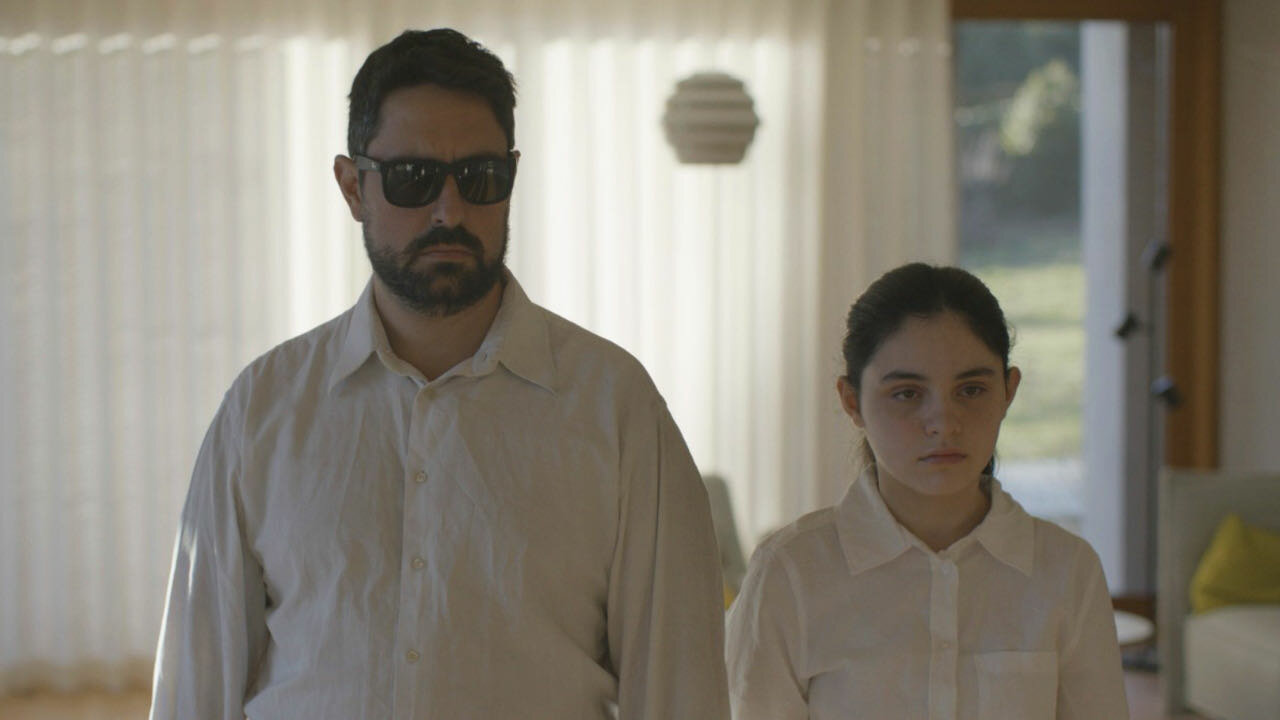
Pin de Fartie (Alejo Moguillansky, 2025).
The festival’s top section is always its most conservative, and if Fastvold’s film made such a lasting impression it is because it possessed something that was sorely lacking from other official competition entries: a risk-friendly readiness to experiment with genre and form. That’s long been Alejo Moguillansky’s MO. A member of Pampero Cine—an Argentinian film collective he founded in 2002 with Mariano Llinás, Laura Citarella, and Agustín Mendilaharzu—his cinema bristles with a kind of narrative freedom that can make watching his films like playing games. Meticulously choreographed and imbued with both humor and melancholy, they’re powered not by conflict or character development but by repetitions and disruptions to the temporal flow. Even as they crib from preexisting texts—like Castro (2009) does Beckett’s Murphy, The Parrot and the Swan (2013) does Tchaikovsky’s Swan Lake, or The Little Match Girl (2017) does Hans Christian Andersen’s short story of the same name—his works do not stick to their source material but gradually push it to the background, inviting other stories and fictions to contaminate the original. Pin de Fartie, a highlight of this year’s Orizzonti sidebar, follows that formula to exhilarating effects. Very loosely based on Beckett’s 1957 Endgame—a one-set, post-apocalyptic play in which four characters bicker about the meaningless of life—the film isn’t interested in faithfully reenacting its urtext but in diluting it across different storylines. In the first, a blind man (Santiago Gobernori) spends his days at a lakeside retreat somewhere in Switzerland arguing with a young girl (Moguillansky’s daughter Cleo). That’s the closest we get to an actual adaptation; though they continue to pivot on Endgame, the following sections add new degrees of separation. As the action, such as it is, moves to Buenos Aires, Moguillansky turns to a couple of actors (Laura Paredes and Marcos Ferrante) who fall in love during weekly rehearsals of the play, and finally casts himself as a son reading the text to his blind pianist mother (Margarita Fernández). In keeping with the director’s previous work, there are omniscient narrators—Luciana Acuña and composer Maxi Prietto, whose original songs double as commentary on the proceedings—and behind-the-scenes glimpses of the film’s crewmembers at work.
Moguillansky zigzags from one story to the next, and there’s a serendipitous quality to the journey that makes it seem as though Pin de Fartie is inventing itself as it goes along. Halfway through, a character remarks on the director’s resemblance to Swiss tennis star Stan Wawrinka, which leads Moguillansky to pull up pictures of the athlete, and notice a Beckett quote tattooed on his left arm (Ever tried. Ever failed. No matter. Try again. Fail again. Fail better). It’s a testament to the film’s openness to the unexpected that this feels like a coincidence Moguillansky discovers at the same time as the rest of us watching. Every anecdote and every digression begets another, in a sort of arborescent network that respects no clear chronology or sense of space. But the logic is never accidental; though Pin de Fartie oozes an improvisational aura, it is carefully structured. Moguillansky stages the romance between Paredes’s and Ferrante’s characters as a routine offset by minimal variations, but each small change in their weekly rendezvous—how they smile at each other on their way to the rehearsals, the progressively longer, more electric silences that punctuate them—communicates huge swaths of feelings. Time and again, the director focuses on Beckett’s physical text, lingering on close-ups of the open book while a hand highlights a few lines on the page; we’re encouraged to read and follow along. Later, over protracted static shots, Moguillansky invites us to look at the old pianist’s fingers as she plays Beethoven’s Moonlight Sonata. Pin de Fartie captures literature, music, and theater in their full materiality, stressing their distance and difference from cinema; their inclusion makes for some strident clashes with the film’s fabric. But the sense of continuity between all its vignettes derives not only from the source text but also from the director’s eagerness to bring his medium into conversation with others, and to fashion a new language through the encounter. Pin de Fartie was the last film I saw at the festival, and one of a very few that communicated a genuine love for cinema. I do not mean some nostalgic reverence for an antiquated art, but an infectious belief in its power to reinvent itself and us.
Keep reading our fall festival coverage.