
Illustration by Franz Lang.
The horizon line of the Adriatic Sea seems to box in the cabanas of the Lido like a ceiling. I’m looking toward the beach where Dirk Bogarde’s Gustav Aschenbach succumbs to cholera in Visconti’s Death in Venice (1971); he’s decided to stay in the disease-ridden city to meet what he feels is his destiny: expiring in a beach chair while watching his paragon of the sublime, young Tadzio, stride into the water. Unlike Aschenbach, I don’t hear Mahler’s Adagietto, but a few sharp whistles piercing through La Bouche’s thumping “Be My Lover.” I turn around to see two security guys clearing the main road for a procession of Venice Film Festival–branded Lexuses, the A-listers’ chariots to the red carpet. “Experience Amazing,” exhorts one of the car’s decals alongside the festival’s logo: the winged lion of Saint Mark, the symbol of Venice.
The city’s most famous statue of the lion, perched on a column over the Piazza San Marco, was likely sculpted in seventh-century China as a tomb guardian, protecting the dead from malicious spirits. After whisking it down the Silk Road, the Venetians made some alterations to the sculpture, hacking off his horns and propping a book open under his paws: Pax tibi, Marce, Evangelista meus (Peace unto you, Mark, my evangelist). Venetian culture was molded through similar cycles of appropriation. Originally a settlement of refugees from Attila the Hun, who erected humble shacks on muddy fishing islets, Venice amassed most of its wealth during the Crusades; its objective in the conflict, and the Republic’s enduring diplomatic posture, was to make money. They set themselves up as an in-demand shipping agent for other armies, then easily took and pillaged new territory as the Byzantine Empire disintegrated. The landmarks we consider archetypically Venetian are a hodgepodge of plunder—for one, the imposing façade of St. Mark’s Basilica, which is, incredibly, just a thin outer layer of marble cloaking a brick edifice. “For the most part, these marbles, like the columns and the interior facing, were the spoils of war,” wrote Mary McCarthy in 1958, “and they were put on almost haphazardly, green against gray, against red or rose or white with red veining, without any general principle of design beyond the immediate pleasure of the eye.”
McCarthy describes Venice as a city of alluring surfaces, making slack-jawed tourists of even the most hardened cynics and sophisticates. It is also a place of stasis, structured around ironclad governmental checks and balances that preserved the status quo. Most accounts of Venetian history center on fixed concepts: a system of government, a trade economy, a carnival, a plague, a mighty navy. Absent are the human wrinkles of a dynamic cultural record, a cast of political characters—there’s Tintoretto, Marco Polo, Casanova, and Titian, but can you name any of the doges? How about a novelist? Since the Republic’s collapse, Venice has mustered an unchanging face for the sake of tourism, welcoming 30 million visitors annually against less than 50,000 permanent residents. In the morning, narrow alleyways and luxury storefronts are mobbed by gawking, lurching hordes, but after 11:00 p.m., the streets are empty, the lights flicked off, leaving me, like Donald Sutherland in Don’t Look Now (1973), checking over my shoulder for a red-coated dwarf as I hustled back to my accommodation.
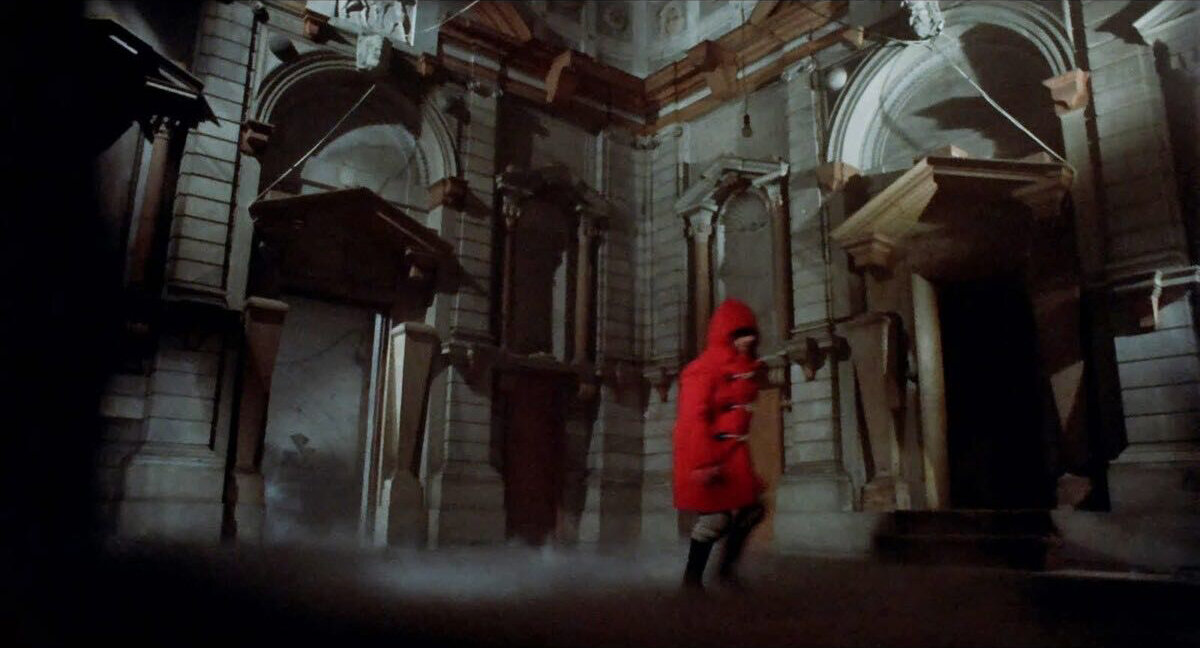
Don't Look Now (Nicolas Roeg, 1973).
One day after their glitzy Lido premiere, festival films are screened for locals at the San Marco multiplex. When I strayed from the beach island to attend a public screening of Frankenstein (all films 2025 unless otherwise noted), the atmosphere was intimate and convivial. As disparate attendees excitedly recognized each other, I worried I was intruding on their wholesome family night. After all, the festival took place two months after the Venetian wedding of Jeff Bezos and Lauren Sánchez, a flashpoint for conversations surrounding overtourism. Protesters chucked a papier-mâché mannequin of Bezos clinging to an Amazon shipping container into the Grand Canal, evoking Sunset Boulevard (1950) and Titanic (1997) for an era of wealth inequality and climate catastrophe.
The film festival is a different sort of tourist event. It’s part of the prestigious Biennale, yet compartmentalized on the Lido in the same way that plague victims were quarantined on the city’s smaller islets. As soon as the vaporetto docks, you see cars and smell the seashore, a realm apart from classical Venice. The festival’s buildings are grand, palatial, imposing, but the grounds are cordoned off by security checkpoints, confining you to an insular campus. A fitting word since festivals often feel like school: You have your backpack and your notebook and your schedule of screenings and meetings; there are papers to write, parties to attend. If tourism is a quest to learn about the “real” thing, so is festivalgoing, an attempt to cut through the noise and seek out discoveries. But the Venice schedule is designed to thwart you. The festival has fixed screening slots, so every morning at roughly the same time, you’re seeing the hyped premiere of that day; despite marginal ebbs and flows in quality, the films conformed to expectations, for better or worse. This had a numbing effect as the days passed. Which combination of filmmaker, genre, and key cast would be on the menu today, which branded pellet on the plate? Beneath the marble, there would usually be brick—and assembling a competition lineup is undoubtedly an exercise in classically Venetian diplomacy.
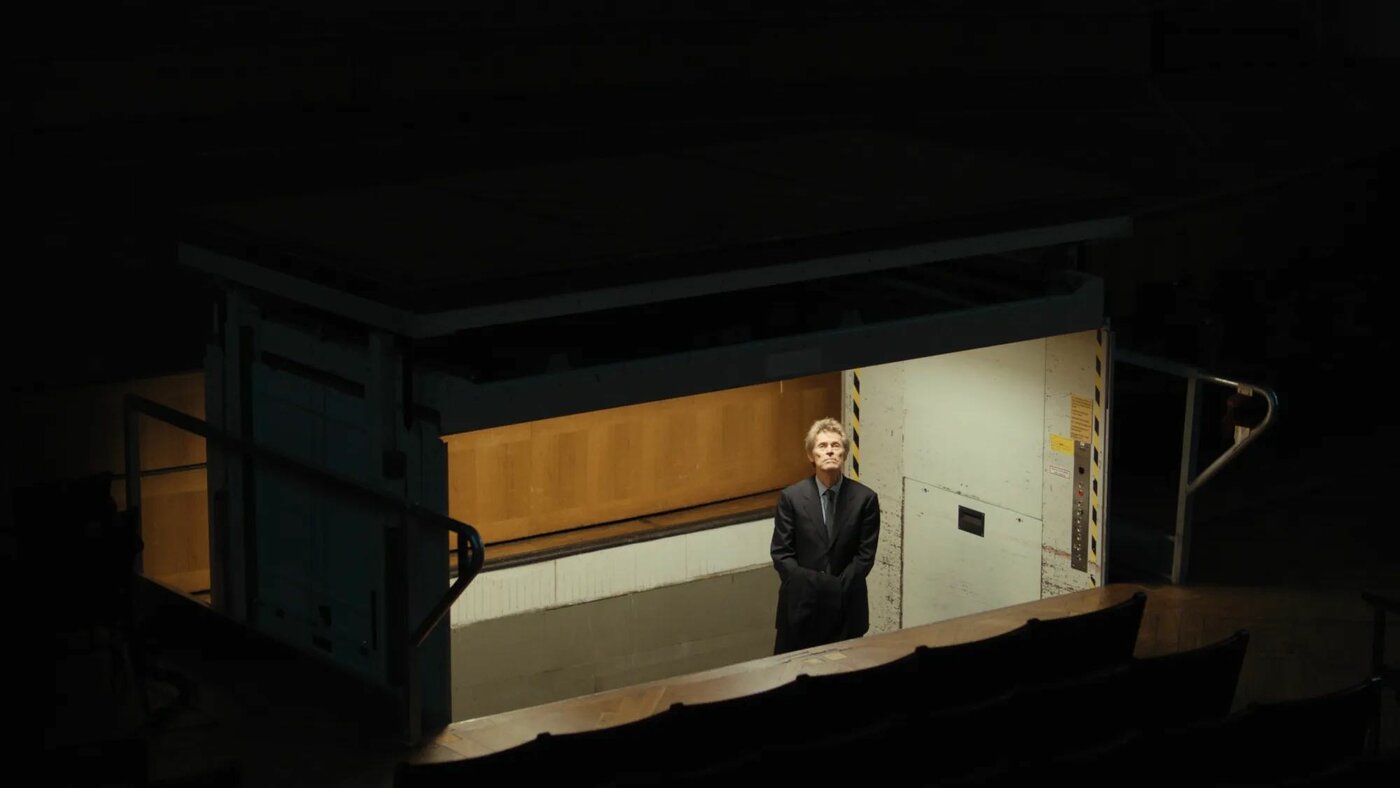
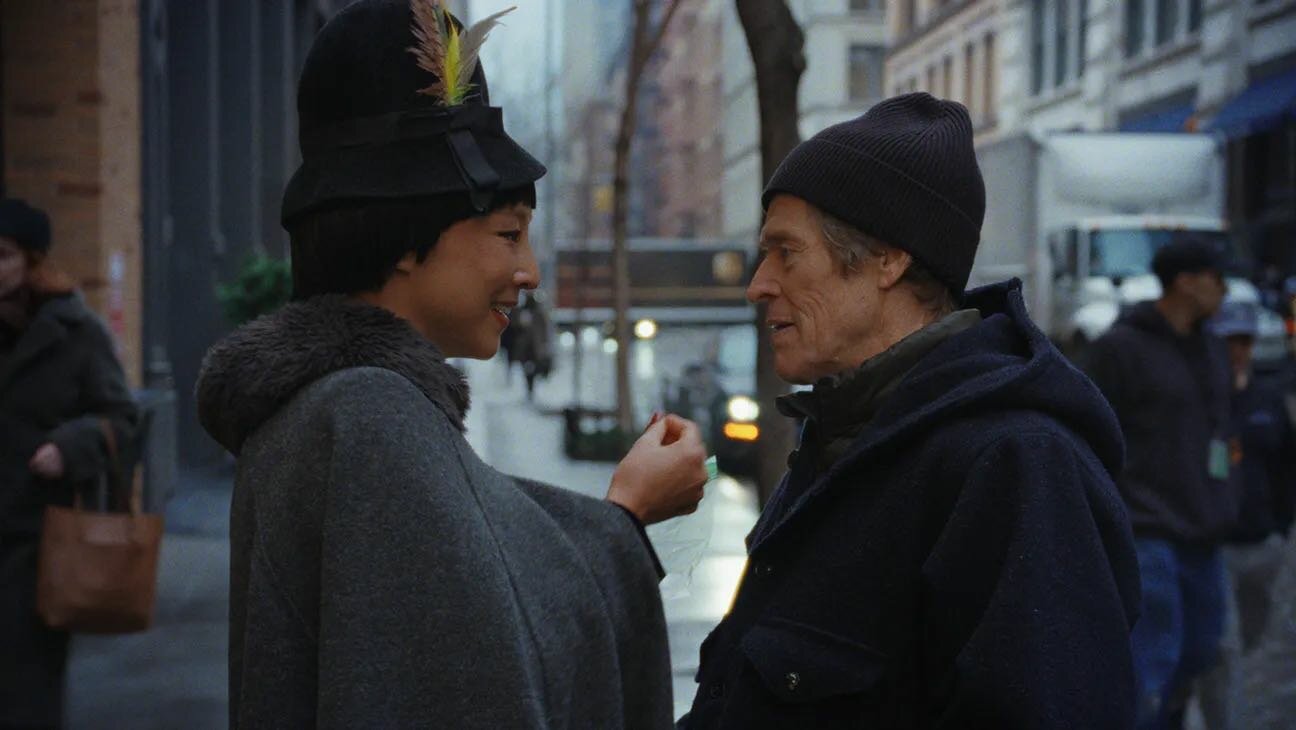
Top: The Souffleur (Gastón Solnicki, 2025). Bottom: Late Fame (Kent Jones, 2025).
Regular moviegoing feels this way, too, challenging us to find, not hallucinate, genuine signs of life. I’m not sure I’ll ever forget an impish Willem Dafoe yelling “Whose potato chip is this?” while tossing loose Lays to random partygoers in Gastón Solnicki’s The Souffleur, from the Orizzonti sidebar. Dafoe plays Lucius, the proprietor of the InterContinental Hotel in Vienna, which has just been sold to an Argentine developer (Solnicki himself) to be demolished. The film, a lean 78 minutes, teeters with Lucius on this uncertain precipice, laser-focused on gestures and gentle antics. We watch Lucius fuss over the bitter taste of his hotel’s soufflé, labor over the hands on a broken wall clock; despite its charms, the hotel is a mess, peeling and understaffed. We see why its days are numbered. During a suit fitting, one of Lucius’s errands, a tailor recounts the time Billy Wilder came into his shop—though this anecdote is pretty banal, it means something to the tailor, and might live on in whomever he tells it. That modest, aimless poignancy is typical of the film, which bottles sparks of vitality amid the inevitability of endings. For Lucius, the InterContinental is a vessel containing long stretches of his life, but hotels are temporary dwellings, stopovers. Solnicki structures the film around transience, how people briefly fill a place with life. The full cast can’t hold interest quite as easily as Dafoe, whose charisma is so livewire and lived-in. But there are some surprisingly moving documentary-style flourishes, in which hotel workers introduce themselves to the camera; one man is asked to repeat his name and title about half a dozen times, a touchingly droll imprint of this person, this place, looping a moment in time before it disappears.
Solnicki’s character is aloof and self-involved as he swoops in to raze the building, in contrast to Lucius’s puckish insouciance toward him. Another Dafoe film in Orizzonti, Kent Jones’s Late Fame, delves into the ways that real estate and money have reshaped cultural life, staying close to the people who have weathered these transitions, as well as the young people who are coming fresh to it. Dafoe stars as Ed Saxberger, a postal worker living a quiet life in New York—until a dandyish twentysomething wearing a fur hat, bizarrely formal in his speech, shows up on his West Village doorstep. “You’re Ed Saxberger… You wrote Way Past Go,” says the kid, named Meyers (Edmund Donovan). Yes, that was—is?—him, a downtown poet in the mid-’70s, having moved to the city after the first wave of the New York School had crested. Charmed by this earnest excitement, and feeling a dormant part of himself stirring, Ed agrees to meet Meyers’s group of friends, aspiring artists and writers who call themselves the Enthusiasm Society. As Ed gets in deeper with the group, particularly with the theatrical and vivacious Gloria (Greta Lee), he questions what it means to be a poet—to be a person enjoying a small life, to not have written a poem in years, but to be a totem of a moment when things were “happening.”
Meyers’s mannerisms, his odd fur hat, and the name of the Enthusiasm Society call back to the film’s mid-1890s source material, an Arthur Schnitzler novella. There’s warmth in the way that screenwriter Samy Burch (May December, 2023, and Coyote vs. Acme) updates the satire: Ed tends to quirk an affectionate eyebrow as the kids self-consciously identify as “essayists” instead of “critics,” scorn technology then whip out their phones, and suggest inviting Gregory Corso to a reading without realizing he’s long dead. Every generation finds itself by fumbling pretentiously for an identity, and in these moments, the youth come across as relatable ingenues, not only ridiculous. Ed’s new squad is a circle of fresh Gallatin, Pratt, and RISD graduates: Meyers’s family wealth is obvious from one look at his loft, but Ed appreciates that he doesn’t pretend otherwise. The way that Meyers puts his energy toward art reveals how differently he and Ed think about it. On Meyers’s wall, there is a huge framed print of the cover of Howl, a decorative object rather than something to be read. Later, Meyers sets Ed up to meet with an editor at a publishing company (Jake Lacy, genuine as a character who, in a worse film, would be a cartoonish, braindead drone). He thinks he’s there to discuss a reissue of his poetry, but the publisher is actually interested in his memoirs—looking past the art itself to the period of history it represents.
Ed matter-of-factly describes the depressing trajectory of SoHo on a walk with Gloria—he points to cast-iron buildings that once held artist lofts and are now luxury storefronts—but he doesn’t carry bitterness, nor indicate that the best years of his life are behind him. A repeated refrain in one of Ed’s poems is “seasons collide”: the film is about the interaction between generations, not oversimplifying what one era meant. Toward the end of the film, a young poet requests that Ed read his work and tell him if it’s “good,” but Ed rejects that notion—only the poet can know if the work is worthwhile, and besides, what makes him think that Ed’s opinion actually matters here? As Ed gently imparts the names of poets who inspired him, like Robert Creeley and James Schuyler, his advice is to listen to what affects you while making something that’s yours.
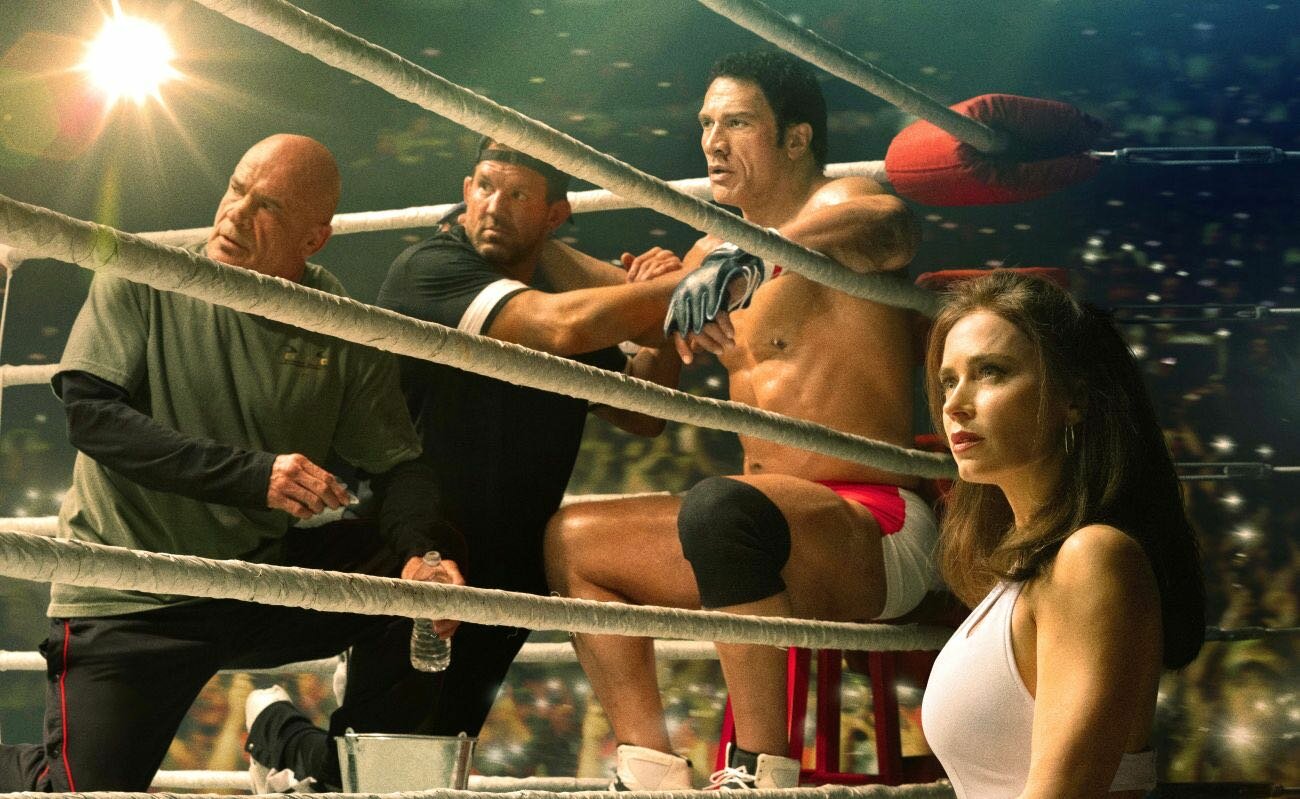
The Smashing Machine (Benny Safdie, 2025).
You might not expect that there would be tonal parallels between Late Fame and a biographical drama about a mixed-martial-arts fighter passing into a new phase of his life. On paper, Benny Safdie’s first solo directorial outing, The Smashing Machine, seems like obvious Oscar bait for Dwayne “The Rock” Johnson and Emily Blunt, passing the torch of great character studies from the milieu of boxing to that of MMA. It’s a fictionalization of the 2002 documentary of the same name, which details the career of Ultimate Fighting Championship star Mark Kerr in the late 1990s. Safdie recreates several scenes from that doc, but his film has a lighter touch. Comparing their twin opening sequences is instructive: In the doc, we see Kerr pummeling his opponents in an enormous arena, spotlight on the ring, the blows stylized in slow-motion and impressionistically stitched together. Safdie starts us off in a smaller room with brighter lighting and mirrored ceilings, rinky-dink and claustrophobic. In both films, Mark explains in voiceover how it feels to fight in such moments, but while the doc overwhelms the mix with bombastic orchestral music, Safdie stays with the words, draping them atop Nala Sinephro’s ambient jazz score. “In the ring, my thoughts are pretty pure: I’m gonna hurt him before he hurts me,” Johnson’s Mark says with a cheery, gee-whiz buoyancy over film of him unceremoniously headbutting a guy with torpedo force. (Anyone who has watched an episode of the reality show Power Slap: Road to the Title, a non-UFC Dana White venture, will know how jarring hand-to-hand combat is when filmed plainly.)
Mark’s purity of thought is the engine of the film’s crisis: It never occurs to him that he could lose a fight because he never has, and then, of course, he does. So who is he now? We see Kerr in understated denial, sliding into deeper dependence on narcotics. Safdie, not unlike Solnicki, builds scenes through bits. At home with his girlfriend Dawn (Blunt), Mark passive-aggressively comments on everything from the smoothies she makes him to the way she prunes the cactuses in their garden; Dawn sees right through his schtick, that he’s always putting himself first, but she also can’t help escalating the situation when baited. “I don’t know who I’m talking to,” she says to Mark in a few different arguments, which isolates the root of his struggle. He’s unwilling to articulate himself when that would mean engaging with weakness or vulnerability. After he overdoses, his friend and fellow fighter Mark Coleman (UFC fighter Ryan Bader) comes to see him in the hospital, but he can’t even admit that he collapsed, only recollecting that suddenly he was “on the floor.” Once he’s out of rehab, he goes with Dawn to an amusement park, where a worker makes the mistake of suggesting that he “can’t” go on a Rotor ride that is likely to make him nauseous. As he explains before opting for the merry-go-round: “It’s not that I can’t handle it, I am choosing not to go on the ride!” The Smashing Machine is pitched in a lower key than Good Time (2017) and Uncut Gems (2019)—as the film meandered, I missed some of the Safdie duo’s electric momentum and tight plotting—but its unflashy naturalism is its calling card, which may be why the nonprofessional actor, Bader, is the standout performer among movie stars. (The Rock’s comic timing is passable, but there’s not much more to his portrayal of Kerr outside of self-reflexivity.) The film’s climax passes by quietly, rejecting the movie-world binary of heroism or martyrdom.
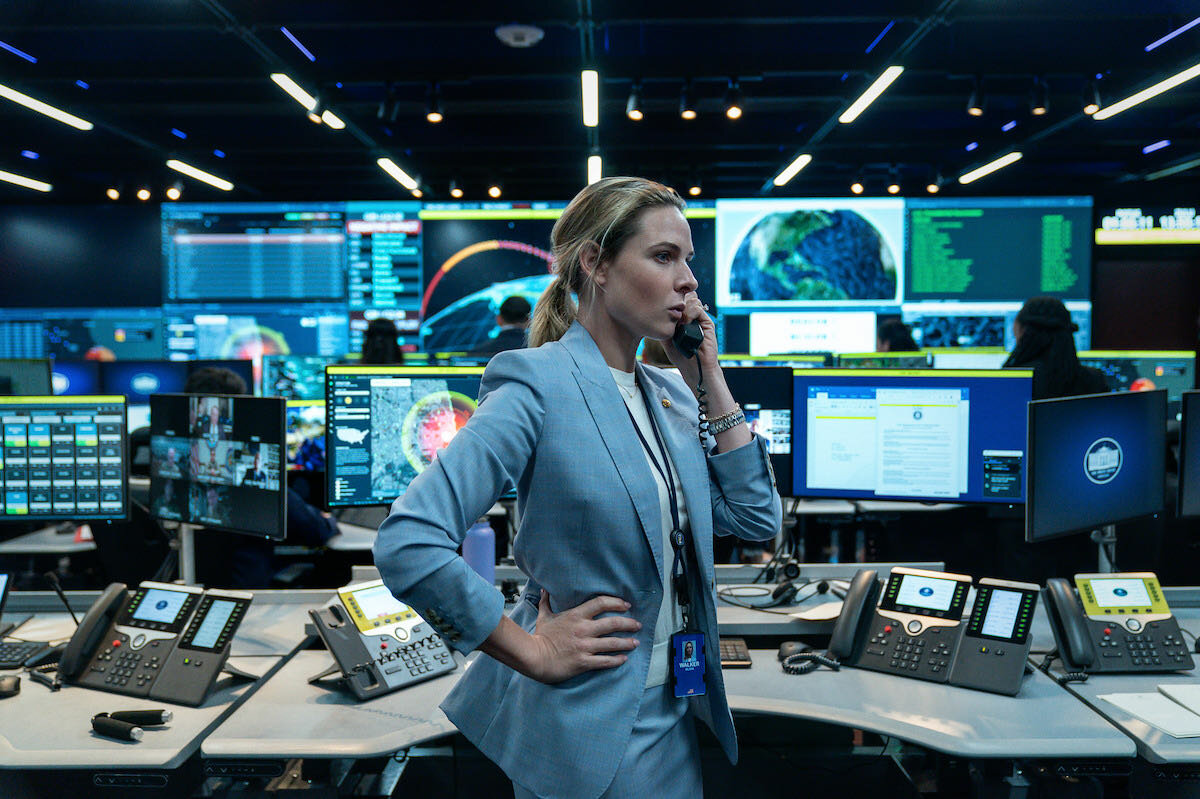
A House of Dynamite (Kathryn Bigelow, 2025).
Still, sometimes it’s okay for a movie to be… a movie. And I’m using the word “okay” very deliberately. Kathryn Bigelow’s A House of Dynamite is a totally engrossing, well-directed, big-screen entertainment, but in the week since I’ve returned from Venice, its impact has faded. The premise: A nuclear warhead is hurtling toward the United States. What happens if, despite the military and government’s best efforts to follow protocol, all safeguards fail? Bigelow brings us into the Situation Room, a military base, US Strategic Command, FEMA, the NSA, and the offices of the Secretary of Defense (Jared Harris) and the President (Idris Elba), replaying the events across multiple perspectives. Much of the film takes place in windowless computer clusters, cutting across numbers and maps on screens and frantic Zoom calls; assured editing from David Fincher regular Kirk Baxter makes this a nail-biter. After a certain point, exhausted by following guidebooks and getting their hopes up, all the characters can do is wait out the countdown clock for the inevitable. And though it’s not clear which foreign power fired the missile, the president has to figure out how, or if, to retaliate.
The film very cannily avoids definitive endpoints, and this balancing act is intriguing. There is a completely unhinged scene in which Elba’s POTUS shoots free throws with WNBA star Angel Reese at a children’s benefit while Phil Collins’s “In the Air Tonight” blasts in the arena. No political affiliations are articulated in the film, but it’s clear which president we’re referencing here. Two recent films—Alex Garland’s Civil War (2024) and Ari Aster’s Eddington (2025)—also avoid naming political parties even as they’re muddily and obviously in dialogue with America under Trump. Bigelow invites us into an Obama-era wormhole to keep our eyes on the thought experiment, but this is also weird. For the film to be affecting, we have to accept a basic level of human dignity across all of these characters, and while Bigelow succeeds within the world of her film, it’s hard for this exercise to transcend escapist fantasy—the continual casting of Brits and Europeans as Americans (Elba, Harris, Rebecca Ferguson, and Jason Clarke) contributes to a theatrical, aesthetic imaginary of neoliberal competence. With today’s political characters, nuclear war would surely be an immeasurably worse, much stupider horror story. That’s probably not a version of the movie that anyone wants to watch, but it would be harder to forget.
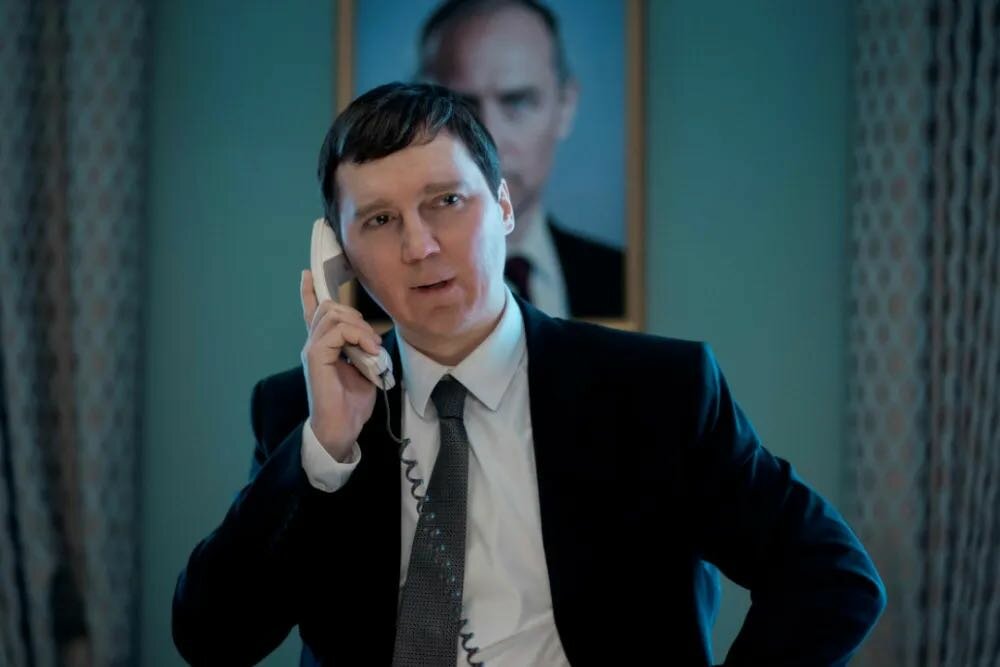
The Wizard of the Kremlin (Olivier Assayas, 2025).
The relationship between ideology and culture isn’t so clear-cut anymore. At the beginning of Olivier Assayas’s The Wizard of the Kremlin, an American journalist reporting from Moscow, Rowland (Jeffrey Wright), opens Twitter to find an anonymous account has tweeted a quote from Yevgeny Zamyatin’s We (1921), a science-fiction novel about a police state that paved the way for Aldous Huxley, George Orwell, and Kurt Vonnegut. Rowland, a scholar of Zamyatin’s work, is delighted; he replies to this kindred spirit with another quote from the book, and soon finds himself invited to dinner. Behind the posts is the disgraced Vadim Baranov (Paul Dano), the film’s stand-in for Vladislav Surkov, Vladimir Putin’s right-hand man for two decades. Writing with Emmanuel Carrère (author of, most pertinently here, A Russian Story and Limonov), Assayas adapts Giuliano da Empoli’s novel, which maps the rise of Putin onto a loose fictionalization of Surkov’s story. Across his life, Baranov moved from wannabe poet to avant-garde theater director to businessman to TV-station PR man to propagandist—he explains that his training in art prepares him to shape public opinion, engineering the Putin era’s postmodernist weaponization of objectivity. We experience the post-Soviet era through Baranov’s sheltered perspective, beginning with a happy childhood as the son of a Communist civil servant: Everything outside of his field of view is abstracted, and he approaches the Putin regime as an art project to amass power.1 Still, scenes are drained of color, a palette of slushy grays for this canvas. Dano plays Baranov as a doughy vacuum of charisma who nonetheless, with a brattish air of entitlement, believes he’s the smartest person in the room.
Assayas’s movies tend to pit art against capitalism in a changing world: Here, he’s disturbed by the way that this tension ceases to meaningfully exist, tracing the blackpilled co-optation of punk and literature by autocrats and oligarchs. As always, his characters are motormouths, their thoughts on their sleeve; while this style can invite cliché-ridden dialogue, he’s perceptive about people’s tendency to throw their pop-psychological weight around when they don’t have a clue. His characters stumble through the darkness, wielding words to try and find their footing in times of cultural and political upheaval, because language is all they have; they’re powerless. And Baranov is an especially unsettling Assayas lead. He speaks in persuasive fallacies to create the world—to conflate every world, as he makes puppet pro-Kremlin groups of biker skinheads and leftist activists alike—to obliterate meaning. Despite a peppering of archival news footage of car bombings and the Maidan Uprising, Wizard of the Kremlin stands at a remove from the regime’s atrocities; the film’s project, like any Assayas movie, is cerebral, invested in the mechanisms of power, self-delusion, and vanity. The way the film comes to inhabit Baranov’s psychopathic tunnel vision—fortified by his appropriation of political struggle, abstraction of suffering, and abdication of responsibility—is chilling in a way that I haven’t forgotten.

Writing Life: Annie Ernaux through the Eyes of High School Students (Claire Simon, 2025).
On the very first day of screenings, I saw a film that went back to basics with words: Claire Simon’s Writing Life: Annie Ernaux through the Eyes of High School Students, a documentary that travels to several French high schools to listen in on class discussions of Ernaux’s novels. The seminar formats may be varied—there’s a striking breadth of works by Ernaux that spark class discussion—but the students are consistently engaged. Even when they’re skeptical, Ernaux is a figure with whom they can dialogue, one dedicated to relating her experiences in sharp and plain language; l’écriture plate (“flat writing”), she calls it, eschewing the adornments of metaphor and emotion. This style allows Ernaux to pierce through time to speak with the students about a range of complex, graphic topics, from communicating with parents, to sexual consent, to abortion. Simon finds discussions spilling outside of class time, the teenagers hungry to grapple with Ernaux’s experiences and share their own. Here is a film that spends time in the real world and refuses a reductive language—a film that yearns for depth, instead of merely skirting on the surface of who we are.
Keep reading our fall festival coverage.
- Surkov’s creepy art-prankster tendencies are clear from his thinly veiled Künstlerroman, Almost Zero, which he published under a pseudonym, Natan Dubovitsky. Though Surkov maintains he didn’t actually write it, he did sign his name to a stunt-like preface which calls the author “an unoriginal Hamlet-obsessed hack,” then asserts this is the “best book he’s ever read.” ↩