One Shot is a series that seeks to find an essence of cinema history in one single image of a movie.
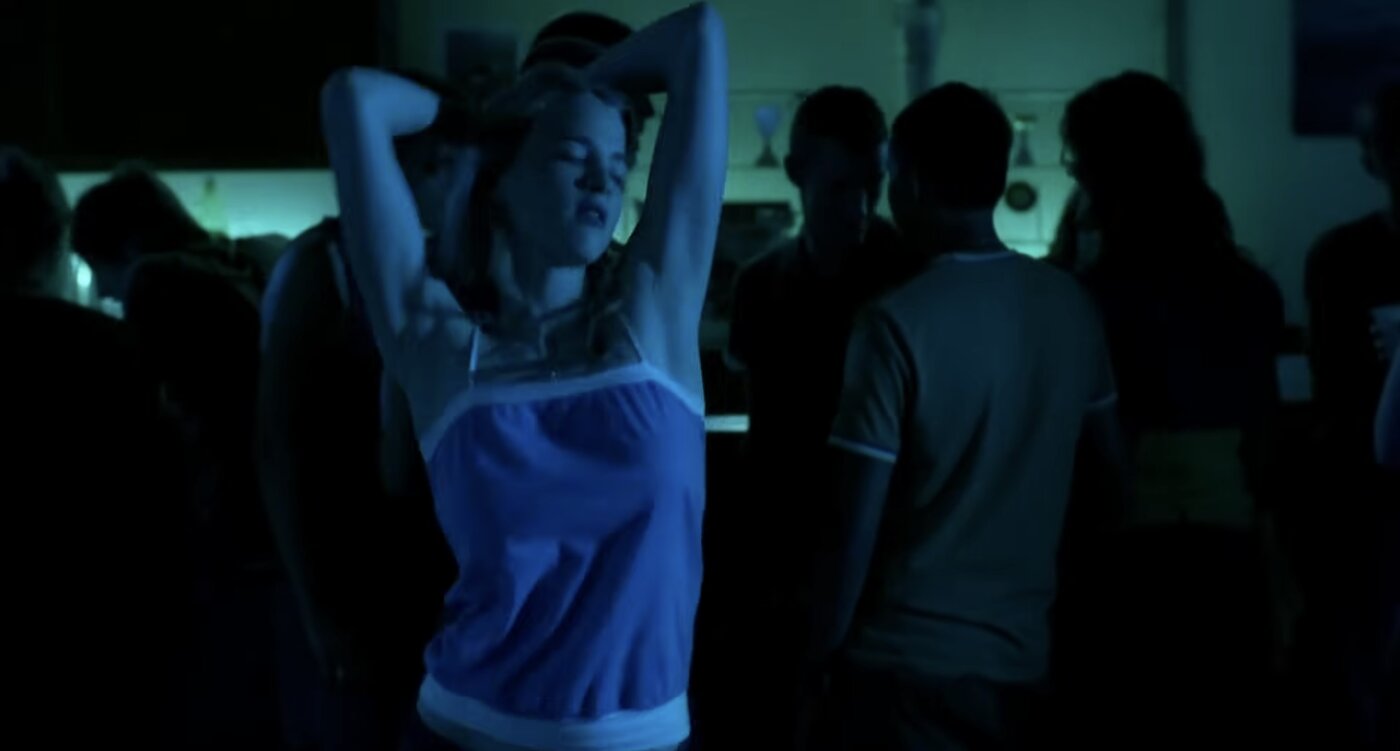
Water Lilies (Céline Sciamma, 2007).
Shown in slow motion with electronic music playing in the background, Floriane (Adèle Haenel) dances freely. With everyone behind her reduced to darkened figures, Floriane alone is lit up, as if she were living in a world of her own.
The scene comes from Céline Sciamma’s debut feature, Naissance des pieuvres (2007), also known as Water Lilies. Floriane, captain of the synchronized swimming team, is the beautiful yet unreachable girl who mesmerizes the unassuming, slightly awkward Marie (Pauline Acquart) from the moment she watches Floriane and her team perform. Marie begins following her to competitions and social events, and what develops between them becomes an intense but almost impossible-to-define bond, somewhere between friendship, sisterhood, and romance. Floriane appears to reciprocate Marie’s longing at times, but in ways so teasing and ambiguous that Marie is never quite sure what their relationship means nor what she can expect from it.
Such an uneven power dynamic is no stranger to those familiar with queer(-coded) coming-of-age films or the mean-girl trope in American teen cinema, with the two sometimes overlapping. What is so special about Water Lilies, however, is the care Sciamma affords the characters on both sides of this dynamic, and especially Floriane. Although much of the story is told from Marie’s perspective, Floriane is never reduced to the attractive yet cruel girl who toys with others’ feelings without caring. Her ending avoids a simple resolution: she is neither subjected to heartless punishment nor let off easily due to her pretty privilege by a sympathetic backstory that feels forced; nor is she converted into a “good girl.” Instead, Sciamma gives both girls enough space to be understood on their own terms. We see Floriane’s complexity in the sexual harassment she endures, the pressure from her peers to perform sexual maturity, and her half-unwilling, half-rebellious choice to conform to these expectations and take advantage of them. Marie’s persistent pursuit of Floriane is also never portrayed as merely pathetic, as there has always been an edge to her, too: She is not entirely blind to Floriane’s manipulation and, at times, manages to stand her ground despite her desire for her.
The dancing scene, perhaps, draws to an end the uneven power dynamic. It is the last time we see Floriane, and it comes after she kisses Marie in the bathroom only to leave and act as though it meant nothing to her, prompting the humiliated Marie to leave the party—and perhaps their relationship, whatever it has become.
While the scene is where the film’s balance between its two girls tips, Sciamma still does not withdraw her sympathy from Floriane. Floriane resembles something of a siren through her close association with water, and even more so here as she is bathed in blue light. The siren is usually imagined from the perspective of those drawn towards her—beautiful, irresistible, and dangerous because of the power she possesses over others—yet the film turns our attention instead to the strangely pathetic position of the siren herself. While Marie sees right through Floriane’s seemingly flawless exterior and stays by her side, Floriane just can’t bring herself to drop her guard completely. She lets Marie in for a brief moment, only to retreat back into her facade whenever they are in public, too insecure to step out from behind the persona. There is something ironic, but also profoundly sad, about watching her dance as though no one else in the room matters, appearing so free and self-possessed while being so enclosed deep inside, without even realizing that she has just lost her last chance to open up. Marie moves on, while Floriane keeps dancing.