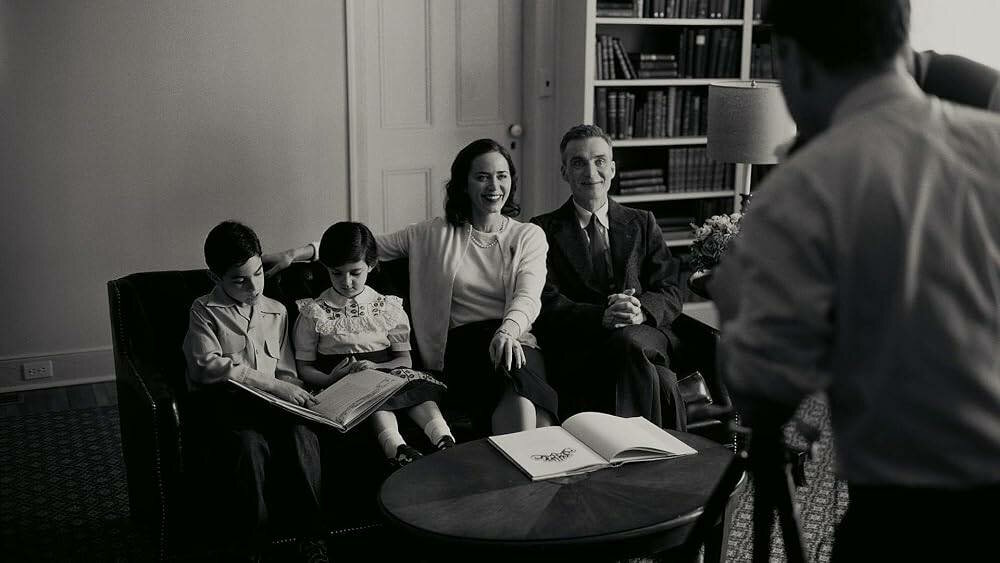
Oppenheimer (Christopher Nolan, 2023).
In what has to be one of the earlier instances of literary criticism, Herodotus wrote that it was Homer “who gave to Greece its gods.” By this, he did not mean that The Iliad and The Odyssey gave the Greeks an entire theology but rather that these epic poems gave a form and a function to the myth of the gods. When people spoke of the deities in their everyday lives, they did so in the wake of Homer’s works.
Since antiquity, artists, writers, and filmmakers alike have been tempted by and aspired to such influence. Christopher Nolan’s new adaptation of The Odyssey clearly demonstrates a similar, long-held ambition; not only to work with the myths of our contemporary world but to give them form and function. In many ways, he’s succeeded; The Odyssey is more a victory lap than a culmination. How quickly, after the release of The Dark Knight (2009), did people begin to quote lines from Heath Ledger’s Joker like it was liturgy? Has the idea of “inception” not become a part of our shared vocabulary? And did Oppenheimer (2023) not find in its titular character a figurehead for our current era of human-made spectacle and catastrophe on its way to box office and Oscar glory? For better or worse, Nolan is likely the world’s most popular (human) image-maker. It’s fair to ask, then, not just what his films are but what they want.
By now, we mostly know what a Nolan film is, what it looks and sounds like, what its aesthetic flourishes are: the dead wives, daffy temporal gimmicks, knock-kneed narrative structures, and specific sound mixes that span across his filmography. Many of these have calcified into clichéd talking points that precede every new Nolan film, often dictating conversations about the films in advance. What is lost, in paying such attention to what is continually there in Nolan’s films, is the perception of what is not there, what the films want but will not allow themselves to show. By this I mean exactly this: Nolan’s films are about the tension between spectacle and everyday life, and the way the former threatens the latter. Yet while his films are brimming with spectacle, depictions of the everyday, the banal, the ordinary, are so often absent. Why don’t (or why won’t) his films show this, particularly when everyday life is held out as the very thing so many of his characters and narratives want to achieve?
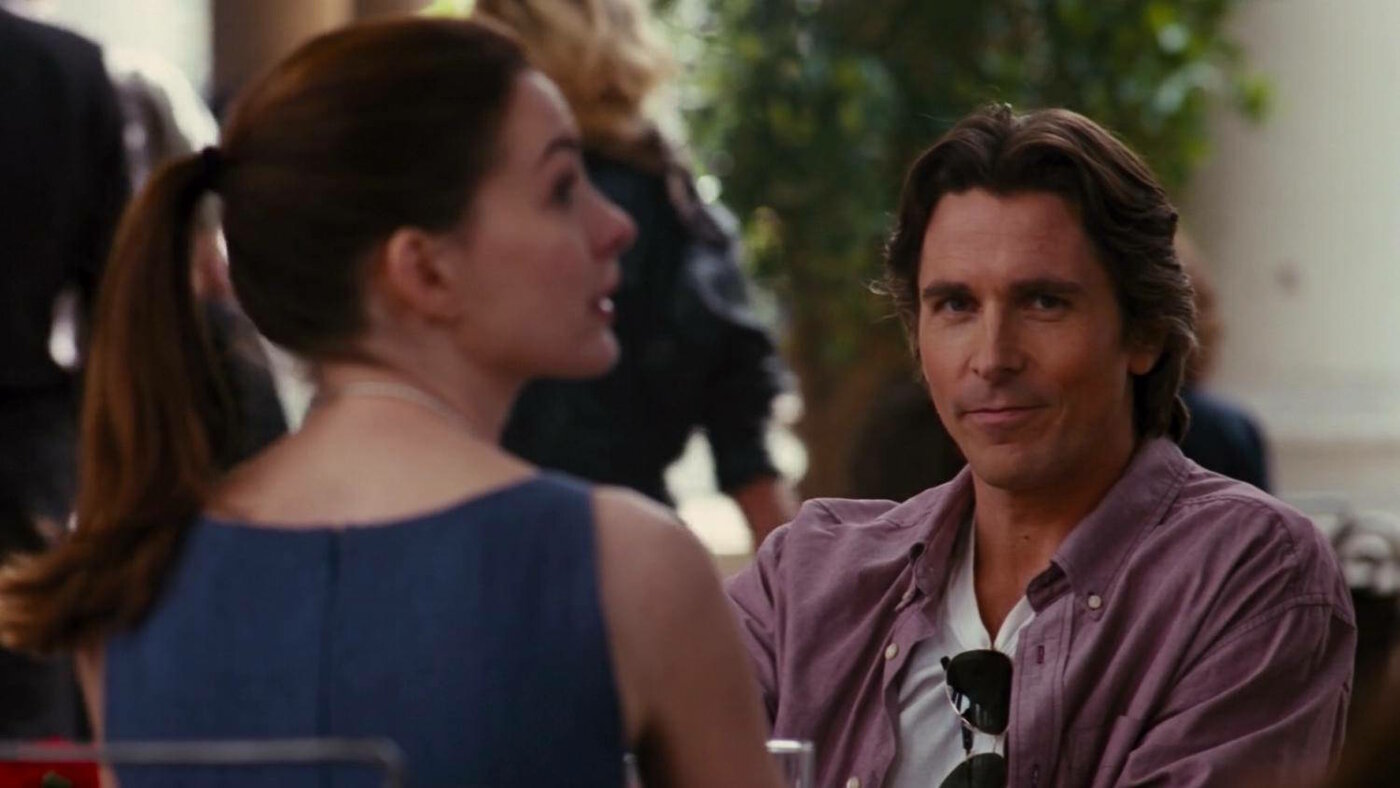
The Dark Knight Rises (Christopher Nolan, 2012).
If we are to pick one reason why Nolan has become so popular—he’s maybe the only filmmaker at present who can make what he wants at the scale he wants it—it is arguably his facility with spectacle. A spectacle is a major event, something that unifies large groups of people with its ability to alter human behavior and allow for a shared understanding of time as pre- and post-event. Think of how, for example, we demarcate our lives with “pre-” and “post-Covid.” The same goes for Nolan’s before-and-after approach. There is, obviously, the atomic test in Oppenheimer, which moves the world from pre- to post-atomic era. Or the importance of the Battle of Dunkirk in Dunkirk (2017) for the trajectory of WWII and the fate of sovereign life in the twentieth century. Even such fictional events as the dream implantation in Inception (2010) and the criminal occupation of Gotham in The Dark Knight Rises (2012) are given a similar status. It’s in The Odyssey (2026) too. Nolan fashions the Trojan horse scene into a spectacle about running afoul of antiquity’s laws of hospitality, making it serve the exact same function as the Trinity test in Oppenheimer: an event that threatens the continuation of a certain way of life.
Nolan is remarkably skilled at conjuring such spectacles. While he has an overreliance on a D. W. Griffith-like crosscutting, his greatest strength may lie in his refusal to conflate spectacles or set pieces with an overly bombastic image, à la Denis Villeneuve, instead naturalistically combining images of varied scope into the meshwork of his films. That is to say, Nolan’s films are never reducible down to an image or two. The Dark Knight Rises is more than the inverted airplane, just as Oppenheimer is more than the soundless white flash of the success of the Trinity test, or the folded-over city in Inception. Nolan, again contra Villeneuve, doesn’t think in static images but in terms of how images can be put together to convey an event or spectacle. Dunkirk is a prime example of this: The Battle at Dunkirk was already a significant historical event, but reconstructing it as a set of three decreasing temporal scales—land, sea, and air—that all culminate in one moment spectacularizes it. All the film’s preceding images are mobilized in service of this climax. No image is allowed to go its own way; a soldier can’t even stop to take a shit. Such a facility has saliency in our current age, where images of spectacle risk shattering the fragile casing that surrounds ordinary life. But what does this facility hide? What is lost in stringing spectacle upon spectacle?

Inception (Christopher Nolan, 2010).
For all the personal interest media items about Nolan’s everyday habits—no smartphones, no emails, physical newspapers only—his films lack a sense of the quotidian: the routine habits and encounters that constitute the majority of most people’s lives and comprise the main subject for filmmakers of the ordinary such as Éric Rohmer, Hong Sang-soo, Angela Schanelec, and, to a lesser extent, Richard Linklater. The everyday and the ordinary is a delicate subject for cinema because the very visualizing or aestheticizing of it threatens to turn it into spectacle. One risks, in bringing it into appearance, losing the highway-hypnotic element that forms the texture of the ordinary and everyday; making it an event is to make it extra-ordinary.
One could attribute this avoidance of the everyday to the increasing scale of Nolan’s work. Long gone are the days of Insomnia (2002), a fairly rote policer, where the stakes are about catching both a criminal and some shut-eye. That film has no real spectacle; its lone action sequence is an admittedly well-mounted chase through a lumber mill. But with the Batman films, Nolan took on, along with the increased budgets, the implicit requirement for visual extravagance. The bigger the budget, the bigger the narrative stakes; and the bigger the stakes—say, going from a police detective catching one criminal to a superhero saving a city from a nuclear bomb—the harder it became for Nolan to concern himself with the routine problems of the characters. Moments like the suggestion of Bruce Wayne’s days as an Ivy League cad in Batman Begins (2005) are pretty much excised by The Dark Knight Rises. The demand for spectacle was no doubt driven by the continued critical and financial success of the films. Their increasing magnitude came to be expected. And the expectations started to seep into their construction, to the point where they became about their own process. The Prestige (2006) is about visual sleight of hand, Inception about the art of filmmaking, and Oppenheimer about a man who is given untold financial resources to see if he can pull off a spectacle in front of the world. Such reflexive and autobiographical readings of Nolan’s films are widely circulated, but if they supply the most interesting way to understand his use of spectacle, then they also speak to their emptiness; we should want more from auteurism than to connect what is onscreen solely to a director’s personal life.
Oddly, Nolan’s films withhold any semblance of everyday life from their characters despite the fact that the threat to such everydayness gives his narratives their stakes. This is what is promised (but never depicted) for Leo DiCaprio’s Cobb in Inception in those images of his children with their faces turned away. If he can succeed in his mission, he will get back to a life with his children. The same stakes motivate The Dark Knight: Bruce Wayne believes that if he can install Harvey Dent as Gotham’s savior, he will be able to live a normal life—relative to his wealth—with Rachel Dawes. Tenet (2020) distills this down to Elizabeth Debicki’s character’s goal to pick her son up from private school every day. Oppenheimer and Dunkirk are about historical events that threaten the continuation of everyday life. Memento (2000) is about the lengths its character has to go to, to try to live ordinarily. Even The Prestige is about sacrificing a normal life in the pursuit of spectacle-making. And finally, The Odyssey, which of course is about a return to one’s family. Why, then, is Nolan riveted by, but unwilling or unable to depict, the ordinary?
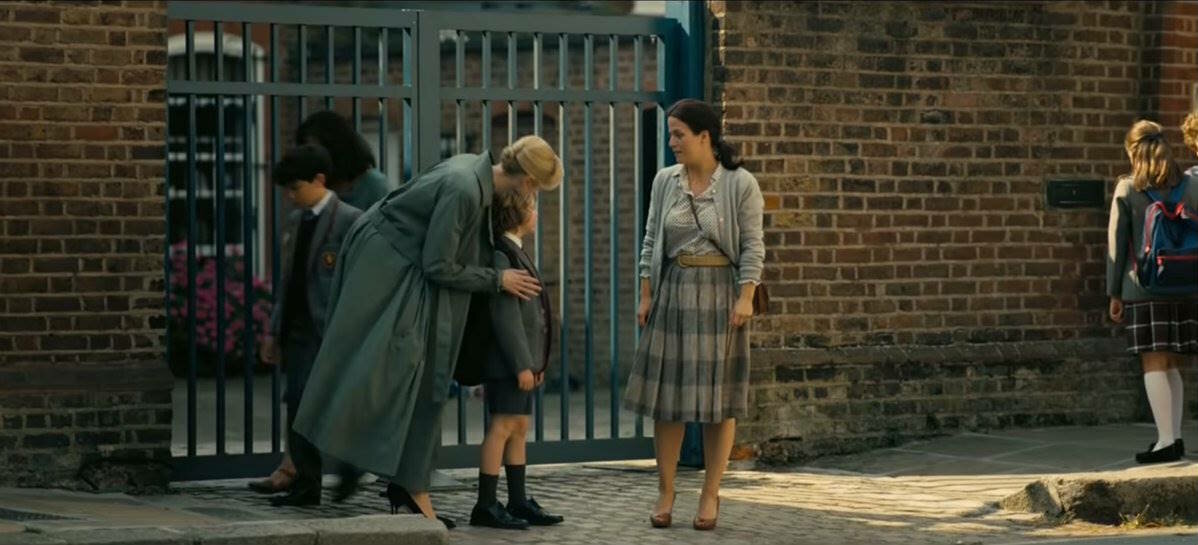
Tenet (Christopher Nolan, 2020).
It’s dangerous to critique something that is not there in a filmmaker’s work. Nolan is under no obligation to include depictions of everyday life in his films. But he is fascinated by the way spectacle can annihilate what is ordinary and everyday, and therein lies the paradox: His films are caught between what they want and what they rarely show. And so often, when that everydayness is depicted, it is given only minimal texture and the barest pretense of plausibility. There is no intricacy to, say, Cobb’s home life in Inception that would give an urgency to the threat of its permanent loss. In fact, the urgency of his films is dulled when the everyday life that is threatened has no discernable qualities. Spielberg’s Close Encounters of a Third Kind (1977) is a useful counterexample. What is striking about that film is not just how it moves between scales of mundane suburban life up to the spectacular level of alien visitations, but that the specific timbre of the former is what gives the latter real stakes. The arrival of a spectacle offers a genuine threat to the textured fabric of ordinary life. The two scales deepen in the way they play dialectically off one another, and this is one of the main lessons Nolan has not taken from one of his major influences, Michael Mann. A Mann film, unlike a Nolan film, modulates its scale in accordance with the everyday realities of its characters.
It’s not as though everything in Nolan’s films is spectacle. There is a distinction to be made in The Odyssey, for instance, between the ransacking of Troy and Odysseus’s fight to reclaim the Ithacan throne. The former bears the weight of the world changing forever. It exists far outside the limits of character agency and even threatens to alter future human behavior, while the latter scene feels oddly toned down, if still slackly cut together, for a Nolan denouement. The action there is simply proportional to the character’s desires and physical realities. If this seems like something of a maturation for Nolan, just recall that the film ends the same way as the Batman trilogy: a man and a woman, fleeing toward a quiet life of retirement, to a setting just beyond the scope of the narrative. What does a Nolan film that follows them look like?
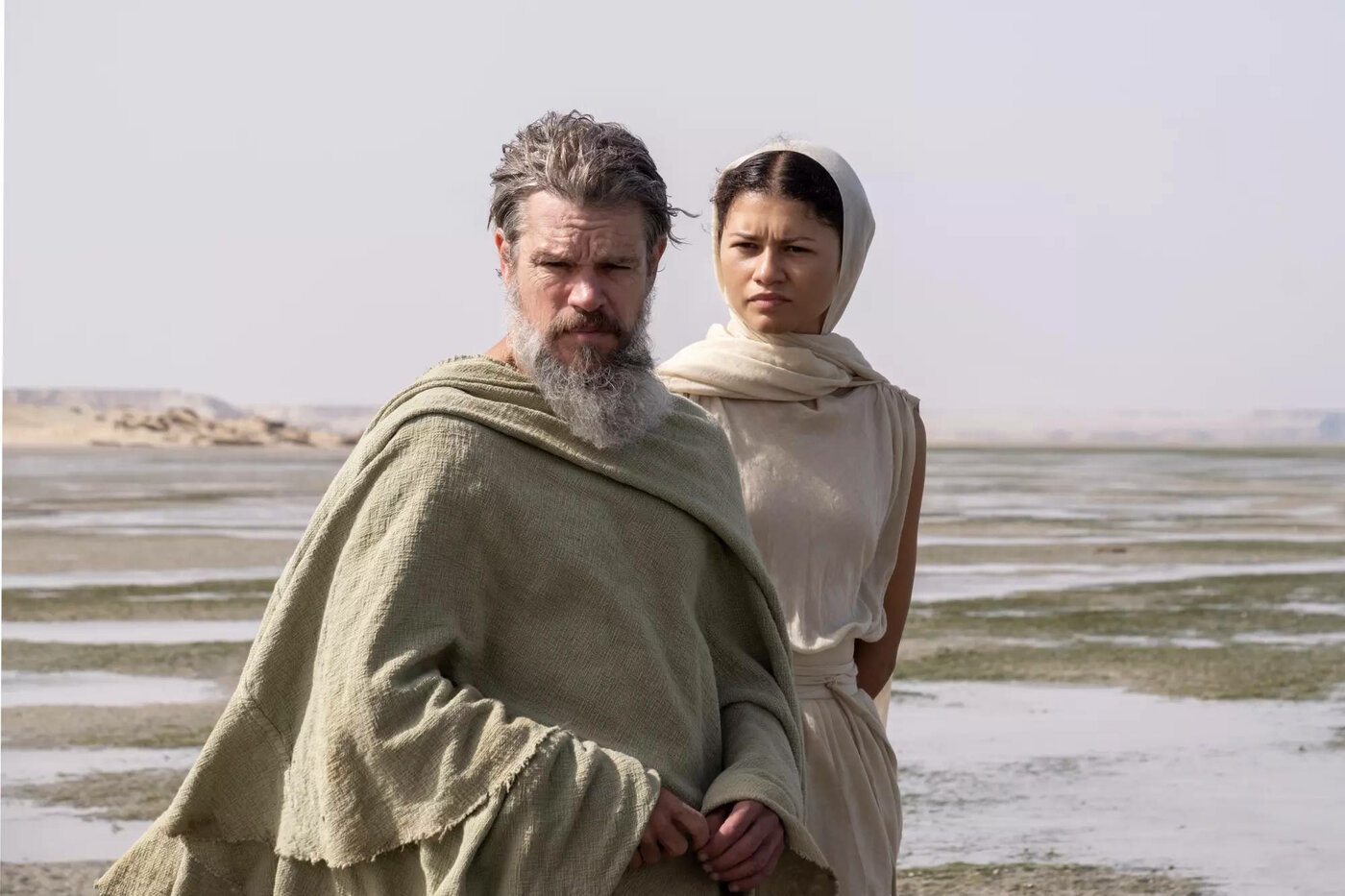
The Odyssey (Christopher Nolan, 2026).
It could be argued that what is good in Nolan’s films is sacrificed to these complex narrative machines designed to annex any glimmer of everyday life into the next spectacle. This is why the films almost always feel rushed (The Odyssey’s first two hours generally feel like a student speedreading the major plot points right before a test). Moments I have a lot of affinity for, such as the goings-on in Berkeley academic life early in Oppenheimer, are quickly made into symbolizing events. To go from flirtation with a woman to a sex scene (one of the few in Nolan’s films) where “I am become death” is quoted while astride shows that Nolan the screenwriter can’t help but leave price tags on the gifts his images sometimes give. The everyday suggestion of eros-thanatos that sex can offer visually is made into an event by the dialogue. Such a tendency has been there from the get-go. The Following (1998) begins, in a setup not dissimilar to Joy Williams’s fine novel Breaking and Entering, with two criminals breaking into people’s homes not for material gain but to luxuriate in another person’s ordinary life. However, the bracingness of this conceit, which Willams’s novel stays with to the end, is lost as Nolan’s compulsion for generic and temporal spectacle overtakes his fascination for ordinary life. It sets the template for his career—compulsion, repetition.
Not every film, however, is blighted by this repression of the ordinary. Tenet and Interstellar (2014) accept, rather than threaten, the loss of ordinary life. No other scene has the urgency of the one in Interstellar, Nolan’s finest film, where Matthew McConaughey watches 23 years’ worth of video messages from his children. One feels the absolute loss of the major events—graduations, marriages, births—along with the small moments, the family meals and the drives home from school. In Tenet, this sense comes just briefly, right at the end, where one realizes John David Washington’s protagonist is beginning a friendship with Robert Pattinson’s Neil, for whom the friendship is just ending. Such a moment suggests a whole other film, hidden within the furrows of this one, that is lost (this could be said of several of Nolan’s features). It calls to mind Serge Daney’s great line about Douglas Sirk’s Imitation of Life (1959), where he writes that part of what one cries for in the last scene of Annie Johnson’s funeral is “the other film, the one we haven’t seen, with Lana Turner in a small role.” What somehow makes me misty at this backwards Bond film is this other film I didn’t see, the one behind this one, the one about a friendship that is already lost and somehow still to come. These two moments most clearly put forth Nolan’s only profound thought about time, something only hinted at in The Odyssey’s quest to return to a home that is already gone: Time is loss. To make a film about that does not necessarily require convoluted structural conceits, spectacle, or even sustained depictions of the everyday, but an honesty about what slips away forever.