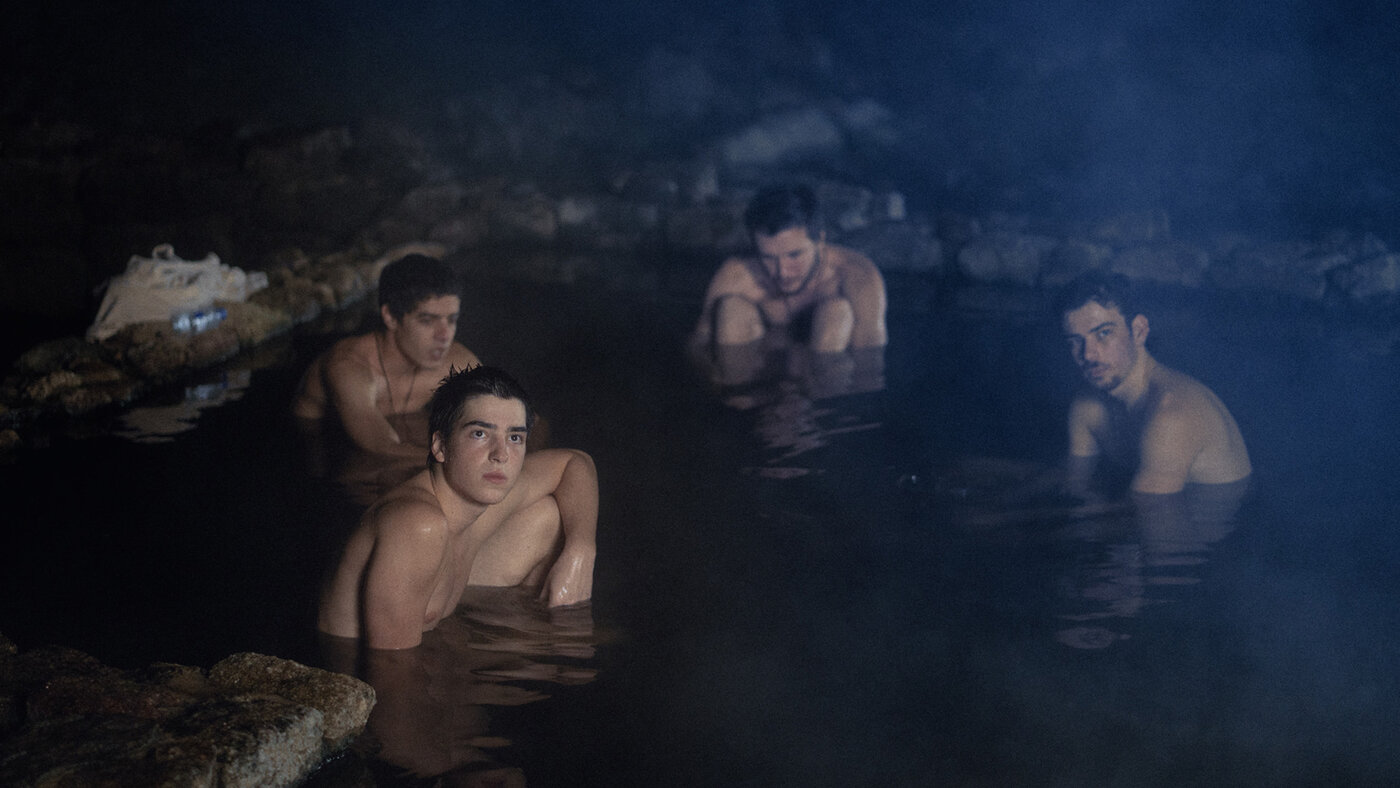
Last Night I Conquered the City of Thebes (Gabriel Azorín, 2025).
For the past several months, my Instagram algorithm has fed me, on a fairly regular basis, ads for a New York City-based bathhouse called The Russian and Turkish Baths. In the ads, at least the ones targeted at me, attractive young men—sometimes alone, other times in friendly pairs or trios—gush effusively to the camera about their experience inside the facility. In the current hellscape of viral marketing techniques, these ads seem fairly innocuous. The best part of the ads isn’t the ads themselves, but the stream of winking comments underneath them suggesting (perhaps hoping) that these young men, their smiles brimming, got up to less than family-friendly activities inside.
Yet something about these ads also provokes a more cynical reaction. It seems impossible that the owners of this bathhouse are ignorant of the long and varied history of queer bathhouses. How else would they know to shepherd their ads with hot, shirtless guys—instead of the dozens of other videos with women, heterosexual couples, and families featured on their official profile —to a gay man like me? I’ve been fascinated by the uneasy tension between this evoked but unacknowledged history and the blatant demographic targeting since the ads hit my feed. It therefore felt all the more like an uncanny twist of fate that around the same time, I watched Last Night I Conquered the City of Thebes (2025). An alternative imagining of bathhouse culture, the feature debut of Spanish director Gabriel Azorín combines a contemporary and historical view of the ways men connect with each other in times of change and crisis.
The first half of Thebes’ bare-bones plot consists of the journey of a group of young men, led by best friends Jota (Antònio Gouveia) and António (Santiago Mateus), to a recently rediscovered Roman bath in Galicia. The public nature of these ancient baths lends a crucial transparency to the activities of Jota, Antonío, and the rest of their crew. By placing them alongside groups of families and commingling with all genders, Azorín tempers and demystifies the homoerotic elements of communal baths that viewers might have taken for granted. We don’t see any sexual activity, or even hints of it. Instead, these baths are a locus of communion, if not necessarily for community; people sit, relax, and talk, but only among the people with whom they came. Despite the physical openness of its setting, the first half of the film trades in emotional ambiguity. The friends’ relationship, while close and intimate, is accompanied by a strain of Antonío’s awkwardly articulated longing for Jota, who we learn is soon leaving home. As the afternoon saunters into evening and night, they luxuriate in the warm water, drifting between the facility’s pools as their conversations also lazily drift from their latest Fortnite campaigns to their anxieties about growing up—all while daylight retreats behind the horizon in a hypnotic facsimile of real time.
The passage of time is important to Azorín, who in the second half of Thebes transports the viewer back to an imagined ancient Rome, where the baths at which António and Jota have just spent their day and night are no longer ruins, but are intact and vital. A tangible connection to the past is less apparent in the Russian and Turkish Baths’ slick, queer-baity Instagram ads, which are blissfully atemporal, but like Rome, New York City has its own history of bathhouses. As far back as the late nineteenth century, institutions like the Everard Baths catered to an infamously gay clientele. In Smithsonian Magazine, Robert Klara describes the building, unsurprisingly, as a “Romanesque edifice,” which survived everything, from changes of ownership during World War II, to a deadly fire in 1977, until crackdowns by the NYPD in 1986 during the mounting AIDS epidemic forced its closure.
As Rasheed Newsom observes in LitHub, “There was a ruthless calculus to how federal, state, and city governments tended to respond to the AIDS crisis in the 1980s.” These mainstream political bodies wielded growing concern over the AIDS crisis as a pretense for shutting down loci of queer community-building and safety, including gay bathhouses, which they had wanted gone long before AIDS came around. For their safety and their pleasure during such politically charged times, gay men established systems of knowledge sharing that have helped them discover and navigate the everchanging underground networks of bathhouses in urban centers. The underground systems of knowledge likely oriented gay men away from the Everard Baths in the mid-1970s and toward The Continental Baths, a far more gleaming and reputable safe haven for gay men in New York City than that dilapidated, code-flouting tinder box (affectionately known by patrons as the “Everhard”).
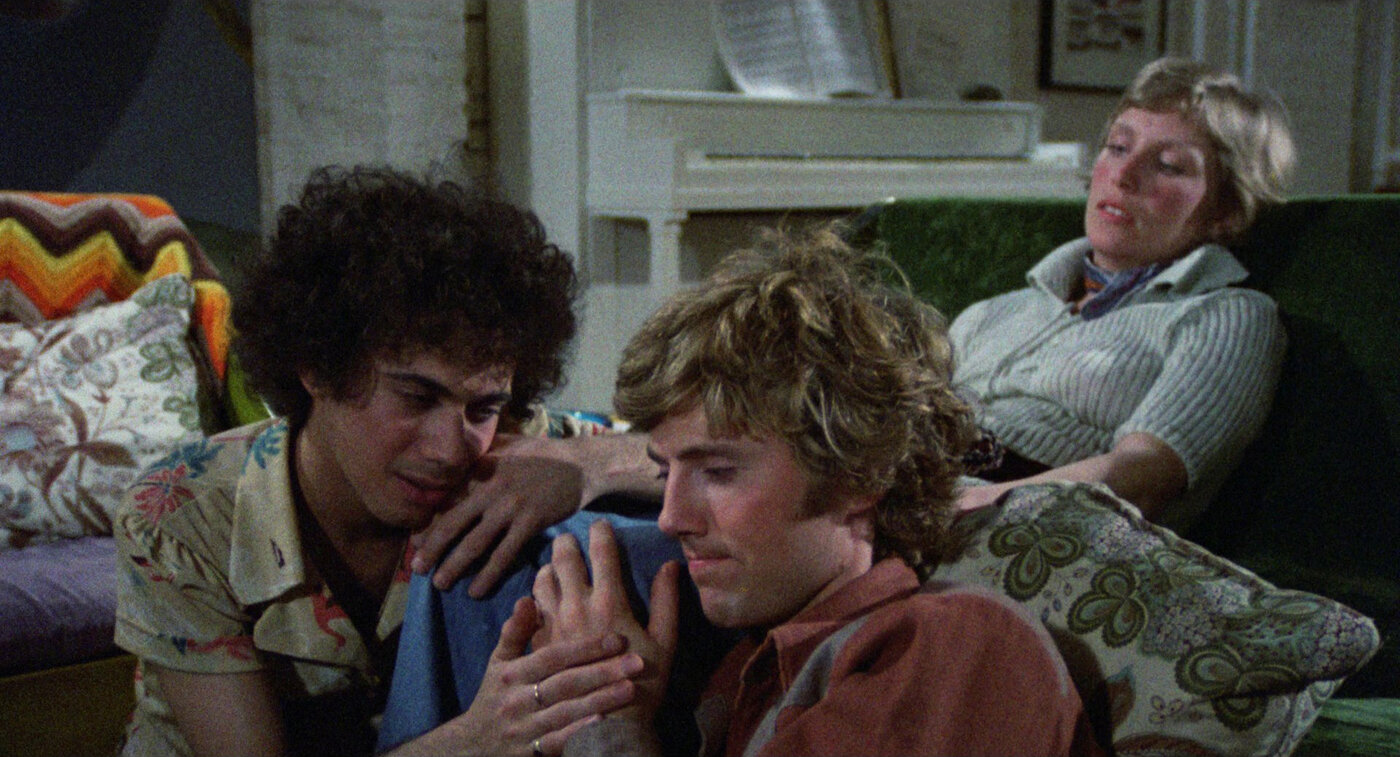
Saturday Night at the Baths (David Buckley, 1975).
However, sitting delicately in the pocket of time between the Stonewall uprising in 1969—the unofficial beginning of the modern gay rights movement—and the onset of AIDS in the early 1980s, was a relative golden era of public gay life, and a flourishing of in-community activity in communal spaces like gay bars, porn theaters, and bathhouses. One such landmark of this era was David Buckley’s queer bathhouse-set Saturday Night at the Baths (1975). In it, Michael, a straight, repressed pianist is nervous about his new job playing mood music at the eponymous Continental Baths in New York City. He asks his girlfriend, as only a straight man would, what they’re famous for. With a smile as knowing as the comments underneath the Russian and Turkish Baths ads, she responds: “Decadence.”
Saturday Night at the Baths was not only set at the real Continental Baths, but its plot more or less cribbed from its own nascent legend. Stage and screen icon Bette Midler famously got her start singing at the baths during this time, accompanied by a pianist by the name of Barry Manilow. Saturday Night’s star Robert Aberdeen, with his thin frame and appealingly boyish mop of blonde hair, bears a striking physical likeness to Manilow. While Manilow would only publicly come out as gay in 2017, it takes an in-the-know filmmaker like Buckley to make such a clear-eyed reference to the real goings-on of the Continental Baths, which included much more than just anonymous sex. In this way, Saturday Night is another form of intra-community communication, speaking to the gay men watching it in 1975 in a kind of winking, elbow-to-the-ribs mode.
Azorín understands the importance of knowledge sharing and the value in wading through a challenge to earn a worthwhile experience. In Thebes, the thick bogs and dense woods Jota, António, and co. encounter on their journey to the baths suggest they were privy to a route outside the realm of common knowledge, though we never learn who divulged that information. In some ways it echoes the journey taken by Mark and Kurt, the protagonists of Kelly Reichardt’s similarly plotted Old Joy (2006). In it, father-to-be Mark (Daniel London) and his old friend Kurt (Will Oldham) get lost on their way to natural hot springs deep in the woods outside Portland, Oregon. Frustrated by Kurt’s blasé approach to navigation, Mark tries to take control of the journey while Kurt gets high and rambles about his own professional directionlessness. Reichardt renders the divergent paths of two adults’ lives as sharply as she ever will in a film—not counting the devastating final sequence 30 minutes later—while still preserving the embers of adventure and leisure that fueled their friendship in the first place. Later, when Kurt asks a waitress at a roadside diner where the hot springs are, she doesn’t have a definitive answer: “Oh, you’re real close, I think. I’ve never been there, but they’re around here somewhere.” Like Mark and Kurt’s friendship, these springs are half secret of the woods, half forgotten landmark, in the process of being lost to history.

Old Joy (Kelly Reichardt, 2006).
The fate of Jota and António’s friendship is at the center of Azorín’s gaze in Thebes, but on the outskirts his eyes trace a history more epic in scale than that of Old Joy. We see a group of middle-age tourists, led by a young, enthusiastic guide, visiting the baths and nearby Roman ruins. The guide, in contrast to whoever gave the boys directions, is an official channel of knowledge; she explains that, between military campaigns, Roman soldiers frequented these natural hot springs for respite and communion. This brief scene is useful as exposition in a film otherwise firmly planted in the present—whenever that present happens to be. Space and time are malleable objects in Azorín’s hands. Every patient, unbroken shot trains the viewer’s senses toward a realistic passage of time that slows to a crawl in an atmosphere thick with steam and unspoken feelings. Two shots in particular, comprising more than 30 minutes of Thebes’ runtime, clarify this paradox. In the first, approximately ten minutes long, it’s easy to ignore the setting sun and enveloping darkness when Azorín draws attention to more intimate details, like the boys’ movements within the baths, their playing with an app that helps identify constellations in the sky, and their shared cigarette. When it feels like there’s nothing left to be gained by listening to their hushed conversation, Azorín throws the viewer into a night sky dotted with 3D animations augmented onto the constellations. One wonders if, to this group of young men, the vastness of space and time is a comfort or a burden.
Once the sun has completely disappeared and all the tourists have left, light begins to return, disrupting the film’s style of observational realism, and illuminates Jota and António now sitting in conjoined baths away from the rest of their friends. This new artificial light creeps almost imperceptibly, not explicitly signaling the historical leap the film will make in its second half as much as establishing Azorín’s interest in time as a malleable, reflexive concept. António monologues to Jota about how much he admires his friend, lamenting the feeling that, by leaving, Jota has abandoned the big dreams he said he would achieve when he grew up. Whether António views Jota as an older brother or an unrequited crush will remain ambiguous, but his admission, gradual but revelatory, finds a satisfying mirror in Azorín’s controlled play with light.
The clandestine, or even simply underknown, nature of hot springs and bathhouses seems to inspire revelatory behavior in all who visit. Or perhaps, as Leah Feygin observes, it arises simply because “bathhouses have always been capable of holding the full, unguarded self.” In Old Joy, Reichardt uses the opportunity of naked vulnerability (both literal and figurative) at the hot springs to turn Mark and Kurt’s previously idle chit chat into something deeper, giving way to an interaction neither they nor the viewer saw coming. Without a word, Reichardt queers a film that had previously never made such intentions known. Tsai Ming-liang goes even further in The River (1997), when Hsiao-keng (Lee Kang-sheng) meets his father in the private room of a gay bathhouse so dark and sweaty, so enveloped in long-neglected erotic desire, that they don’t realize they’re pleasuring each other until the lights come on again. In Saturday Night at the Baths, the constant immersion in the seeming underworld of the Continental Baths, and the casual liberation of his co-workers, also push Michael’s previously repressed feelings to the surface to disturb his bubble of heterosexual respectability.

The River (Tsai Ming-liang, 1997).
In Thebes, Azorín handles the transition from present to ancient past with a delicate hand. Just a single cut separates António and Jota from a world not unlike theirs. It too is populated by young men relaxing in the still waters of the Roman baths. The shot that immediately follows Jota and António’s long conversation adheres to basic spatial logic; however, a simultaneity of experience is suggested when an unknown young man suddenly appears where António previously was. On the level of shot construction, the present is in direct conversion with the past to such an extent that they’re not only inextricable, but indistinguishable.
We learn the names of some of these Romans. The man who first appears is Aurelius (Oussama Asfaraah); another, Pompei (Pavle Čemerikić), arrives later with an injured man around his shoulders. With the other men already in the baths, they form a web of connections that Azorín is happier to elucidate through gestures—Pompei treats the injured man’s wounds with arresting delicacy and tenderness—than through dialogue. Most of the conversation that does occur is between Aurelius and Pompei, whose unit is about to embark on a new military campaign. Aurelius, a lowly foot soldier, is certain he’ll be sent to the frontlines, his grim fate sealed. He wants to flee from the war, while Pompei feels obliged to put his medical skills to use. Like António and Jota, they seem poised for a separation, though theirs carries a much heavier, mortal weight than António and Jota’s mere geographical distance.
Though AIDS is never mentioned, the allegorical dimensions of this scene are inescapable. In Aurelius’ fear and Pompei’s duty in the face of certain death, Azorín evokes some of the crucial paradoxes of the AIDS crisis, when sex was simultaneously something of which to be fearful and defiantly indulged, where celibacy and care were politically charged solutions to a seemingly unwinnable war. At the same time, Azorín is also concerned with the ways young men today are meant to simply exist with each other. His images of masculine communion, whether explicitly or ambiguously queer, however, require some fantastical intervention with history. No surprise, then, that his version of that intervention tries to make the line between past and present as invisible as possible, to make them exist almost at the same time.
Queer communion feels increasingly atomized, strewn across both digital and physical landscapes, compartmentalized by class and racial lines perhaps as much as it ever was in history. Where a simple swipe on an Instagram feed can divest the user from engaging with what they see, for Azorín, something as equally simple as the cut is a way to force the viewer to actually reckon with it. The physical spaces that are still safe spaces for gay men and all queer people operate under worsening financial strains. In a cynical mood, one wonders what hope there is for queer communion, either sexual or not, in spaces organized around heteronormativity or facilitated by technocapitalism—even if they’re infinitely more sanitary and fire-proof places to get laid in than the Everard. What Azorín gets at in Thebes is more hopeful, an imagining of a present that, counterintuitively, takes its cues from the past.
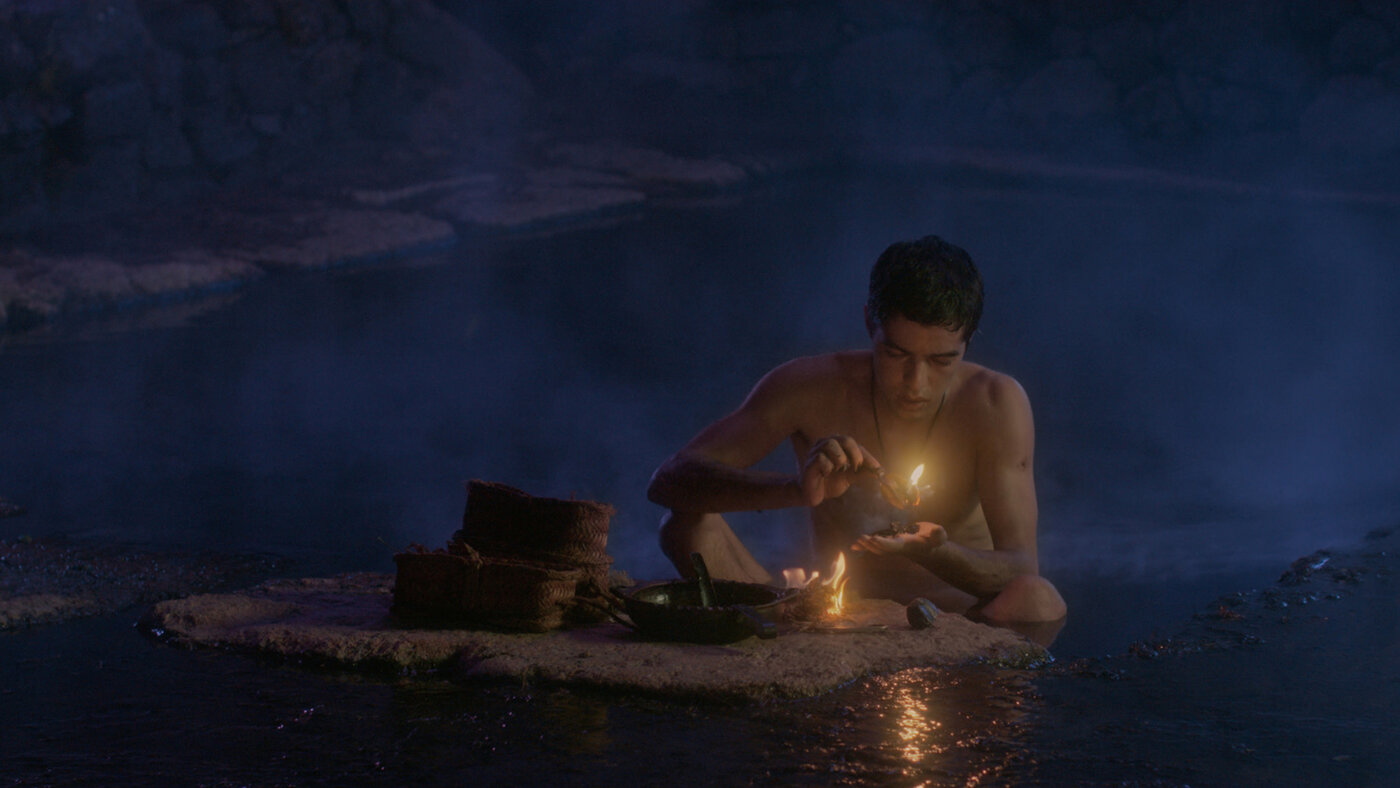
Last Night I Conquered the City of Thebes (Gabriel Azorín, 2025).